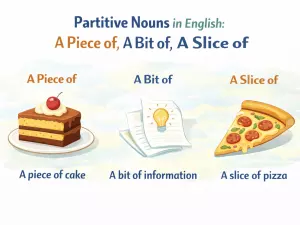
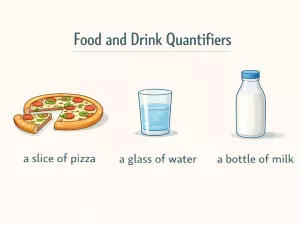
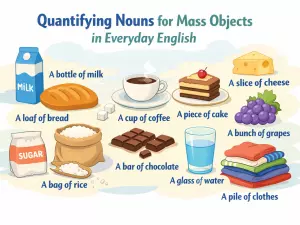
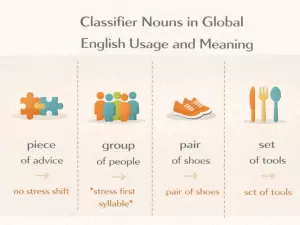
Partitive Structures in English: A Piece of, A Slice of, A Glass of

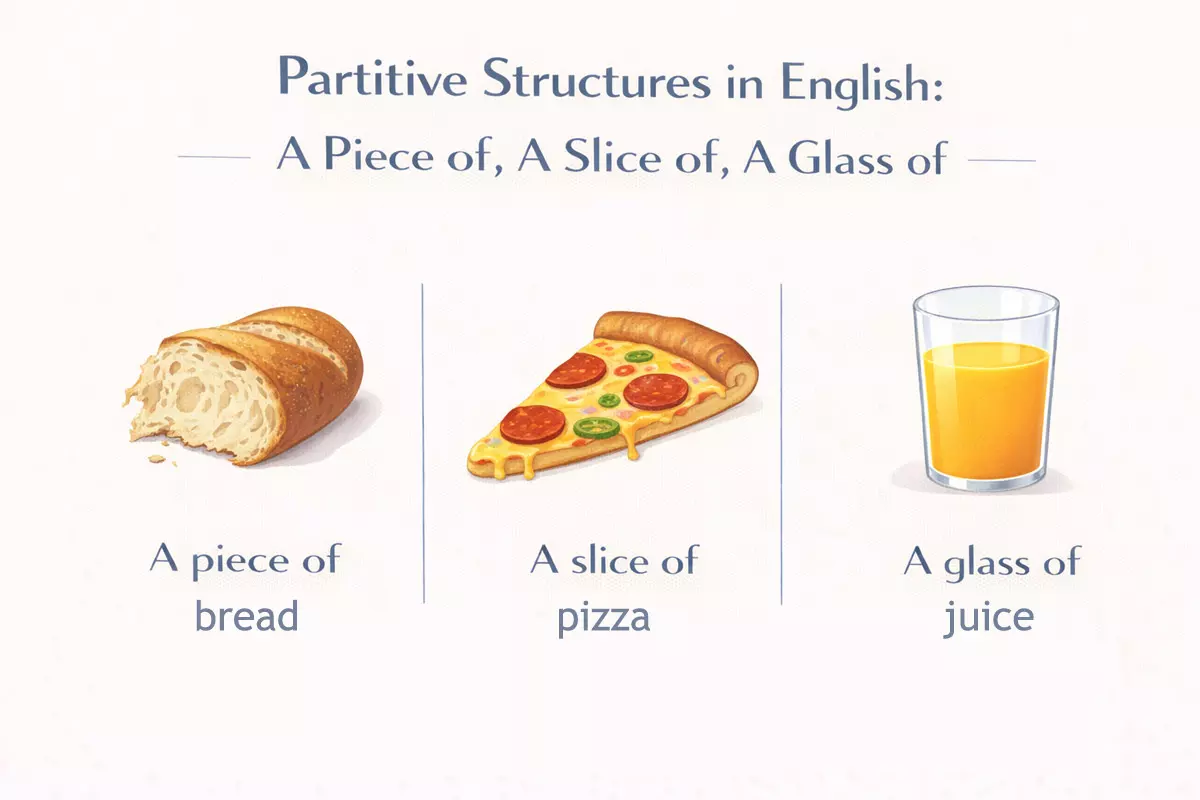 Here we the purpose and use of partitive structures in English, common partitives for different items, how they differ from countable nouns, typical sentence patterns, clarity issues, frequent mistakes, real-life examples, and practice exercises.
- Purpose of partitive structures in English
- Common partitives for food, objects, and substances
- Difference between partitives and countable nouns
- Sentence patterns using partitive expressions
- When partitives are required for clarity
- Common learner errors with partitives
- Examples in everyday and practical contexts
- Practice: choosing the correct partitive
Have you ever noticed how English speakers use phrases like a slice of bread or a piece of advice to talk about specific amounts of something? These are known as partitive constructions, and they make it easier to describe portions or quantities in everyday conversation. By using expressions such as a cup of tea, a handful of nuts, or a bunch of flowers, speakers can communicate more clearly and naturally about how much of something they mean, whether it’s food, liquids, or even abstract concepts.
Purpose of partitive structures in English
Partitive expressions help English speakers talk about quantities of uncountable nouns and groupings of countable nouns in a clear, natural way. Rather than simply mentioning “bread” or “water,” these structures allow us to specify how much or what kind of portion we mean. This is especially useful when the noun itself does not have a plural or cannot be counted directly.
Why use partitives?
- To express exact amounts of substances or items that are otherwise vague or uncountable.
- To make requests and offers more specific (e.g., “a slice of pizza” instead of just “pizza”).
- To describe portions, servings, or containers for easier understanding.
- To avoid ambiguity when talking about mass nouns or groups.
- To sound more natural and fluent in everyday conversation.
Common contexts for partitive structures
Speakers use these phrases in many everyday situations, such as ordering food, giving instructions, or describing objects. For example, you might say “Could I have a glass of water?” at a restaurant, or “I bought a loaf of bread” at the store.
Examples of common partitive patterns

- a piece of cake → I ate a piece of cake after dinner.
- a slice of cheese → She put a slice of cheese on the sandwich.
- a cup of tea → He drinks a cup of tea every morning.
- a bar of chocolate → I bought a bar of chocolate at the shop.
- a bottle of juice → There is a bottle of juice in the fridge.
- a grain of rice → A grain of rice fell on the table.
- a sheet of paper → Please take a sheet of paper.
- a carton of milk → We need a carton of milk for breakfast.
- a handful of nuts → She ate a handful of nuts.
- a drop of oil → Add a drop of oil to the pan.
- a bowl of soup → He had a bowl of soup for lunch.
- a roll of tape → Give me a roll of tape, please.
- a jar of jam → There is a jar of jam on the shelf.
- a box of matches → He opened a box of matches.
- a tube of toothpaste → Buy a tube of toothpaste.
- a bunch of grapes → She washed a bunch of grapes.
- a pile of books → There is a pile of books on the desk.
- a set of keys → I can’t find my set of keys.
- a group of students → A group of students entered the room.
- a pair of shoes → He bought a new pair of shoes.
Comparing partitive phrases
| Partitive Phrase | Typical Use |
|---|---|
| a slice of | Flat foods (bread, cake, cheese, pizza) |
| a glass of | Drinks (water, juice, wine) |
| a piece of | General portions (advice, cake, paper) |
| a bottle of | Liquids in bottles (milk, soda, oil) |
| a bar of | Solid blocks (chocolate, soap, gold) |
Overall, using these structures makes communication more precise and helps listeners understand exactly what quantity or portion is meant. This is especially important in English, where many nouns do not change form to show amount, and context alone might not make meanings clear.
Common partitives for food, objects, and substances
In English, partitive expressions help us talk about amounts or portions of things that can't easily be counted as whole units. These structures are widely used when discussing food, liquids, and materials, as well as certain objects. Instead of counting “breads” or “waters,” we use phrases like “a slice of bread” or “a glass of water” to specify the quantity or form. Choosing the right partitive depends on both the substance and the context.
How partitives match with different nouns
Some partitive words are tied to specific categories of nouns. For example, “slice” is often used with flat or cuttable foods, whereas “glass” and “cup” refer to drinks. Using the wrong partitive can sound unnatural or even change the meaning. Here’s a quick comparison of commonly paired partitives and nouns:
| Partitive | Typical Nouns |
|---|---|
| slice | bread, cheese, pizza, cake, ham |
| piece | cake, paper, advice, furniture, meat |
| glass | water, juice, wine, milk |
| bar | chocolate, soap, gold |
| cup | tea, coffee, yogurt, soup |
| loaf | bread |
| bag | flour, rice, sugar, potatoes |
| drop | water, oil, blood |
| sheet | paper, metal, glass |
| lump | sugar, coal, clay |
Tips for using partitives accurately
When choosing a partitive, consider both the physical form and the usual collocations in English. For instance, we say “a bar of soap” but not “a slice of soap.” Some partitives, like “piece,” are quite flexible and can be used with many different nouns, while others are more restricted. Exposure to authentic language and practice will help you sound more natural when describing quantities and portions.
Difference between partitives and countable nouns
Understanding the roles of partitive structures and countable nouns helps clarify how English speakers refer to quantities and portions. Generally, partitives (like "a piece of" or "a glass of") allow us to talk about amounts of things that cannot be counted individually, while countable nouns refer to items that can be counted as separate units without extra wording.
How partitives work
Partitive phrases are used when we want to mention a specific portion or quantity of an uncountable noun. For example, "a slice of bread" or "a bit of advice." These structures make it possible to talk about something that normally has no plural or cannot be counted directly.
What are countable nouns?
Countable nouns are words for items that can be counted as individual units, such as "apple," "book," or "car." They have both singular and plural forms, and we can use numbers directly with them — for example, "three books" or "ten apples."
Key distinctions
To make the differences even clearer, here is a comparison of how partitives and countable nouns behave in English:
| Partitive Structures | Countable Nouns |
|---|---|
| Used with uncountable nouns (e.g., water, bread, information) | Refer to individual items (e.g., apple, chair, coin) |
| Require a "container" or "portion" word (e.g., a cup of tea, a loaf of bread) | Can be used directly with numbers (e.g., two apples, five coins) |
| No plural form for the uncountable noun itself; the partitive or number changes (e.g., three pieces of advice) | Have singular and plural forms (e.g., book/books, child/children) |
| Examples: a glass of milk, a slice of cake, a bit of luck | Examples: a dog, two cars, several pens |
Common partitive patterns
- a square of cake → She ate a square of cake.
- a loaf of bread → He bought a loaf of bread.
- a pack of chocolate → I bought a pack of chocolate.
- a splash of water → A splash of water hit the floor.
- a page of paper → Write your name on a page of paper.
- a plate of soup → She ordered a plate of soup.
- a glass of juice → He drank a glass of juice.
- a spoonful of rice → Add a spoonful of rice.
- a mug of coffee → I need a mug of coffee.
- a cube of cheese → He cut a cube of cheese.
- a piece of news → I heard a piece of news.
- a dash of salt → Add a dash of salt.
- a stick of toothpaste → Use a stick of toothpaste.
- a can of soda → She opened a can of soda.
- a bowlful of nuts → He ate a bowlful of nuts.
- a pinch of pepper → Add a pinch of pepper.
- a jug of milk → There is a jug of milk on the table.
- a cube of sugar → Put a cube of sugar in the tea.
- a packet of seeds → She planted a packet of seeds.
- a strand of hair → I found a strand of hair.
In summary, partitives are essential for referencing amounts of uncountable things, while countable nouns stand alone. Using the correct structure helps express quantity, portion, or container clearly and naturally in English.
Sentence patterns using partitive expressions
Understanding how to use partitive structures helps you describe quantities more naturally in English. These structures typically combine a quantifying word with "of" and a noun, such as "a piece of cake" or "a glass of milk." Their usage is common when referring to uncountable nouns or collections that are divided into parts. The following patterns and examples illustrate how these expressions fit into everyday sentences.
Common patterns with partitive forms
- Subject + verb + partitive expression
Example: She bought a loaf of bread. - Would you like + partitive expression + of + noun?
Example: Would you like a slice of pizza? - There is/are + partitive expression + of + noun
Example: There is a bar of chocolate on the table. - Give me + partitive expression + of + noun
Example: Give me a glass of water, please. - Can I have + partitive expression + of + noun?
Example: Can I have a piece of advice? - He/She/They took + partitive expression + of + noun
Example: He took a sip of tea. - Negative sentences with partitives
Example: I don’t want a drop of oil on my plate. - Describing quantity or quality
Example: That was a touch of genius. - With adjectives for emphasis
Example: She gave him a generous slice of cake. - Questions with partitives
Example: Is there a bottle of juice left?
Variety of partitive structures
English offers a wide range of partitive expressions to suit different contexts and substances. Here are some of the most commonly used:
- a piece of (cake, advice, furniture)
- a slice of (bread, cheese, pie)
- a glass of (water, juice, wine)
- a cup of (tea, coffee, soup)
- a bottle of (milk, water, soda)
- a bit of (luck, news, help)
- a bar of (chocolate, soap, gold)
- a bowl of (rice, soup, salad)
- a bunch of (grapes, flowers, keys)
- a drop of (water, oil, blood)
- a spoonful of (sugar, honey, medicine)
- a handful of (nuts, coins, sand)
- a sheet of (paper, glass, metal)
- a tube of (toothpaste, cream, paint)
- a can of (soda, beans, soup)
- a pile of (books, clothes, leaves)
- a dash of (salt, pepper, humor)
Comparing partitive expressions for different contexts
| Partitive Expression | Typical Nouns Used With | Example Sentence |
|---|---|---|
| a piece of | cake, advice, furniture | Can I have a piece of cake? |
| a glass of | water, juice, milk | She poured a glass of juice. |
| a slice of | bread, cheese, pizza | He ate a slice of pizza. |
| a bar of | chocolate, soap, gold | I bought a bar of chocolate. |
| a cup of | tea, coffee, soup | Would you like a cup of tea? |
| a bowl of | rice, soup, salad | She made a bowl of salad. |
Using the right partitive structure adds clarity and precision to your communication, especially when talking about amounts, portions, or types. With practice, these expressions become a natural part of describing everyday objects and experiences.
When partitives are required for clarity
Sometimes, using a partitive phrase like “a piece of” or “a glass of” is essential to avoid confusion, especially with uncountable nouns or when the exact quantity or type needs to be specified. Without these structures, English sentences can sound vague or even misleading. For example, saying “I’d like cheese” leaves open the question of how much or what form, while “I’d like a slice of cheese” makes the request clear.
Situations Where Partitives Help Specify Meaning
- Distinguishing between the whole and a portion: “a loaf of bread” vs. “bread”
- Clarifying the container or unit: “a bottle of water” instead of just “water”
- Talking about types or forms: “a bar of chocolate” (not powdered or hot chocolate)
- Ordering or sharing food and drinks: “a cup of tea”, “a piece of cake”
- Describing amounts in recipes: “a pinch of salt”, “a teaspoon of sugar”
- Referring to non-physical concepts: “a bit of advice”, “a moment of silence”
- Emphasizing a single item out of many: “a sheet of paper”, “a strand of hair”
- Making distinctions in quantity: “a handful of nuts” vs. “nuts”
- Discussing abstract or collective nouns: “a ray of hope”, “a sense of humor”
- Describing portions in transactions: “a kilo of apples”, “a yard of fabric”
Examples of Clarity with and without Partitives

To show how partitive forms clarify meaning, compare these phrases:
| Without Partitive | With Partitive |
|---|---|
| Can I have water? | Can I have a glass of water? |
| He bought cheese. | He bought a block of cheese. |
| She wants cake. | She wants a slice of cake. |
| Give me paper. | Give me a sheet of paper. |
| I need sugar. | I need a teaspoon of sugar. |
These examples show that partitive constructions help listeners and readers understand exactly what is meant, minimizing misunderstandings. In day-to-day conversation, especially when asking for items, giving instructions, or talking about quantities, using partitive structures is often not just helpful but necessary for effective communication.
Common learner errors with partitives
Learners of English often face challenges when using partitive structures like "a piece of," "a slice of," or "a glass of." These expressions can be confusing because they combine a quantity word with an uncountable noun, and not every combination is correct. Some errors come from directly translating phrases from another language, while others result from misunderstanding which partitive goes with which noun.
Mixing up partitive and noun combinations
A frequent issue is mismatching the partitive with the noun. Not all containers or portions can be paired with every noun, and using the wrong word can sound unnatural or even confusing. For example, "a slice of bread" is correct, but "a slice of milk" is not.
| Incorrect Example | Correct Form |
|---|---|
| a glass of bread | a slice of bread |
| a piece of tea | a cup of tea |
| a slice of water | a glass of water |
| a loaf of juice | a bottle of juice |
| a bar of cheese | a piece of cheese |
Overusing or omitting the partitive
Another common mistake is leaving out the partitive word when it is needed, or adding it where it is unnecessary. For instance, "I want bread" is correct if you mean bread in general, but "I want a bread" is incorrect. If you want a portion, specify: "I want a piece of bread."
- Incorrect: "Can I have a water?" ❌
- Correct: "Can I have a glass of water?" ✅
- Incorrect: "Give me two cheeses."
- Correct: "Give me two pieces of cheese."
- Incorrect: "I’d like a cake." (when meaning a portion)
- Correct: "I’d like a slice of cake."
Direct translation from other languages
Translating word-for-word from a native language can lead to unusual combinations. For example, in some languages, it is common to say "a cup of soup" or "a bread," but in English, the correct options may be "a bowl of soup" or "a loaf of bread."
Choosing the wrong quantity word
It’s easy to confuse partitives that refer to shape, portion, or container. Here are some typical mismatches and their correct forms:
- "a bar of chocolate" (not "a piece of chocolate" for a whole bar)
- "a bottle of wine" (not "a glass of wine" if you mean the whole bottle)
- "a slice of pizza" (not "a piece of pizza" unless it’s not a traditional slice)
- "a loaf of bread" (not "a piece of bread" for the whole item)
- "a carton of milk" (not "a cup of milk" for the container)
- "a sheet of paper" (not "a piece of paper" for a standard page)
Summary tips
When using partitive expressions in English, always check if the noun commonly pairs with your chosen partitive. Remember that some partitives are specific to certain foods, drinks, or objects. Practice with common combinations, and avoid translating directly from your first language to prevent awkward or incorrect phrases.
Examples in everyday and practical contexts
Partitive expressions such as "a piece of," "a slice of," and "a glass of" are woven into daily conversations, especially when talking about food, drinks, and measurable amounts. These structures help English speakers refer to quantities of uncountable nouns or break down larger items into smaller, manageable parts. Let’s look at how these forms naturally appear in different real-life scenarios.
Common uses at home and in social settings
- Could you pass me a slice of bread?
- She offered him a piece of cake at the party.
- I’d like a glass of water, please.
- He took a handful of nuts as a snack.
- They bought a loaf of bread from the bakery.
- Would you like a cup of tea?
- She only ate a bit of cheese with her crackers.
- He poured a jug of juice for breakfast.
- We need a packet of sugar for the recipe.
- Give me a sheet of paper, please.
- There’s a bar of chocolate in the drawer.
- He ordered a bowl of soup at the restaurant.
Typical situations in daily routines
When shopping, ordering food, or preparing meals, these forms make requests and offers clearer. For instance, in a café, someone might say, “Could I have a cup of coffee and a slice of cake?” At home, you might hear, “We need a carton of milk for breakfast,” or “Can you bring a roll of paper towels from the store?” These structures help speakers specify amounts without confusion.
Tips for natural usage
- Choose the partitive that matches both the quantity and the noun type (e.g., "a glass of" for liquids, "a piece of" for solid but uncountable nouns).
- Some nouns accept more than one partitive, depending on context (e.g., "a piece of chocolate" vs. "a bar of chocolate").
- Using these structures helps avoid awkward or ungrammatical phrases like "two breads" (instead use "two loaves of bread").
Mastering these patterns allows for clearer, more precise communication in everyday English interactions.
Practice: choosing the correct partitive
Understanding when to use structures like "a piece of," "a slice of," or "a glass of" depends on both the noun and the context. Let’s work through some practical exercises to help you get more comfortable with these common English partitive forms.
Common Partitive-Noun Combinations
Some nouns are almost always paired with specific partitive structures. Here’s a list illustrating typical pairings:
- a portion of cake → She ate a portion of cake.
- a heel of bread → He ate the heel of bread.
- a tumbler of water → I drank a tumbler of water.
- a teapot of tea → There is a teapot of tea on the table.
- a crust of bread → The child left the crust of bread.
- a chunk of chocolate → He broke off a chunk of chocolate.
- a page from a notebook → Write it on a page from a notebook.
- a dairy bottle of milk → She bought a dairy bottle of milk.
- a smear of oil → There was a smear of oil on the pan.
- a serving of soup → He ordered a serving of soup.
- a pouch of nuts → She opened a pouch of nuts.
- a sleeve of biscuits → He ate a sleeve of biscuits.
- a fizzy drink → She bought a fizzy drink.
- a spoonload of honey → Add a spoonload of honey.
- a kernel of rice → A kernel of rice fell on the table.
- a vine of grapes → A vine of grapes hung on the wall.
- a length of tape → Cut a length of tape.
- a shaving of cheese → He added a shaving of cheese.
- a tip of advice → She gave me a tip of advice.
- a trace of salt → There was a trace of salt in the soup.
Which Partitive Fits?
Read each sentence and decide which partitive structure completes it best. Choose from: piece, slice, glass, cup, loaf, bar, bottle, sheet, drop, or bowl.
- She poured herself a ______ of orange juice before breakfast.
- Could you pass me a ______ of chocolate?
- I’d like a ______ of pizza, please.
- He bought a ______ of bread at the bakery.
- May I have another ______ of paper?
- They shared a ______ of soup on a cold day.
- Put a ______ of oil in the pan.
- He drank a ______ of tea while reading.
- Would you like a ______ of cheese with your crackers?
- She gave me a helpful ______ of advice.
Show answers
- glass
- bar
- slice
- loaf
- sheet
- bowl
- drop
- cup
- slice
- piece
Quick Comparison Table
Below is a summary comparing some common partitive forms and their typical uses:
| Partitive | Usual Nouns | Example |
|---|---|---|
| piece of | cake, advice, paper, furniture | a piece of cake |
| slice of | bread, pizza, cheese, cake | a slice of pizza |
| glass of | water, juice, milk, wine | a glass of water |
| cup of | tea, coffee, soup, milk | a cup of tea |
| bar of | chocolate, soap, gold | a bar of chocolate |
| loaf of | bread | a loaf of bread |
| bottle of | water, wine, milk, juice | a bottle of wine |
| sheet of | paper, glass, metal | a sheet of paper |
| bowl of | soup, rice, cereal, salad | a bowl of soup |
| drop of | water, oil, blood | a drop of oil |
Test Yourself: Spot the Error
Some sentences below use an incorrect partitive. Find and correct the mistake.
- I’d like a glass of bread, please.
- She handed me a slice of water.
- He bought a bottle of cheese at the store.
- Would you like a bar of cake?
- Can I have a bowl of bread for breakfast?
- She poured a cup of soup into the plate.
- He ate a spoon of pizza.
- They drank a slice of juice after lunch.
- I need a piece of milk for the recipe.
- She added a glass of rice to the pot.
Show answers
- I’d like a slice (or piece) of bread, please.
- She handed me a glass of water.
- He bought a slice (or piece) of cheese at the store.
- Would you like a slice (or piece) of cake?
- Can I have a slice of bread for breakfast?
- She poured a bowl of soup onto the plate.
- He ate a slice of pizza.
- They drank a glass of juice after lunch.
- I need a glass of milk for the recipe.
- She added a cup of rice to the pot.
By practicing these distinctions, you’ll start to choose the best partitive structure for each situation, making your English both accurate and natural.