Dual-Form Nouns with Different Meanings in English Usage

 Here we what dual-form nouns are in English grammar, how their meanings shift between singular and plural forms, and common examples like glass, paper, and work.
- What dual-form nouns are in English grammar
- Meaning changes between singular and plural forms
- Common examples like glass, paper, and work
- Countable vs uncountable meaning shifts
- Context clues for choosing the correct form
- Typical learner errors with dual-form nouns
- Practice: select correct meanings in short contexts
English often surprises us with words whose meanings shift when moving from singular to plural forms. For example, the word "custom" refers to a tradition or habitual practice, while "customs" means the official procedures at borders. Such quirks can be confusing, even for experienced speakers, and highlight the complexity and richness of the language. Navigating these subtle differences is part of what makes learning and using English both challenging and endlessly interesting for learners and native speakers alike.
What dual-form nouns are in English grammar
Some nouns in English appear in two distinct forms, each carrying its own meaning. These dual-form nouns are not just different in spelling or pronunciation—they often represent separate concepts, ideas, or physical objects. Understanding them is key for clear and accurate communication, especially since their forms can be deceptively similar.
How dual-form nouns work
A dual-form noun is a word that, when changed (often by adding or removing a letter, or shifting between singular and plural), represents a different meaning. The two forms might be closely related or might have diverged entirely in their usage. Sometimes, both forms are in regular use; in other cases, one is more common in specific contexts or regions.
Common patterns among dual-form nouns
- Singular vs. plural meanings: Some nouns have a regular singular and plural form, but each refers to a different thing (e.g., "custom" vs. "customs").
- Spelling changes: A slight change in spelling can indicate a shift in meaning, even if the pronunciation is similar (e.g., "advice" vs. "advise").
- Different grammatical functions: One form may be used as a noun, while the other serves as a verb, or they may both be nouns but with distinct meanings.
Examples of dual-form nouns with different meanings
Here are several English nouns that illustrate this phenomenon. Each pair consists of two forms—sometimes singular/plural, sometimes simply different spellings—with unique definitions:
- Custom (a tradition) → Customs (border control)
- Good (morality) → Goods (merchandise)
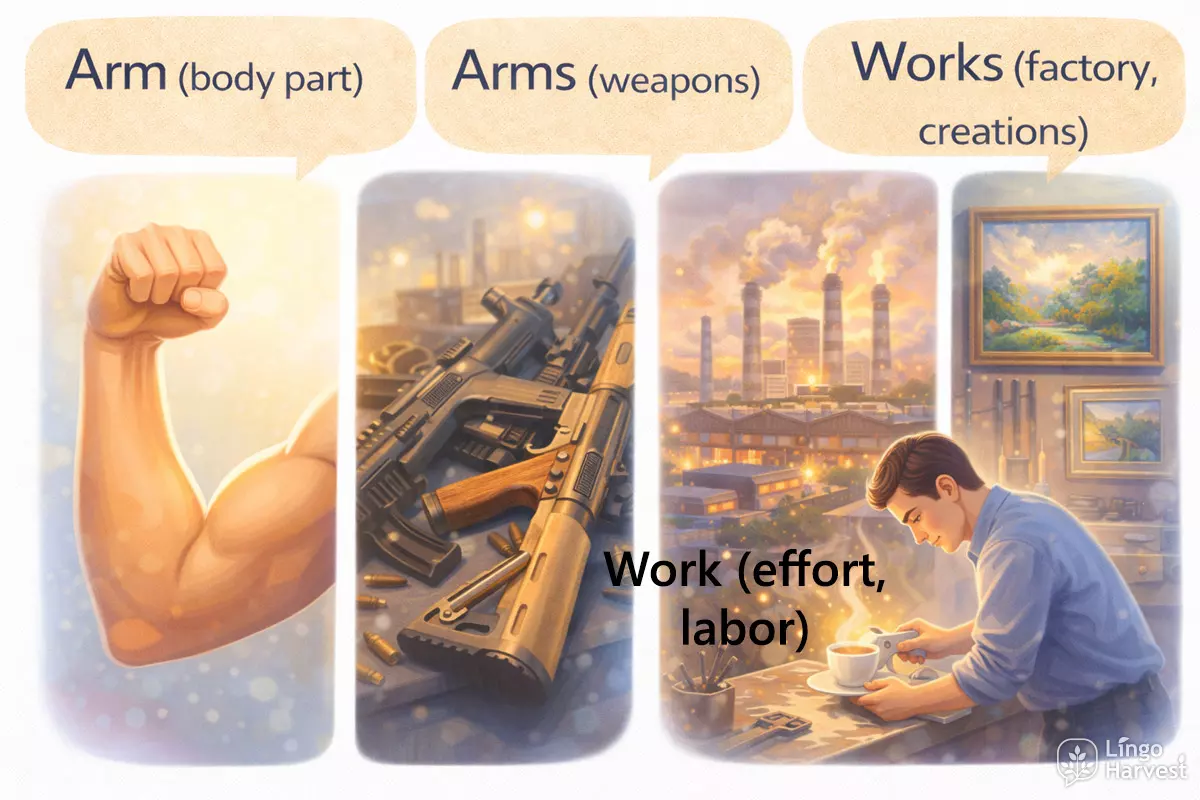
- Arm (body part) → Arms (weapons)
- Work (effort, labor) → Works (factory, creations)
- Letter (alphabet symbol) → Letters (literature, correspondence)
- Force (strength, power) → Forces (military groups)
- Colour (hue) → Colours (flags, military insignia)
- Glass (material, cup) → Glasses (spectacles)
- Spirit (mood, soul) → Spirits (alcoholic drinks, ghosts)
- Interest (curiosity, concern) → Interests (financial stakes, hobbies)
- Paper (material, newspaper) → Papers (documents, official records)
- Respect (admiration) → Respects (condolences)
- Advice (suggestion) → Advices (formal communications, rarely used)
- Light (illumination) → Lights (lamps, traffic signals)
- Part (portion) → Parts (components, regions)
- Ground (soil, land) → Grounds (reasons, premises)
- Work (task) → Works (artistic creations, industrial sites)
- Quarter (one fourth) → Quarters (living accommodations)
- Service (act of helping) → Services (religious ceremonies, public utilities)
- Effect (result) → Effects (personal belongings, special effects)
Why they matter in usage
Recognizing the differences between these paired forms helps avoid misunderstandings. For learners and advanced users alike, knowing which version of a noun to use is essential for idiomatic and accurate English.
Meaning changes between singular and plural forms
In English, some nouns shift their meaning entirely when moving from the singular to the plural form. These dual-form nouns can surprise learners and even native speakers, as the plural is not always just a simple increase in number. Instead, the new form may refer to a different concept, object, or idea. Understanding these distinctions is essential for clear communication.
Common examples of dual-form nouns with shifting meanings
While many English nouns simply add an s or change form to indicate more than one, the following cases involve a notable change in meaning:
- Custom / Customs: A "custom" is a tradition or habitual practice; "customs" refers to border control or duties at entry points.
- Good / Goods: "Good" means something beneficial or positive, while "goods" are items or merchandise.
- Manner / Manners: "Manner" is a way of doing something; "manners" are polite behaviors.
- Work / Works: "Work" is a task or employment; "works" may refer to creations (as in art or literature) or factories.
- Force / Forces: "Force" is physical power; "forces" often means military or law enforcement groups.
- Letter / Letters: A "letter" is a character or a piece of correspondence; "letters" can refer to literature or scholarly learning.
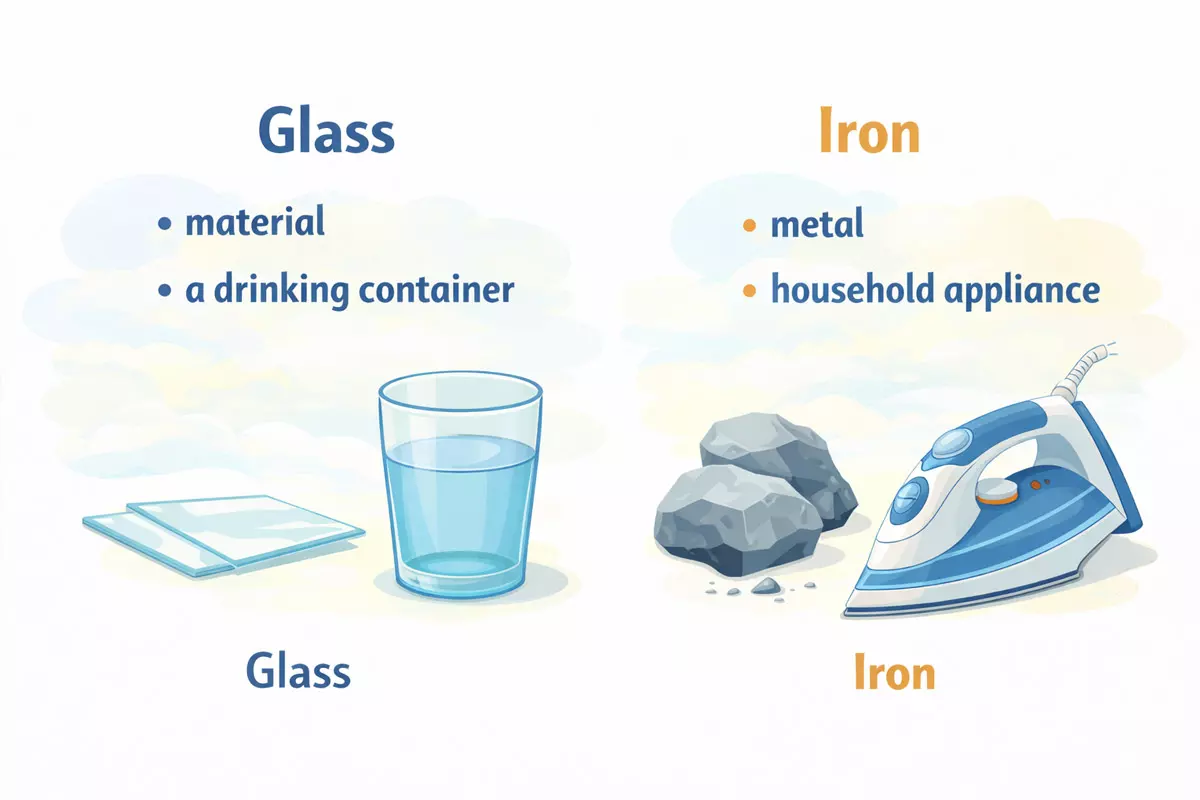
- Iron / Irons: "Iron" is a metal; "irons" can mean shackles or devices for pressing clothes.
- Color / Colors: "Color" is a hue; "colors" can refer to a flag, especially in a military context.
- Direction / Directions: "Direction" is guidance or a course; "directions" are instructions or steps to follow.
- Spirit / Spirits: "Spirit" can be enthusiasm or a supernatural being; "spirits" often means alcoholic drinks or multiple supernatural beings.
- Quarter / Quarters: "Quarter" is one fourth of something; "quarters" are living accommodations.
- Advice / Advices: "Advice" is a recommendation; "advices" (rare, formal) means pieces of information or news.
- Arm / Arms: "Arm" is a limb; "arms" are weapons.
- Mean / Means: "Mean" is an average or a method; "means" usually refers to resources or ways of achieving something.
- Pain / Pains: "Pain" is discomfort; "pains" can mean efforts ("take pains").
- Glass / Glasses: "Glass" is the material or a drinking vessel; "glasses" are spectacles.
- Help / Helps: "Help" is assistance; "helps" (rare) can mean helpers or domestic staff.
- Part / Parts: "Part" is a portion; "parts" can mean regions or talents ("good parts").
- Air / Airs: "Air" is the atmosphere; "airs" are affected manners or melodies.
- Light / Lights: "Light" refers to illumination; "lights" can be sources of light or aspects of something ("in different lights").
Comparison of selected dual-form nouns
Some of these words are especially confusing, as the plural form is used in very different contexts. The table below highlights a few striking examples and their distinct meanings:
| Singular Form | Plural Form |
|---|---|
| Custom Tradition or habitual practice |
Customs Border control or import duties |
| Good Benefit or positive quality |
Goods Merchandise or wares |
| Work Employment or task |
Works Creations (art, literature) or factories |
| Arm Limb of the body |
Arms Weapons |
Being aware of these vocabulary shifts helps in both understanding and producing precise English. When you encounter a noun with an unexpected plural meaning, check the context to ensure you capture the intended sense. This awareness can prevent misunderstandings and add nuance to your language skills.
Common examples like glass, paper, and work
Some English nouns change meaning depending on whether they are used in the singular or plural form. This shift can be subtle or quite dramatic, making these words especially interesting—and sometimes confusing—for learners. Let’s look at how words like glass, paper, and work illustrate this duality, along with several other frequently encountered cases.
How singular and plural forms differ in meaning
The singular version of these nouns often refers to a material, concept, or uncountable substance, while the plural usually indicates distinct objects or types. Recognizing the difference helps avoid misunderstandings in both writing and conversation.
| Singular Form | Plural Form | Meaning Difference |
|---|---|---|
| glass | glasses | glass: transparent material or a drinking vessel; glasses: spectacles for vision |
| paper | papers | paper: material for writing/printing; papers: documents, newspapers, or academic articles |
| work | works | work: effort, employment, or tasks; works: artistic creations, factories, or engineering sites |
| custom | customs | custom: tradition or habitual practice; customs: border control authorities |
| force | forces | force: strength or power; forces: military groups |
| good | goods | good: virtue or benefit; goods: merchandise or possessions |
| arm | arms | arm: limb; arms: weapons |
| damage | damages | damage: harm or injury; damages: monetary compensation in law |
| letter | letters | letter: a written message or alphabet symbol; letters: plural of either, or academic credentials |
| manner | manners | manner: a way of doing; manners: social conduct or etiquette |
| iron | irons | iron: metal or device for pressing clothes; irons: shackles or golf clubs |
| experience | experiences | experience: knowledge gained; experiences: individual events or adventures |
| air | airs | air: gas we breathe; airs: affected manners or melodies |
| content | contents | content: satisfaction or subject matter; contents: items inside something |
Usage tips
- Check the context: “glass” on a table is probably a cup, but “glasses” on your nose are for seeing better.
- Don’t assume the plural is just “more” of the singular—often the meaning shifts entirely.
- Some words, like “works” and “papers,” are common in formal or technical settings.
Understanding these patterns helps you sound natural and precise in English. Pay attention to both form and context to master these vocabulary quirks.
Countable vs uncountable meaning shifts
Many English nouns change meaning depending on whether they are used in a countable or uncountable sense. This distinction can be subtle but has a significant impact on how a word is understood in context. In their countable form, these nouns often refer to distinct, individual items or instances. When uncountable, they usually describe a substance, concept, or an abstract mass.
How dual-form nouns alter meaning
Some words are especially prone to these shifts, leading to different interpretations. For example, "paper" as a material (uncountable) vs. "a paper" meaning a newspaper or academic article (countable). Mastering these nuances is crucial for clear communication.

- Chicken – The animal or meat (uncountable: "We had chicken for dinner") vs. an individual bird (countable: "There are three chickens in the yard").
- Light – General illumination (uncountable: "There is not much light in this room") vs. a lamp or device (countable: "Turn off the lights").
- Glass – The material (uncountable: "The window is made of glass") vs. a drinking vessel (countable: "She drank two glasses of water").
- Iron – The metal (uncountable: "Iron is a strong material") vs. a device for pressing clothes (countable: "Pass me the iron").
- Work – Tasks or labor in general (uncountable: "He has too much work") vs. a piece of art or creation (countable: "Shakespeare’s works are famous").
- Experience – Knowledge gained (uncountable: "She has a lot of experience") vs. a specific event (countable: "It was an unforgettable experience").
- Hair – The substance collectively (uncountable: "Her hair is long") vs. individual strands (countable: "I found a hair in my soup").
- Paper – Material (uncountable: "Paper is expensive") vs. a newspaper or essay (countable: "He wrote two papers").
- Time – The concept (uncountable: "Time heals all wounds") vs. specific occurrences (countable: "We visited three times").
- Room – Space (uncountable: "There is no room for error") vs. a part of a building (countable: "There are five rooms in the house").
- Chocolate – The substance (uncountable: "Chocolate is delicious") vs. individual pieces (countable: "She ate three chocolates").
- Stone – Material (uncountable: "The house is built of stone") vs. individual rocks (countable: "There are several stones on the path").
- Business – Commerce in general (uncountable: "He is in business") vs. a company or shop (countable: "He owns three businesses").
- Toast – Bread as a food (uncountable: "She likes toast for breakfast") vs. a celebratory speech (countable: "He gave a toast at the wedding").
- Paper – Material (uncountable: "Paper is recyclable") vs. exam or assignment (countable: "The teacher handed out the papers").
- Wood – The material (uncountable: "The table is made of wood") vs. a forested area (countable: "They walked through the woods").
- Fruit – The category (uncountable: "Fruit is healthy") vs. types or pieces (countable: "There are many fruits in the basket").
- Water – The liquid (uncountable: "Water is essential") vs. types or servings (countable: "Two waters, please" in a restaurant context).
- Salt – The substance (uncountable: "Add salt to taste") vs. varieties (countable: "There are many salts in the shop").
- Wine – The drink (uncountable: "Wine is produced here") vs. types or glasses (countable: "Three wines were served").
Key patterns to notice
Often, the countable version pinpoints a single unit, type, or example, while the uncountable version highlights a general mass or concept. When learning vocabulary, pay attention to example sentences to catch these differences. Context always determines which meaning is intended.
Context clues for choosing the correct form
Understanding which version of a dual-form noun to use often depends on subtle hints in the sentence. Native speakers rely on these signals to pick the right word, especially when the two forms have distinct meanings (e.g., "advice" vs. "advise," "practice" vs. "practise"). These cues might be grammatical (like the need for a verb or noun), contextual (what the sentence is about), or collocational (common words that appear together).
Types of clues in sentences
Several kinds of information in a sentence can help you decide which form fits:
- Surrounding words: Pay attention to verbs, adjectives, or prepositions nearby.
- Intended action: Is the sentence describing an activity or a thing?
- Subject-object relationships: Who or what is performing the action?
- Fixed expressions: Some phrases always use one form ("give advice," never "give advise").
- Verb tense or noun markers: Look for clues like "a," "an," or verb endings ("-ed," "-ing").
Common dual-form noun pairs and their context clues
Below is a table summarizing several noun pairs with both forms and the typical clues that signal which to use. Notice how context helps determine the correct choice.
| Noun Pair | Form & Usage | Contextual Clues |
|---|---|---|
| Advice / Advise | Advice: noun (suggestion) Advise: verb (to recommend) |
"Give advice", "I advise you to..." Look for "give," "some," or subject + verb. |
| Practice / Practise | Practice: noun (activity) Practise: verb (to perform) |
"Medical practice", "to practise piano" "To" + verb, or article + noun. |
| Licence / License | Licence: noun (document, UK) License: verb (to permit, UK); noun & verb (US) |
"Driving licence" (UK), "license a car" Check region and grammar role. |
| Effect / Affect | Effect: noun (result) Affect: verb (to influence) |
"The effect of...", "to affect mood" "The" + noun, "to" + verb. |
| Compliment / Complement | Compliment: praise Complement: to complete or match |
"Paid a compliment", "colors complement each other" Look for context of praise vs. matching. |
| Stationary / Stationery | Stationary: not moving Stationery: writing materials |
"Remained stationary", "buy stationery" Movement vs. office supplies context. |
| Principal / Principle | Principal: main, leader Principle: rule or belief |
"School principal", "basic principle" Role/title vs. abstract idea. |
| Assure / Ensure / Insure | Assure: to promise Ensure: to make certain Insure: to provide insurance |
"I assure you", "ensure safety", "insure a car" Subject and action type. |
| Inquiry / Enquiry | Inquiry: formal investigation Enquiry: general question (mainly UK) |
"Police inquiry", "customer enquiry" Formality and context. |
| Raise / Raze | Raise: to lift up Raze: to destroy |
"Raise a flag", "raze a building" Creation vs. destruction context. |
Quick tips for identifying the right form
- Check for articles ("a," "an," "the") to spot nouns.
- Look for "to" before verbs.
- Notice if the sentence is about an action or an object.
- Remember common collocations (e.g., "make a difference," "take effect").
- Regional spelling may change meaning, so consider British vs. American usage.
By focusing on these clues, you’ll become more confident in selecting the correct variant of dual-form nouns, even in tricky contexts.
Typical learner errors with dual-form nouns
Learners often struggle when English words have both singular and plural forms with distinct meanings. Confusion arises not just from irregular spelling, but also from the way context alters interpretation. For example, "custom" and "customs" differ significantly: one means a tradition, the other refers to border control. Misunderstandings may lead to awkward phrasing, incorrect grammar, or even communication breakdowns.
Common mistakes and confusions
- Using the wrong form for the intended meaning (e.g., saying "customs" when referring to a tradition).
- Assuming both forms are always interchangeable.
- Applying a regular plural to words with irregular dual meanings.
- Mixing up countable/uncountable usage (e.g., "damage" vs. "damages").
- Translating directly from a native language, resulting in odd expressions.
- Mispronouncing or misspelling the forms, leading to misunderstanding.
- Forgetting that the plural may refer to a specialized field or concept.
Examples of dual-form nouns and learner pitfalls
Below is a comparison of several English nouns that change meaning depending on whether the singular or plural form is used. This helps highlight patterns that can cause problems for non-native speakers.
| Singular Form (Meaning) |
Plural Form (Meaning) |
|---|---|
| Custom (a tradition or habit) |
Customs (border control) |
| Good (moral or benefit) |
Goods (merchandise, products) |
| Damage (harm or destruction) |
Damages (compensation in law) |
| Work (activity, job) |
Works (artistic creations, factories) |
| Force (strength, power) |
Forces (military troops) |
| Content (satisfaction, or subject of something) |
Contents (things inside something) |
| Letter (a written message or alphabet character) |
Letters (correspondence, or literature) |
| Physic (medicine) |
Physics (science discipline) |
| Arm (body part) |
Arms (weapons) |
| Quarter (one fourth, a district) |
Quarters (lodgings, living spaces) |
Tips to avoid confusion
- Always check the context: some forms have specialized meanings only in plural.
- Memorize common pairs and their typical uses.
- Notice if a noun changes from concrete to abstract, or from general to specialized, between forms.
- Read and listen to authentic English to see dual-form nouns in action.
Being aware of these distinctions helps learners communicate more clearly and prevents embarrassing mistakes. Practice and careful attention to context are key in mastering these tricky vocabulary pairs.
Practice: select correct meanings in short contexts
Understanding dual-form nouns in English can be tricky, especially since some words change their meaning depending on whether they are used in the singular or plural. Below, you’ll find a series of practice tasks. For each, choose the most appropriate meaning for the noun in context. This will help reinforce how these words function differently depending on their form.
Choose the Right Meaning
Read each sentence and select the correct meaning for the highlighted noun. Each example shows how context determines whether the singular or plural form carries a distinct definition.
- He gave me some advice before the interview.
a) A suggestion or recommendation
b) Money or material goods - The customs at the airport were very strict.
a) Traditions and habits
b) The place where baggage is checked at borders - She wore a beautiful glass around her neck.
a) A drinking vessel
b) Material made from melted sand - The old man shared many interesting stories from his youth.
a) Levels of a building
b) Narratives or tales - During the storm, several works of art were damaged.
a) Jobs or employment
b) Artistic creations - There are several quarters in the city.
a) Coins worth 25 cents
b) Districts or neighborhoods - He learned about ancient ruins in history class.
a) Destroyed buildings or remains
b) The process of something being spoiled - She often gets looks from strangers.
a) Appearances or glances
b) Physical features - He paid his dues on time.
a) Money owed as a fee
b) Respect or honor - The force of the wind knocked down the tree.
a) A group of people with a specific purpose
b) Physical power or strength
Comparing Dual-Form Nouns in Context
Some English nouns have forms where the singular and plural carry distinct meanings. Here are several such pairs, with short descriptions:
- Good (singular: benefit or something positive) vs. Goods (plural: merchandise or products)
- Work (activity or employment) vs. Works (artistic compositions or factories)
- Custom (tradition or usual practice) vs. Customs (border control at airports/ports)
- Glass (material) vs. Glasses (spectacles for vision)
- Quarter (fourth part or coin) vs. Quarters (living accommodations)
- Force (strength) vs. Forces (military groups)
- Letter (written message) vs. Letters (alphabetical characters)
- Spirit (attitude or soul) vs. Spirits (alcoholic drinks)
- Arm (body part) vs. Arms (weapons)
- Work (job) vs. Works (creations, e.g., of art or literature)
Extended Matching: Dual-Form Noun Meanings Table
| Singular Form | Plural Form | Different Meanings |
|---|---|---|
| Custom | Customs | Tradition vs. Border checks |
| Glass | Glasses | Material vs. Eyewear |
| Good | Goods | Benefit vs. Products |
| Work | Works | Job/Activity vs. Artistic pieces |
| Quarter | Quarters | Fourth part vs. Accommodation |
| Spirit | Spirits | Attitude vs. Alcohol |
| Letter | Letters | Message vs. Alphabet |
| Arm | Arms | Limb vs. Weapons |
Show answers
- a) A suggestion or recommendation
- b) The place where baggage is checked at borders
- b) Material made from melted sand
- b) Narratives or tales
- b) Artistic creations
- b) Districts or neighborhoods
- a) Destroyed buildings or remains
- a) Appearances or glances
- a) Money owed as a fee
- b) Physical power or strength