Foreign-Origin Nouns in English and Their Usage Patterns

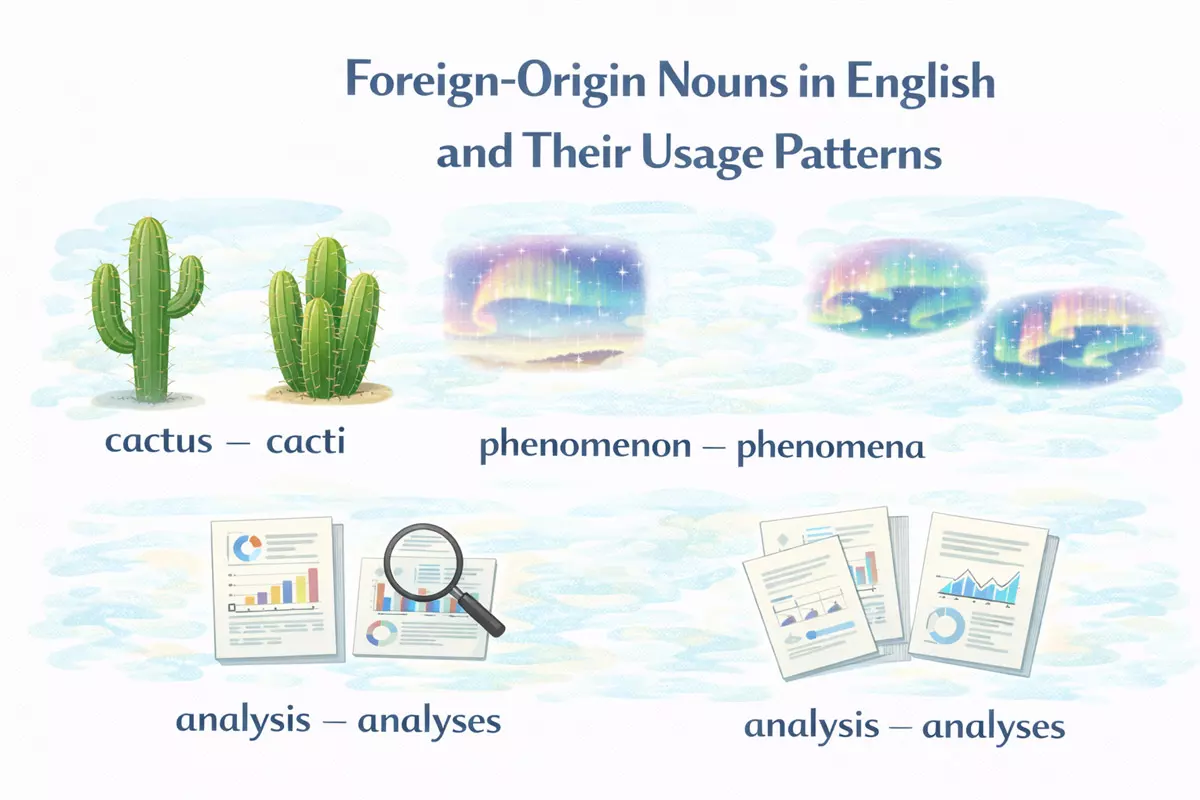 Here we how English borrows nouns from Latin, Greek, and French, explores changes in their spelling, pronunciation, and plural forms, discusses register differences, highlights typical learner mistakes, and provides practice choosing correct forms.
- How foreign-origin nouns enter English
- Common sources like Latin, Greek, and French
- Regular vs irregular plural patterns for borrowed nouns
- Pronunciation changes in borrowed noun forms
- Register differences in using foreign-origin nouns
- Common learner mistakes with borrowed noun spelling
- Practice: choose correct forms of foreign-origin nouns
Words borrowed from other languages have become a lasting part of English, influencing how we communicate and express ideas. Examining the integration of these international terms into everyday conversation highlights interesting patterns in language evolution, as people adopt foreign words to fill gaps or convey specific nuances. This blending not only enriches English vocabulary but also reflects cultural exchange and adaptation, showing how language continuously evolves to meet the needs of its speakers.
How foreign-origin nouns enter English
English has always been open to adopting words from other languages, especially nouns. This process occurs through a mix of historical events, trade, cultural contact, and the global movement of people and ideas. When English speakers encounter new objects, concepts, or customs, they often borrow the native term rather than inventing a new word. Over time, these borrowed nouns become part of everyday English, sometimes retaining their original form and sometimes adapting to English pronunciation and spelling rules.
Common pathways for borrowed nouns
- Trade and commerce: Items and foods like coffee (from Arabic), chocolate (from Nahuatl), and tea (from Chinese) arrived with their foreign names.
- Conquest and colonization: Words such as piano (Italian), bungalow (Hindi), and café (French) entered English as new cultures interacted.
- Science and academia: Specialized vocabulary, including phenomenon (Greek), algebra (Arabic), and bacterium (Latin), reflects the international nature of scholarship.
- Arts and culture: Terms like ballet (French), karaoke (Japanese), and opera (Italian) highlight cultural exchanges.
- Migration and diaspora: Everyday nouns such as patio (Spanish), kindergarten (German), and robot (Czech) have become naturalized through immigrant communities.
Stages of integration
Foreign nouns may follow a path from initial borrowing to complete assimilation. At first, a word might be used mainly in specific contexts or communities. Gradually, spelling and pronunciation may shift to fit English norms. Some words keep their foreign plural forms (like cacti), while others are fully anglicized (cafés).
Examples of borrowed nouns and their origins

- Safari (Swahili) → They went on a safari in Kenya.
- Guitar (Spanish via Arabic) → He learned to play the guitar.
- Pizza (Italian) → We ordered pizza for dinner.
- Kimono (Japanese) → She wore a traditional kimono.
- Yoga (Sanskrit) → I practice yoga every morning.
- Umbrella (Italian via Latin) → Take an umbrella, it might rain.
- Boss (Dutch) → My boss approved the request.
- Alcohol (Arabic) → Alcohol is not allowed in this building.
- Fiancé (French) → She introduced her fiancé to her family.
- Safari (Swahili) → The guide explained the rules of the safari.
- Avatar (Sanskrit) → The game lets you customize your avatar.
- Banana (Wolof / West African) → He ate a banana after training.
- Safari (Swahili) → Safari is a popular browser name as well.
- Cookie (Dutch) → The website uses cookies.
- Violin (Italian) → She plays the violin in an orchestra.
- Jungle (Hindi) → They explored the jungle carefully.
- Chef (French) → The chef prepared a special menu.
- Polka (Czech) → They danced a lively polka.
Adaptation: spelling, plural forms, and pronunciation
Many borrowed nouns are adapted to fit English spelling or pronunciation rules. For instance, spaghetti keeps its Italian form, while café is often pluralized as cafés instead of the original French cafés (with a silent "s"). Some nouns keep irregular plurals (phenomena), while others use standard English endings (pizzas).
| Borrowed Noun | Original Language | Plural in English |
|---|---|---|
| cactus | Latin | cacti / cactuses |
| phenomenon | Greek | phenomena |
| café | French | cafés |
| pizza | Italian | pizzas |
| alumnus | Latin | alumni |
The process of adopting nouns from other languages continues to shape English, reflecting ongoing contact with diverse cultures and communities. Whether through food, science, or daily life, these terms enrich the language and make English vocabulary remarkably diverse.
Common sources like Latin, Greek, and French
Many nouns in English have roots in other languages, especially those that have shaped academic, scientific, and cultural vocabulary. Latin, Greek, and French have each contributed a vast array of terms, often with distinct patterns and meanings that persist in modern English.
Latin-Derived Nouns
Words borrowed from Latin often relate to law, science, religion, or formal discourse. These nouns can sometimes retain Latin plural forms, though anglicized versions are also common. For instance:
- alumnus (alumni) → He is an alumnus of Harvard University.
- datum (data) → Each datum was carefully recorded.
- radius (radii) → The radii of the circles are equal.
- formula (formulae / formulas) → The formula explains the reaction.
- stimulus (stimuli) → Light is a strong stimulus for plants.
- cactus (cacti / cactuses) → Several cacti grow in the desert.
- curriculum (curricula) → The school updated its curriculum.
- medium (media / mediums) → Social media spreads news quickly.
- appendix (appendices / appendixes) → See the appendix for details.
- memorandum (memoranda / memorandums) → The manager sent a memorandum.
Greek-Origin Nouns
- analysis (analyses) → The analysis took several hours.
- crisis (crises) → The country faced multiple crises.
- phenomenon (phenomena) → This phenomenon is hard to explain.
- criterion (criteria) → Price is the main criterion.
- thesis (theses) → She defended her thesis successfully.
- hypothesis (hypotheses) → The hypothesis was later confirmed.
- axis (axes) → The graph has two axes.
- bacterium (bacteria) → This bacterium causes infection.
- diagnosis (diagnoses) → The diagnosis surprised the patient.
- parenthesis (parentheses) → The word appears in parentheses.
French Loanwords
- chef → The chef designed a new menu.
- genre → This film fits the horror genre.
- café → We met at a small café.
- fiancé / fiancée → She introduced her fiancé.
- résumé → Send your résumé by email.
- ballet → They watched a classical ballet.
- croissant → He ordered a croissant for breakfast.
- bouquet → She received a bouquet of flowers.
- debut → The singer made her debut last year.
- rendezvous → They arranged a secret rendezvous.
- soirée → The gallery hosted an evening soirée.
- cliché → The ending felt like a cliché.
- matinée → We went to a matinée performance.
- attaché → The cultural attaché attended the event.
- façade → The building has a historic façade.
| Source Language | Example Noun (Singular/Plural) | Typical Usage Context |
|---|---|---|
| Latin | alumnus/alumni | Education, formal registers |
| Greek | phenomenon/phenomena | Science, academia |
| French | rendezvous/rendezvous | Everyday, social |
| Latin | curriculum/curricula | Education, curriculum planning |
| Greek | analysis/analyses | Research, scientific fields |
| French | genre/genres | Arts, literature, music |
Patterns and Adaptation
Borrowed nouns frequently retain foreign spelling or pluralization, especially in academic and formal contexts. In everyday speech, however, anglicized forms are often preferred. Awareness of these patterns can help with both understanding and using such words correctly.
Regular vs irregular plural patterns for borrowed nouns
English often adapts foreign nouns using its standard "-s" or "-es" ending, but many loanwords retain their original plural forms. Whether a borrowed term follows the local or native pluralization rules depends on its origin, how well it’s integrated, and context of use. This mix can make choosing the right plural tricky, especially for academic or formal writing.
Common regularized plurals
Many imported words eventually follow the predictable English pattern, especially in casual settings or as the term becomes more familiar. Here are some examples:
- cafés (from French "café")
- pizzas (from Italian "pizza")
- tacos (from Spanish "taco")
- mantras (from Sanskrit "mantra")
- curriculums (from Latin "curriculum")
- tempos (from Italian "tempo")
- kimonos (from Japanese "kimono")
- avatars (from Sanskrit "avatar")
- radios (from Latin "radius")
- pianos (from Italian "pianoforte")
Irregular plural forms retained from source languages
However, certain borrowed words keep their original plurals, especially in academic, scientific, or formal contexts. These forms can come from Latin, Greek, Italian, and other languages, and are often seen as more precise or traditional.
- criteria (from Greek "criterion")
- phenomena (from Greek "phenomenon")
- alumni (from Latin "alumnus")
- cacti (from Latin "cactus")
- stimuli (from Latin "stimulus")
- indices (from Latin "index")
- formulae (from Latin "formula")
- fungi (from Latin "fungus")
- ravioli (from Italian "raviolo")
- syllabi (from Latin "syllabus")
Comparison of pluralization patterns
Some foreign-origin nouns have both regular and irregular plural forms in English, and usage can depend on context or register. The following table illustrates a few notable cases:
| Singular | Regular Plural | Irregular (Original) Plural | Notes |
|---|---|---|---|
| antenna | antennas | antennae | "Antennas" for electronics, "antennae" for biology |
| curriculum | curriculums | curricula | Both accepted, "curricula" preferred in academia |
| index | indexes | indices | "Indexes" for books, "indices" in math/science |
| formula | formulas | formulae | Both used; "formulae" is more formal/scientific |
| focus | focuses | foci | Both forms exist, "foci" in scientific contexts |
Patterns and trends
Overall, borrowed nouns in English show a spectrum from fully regularized to strictly irregular plurals. The tendency is toward regularization over time, especially as foreign words become widespread. Still, in technical language or when precision is needed, the original plural may be favored. This flexibility can cause uncertainty, but also enriches English vocabulary with subtle shades of meaning and tone.
Pronunciation changes in borrowed noun forms
When English adopts nouns from other languages, their pronunciation often shifts to fit English sound patterns. This adjustment can involve stress placement, vowel quality, or even changes in consonant sounds. Such transformations help speakers integrate new terms more easily, but they may also obscure the word’s original form.
Common patterns in sound adaptation
English speakers tend to regularize borrowed nouns by simplifying or anglicizing unfamiliar sounds. For example, final syllables may be reduced, accent marks dropped, or consonant clusters softened. Some typical adaptations include:
- Stress shift: French loanwords often move stress to the first syllable (e.g., garage).
- Vowel change: The “i” in Italian panini becomes a short vowel in English.
- Simplification of endings: The -e in fiancée is often unstressed or even silent in English.
- Consonant alteration: German “ch” sounds may become “k” or “sh” (e.g., Bach).
- Dropping diacritics: Accents in words like café are often omitted in speech.
Examples of borrowed nouns and their English pronunciations

Some foreign terms have acquired distinctive pronunciations that diverge notably from their source language. Here are several examples illustrating how English adapts these words:
| Word (origin) | Pronunciation | Example sentence |
|---|---|---|
| Croissant (French) | /krəˈsɑːnt/ or /kwɑːˈsɒnt/ | He ordered a croissant with his coffee. |
| Tsunami (Japanese) | /tsuːˈnɑːmi/ | The tsunami warning was issued early. |
| Genre (French) | /ˈʒɒnrə/ | This movie belongs to a different genre. |
| Chutzpah (Yiddish) | /ˈhʊtspə/ | It took real chutzpah to say that. |
| Rendezvous (French) | /ˈrɒndeɪvuː/ | They arranged a secret rendezvous. |
| Piano (Italian) | /piˈænəʊ/ | She plays the piano beautifully. |
| Fjord (Norwegian) | /fjɔːrd/ | The fjord was surrounded by mountains. |
| Ballet (French) | /bæˈleɪ/ | We watched a classical ballet. |
| Guru (Sanskrit / Hindi) | /ˈɡʊruː/ | He is considered a marketing guru. |
| Kimono (Japanese) | /kɪˈməʊnəʊ/ | She wore a silk kimono. |
| Gnocchi (Italian) | /ˈnɒki/ or /ˈnjɒki/ | They served homemade gnocchi. |
| Enchilada (Spanish) | /ˌentʃɪˈlɑːdə/ | I ordered a chicken enchilada. |
| Quiche (French) | /kiːʃ/ | She baked a spinach quiche. |
| Siesta (Spanish) | /siˈestə/ | He took a short siesta after lunch. |
| Sushi (Japanese) | /ˈsuːʃi/ | They went out for sushi. |
| Algebra (Arabic) | /ˈældʒɪbrə/ | Algebra is part of the math exam. |
| Safari (Swahili) | /səˈfɑːri/ | They went on a safari in Africa. |
| Opera (Italian) | /ˈɒpərə/ | We attended an opera last night. |
| Polka (Polish) | /ˈpɒlkə/ | The band played a lively polka. |
| Yacht (Dutch) | /jɒt/ | They sailed on a luxury yacht. |
Notable trends and exceptions
While many imported nouns become fully anglicized, some retain their foreign pronunciations among certain speakers or in formal contexts. This is particularly true for words used in academic, culinary, or musical settings. However, over time, even these may shift as the loanword becomes more established.
Comparison of original and English pronunciations
To illustrate how pronunciation may diverge, here’s a table showing a few nouns with their original language pronunciations versus common English renderings:
| Original Word & Language | Typical English Pronunciation |
|---|---|
| Ballet (French: [balɛ]) | /bæˈleɪ/ |
| Genre (French: [ʒɑ̃ʁ]) | /ˈʒɒnrə/ |
| Gnocchi (Italian: [ˈɲɔkki]) | /ˈnɒki/ or /ˈnjɒki/ |
| Chutzpah (Yiddish: [ˈχʊtspɑh]) | /ˈhʊtspə/ |
| Rendezvous (French: [ʁɑ̃devu]) | /ˈrɒndeɪvuː/ |
These patterns show that pronunciation changes are both systematic and variable, influenced by how easily English speakers can reproduce unfamiliar sounds. Over time, the adapted forms often become standard, sometimes differing greatly from their origins.
Register differences in using foreign-origin nouns
The way English speakers use nouns borrowed from other languages often depends on formality, audience, and context. Some loanwords signal a more formal or technical register, while others have been fully assimilated and feel neutral or even informal. Understanding these distinctions helps writers and speakers pick the right term for a given situation.
Formal and informal contexts
Certain borrowed nouns remain associated with high-register or academic settings. For example, words like phenomenon (from Greek) or cul-de-sac (from French) are typically used in formal writing or speech. In contrast, everyday English might favor simpler or native alternatives when available. Conversely, some loanwords—like pizza or robot—are so common they function in all registers.
Examples of register-sensitive foreign nouns
- Agenda (Latin) → more formal than plan
- Déjà vu (French) → used for emphasis or literary effect
- Alibi (Latin) → legal or police contexts
- Faux pas (French) → social or formal etiquette
- Entrepreneur (French) → business, formal discussions
- Graffiti (Italian) → informal, urban contexts
- Safari (Arabic via Swahili) → neutral, travel contexts
- Genre (French) → formal, academic, or artistic contexts
- Rendezvous (French) → formal or romantic nuance
- Panorama (Greek) → more formal than view
- Kindergarten (German) → now neutral in education
- Veranda (Hindi/Portuguese) → neutral, architectural
- Patio (Spanish) → neutral, home/garden contexts
- Gaffe (French) → formal or journalistic
- Tsar (Russian) → historical, political writing
- Chef (French) → culinary, professional kitchens
- Chauffeur (French) → formal, luxury transport
- Pizza (Italian) → everyday, informal
- Robot (Czech) → everyday, technical or informal
- Buffet (French) → neutral, dining contexts
Comparing register levels of borrowed nouns
| Foreign-Origin Noun | Typical Register | Common Native Equivalent | Context Example |
|---|---|---|---|
| Commence | Formal | Begin / Start | The ceremony will commence at noon. |
| Resume | Neutral | Continue | Let’s resume the meeting after lunch. |
| Venue | Neutral/Formal | Place / Location | The concert’s venue is downtown. |
| Infant | Formal | Baby | The infant was sleeping peacefully. |
| Facade | Formal/Architectural | Front | The building’s facade was restored. |
| Encore | Performance/Neutral | Repeat performance | The crowd demanded an encore. |
| Debris | Neutral/Formal | Rubble / Trash | The street was covered in debris. |
| Agenda | Formal | Plan / List | We have a full agenda today. |
Choosing the right noun
Selecting between a borrowed term and its native alternative depends on formality, clarity, and audience expectation. In academic papers, foreign-derived nouns often sound more precise or objective. In casual speech, simpler words are usually preferred. Awareness of these subtle differences helps avoid sounding either too stiff or too colloquial for the occasion.
Common learner mistakes with borrowed noun spelling
Learners often struggle with the spelling of nouns borrowed from other languages, mainly because these words tend to keep unusual or unpredictable patterns from their origins. English integrates terms from French, Latin, Greek, Italian, and many other sources, so it’s easy to confuse how these words should be spelled or adapted. Some errors stem from mixing up English spelling rules with those of the original language, while others result from irregular pronunciation or silent letters.
Why spelling errors happen with foreign nouns
Borrowed words frequently break expected English spelling conventions. For instance, silent letters, double consonants, or unique endings may persist from the source language. Learners may also overgeneralize English rules to these exceptions. Additionally, many loanwords are common in academic, culinary, or artistic contexts, where their spelling is less familiar.
Typical spelling pitfalls
- Omitting silent letters (e.g., bouquet as "bokay")
- Adding unnecessary endings (e.g., café as "cafee")
- Confusing similar-sounding vowels (e.g., naïve as "naive" or "naeve")
- Misplacing double consonants (e.g., cappuccino as "capuccino")
- Missing accent marks (e.g., fiancé as "fiance")
- Incorrect plural forms (cactus as "cactuses" instead of "cacti")
- Mixing up “ch” and “sh” spellings (e.g., champagne as "shampagne")
- Using “ph” and “f” interchangeably (philosophy as "filosophy")
- Forgetting unique digraphs (e.g., gnocchi as "noki")
- Dropping or adding letters from the original language (risotto as "risoto")
- Replacing “qu” with “kw” (unique as "unik")
- Spelling “y” as “i” (yogurt as "ioghurt")
- Incorrectly anglicizing endings (alumni as "alumnies")
- Confusing “ie” and “ei” (caffeine as "cafeine")
- Misusing “ou” and “u” (souvenir as "suvenir")
- Adding or omitting “e” at the end (torte as "tort")
- Writing “sc” as “sk” (fresco as "fresko")
- Interchanging “au” and “aw” (chauffeur as "chawfeur")
Confusing plural forms in borrowed nouns
A frequent challenge is that pluralization doesn’t always follow standard English rules. Many foreign nouns keep their original plural endings, which can cause confusion. Some learners apply regular "-s" endings universally, leading to mistakes.
| Singular | Correct Plural | Common Mistake |
|---|---|---|
| cactus | cacti | cactuses |
| phenomenon | phenomena | phenomenons |
| criterion | criteria | criterions |
| analysis | analyses | analysises |
| alumnus | alumni | alumnuses |
| medium | media | mediums |
| focus | foci | focuses |
| syllabus | syllabi | syllabuses |
| appendix | appendices | appendixes |
| fungus | fungi | funguses |
Tips for avoiding spelling mistakes
- Check the word’s origin if unsure—patterns often reflect the source language.
- Look up unfamiliar terms in reliable dictionaries, paying attention to both spelling and plural forms.
- Practice writing and recognizing tricky borrowed nouns in context.
- Notice accent marks and silent letters, especially in French and Italian words.
- Be cautious with words ending in -us, -um, -is, or -on; their plurals may be irregular.
By understanding these common traps, learners can improve both their spelling and confidence with foreign-origin nouns in English.
Practice: choose correct forms of foreign-origin nouns
Understanding how to use nouns borrowed from other languages is essential for clear and accurate English. Many of these words have irregular plural forms, or retain their original endings, which can cause confusion. Below you'll find exercises and examples that focus on choosing the correct forms—singular or plural—of commonly used foreign-origin nouns.
Exercise: Select the Correct Plural Form
Read each sentence and choose the correct plural form of the noun in brackets. Some nouns have English-style plurals, others retain their original forms.
- The museum displayed several ancient (criterion).
- Many (phenomenon) were observed during the experiment.
- The chef prepared different types of (cactus) salad.
- She studied the (curriculum) of three universities.
- We saw multiple (analysis) in the report.
- The artist showcased her latest (portfolio).
- The professor discussed various (thesis) with the students.
- The doctor examined the patient's (diagnosis).
- They have a collection of rare (alumnus) at the meeting.
- Several (bacterium) were found in the sample.
Show answers
- criteria
- phenomena
- cacti
- curricula
- analyses
- portfolios
- theses
- diagnoses
- alumni
- bacteria
Common Foreign-Origin Nouns: Singular vs. Plural
Below is a reference table with some frequently used nouns of foreign origin, showing their singular and plural forms. Notice which retain their original endings and which have been anglicized.
| Singular | Plural |
|---|---|
| analysis | analyses |
| criterion | criteria |
| phenomenon | phenomena |
| cactus | cacti / cactuses |
| alumnus | alumni |
| syllabus | syllabi / syllabuses |
| fungus | fungi / funguses |
| appendix | appendices / appendixes |
| curriculum | curricula / curriculums |
| thesis | theses |
| datum | data |
| medium | media / mediums |
| stimulus | stimuli |
| index | indices / indexes |
| radius | radii / radiuses |
| focus | foci / focuses |
| nebula | nebulae / nebulas |
| axis | axes |
| oasis | oases |
| diagnosis | diagnoses |
Quick Practice: Identify the Odd Form
Choose which word in each group is NOT a correct plural form:
- criteria, criterions, criteriae
- phenomena, phenomenons, phenomenon
- cacti, cactuses, cactus
- syllabi, syllabus, syllabuses
- analyses, analysis, analysises
- bacteria, bacterium, bacterias
- media, medium, medias
- radii, radius, radiuses
- theses, thesis, thesises
- appendices, appendix, appendixes
Show answers
- criterions, criteriae
- phenomenons, phenomenon
- cactus
- syllabus
- analysises
- bacterias
- medias
- radius
- thesises
- appendix
Mastering these plural forms helps you write and speak with greater precision, especially in academic, scientific, or technical contexts.