Role Nouns in Professional and Workplace English Usage

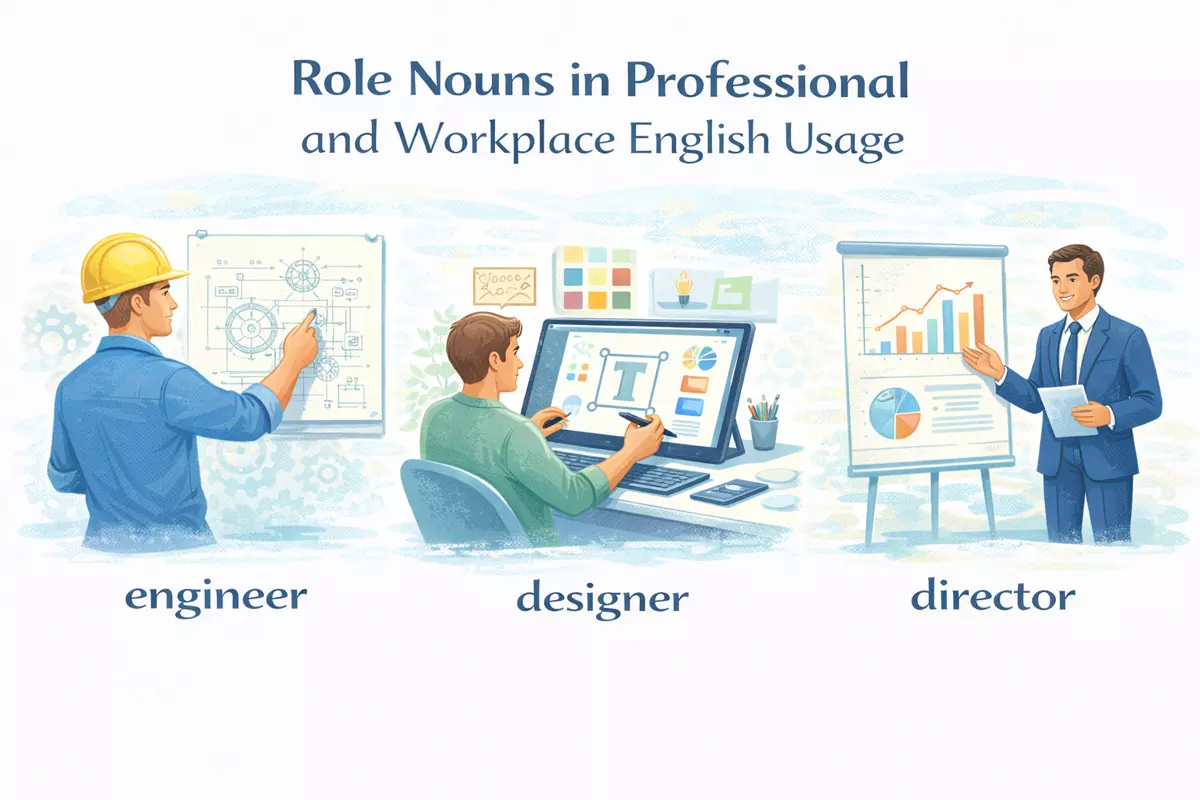 The article defines role nouns in professional settings, gives examples such as manager and assistant, compares formal and informal usage, explains how they show responsibility and hierarchy, and addresses typical learner errors in workplace communication.
- What role nouns refer to in professional settings
- Common workplace role nouns like manager and assistant
- Formal vs informal role noun choices
- Role nouns in job descriptions and emails
- Using role nouns for responsibility and hierarchy
- Typical learner mistakes with role-based nouns
- Practice: describe workplace roles using correct nouns
In professional environments, the language we use to describe positions and responsibilities plays a crucial role in shaping both communication and workplace culture. By understanding and consistently applying accurate terms for job titles and functions, employees can promote clarity, minimize misunderstandings, and demonstrate respect for each other's roles. This attention to language not only supports effective collaboration but also contributes to an inclusive and professional atmosphere where everyone feels valued and understood.
What role nouns refer to in professional settings
Role nouns are terms that identify a person’s position, duties, or professional identity within an organization. These words serve as labels that clarify not only what someone does but also how they fit into a workplace hierarchy or workflow. Understanding these terms is essential for clear communication, especially in diverse or international teams where job titles and responsibilities may differ.
Defining professional identity
In offices, factories, and other work environments, role nouns such as "manager," "engineer," or "assistant" help establish expectations about authority, responsibility, and expertise. They often imply certain tasks, required skills, and relationships to other roles. For example, a "supervisor" typically oversees others, while a "consultant" offers specialized advice without direct management duties.
Examples of common role nouns in the workplace
- Manager → The manager approved the new schedule.
- Supervisor → The supervisor checked our progress.
- Team leader → The team leader organized the tasks.
- Director → The director planned the strategy.
- Coordinator → The coordinator arranged the event.
- Assistant → The assistant prepared the documents.
- Advisor → The advisor gave useful guidance.
- Intern → The intern learned quickly.
- Administrator → The administrator updated the records.
- Technician → The technician repaired the machine.
- Operator → The operator monitored the system.
- Consultant → The consultant reviewed the plan.
- Specialist → The specialist solved the problem.
- Representative → The representative spoke to the clients.
- Executive → The executive attended the meeting.
- Analyst → The analyst studied market trends.
- Officer → The officer ensured safety.
- Trainer → The trainer taught new skills.
- Agent → The agent negotiated contracts.
- Facilitator → The facilitator helped guide the discussion.
Role nouns and workplace structure
These labels also reflect organizational structure and can indicate hierarchy or department. For instance, a "Chief Executive Officer" (CEO) holds the highest executive position, while a "project coordinator" may operate within a specific team. Such distinctions help employees and stakeholders understand reporting lines and collaboration pathways.
Comparing similar role nouns
Sometimes, different terms can seem interchangeable but carry subtle distinctions. Here’s a comparison of some frequently confused professional labels:
| Role Noun | Typical Function |
|---|---|
| Manager | Oversees people and resources, responsible for team or department outcomes |
| Supervisor | Directly monitors daily work and staff, often at an operational level |
| Coordinator | Organizes activities or projects, ensuring processes run smoothly |
| Administrator | Handles systems, records, or organizational procedures, often in a support capacity |
| Consultant | Provides expert advice, usually without direct authority over staff |
Why precise usage matters
Using the correct role noun helps avoid misunderstandings about authority, accountability, and workflow. It also shows respect for colleagues’ expertise and contributions, which can improve morale and collaboration. In summary, these terms anchor professional identity and clarify how individuals participate in the broader goals of their workplace.
Common workplace role nouns like manager and assistant
In professional environments, job titles and position names provide clarity about responsibilities and organizational structure. These nouns often reflect hierarchy, specialization, or area of expertise. Understanding and using these terms accurately is essential for effective communication in business settings.
Typical Role Nouns in the Workplace
Workplace English includes a wide range of nouns to describe positions, from leadership to support roles. Many are easily recognized, but some may vary between industries or companies. Here is an overview of commonly encountered terms:
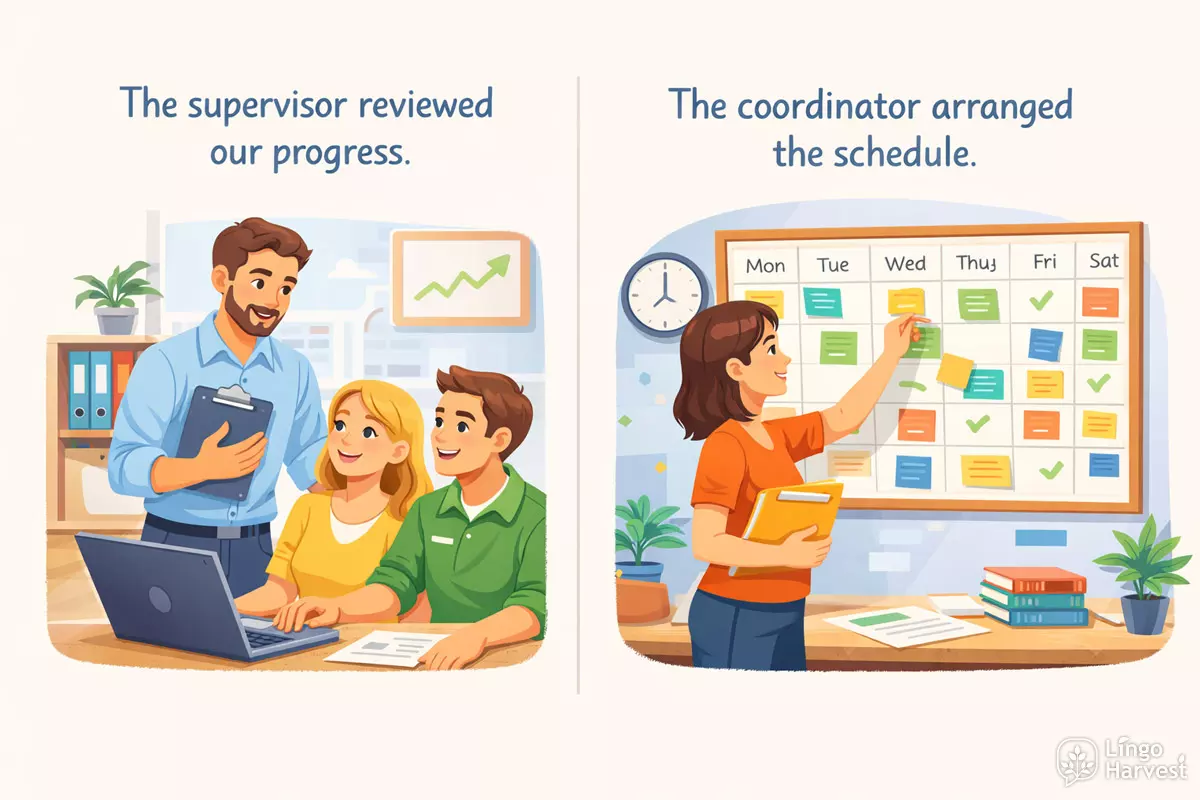
- Supervisor → The supervisor reviewed our progress.
- Coordinator → The coordinator arranged the schedule.
- Director → The director approved the proposal.
- Analyst → The analyst examined the data.
- Consultant → The consultant offered expert advice.
- Administrator → The administrator updated the records.
- Executive → The executive attended the board meeting.
- Specialist → The specialist fixed the technical issue.
- Officer → The officer ensured workplace safety.
- Intern → The intern assisted with basic tasks.
- Technician → The technician repaired the equipment.
- Partner → She runs the firm with her business partner.
- Team leader → The team leader assigned tasks to everyone.
- Associate → An associate helped prepare the report.
- Chief → The Chief Financial Officer presented the budget.
- Representative → The representative spoke to the clients.
- Trainer → The trainer taught new employees.
- Clerk → The clerk organized the files.
- Advisor → The advisor suggested a better solution.
- Director → The film’s director planned each scene.
Role Noun Patterns and Variations
Many job titles combine a general role noun with a specific area or function. For example, "marketing manager," "IT assistant," or "sales coordinator." This pattern helps clarify both rank and focus area within an organization. Some positions use gender-neutral or plural forms, such as "team members" or "staff."
Comparing Responsibilities Across Roles
| Role Noun | Typical Responsibilities |
|---|---|
| Manager | Oversees teams or departments, sets goals, supervises workflow, and makes key decisions. |
| Assistant | Supports managers or teams by handling scheduling, communication, and administrative tasks. |
| Coordinator | Organizes activities, aligns resources, and ensures projects or events run smoothly. |
| Analyst | Examines data, prepares reports, and provides insights to guide business strategies. |
| Director | Leads entire departments or divisions, develops strategic plans, and oversees senior managers. |
| Consultant | Offers expert advice, evaluates processes, and recommends improvements to clients or organizations. |
| Technician | Handles technical tasks, equipment maintenance, and practical problem-solving within specialized fields. |
| Intern | Gains practical experience by assisting with various tasks, often under supervision. |
Being familiar with these nouns and their nuances helps professionals navigate workplace conversations and documentation. Whether drafting an email, updating a résumé, or participating in meetings, choosing the right term makes communication more precise and effective.
Formal vs informal role noun choices
Choosing between formal and informal terms for roles can significantly affect how professional or approachable your workplace communication sounds. In many business settings, formality signals respect and authority, while informal terms can create a sense of friendliness or equality. The context—such as emails, meetings, reports, or casual conversations—often determines which register is most suitable.
Common Differences in Usage
Formal role nouns are typically longer or derived from Latin or French, while their informal counterparts tend to be shorter, more conversational, or based on everyday English. For example, "administrator" is more formal than "admin," and "supervisor" is more official than "boss." The choice often depends on the audience and the level of hierarchy involved.
Examples of Formal and Informal Role Nouns
| Formal Term | Informal Equivalent |
|---|---|
| Administrator | Admin |
| Supervisor | Boss |
| Colleague | Co-worker |
| Subordinate | Team member |
| Executive | Top brass |
| Assistant | Helper |
| Executive assistant | Right-hand |
| Human resources manager | HR person |
| Receptionist | Front desk |
| Chief Executive Officer | CEO |
| Intern | Temp |
| Janitor | Cleaner |
| Director | Head |
| Technician | Tech |
| Consultant | Advisor |
| Entrepreneur | Business owner |
| Project manager | Project lead |
| Facilitator | Moderator |
Context Matters
The appropriateness of formal or informal role nouns depends on the situation and your relationship to the audience. For instance, formal terms are preferable in official documents, presentations, and communications with clients or upper management. In contrast, informal vocabulary is more common in internal chats, team meetings, or when addressing peers. Using the right register helps convey the intended tone: formal for professionalism, informal for approachability and camaraderie.
- Use formal nouns for job titles, contracts, and cross-departmental emails.
- Choose informal alternatives when sending quick messages to teammates or in casual discussions.
- Be aware of company culture—some organizations prefer a consistently formal or informal style.
- Switching registers can signal hierarchy, solidarity, or distance, so consider how you want to be perceived.
Ultimately, understanding the difference between formal and informal role nouns allows you to tailor your language to fit the purpose, audience, and medium, supporting clearer and more effective workplace communication.
Role nouns in job descriptions and emails
In professional contexts, specific job titles and position terms help clarify responsibilities and expectations. These nouns don’t just label a person’s function—they also shape perceptions of hierarchy, authority, and expertise in the workplace. Choosing the right term helps avoid confusion, especially in formal documents like job postings or important correspondence.
Common uses of occupational nouns

Role terms such as "manager," "assistant," or "engineer" provide immediate context about someone's duties. In job postings, these labels set out what the organization expects from applicants. In emails, they clarify who is responsible for which tasks or decisions. Here are several widely-used examples:
- Supervisor → The supervisor checked the team’s progress.
- Coordinator → The coordinator organized the event schedule.
- Analyst → The analyst reviewed the sales data.
- Director → The director approved the final plan.
- Consultant → The consultant gave advice on the project.
- Administrator → The administrator updated the company records.
- Technician → The technician repaired the broken machine.
- Officer → The officer ensured that everyone followed the rules.
- Specialist → The specialist solved the technical problem quickly.
- Intern → The intern helped prepare the documents.
- Representative → The representative spoke on behalf of the company.
- Advisor → The advisor suggested a different strategy.
- Team Lead → The Team Lead assigned tasks to each member.
- Partner → She runs the business with her partner.
- Clerk → The clerk organized the files in the office.
- Designer → The designer created a new logo.
- Producer → The producer managed the whole film project.
- Trainer → The trainer taught the new employees how to use the system.
Choosing the right job title
Selecting the appropriate noun for a position is important for clarity and inclusivity. For instance, the term “Chairperson” is often preferred over “Chairman” to avoid gender bias. Similarly, "Salesperson" or "Sales Associate" are more neutral than “Salesman.”
Comparing formal and informal usage
Sometimes, job titles are adapted for different levels of formality. In emails, people may use shortened or informal versions of their roles, while official descriptions usually require the full, formal title. The table below outlines some typical differences:
| Formal Title | Informal/Email Reference |
|---|---|
| Chief Executive Officer | CEO |
| Human Resources Manager | HR Manager |
| Administrative Assistant | Admin |
| Software Engineer | Developer |
| Customer Support Specialist | Support Rep |
| Marketing Coordinator | Marketer |
Tips for effective use in communication
- Use specific titles to avoid ambiguity (e.g., “Project Manager” instead of just “Manager”). - Match the formality of your noun to the context—formal for job ads or contracts, less formal in team emails. - Prefer gender-neutral options where possible for inclusivity. - When introducing yourself or others, include the role noun for clarity, especially if responsibilities aren’t obvious. Using precise occupational terms fosters clear, professional communication and helps everyone understand their place within an organization.
Using role nouns for responsibility and hierarchy
In professional settings, specific nouns are often used to clarify duties and organizational structure. These terms help colleagues, clients, and management quickly understand who is accountable for what, and how decision-making flows within a team or company. Choosing the right role noun can reduce confusion and set expectations for communication and authority.
Defining workplace positions with role nouns
Role nouns such as "manager," "director," or "assistant" make it clear what level of responsibility someone holds. They also signal reporting lines and task ownership. This clarity is especially important in large organizations or cross-functional teams, where titles help avoid misunderstandings about who leads projects or handles certain issues.
- Manager – oversees teams or departments
- Supervisor – monitors daily work and enforces standards
- Coordinator – organizes tasks and resources
- Director – sets strategic direction for large units
- Executive – holds high-level decision-making power
- Lead – guides a group on a specific project
- Assistant – supports another role, often administratively
- Officer – responsible for key operational areas (e.g., "Chief Financial Officer")
- Analyst – interprets data or processes for decision-making
- Specialist – brings expertise in a focused area
- Intern – performs tasks under supervision, often as training
- Consultant – provides expert advice on specific topics
- Partner – shares ownership or leadership in a business
- Administrator – manages systems, processes, or facilities
- Representative – acts on behalf of a group or company
- Chair – leads a committee or board
- Supervisor – directly oversees employees or functions
- Team Member – contributes to group efforts without a leadership title
Comparing hierarchical levels
To better understand how these terms signal hierarchy, here’s a comparison of common role nouns and their typical levels of responsibility:
| Role Noun | Typical Responsibility Level |
|---|---|
| Chief Executive Officer (CEO) | Top-level executive, ultimate authority |
| Director | Senior leadership, sets direction for departments |
| Manager | Mid-level, oversees teams or processes |
| Coordinator | Organizes tasks, often without direct reports |
| Assistant | Supports others, usually entry-level or administrative |
| Intern | Learning role, limited responsibility |
Why precise role nouns matter
Using accurate titles helps with efficient communication and sets a professional tone. It also assists in delegating tasks, resolving conflicts, and onboarding new team members. When everyone understands the meaning behind a title, daily operations and collaborations run more smoothly. For international teams, clear role nouns can also bridge cultural gaps and streamline reporting structures.
Typical learner mistakes with role-based nouns
People learning English for professional or workplace settings often encounter confusion when using nouns that represent roles, such as "manager," "engineer," or "intern." These words may seem straightforward, but learners can make errors that affect clarity or professionalism. Addressing these issues helps improve both spoken and written communication in job-related contexts.
Common issues with article usage
One frequent problem is omitting or misusing articles ("a," "an," "the") before nouns that indicate roles. For example, learners might say "I am manager" instead of "I am a manager." The article is needed because the noun refers to a role, not a unique title.
- ❌ She is engineer. → She is an engineer.
- ❌ He became director. → He became a director.
Confusion between job titles and general roles
Using a role noun as a job title when it should be generic, or vice versa, can cause ambiguity. For instance, "the Manager" (with a capital letter) may refer to a specific person, while "a manager" is any person in that role.
- ❌ Please send this to Manager. → Please send this to the manager.
- ❌ My friend is Project Manager. → My friend is a project manager.
Incorrect pluralization and gender forms
Some learners add unnecessary endings or use outdated gendered forms. Modern business English favors neutral terms ("actor" for all genders, "chairperson" instead of "chairman"/"chairwoman"). Plural forms should follow standard rules.
- ❌ She is an actress (unless specifically referring to gender in arts). → She is an actor.
- ❌ Two secretarys. → Two secretaries.
- ❌ Policemans. → Police officers.
Role nouns with or without "the"
Choosing whether to use "the" before a role noun depends on context. In general references, articles are used, but for unique roles in an organization, "the" is correct only if referring to one specific person.
- ❌ The CEO is responsible for strategy. (Correct if there is only one CEO in context; otherwise, use "A CEO")
- ❌ I spoke to director. → I spoke to the director.
Common vocabulary errors with role-based nouns
Some role nouns are easily confused or misapplied, especially in multinational workplaces. Here’s a list of commonly mixed-up terms, with the most frequent mistakes:
- chef / chief
- advisor / adviser
- consultant / counsel
- officer / official
- worker / employee / staff
- supervisor / superintendent
- director / manager / leader
- intern / trainee
- assistant / associate
- administrator / administrative assistant
- client / customer
- auditor / accountant
- editor / publisher
- producer / production manager
- technician / technologist
- secretary / personal assistant
- receptionist / greeter
- engineer / operator
- partner / shareholder
- president / chairperson
Comparison of correct and incorrect role noun usage
| Incorrect Usage | Correct Usage |
|---|---|
| I am accountant. | I am an accountant. |
| She is the engineer of our team. (generic) | She is an engineer on our team. |
| He is a CEO of the company. (if only one CEO exists) | He is the CEO of the company. |
| We need more informations from the manager. | We need more information from the manager. |
| Three manageres attended the meeting. | Three managers attended the meeting. |
| She is a chairman. | She is a chairperson. |
| He is a staff. | He is a staff member. |
| I work as a police. | I work as a police officer. |
By recognizing these common pitfalls and reviewing the examples above, learners can communicate their professional roles with greater accuracy and confidence. Mastering these distinctions is essential for effective workplace communication.
Practice: describe workplace roles using correct nouns
Understanding and using precise nouns for professional roles is essential for clarity in business communication. This exercise focuses on identifying and applying the correct terms for various positions and functions within organizations.
Common Professional Role Nouns
Below is a list of job titles and workplace roles, each representing a specific set of responsibilities. Review these examples to broaden your vocabulary and improve your descriptive accuracy:
- Manager – supervises a team or department
- Technician – handles technical equipment or systems
- Consultant – provides expert advice
- Accountant – manages financial records
- Analyst – interprets data and trends
- Coordinator – organizes activities or projects
- Supervisor – oversees daily operations
- Assistant – supports another role or department
- Administrator – manages office operations
- Engineer – designs and develops structures or systems
- Director – leads an organization or division
- Intern – trainee gaining practical experience
- Executive – holds a senior decision-making position
- Salesperson – sells products or services
- Recruiter – finds and hires employees
- Editor – reviews and corrects content
- Designer – creates visual concepts
- Operator – controls machinery or systems
- Trainer – instructs or coaches staff
- Specialist – has expertise in a particular area
Role Noun Selection: Practical Tasks
Try the following exercises to test your ability to choose accurate workplace nouns. Read each description and select the correct term.
- This person is responsible for hiring new staff: __________
- A professional who interprets complex dаta: __________
- Someone who leads a company division: __________
- An employee in training to gain experience: __________
- A person who organizes meetings and schedules: __________
- A worker who repairs equipment or systems: __________
- A person who advises clients professionally: __________
- A worker who creates visual designs: __________
- Someone responsible for teaching new employees: __________
- An employee who supports office tasks and paperwork: __________
Show answers
- Recruiter
- Analyst
- Director
- Intern
- Coordinator / Assistant
- Technician
- Consultant
- Designer
- Trainer
- Clerk / Administrator
Comparing Similar Role Nouns
Some workplace nouns are easy to confuse. The table below clarifies distinctions between commonly mixed-up terms:
| Role Noun | Typical Responsibilities |
|---|---|
| Manager | Leads a team, responsible for planning, organizing, and supervising |
| Supervisor | Oversees daily tasks and workflow, ensures procedures are followed |
| Administrator | Handles office or system administration, maintains records and schedules |
| Coordinator | Arranges events, resources, and communication between groups |
Quick Practice: Fill in the Gaps
Complete each sentence with the most suitable workplace noun:
- The __________ fixed the network issue quickly.
- Our new __________ is designing the company logo.
- The __________ called a meeting to discuss sales targets.
- The __________ trained the team on safety rules.
- A __________ reviewed the financial data.
- The __________ organized this month’s schedule.
- A __________ helped us solve a complex problem.
- The __________ spoke on behalf of the company.
- The __________ updated all employee records.
- A __________ created a report for the board.
Show answers
- Technician
- Designer
- Manager / Director
- Trainer
- Analyst
- Coordinator / Administrator
- Consultant / Specialist
- Representative
- Clerk / Administrator
- Executive / Officer