Essential Business Nouns for Professional Communication

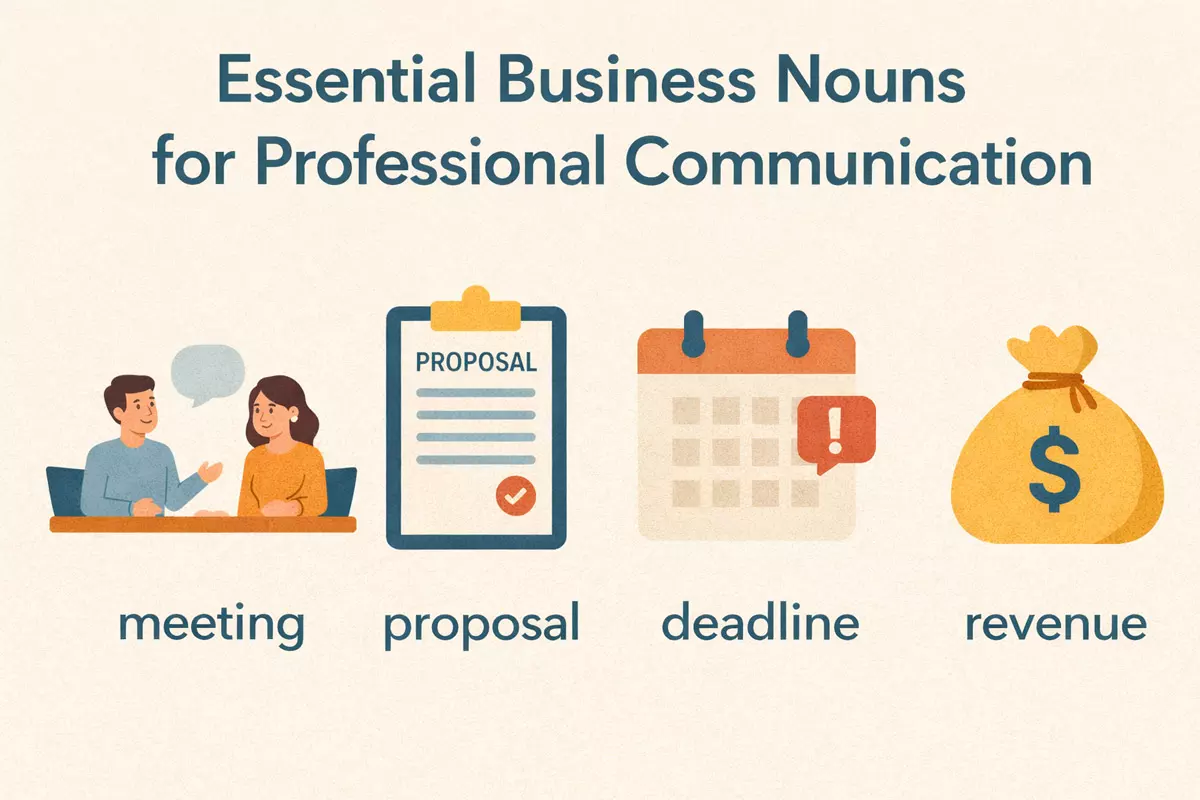 Here we core business-related nouns for meetings, management, projects, finance, and strategy. It also offers guidance on using these nouns in emails and presentations, highlights common learner mistakes, and provides practice with professional messages.
- Core categories of business-related nouns
- Key nouns for meetings, management, and projects
- Financial and performance-related business nouns
- Strategic and planning nouns in professional settings
- Using business nouns in emails and presentations
- Common learner errors with business vocabulary
- Practice: complete professional messages using business nouns
Mastering the right terminology is essential in the workplace, as it enables clear communication and greater efficiency. By understanding and using the core terms common in business interactions, professionals can express their ideas more precisely and avoid misunderstandings. This not only streamlines teamwork and collaboration but also helps to build stronger professional relationships. Ultimately, a solid grasp of relevant terminology allows individuals to contribute more effectively and confidently in any business setting.
Core categories of business-related nouns
Understanding the main groups of nouns used in business helps professionals communicate with precision. Each category has its own focus, from people and processes to documentation and resources. By recognizing which term fits each context, you can ensure clarity in meetings, emails, and reports.
People and Roles
Titles and job functions are central to workplace interactions. Common examples include:
- Manager → The manager approved the final budget.
- Executive → An executive addressed the company-wide meeting.
- Stakeholder → Each stakeholder was informed about the changes.
- Colleague → A colleague helped me finish the report.
- Partner → Our partner supports the expansion plan.
- Consultant → The consultant recommended a new strategy.
- Supervisor → The supervisor reviewed my performance.
- Recruiter → The recruiter contacted potential candidates.
- Client → The client requested an updated proposal.
- Intern → The intern assisted with data entry.
- Associate → An associate prepared the presentation.
- Vendor → The vendor delivered the equipment on time.
Processes and Actions
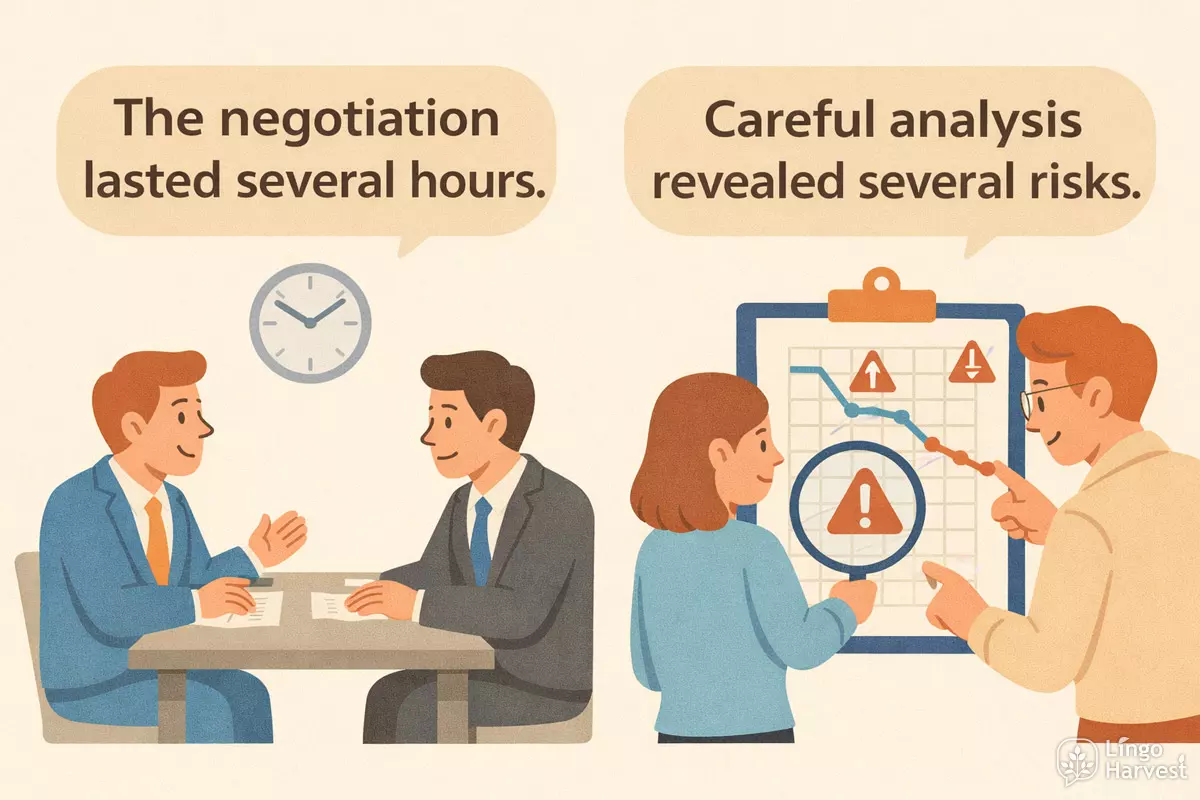
- Negotiation → The negotiation lasted several hours.
- Analysis → Careful analysis revealed several risks.
- Implementation → Implementation of the plan begins next month.
- Planning → Planning is essential for long-term success.
- Approval → Final approval is still pending.
- Acquisition → The acquisition strengthened the company’s position.
- Distribution → Distribution will start next week.
- Evaluation → The evaluation focused on efficiency.
- Development → Product development took over a year.
- Presentation → The presentation impressed the investors.
Objects and Resources
- Document → Please review the document carefully.
- Contract → The contract was signed yesterday.
- Report → The report summarizes quarterly results.
- Invoice → The invoice was sent to accounting.
- Asset → Data is a valuable asset.
- Equipment → New equipment was installed in the office.
- Inventory → Inventory levels are checked weekly.
- Database → Customer information is stored in a secure database.
- Facility → The facility operates around the clock.
- Resource → Time is our most limited resource.
These terms are essential for inventory management, finance, and project tracking.
Financial Terms
Financial vocabulary is crucial for discussing budgets, profits, and transactions. The table below presents common examples and their typical business context.
| Term | Description |
|---|---|
| Revenue | Income generated from normal business operations |
| Expense | Costs incurred in the process of earning revenue |
| Profit | Financial gain after expenses are subtracted from revenue |
| Budget | Planned allocation of financial resources for a specific period |
| Capital | Wealth in the form of money or assets, used for investment |
| Liability | Financial debts or obligations of a business |
Abstract Concepts and Strategies
Business English also relies on nouns that describe intangible ideas and approaches. Examples include:
- Strategy → The company’s strategy focuses on long-term growth.
- Objective → The main objective is to increase customer satisfaction.
- Opportunity → This partnership creates a new opportunity for expansion.
- Risk → There is a risk of delay due to supply issues.
- Vision → The founder shared a clear vision for the future.
- Mission → The mission emphasizes quality and transparency.
- Priority → Safety is a top priority in the workplace.
- Trend → Remote work is a growing trend.
- Policy → The policy outlines data protection rules.
- Culture → The company culture encourages collaboration.
These are key for discussing direction, goals, and the broader context of organizational decisions. By familiarizing yourself with these essential groups, you can navigate workplace dialogues and documentation more confidently and precisely.
Key nouns for meetings, management, and projects
Clear and precise vocabulary is essential for effective communication in any business context. Whether you are organizing a team gathering, overseeing a group, or moving a work initiative forward, using the right nouns helps you express your intentions and expectations accurately. Here’s a breakdown of useful terms commonly encountered in these professional situations.
Common nouns for meetings
- Agenda – a list of items to be discussed or acted upon during a meeting
- Minutes – the official written record of everything discussed and decided
- Participant – a person involved in the meeting
- Chairperson – the individual leading or facilitating the discussion
- Action item – a task assigned during the meeting for follow-up
- Consensus – general agreement reached by the group
- Proposal – a formal suggestion put forward for consideration
- Quorum – the minimum number of people required to make decisions valid
- Adjournment – the formal end of the meeting
Essential management vocabulary
- Objective – a specific result that a team or individual aims to achieve
- Deadline – the date or time by which something must be completed
- Resource – assets (people, time, money, or materials) available for use
- Milestone – a significant event or point in a project’s timeline
- Stakeholder – anyone affected by or invested in the outcome
- Supervisor – a person overseeing the work of others
- Feedback – constructive information about performance or progress
- Delegation – the act of assigning tasks or responsibilities
- Priority – something regarded as more important than others
Project-related terms
- Deliverable – a tangible or intangible output produced as part of a project
- Scope – the boundaries of what the project will and will not include
- Phase – a distinct stage within a project
- Timeline – a schedule of events and deadlines
- Risk – potential problems that could impact the project's success
- Budget – the amount of money allocated for a project
- Constraint – a limitation or restriction within the project
- Requirement – something that must be fulfilled or met
- Evaluation – the process of assessing progress or outcomes
Comparison of meeting roles and project roles
| Meeting Role | Project Role |
|---|---|
| Chairperson | Project Manager |
| Participant | Team Member |
| Minute-taker | Documentation Specialist |
| Observer | Stakeholder |
Mastering these nouns allows professionals to communicate more efficiently, delegate responsibilities, and ensure that collaborative efforts are well-organized and productive. Using the correct terminology builds clarity and trust in team interactions and across project workflows.
Financial and performance-related business nouns
Discussing company results, budgets, and growth requires a specific set of vocabulary. These terms help professionals communicate clearly about revenues, expenses, and overall efficiency. Mastering this language allows you to interpret reports, participate in meetings, and make informed decisions.
Common terms for financial discussion
- Revenue – total income generated from sales or services
- Profit – the amount remaining after expenses have been deducted from income
- Loss – when expenses exceed income
- Budget – a plan outlining projected income and expenditures
- Expense – costs incurred in the process of doing business
- Asset – resources owned by a company with economic value
- Liability – financial obligations or debts
- Equity – the value of ownership in the company
- Dividend – a portion of profits distributed to shareholders
- Capital – financial resources available for use
- Turnover – the total sales or revenue in a given period
- Margin – the difference between sales and the cost of goods sold
- Forecast – a prediction of future financial results
- Invoice – a document requesting payment for goods or services
- Balance – the amount of money available or owed
- Share – a unit of ownership in a company
- Yield – earnings generated from an investment
- Return – profit made on an investment
- Depreciation – the reduction in value of an asset over time
Performance metrics vocabulary
When analyzing how well a company or department is doing, specific nouns are used to quantify and describe outcomes. These words appear in reports, presentations, and evaluations.
- Quota – a set target or goal, often used in sales
- Benchmark – a standard for comparison
- Indicator – a measurable value showing progress
- Output – the amount of goods or services produced
- Efficiency – how well resources are used to achieve results
- Growth – increase in size, revenue, or market share
- Productivity – the rate of production relative to input
- Performance – the accomplishment of tasks or objectives
- Milestone – a significant event or achievement in a process
- Ratio – a comparative value, often used in financial analysis
- Scorecard – a tool for tracking and evaluating performance
- Appraisal – assessment of performance or value
- Target – a specific objective to be reached
Comparing key financial and performance nouns
| Term | Typical Use in Business |
|---|---|
| Revenue | Measuring total money earned before expenses |
| Profit | Evaluating financial gain after costs are subtracted |
| Expense | Tracking costs involved in operations |
| Margin | Assessing the difference between sales and costs |
| Quota | Setting sales or production goals for teams or individuals |
| Benchmark | Comparing performance against an industry standard |
| Appraisal | Conducting formal evaluations of employees or assets |
| Milestone | Marking significant achievements in a project or business process |
Understanding and using this vocabulary not only improves professional communication but also helps you interpret business documents and contribute more effectively to discussions about company health and strategy. Whether reviewing a financial report or setting team objectives, these nouns are essential for clarity and precision.
Strategic and planning nouns in professional settings
Clear and precise nouns related to strategy and planning help professionals discuss objectives, allocate resources, and drive organizational direction. Using the right terms makes meetings and documentation more effective, especially when collaborating across departments or presenting to stakeholders.
Common nouns in business strategy and planning
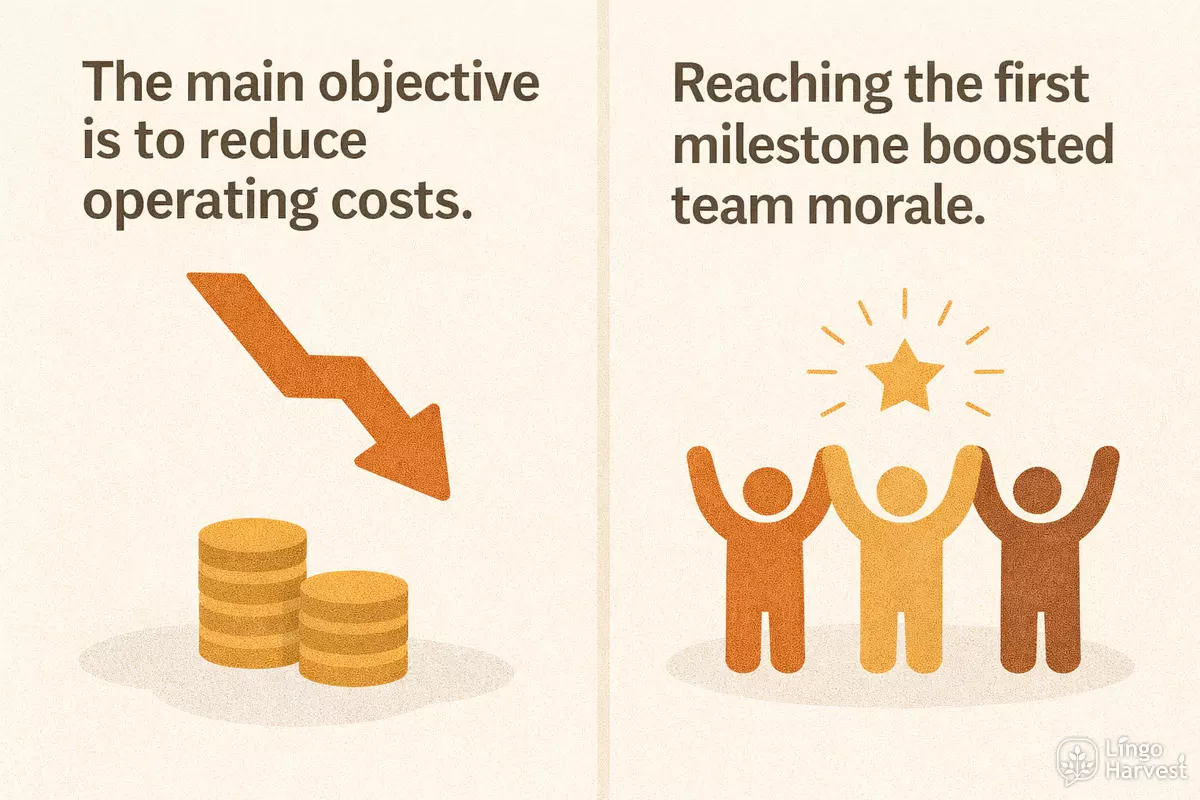
- Objective → The main objective is to reduce operating costs.
- Milestone → Reaching the first milestone boosted team morale.
- Initiative → The initiative focuses on improving customer service.
- Forecast → The sales forecast looks optimistic for next quarter.
- Agenda → The agenda includes budget and staffing issues.
- Roadmap → The roadmap outlines goals for the next two years.
- Blueprint → The blueprint provides a clear structure for growth.
- Assessment → The assessment identified several risks.
- Priority → Security is a top priority for the company.
- Strategy → Their strategy focuses on long-term sustainability.
- Framework → The framework supports consistent decision-making.
- Timeline → The timeline was extended by two weeks.
- Allocation → Budget allocation was approved by management.
- Contingency → A contingency plan is in place for emergencies.
- Deliverable → The final deliverable is due on Friday.
- Projection → Revenue projections exceed expectations.
- Scenario → We prepared for the worst-case scenario.
- Evaluation → The evaluation showed measurable improvement.
- Benchmark → This figure serves as a performance benchmark.
- Plan → The plan was approved by all stakeholders.
How these nouns support professional communication
Terms like milestone and deliverable clarify expectations and progress, while words such as contingency or scenario help teams prepare for uncertainty. Using nouns like framework and blueprint signals structured thinking, which is valuable when aligning teams or setting out methodologies.
Examples of usage in context
| Noun | Sample usage in professional context |
|---|---|
| Objective | Our primary objective this quarter is to improve customer retention by 10%. |
| Milestone | Completing the prototype is a key milestone in our product development roadmap. |
| Forecast | The sales forecast indicates a potential increase in Q3 revenue. |
| Contingency | We need a contingency in case of supply chain disruptions. |
| Framework | This framework guides our decision-making for new market entry. |
| Roadmap | The technology roadmap outlines key releases over the next year. |
| Benchmark | We use industry benchmarks to evaluate our performance. |
| Scenario | Let’s prepare a scenario analysis to assess possible outcomes. |
Choosing the right planning and strategy nouns reduces ambiguity, supports goal-setting, and helps teams communicate efficiently. Whether drafting a project plan or leading a strategy session, these terms help professionals express complex ideas with clarity and focus.
Using business nouns in emails and presentations
Clear communication in the workplace often depends on choosing the right nouns for your message. Whether you’re drafting a formal email or preparing a slide deck, specific business terminology helps convey intent, clarify roles, and set expectations. Selecting the most accurate term can reduce misunderstandings and demonstrate professionalism to colleagues and clients alike.
Common contexts for business nouns
Business nouns frequently appear in everyday correspondence and spoken presentations. You might use them to describe objectives, responsibilities, or resources. For example, in an email, referencing a "timeline" or "budget" provides precise information. During a presentation, terms like "stakeholders," "deliverables," and "outcomes" make your points more concrete.
Examples of business nouns in action
Here are some key nouns that regularly appear in professional communication, along with their typical uses:
- Proposal → Suggesting a plan or idea for consideration
- Agenda → Listing topics to be discussed in a meeting
- Deadline → Setting the latest date for completion
- Feedback → Requesting or providing comments and suggestions
- Budget → Referring to available financial resources
- Milestone → Marking significant progress points
- Report → Summarizing findings or results
- Contract → Detailing formal agreements
- Strategy → Outlining plans for achieving goals
- Resource → Identifying tools, personnel, or materials
- Requirement → Specifying necessary conditions or criteria
- Objective → Stating a desired result or aim
- Stakeholder → Denoting a person or group with an interest in the outcome
- Risk → Pointing out potential issues or uncertainties
- Approval → Indicating official agreement or acceptance
- Schedule → Laying out a plan of activities and timings
- Summary → Providing a concise overview
- Insight → Sharing a new understanding or perspective
- Assignment → Defining tasks or responsibilities
- Update → Communicating new information or progress
Phrase patterns for professional clarity
Certain noun-based phrases are especially effective for structuring both written and spoken communication. Consider these patterns:
- “Please review the attached proposal.”
- “Our next milestone is scheduled for June 15.”
- “We need your feedback on this report.”
- “The budget has been approved.”
- “Let’s discuss the agenda.”
- “Who are the key stakeholders?”
- “This requirement must be met.”
- “Have you completed the assignment?”
Comparing formal and informal usage
The tone and format of business nouns can shift depending on your audience. Here’s a quick comparison of how the same nouns might appear in a formal versus an informal message:
| Noun | Formal Example | Informal Example |
|---|---|---|
| Deadline | The deadline for submission is June 30. | Let’s try to finish this by the end of the month. |
| Feedback | We appreciate your feedback on the document. | Let me know what you think. |
| Report | Please review the attached report. | Take a look at this write-up. |
| Agenda | The meeting agenda is attached for your reference. | Here’s what we’ll talk about. |
Choosing nouns thoughtfully helps your communication remain clear, professional, and targeted to your audience’s expectations. By varying your vocabulary and adapting your tone, you can ensure your messages achieve their intended purpose in both written and spoken formats.
Common learner errors with business vocabulary
Many English learners encounter challenges when using professional nouns in business contexts. These difficulties often stem from translating directly from their native language, misunderstanding subtle differences between similar terms, or misapplying collocations that are unique to business English. Recognizing these pitfalls can help learners communicate more clearly and confidently in workplace situations.
Mixing up similar business nouns
Confusing words with related meanings is one of the most frequent issues. For instance, "revenue" and "profit" are not interchangeable, though both refer to financial aspects of a company. Such mistakes can lead to misunderstandings in meetings or reports.
Incorrect usage in context
Another common problem is using a word outside its appropriate business context. Some nouns have specific meanings in a professional setting that differ from their everyday use. For example, "agenda" in business refers to a list of topics for a meeting, not a personal plan or intention.
Frequent noun errors in business English
- Using "company" when "corporation" or "firm" is required
- Mixing up "client" and "customer"
- Confusing "salary" with "wage"
- Using "department" instead of "division"
- Referring to "position" when "role" is correct
- Calling a "project" a "process"
- Misusing "opportunity" and "offer"
- Using "strategy" when "tactic" is meant
- Confusing "objective" with "goal"
- Mixing up "budget" and "forecast"
- Using "feedback" as countable ("a feedback")
- Calling a "colleague" a "partner" inappropriately
- Misunderstanding "resource" (e.g., calling people "resources" too directly)
- Using "order" instead of "request"
- Confusing "contract" with "agreement"
- Using "meeting" for any gathering, even informal ones
- Calling an "invoice" a "bill" in professional documents
- Mixing up "market" and "marketing"
Commonly confused business nouns: comparison chart
| Word | Correct Business Meaning | Common Error |
|---|---|---|
| Revenue | Total income from sales or services | Used as "profit" (net earnings) |
| Client | Someone who receives professional services | Used interchangeably with "customer" |
| Salary | Fixed regular payment (usually monthly/yearly) | Confused with "wage" (hourly/daily pay) |
| Agenda | List of topics for a meeting | Used for "intention" or "plan" |
| Feedback | Comments or suggestions (uncountable) | Used as countable ("a feedback") |
| Contract | Legally binding agreement | Used as "agreement" (which may be informal) |
Trouble with countable vs. uncountable nouns
English business vocabulary includes many nouns that are uncountable, such as "information," "advice," and "equipment." Learners often add an article or make them plural, which is incorrect. For example, saying "an information" instead of just "information." Awareness of these patterns is crucial for accurate business communication.
Practice: complete professional messages using business nouns
Applying business vocabulary in real-world scenarios is key to effective professional communication. This section offers practical exercises to help you incorporate essential nouns into workplace messages. By finishing sample emails and messages, you will strengthen your command of core business terms and improve your clarity when communicating with colleagues and clients.
Fill-in-the-Blank Email Tasks
Read each message and select the most appropriate noun from the list below to complete the sentences.
- proposal
- invoice
- feedback
- deadline
- agenda
- budget
- strategy
- partnership
- update
- contract
- appointment
- resources
- performance
- negotiation
- shipment
- requirement
- confirmation
- schedule
- report
- authorization
- Please review the attached ________ and let us know if you have any questions regarding the terms.
- We are looking forward to your ________ on the recent project developments.
- The next team meeting will focus on finalizing the project ________ to ensure we meet our targets.
- Kindly send the signed ________ by Friday to proceed with the order.
- Due to unforeseen circumstances, the ________ for this quarter has been adjusted.
- The management approved the new ________ for staff training.
- Please submit your ________ before the end of the week.
- The report includes a detailed ________ of market trends.
- We need to agree on a clear ________ for the next phase.
- The board reviewed the long-term ________ of the company.
Show answers
- proposal
- feedback
- strategy
- contract
- budget
- plan
- report
- analysis
- timeline
- vision
Choose the Correct Noun
Select the correct business term to complete each message.
- Could you please send me the ________ for last month’s consulting services?
- The meeting ________ is attached for your reference.
- We need your ________ to access the financial documents.
- The ________ was delayed due to customs clearance issues.
- Please review the ________ before signing the agreement.
- The ________ outlines the goals for the next quarter.
- We are waiting for official ________ from the board.
- The warehouse confirmed receipt of the ________.
- All staff must follow the updated ________.
- The auditor requested additional ________.
Show answers
- invoice
- agenda
- authorization
- shipment
- contract
- strategy
- approval
- delivery
- policy
- documentation
Common Business Noun Usage: Examples
Here are some typical ways essential nouns appear in professional correspondence:
- “Please find attached the report for your review.”
- “We require your confirmation before proceeding.”
- “Let’s discuss the requirement in more detail during our next call.”
- “The appointment is scheduled for Monday at 10 AM.”
- “Our team will provide an update by the end of the week.”
- “Thank you for your feedback on the draft.”
- “The schedule has been revised according to your suggestions.”
- “We look forward to a successful partnership.”
- “The negotiation was productive and reached a positive outcome.”
- “Additional resources will be allocated as needed.”
Business Noun Comparison Table
| Business Noun | Typical Use in Messages |
|---|---|
| agenda | “The agenda for tomorrow’s meeting is attached.” |
| deadline | “Please submit your work before the deadline.” |
| budget | “Our budget for the next quarter has increased.” |
| authorization | “We need your authorization to proceed.” |
| feedback | “Your feedback is important to us.” |
| contract | “The contract will be sent for your signature.” |
Using these nouns accurately helps you communicate with precision and professionalism in business settings.