Formal vs Informal Noun Choice in Spoken and Written English

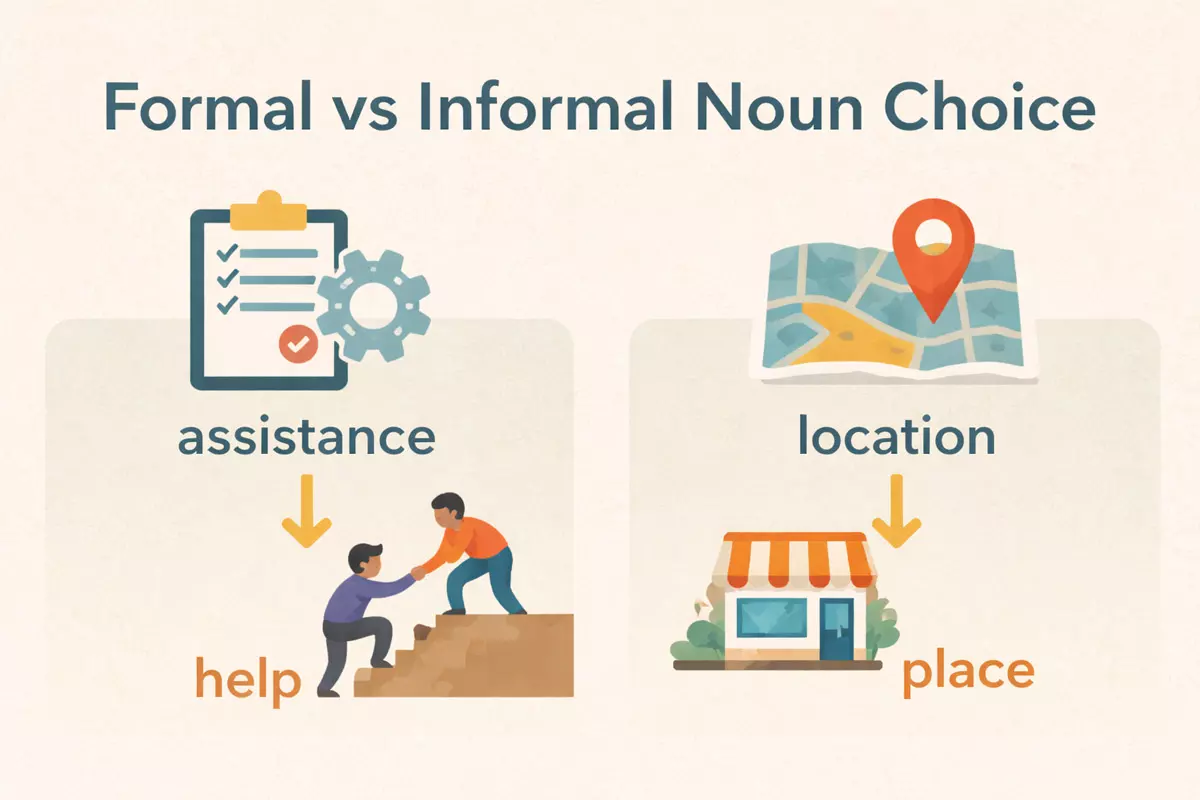 Here we how formal and informal noun registers differ, compares everyday versus academic nouns, explains register shifts in speech and writing, explores slang and abstract nouns, points out common learner errors, and provides rewriting practice.
- Difference between formal and informal noun register
- Everyday nouns vs academic and official nouns
- Register shifts between speech and writing
- Informal noun reductions and slang nouns
- Formalization through abstract noun choice
- Common learner errors with wrong register nouns
- Practice: rewrite sentences in formal and informal styles
Selecting appropriate nouns plays a crucial role in shaping how your message is understood, particularly when moving from informal conversation to more formal writing. The transition between these contexts demonstrates how word choice affects clarity, tone, and how your audience perceives your communication. By paying attention to vocabulary and adapting your language to suit different situations, you can ensure your message is both effective and appropriate for your intended readers or listeners.
Difference between formal and informal noun register
Understanding how noun choices change between formal and informal contexts is essential for effective communication. In English, certain nouns are naturally suited to academic, professional, or official settings, while others feel more comfortable in everyday conversation or casual writing. The selection of nouns not only affects the tone but also influences clarity and appropriateness for your audience.
Key characteristics of formal noun usage
Formal nouns tend to be more abstract, precise, and often originate from Latin or Greek roots. They are commonly found in written documents, academic papers, reports, and speeches. These nouns may sound less personal and sometimes less familiar to everyday speakers.
- Utilize more technical or specialized vocabulary
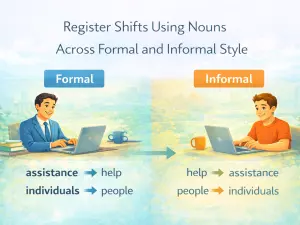
- Favor longer, multi-syllabic words (e.g., assistance instead of help)
- May avoid contractions or slang
- Often used to convey authority or neutrality
- Examples: information, individual, residence, assistance, circumstance, transportation, employment, acquisition, commencement, conclusion
Features of informal noun use
Conversational English typically employs shorter, simpler nouns that are widely recognized and less abstract. Informal nouns are common in spoken language, personal emails, text messages, and friendly interactions.
- Prefer everyday vocabulary and shorter words
- Include colloquialisms and sometimes slang
- Sound more direct and personal
- Examples: info, guy, home, help, thing, ride, job, buy, start, end
Comparison of formal and informal noun choices

To illustrate how noun selection shifts between registers, here’s a comparison of common pairs:
| Formal Noun | Informal Noun | Example (Informal) |
|---|---|---|
| Assistance | Help | Thanks for your help with the report. |
| Residence | Home | I’ll be home after work. |
| Commencement | Start | Let’s start the meeting at nine. |
| Employment | Job | She got a new job last month. |
| Individual | Person/Guy | That person can help you with the form. |
| Information | Info | Can you send me the info by email? |
| Acquisition | Buy | I want to buy a new laptop. |
| Transportation | Ride | Can you give me a ride to the airport? |
| Conclusion | End | We left early, before the end of the event. |
| Circumstance | Thing/Situation | It’s a difficult situation, but we’ll manage. |
When to use each register
Choosing the right level of formality depends on your context and audience. In professional or academic writing, formal nouns help maintain credibility and clarity. For friendly conversations or quick messages, informal nouns make communication more relatable and efficient. Adapting your noun choices to the situation shows linguistic flexibility and awareness.
Everyday nouns vs academic and official nouns
The nouns we choose in speech and writing often reflect the context and our audience. In casual conversation, people tend to use simple, familiar words that are easily understood. In contrast, academic texts and official documents favor more specialized or abstract nouns, which can make the language sound more precise or formal.
Common characteristics
- Everyday words are concrete, direct, and often monosyllabic (e.g., car, job, kids).
- Academic and official terms tend to be longer, more abstract, and sometimes borrowed from Latin or Greek roots (e.g., vehicle, occupation, offspring).
- The choice of noun can signal the level of formality and the writer’s or speaker’s intent.
When do we use each type?
Informal settings—like chatting with friends or texting—call for everyday vocabulary. In contrast, research papers, government documents, and business correspondence often require formal or technical nouns to convey authority or specificity.
Examples: informal vs formal nouns
| Informal Noun | Academic/Official Noun |
|---|---|
| job | occupation |
| kids | children |
| help | assistance |
| rules | regulations |
| info | information |
| car | vehicle |
| teacher | instructor |
| chance | opportunity |
| start | commencement |
| end | termination |
| buy | purchase |
| pay | remuneration |
How noun choice affects tone
Selecting a more formal noun can make your writing sound objective, impersonal, or authoritative. Using informal nouns often creates a sense of closeness and relatability. Being aware of these differences helps you match your language to your communication goals—whether you want to sound friendly, neutral, or professional.
Register shifts between speech and writing
Spoken English and written English often require different levels of formality, which is reflected in the choice of nouns. Everyday conversation tends to favor informal or colloquial options, while academic texts, professional emails, or news articles often demand more formal vocabulary. This shift in register is not just about word choice, but also about audience expectations and communicative context.
Common patterns in noun selection
When moving from casual speech to formal writing, speakers and writers often swap out everyday nouns for more precise or elevated alternatives. Below is a list highlighting typical substitutions:
- kid → child
- guy → man
- thing → item / object
- job → occupation / position
- stuff → materials / substances
- help → assistance
- chance → opportunity
- boss → supervisor / manager
- fix → solution / repair
- friend → acquaintance / colleague
- money → funds / capital
- gonna → going to (though not a noun, this illustrates register shift)
- info → information
- kids → children / minors
- home → residence / dwelling
- start → commencement / initiation
- end → conclusion / termination
- buy → purchase
- bosses → superiors
- rules → regulations / guidelines
Contextual factors influencing noun formality
Several factors affect how people shift between casual and formal noun choices:
- Audience: Speaking with friends encourages informal nouns; addressing an authority figure or wider public calls for more formal terms.
- Purpose: Persuasive essays, reports, and official statements require precise, formal nouns, while storytelling or chatting allows for relaxed vocabulary.
- Medium: Text messages and social media posts tend to be less formal than business correspondence or published articles.
Comparing noun choice in speech and writing
| Informal (Speech) | Formal (Writing) |
|---|---|
| guy | individual |
| kids | children |
| stuff | materials / items |
| job | position / occupation |
| help | assistance |
| boss | supervisor |
| info | information |
| fix | solution / repair |
Understanding how noun choice adapts to context helps speakers and writers communicate more effectively. Recognizing these register shifts is essential for anyone aiming to sound natural in both casual conversations and formal documents.
Informal noun reductions and slang nouns
Understanding how nouns are shortened or transformed in casual speech is essential for grasping real-world English, especially in conversation and informal writing. In relaxed settings, speakers often use clipped forms, blends, or entirely new slang terms rather than the full, dictionary versions of nouns. These variations can signal group membership, save time, or simply reflect the speaker's personality.
Common Patterns of Reduction

Many everyday words are shortened for convenience or style. The most frequent processes include dropping syllables, blending words, or creating playful alternatives. Some typical examples are:
- Info (information) – I’ll send you the info later today.
- Pic (picture) – She posted a pic from the trip.
- App (application) – This app helps track expenses.
- Fridge (refrigerator) – There’s milk in the fridge.
- Gym (gymnasium) – He goes to the gym every morning.
- Math (mathematics) – Math was my favorite subject at school.
- Phone (telephone) – I left my phone at home.
- Doc (doctor/document) – The doc said everything looks fine.
- Ad (advertisement) – I saw an ad for that product online.
- Vet (veterinarian) – We took the dog to the vet.
- Uni (university, chiefly UK/AUS) – She studies economics at uni.
- Promo (promotion) – The brand launched a new promo.
- Demo (demonstration) – They watched a demo of the software.
- Mag (magazine) – He reads a tech mag every month.
- Bro (brother/friend) – Thanks for the help, bro.
- Fam (family/friends) – I’m spending the weekend with fam.
- Sub (submarine sandwich/substitute) – I ordered a chicken sub for lunch.
- Lab (laboratory) – The samples are tested in the lab.
- Flu (influenza) – She stayed home with the flu.
- Flix (movies, from "flicks") – Let’s watch some flix tonight.
Slang Nouns in Everyday Speech
Slang terms often replace standard nouns in informal contexts. These words can be highly regional or generational, and their meanings may shift over time. Some current or classic examples include:
- BFF (best friend forever) – She’s my BFF from high school.
- Squad (close friend group) – I’m meeting my squad after work.
- Couch potato (inactive person) – I turned into a couch potato all weekend.
- Bae (significant other) – I’m going out to dinner with my bae.
- Bucks (dollars, money) – This jacket costs fifty bucks.
- Gig (job or performance) – I’ve got a freelance gig this month.
- Crib (house/apartment) – Let’s hang out at my crib.
- Dude (person, usually male) – That dude helped me fix my bike.
- Chill (relaxed person or event) – It was a really chill evening.
- Vibe (atmosphere or feeling) – I like the vibe of this place.
- Props (recognition, credit) – Props to you for finishing the project.
- Ride (car) – Nice ride, is it new?
- Hangout (casual gathering place) – This café is our usual hangout.
- Plug (supplier, often for goods or info) – He’s my plug for concert tickets.
- Peep (person, friend) – I’ll text my peeps about the plan.
Comparing Formal and Informal Noun Usage
The choice between a formal noun and its informal or slang variant can affect how a speaker is perceived. Formal terms are typically used in academic, professional, or official writing, while informal versions are favored in conversation, text messages, or social media.
| Formal Noun | Informal/Slang Variant |
|---|---|
| Photograph | Pic |
| Refrigerator | Fridge |
| Automobile | Ride |
| Friend | Bro / BFF |
| Residence | Crib |
| Information | Info |
| Employer | Boss |
| Event | Gig |
| Recognition | Props |
| Atmosphere | Vibe |
When to Use Informal Reductions
Reduced or slang nouns are appropriate in friendly interactions, quick messages, or when you want to sound approachable. However, they should be avoided in formal documents, academic essays, or professional emails. Choosing the right level of formality helps ensure your message is understood and appropriate for the context.
Formalization through abstract noun choice
One of the most notable ways English expresses formality is through the use of abstract nouns. Instead of directly referencing people or actions, formal communication often frames ideas in terms of concepts, qualities, or processes. This approach is especially common in academic writing, business documents, and official correspondence, where a distant, impersonal tone is preferred.
How abstract nouns increase formality
Abstract nouns help generalize or objectify statements, which can make language sound more authoritative and less personal. For example, rather than saying “We decided to cancel the event,” a formal variant might be “The decision to cancel the event was made.” This shift not only removes the agent but also emphasizes the process or outcome over individual action.
Common patterns: verb-to-noun shifts
Many verbs and adjectives can be transformed into abstract nouns, which are then used to create a more formal effect. Here are some frequent transformations:
- decide → decision → The final decision was made yesterday.
- agree → agreement → We reached an agreement after the meeting.
- develop → development → Product development took six months.
- analyze → analysis → The analysis revealed several risks.
- approve → approval → The project received official approval.
- fail → failure → The experiment ended in failure.
- achieve → achievement → Winning the award was a major achievement.
- assess → assessment → The assessment showed clear improvement.
- inform → information → This information is confidential.
- permit → permission → You need permission to enter the building.
- conclude → conclusion → She came to a logical conclusion.
- respond → response → His response was quick and polite.
- involve → involvement → Her involvement helped the project succeed.
- propose → proposal → The proposal was approved by the board.
- arrange → arrangement → The arrangement works for everyone.
- participate → participation → Participation is voluntary.
- require → requirement → Meeting the deadline is a strict requirement.
- apply → application → Submit your application online.
Comparing formal and informal noun choices
| Informal | More Formal (Abstract Noun) |
|---|---|
| We discussed the plan. | The discussion of the plan took place. |
| She applied for the job. | Her application for the job was submitted. |
| They agreed to help. | An agreement to provide assistance was reached. |
| We failed to meet the deadline. | There was a failure to meet the deadline. |
| He decided to leave early. | The decision to leave early was made. |
When and why to use abstract nouns
Abstract noun constructions are preferred in situations where neutrality, authority, or distance are important. This includes research papers, reports, legal documents, and formal emails. Such phrasing can make statements seem less subjective and more universally valid, but overuse may create overly dense or impersonal prose in contexts where clarity or directness is valued.
Common learner errors with wrong register nouns
Choosing nouns that are too formal or too casual for the context is a frequent stumbling block for English learners. This often leads to awkwardness, misunderstandings, or sentences that don’t fit the setting. Many students, especially in academic or professional situations, may overuse formal vocabulary in everyday speech, or do the opposite: rely on informal terms in essays and emails. Both situations can affect clarity and how the message is received.
Typical mistakes in noun register
Problems usually arise when learners:
- Use formal nouns like assistance instead of help in casual conversation, making speech sound unnatural.
- Choose informal nouns such as kids or stuff in academic writing, reducing the perceived seriousness.
- Confuse near-synonyms with different levels of formality, e.g., purchase vs. buy.
- Borrow nouns from written English into spoken contexts without adjusting tone.
- Adopt colloquial expressions in formal emails or presentations.
Examples: Formal and informal noun pairs
To illustrate, here are common noun choices that often cause confusion. Learners may swap these in the wrong context:
- Assistance → Help → Thanks for your help with the report.
- Residence → Home/House → Their home is close to the city center.
- Children → Kids → The kids are playing outside.
- Commencement → Start → The start of the course is next Monday.
- Individual → Person/Guy → That person can answer your question.
- Information → Info → I’ll send you the info by email.
- Occupation → Job/Work → She’s looking for a new job.
- Purchase → Buy → I want to buy a new laptop.
- Utilization → Use → This tool is easy to use.
- Requirement → Need → There’s no need to rush.
- Obtain → Get → You can get the documents online.
- Enquiry → Question/Ask → I have a question about the schedule.
- Request → Ask → She asked for more time.
- Residence → Home → He stayed at home all day.
- Commencement → Beginning → The beginning of the movie was slow.
- Subsequent → Next → We’ll discuss this in the next meeting.
- Demonstration → Show → They gave a short show of the software.
- Possession → Thing/Stuff → Leave your stuff here.
Context matters: Why register errors stand out
Misusing register can change the tone of your message. For example, saying “I require assistance with my homework” to a friend sounds overly stiff, while “I need help” is more natural in that context. In business writing, however, “require assistance” may be appropriate. Understanding these distinctions is key to clear, effective communication.
Spotting the difference: Register comparison
| Formal Noun | Typical Informal Alternative |
|---|---|
| Assistance | Help |
| Children | Kids |
| Residence | Home/House |
| Purchase | Buy |
| Requirement | Need |
| Demonstration | Show |
| Individual | Person/Guy |
| Information | Info |
| Possession | Thing/Stuff |
| Occupation | Job/Work |
Tips for avoiding register mistakes
- Consider your audience before choosing nouns.
- Notice how native speakers switch vocabulary in different situations.
- Practice rewriting sentences to match formal or informal contexts.
- Read and listen widely to build a sense of appropriateness.
Awareness of noun register helps learners sound both natural and appropriate, whatever the setting.
Practice: rewrite sentences in formal and informal styles
Applying different noun choices can transform the tone of your English, whether you are speaking or writing. Here, you'll find practice activities designed to help you recognize and produce both formal and informal noun usage. The focus is on real-life contexts—academic writing, emails, conversations—where your choice of words can affect clarity and appropriateness.
Identifying Formal and Informal Nouns
Below are pairs of sentences. For each, notice how the noun choice changes the register. Consider why the formal or informal option might be preferred in a given context.
- We received assistance from the staff. → We got help from the staff.
- There was a modification to the schedule. → There was a change to the schedule.
- The individual left the building. → The guy left the building.
- Please submit your application. → Please send in your form.
- We require further information. → We need more info.
- This is a matter of importance. → This is a big deal.
- The commencement of the project is next week. → The project starts next week.
- She gave a presentation. → She gave a talk.
- The residence was located downtown. → The house was downtown.
- There was a discussion about the topic. → They had a chat about it.
- He showed great determination. → He really wanted it.
- We encountered a problem. → We ran into a mess.
- They offered their assurance. → They promised.
- The vehicle was parked outside. → The car was outside.
- The commencement of the event was delayed. → The event started late.
Rewrite Exercise: Transforming Sentences
Try rewriting the following sentences, first in a more formal way and then in a more informal style. Focus on swapping nouns to adjust the tone.
- I need your answer soon.
- She told me about her new job.
- Can you give me some advice?
- We had a problem with the machine.
- He made a decision yesterday.
Show answers
- I need your answer soon.
Formal: I require your response at your earliest convenience.
Informal: Let me know what you think soon. - She told me about her new job.
Formal: She informed me of her new position.
Informal: She talked to me about her new gig. - Can you give me some advice?
Formal: Could you provide me with some guidance?
Informal: Can you give me a tip? - We had a problem with the machine.
Formal: We experienced an issue with the equipment.
Informal: The thing broke down. - He made a decision yesterday.
Formal: He reached a conclusion yesterday.
Informal: He chose yesterday.
Practicing with these examples can build your confidence in choosing the right nouns for any situation. The more you notice these differences, the more naturally you will use them in your own English.