Register Shifts Using Nouns Across Formal and Informal Style

 Here we what register means in language, how formal and informal noun choices differ, and the impact of abstract vs concrete nouns.
- What register means in language usage
- Differences between formal and informal noun choices
- Abstract nouns vs concrete nouns in register shifts
- Professional vs casual noun selection in context
- How noun choice affects tone and authority
- Typical learner mistakes with mixed-register nouns
- Practice: rewrite sentences in different registers
Examining how noun choices shift between casual conversations and formal communication uncovers the subtle ways language adapts to context. In informal settings, people often use simpler, more familiar nouns, while official exchanges typically feature precise and specialized terms. Understanding these nuanced differences in noun usage not only highlights the flexibility of language but also helps us communicate more effectively by choosing words suited to the situation.
What register means in language usage
When discussing how people choose words, especially nouns, in different contexts, the concept of "register" comes up frequently. Register refers to the variety or level of language used depending on the situation, audience, and purpose. For example, the way you describe a process in a scientific report will differ from chatting with friends about the same topic. This difference isn't just about vocabulary, but also tone, formality, and even which grammatical structures are considered acceptable.
Key aspects of language register
- Formality: Ranges from very formal (academic papers, business correspondence) to highly informal (casual conversations, texting).
- Audience: Adjusts according to who is listening or reading—superiors, peers, children, or strangers.
- Purpose: Influences the register based on whether the goal is to inform, persuade, entertain, or request.
- Medium: Spoken, written, or digital communication can all affect register choices.
Register is closely linked to social context. It helps signal relationships and situational appropriateness. Shifting between registers—such as moving from formal to informal—can change how your message is received and interpreted. In English, this often means swapping out nouns or noun phrases to match the expected tone. For instance, "residence" might be more suitable in an official document, while "home" is common in everyday speech.
Common differences in noun usage by register

- Request (formal) → Ask (informal) → Can I ask you a small favor?
- Commencement (formal) → Start (informal) → Let’s start the meeting now.
- Assistance (formal) → Help (informal) → Could you help me with this?
- Child (neutral/formal) → Kid (informal) → That kid is really smart.
- Utilization (formal) → Use (informal) → We can use this tool tomorrow.
- Individual (formal) → Person/guy (informal) → He’s the guy I told you about.
- Occupation (formal) → Job (informal) → She got a new job last week.
- Residence (formal) → Home/house (informal) → We finally bought our own house.
- Commencement (formal) → Beginning/start (informal) → The beginning of the course was easy.
- Assumption (formal) → Guess (informal) → That’s just my guess, not a fact.
- Purchase (formal) → Buy (informal) → I want to buy a new laptop.
- Assistance (formal) → Help (informal) → Thanks for your help yesterday.
- Establishment (formal) → Place (informal) → This place serves great coffee.
- Selection (formal) → Pick/choice (informal) → Make your pick before noon.
- Inquiry (formal) → Question (neutral/informal) → I have one more question for you.
- Childhood (neutral/formal) → Growing up (informal) → Growing up here was fun.
- Alteration (formal) → Change (informal) → We need to change the plan.
- Vehicle (formal) → Car/ride (informal) → I can give you a ride home.
Why register matters in communication
Choosing the appropriate register makes communication clearer and more effective. Using overly formal nouns in everyday speech can sound stiff or distant, while too casual language in a professional setting may seem disrespectful or unprofessional. Awareness of these shifts is especially important for learners or anyone aiming to adjust their style to match different social or professional situations.
Differences between formal and informal noun choices
Choosing the right noun can immediately signal a shift in register, shaping how formal or casual your message feels. In more formal contexts, noun selections tend to be abstract, Latinate, and precise. Informal language, on the other hand, leans toward concrete, Anglo-Saxon, or colloquial nouns that create a more conversational tone.
Typical Features of Formal and Informal Nouns
- Formality: Formal style favors nouns that are longer, less common in daily speech, and often derived from Latin or Greek roots.
- Simplicity: Informal language uses shorter, everyday nouns, frequently monosyllabic and familiar.
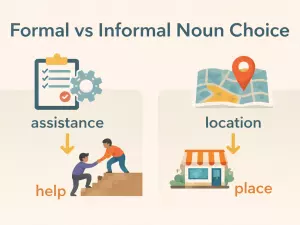
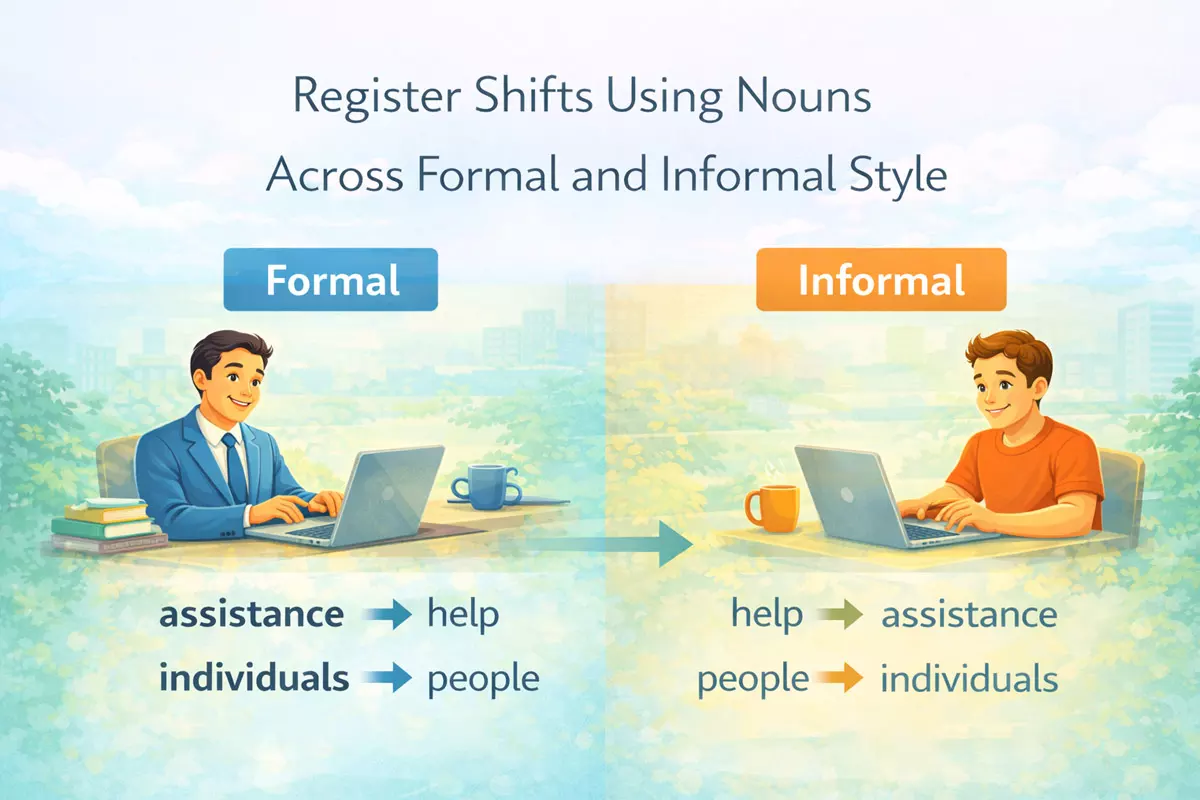
- Abstraction: Abstract nouns are more prevalent in formal writing (e.g., “assistance” vs. “help”).
- Specificity: Informal speech often employs general or vague nouns, while formal writing aims for specificity and clarity.
- Colloquialisms: Slang and idiomatic nouns appear almost exclusively in casual conversation.
Common Patterns and Examples
Here are some pairs that illustrate how noun choice shifts between registers:
| Formal Noun | Informal Noun |
|---|---|
| Assistance | Help |
| Residence | Home |
| Commencement | Start |
| Individual | Person/guy |
| Utilization | Use |
| Inquiry | Question |
| Occupation | Job |
| Termination | End |
| Children | Kids |
| Assumption | Guess |
| Assistance | Help |
| Commencement | Start |
| Acquisition | Get |
| Apprehension | Worry |
| Discrepancy | Gap |
| Insufficiency | Lack |
| Commotion | Noise |
Register Shifts in Context
The impact of these choices becomes clear in sentences. For instance, “Please provide your residence address” sounds more official than “Where do you live?” In spoken English or casual writing, using informal nouns often makes communication feel warmer and more direct. Meanwhile, formal nouns are essential for academic, technical, or legal settings, where clarity, neutrality, and precision are valued.
Ultimately, selecting an appropriate noun form is a key part of adjusting register. Understanding these distinctions helps in crafting language that fits the context and audience.
Abstract nouns vs concrete nouns in register shifts
Choosing between abstract and concrete nouns can dramatically influence how formal or informal a text feels. In formal contexts, speakers and writers often favor abstract terms to discuss ideas, concepts, or qualities—think “justice,” “motivation,” or “progress.” These words signal a more academic or distant stance, making them common in essays, reports, and official communications. In contrast, informal language typically leans on concrete nouns—words that refer to tangible objects or direct experiences, such as “car,” “pizza,” or “friend.” This choice creates immediacy and relatability, helping the audience connect with the message on a practical level.
Common patterns in noun selection across registers
Formal writing doesn’t just use more abstract nouns; it often pairs them with complex sentence structures and passive voice. Informal speech and writing, on the other hand, rely on concrete nouns within simpler, more direct sentences. Consider these examples:
- “Achievement is valued in this organization.” (abstract, formal)
- “We like it when people do well here.” (concrete, informal)
- “The process requires concentration.” (abstract, formal)
- “You have to focus a lot.” (concrete/action, informal)
Comparing abstract and concrete noun usage
Writers often shift between these noun types depending on audience, purpose, or even the medium (e.g., academic article versus a social media post). Here’s a structured comparison of how these nouns function in different registers:
| Register | Typical Noun Choice | Example Nouns | Sample Sentence |
|---|---|---|---|
| Formal | Abstract | liberty, development, integrity, efficiency | This policy promotes efficiency and integrity in the workplace. |
| Informal | Concrete | dog, chair, phone, coffee | I spilled coffee on my phone this morning. |
| Academic | Abstract (with some technical concrete) | growth, hypothesis, data, experiment | The experiment provided data supporting the growth hypothesis. |
| Conversational | Concrete | movie, pizza, bus, shoes | Let’s grab pizza after the movie tonight. |
When to choose abstract or concrete nouns
The decision depends on purpose. Use abstract nouns to sound objective, analytical, or authoritative; they suit arguments, analysis, and generalizations. Concrete nouns, meanwhile, ground communication in everyday reality. If you want clarity, relatability, or vivid imagery, concrete terms are usually best.
Expanded examples of abstract and concrete nouns
- Abstract: courage, wisdom, freedom, love, patience, knowledge, health, ambition, fear, democracy, loyalty, trust, ability, anger, beauty, chaos, education, honesty, inspiration, responsibility, truth
- Concrete: apple, bicycle, window, teacher, mountain, computer, bread, river, pencil, suitcase, garden, lamp, horse, table, jacket, phone, bus, sandwich, book, cup
By being intentional with noun selection, writers and speakers can shift the tone and register of their language to better suit the context and the needs of their audience.
Professional vs casual noun selection in context
Choosing the right nouns can dramatically shift the tone of your communication, signaling whether your message is intended for a formal or informal setting. In workplace emails, research articles, or business reports, more precise and technical nouns are common, while everyday conversations or personal messages feature simpler, more familiar terms.
How context shapes noun choice
The situation, audience, and purpose all influence which nouns feel natural. Professional environments often require abstract or specialized terminology to convey expertise and clarity. In contrast, casual conversations favor concrete, relatable nouns for ease and warmth.
- Formal: "assistance" vs. Casual: "help"
- "individual" vs. "person"
- "residence" vs. "home"
- "utilization" vs. "use"
- "documentation" vs. "papers"
- "vehicle" vs. "car"
- "commencement" vs. "start"
- "purchase" vs. "buy"
- "colleague" vs. "workmate"
- "assortment" vs. "mix"
- "assumption" vs. "guess"
- "requirement" vs. "need"
- "equipment" vs. "gear"
- "assistance" vs. "help"
- "request" vs. "ask"
- "statement" vs. "comment"
- "discussion" vs. "chat"
- "agreement" vs. "deal"
- "occupation" vs. "job"
- "provision" vs. "supply"
Comparing usage in real scenarios

To illustrate how noun selection varies, consider these sample sentences:
- Formal: "Please submit the documentation by the deadline."
- Informal: "Send me the papers when you can."
- Formal: "We require your assistance with the project."
- Informal: "Can you help us out?"
- Formal: "The commencement of the event is scheduled at noon."
- Informal: "The event starts at noon."
Summary table: Formal vs. informal noun choices
| Formal/Professional Noun | Casual/Informal Noun | Example Sentence (Formal Word) |
|---|---|---|
| assistance | help | Thank you for your assistance on this project. |
| individual | person | Each individual must complete the form. |
| residence | home | Her residence is located near the river. |
| utilization | use | We improved the utilization of our resources. |
| documentation | papers | Please submit all required documentation. |
| vehicle | car | Only one vehicle is allowed per permit. |
| commencement | start | The commencement of the event was delayed. |
| purchase | buy | The purchase was confirmed yesterday. |
| colleague | workmate | My colleague submitted the final report. |
| assortment | mix | The store offers a wide assortment of products. |
Understanding how to adjust your noun choices lets you move smoothly between different registers, ensuring your message matches both your audience and the context. Making these subtle shifts in vocabulary is a key skill for effective communication in English.
How noun choice affects tone and authority
Word selection, especially with nouns, can dramatically alter how a message is received—shaping whether it sounds formal, casual, commanding, or approachable. Choosing between abstract and concrete nouns, or opting for technical versus everyday vocabulary, can instantly shift the level of professionalism or intimacy in your writing or speech.
Formal vs. informal noun use
Formality often involves using more complex, Latinate nouns (e.g., “assistance” instead of “help”), which lend an air of detachment or expertise. In contrast, informal settings favor simpler, more familiar nouns that feel personal and direct. For example:
- “Commencement” vs. “start”
- “Residence” vs. “home”
- “Utilization” vs. “use”
- “Individual” vs. “person”
- “Childhood” vs. “kid years”
Implied authority through noun selection
Nouns that suggest institutional or specialist domains—like “legislation,” “protocol,” or “phenomenon”—can convey authority and objectivity. In contrast, using nouns such as “thing,” “guy,” or “stuff” can undermine perceived expertise, making the communication feel more relaxed but less authoritative.
Comparing noun choices and their impact
The table below illustrates how different noun selections can affect the perceived register and authority of a sentence.
| Formal/Authoritative Noun | Informal/Common Noun | Example Sentence (Formal Noun) |
|---|---|---|
| Compensation | Pay | Employees received financial compensation for overtime work. |
| Applicant | Person applying | Each applicant must submit a completed form. |
| Credentials | Papers | The manager carefully verified her credentials. |
| Initiation | Start | The initiation of the project was postponed. |
| Property | Home | The property was sold at a high price. |
| Consumption | Use | Energy consumption has increased this year. |
| Legislation | Law | The new legislation affects small businesses. |
| Childhood | Kid years | His childhood was spent in a small town. |
| Protocol | Way | According to protocol, all guests must register. |
| Phenomenon | Thing | The phenomenon has attracted global attention. |
Other factors influencing tone
Beyond word choice, register is also shaped by noun specificity and collective versus individual terms. For instance, “faculty” (collective, formal) vs. “teachers” (individual, informal), or “equipment” (uncountable, technical) vs. “tools” (countable, everyday). These subtle shifts can signal either authority or friendliness. In summary, selecting the right noun for your context is a powerful tool for steering how your message is interpreted—either reinforcing credibility and expertise, or promoting openness and relatability.
Typical learner mistakes with mixed-register nouns
Understanding when and how to use nouns across different registers can be tricky for language learners. One common issue is mixing up formal and informal vocabulary in the same sentence or context, which can create confusion or sound unnatural. Learners often choose a word they know without considering whether it matches the overall style of the conversation or text.
Common pitfalls when choosing register
Mixing registers often happens because of direct translation from a first language, or because learners aren’t yet sensitive to the subtle tone differences between words. For instance, using "kids" in a formal essay or "offspring" in a casual chat can feel out of place. Here are several frequent problems:
- Pairing a formal noun with informal verbs or expressions (e.g., "The individual was super mad.")
- Overusing formal nouns in everyday speech (e.g., "I require assistance with my homework" instead of "I need help")
- Employing informal nouns in academic or business writing (e.g., "guy" instead of "man" or "gentleman")
- Not noticing register shifts within the same paragraph or sentence
- Choosing technical or specialized nouns in general conversation
- Assuming synonyms are always interchangeable, regardless of context
- Forgetting that some nouns carry cultural or emotional weight in certain registers
- Misusing slang nouns in semi-formal situations
- Using contractions with formal nouns (e.g., "the corporation’s gonna")
- Borrowing formal nouns from reading but misapplying them in speech
Register mismatches: Examples and corrections
Below is a comparison of how learners might mix registers, with corrections for clarity and appropriateness:
| Problematic Mixed Register | Improved Version |
|---|---|
| She’s gonna attend the conference with her offspring. | She’s going to attend the conference with her children. |
| The individual freaked out during the presentation. | The individual became anxious during the presentation. |
| I require a ride, dude. | I need a ride, man. |
| The corporation’s boss was super chill. | The company’s manager was very relaxed. |
| My mom acquired a new automobile. | My mom got a new car. |
| The children commenced their homework, bro. | The children started their homework. |
| We require assistance from the guys. | We need help from the team. |
| The gentleman was totally stoked about the results. | The man was very pleased with the results. |
| The project’s stakeholders were kinda upset. | The project’s stakeholders were somewhat dissatisfied. |
| The boss acquired a new whip. | The manager bought a new car. |
Tips for avoiding register clashes
To prevent errors with mixed-register nouns, try these strategies:
- Pay attention to the context and audience before choosing nouns.
- Read and listen to authentic materials to develop a sense for formal and informal usage.
- Check example sentences in dictionaries to see how nouns are used in various registers.
- When in doubt, opt for a neutral noun rather than a highly formal or slang term.
- Practice rewriting sentences to match a specific register for better awareness.
By being mindful of these patterns and adjusting your word choices, you can communicate more naturally and appropriately across different contexts.
Practice: rewrite sentences in different registers
To develop your awareness of noun usage across formal and informal styles, let’s work through practical exercises. Notice how register shifts change both the choice of nouns and the overall tone. This practice will help you identify, analyze, and create sentences that match different communicative situations.
Task 1: Transforming Sentences
Below are sentences written in an informal style. Rewrite each one in a formal register, focusing on noun choice and structure.
- My friend gave me a hand with my homework.
- The boss wants everyone at the meeting.
- We had a chat about the project.
- Kids these days use their phones all the time.
- They got the job done fast.
- He said no straight away.
- The company is cutting jobs.
- They fixed the problem pretty quickly.
- She is in charge of the team.
- They are looking into the complaint.
Show answers
- My friend assisted me with my homework.
- The manager requests the attendance of all staff at the meeting.
- We held a discussion regarding the project.
- Young people today frequently utilize their mobile devices.
- The task was completed promptly.
- He declined immediately.
- The company is reducing its workforce.
- The issue was resolved in a timely manner.
- She is responsible for overseeing the team.
- They are investigating the complaint.
Task 2: Switch from Formal to Informal
Now, take these formal sentences and rewrite them in a relaxed, conversational tone. Pay attention to how nouns shift in register.
- The applicant submitted the documentation.
- The individual expressed dissatisfaction with the service.
- Participants are required to provide identification.
- The organization is undergoing restructuring.
- Attendance at the seminar is mandatory.
- The supervisor granted approval for the proposal.
- Access to the facility is restricted.
- The equipment is currently under maintenance.
- The committee will review the report.
- Compliance with these regulations is essential.
Show answers
- The person sent in the papers.
- The guy wasn’t happy with the service.
- You have to show your ID.
- The company is changing things up.
- You have to go to the seminar.
- The boss said the plan is okay.
- Only some people are allowed into the building.
- The machines are being fixed right now.
- The group will look over the report.
- You really have to follow these rules.
Comparing Register Shifts: Table of Examples
| Formal Noun Phrase | Informal Equivalent |
|---|---|
| the provision of assistance | help |
| the commencement of the event | when it starts |
| the submission of documentation | sending in papers |
| participation of individuals | people joining in |
| utilization of resources | using stuff |
| notification of changes | letting you know about changes |
| an assortment of options | a bunch of choices |
| attendance is compulsory | you have to be there |
Task 3: Identify the Register
Decide whether each sentence below is formal or informal. Write ‘F’ for formal, ‘I’ for informal.
- The utilization of this equipment is subject to approval.
- He got a bunch of stuff for his new place.
- Attendance at the workshop is mandatory.
- We had a quick talk about it.
- The purchase was finalized yesterday.
- We regret to inform you that your application was unsuccessful.
- She’s gonna be late for the meeting.
- Your request will be processed within three business days.
- We grabbed some coffee and chatted for a bit.
- All participants are required to sign the agreement.
Show answers
- F
- I
- F
- I
- F
- F
- I
- F
- I
- F
Practicing these transformations will help you flexibly adjust your language to suit formal or informal contexts, especially through your choice of nouns. Experiment with more sentences from your own experience to deepen your understanding of register shifts.