Nouns in Polite Requests and Offers in Real Conversations

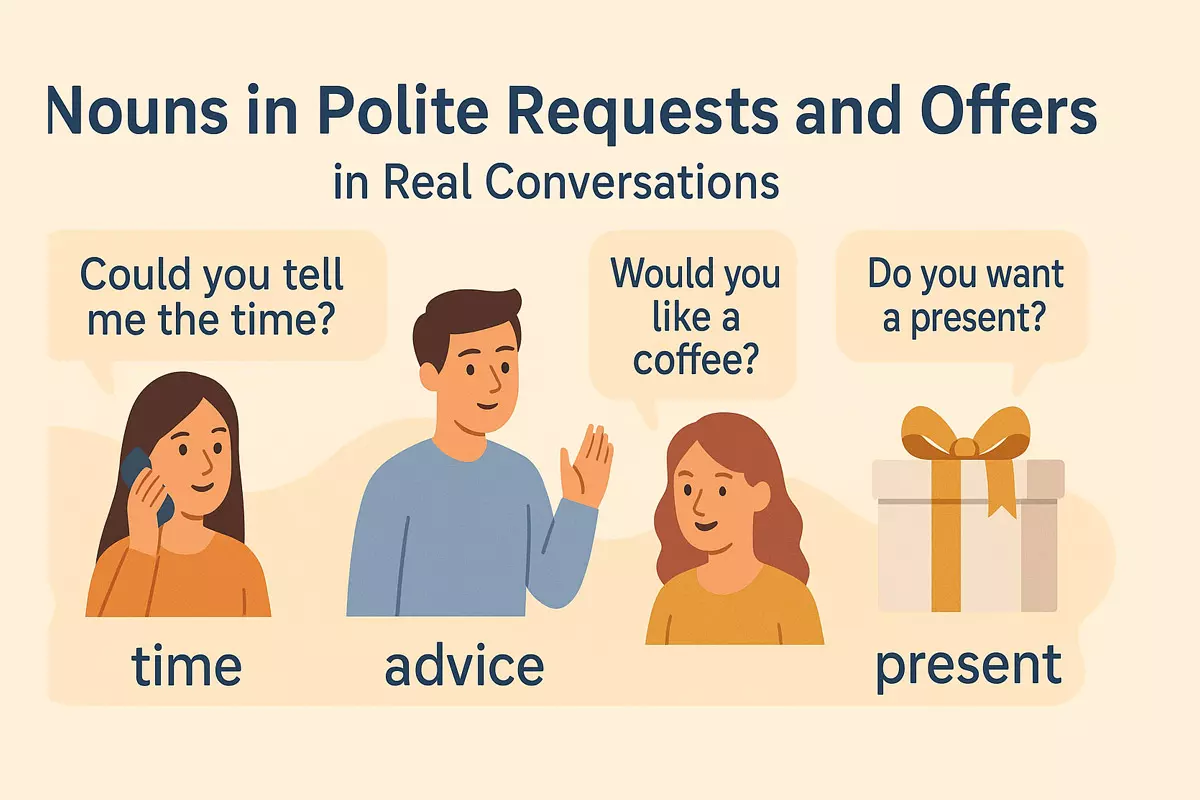 The article explains how nouns such as favor, help, and opportunity influence the tone of requests and offers. It covers formal versus casual usage, frequent learner mistakes, and gives practice in making requests more polite.
- Role of nouns in softening requests and offers
- Common request nouns like favor, help, and time
- Offer-related nouns such as option and opportunity
- Tone control through noun choice in interaction
- Formal vs casual request nouns in conversation
- Typical learner mistakes in polite noun phrases
- Practice: rewrite direct requests using polite noun forms
The language we use in daily interactions, especially the specific nouns chosen when making requests or offers, can significantly influence how polite and considerate we appear to others. By carefully selecting certain words, individuals can soften their statements and convey respect, which helps to maintain positive relationships and minimize misunderstandings. Observing these linguistic strategies in real conversations highlights how much thought goes into everyday communication, demonstrating that even small choices in wording can make a meaningful difference in social harmony.
Role of nouns in softening requests and offers
Nouns often play a subtle but significant part in making requests and offers less direct or imposing. By framing what we want or propose in terms of things, actions, or abstract concepts, speakers can reduce the pressure on listeners and create a more comfortable conversational space. This approach helps to shift the focus from the person to the object or action, which can feel less confrontational.
How nouns reduce directness
Instead of using imperatives or direct questions, speakers frequently introduce nouns to soften the tone. For example, saying “Could I get some help?” is gentler than “Help me.” The presence of a noun like “help” makes the request seem less like a command and more like an inquiry or suggestion.
Common noun-based patterns in polite language
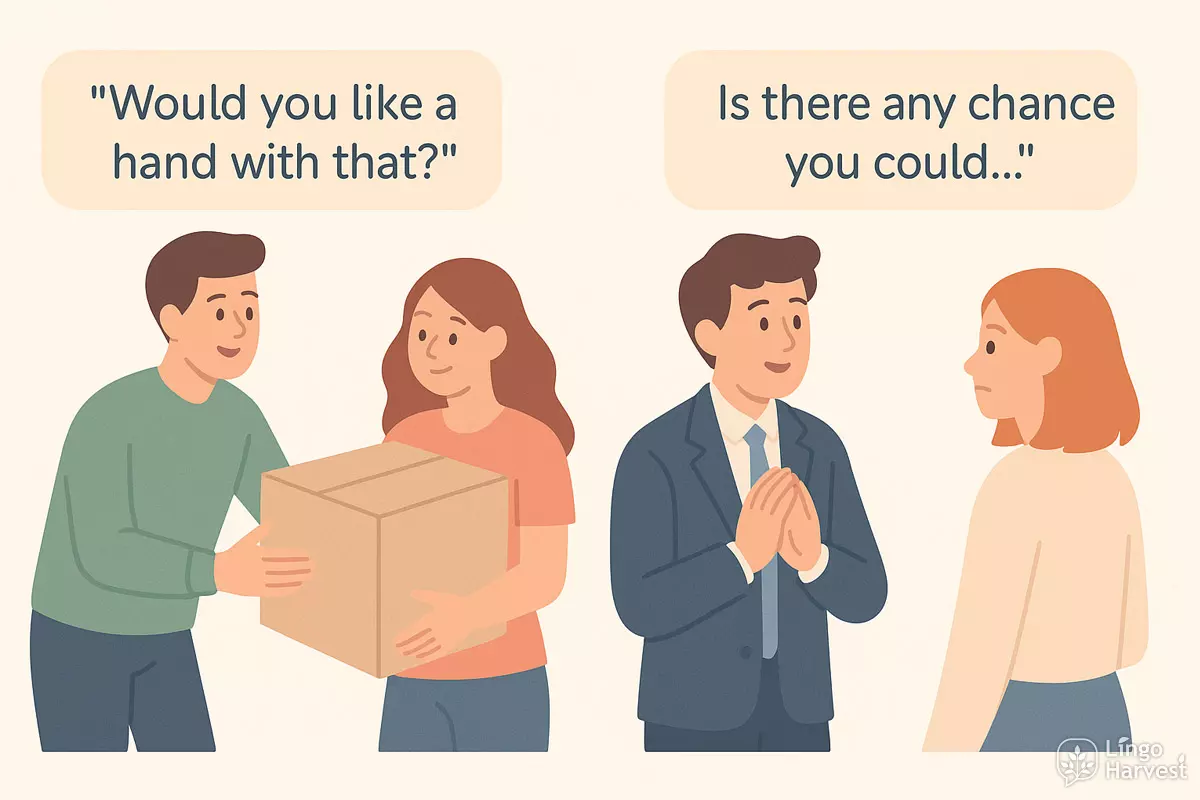
Noun phrases are particularly useful in English for making communication tactful. Here are several patterns where nouns are central to softening:
- “Would you like a hand with that?”
- “Is there any chance you could…”
- “I was wondering if you have a moment.”
- “Could I ask a favor?”
- “Do you need any assistance?”
- “Would you mind giving me some advice?”
- “Is it possible to get a ride?”
- “May I make a suggestion?”
- “Would you care for a cup of tea?”
- “Can I offer you a seat?”
- “Would you be interested in an opportunity?”
- “Could I trouble you for a minute?”
- “May I have your attention for a second?”
- “Would you accept this gift?”
- “Is there any possibility of…”
- “Can I get your opinion?”
- “Would you like some company?”
- “Could you spare a moment?”
- “May I offer a suggestion?”
- “Do you have any questions?”
Comparing direct and noun-based forms
The difference between using a noun and a more direct form is often noticeable in conversation. Notice how the noun-based version sounds more polite and less urgent:
| Direct Form | Noun-based Softened Form |
|---|---|
| Help me with this. | Could I get some help with this? |
| Sit down. | Would you like a seat? |
| Give me your advice. | Would you mind giving me some advice? |
| Tell me your opinion. | Can I get your opinion? |
Summary
Using nouns to frame requests and offers not only makes them sound more polite but also acknowledges the other person’s autonomy. This linguistic strategy is widespread in real conversations, helping to maintain positive social dynamics and reduce the risk of offense or discomfort.
Common request nouns like favor, help, and time
In English conversations, certain nouns frequently appear when people make polite requests. Words such as “favor,” “help,” and “time” are especially common because they naturally soften the tone and express respect for the other person’s willingness or ability to assist. Using these nouns signals that you recognize the imposition and want to be considerate.
How these nouns shape polite requests
These nouns often follow modal verbs or polite question structures, creating a buffer that makes the request less direct and more socially appropriate. For example, instead of saying “Do this for me,” someone might say, “Could I ask a favor?” or “May I have a moment of your time?” This approach helps maintain positive relationships, especially in professional or unfamiliar settings.
- Favor: “Can I ask you a favor?” / “Would you do me a favor?”
- Help: “Could you help me with this?” / “I could use some help.”
- Time: “Do you have a minute?” / “Could I borrow a moment of your time?”
- Assistance: “Would you be able to offer some assistance?”
- Advice: “Could I get your advice on something?”
- Support: “May I ask for your support?”
- Guidance: “Would you mind giving me some guidance?”
- Permission: “May I have your permission to…”
- Information: “Could you give me some information about…”
- Opinion: “Would you share your opinion?”
- Input: “May I have your input on this?”
- Recommendation: “Could you make a recommendation?”
- Assistance: “Would you be able to offer some assistance?”
- Access: “Could I have access to the files?”
- Opportunity: “May I have the opportunity to try?”
- Attention: “Could I have your attention for a moment?”
- Patience: “Thank you for your patience.”
- Understanding: “I appreciate your understanding.”
Choosing the right noun for the situation
Selecting which noun to use depends on the context and your relationship with the other person. “Favor” is often used among friends or colleagues when the request is personal but not part of their job. “Help” is direct, but still polite, and works well in most situations. “Time” is ideal when you need someone to pause what they’re doing for you. Other nouns like “advice” or “guidance” are best when you want expertise or opinions.
Comparing common request nouns
| Noun | Typical Request Example |
|---|---|
| Favor | “Could I ask you a favor?” |
| Help | “Would you be able to help me with this?” |
| Time | “Do you have a moment to talk?” |
| Advice | “Could I get your advice about something?” |
| Support | “May I ask for your support on this project?” |
| Information | “Can you give me some information regarding the meeting?” |
| Permission | “May I have your permission to leave early?” |
| Guidance | “Would you mind giving me some guidance?” |
Summary
Using these nouns in requests helps convey politeness and consideration. They make direct questions softer and more socially acceptable, which is essential for smooth, respectful communication in everyday interactions.
Offer-related nouns such as option and opportunity
Nouns like “option” and “opportunity” serve a unique role in polite offers during everyday conversations. Speakers use these words to shift the focus away from themselves and instead highlight choices or openings for the listener. This approach lessens social pressure and allows the recipient to feel more comfortable accepting or declining.
How nouns create polite distance in offers
Choosing nouns such as “choice,” “possibility,” or “alternative” instead of direct verbs (“Would you like...?”) softens the interaction. For example, saying, “There’s an option to join us later if you wish,” is less forceful than, “Join us later.” This subtlety communicates respect for the listener’s autonomy.
Common nouns used in offers
Below is a range of words often found in real-life offers. These terms help frame the invitation or suggestion as open-ended and considerate:
- option → We have several options to consider.
- opportunity → This job offers a great opportunity for growth.
- alternative → We need to find an alternative solution.
- possibility → There is a possibility of rain tomorrow.
- suggestion → She made a helpful suggestion.
- chance → He took a chance and applied for the position.
- proposal → The committee approved the proposal.
- choice → This is a difficult choice to make.
- invitation → She accepted the invitation to the event.
- recommendation → The doctor gave a clear recommendation.
- idea → That idea could work well.
- route → This route is faster during rush hour.
- arrangement → The arrangement worked for everyone.
- solution → They found a practical solution.
- plan → The plan was discussed in detail.
- offer → He received a job offer.
- prospect → The prospect of success motivated the team.
- benefit → One benefit of the program is flexibility.
- avenue → Education is an important avenue for change.
- opening → There is an opening in the marketing department.
Sample phrases for making offers politely
Speakers often combine these nouns with modal verbs or indirect language to enhance politeness. Here are several real-world patterns:
- “There’s an opportunity for you to...”
- “One option might be to...”
- “You have the choice to...”
- “If you prefer, another alternative is...”
- “May I suggest a possibility?”
- “Would you consider this proposal?”
- “We have an arrangement where you could...”
- “Here’s a suggestion, if you’re interested.”
- “This plan is available if you’d like.”
- “You’re welcome to take advantage of this benefit.”
Comparing direct and indirect offer forms
| Direct Form | Polite Noun-Based Form |
|---|---|
| “Join us for coffee.” | “There’s an option to join us for coffee if you’d like.” |
| “Take this seat.” | “There’s a seat available, should you want the opportunity.” |
| “Use my charger.” | “You have the alternative of using my charger if you need.” |
| “Come with us.” | “You’re invited, but the choice is yours.” |
This indirect, noun-centered style is common in English, especially when speakers want to be tactful or minimize imposition. By focusing on the availability of choices rather than issuing commands or direct invitations, conversations remain courteous and flexible.
Tone control through noun choice in interaction
Word selection, especially the nouns used in requests and offers, can shift how an utterance is perceived in everyday exchanges. By carefully choosing specific nouns, speakers subtly manage politeness, formality, distance, or warmth without changing the core message. For instance, using a general noun like “thing” versus a precise term like “document” can make a request sound either softer or more direct.
Ways noun choice shapes perceived politeness
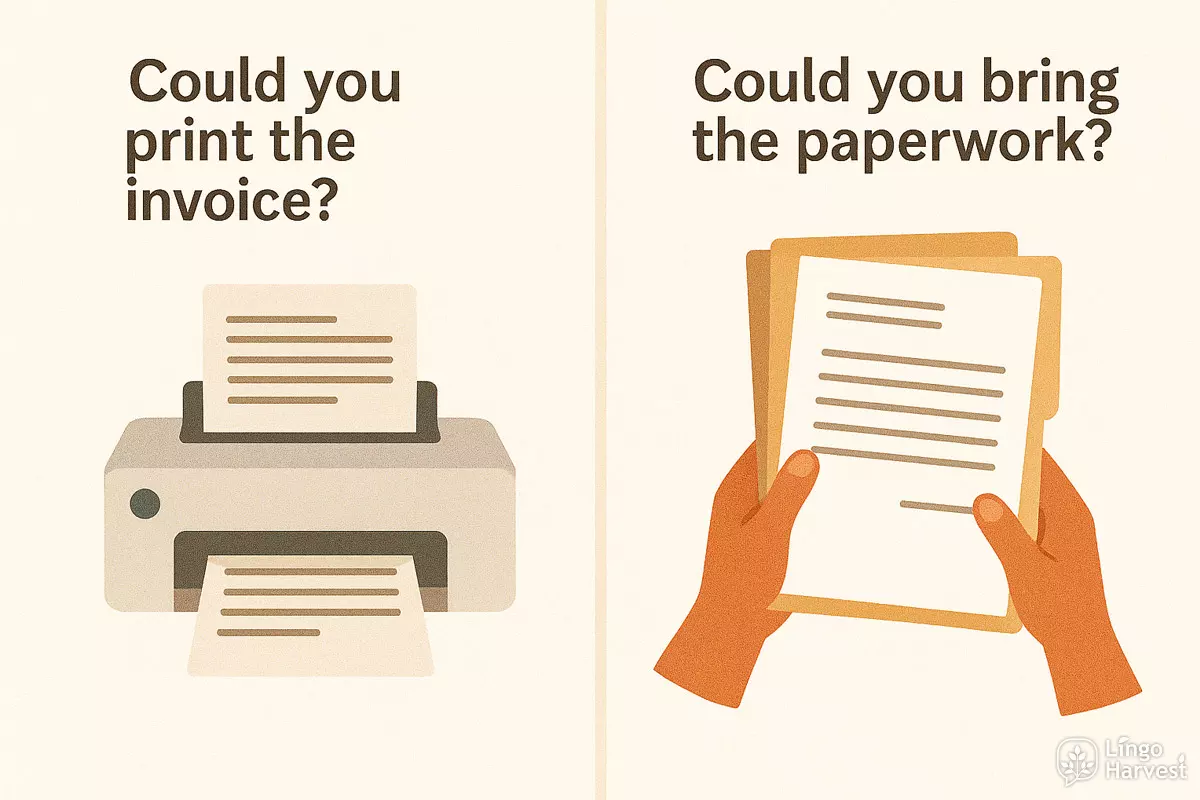
Selecting between abstract and concrete nouns or between formal and informal vocabulary influences the social meaning of a request or offer. Abstract nouns often introduce vagueness that can soften a request, while concrete nouns may add clarity but may sound more commanding. Similarly, diminutives or affectionate forms (“cuppa” instead of “cup of tea”) can make an offer feel more personal.
- Abstractions: “Could you take care of this?” vs. “Could you print the invoice?”
- Collective nouns: “Could you bring the reports?” vs. “Could you bring the paperwork?”
- Diminutives: “Would you like a cuppa?” vs. “Would you like some tea?”
- Technical terms: “Could you review the manuscript?” vs. “Could you check this?”
- Personal nouns: “Can you ask the manager?” vs. “Can you ask him?”
- Possessive forms: “Can I borrow your pen?” vs. “Can I borrow a pen?”
- General nouns: “Could you handle this?” vs. “Could you handle the delivery?”
- Minimizing nouns: “Just a quick favor” vs. “I need your help”
- Honorifics/titles: “Doctor, could you…” vs. “Could you…”
- Formal nouns: “Would you accept this proposal?” vs. “Would you take this idea?”
- Quantified nouns: “Could you give me some advice?” vs. “Could you give me advice?”
- Uncountable vs. countable: “Do you have information?” vs. “Do you have any details?”
Comparing noun choices in requests and offers
Sometimes, contrasting two noun choices highlights how the interactional tone shifts. Consider the following structured comparison:
| Noun Choice | Effect on Tone |
|---|---|
| “Could I have a moment of your time?” | Polite, indirect, respectful |
| “Could I have your phone?” | Direct, potentially abrupt |
| “May I offer you some assistance?” | Formal, considerate |
| “Want a hand?” | Informal, friendly, casual |
| “Would you like refreshments?” | Neutral, slightly formal |
| “Would you like a snack?” | Personal, warm, approachable |
Guidelines for choosing nouns in social interaction
When framing requests or offers, consider the relationship with the listener, the level of formality desired, and the need for precision or warmth. Opting for more general or collective nouns can soften demands, while specific or technical terms may be better in professional settings. Adjusting noun choice is a subtle yet effective strategy for managing interpersonal dynamics in real conversations.
Formal vs casual request nouns in conversation
Choosing between formal and casual nouns can shape the tone of requests and offers in conversation. The noun you select often signals your relationship to the listener, your intentions, and the setting—whether it’s a business meeting, a chat with a friend, or a service encounter. While formal nouns tend to show respect and distance, casual ones suggest closeness or informality.
Common formal nouns for requests
In more polite or professional settings, people often use nouns that sound neutral or distant. These help soften the request and make it sound less direct. Here are some typical examples:
- Assistance (e.g., "May I request your assistance?")
- Permission (e.g., "Could I have your permission to...")
- Favor (e.g., "Would you do me a favor?")
- Information (e.g., "I would like some information about...")
- Support (e.g., "I am seeking your support.")
- Advice (e.g., "May I ask for your advice?")
- Recommendation (e.g., "Could you give me a recommendation?")
- Assurance (e.g., "Could I get your assurance?")
- Approval (e.g., "I need your approval for...")
- Clarification (e.g., "May I ask for clarification?")
Typical casual nouns in everyday requests
In relaxed conversations, speakers often use simpler, more direct nouns. These fit situations among friends, family, or close colleagues. Some frequent choices include:
- Help (e.g., "Can I get some help?")
- Hand (e.g., "Could you give me a hand?")
- Tip (e.g., "Got any tips for me?")
- Idea (e.g., "Do you have any ideas?")
- Heads-up (e.g., "Give me a heads-up if you see anything.")
- Note (e.g., "Leave me a note if you go out.")
- Lift (e.g., "Can I get a lift to the station?")
- Pointer (e.g., "Any pointers on this?")
- Update (e.g., "Send me an update.")
- Heads-up (e.g., "Give me a heads-up next time.")
Comparing formal and casual request nouns
The choice between these two styles isn’t just about vocabulary—it reflects your relationship with the other person and the situation. Here is a structured comparison of some common nouns used in both formal and casual contexts:
| Formal Request Noun | Casual Request Noun |
|---|---|
| Assistance | Help |
| Favor | Hand |
| Recommendation | Tip |
| Information | Update |
| Advice | Pointer |
Context always matters. Adapting your choice of noun to the social setting and your relationship with the listener helps ensure your request is received as intended. In formal situations, opting for more elaborate or neutral nouns adds politeness and respect. With friends, shorter and more familiar nouns usually feel natural and warm.
Typical learner mistakes in polite noun phrases
Many English learners run into trouble when using noun phrases in polite requests and offers. These errors often make speech sound abrupt, awkward, or less natural—even when the speaker's intention is friendly. By focusing on common pitfalls, you can avoid misunderstandings and communicate more smoothly in everyday conversations.
Frequent issues with articles and quantifiers
Problems often arise with the use of articles (a, an, the) and quantifiers (some, any, a little, a few). Learners may leave them out or use them incorrectly, which can make a request sound too direct or unclear. For example, saying "Can I have sugar?" instead of "Can I have some sugar?" may seem blunt.
- Missing articles: "Could you pass salt?" → "Could you pass the salt?"
- Omitting quantifiers: "Would you like tea?" → "Would you like some tea?"
- Wrong quantifier: "Can I have few cookies?" → "Can I have a few cookies?"
- Unnecessary definite article: "May I have the water?" (when not referring to specific water) → "May I have some water?"
Misusing possessive and demonstrative adjectives
Another pattern is confusion between my/your and this/that when making offers or requests. Overusing or omitting these words can make a phrase sound unnatural.
- Overuse: "Can I borrow your pen?" (when the pen is on the table and ownership is unclear)
- Omission: "Would you like cake?" (sounds less warm than "Would you like some of this cake?")
- Wrong demonstrative: "Would you like that bread?" (when offering bread in front of you, it should be "this bread")
Incorrect noun forms and politeness strategies
Politeness in English often relies on using the right noun form and softening phrases. Learners sometimes use plural instead of singular, or forget to add words that make a request more gentle.
- Plural instead of singular: "Can I have a waters?" ❌
- Missing softener: "Give me a pen" → "Could you give me a pen, please?"
- Too direct: "I want coffee" → "I’d like a coffee, please."
- Unnecessary formality: "Might you be so kind as to pass the bread?" (overly formal for everyday settings)
Comparison of correct and incorrect noun phrases
| Incorrect | More natural / Polite |
|---|---|
| Can I have sugar? | Can I have some sugar? |
| Give me pen. | Could you give me a pen, please? |
| I want water. | I’d like some water, please. |
| Would you like tea? | Would you like some tea? |
| Can I have few cookies? | Can I have a few cookies? |
| Could you pass salt? | Could you pass the salt? |
| May I have the water? | May I have some water? |
| Would you like that bread? | Would you like this bread? |
Summary tips for improvement
- Check if an article or quantifier is needed for the noun.
- Use softeners like "some", "a bit of", or "a few" for uncountable or plural nouns.
- Match demonstratives and possessives to the context.
- Remember that directness can sound rude; add "please" or use modal verbs ("could", "would").
- Listen to real conversations to get a sense of natural phrasing.
Being aware of these typical errors helps learners sound more polite and confident when making requests or offers in English.
Practice: rewrite direct requests using polite noun forms
Transforming direct requests into more polite forms often involves shifting from imperative verbs to noun-based expressions. This practice helps conversations sound more diplomatic and considerate, especially in professional or social settings. Below, you’ll find exercises and examples for turning straightforward commands into more courteous suggestions or inquiries using nouns.
Common Patterns for Polite Noun Requests
Polite requests often use noun phrases such as “a favor,” “a suggestion,” or “an opportunity.” Here are some useful expressions:
- Would you mind giving me some advice?
- Could I ask for a moment of your time?
- I’d appreciate your assistance.
- May I have your opinion on this?
- Would it be possible to get some help?
- Could you offer an explanation?
- I’d like to request an extension.
- Would you be able to provide an update?
- Can I make a suggestion?
- Could I trouble you for a recommendation?
- May I request your feedback?
- I would appreciate your response.
- Would it be possible to have a quick meeting?
- Could you send me the information?
- May I have your attention for a moment?
- Could I receive confirmation?
- Would you mind sharing your thoughts?
- Could I ask for clarification?
- I’d like to request your assistance with this task.
- Would you be able to grant permission?
Exercise: Polite Reformulation Task
Rewrite the following direct requests using noun-based polite forms. Try to use a variety of patterns and vocabulary from the list above.
- Help me with this report.
- Tell me your opinion.
- Give me more time.
- Send the document to me.
- Explain this to me.
- Check these numbers.
- Fix this problem.
- Show me the results.
- Answer my question.
- Arrange a meeting.
Show answers
- I’d appreciate your assistance with this report.
- May I have your opinion?
- I’d like to request an extension.
- Could you send me the document?
- Could you offer an explanation?
- Could you review these figures?
- Please address this issue.
- Could you share the results?
- I’d appreciate a response to my question.
- Could you arrange a meeting?
Tips for Using Polite Noun Forms Naturally
When rephrasing, consider the relationship and context—using nouns adds formality and softens requests. Start with modal verbs (could, would, may) and follow with a noun phrase to sound considerate. Practice with different scenarios to build fluency and confidence in polite communication.