Nouns Used with Modal Structures in English Grammar

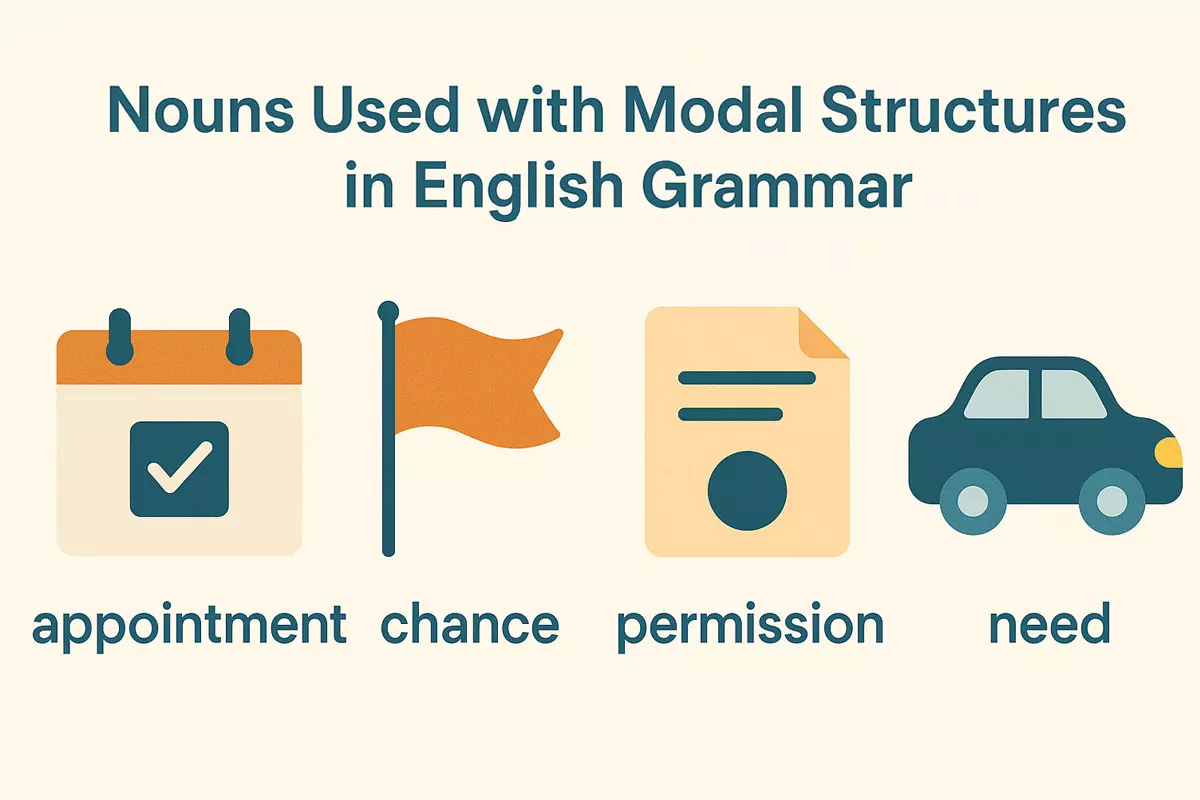 Here we how nouns convey modal meaning in English, including common patterns and the use of nouns to show necessity, permission, and possibility. It also discusses frequent learner errors and provides practice with modal-related nouns.
- How modal meaning connects with nouns
- Common noun + modal patterns in statements
- Nouns expressing necessity, permission, and possibility
- Modal meaning through abstract noun choice
- Nouns with modal adjectives and predicates
- Typical learner errors with modal-related nouns
- Practice: complete sentences using nouns with modal meaning
Examining the relationship between English modal verbs and various types of nouns uncovers subtle patterns that influence both meaning and clarity in communication. By recognizing how modals like can, must, or might interact with different naming words, learners can improve their ability to express ideas such as possibility, necessity, and permission accurately. Developing an awareness of these connections not only enhances everyday speech but also leads to greater confidence and precision in both spoken and written English.
How modal meaning connects with nouns
Modal concepts—like possibility, necessity, obligation, or permission—often interact with nouns in English grammar, especially when expressing abstract ideas or making generalizations. Instead of modifying verbs directly, modal structures can be linked to noun phrases through certain patterns, helping to express what is possible, required, or allowed about a thing, situation, or concept.
Common ways modal meaning is conveyed with nouns
- Modal verbs + noun phrases: Using structures like “can be a problem,” “may be a risk,” or “must be a reason.”
- There is/are + modal noun: For example, “There is a possibility,” “There is a need,” “There are options.”
- Noun + of + gerund/infinitive: Such as “the chance of winning,” or “the need to improve.”
- Adjective + noun combinations: Phrases like “necessary action,” “possible outcome,” or “required documents.”
- It is + adjective + noun: Examples include “It is a good idea,” “It is a requirement,” or “It is an obligation.”
Modal nouns and their core meanings
Certain nouns inherently carry modal meanings and frequently appear in formal or academic English to express potential, obligation, or permission. Here are some common modal nouns and the concepts they convey:
- Possibility: possibility, chance, likelihood, opportunity, probability
- Obligation: necessity, requirement, obligation, duty, need
- Permission: permission, approval, authorization, consent
- Ability: ability, capacity, capability, potential
- Prohibition: ban, restriction, limitation, prohibition
- Advice: suggestion, recommendation, proposal, guidance
- Intention: intention, plan, aim, purpose
- Risk: risk, danger, threat, hazard
- Requirement: prerequisite, condition, stipulation, demand
- Right: right, entitlement, privilege, license
Examples of modal meaning expressed with nouns
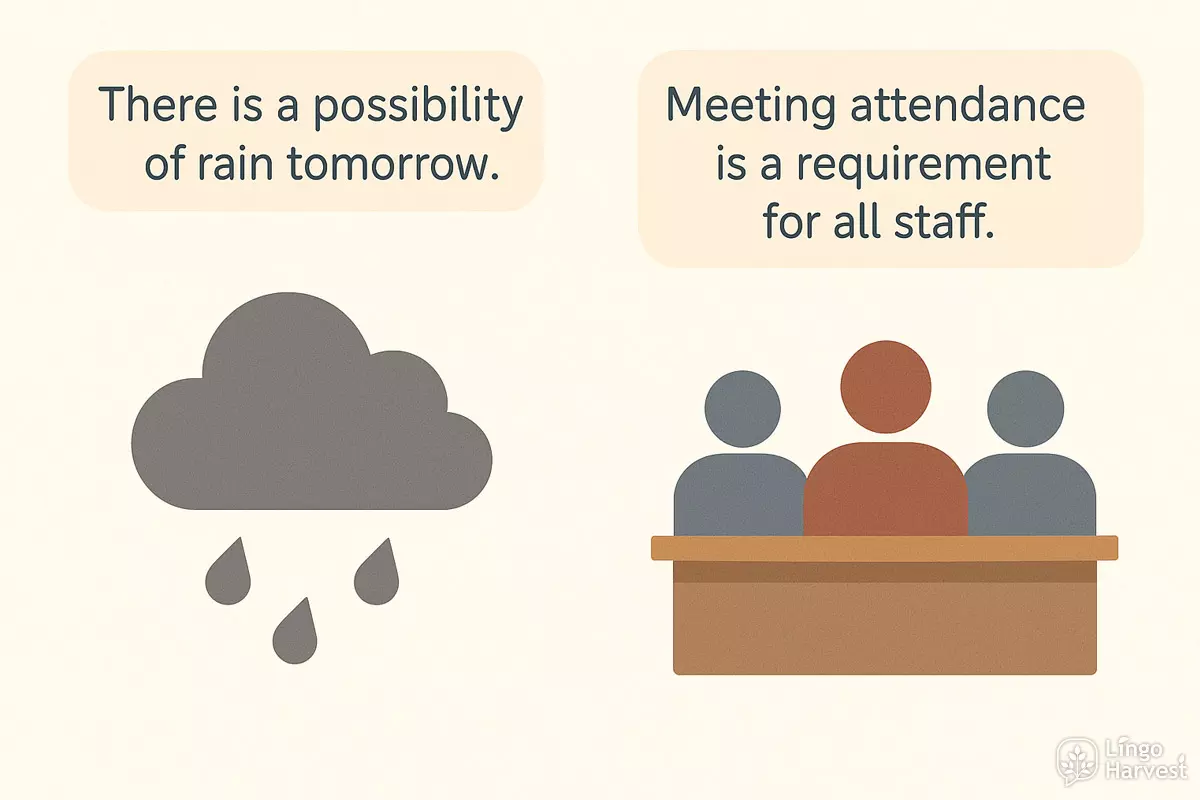
Below is a table illustrating how modal ideas can be expressed using noun-based structures, showing the noun and a typical modal context:
| Modal Noun | Common Example Phrase |
|---|---|
| possibility | There is a possibility of rain tomorrow. |
| requirement | Meeting attendance is a requirement for all staff. |
| permission | You need permission to access this area. |
| ability | The ability to adapt is crucial in this job. |
| risk | There is a risk of injury during the activity. |
| suggestion | I have a suggestion for improving the process. |
| obligation | It is an obligation to follow the safety rules. |
| intention | Her intention to resign was clear. |
| right | Everyone has the right to free speech. |
| ban | There is a ban on smoking here. |
Summary
Grammatical patterns involving modal meaning and nouns help speakers convey nuanced attitudes about events, actions, or situations. By choosing appropriate modal nouns and combining them with supporting verbs, adjectives, or prepositions, English users can express possibility, necessity, permission, and more, making communication both precise and flexible.
Common noun + modal patterns in statements
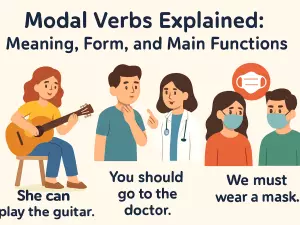
In English grammar, modal verbs such as can, must, should, and might often appear alongside common nouns to express ability, necessity, possibility, or permission. Understanding how these structures work helps clarify meaning and intention in statements. Typically, a noun serves as the subject, followed by a modal verb and the main verb of the sentence. This construction is frequent in both spoken and written English for making generalizations, suggestions, or expressing obligations.
Typical sentence structures
The most straightforward pattern places a noun before the modal verb, followed by the base form of a verb:
- Children can learn languages quickly.
- Drivers must follow the speed limit.
- Visitors should sign in at reception.
- Employees may request additional leave.
Such statements can describe rules, general truths, or possibilities concerning groups or categories of people and things. The modal verb modifies the action, setting the tone for what is possible, required, or allowed for the noun in question.
Usage with different modals
Each modal verb brings a different nuance when used with a noun subject. Here's a comparison of how various modals combine with common nouns to convey distinct meanings:
| Noun Subject | Modal Verb | Example Statement |
|---|---|---|
| Students | can | Students can access the library after hours. |
| Passengers | must | Passengers must fasten their seatbelts. |
| Applicants | should | Applicants should submit their forms online. |
| Cats | might | Cats might hide when there are loud noises. |
| Visitors | may | Visitors may take photographs inside the museum. |
| Children | must not | Children must not play near the road. |
| Patients | should not | Patients should not eat before surgery. |
| Employees | could | Employees could receive a bonus this year. |
Common noun + modal combinations
Here are some frequent pairings you might encounter, illustrating how various modal verbs interact with common nouns:
- Dogs can swim.
- Teachers must prepare lessons.
- Guests may leave early.
- Parents should encourage reading.
- Members might vote against the proposal.
- Children must not run in the hallways.
- Doctors should explain the procedure.
- Customers can return items within 30 days.
- Visitors may not enter restricted areas.
- Applicants must provide references.
- Players could improve their scores next game.
- Students should not use phones during exams.
- Residents can request maintenance.
- Passengers might experience delays.
- Employees must follow safety guidelines.
In summary, pairing common nouns with modal verbs is a practical way to communicate rules, abilities, and possibilities. By mastering these patterns, learners can make their statements clearer and more precise in everyday English.
Nouns expressing necessity, permission, and possibility
Many common nouns in English capture ideas like obligation, allowance, or chance, and these often appear in sentences structured with modal verbs or modal-like expressions. Understanding how to use these nouns helps clarify who is responsible, what is permitted, or whether something can happen.
Key nouns for expressing necessity
Words that convey obligation or required action often appear with modals such as "must," "should," or phrases like "it is necessary that." Here are some frequent examples:
- necessity → There is a necessity to reduce costs.
- requirement → One key requirement is to submit the form on time.
- obligation → She has an obligation to follow company rules.
- duty → It is his duty to report the incident.
- need → There is a need to improve safety.
- imperative → It is imperative to act quickly.
- compulsion → He felt a strong compulsion to apologize.
- responsibility → It is your responsibility to lock the door.
- requirement → Meeting the deadline is a strict requirement.
- commitment → She made a commitment to attend every meeting.
Common nouns for permission
- permission → You need permission to enter the building.
- authorization → The manager gave authorization to proceed.
- consent → Written consent is required.
- approval → The plan received official approval.
- allowance → He was given an allowance to work remotely.
- license → You need a license to operate this equipment.
- sanction → The action was taken without formal sanction.
- right → Employees have the right to refuse unsafe work.
- entitlement → This benefit is an entitlement under the contract.
- clearance → Security clearance is required for access.
Nouns indicating possibility
- possibility → There is a possibility that plans will change.
- chance → She has a chance to win the award.
- probability → The probability of rain is low.
- likelihood → There is a high likelihood of success.
- opportunity → This job offers an opportunity to grow.
- option → Remote work is one option.
- potential → The project has great potential.
- risk → There is a risk of delay.
- prospect → The prospect of promotion motivated her.
- scope → There is scope to improve the process.
For instance: "There is a strong possibility of rain."
How these nouns interact with modal structures
The following table summarizes how these nouns typically fit with modal verbs or modal-like constructions in English:
| Noun Type | Typical Modal Structure |
|---|---|
| Necessity | It is a necessity/requirement to... There is an obligation to... One must/should... |
| Permission | Permission/consent is needed to... One may/can... It is allowed/permitted to... |
| Possibility | There is a (strong) possibility/chance that... It might/could... There is an opportunity to... |
By choosing the right noun and matching it with an appropriate modal or structure, you can express nuances of rules, freedoms, or uncertainty in both spoken and written English. This usage is especially common in formal contexts, instructions, and academic writing.
Modal meaning through abstract noun choice
The use of abstract nouns in English often conveys subtleties of possibility, necessity, obligation, or likelihood—core components of modality. Rather than relying solely on modal verbs like must or may, writers and speakers frequently select abstract nouns to express similar ideas. This approach is especially common in formal, academic, or official contexts, where indirectness or objectivity is preferred.
How abstract nouns signal modality
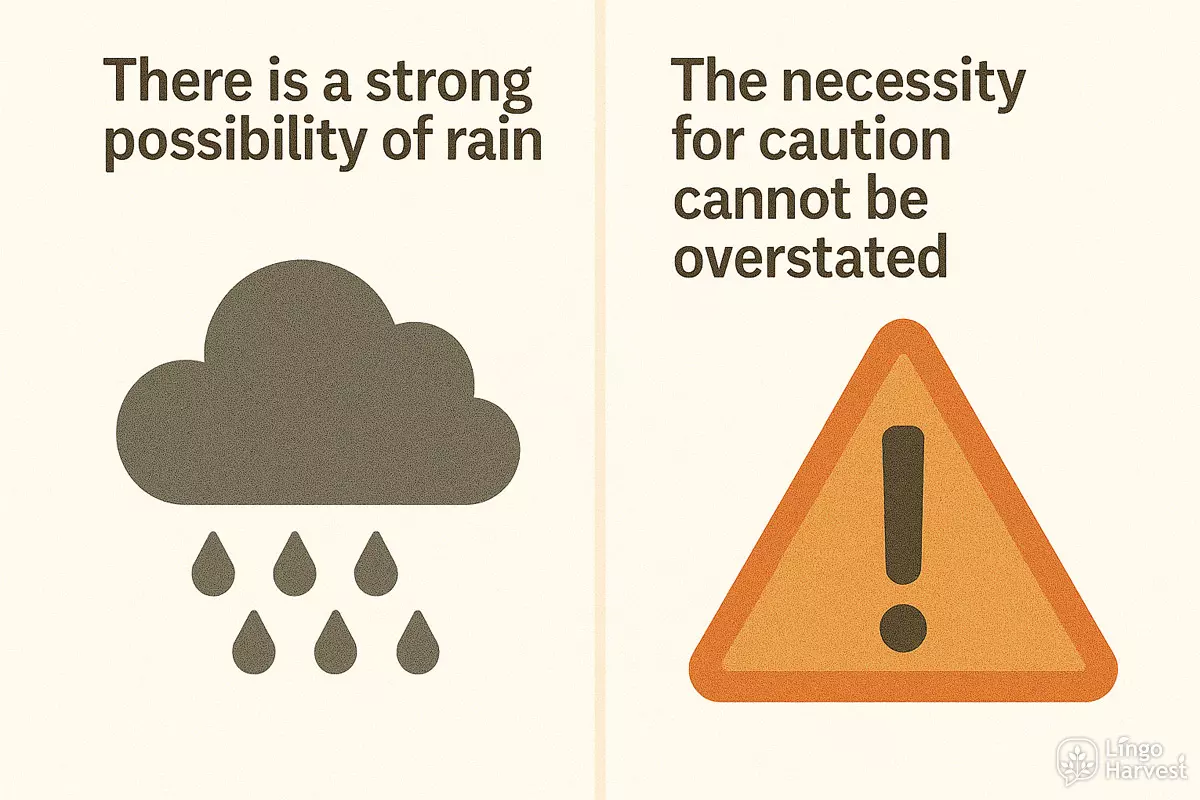
Abstract nouns such as possibility, necessity, requirement, and likelihood allow for modal meaning without direct modal verbs. These nouns, when combined with structures like "There is a...", "The...", or "It is a...", serve to introduce modal nuance. For example, "There is a chance that..." suggests uncertainty, while "The obligation to..." indicates necessity.
- possibility – "There is a strong possibility of rain."
- necessity – "The necessity for caution cannot be overstated."
- requirement – "Meeting the requirement is essential."
- likelihood – "The likelihood of success is high."
- obligation – "There is an obligation to report errors."
- chance – "There is a chance that he will attend."
- risk – "The risk of failure is significant."
- probability – "The probability of rain increases in April."
- option – "Another option is available."
- permission – "Permission is granted to proceed."
- expectation – "The expectation is that all tasks will be completed."
- ability – "Ability to adapt is crucial."
- potential – "There is potential for improvement."
- need – "There is a need for clarity."
- certainty – "Certainty is rare in complex situations."
- impossibility – "Impossibility should not be assumed."
- authority – "Authority to act is required."
- responsibility – "Responsibility lies with the manager."
- prohibition – "Prohibition of smoking is enforced."
- suggestion – "A suggestion was made to revise the plan."
Comparing modal verbs and abstract nouns
Switching between modal verbs and their corresponding abstract nouns can alter the tone and formality of a statement. The table below compares how modal verbs and abstract nouns are used to communicate similar modal meanings:
| Modal Verb Structure | Abstract Noun Structure |
|---|---|
| You must submit the form. | Submission of the form is a requirement. |
| It may rain tomorrow. | There is a possibility of rain tomorrow. |
| You can leave early. | Permission to leave early is granted. |
| You should wear a helmet. | Wearing a helmet is a recommendation. |
| Smoking is not allowed. | There is a prohibition on smoking. |
Choosing an abstract noun in place of a modal verb can make statements more impersonal or formal, which is often desirable in official documents, academic writing, or professional communication. This technique also allows writers to foreground the concept (such as necessity or risk) rather than the actor, subtly shifting the focus of responsibility or expectation.
Nouns with modal adjectives and predicates
Understanding how nouns interact with modal adjectives and predicate structures is essential for expressing possibility, necessity, and other modal meanings in English. Often, these combinations are used to convey opinions, obligations, or likelihoods about a situation or fact. Instead of using modal verbs directly, English frequently employs patterns where a noun is linked to a modal adjective or predicate, creating a more formal or nuanced statement.
Common Patterns and Usage
The most typical structure pairs a noun with a form of the verb “to be” and a modal adjective. This allows speakers to express modality in an impersonal or general way. For example:
- It is necessary that everyone arrive on time.
- There is a possibility that the event will be postponed.
- It is likely that she will join us.
Sometimes, the noun phrase itself becomes the subject, especially in more formal English:
- The likelihood of rain is high.
- The necessity for change is clear.
Examples of Modal Nouns and Adjectives
Writers and speakers can combine a wide range of nouns and modal adjectives to express shades of meaning. Here are some useful combinations:
- chance – possible → It is possible that she will arrive late.
- necessity – necessary → It is necessary to wear safety equipment.
- possibility – possible → It is possible to finish the task today.
- certainty – certain → It is certain that the results will improve.
- probability – probable → It is probable that prices will rise.
- risk – likely/unlikely → It is likely that the meeting will be postponed.
- requirement – required → Identification is required to enter the building.
- obligation – obligatory → Attendance is obligatory for all staff.
- impossibility – impossible → It is impossible to solve this without help.
- expectation – expected → Delays are expected during peak hours.
- suggestion – advisable → It is advisable to back up your files.
- danger – dangerous → It is dangerous to swim here.
- permission – permitted → Parking is permitted after 6 p.m.
- need – needed → Further testing is needed.
- recommendation – recommended → Regular exercise is recommended.
- proposal – proposed → The proposed changes were approved.
- opportunity – possible → It is possible to apply online.
- request – requested → The requested documents were submitted.
Sentence Structures with Modal Predicates
Modal meaning can be expressed through different sentence patterns. Some of the most frequent are:
- It is [modal adjective] + that-clause: It is essential that you submit the form.
- There is [modal noun] + that-clause: There is a chance that he will call.
- [Modal noun] + of + noun/gerund: The possibility of winning is slim.
- [Modal noun] + to-infinitive: The need to improve is obvious.
Comparison of Modal Noun Structures
Below is a table highlighting some common patterns and their typical uses:
| Pattern | Example Sentence |
|---|---|
| It is + modal adjective + that-clause | It is crucial that everyone attend the meeting. |
| There is + modal noun + that-clause | There is a risk that traffic will be heavy. |
| Modal noun + of + gerund/noun | The probability of success is low. |
| Modal noun + to-infinitive | The need to act quickly is apparent. |
| Modal noun as subject + be + modal adjective | The obligation is clear. |
Summary
Using noun phrases with modal adjectives and predicates adds variety and formality to English sentences. Mastering these combinations enables more precise and nuanced communication, especially in academic, formal, or professional contexts.
Typical learner errors with modal-related nouns
Learners of English often encounter confusion when combining modal verbs with their corresponding noun forms. This is especially common with nouns such as “possibility,” “necessity,” “ability,” or “permission.” Errors tend to arise due to differences between modal verbs and their nominal counterparts, as well as interference from a learner’s first language. Understanding these pitfalls can help avoid common mistakes in both written and spoken English.
Confusing modal verbs and their noun forms
One frequent issue is the misuse of modal-related nouns in sentences where a modal verb would be more natural, or vice versa. For example, saying “He has the can to swim” instead of “He has the ability to swim”, or “It is a must to finish” instead of “It is necessary to finish”. Learners may also overuse direct translations, which can sound awkward or incorrect in English.
Common mistakes in usage and structure
Another challenge is the incorrect pairing of modal-related nouns with verbs or prepositions. Some nouns require specific prepositions or patterns that are not always intuitive.
- Using “possibility” with the wrong verb: “It can a possibility” ❌ vs. “It is a possibility” ✅
- Omitting articles: “There is possibility to win” ❌ vs. “There is a possibility to win” ✅
- Incorrect noun formation: “He has the must to go” ❌ vs. “He must go” or “It is a must for him to go” ✅
- Mixing up noun and verb forms: “He has possibility swim” ❌ vs. “He has the possibility to swim” ✅
- Using plural forms incorrectly: “There are many abilities” (when talking about a single skill) ❌ vs. “He has the ability to…” ✅
- Wrong prepositions: “Permission of do something” ❌ vs. “Permission to do something” ✅
- Redundant modal + noun: “He can has the ability” ❌ vs. “He has the ability” or “He can…” ✅
- Confusing necessity and need: “There is a necessity of going” ❌ vs. “There is a necessity to go” ✅
- Using “must” as a noun incorrectly: “It is a musted thing” ❌ vs. “It is a must” ✅
- Literal translation: “He has the possibility for swimming” ❌ vs. “He has the possibility to swim” ✅
Comparison of modal verbs and their noun equivalents
Learners often struggle to match the right noun with the corresponding modal verb and to use them in appropriate contexts. The table below summarizes some of the most common pairings and highlights typical mistakes.
| Modal Verb | Related Noun | Common Error Example |
|---|---|---|
| can / could | ability | “He has can to swim” |
| may / might | possibility | “It may a possibility” |
| must | necessity / obligation | “It is a musted to go” |
| should / ought to | advice / recommendation | “He gave me a should” |
| may / can | permission | “He has a may to leave” |
Tips to avoid errors
To minimize mistakes, learners should:
- Memorize common noun forms for each modal and their correct usage patterns.
- Practice forming sentences with both modal verbs and their noun equivalents.
- Pay attention to article use (“a”/“an”) and prepositions (“to,” “of”) with these nouns.
- Check for redundancy—avoid using both a modal verb and its noun in the same phrase.
By focusing on these areas, students can gradually improve their accuracy and fluency when using nouns related to modal structures.
Practice: complete sentences using nouns with modal meaning
Understanding how nouns express modal ideas in English grammar can help you build more precise and nuanced sentences. Below, you'll find activities to reinforce your knowledge of nouns that carry modal meanings, such as "necessity," "possibility," "ability," "permission," and "obligation." These nouns often combine with specific verbs and structures to convey similar ideas as modal verbs.
Fill in the Blanks: Modal Nouns in Context
Complete each sentence by choosing the appropriate noun from the list: possibility, necessity, ability, permission, obligation, probability, opportunity, requirement, suggestion, request.
- There is a strong ________ that the meeting will be postponed due to the weather.
- Attendance at the seminar is a strict ________ for all new employees.
- She showed great ________ in solving the complex problem.
- Do you have ________ to enter this restricted area?
- The manager made a ________ for everyone to arrive on time.
- Is there any ________ of finishing the project by Friday?
- He emphasized the ________ of wearing safety equipment at all times.
- We were given the ________ to travel abroad for training.
- His ________ to complete the assignment was questioned by the supervisor.
- The teacher made a helpful ________ about how to improve our essays.
Show answers
- probability
- requirement
- ability
- permission
- request
- possibility
- necessity
- opportunity
- obligation
- suggestion
Common Modal Nouns and Their Usage
Here is a table showing several modal nouns, their meanings, and examples of how they are used in sentences. This will help you see the patterns and contexts in which these nouns appear.
| Noun | Sample Usage | Meaning |
|---|---|---|
| necessity | There is a necessity to act quickly. | Something required or needed |
| possibility | The possibility of rain is high today. | Something that might happen |
| obligation | You have an obligation to tell the truth. | Something you must do |
| permission | They gave us permission to leave early. | Being allowed to do something |
| ability | Her ability to speak Spanish is impressive. | The skill or power to do something |
| requirement | English is a requirement for this job. | Something that is demanded or needed |
| opportunity | This is a great opportunity to learn. | A chance to do something |
| probability | The probability of success is high. | The likelihood of something happening |
| suggestion | He made a suggestion to improve the process. | An idea or proposal |
| request | She submitted a request for more time. | Asking for something |
Sentence Transformation: Modal Structures
Rewrite the sentences using a noun with modal meaning. For example: "You must wear a helmet." → "There is an obligation to wear a helmet."
- You can speak three languages.
- It is possible that she will arrive late.
- You are required to submit the form by Friday.
- May I leave early?
- You must wear a helmet.
- It is likely that prices will increase.
- You are not allowed to park here.
- It is necessary to restart the computer.
- You should back up your files.
- It is impossible to finish this in one day.
Show answers
- You have the ability to speak three languages.
- There is a possibility that she will arrive late.
- There is a requirement to submit the form by Friday.
- Do I have permission to leave early?
- There is an obligation to wear a helmet.
- There is a likelihood that prices will increase.
- You do not have permission to park here.
- There is a necessity to restart the computer.
- There is a recommendation to back up your files.
- There is an impossibility of finishing this in one day.
Practicing these structures helps you recognize and use modal nouns confidently, making your English more flexible and expressive.