Nouns in Conditional Constructions for Cause and Result

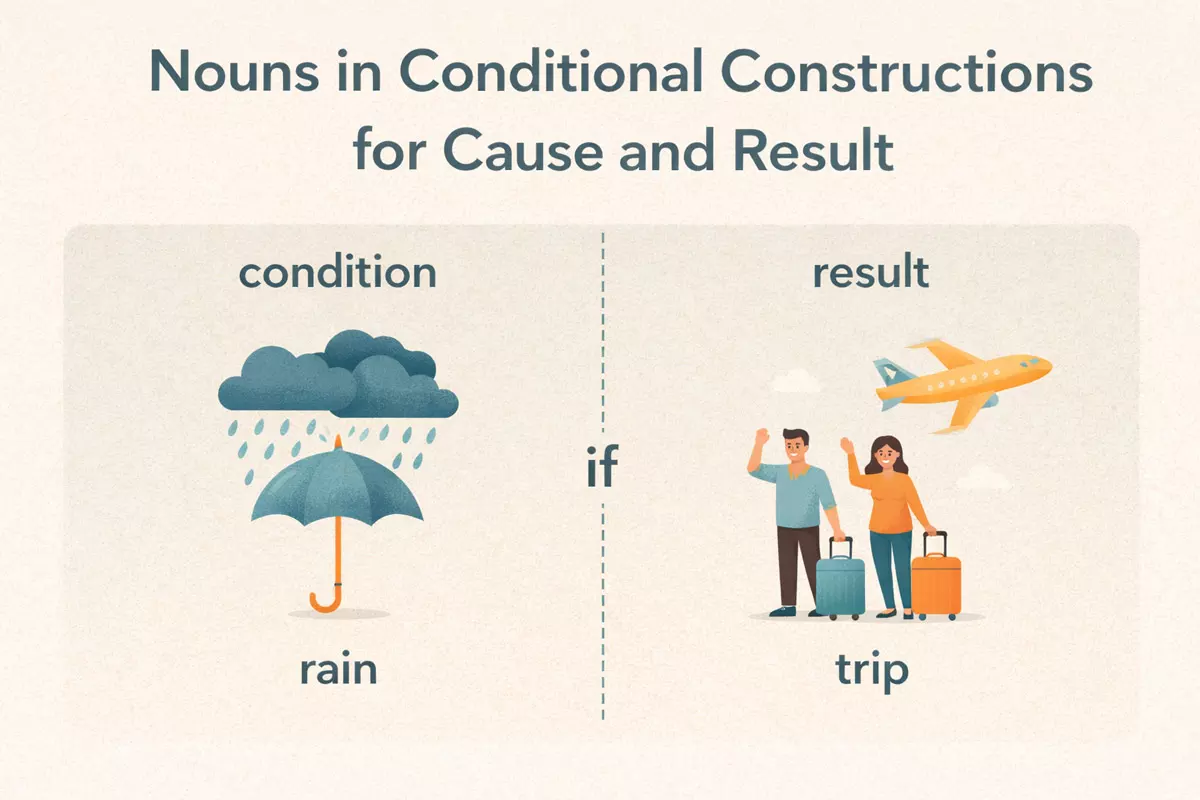 This article explains how nouns function in conditional sentences, covering their use in expressing causes, results, and hypothetical ideas. It discusses first, second, and third conditionals, common errors, and offers practice with noun phrases.
- Role of nouns inside conditional sentence patterns
- Cause and result nouns in if-clauses
- Abstract nouns in hypothetical conditions
- First, second, and third conditional noun usage
- Noun phrases that summarize conditional outcomes
- Common learner errors with conditional noun reference
- Practice: build conditional sentences using noun phrases
Examining the role of naming words in if-then statements sheds light on how language conveys cause-and-effect relationships. When we analyze these sentence structures, we notice that the choice of specific nouns and terms can clarify or obscure the logical flow between conditions and outcomes. Understanding how naming words function within these frameworks helps us appreciate the precision and subtlety required to express reasoning and consequences effectively. This awareness can improve both our comprehension and our own communication skills.
Role of nouns inside conditional sentence patterns
Nouns are essential components in conditional statements, often anchoring the cause or the result. In these patterns, the noun can serve as the subject, object, or even complement, shaping the logic of hypothetical or real scenarios. When forming conditional sentences, the placement and function of the noun often dictate the focus: whether the condition is about a thing, person, event, or concept.
How nouns function within conditional clauses
In conditional sentences, nouns typically appear in both the "if" (protasis) and the "then" (apodosis) clauses. Their roles include:
- Identifying the entity affected by the condition (e.g., If the weather improves, we will go hiking.)
- Marking the cause in the conditional clause (e.g., If rain falls, the ground gets wet.)
- Signaling the result in the main clause (e.g., If you study, good grades will follow.)
- Distinguishing between general truths and specific cases (e.g., If water boils, it turns to steam.)
Common positions for nouns in conditional patterns
Nouns can occupy several syntactic positions, affecting emphasis and clarity. Here are frequent placements:
- Subject of the condition: If the meeting starts late, we will postpone lunch.
- Object: If you see a mistake, please report it.
- Complement: If the answer is correct, you may proceed.
- Within a prepositional phrase: If you are in trouble, call me.
Varieties of noun usage in cause and result
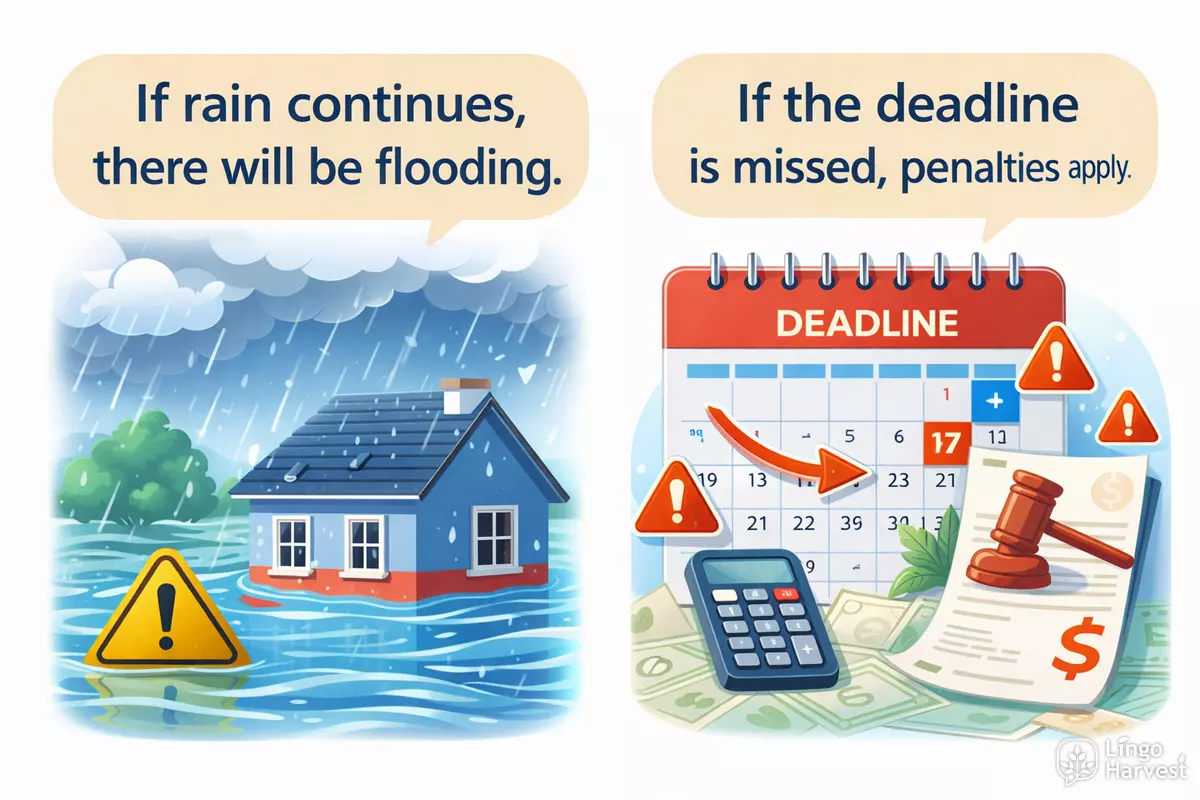
Nouns can specify different types of causes or outcomes. Here are examples illustrating this diversity:
- If rain continues, there will be flooding.
- If the deadline is missed, penalties apply.
- If temperature drops, pipes may freeze.
- If guests arrive early, preparations must be rushed.
- If the signal is lost, the device stops working.
- If motivation wanes, progress slows.
- If the solution is found, the problem ends.
- If the offer stands, we’ll accept it.
- If the law changes, new rules will apply.
- If the engine overheats, stop driving.
- If symptoms persist, consult a doctor.
- If the opportunity arises, seize it.
- If the password is forgotten, reset it.
- If the route is blocked, find an alternative.
- If the invitation is declined, inform the host.
Comparing noun roles in different conditional types
Nouns behave differently depending on the type of conditional (zero, first, second, third). Here is a structured comparison:
| Conditional Type | Noun Example in Condition | Noun Example in Result |
|---|---|---|
| Zero | If water boils | Steam forms |
| First | If the package arrives | A notification will be sent |
| Second | If he had money | He would buy a car |
| Third | If the alarm had sounded | Damage could have been avoided |
By understanding how nouns operate within these patterns, you can clarify both the cause and the effect, ensuring your conditional statements are precise and effective for expressing hypothetical and factual relationships.
Cause and result nouns in if-clauses
When discussing conditional sentences, it's common to focus on verbs, but nouns expressing cause or result also play a vital role. These nouns often clarify what triggers the condition or what outcome is expected, adding precision to conditional statements. Instead of only using clauses like "if it rains," you can use noun phrases such as "if the rain continues" or "if the failure occurs," which make the condition more specific and sometimes more formal.
Common cause and result nouns used in conditionals
Certain nouns frequently appear in "if"-clauses to signal the reason for a condition or its possible outcome. These can include both abstract and concrete terms. Here are some examples commonly found in academic, technical, and everyday English:
- accident
- delay
- failure
- success
- problem
- change
- mistake
- increase
- decrease
- rain
- interruption
- error
- growth
- loss
- achievement
- shortage
- improvement
- breakdown
- accumulation
- discovery
Patterns for using nouns in conditional constructions
You can structure conditionals with these nouns in several ways. Typically, a noun phrase follows "if" and is paired with a verb such as "occurs," "happens," or "exists." These patterns help emphasize either the cause (reason) or the result (outcome) within the conditional framework. Here are some common patterns:
- If + noun + occurs/happens/takes place (e.g., If an error occurs, we will fix it.)
- If there is/are + noun (e.g., If there is a delay, you will be notified.)
- If noun + continues/increases/decreases (e.g., If the shortage continues, prices may rise.)
- If noun + is found/discovered (e.g., If a mistake is found, corrections will be made.)
Comparing cause and result nouns in context
Both cause and result nouns shape the logic of conditional sentences. Cause nouns usually refer to the reason for the condition, while result nouns describe what might happen as a consequence. For clarity, here’s how these nouns function side by side:
| Cause Noun Example | Result Noun Example |
|---|---|
| If a breakdown occurs, | if a solution is found, |
| If an error happens, | if a benefit results, |
| If a delay arises, | if an improvement is achieved, |
| If a problem develops, | if an increase is observed, |
Using precise nouns in "if"-clauses helps communicate both the condition’s trigger and the anticipated outcome. This approach is especially useful in formal writing, reports, and technical communication where clarity and specificity matter.
Abstract nouns in hypothetical conditions
When constructing hypothetical or conditional sentences, abstract nouns often play a crucial role in expressing intangible causes, possible results, or imagined situations. These nouns—such as "freedom," "success," or "failure"—help to generalize conditions and outcomes beyond specific, concrete instances.
Role of Abstract Nouns in Conditional Statements
Abstract nouns allow speakers and writers to discuss scenarios that are not tied to particular people or objects. For instance, in sentences like "If trust existed, cooperation would improve," the word "trust" acts as an abstract cause, while "cooperation" is the abstract result. This pattern is especially common in academic writing, policy discussions, and philosophical arguments.
Common Abstract Nouns Used in Conditional Constructions
Writers frequently employ a range of abstract terms when formulating if-then statements. Here are several you might encounter:
- Freedom
- Justice
- Happiness
- Success
- Failure
- Trust
- Respect
- Peace
- Knowledge
- Growth
- Progress
- Change
- Responsibility
- Equality
- Support
- Innovation
- Motivation
- Confidence
- Security
- Understanding
Patterns for Using Abstract Nouns in If-Clauses
There are several typical ways in which abstract nouns appear within conditional constructions. These patterns help clarify both the hypothetical premise and its imagined outcome:
- If trust is established, collaboration will increase.
- If there were equality, opportunities would be fairer.
- If motivation decreases, performance may suffer.
- If innovation were prioritized, growth could accelerate.
Comparison: Abstract vs. Concrete Nouns in Conditionals
The choice between abstract and concrete nouns can influence the generality or specificity of a conditional. Abstract terms make statements broadly applicable, while concrete nouns tie them to real-world entities. The table below contrasts several examples:
| Abstract Noun Example | Concrete Noun Example |
|---|---|
| If trust is lost, progress stops. | If the key is lost, the door cannot be opened. |
| If knowledge increases, decisions improve. | If the report is updated, results change. |
| If motivation drops, success is unlikely. | If the machine breaks, production halts. |
| If peace is achieved, prosperity follows. | If the agreement is signed, the project begins. |
By choosing abstract nouns, speakers can address broader principles, trends, or hypothetical scenarios, rather than being limited to tangible items or single events. This flexibility is a powerful feature of conditional constructions in both spoken and written communication.
First, second, and third conditional noun usage
Understanding how nouns function in different types of conditional sentences is essential for expressing cause and result clearly in English. Each conditional form—first, second, and third—uses nouns in slightly different ways to frame hypothetical situations, real possibilities, or impossible past events.
First Conditional: Nouns for Real Possibilities
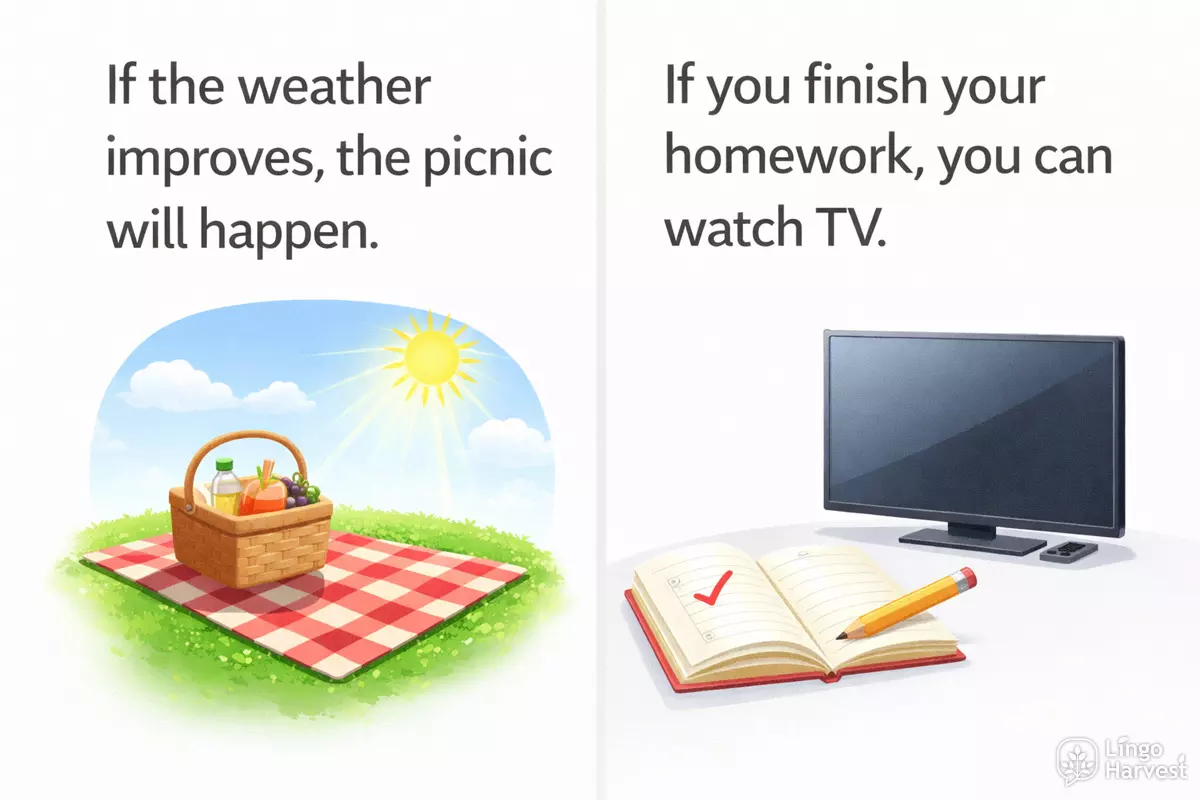
In the first conditional, we talk about likely future outcomes. Nouns often represent real events or objects whose occurrence depends on a possible condition. For example:
- If the weather improves, the picnic will happen.
- If you finish your homework, you can watch TV.
- If the team wins, there will be a celebration.
- If my package arrives, I’ll send you a photo.
Nouns here tend to be tangible or scheduled events, underlining real cause and effect.
Second Conditional: Imagined or Hypothetical Noun Scenarios
The second conditional is used for unreal or unlikely present/future situations. Here, nouns are often abstract or hypothetical, representing dreams, wishes, or unlikely outcomes:
- If I had a million dollars, I would buy a house.
- If she were the president, she would change the law.
- If we owned a car, travel would be easier.
- If there were more time, we could finish the project.
Noun phrases in this context often express unrealized possibilities or hypothetical results.
Third Conditional: Nouns in Impossible Past Situations
When discussing the third conditional, we refer to hypothetical outcomes of past events that did not happen. Nouns here frequently denote missed opportunities or consequences:
- If you had received the invitation, you would have attended the party.
- If they had heard the news, they would have changed their plans.
- If I had brought my umbrella, I would have avoided the rain.
- If she had taken the exam, she might have won a scholarship.
These nouns highlight the cause (event or object) and the resulting effect that was missed or avoided.
| Conditional Type | Example with Noun Usage |
|---|---|
| First Conditional | If the alarm rings, the students will leave the building. |
| Second Conditional | If I had a passport, I would travel to another country. |
| Third Conditional | If he had known about the deadline, he would have submitted the application. |
Common Patterns and Noun Types
Across all conditional forms, the nouns used frequently fall into certain categories:
- Events: party, meeting, trip, exam
- Objects: umbrella, ticket, car, phone
- People or groups: students, team, family, manager
- Abstract concepts: chance, opportunity, problem, solution
- Outcomes/results: success, failure, reward, loss
- Time elements: day, week, deadline, moment
- Weather: rain, snow, storm, sunshine
- Places: office, school, park, city
Selecting the right noun helps clarify the cause and result in each conditional scenario, making your sentences more precise and meaningful.
Noun phrases that summarize conditional outcomes
When discussing conditional constructions, succinct noun phrases often encapsulate the effects or consequences that stem from a particular cause. These expressions allow speakers and writers to refer to complex chains of reasoning or hypothetical scenarios in a compact form. Using such noun phrases helps streamline communication, especially in academic, technical, or analytical contexts where clarity and brevity are valued.
Common structures for encapsulating outcomes
Typically, these noun groups are built from abstract nouns or nominalizations that generalize the result of a condition. For example, rather than saying, "If you don't water the plant, the plant will die," one might summarize the result as "plant death." This approach is particularly useful in formal writing and presentations.
- Failure of the system → The failure of the system caused a temporary shutdown.
- Success of the operation → The success of the operation exceeded expectations.
- Increase in revenue → The increase in revenue followed the new marketing strategy.
- Loss of data → A loss of data occurred after the power outage.
- Achievement of goals → The achievement of goals motivated the entire team.
- Occurrence of side effects → The occurrence of side effects was carefully monitored.
- Reduction in efficiency → A reduction in efficiency was noticed after the update.
- Emergence of problems → The emergence of problems delayed the launch.
- Improvement in performance → Training led to a clear improvement in performance.
- Delay in response → The delay in response frustrated customers.
- Completion of the process → The completion of the process took longer than expected.
- Onset of symptoms → The onset of symptoms occurred within hours.
- Breakdown of communication → A breakdown of communication caused confusion.
- Stabilization of prices → The stabilization of prices helped the market recover.
- Growth in demand → Growth in demand forced the company to expand.
- Decline in quality → Customers complained about a decline in quality.
- Resolution of the issue → The resolution of the issue restored trust.
- Escalation of conflict → The escalation of conflict required mediation.
Comparing explicit and summarized outcome forms
Summarizing with noun phrases can make arguments more concise, but it may obscure some details. The table below contrasts full conditional sentences with their condensed noun phrase equivalents.
| Conditional Sentence | Condensed Noun Phrase |
|---|---|
| If the server crashes, we will lose data. | Loss of data |
| If the project is completed on time, we will achieve our goals. | Achievement of goals |
| If prices remain stable, the economy will improve. | Stabilization of prices |
| If communication fails, problems may arise. | Breakdown of communication |
| If demand increases, production will need to expand. | Growth in demand |
Why these noun phrases matter
Condensed outcome expressions are especially useful for summarizing findings, drawing conclusions, or highlighting potential risks and benefits without restating entire conditional clauses. They serve as shorthand for complex scenarios, making them valuable tools in both spoken and written English.
Common learner errors with conditional noun reference
Learners often struggle with referencing nouns correctly when constructing conditional sentences, which can lead to ambiguity or grammatical mistakes. Understanding how to tie nouns to their correct referents in cause and result clauses is crucial for clarity.
Ambiguous noun reference
Sometimes, it’s unclear which noun a pronoun or reference word points to in a conditional sentence. This usually happens when multiple nouns are present, or when the noun in the "if" clause does not match the one in the "then" clause.
- If the student forgets his book, he cannot do his homework. (Does "his" refer to the student or someone else?)
- If the teacher gives a test, it will be difficult. ("It" clearly refers to "test", but sometimes this is less clear.)
Incorrect noun form or number
Choosing the wrong singular or plural form can change the meaning or cause confusion, especially in result clauses.
- If a dog barks, they may be hungry. (Mismatch in number: "a dog" vs. "they")
- If students finish early, he can leave. (Mismatch: "students" vs. "he")
Overusing or omitting nouns unnecessarily
Repeating nouns where a pronoun would suffice, or omitting necessary nouns, can both be problematic.
- If the weather is bad, the weather will delay the flight. (Repetition; should use "it")
- If she reads, will understand? (Missing pronoun or noun in the result clause)
Typical missteps and improved alternatives
Below is a comparison of common errors and their corrected versions:
| Incorrect Example | Corrected Version |
|---|---|
| If a child loses their toy, he will cry. | If a child loses his or her toy, he or she will cry. Or: If children lose their toys, they will cry. |
| If the manager approves the plan, they will start the project. | If the manager approves the plan, he or she will start the project. |
| If the lights goes out, it will be dark. | If the lights go out, it will be dark. Or: If the light goes out, it will be dark. |
| If students submit late, he will lose marks. | If students submit late, they will lose marks. |
Checklist: How to avoid reference errors in conditionals
- Check that pronouns match the number and gender of the noun they refer to.
- Replace repeated nouns with clear pronouns when possible.
- Ensure each pronoun or noun has a clear, unambiguous antecedent.
- Re-read your sentence to see if a reader could confuse who or what is being referred to.
- Be consistent with noun forms (singular/plural) throughout both parts of the conditional.
Careful attention to these details will help learners express cause and result relationships accurately and avoid common pitfalls in conditional constructions.
Practice: build conditional sentences using noun phrases
When working with conditionals, noun phrases often play a crucial role in expressing causes and results. Let’s explore how to form such sentences and practice recognizing and creating them.
Patterns for Conditional Sentences with Noun Phrases
Mastering conditionals with noun groups involves understanding how to combine them with “if,” “unless,” or similar conjunctions. Here are some common structures:
- If + noun phrase (subject) + verb, noun phrase (result) + verb.
- Unless + noun phrase + verb, noun phrase + verb.
- Noun phrase (cause) + leads to + noun phrase (result).
- Given + noun phrase, noun phrase + verb.
Examples: Cause and Result with Noun Phrases
Below are several examples illustrating how noun phrases work in conditional contexts:
- If the heavy rain continues, the river banks will overflow.
- Unless proper documentation is provided, your application will be delayed.
- A lack of sleep results in poor concentration.
- If the new policy is implemented, employee satisfaction may increase.
- Given the current economic situation, investments are risky.
- If the temperature drops below zero, water pipes may freeze.
- Unless the project deadline changes, the team will need to work overtime.
- Frequent power outages cause inconvenience for residents.
- If the patient’s symptoms worsen, additional tests will be ordered.
- Without a valid ticket, entry is not permitted.
- In case of fire, evacuation procedures must be followed.
- If the shipment arrives late, production schedules will be affected.
- High demand leads to increased prices.
- If the weather improves, the event will be held outdoors.
- Insufficient information results in confusion.
Practice: Complete the Sentences
Fill in each blank with an appropriate noun phrase to form a meaningful conditional sentence.
- If _____________ is not available, the meeting will be postponed.
- Unless _____________ improves, customer complaints will rise.
- _____________ causes delays in delivery.
- If _____________ is approved, construction can begin.
- Without _____________, the process cannot continue.
- If _____________ fails, the entire system will shut down.
- Unless _____________ is completed on time, the launch will be delayed.
- _____________ affects employee motivation.
- If _____________ is detected early, damage can be minimized.
- Without _____________, the agreement is invalid.
Show answers
- the conference room
- product quality
- traffic congestion
- the budget
- proper authorization
- the power supply
- the testing phase
- workplace culture
- a security breach
- a valid signature
Transformations: Rewriting for Clarity
Rewrite each sentence by replacing the clause in parentheses with a clear noun phrase.
- If (people do not have enough information), mistakes will happen.
- (If the weather is bad), the flight will be cancelled.
- (When there is high demand), prices increase.
- Unless (the team submits the report), the process will stall.
- If (customers do not receive support), satisfaction will drop.
- (When the system fails), operations stop.
- If (employees lack training), errors become more frequent.
- Unless (approval is granted), the project cannot proceed.
- (When costs rise sharply), profits decline.
- If (communication breaks down), misunderstandings occur.
Show answers
- If insufficient information is available, mistakes will happen.
- If bad weather occurs, the flight will be cancelled.
- High demand causes prices to increase.
- Unless the team’s report is submitted, the process will stall.
- If adequate support is not provided, customer satisfaction will drop.
- System failure causes operations to stop.
- If proper training is lacking, errors become more frequent.
- Unless approval is granted, the project cannot proceed.
- Rising costs lead to a decline in profits.
- If communication breaks down, misunderstandings occur.
Quick Check: Identify the Noun Phrases
In the following conditional sentences, highlight the noun phrase that acts as the cause or result.
- If the new system fails, data loss may occur.
- Without careful planning, errors are likely.
- High temperatures lead to equipment failure.
- If the contract is signed, work can start immediately.
- Lack of communication causes misunderstandings.
- If security measures are weak, breaches may happen.
- Excessive workload results in employee burnout.
- If funding is approved, the project will expand.
- Poor maintenance leads to frequent breakdowns.
- If deadlines are missed, penalties may apply.
Show answers
- the new system (cause), data loss (result)
- careful planning (cause), errors (result)
- high temperatures (cause), equipment failure (result)
- the contract (cause), work (result)
- lack of communication (cause), misunderstandings (result)
- weak security measures (cause), breaches (result)
- excessive workload (cause), employee burnout (result)
- approved funding (cause), project expansion (result)
- poor maintenance (cause), breakdowns (result)
- missed deadlines (cause), penalties (result)