Event Nouns vs Action Nouns in English Grammar Explained

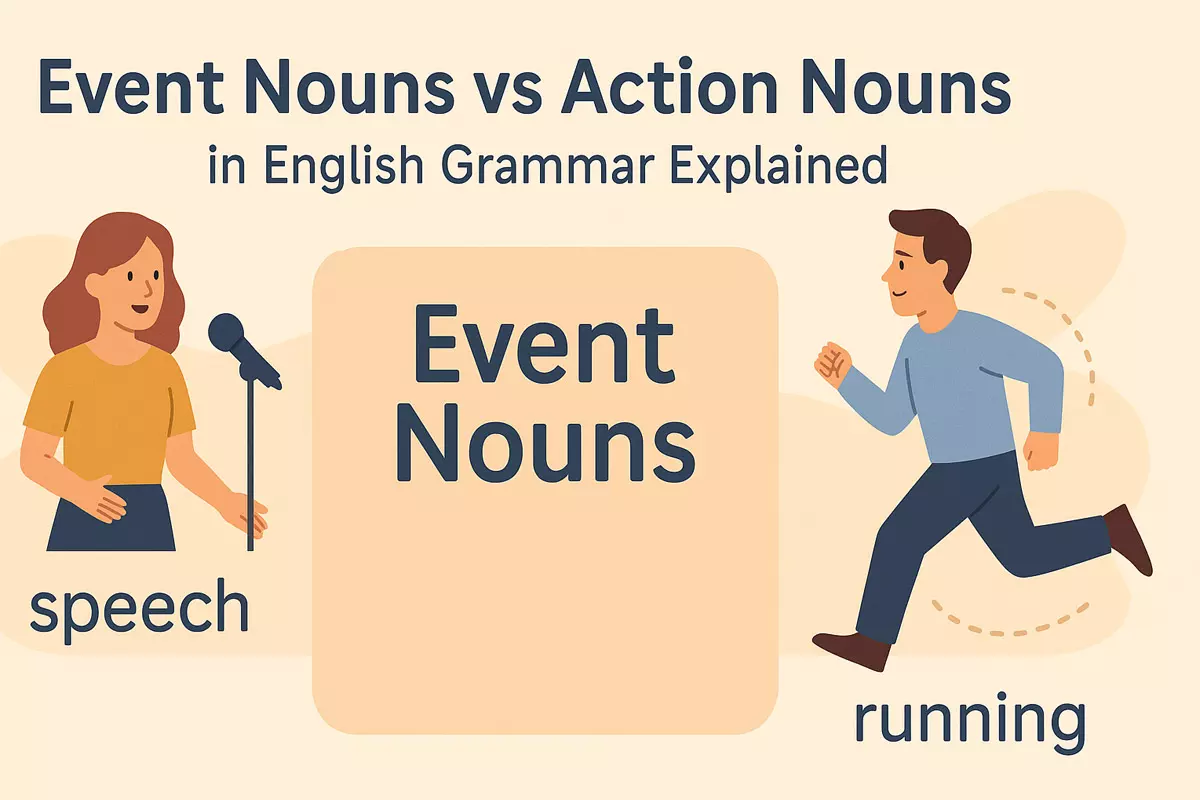 The article explains how event nouns emphasize outcomes or occasions while action nouns highlight processes or activities. It provides verb–noun pairs, context clues for usage, common learner mistakes, and practice in choosing the correct noun type.
- Difference between event and action nouns
- How event nouns focus on outcomes and occasions
- How action nouns focus on processes and activities
- Common verb–noun pairs showing event vs action
- Context clues for choosing the correct noun type
- Typical learner confusion between events and actions
- Practice: choose correct noun types in short contexts
Have you ever noticed that some English nouns refer to the process of something happening, while others point to the actual event itself? Recognizing the distinction between words that describe actions in progress and those that denote completed events can help us communicate more precisely. This understanding allows us to choose the right noun for the context, making our language clearer and more effective when we talk about experiences, processes, or results.
Difference between event and action nouns
Understanding how these two types of nouns function in English grammar helps clarify meaning and sentence structure. Both event nouns and action nouns are derived from verbs, but they serve different roles and convey distinct nuances.
What are event nouns?
Event nouns describe an occurrence or a happening, often emphasizing the result, state, or outcome rather than the process itself. These words typically refer to something that has taken place or exists as an entity, rather than focusing on the activity. For example, “arrival,” “explosion,” and “decision” all indicate that something has happened or been completed.
What are action nouns?
Action nouns, on the other hand, refer directly to the process or activity itself. They highlight the ongoing or repeated nature of an action, such as “running,” “singing,” or “negotiation.” These nouns emphasize the dynamic aspect of the verb they are derived from.
Key distinctions summarized
Below is a structured comparison highlighting the main differences between these noun types:
| Aspect | Event Nouns | Action Nouns |
|---|---|---|
| Focus | The outcome or result of an action | The process or activity itself |
| Typical Endings | -al, -ion, -ment, -ance | -ing, -tion (when describing process) |
| Examples | arrival, explosion, agreement, performance | running, singing, driving, negotiation |
| Use in Sentences | Refers to a completed or defined event Her arrival was unexpected. |
Describes ongoing or habitual action Running improves health. |
Common patterns and examples
- Event nouns: completion, departure, explosion, invention, movement, admission, performance, announcement, agreement, formation
- Action nouns: swimming, reading, writing, negotiating, dancing, discussing, traveling, cooking, learning, building
How to recognize them in context
Event nouns often answer “what happened?” or “what was the outcome?” Meanwhile, action nouns typically respond to “what is/was being done?” or “what activity is involved?” Recognizing these subtle differences can improve both comprehension and clarity in writing and speaking.
How event nouns focus on outcomes and occasions
Event nouns in English draw attention to the result or circumstance of an action, rather than the process itself. These words encapsulate a whole happening or its effect, allowing speakers to talk about completed or specific instances without detailing how they unfolded. For example, "arrival" refers to the fact that someone has reached a place, not to the act of traveling.
Highlighting results and completed happenings
When we use nouns like "explosion," "decision," or "change," the emphasis is on what has taken place or what outcome was achieved. This quality makes event nouns useful for summarizing stories, reports, or experiences. They help us answer questions like "What happened?" or "What was the outcome?" rather than "How did it happen?"
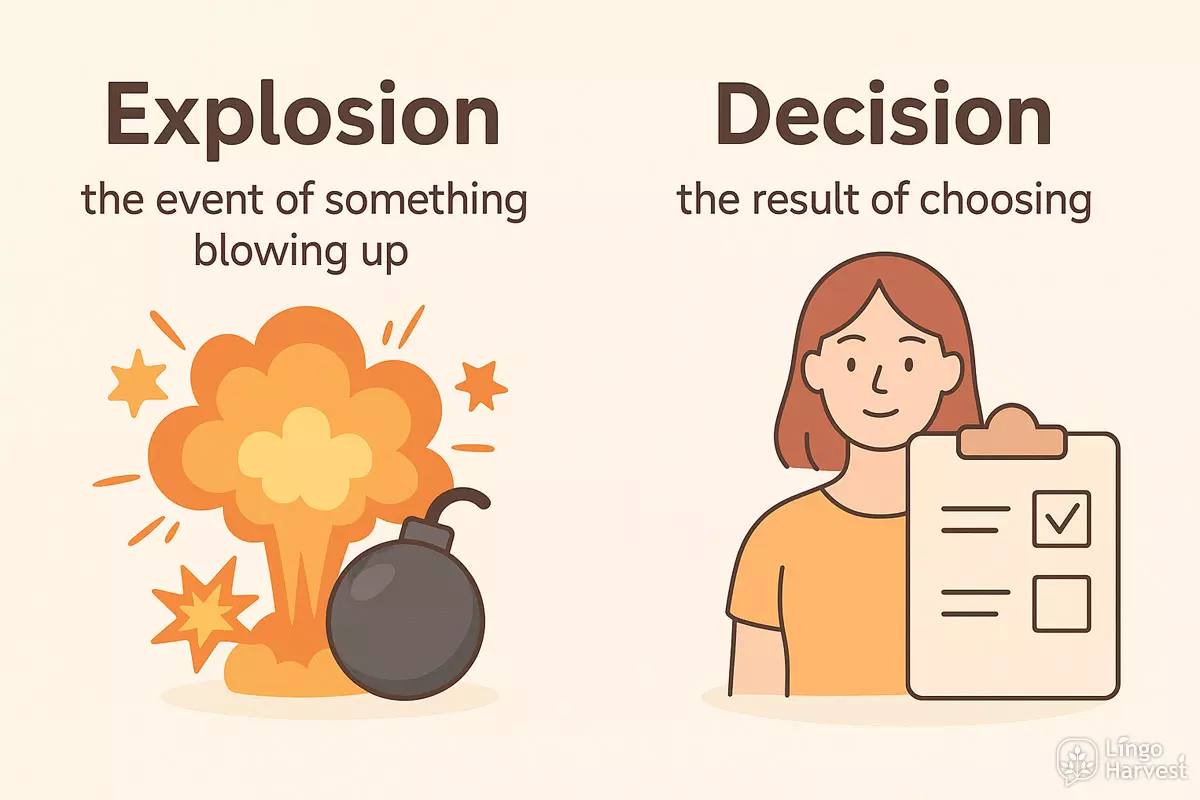
- Explosion – the event of something blowing up
- Decision – the result of choosing
- Change – the occurrence of something becoming different
- Meeting – the occasion when people come together
- Failure – the event of not succeeding
- Visit – the occasion of going to see someone or somewhere
- Discovery – the finding of something new
- Breakdown – the event of something ceasing to function
- Graduation – the completion of a course of study
- Launch – the event of starting or sending off
- Opening – the occasion of beginning or becoming accessible
- Closure – the ending of an activity or institution
- Departure – the act or instance of leaving
- Accident – an unexpected event, often negative
- Appointment – a scheduled meeting or arrangement
- Celebration – the event of marking a special occasion
- Injury – the occurrence of harm or damage
- Success – the achievement of a goal
Occasions vs. processes
Event nouns often refer to the time or place where something significant occurs. This makes them distinct from action nouns, which focus on the ongoing process. For instance, "competition" names the entire sporting event, not the act of competing, while "interruption" signals the moment something was stopped.
Examples in context
Using these nouns in sentences highlights their role:
- The announcement surprised everyone. (focus on the outcome, not how it was made)
- Her arrival marked the beginning of the meeting. (the fact of being there, not the journey)
- After the breakdown, the project was delayed. (the result, not the process of failing)
This approach to naming events allows English speakers to efficiently discuss results, notable occasions, and completed happenings without focusing on the steps involved.
How action nouns focus on processes and activities
Action nouns, also called verbal nouns, highlight the dynamic nature of an event by naming the process or activity itself. Unlike event nouns, which often refer to specific occurrences or completed outcomes, these nouns direct attention to what is happening or being done, rather than to the result or the event as a whole.
Understanding action nouns in context
When using an action noun, the focus shifts to the ongoing or habitual action. For example, in the sentence His running improved over the summer, "running" draws attention to the activity itself, not a particular race or event. This is common in both formal and informal English, especially when discussing processes, routines, or skills.
Common patterns and examples
Action nouns are typically formed by adding suffixes such as -ing, -tion, or -ment to verbs. Here are some frequent examples:
- Running → Running helps improve cardiovascular health.
- Swimming → Swimming is a low-impact form of exercise.
- Discussion → The discussion lasted over an hour.
- Development → Product development takes time and testing.
- Teaching → Teaching requires patience and clear communication.
- Preparation → Good preparation reduces stress.
- Movement → Movement was restricted during the event.
- Writing → Writing helps organize your thoughts.
- Investigation → The investigation revealed several issues.
- Training → Training begins next Monday.
- Exploration → Space exploration requires advanced technology.
- Planning → Careful planning is essential for success.
- Building → Building started earlier than expected.
- Learning → Learning continues throughout life.
- Negotiation → Negotiation led to a fair agreement.
- Reading → Reading before bed helps me relax.
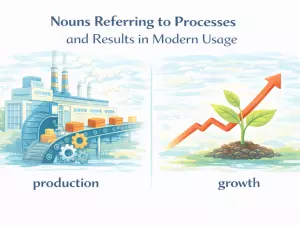
- Production → Production increased after the upgrade.
- Expansion → Expansion into new markets is planned.
How action nouns differ from event nouns
Action nouns are best understood by comparing them with event nouns. While both relate to verbs, their nuance in meaning and use changes the focus of a sentence.
| Action Noun (Process) | Event Noun (Occurrence) |
|---|---|
| Training (the act of training) | Session (a specific training event) |
| Writing (the process of writing) | Publication (a completed written work) |
| Negotiation (the act of negotiating) | Agreement (the result of negotiation) |
| Development (the process of developing) | Launch (a specific event of starting something) |
| Preparation (the act of preparing) | Event (a planned occasion) |
Using action nouns for emphasis and clarity
Writers and speakers often choose action nouns to emphasize the activity or the ongoing nature of what is being discussed. For example, saying Her teaching is inspiring highlights the process, whereas Her lecture was inspiring refers to a specific event. This distinction can provide clarity and precision in communication, especially in academic, technical, or instructional contexts.
Practice: Identify the action noun
For each sentence, choose the word that serves as the action noun.
- The preparation for the conference took months.
- We admired his painting of landscapes.
- The discussion helped everyone understand the topic.
- She enjoys writing in her free time.
- Regular training improved the team’s performance.
- Careful planning prevented major mistakes.
- The investigation uncovered new evidence.
- The company’s development of the app took a year.
- His reading of the poem was dramatic.
- The expansion of the business created new jobs.
Show answers
- preparation
- painting
- discussion
- writing
- training
- planning
- investigation
- development
- reading
- expansion
Common verb–noun pairs showing event vs action
Understanding how certain verbs naturally pair with either event nouns or action nouns can help clarify their meaning and usage in English. These pairings often reflect whether we are talking about a one-time occurrence (event) or the process/activity itself (action). Recognizing these combinations is useful for both comprehension and accurate expression.
Typical verb–noun pairings
Some verbs tend to collocate with event nouns, others with action nouns, and a few work with both, but the meaning subtly shifts. Consider these examples:
- Hold a meeting (event) vs. do research (action)
- Have an accident (event) vs. perform surgery (action)
- Experience a delay (event) vs. give assistance (action)
- Attend a ceremony (event) vs. make progress (action)
- Host a party (event) vs. take measurements (action)
- Witness a crash (event) vs. conduct an investigation (action)
- Organize a conference (event) vs. offer advice (action)
- Celebrate a victory (event) vs. carry out repairs (action)
- Report an incident (event) vs. provide support (action)
- Announce a launch (event) vs. give instructions (action)
- Face a disaster (event) vs. offer assistance (action)
- Survive an earthquake (event) vs. perform maintenance (action)
- Witness a performance (event) vs. make an effort (action)
- Join a protest (event) vs. take action (action)
Comparison of verb–noun pairs: event vs action
In some cases, the same verb can be used with both an event noun and an action noun, but the meaning or nuance shifts. See the table below for illustrative contrasts:
| Verb + Event Noun | Verb + Action Noun |
|---|---|
| attend a wedding | do training |
| organize an exhibition | give feedback |
| report an emergency | perform analysis |
| join a strike | make improvements |
| celebrate a birthday | offer clarification |
| host a seminar | take responsibility |
Notice how event nouns typically refer to a specific happening or occurrence, while action nouns express the process, effort, or activity. This distinction affects which verbs are natural partners, and helps avoid awkward or incorrect combinations in English sentences.
Context clues for choosing the correct noun type
When deciding whether to use an event noun or an action noun, pay attention to the surrounding words and the overall meaning of the sentence. The structure, verbs, and prepositions nearby can all hint at which noun form is most appropriate. Understanding these signals helps make your writing clearer and more precise.
Typical signals for event nouns
Event nouns often refer to occasions, happenings, or outcomes. These nouns are generally used with time expressions or when discussing something as a “thing” rather than a process. Look for these clues:
- Prepositions like during, after, or before (e.g., during the meeting)
- Articles such as the or a before the noun (e.g., the interruption was unexpected)
- Adjectives describing qualities or characteristics (e.g., a successful negotiation)
- Context where the noun is a countable unit (e.g., three arrivals yesterday)
- Use as the subject or object of a sentence about results (e.g., The decision surprised us.)
Typical signals for action nouns
Action nouns refer more directly to the act or process itself, rather than its result or occurrence. To spot them, look for:
- Verbs like by or through indicating means or method (e.g., by running, through reading)
- Absence of an article, especially in general statements (e.g., Swimming is good exercise.)
- Use with verbs such as enjoy, avoid, start (e.g., I enjoy learning.)
- When the noun acts as a general activity or state (e.g., Listening is important.)
- Preceded by possessive forms (e.g., her teaching is excellent.)
Comparison of event and action noun patterns
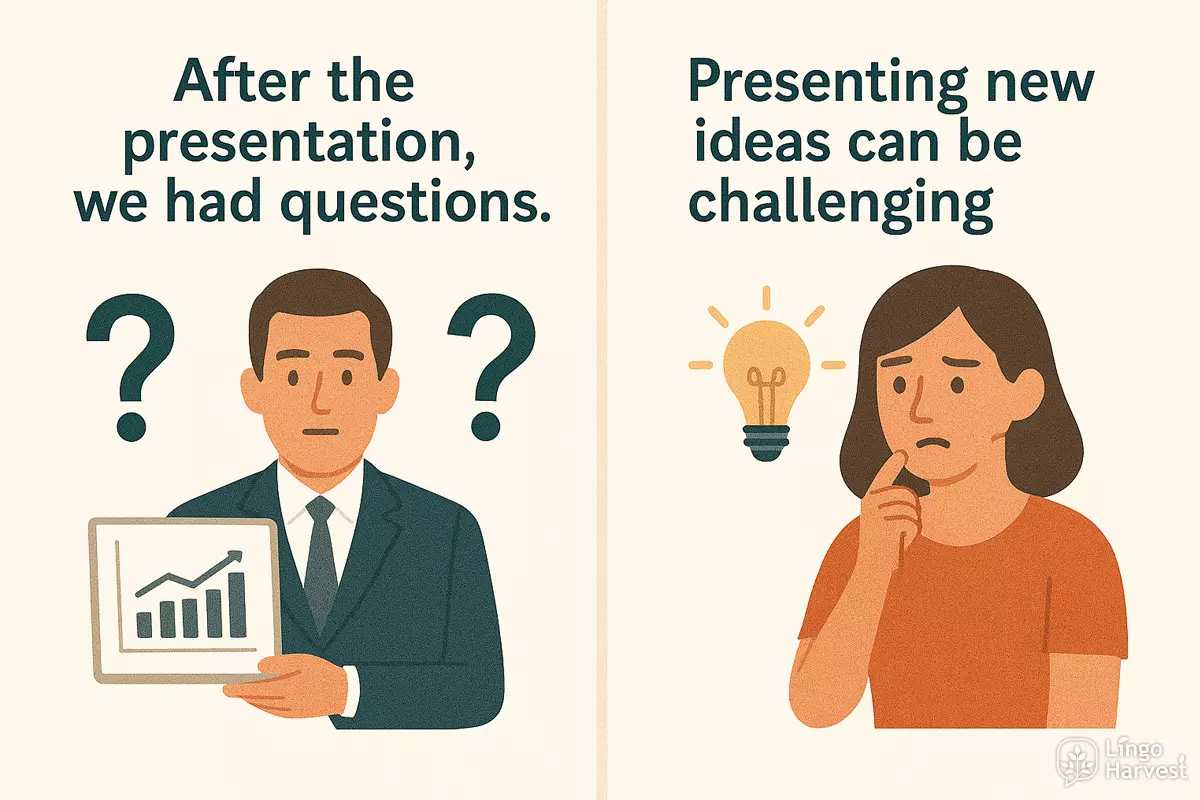
| Context Example | Noun Type Used |
|---|---|
| After the presentation, we had questions. | Event noun (focus on the occurrence) |
| Presenting new ideas can be challenging. | Action noun (focus on the process) |
| Her arrival was unexpected. | Event noun (emphasizes the result of arriving) |
| Arriving early helps reduce stress. | Action noun (emphasizes the act of arriving) |
| The discussion lasted two hours. | Event noun (refers to the meeting itself) |
| Discussing ideas openly encourages creativity. | Action noun (refers to the ongoing activity) |
Quick checklist for identifying noun types
- ✅ Is the noun countable and used with articles? Likely an event noun.
- ✅ Does it describe a process, activity, or general state? Probably an action noun.
- ✅ Are time expressions or adjectives indicating result present? Event noun fits.
- ✅ Is it paired with verbs like “enjoy,” “avoid,” or “prefer”? Action noun is typical.
- ✅ Is the sentence about an occurrence or a method? This helps distinguish between the types.
By observing these patterns and signals, you can confidently select the most natural and accurate noun form for your sentence. This not only aids clarity but also enhances your overall grammar skills in English.
Typical learner confusion between events and actions
Many English learners find it tricky to distinguish between nouns that refer to occurrences (event nouns) and those that refer to the process or act itself (action nouns). This is especially challenging when words look similar or when both forms can appear in similar contexts. The confusion often leads to awkward sentences or subtle meaning mistakes.
Common sources of misunderstanding
- Similar endings: Words ending in -ion, -ment, or -ing can be either category, making it hard to tell them apart.
- L1 interference: Learners may rely on patterns from their native language, which don’t always match English usage.
- Context overlap: Some nouns can describe both the process and the event, depending on context, adding to the confusion.
Typical mistakes in usage
Learners sometimes select the wrong noun, resulting in sentences that sound odd or change the intended meaning. Consider these examples:
- Using “arrival” (event) instead of “arriving” (action): “The arriving of the train was late.” ❌ Correct: “The arrival of the train was late.” ✅
- Mixing up “decision” (event) and “deciding” (action): “The deciding was difficult.” ❌ Correct: “The decision was difficult.” ✅
- Confusing “movement” (event) with “moving” (action): “His movement to the city took a week.” (ambiguous) vs. “His moving to the city took a week.” (clear process)
Event nouns vs. action nouns: key differences
| Event Nouns | Action Nouns | Typical Usage Example |
|---|---|---|
| arrival | arriving | The arrival of spring |
| decision | deciding | Her decision surprised us |
| movement | moving | Movement of planets |
| appointment | appointing | The appointment was at 3pm |
| change | changing | A change in policy |
| failure | failing | Failure to attend |
| growth | growing | Growth of the company |
| loss | losing | Loss of keys |
| agreement | agreeing | Agreement was reached |
| development | developing | Development of skills |
Practical tips to avoid confusion
- Check if the noun refers to a completed occurrence or the ongoing process.
- Look for clues in the sentence: event nouns often fit after “the” and before “of,” while action nouns may follow verbs like “enjoy,” “start,” or “continue.”
- Practice with real examples and notice how native speakers use these forms in context.
Understanding the subtle distinctions between these types of nouns helps learners communicate more precisely and naturally in English.
Practice: choose correct noun types in short contexts
Getting comfortable with event nouns and action nouns in English means recognizing them in real sentences and using them accurately. Below, you’ll find short practice activities and example-rich tasks to help you distinguish between these two noun types. Each activity uses authentic, concise contexts to test your understanding and build confidence.
Task 1: Identify the Noun Type
Read each sentence and decide if the highlighted noun is an event noun (describing an occurrence or happening) or an action noun (referring to the process or act itself).
- The arrival of the guests was delayed by traffic.
- Her decision surprised everyone.
- The discussion lasted for two hours.
- We celebrated the opening of the new park.
- His movement was slow after the injury.
- The growth of the company has been impressive.
- She admired the creation of the artist.
- The explosion was heard across town.
- Our negotiation ended with an agreement.
- The statement clarified the issue.
Show answers
- Event noun
- Event noun
- Action noun
- Event noun
- Action noun
- Event noun
- Event noun
- Event noun
- Action noun
- Event noun
Task 2: Choose the Correct Noun
Select the most suitable noun for each blank. Options include both event and action nouns.
- The sudden ___________ of laughter broke the silence. (explosion / explaining)
- After a long ___________, the team reached a decision. (discussion / discuss)
- We witnessed the ___________ of the new bridge. (opening / operate)
- Her ___________ of the rules was impressive. (understanding / understand)
- The quick ___________ of the problem surprised everyone. (solution / solve)
- The ___________ of the report took several hours. (preparation / prepare)
- His calm ___________ helped resolve the conflict. (response / respond)
- The ___________ of the plan caused confusion. (announcement / announce)
- The ___________ of the experiment was unexpected. (outcome / out)
- The ___________ of the city continues rapidly. (expansion / expand)
Show answers
- explosion
- discussion
- opening
- understanding
- solution
- preparation
- response
- announcement
- outcome
- expansion
Common Event vs Action Nouns: Comparison Table
This table shows typical pairs of related event and action nouns, helping you spot patterns and differences.
| Action Noun (Process/Act) |
Event Noun (Result/Occurrence) |
|---|---|
| negotiation | agreement |
| discussion | decision |
| movement | arrival |
| creation | product |
| preparation | event |
| explaining | explanation |
| training | achievement |
| writing | publication |
| studying | exam |
| investigating | discovery |
Quick Check: Spot the Pattern
Look at the list below and say which items are more likely to be event nouns. (No need to answer in writing—just check your intuition.)
- arrival
- teaching
- explosion
- movement
- party
- training
- decision
- operation
- graduation
- studying
- conference
- choosing
- celebration
- reading
- announcement
- running
- opening
- preparing
Show answers
- arrival
- explosion
- party
- decision
- graduation
- conference
- celebration
- announcement
- opening
Practicing with these real-world examples helps you develop an instinct for distinguishing between nouns that describe actions or processes and those that refer to results or events. Over time, this awareness will make your English more precise and natural.