Deverbal Nouns vs Gerunds in Academic Writing Usage

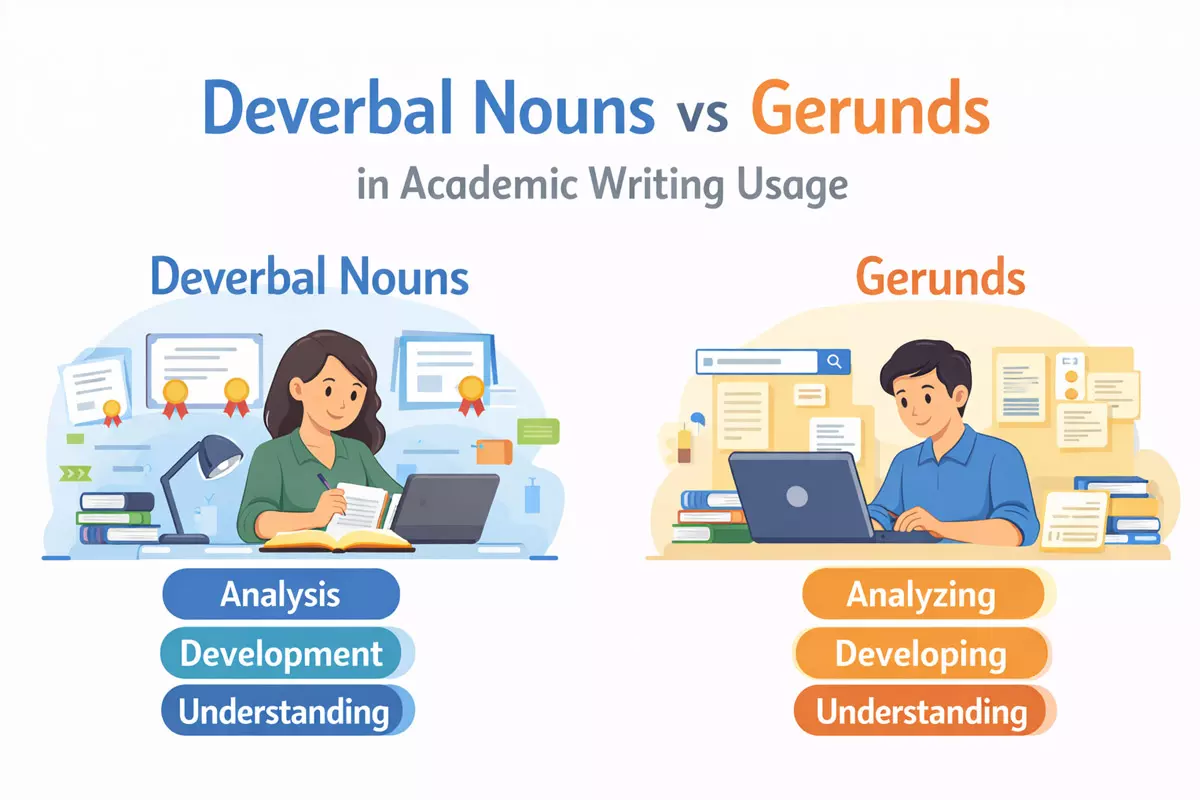 This article defines deverbal nouns in academic English, contrasts them with gerunds, and explains their role in creating dense, nominal style. It also covers article and modifier use, common learner errors, and offers practice rewriting sentences with deverbal nouns.
- What deverbal nouns are in academic English
- Structural difference between deverbal nouns and gerunds
- Information density and nominal style
- Article and modifier behavior with deverbal nouns
- Preference for deverbal nouns in formal writing
- Typical learner errors with verb-based noun forms
- Practice: rewrite sentences using deverbal nouns
Understanding the subtle differences between noun forms derived from verbs and verb-based nominal expressions can be challenging for academic writers, but mastering these distinctions is essential for producing clear and sophisticated scholarly prose. By recognizing how each functions within academic writing, authors can improve the precision and impact of their arguments, making their work more persuasive and professional. Developing this skill not only enhances clarity but also demonstrates a strong command of academic conventions and style.
What deverbal nouns are in academic English
Deverbal nouns are words that originate from verbs but function as nouns in sentences. In academic English, these forms are especially common, as they allow writers to discuss actions, processes, or results in a more abstract or formal way. These nouns often carry a sense of generalization or categorization, which is valuable for scholarly analysis.
Formation and Examples

Most deverbal nouns are created by adding specific suffixes to verb roots. Common suffixes include -tion, -ment, -ance, -ence, and -al. Here are some typical examples found in academic texts:
- Analysis (from analyze) → The analysis revealed several key weaknesses in the system.
- Development (from develop) → The development of the app took more than a year.
- Observation (from observe) → Her observation helped us understand the problem better.
- Admission (from admit) → His admission surprised everyone in the room.
- Performance (from perform) → Her performance shocked the audience in a good way.
- Reference (from refer) → Please add a reference to support this argument.
- Creation (from create) → The creation of new jobs boosted the local economy.
- Assessment (from assess) → The assessment showed excellent progress.
- Approval (from approve) → We received approval to start the project.
- Resistance (from resist) → Their resistance slowed down the negotiations.
- Attendance (from attend) → Attendance at the event reached 2,000 people.
- Explanation (from explain) → His explanation made the topic clear.
- Publication (from publish) → Her publication changed the academic field.
- Application (from apply) → Your application has been accepted.
- Suggestion (from suggest) → His suggestion improved the workflow.
- Movement (from move) → The movement of goods increased last year.
- Measurement (from measure) → Precise measurement is necessary in this experiment.
- Organization (from organize) → Good organization saves time and reduces stress.
How Deverbal Nouns Function in Academic Contexts
In research writing, these nouns let authors refer to complex actions or phenomena as discrete concepts. For example, instead of describing the act of analyzing data, a writer might refer to "the analysis" as a stage in their methodology. This supports concise, objective, and impersonal style—hallmarks of scholarly communication. Deverbal nouns typically:
- Serve as subjects or objects in sentences (e.g., "The observation was significant.")
- Appear in titles and headings (e.g., "Development of New Methods")
- Are often modified by adjectives (e.g., "systematic assessment")
- Allow for generalization about processes or results
Common Suffixes and Their Functions
Below is a comparison of frequent deverbal noun suffixes and the meanings they convey in academic vocabulary:
| Suffix | Function/Meaning | Example |
|---|---|---|
| -tion / -sion | Action, process, result | Evaluation, conclusion |
| -ment | Result, means, state | Agreement, achievement |
| -ance / -ence | State, quality, action | Attendance, reference |
| -al | Action, result of action | Approval, removal |
| -ure | Process, function, result | Exposure, closure |
Why Use Deverbal Nouns?
Writers choose these forms for clarity and precision. They support the abstract, impersonal tone preferred in academic genres, allowing ideas to be discussed as entities rather than as actions performed by specific people. This helps keep the writing objective and focused on information rather than agency. In summary, these noun forms derived from verbs are integral to academic English, providing a toolkit for expressing complex ideas with clarity and formality.
Structural difference between deverbal nouns and gerunds
When comparing deverbal nouns and gerunds, their forms and grammatical behavior in sentences reveal key distinctions. Both originate from verbs, but their function, appearance, and usage in academic writing can be quite different.
Form and Morphology
Deverbal nouns are typically created by adding suffixes such as -tion, -ment, -ance, -al, or -ing to a verb root. Gerunds, by contrast, always take the -ing form of the verb. While they may look similar, their syntactic roles and modifiers set them apart.
Grammatical Function
Gerunds always act as nouns, but they retain some verbal properties. They can take objects and be modified by adverbs, resembling verbs in some contexts. Deverbal nouns, however, behave as full nouns: they may take articles, be modified by adjectives, and rarely take direct objects.
Comparison of Key Features
| Feature | Deverbal Noun | Gerund |
|---|---|---|
| Typical Suffixes | -tion, -ment, -ance, -al, -ing | -ing only |
| Can Take an Article | ✅ (e.g. the decision) | ❌ (e.g. the running is rare outside special contexts) |
| Modified By | Adjectives (e.g. quick recovery) | Adverbs (e.g. quickly running) |
| Can Take Objects | Rarely (e.g. the examination of data) | Frequently (e.g. examining data) |
| Plural Forms | ✅ (e.g. decisions) | ❌ (gerunds are generally uncountable) |
| Position in Sentence | Subject, object, after prepositions | Subject, object, after prepositions |
Examples and Patterns
- Deverbal Nouns: completion, agreement, movement, observation, explanation, admission, translation, development, application, description, decision, arrangement, performance, discussion, assignment, presentation, construction, suggestion, implementation, improvement
- Gerunds: running, reading, writing, studying, analyzing, researching, discussing, presenting, observing, describing, developing, implementing, improving, explaining, admitting, translating, performing, constructing, arranging, suggesting
Understanding these structural distinctions helps writers select the most precise form for their academic context. Deverbal nouns offer a more abstract or general sense, while gerunds often focus on the action itself. The choice impacts both clarity and tone in scholarly prose.
Information density and nominal style
In academic writing, the choice between deverbal nouns and gerunds often reflects an author’s need for compactness and precision. Deverbal nouns—nouns derived from verbs—allow writers to pack more information into a sentence, supporting a denser, more abstract style. By contrast, gerunds, which are verb forms functioning as nouns, tend to retain more of the syntactic features of verbs, making sentences slightly more dynamic but less compact.
How nominalization increases density
Transforming verbs into nouns (nominalization) enables the grouping of complex actions or processes into single units. This is especially useful in scientific and technical texts, where clarity and brevity are valued. For example, “analysis of data” (deverbal noun) is often preferred over “analyzing data” (gerund) when summarizing results or procedures.
- Allows for more modifiers and prepositional phrases
- Enables chaining of concepts (e.g., “evaluation of the effectiveness of interventions”)
- Supports passive or agentless constructions
- Often used in titles and section headings
- Facilitates formal tone and abstraction
- Can obscure agency or responsibility (sometimes intentionally)
- Helps avoid repetition of verbs
- Encourages use of technical terms
- Common in reporting results and objectives
- Useful for summarizing complex actions
Comparing sentence structures
The structure of a sentence changes depending on whether a deverbal noun or a gerund is used. Deverbal nouns typically require supporting words (articles, prepositions, adjectives), while gerunds fit more naturally into verb-based clauses.
| Deverbal Noun Example | Gerund Example |
|---|---|
| The implementation of the policy improved efficiency. | Implementing the policy improved efficiency. |
| Our investigation revealed new patterns. | Investigating the data revealed new patterns. |
| The measurement of temperature was precise. | Measuring temperature was precise. |
| After the completion of the experiment, the results were analyzed. | After completing the experiment, the results were analyzed. |
| The identification of variables is crucial. | Identifying variables is crucial. |
Nominal style: benefits and drawbacks
While the nominal style can enhance succinctness and facilitate complex argumentation, it may also reduce readability, especially for readers less familiar with dense academic prose. Overuse of deverbal nouns can lead to abstract, impersonal writing. In contrast, judicious use of gerunds can add clarity and immediacy, making the text more engaging. Writers should consider audience, discipline, and communicative intent when choosing between these forms. Balancing nominal and verbal elements often produces the clearest, most effective academic writing.
Article and modifier behavior with deverbal nouns
When working with nouns derived from verbs, the way articles (a, an, the) and modifiers (such as adjectives and possessives) interact with these forms can differ significantly from patterns seen with gerunds or base nouns. This is especially relevant in academic writing, where precision and clarity are crucial.
Articles with deverbal nouns: usage patterns
Deverbal nouns typically behave like regular count or non-count nouns regarding article use. For instance, "decision" (from "decide") may take an article (“a decision,” “the decision”), while "information" (from "inform") does not. In contrast, gerunds (“deciding,” “informing”) rarely take articles.

- a solution (countable deverbal noun) → We finally found a solution to the long-standing problem.
- the recording (specific noun, often with modifiers) → The recording of the interview will be uploaded to the shared folder.
- evidence (uncountable; no article) → There is strong evidence that the policy has improved student outcomes.
- an understanding (countable, abstract) → The course gave students an understanding of basic statistical methods.
- the management (specific reference) → The management has decided to revise the company’s safety guidelines.
- analysis (may be count or non-count, context-dependent) → Detailed analysis is required before we can make any final decisions.
- a finding (singular, countable) → One important finding was that motivation increased over time.
- permission (uncountable) → We need permission from the ethics committee to start the study.
- the development (specific process or instance) → The development of this prototype took several months.
- an application (countable, concrete or abstract) → This method has an application in both medical research and education.
Modifier placement and types
Adjectives and other modifiers can precede or follow deverbal nouns, depending on meaning and grammatical structure. Pre-modifiers (adjectives, quantifiers) often clarify type or quality, while post-modifiers (prepositional phrases, relative clauses) provide additional detail.
- rapid growth (adjective + noun) → The company experienced rapid growth during its first three years.
- recent discovery → This recent discovery could lead to new treatments.
- effective management → Effective management is crucial for large international projects.
- the collection of data (noun + prepositional phrase) → The collection of data took place over a six-month period.
- a review of literature → We began the project with a review of literature on the topic.
- the implementation by the team → The implementation by the team was smooth and well coordinated.
- increased production → Increased production led to lower overall costs.
- the destruction of the habitat → The destruction of the habitat has affected many local species.
- the assignment completed yesterday (noun + past participle) → The assignment completed yesterday will be discussed in class tomorrow.
- the proposal submitted by Smith → The proposal submitted by Smith was accepted without major changes.
Comparing deverbal nouns and gerunds: article and modifier patterns
Deverbal nouns and gerunds differ in how they combine with articles and modifiers. The table below summarizes common patterns found in academic texts:
| Form | Typical Article/Modifier Usage | Example |
|---|---|---|
| Deverbal noun (countable) | Takes "a/an/the", can use adjectives and prepositional phrases | a discussion of results, the observation, careful selection |
| Deverbal noun (uncountable) | No article (unless specific), often modified by adjectives | evidence, detailed analysis, the information provided |
| Gerund | Rarely takes articles, modified by adverbs or possessives | collecting data, her writing, quickly responding |
| Base noun | Standard noun modifiers and article usage | the book, a theory, old equipment |
Understanding these distinctions helps writers select appropriate forms and structures for formal writing, ensuring both accuracy and readability.
Preference for deverbal nouns in formal writing
Writers in academic and professional contexts often lean toward using noun forms derived from verbs, rather than the "-ing" forms (gerunds), when aiming for a more formal register. This tendency is rooted in the desire to create a sense of objectivity, precision, and abstraction—qualities highly valued in scholarly writing. Deverbal nouns, such as “investigation” or “development,” typically signal a shift from describing an action to discussing a concept, process, or result.
Why deverbal nouns are favored
The use of deverbal nouns over gerunds is not arbitrary. Several factors make these forms more suitable in academic prose:
- Abstraction: Deverbal nouns emphasize the idea or result rather than the act itself (e.g., “assessment” vs. “assessing”).
- Nominalization: Turning verbs into nouns allows for more complex sentence structures and facilitates the expression of relationships between ideas.
- Impersonality: These nouns help depersonalize statements, supporting an objective tone.
- Collocation with formal modifiers: Deverbal nouns combine naturally with adjectives and other nouns typical in scholarly language (e.g., “systematic analysis,” “policy implementation”).
Common examples in academic writing
The following is a list of frequently encountered deverbal nouns, especially prevalent in research papers, reports, and dissertations:
- Analysis → The analysis revealed significant differences between the two groups.
- Evaluation → A detailed evaluation was conducted to measure student progress.
- Development → The development of this framework required extensive collaboration.
- Investigation → The investigation focused on identifying the main risk factors.
- Implementation → Successful implementation depends on clear institutional support.
- Assessment → The assessment provided valuable feedback on learners’ performance.
- Measurement → Accurate measurement of variables is essential for reliable results.
- Application → This model has practical application in modern data analysis.
- Observation → Careful observation revealed patterns that were previously unnoticed.
- Presentation → The presentation of findings was clear and well-structured.
- Explanation → The explanation offered a logical interpretation of the outcomes.
- Identification → Early identification of errors prevents major complications later.
- Selection → Participant selection followed strict ethical guidelines.
- Estimation → The estimation was based on statistical modelling techniques.
- Interpretation → The interpretation of results requires contextual understanding.
- Production → The production of new materials increased significantly this year.
- Recognition → Recognition of bias is crucial in qualitative research.
- Recommendation → The recommendation calls for further empirical investigation.
- Construction → The construction of the questionnaire followed standard methodology.
- Contribution → Her contribution to the field expanded existing theoretical knowledge.
Comparing formal and informal usage
While both gerunds and deverbal nouns are grammatically correct, their stylistic effects differ. Here’s a structured comparison to illustrate how the choice of form can change the tone and clarity of a sentence:
| Gerund form (less formal) | Deverbal noun (more formal) |
|---|---|
| Studying the data shows trends. | The analysis of the data reveals trends. |
| Testing the hypothesis was important. | The testing of the hypothesis was essential. |
| Measuring temperature is necessary. | Measurement of temperature is required. |
| Observing changes helps us understand. | Observation of changes aids understanding. |
Implications for academic style
Choosing noun forms derived from verbs can elevate the tone and structure of writing. However, overuse may lead to dense, abstract prose that can obscure meaning. Striking a balance between clarity and formality is key: select deverbal nouns when aiming for precision and abstraction, but do not avoid gerunds entirely if they offer greater readability or conciseness.
Typical learner errors with verb-based noun forms
Learners often confuse when and how to use verb-based nouns, especially in academic writing. These forms—deverbal nouns (e.g., “development”) and gerunds (e.g., “developing”)—look similar but have distinct grammatical roles. Misunderstanding the differences can lead to awkward sentences or unclear meaning.
Confusing Gerunds and Deverbal Nouns
A frequent issue is using a gerund where a deverbal noun is required, or vice versa. This can impact both the grammaticality and the formal tone expected in academic contexts.
- Using “planning” instead of “plan” when referring to a concrete document:
Incorrect: “The planning outlines the project steps.”
Correct: “The plan outlines the project steps.” - Replacing deverbal nouns with gerunds for general concepts:
Incorrect: “The managing of resources is crucial.”
Preferred: “Resource management is crucial.” - Confusing subject/object roles:
Incorrect: “The developing of the theory was controversial.”
Preferred: “The development of the theory was controversial.”
Article and Determiner Problems
Deverbal nouns often require articles (“the discovery,” “a solution”), while gerunds usually do not. Learners sometimes omit necessary articles or mistakenly add them to gerunds.
- Omitting articles:
Incorrect: “Discovery of penicillin changed history.”
Correct: “The discovery of penicillin changed history.” - Adding articles to gerunds:
Incorrect: “The improving of results is evident.”
Better: “Improving results is evident.”
Pluralization and Countability
Another area of difficulty is knowing which forms can be made plural. Most gerunds are uncountable and do not take a plural, while many deverbal nouns can be pluralized.
| Form | Acceptable Plural? | Example |
|---|---|---|
| Development | Yes | Recent developments in science |
| Developing | No | Developing countries (adjective, not plural noun) |
| Finding | Yes | Several findings support this view |
| Finding (as gerund) | No | Finding solutions is important |
Preposition and Collocation Errors
Many verb-derived nouns are followed by specific prepositions (“analysis of data,” “increase in demand”). Learners sometimes use the wrong preposition or apply patterns from the verb form.
- Incorrect: “Influence on the outcome” (when meaning “the influence of the outcome”)
- Incorrect: “Participation to the event” → Correct: “Participation in the event”
- Incorrect: “Response for the question” → Correct: “Response to the question”
Summary of Common Problem Areas
To avoid these pitfalls, attention should be paid to:
- Distinguishing between gerunds and nominalizations in context
- Using correct articles and determiners with each form
- Knowing when plural forms are possible
- Selecting the appropriate prepositions after verb-based nouns
Mastering these distinctions helps writers produce clearer, more precise academic texts.
Practice: rewrite sentences using deverbal nouns
Transforming verbs or gerunds into deverbal nouns is a common strategy in formal and academic English, helping to create a more abstract and concise style. This practice section offers hands-on opportunities to identify and apply deverbal noun forms, reinforcing your understanding of their function and stylistic impact.
Exercise: Convert Verb Phrases to Deverbal Nouns
Review the following sentences. Your task is to rewrite each one by replacing the verb or gerund phrase with an appropriate deverbal noun. This not only alters the grammatical structure, but also typically increases the formality of the sentence.
- The committee decided to investigate the issue thoroughly.
- Researchers are analyzing how the climate is changing.
- He failed to respond to the invitation.
- They completed building the new laboratory last month.
- We observed students collaborating during the project.
- The team discussed how to implement the new policy.
- The professor explained how to solve the equation.
- She refused to participate in the experiment.
- The government is planning to reduce emissions.
- The authors concluded that the treatment was effective.
Show answers
- The committee made a thorough investigation of the issue.
- Researchers are conducting an analysis of climate change.
- He failed to provide a response to the invitation.
- The completion of the new laboratory occurred last month.
- We observed student collaboration during the project.
- The team discussed the implementation of the new policy.
- The professor gave an explanation of how to solve the equation.
- She refused participation in the experiment.
- The government is planning a reduction in emissions.
- The authors reached the conclusion that the treatment was effective.
Common Deverbal Noun Patterns
Identifying frequent patterns can make conversion easier. Below are some common verb-to-noun transformations:
- investigate → investigation
- analyze → analysis
- respond → response
- complete → completion
- collaborate → collaboration
- implement → implementation
- explain → explanation
- participate → participation
- reduce → reduction
- conclude → conclusion
- approve → approval
- assess → assessment
- decide → decision
- describe → description
- permit → permission
- fail → failure
- move → movement
- develop → development
- arrange → arrangement
- inform → information
Comparison of Gerunds and Deverbal Nouns
Understanding the difference between gerunds and deverbal nouns can clarify their roles in academic contexts. The table below summarizes key contrasts:
| Form | Deverbal Noun Example | Gerund Example | Typical Usage |
|---|---|---|---|
| -ion, -ment, -ance, -al, etc. | analysis, development, explanation | analyzing, developing, explaining | Noun phrases, often with articles or adjectives |
| -ing (verbal noun) | (not used) | building, reading, writing | Actions as subjects/objects, less formal |
| Possessive/object relationships | the explanation of the theory | explaining the theory | More abstract, often with "of" |
| Modifiers | a careful assessment | carefully assessing | Modified by adjectives, not adverbs |
Tips for Academic Writing
- Use deverbal nouns to increase formality and abstraction in your writing.
- Check if the noun form is countable or uncountable, as this affects article usage.
- Pair deverbal nouns with appropriate prepositions (e.g., "of," "in," "for").
- Avoid overusing nominalizations, which can make prose dense and harder to read.