State Nouns vs Dynamic Nouns in Real English Communication

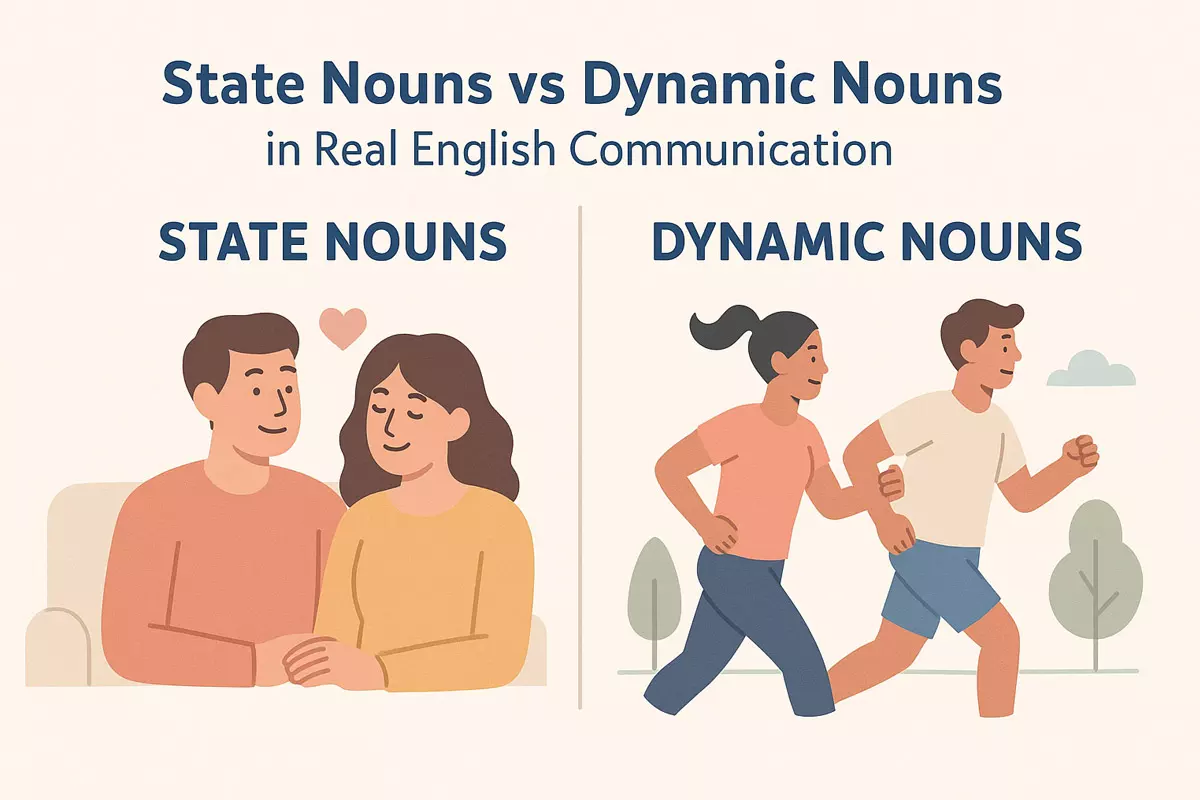 Here we what state and dynamic nouns refer to, how they differ in describing conditions or change, differences in verb choice, examples from everyday English, common learner mistakes, and offers practice classifying nouns by meaning.
- What state nouns and dynamic nouns refer to
- How state nouns describe conditions and situations
- How dynamic nouns express change and movement
- Differences in verb choice with state and dynamic nouns
- Examples from everyday spoken English
- Common learner mistakes with state and dynamic meaning
- Practice: classify nouns by state or dynamic meaning
Recognizing the difference between words that describe states or conditions and those that express actions or changes is essential for clear and effective communication in English. This distinction helps speakers convey their thoughts accurately, making it easier to share ideas, narrate experiences, and engage meaningfully with others. By understanding how these types of words function, individuals can improve their storytelling, avoid misunderstandings, and build stronger connections in everyday conversations.
What state nouns and dynamic nouns refer to
State nouns and dynamic nouns represent two distinct ways of expressing ideas in English. State nouns describe static conditions, qualities, or situations that are generally unchanging or ongoing for some time. In contrast, dynamic nouns relate to actions, processes, or events—things that involve change, movement, or development.
State nouns: expressing conditions and qualities
State nouns typically refer to mental states, emotions, physical conditions, or abstract qualities. These words are used when talking about situations or characteristics that do not involve direct action. You’ll often find them in contexts where the focus is on being, having, or experiencing rather than doing.
- Happiness (a feeling or condition, not an action)
- Knowledge (an abstract possession)
- Ownership (a state of having something)
- Peace (a continuing situation, not an event)
- Health (a condition that can exist over time)
- Friendship (an ongoing relationship)
- Confidence (a stable feeling or belief)
- Interest (a mental state or curiosity)
- Permission (a granted state, not an action)
- Silence (a lack of noise, a static situation)
Dynamic nouns: referring to actions and processes
Dynamic nouns, on the other hand, are linked to activity. They name processes, events, or actions that involve change or movement. You’ll see these nouns in contexts where the focus is on doing, creating, beginning, or ending something.
- Explosion (a sudden event)
- Discussion (the act of talking or debating)
- Growth (the process of increasing)
- Decision (the act of deciding)
- Travel (the act of moving from one place to another)
- Change (the process of becoming different)
- Performance (the act of performing)
- Movement (the act of moving)
- Construction (the process of building)
- Celebration (the act of celebrating)
- Arrival (the event of reaching a place)
- Departure (the act of leaving)
Comparing state and dynamic nouns
To clarify the difference, it helps to look at typical examples side by side:
| State Noun (Condition or situation) |
Dynamic Noun (Action or process) |
|---|---|
| Peace | Negotiation |
| Friendship | Conversation |
| Knowledge | Learning |
| Ownership | Purchase |
| Health | Recovery |
In summary, state nouns anchor us to unchanging qualities, while dynamic nouns highlight action and transformation. Recognizing the distinction can help you choose the right word for the message you want to convey, especially in real-life English communication.
How state nouns describe conditions and situations
State nouns give us a way to talk about facts, qualities, or general conditions that don’t involve action or change. Unlike dynamic nouns, which refer to processes or events, state nouns present a picture of something ongoing, stable, or unchanging. They help us express abstract ideas, emotional states, and circumstances that define the background of a conversation.
Common uses and examples of state nouns
State nouns often refer to feelings, relationships, physical or mental conditions, and general situations. Here are some types you’ll see in everyday English:
- Emotions: happiness, anger, fear, hope
- States of being: health, poverty, silence, darkness
- Relationships: friendship, marriage, leadership
- Qualities: honesty, strength, beauty, weakness
- Conditions: danger, peace, order, chaos
- Existence/Presence: absence, presence, existence
- States of mind: confusion, wisdom, awareness
- General situations: weather, traffic, competition
- Legal/social status: citizenship, ownership, membership
- Possession: property, wealth
How state nouns function in sentences
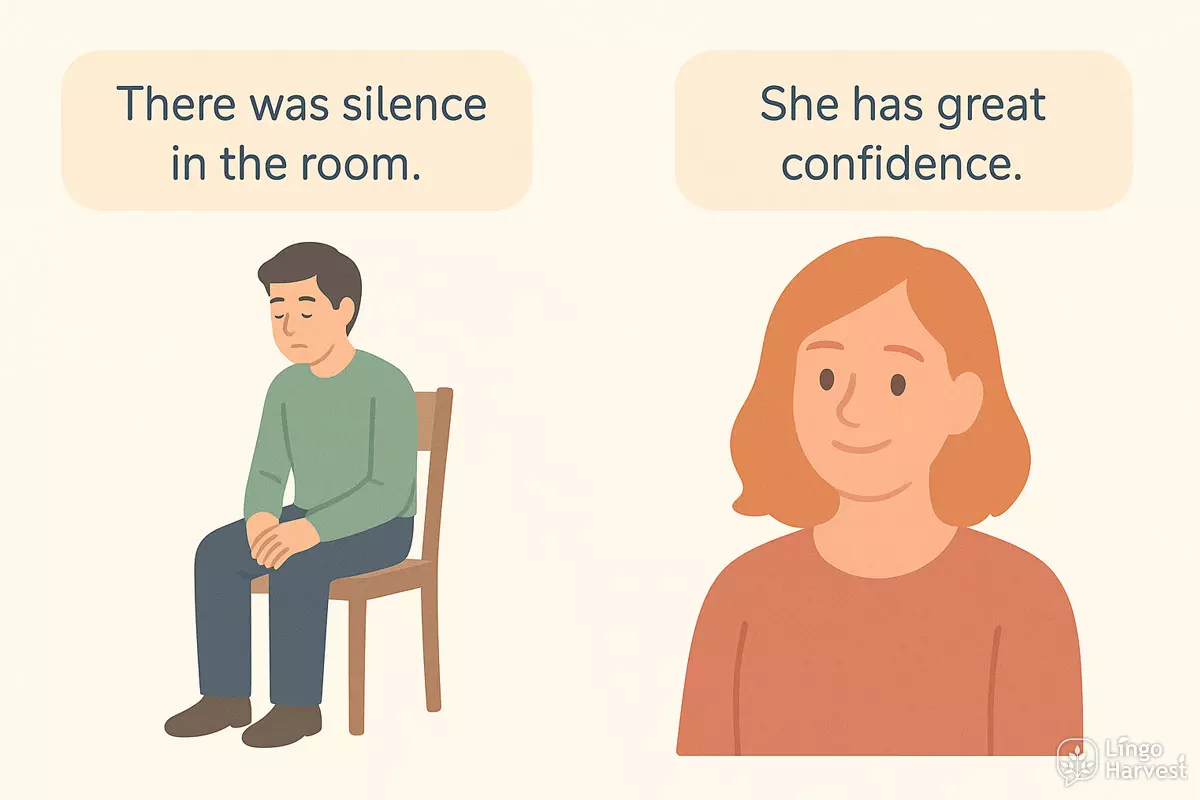
These nouns are often used with verbs like “be,” “have,” or “exist,” since they describe ongoing conditions rather than actions. For example:
- There was silence in the room.
- She has great confidence.
- His absence was noticed.
- Peace is important for progress.
Comparing state and dynamic nouns in context
The contrast between static and dynamic nouns helps clarify how English speakers distinguish between situations and actions. Consider the following table, which shows how similar concepts can be expressed as either a state or a dynamic process:
| State Noun Example | Dynamic Noun Example |
|---|---|
| knowledge | learning |
| friendship | meeting |
| health | recovery |
| ownership | buying |
| silence | speaking |
| poverty | struggling |
| presence | arriving |
| peace | negotiation |
| confidence | trying |
| danger | fighting |
Why state nouns matter in communication
Using state nouns allows speakers to describe the setting, mood, or background of what’s happening, rather than just focusing on actions. This helps conversations feel more natural and nuanced, providing context and depth to our interactions. Whether you’re talking about your relationship with someone or describing a situation at work, these nouns help paint a fuller picture.
How dynamic nouns express change and movement
Dynamic nouns naturally convey a sense of action, development, or transition. Unlike state nouns, which describe static conditions or unchanging qualities, these nouns focus on processes, events, and things that are in flux. In everyday English, they help us talk about progress, shifts, and ongoing activities.
Common patterns and usage
English speakers often use dynamic nouns to describe things that happen or evolve over time. Here are some typical ways these nouns show movement or change:
- Referring to actions: explosion, migration, arrival
- Describing natural phenomena: growth, erosion, rotation
- Highlighting transitions: departure, transformation, collapse
- Talking about progress: development, improvement, decline
- Expressing cycles or repetition: oscillation, fluctuation, turnover
- Focusing on results of change: creation, destruction, formation
- Indicating movement in space: journey, migration, drift
- Social or economic shifts: revolution, inflation, recession
- Technical or mechanical processes: operation, ignition, malfunction
- Personal or psychological processes: recovery, relapse, adaptation
How context influences meaning
The same noun can sometimes be dynamic or static, depending on context. For example, "change" can mean a physical act (dynamic: "a change in leadership occurred") or a state (static: "there was little change"). Dynamic nouns are most clear when used with verbs or adjectives that reinforce movement or process, such as "rapid development" or "ongoing improvement."
Comparing dynamic and state nouns in real use
To better understand how these forms differ, consider the following comparison:
| Dynamic Noun (process/change) |
State Noun (condition/static) |
|---|---|
| Transition | Stability |
| Explosion | Silence |
| Migration | Residence |
| Growth | Size |
| Collapse | Existence |
| Recovery | Health |
| Adaptation | Nature |
| Revolution | Order |
| Fluctuation | Balance |
| Development | Status |
Why dynamic nouns matter in communication
Using nouns that express process or transition allows speakers to talk vividly about events, trends, and changes in the world around them. They help convey not just what something is, but what it is becoming or how it is unfolding. This makes descriptions more precise and engaging in conversation, writing, and analysis.
Differences in verb choice with state and dynamic nouns
Understanding how verbs interact with state and dynamic nouns is essential for natural English communication. State nouns, which refer to conditions or situations (like "knowledge," "peace," or "ownership"), usually pair with verbs that express existence, possession, or continuity. In contrast, dynamic nouns (such as "meeting," "run," or "discussion") often connect with verbs that highlight action, change, or process.
Typical verb patterns with state nouns

State nouns tend to occur with verbs that describe being, having, or experiencing. These verbs generally avoid expressing physical action or movement, focusing instead on mental, emotional, or abstract states. Common verbs in this category include:
- be (is/are/was/were) → Her main concern is safety.
- have/has/had → He has a strong belief in teamwork.
- feel → She felt a sense of relief.
- experience → They experienced great satisfaction.
- possess → The plan possesses real potential.
- lack → The proposal lacks clarity.
- need → This situation needs careful consideration.
- show → His response showed confidence.
- demonstrate → The results demonstrate progress.
- represent → This figure represents a major improvement.
- indicate → The data indicates a problem.
- mean → This change means greater flexibility.
- suggest → Her tone suggests uncertainty.
- signify → The pause signified hesitation.
- imply → His comment implies agreement.
For example, we say "She has knowledge," not "She does knowledge."
Typical verb patterns with dynamic nouns
Dynamic nouns are more likely to pair with verbs that indicate active involvement or change. These verbs often suggest something happening, moving, or being performed. Typical verbs include:
- start → They will start the project next week.
- begin → The meeting began at nine o’clock.
- hold → The company will hold a conference in June.
- conduct → Researchers conducted a detailed survey.
- join → She decided to join the discussion.
- attend → He plans to attend the workshop.
- finish → We finished the task ahead of schedule.
- organize → They organized a charity event.
- lead → She will lead the training session.
- end → The presentation ended with questions.
- interrupt → The phone call interrupted the meeting.
- postpone → They postponed the launch until next month.
- resume → Talks resumed after a short break.
- cancel → The organizers canceled the event.
- continue → The discussion continued late into the evening.
- participate in → Many students participated in the project.
- complete → She completed the course successfully.
- schedule → The manager scheduled a follow-up meeting.
For instance, it's natural to say "They held a meeting" or "She started a discussion."
Side-by-side comparison: verb choices for state vs dynamic nouns
| State Noun Example | Dynamic Noun Example |
|---|---|
| have knowledge | conduct an experiment |
| feel happiness | attend a concert |
| show interest | start a journey |
| lack information | finish a project |
| represent ownership | organize an event |
Common pitfalls and tips
Learners often try to use action verbs with state nouns, resulting in unnatural phrases like "do knowledge" or "run ownership." To sound authentic, choose verbs that match the nature of the noun: use static verbs for states, and dynamic verbs for events or actions. When in doubt, check if the noun describes something ongoing or something happening. This simple check can guide you to the right verb choice and help you avoid awkward constructions.
Examples from everyday spoken English
In real-life conversations, people often use both state nouns and dynamic nouns, sometimes without realizing the subtle differences. State nouns refer to conditions or situations that are generally static, like "health" or "knowledge," while dynamic nouns represent actions, processes, or things that change, such as "discussion" or "decision." Understanding how these types of nouns appear in daily speech helps learners sound more natural and recognize the intent behind what’s being said.
Common state nouns in conversation
- “Her happiness means a lot to me.”
- “I have no idea what you’re talking about.”
- “Their relationship is complicated.”
- “He has a lot of patience.”
- “My knowledge of the subject is limited.”
- “There’s not much hope left.”
Dynamic noun usage in real speech
- “Let’s start the discussion now.”
- “We had a quick argument this morning.”
- “The negotiation was successful.”
- “His decision surprised everyone.”
- “There was a sudden change in the plan.”
- “They made a promise to call.”
Comparing state and dynamic nouns in context
| State Noun (Condition) | Dynamic Noun (Action/Process) |
|---|---|
| “Her confidence is impressive.” | “She made a confession yesterday.” |
| “He has a lot of trust in you.” | “There was a betrayal in the story.” |
| “My belief is strong.” | “We had a debate about it.” |
| “His fear is understandable.” | “They had a fight last night.” |
Noticing patterns in spoken English
When listening to native speakers, you’ll hear state nouns often used to describe feelings, conditions, or opinions, while dynamic nouns usually relate to events or things that happen. For example, someone might say, “I have a lot of hope,” (state) versus “We had a discussion,” (dynamic). Recognizing this distinction helps with both comprehension and more accurate self-expression in real communication.
Common learner mistakes with state and dynamic meaning
Learners often confuse when to use state nouns and dynamic nouns, especially since some words can function as both, depending on context. This confusion can lead to awkward or incorrect sentences, and sometimes make the speaker’s meaning unclear. Understanding the typical pitfalls can help you avoid them in real conversations.
Mixing up uncountable state nouns with countable dynamic ones
A frequent issue is treating state nouns (which often describe general conditions or qualities) as if they were dynamic (often describing actions or processes), or vice versa. For example, using "an information" instead of just "information," or saying "a progress" instead of "progress."
- Incorrect: I have a news for you. ❌
- Correct: I have some news for you. ✅
- Incorrect: Can you give me an advice? ❌
- Correct: Can you give me some advice? ✅
- Incorrect: The mathematics is difficult. ❌
- Correct: Mathematics is difficult. ✅
Confusing static and changing situations
Learners sometimes use state nouns when describing a process or something changing, which requires a dynamic noun. For instance, using "knowledge" (a state) instead of "learning" (a dynamic process), or "life" for "living."
- Incorrect: My knowledge is improving every day. ❌
- Correct: My learning is improving every day. ✅
- Incorrect: I like sport. (meaning a specific activity) ❌
- Correct: I like playing sports. ✅
State and dynamic noun confusion in verbs and collocations
Some nouns change meaning depending on whether they are used in a static or dynamic sense. For example, "work" (state: employment, dynamic: activity), "thought" (state: idea, dynamic: process of thinking), or "change" (state: difference, dynamic: process of becoming different).
| Word | Common Error / Correct Use |
|---|---|
| Work | ❌ I have many works to do. ✅ I have a lot of work to do. ✅ He created several works of art. |
| Change | ❌ I made a change in my life. ✅ I made some changes in my life. ✅ Change is difficult. |
| Experience | ❌ I had a good experience in Paris. (speaking generally) ✅ I have a lot of experience in teaching. ✅ I had a good experience (meaning one event). |
| Light | ❌ There are too much light here. ✅ There is too much light here. ✅ There are many lights in the room. |
Other typical mix-ups
Learners also stumble over the following words, which can act as either state or dynamic nouns depending on usage:
- Noise (state: There is too much noise; dynamic: Did you hear that noise?)
- Paper (state: The paper is expensive; dynamic: I wrote a paper)
- Time (state: Time passes quickly; dynamic: I had a good time)
- Business (state: Business is slow; dynamic: He started a business)
- Order (state: Everything is in order; dynamic: I placed an order)
- Memory (state: Memory is important; dynamic: I have a memory of childhood)
- Interest (state: Interest rates are high; dynamic: I have an interest in art)
- Practice (state: Practice makes perfect; dynamic: I have a medical practice)
- Glass (state: Glass is fragile; dynamic: I bought a glass of water)
- Life (state: Life is beautiful; dynamic: He led a difficult life)
Summary tip
To avoid these issues, always check if the noun describes an unchanging condition or a process/action. Consult examples and pay attention to context, especially with words that can function both ways. This awareness is key to more natural and accurate English communication.
Practice: classify nouns by state or dynamic meaning
Understanding whether a noun describes a fixed condition or an active process is vital for natural English usage. Below, you'll find practical exercises to help distinguish between static (state) and dynamic nouns. These activities focus on real-world vocabulary and encourage you to think about how meaning changes in context.
Task 1: Decide if the noun is State or Dynamic
Read each noun below and decide if it represents a stable condition (state) or an ongoing action/process (dynamic). Think about what the noun describes in daily life or conversation.
- decision
- movement
- ownership
- discussion
- happiness
- growth
- agreement
- construction
- knowledge
- negotiation
- belief
- change
- friendship
- exploration
- silence
- development
- behavior
- arrival
- ownership
- performance
Show answers
- decision – state
- movement – dynamic
- ownership – state
- discussion – dynamic
- happiness – state
- growth – dynamic
- agreement – state
- construction – dynamic
- knowledge – state
- negotiation – dynamic
- belief – state
- change – dynamic
- friendship – state
- exploration – dynamic
- silence – state
- development – dynamic
- behavior – state
- arrival – dynamic
- ownership – state
- performance – dynamic
Task 2: Compare State and Dynamic Nouns in Context
Some nouns can be tricky because their meaning can shift depending on context. Consider the pairs below and identify which noun in each pair is static and which is active.
| State Noun | Dynamic Noun |
|---|---|
| peace | negotiation |
| knowledge | learning |
| ownership | buying |
| friendship | meeting |
| agreement | debate |
| belief | questioning |
Show answers
- peace vs negotiation: peace = state, negotiation = dynamic
- knowledge vs learning: knowledge = state, learning = dynamic
- ownership vs buying: ownership = state, buying = dynamic
- friendship vs meeting: friendship = state, meeting = dynamic
- agreement vs debate: agreement = state, debate = dynamic
- belief vs questioning: belief = state, questioning = dynamic
Quick Tips for Identifying State and Dynamic Nouns
- State nouns often describe conditions, emotions, or relationships: trust, silence, health.
- Dynamic nouns usually refer to events, processes, or activities: training, movement, transaction.
- If you can ask "What is happening?" and the noun answers that question, it's likely dynamic.
- If the noun answers "What exists or is true?", it's probably a state noun.