Nouns with Fixed Prepositions in Common English Patterns

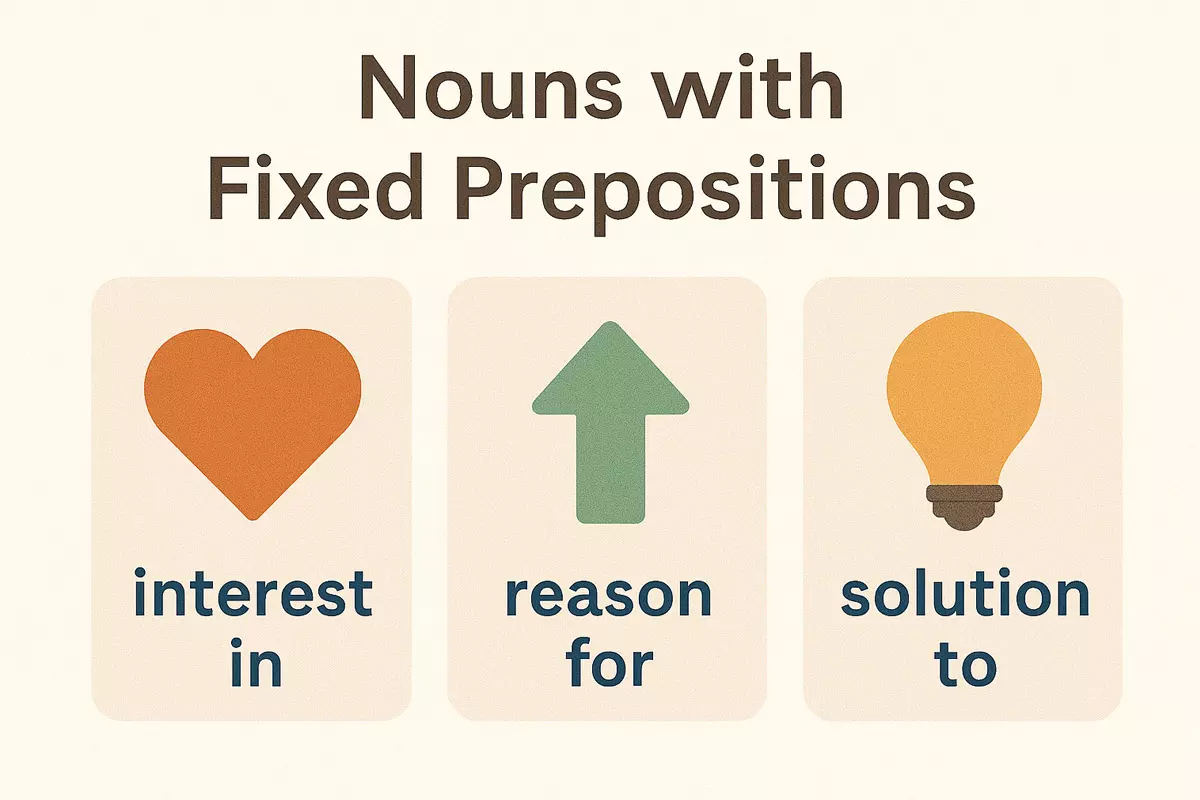 Here we fixed noun–preposition combinations, such as reason for and access to, explains their stable meanings, contrasts them with verb-preposition patterns, highlights common learner errors, and gives strategies and practice for mastering them.
- What fixed noun–preposition combinations are
- Common patterns like reason for and access to
- Meaning stability in fixed noun–preposition pairs
- Differences between noun and verb preposition patterns
- Typical learner errors with wrong prepositions
- Strategies for learning fixed noun–preposition pairs
- Practice: complete sentences with correct prepositions
Have you ever noticed that certain nouns often go with specific prepositions or verbs in English, creating combinations that just sound right to native speakers? These fixed pairings, known as collocations, can be confusing for learners because they don’t always follow strict rules and may not directly translate from other languages. However, mastering these common word combinations is essential for speaking and writing more naturally, helping you sound more fluent and confident in everyday English conversations.
What fixed noun–preposition combinations are
In English, certain nouns are frequently paired with specific prepositions, creating what’s known as fixed or set noun–preposition patterns. These are not random pairings; the preposition is required to convey the correct meaning, and using a different one often sounds unnatural or changes the sense entirely. For example, we say “interest in,” not “interest on” or “interest for.” These patterns are essential for clear, idiomatic communication.
Why these combinations matter
Mastering these set expressions helps both learners and fluent speakers avoid awkward phrasing and misunderstandings. Since the choice of preposition is often arbitrary and not always logical, memorizing common pairings is key. Native speakers rarely notice these collocations, but errors stand out immediately.
Common examples of noun–preposition pairs
Here are several frequently used noun–preposition combinations found in everyday English:
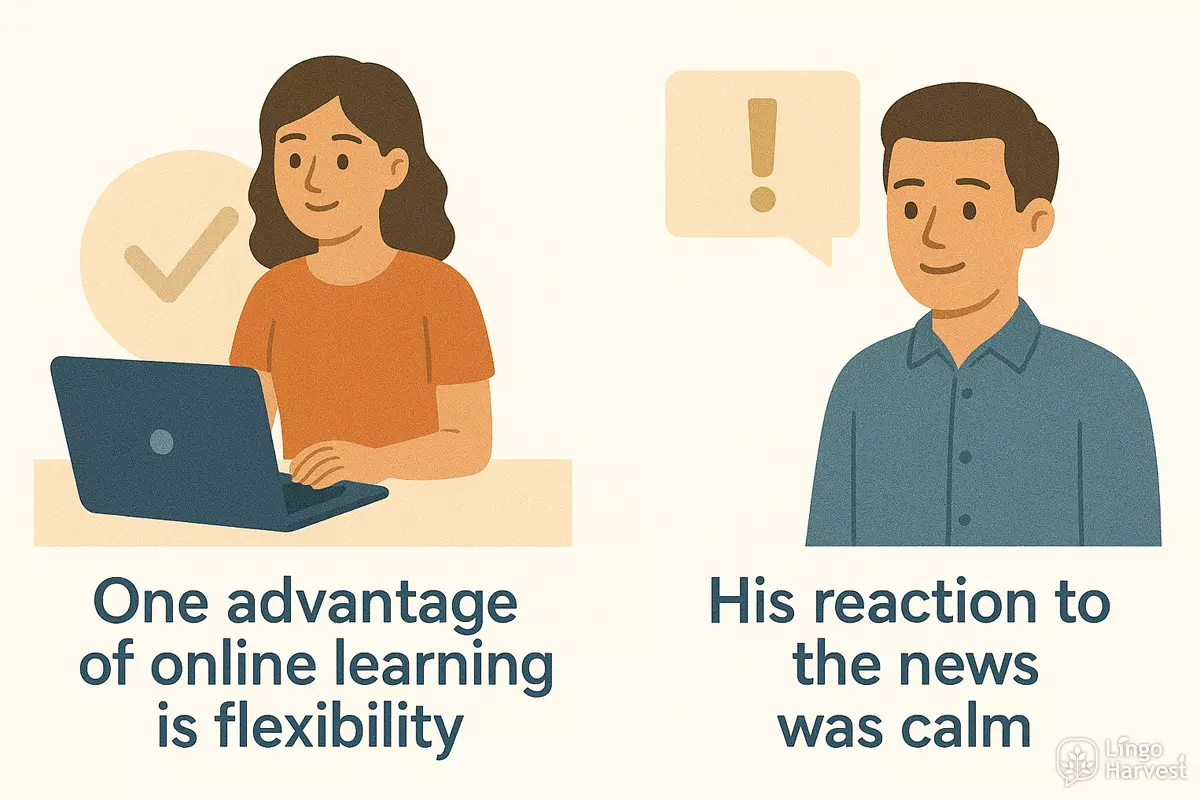
- advantage of — One advantage of online learning is flexibility.
- reaction to — His reaction to the news was calm.
- reason for — There is no reason for anger.
- solution to — We finally found a solution to the problem.
- awareness of — Public awareness of climate change is growing.
- increase in — There has been an increase in prices this year.
- access to — Students have access to online resources.
- belief in — She has a strong belief in justice.
- influence on — Social media has a big influence on teenagers.
- reply to — I haven’t received a reply to my email yet.
- effect on — Lack of sleep has a negative effect on health.
- comparison with — This model looks better in comparison with the old one.
- difficulty in — He has difficulty in understanding accents.
- invitation to — She accepted the invitation to the conference.
- experience with — I have little experience with this software.
- attitude towards — His attitude towards work is very professional.
- fear of — Many people have a fear of flying.
- preference for — She showed a preference for tea over coffee.
- opinion about — What is your opinion about remote work?
- contact with — He lost contact with his old friends.
How these set patterns work
A fixed noun–preposition combination means the noun almost always takes the same preposition in a given context. Sometimes, the meaning shifts if a different preposition is used, or the phrase becomes ungrammatical. For example, “increase in prices” is correct, but “increase on prices” is not.
Typical patterns and comparisons
| Noun | Correct Preposition | Example Phrase |
|---|---|---|
| cause | of | cause of the problem |
| interest | in | interest in science |
| difference | between | difference between cultures |
| damage | to | damage to property |
| respect | for | respect for elders |
The table above illustrates how each noun “locks in” a particular preposition, and how the combination forms a natural phrase. Learning these as units, rather than translating word-for-word, is the most effective strategy.
Common patterns like reason for and access to
Many English nouns consistently “pair” with specific prepositions. These patterns can be challenging for learners because the preposition is often not intuitive or directly translatable from other languages. Recognizing these fixed combinations helps you sound more natural and avoid common mistakes.
Why do certain nouns always use specific prepositions?
Some nouns have developed set relationships with prepositions through frequent use. These combinations are not random: they have become standard over time, and using the wrong preposition can make your meaning unclear or even incorrect. For example, we say “reason for” (not “reason of”) and “access to” (not “access of”).
Examples of nouns with fixed prepositions
Here are some of the most common pairings to watch for in everyday English:
- advantage of → One advantage of online learning is flexibility.
- answer to → She finally found the answer to the question.
- cause of → Smoking is a major cause of health problems.
- connection with / between → There is a strong connection between diet and health.
- cure for → Scientists are searching for a cure for the disease.
- difference between → Can you explain the difference between these two options?
- effect on → The new law had a positive effect on small businesses.
- experience in / with → He has years of experience in marketing.
- increase in → There has been an increase in prices this year.
- interest in → She showed great interest in modern art.
- key to → Hard work is the key to success.
- need for → There is a growing need for clean energy.
- opinion of / about → What is your opinion about remote work?
- opportunity for → This job is a great opportunity for career growth.
- reaction to → His reaction to the news was unexpected.
- relationship with / between → She has a good relationship with her colleagues.
- solution to → We need a long-term solution to this problem.
- threat to → Climate change is a serious threat to wildlife.
- understanding of → He has a deep understanding of the subject.
- reason for → The reason for the delay was bad weather.
- access to → Students have free access to the library.
Typical usage in context
Using the correct preposition is crucial for clarity. Compare these examples:
| Noun + Preposition | Example Sentence |
|---|---|
| reason for | There is a reason for his absence. |
| access to | Students have access to the library. |
| effect on | The weather has an effect on my mood. |
| solution to | We need a solution to this problem. |
| interest in | She has a strong interest in music. |
| connection with | He has a connection with the company. |
| difference between | There is a big difference between the two options. |
| opinion about | What is your opinion about this book? |
Memorizing these patterns and practicing them in context will help you avoid errors and communicate more naturally. When unsure, check reliable sources or observe how native speakers use these combinations in writing and speech.
Meaning stability in fixed noun–preposition pairs
Many English nouns combine with specific prepositions to form set phrases, and these combinations often carry a stable, predictable meaning. Changing the preposition in such a pair can either result in an ungrammatical phrase or shift the meaning entirely. For learners and users of English, recognizing these fixed patterns is crucial for both comprehension and natural expression.
Consistency of meaning
When a noun and preposition consistently appear together, their meaning often becomes more than just the sum of their parts. For example, "interest in" refers to curiosity or concern about something, while "interest on" is strictly used in financial contexts, such as "interest on a loan." Swapping the preposition may result in confusion or a nonsensical phrase.
Common fixed noun–preposition pairs
Some combinations are so established that native speakers rarely question their structure. Here are several widely used pairs:
- approval for → The plan received approval for immediate launch.
- awareness of → There is growing awareness of mental health issues.
- control over → She has full control over the budget.
- damage to → The storm caused serious damage to the roof.
- demand for → There is high demand for electric cars.
- dependence on → Many countries have dependence on imported oil.
- exposure to → Prolonged exposure to noise can be harmful.
- focus on → The discussion focused on climate change.
- improvement in → We saw an improvement in test results.
- lack of → There is a lack of clear instructions.
- link between → Scientists found a link between diet and health.
- need to → There is an urgent need to act.
- permission for → You need permission for access to this area.
- pressure on → There is increasing pressure on small businesses.
- reliance on → The system shows heavy reliance on manual input.
- risk of → There is a risk of data loss.
- support for → Public support for the policy is growing.
- threat of → The threat of flooding remains high.
- trust in → People are losing trust in the media.
- use of → The use of smartphones is widespread.
How preposition choice affects meaning
The preposition is not just a grammatical necessity; it anchors the noun’s meaning in context. For instance, "report on" (e.g., a report on climate change) is different in meaning from "report to" (e.g., to report to a supervisor). The fixed pairing guides the listener or reader to the intended sense.
| Noun + Preposition | Typical Meaning |
|---|---|
| solution to | a way of solving a problem |
| reason for | the cause or explanation of something |
| effect on | the result produced by something |
| increase in | growth or rise in quantity or degree |
| access to | the ability or right to approach or use |
Why stability matters
Memorizing set noun–preposition pairings helps avoid errors and ensures clarity. These stable patterns are rarely interchangeable, so using the wrong preposition can lead to misunderstanding. For English learners, mastering these collocations is a step toward fluency and idiomatic use of the language.
Differences between noun and verb preposition patterns
Understanding how English nouns and verbs pair with prepositions is key to mastering natural-sounding phrases. While both parts of speech often require specific prepositions, the combinations they form—and the reasons behind them—can differ significantly.
How prepositions attach to nouns vs. verbs
Nouns frequently form set phrases with prepositions, often to clarify relationships or specify meaning. For example, "interest in" or "solution to" are fixed patterns. In contrast, verbs tend to use prepositions to indicate direction, recipient, or method, such as "depend on" or "believe in."
Common pattern distinctions
Noun-preposition and verb-preposition pairs don’t always match. A noun and its related verb may require different prepositions, and sometimes a preposition is used with one form but not the other. Here are some examples:
- Advantage of (noun) vs. benefit from (verb)
- Effect on (noun) vs. affect (verb, no preposition)
- Solution to (noun) vs. solve (verb, no preposition)
- Increase in (noun) vs. increase by (verb, different preposition)
- Response to (noun) vs. respond to (verb, same preposition)
- Influence on (noun) vs. influence (verb, no preposition)
- Access to (noun) vs. access (verb, no preposition)
- Reference to (noun) vs. refer to (verb, same preposition)
- Experience of (noun) vs. experience (verb, no preposition)
- Complaint about (noun) vs. complain about (verb, same preposition)
- Desire for (noun) vs. desire (verb, no preposition)
- Dependence on (noun) vs. depend on (verb, same preposition)
- Participation in (noun) vs. participate in (verb, same preposition)
- Decision about (noun) vs. decide on (verb, different preposition)
- Invitation to (noun) vs. invite to (verb, same preposition)
- Preparation for (noun) vs. prepare for (verb, same preposition)
- Reaction to (noun) vs. react to (verb, same preposition)
Comparison of noun and verb preposition usage
Sometimes, the noun and verb forms share a preposition, but not always. Here is a structured comparison for several common word pairs:
| Noun + Preposition | Verb + Preposition (if any) | Example Sentence |
|---|---|---|
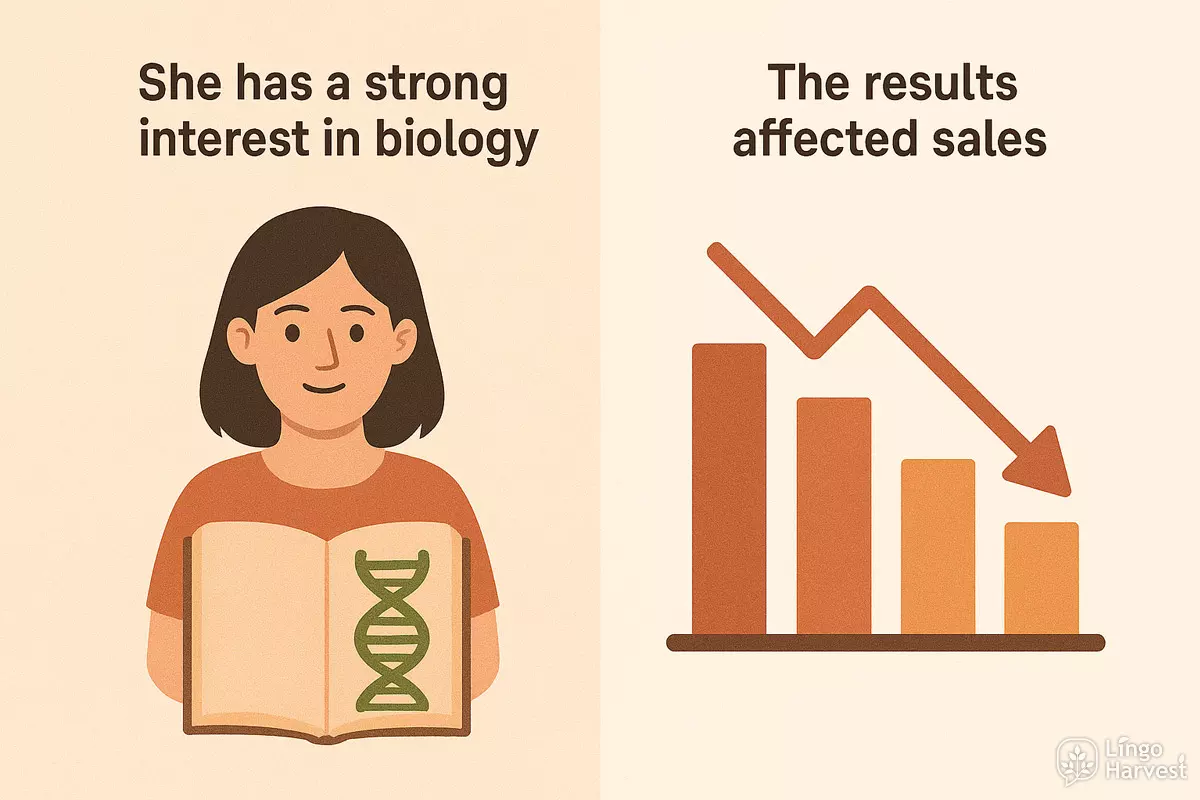
| Interest in | Interested in | She has a strong interest in biology. / She is interested in biology. |
| Effect on | Affect (no preposition) | The effect on sales was huge. / The results affected sales. |
| Solution to | Solve (no preposition) | We need a solution to the problem. / Can you solve the problem? |
| Response to | Respond to | His response to the offer was quick. / He responded to the offer. |
| Access to | Access (no preposition) | Do you have access to the files? / Can you access the files? |
| Participation in | Participate in | Participation in the event is high. / Many people participate in the event. |
| Complaint about | Complain about | We received a complaint about the noise. / They complained about the noise. |
| Decision about | Decide on | The decision about funding is final. / We must decide on the funding. |
Summary
The prepositions that accompany nouns often become fixed parts of phrases, while verbs may or may not use a preposition, and if they do, it’s not always the same one as the noun form. Learning these combinations—especially when there is no clear logic—requires exposure and practice. Paying attention to how nouns and verbs differ in their prepositional patterns will help you use more accurate and idiomatic English.
Typical learner errors with wrong prepositions
Learners of English often confuse which preposition should follow certain nouns, especially when their native language uses different structures. This mix-up is common with nouns that require specific prepositions in established English patterns. Incorrect choices can make sentences sound awkward or even change the intended meaning.
Commonly confused noun + preposition combinations
Below are some of the most frequent mismatches. Notice how a small change in the preposition can make the phrase incorrect or unclear:
- Advantage of/over — Many say "advantage to" instead of "advantage of something" or "advantage over someone."
- Need for — Learners often write "need of" (❌) instead of "need for something" (✅).
- Reason for — "Reason of" is a common error; the standard is "reason for something."
- Increase/decrease in — It should be "increase in prices," not "increase of prices."
- Solution to — Not "solution of the problem," but "solution to the problem."
- Damage to — The correct form is "damage to the car," not "damage of the car."
- Invitation to — Use "invitation to a party," not "invitation for a party."
- Connection with/between — "Connection with someone" or "connection between two things" is correct, not "connection to."
- Attitude to/towards — Avoid "attitude against something," and use "attitude to/towards something."
- Experience in — Say "experience in something," not "experience on something."
- Influence on — The phrase is "influence on someone," not "influence to someone."
- Key to — Use "key to success," not "key of success."
- Response to — The standard is "response to a question," not "response for a question."
- Access to — Correct: "access to information," not "access of information."
- Difference between — Say "difference between two things," not "difference of two things."
Side-by-side comparison of typical mistakes
| Incorrect usage | Correct usage |
|---|---|
| solution of the problem | solution to the problem |
| increase of prices | increase in prices |
| reason of his absence | reason for his absence |
| damage of the building | damage to the building |
| key of the city | key to the city |
| access of information | access to information |
Why do these mistakes happen?
Such errors often arise because learners translate directly from their native language, where the noun-preposition pairing may be different or even absent. Sometimes, similar verbs and adjectives use other prepositions, which adds to the confusion. Exposure to authentic usage and focused practice helps build awareness of these fixed patterns.
For effective improvement, learners should pay attention to common collocations and review example sentences in context. Building a habit of noticing which prepositions follow certain nouns will gradually reduce these frequent slip-ups.
Strategies for learning fixed noun–preposition pairs
Developing a reliable sense for which prepositions go with specific nouns in English can be challenging, especially since many combinations do not follow clear rules. Building familiarity with these patterns requires targeted approaches, regular practice, and attention to usage in context.
Notice patterns in context
Exposure to real-life examples is one of the most effective ways to internalize noun–preposition pairs. When reading, listening, or watching content in English, pay attention to common combinations. For instance, you might see "increase in," "reason for," or "solution to" in news articles or conversations. Collecting these as you encounter them helps reinforce correct usage.
Group similar pairs together
Organizing fixed combinations by meaning or function can make them easier to remember. For example, nouns referring to causes often use "of" or "for" (e.g., "cause of," "need for"), while those about changes may use "in" ("rise in," "decline in"). Creating your own categories or mind maps supports long-term retention.
Practice with focused exercises
Regularly testing yourself is crucial. Try fill-in-the-blank exercises, matching tasks, or make your own example sentences. You can also write short paragraphs using as many fixed pairs as possible, then check your work with a reliable source or teacher.
Use a reference table for review
A reference table helps visualize and compare common noun–preposition collocations. Reviewing such a table regularly can improve recall and accuracy.
| Noun | Fixed Preposition & Example |
|---|---|
| Advantage | of There are many advantages of living in a city. |
| Attitude | towards She has a positive attitude towards change. |
| Cause | of The main cause of the fire is unknown. |
| Effect | on His words had a strong effect on the team. |
| Interest | in She has a keen interest in biology. |
| Reason | for What is the reason for your decision? |
| Solution | to We found a solution to the problem. |
| Increase | in There’s been an increase in demand. |
| Access | to They have access to the database. |
| Difference | between What’s the difference between them? |
| Influence | on He had a big influence on my choice. |
| Response | to Her response to the news was surprising. |
| Connection | with There is a connection with their results. |
| Experience | with He has experience with similar projects. |
| Respect | for She has great respect for her mentor. |
Make use of mnemonic devices
Mnemonics and memory tricks can help you remember some of the trickier pairs. For example, connect the word "solution" to the idea of "solving to a problem," which links "solution" with "to." Visual associations or rhymes can also be effective.
Review and use in conversation
Finally, the best way to master these patterns is to use them regularly. Incorporate new pairs into your speech and writing. If possible, ask for feedback or notice how native speakers use these constructions. Over time, repeated exposure and practice will make them feel natural.
Practice: complete sentences with correct prepositions
Understanding how certain nouns pair with specific prepositions is a key part of mastering English sentence structure. Below you’ll find a range of exercises designed to help you practice choosing the right preposition to complete a sentence. These activities focus on common noun-preposition combinations found in everyday language.
Fill in the blanks: noun + preposition
Read each sentence carefully and insert the best-fitting preposition from the options in parentheses. Pay attention to the noun and its usual partner.
- She has a strong interest ____ (in/on/at) modern art.
- There is a need ____ (of/for/to) more volunteers at the shelter.
- He has a reputation ____ (for/of/about) being very punctual.
- We received an invitation ____ (to/for/of) the conference.
- The solution ____ (to/for/of) the problem was simple.
- He showed great respect ____ (for/to/of) his teacher.
- They made an attempt ____ (on/at/in) breaking the record.
- His attitude ____ (to/towards/for) work has improved.
- She has a fear ____ (of/from/for) flying.
- The answer ____ (for/to/of) your question is complicated.
Show answers
- in
- for
- for
- to
- to
- for
- at
- to/towards
- of
- to
Common noun + preposition patterns
Here are some frequently used noun and preposition pairings. Review these examples to become more familiar with typical combinations:
- advantage of → One advantage of online learning is flexibility.
- cause of → Smoking is a major cause of health problems.
- effect on → Stress has a strong effect on sleep quality.
- increase in → There was a sharp increase in prices last year.
- decrease in → We saw a decrease in traffic during the holidays.
- experience in → She has experience in project management.
- reason for → What is the reason for this delay?
- contact with → He lost contact with his former colleagues.
- reaction to → Her reaction to the news was calm.
- difference between → Do you know the difference between these two models?
- influence on → Social media has a big influence on teenagers.
- solution to → They finally found a solution to the problem.
- response to → We are waiting for a response to our email.
- relationship with → She has a good relationship with her manager.
- damage to → The storm caused serious damage to the roof.
- contribution to → His work made a valuable contribution to the project.
- access to → Students have free access to the library.
- preference for → I have a preference for quiet places.
- belief in → He has a strong belief in hard work.
- information about → Can you give me more information about the course?
Choose the correct option
For each sentence, select the preposition that completes the meaning. Only one answer is correct in each case.
- His contribution ____ the team was essential. (to / for / on)
- The effect ____ climate change is visible worldwide. (of / on / in)
- There was a decrease ____ sales last year. (to / in / at)
- She always has good advice ____ her friends. (for / to / of)
- The solution ____ the problem was simple. (to / for / with)
- He has a strong belief ____ hard work. (in / on / about)
- We noticed an increase ____ prices this month. (in / on / to)
- Her reaction ____ the news was unexpected. (to / for / on)
- They have regular contact ____ their clients. (with / to / for)
- There is a big difference ____ the two versions. (between / of / among)
Show answers
- to
- of
- in
- for
- to
- in
- in
- to
- with
- between
Quick reference: fixed noun-preposition combinations
| Noun | Preposition | Example |
|---|---|---|
| interest | in | interest in photography |
| reason | for | reason for delay |
| solution | to | solution to the puzzle |
| effect | on | effect on results |
| difference | between | difference between opinions |
| increase | in | increase in prices |
| invitation | to | invitation to dinner |
| respect | for | respect for elders |
Regular practice with these patterns will help you use them accurately in both spoken and written English. Review the combinations above and try creating your own sentences to reinforce your understanding.