Family Names and Plural Forms Like The Smiths Explained

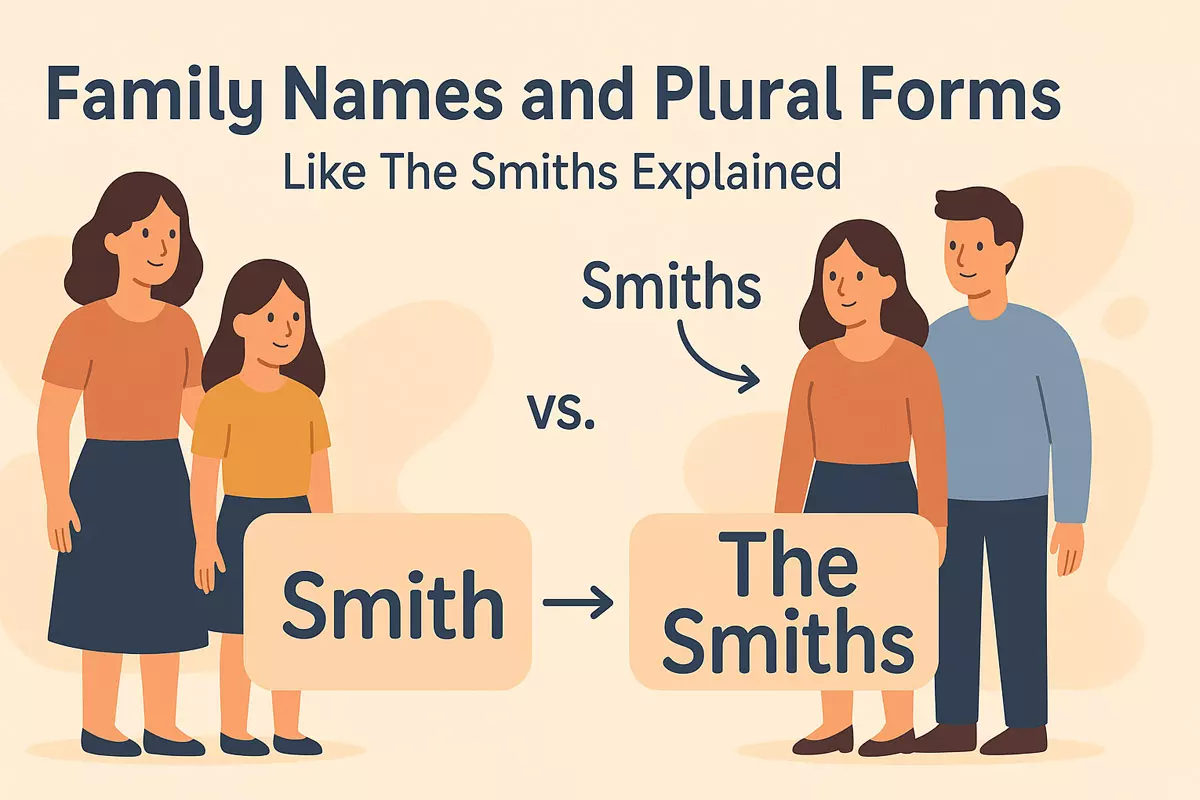 Here we how family names act as collective nouns, rules for pluralizing surnames ending in -s, -x, and -ch, when to use the with plural family names, differences between using a surname for one person or a family, and common mistakes, with practice examples.
- How family names function as collective nouns
- Forming plural surnames ending in -s, -x, and -ch
- Using the with plural family names
- Talking about families as social groups
- Differences between singular surname and family reference
- Common learner mistakes with plural family names
- Practice: form correct plural family names in context
Have you ever wondered why we say the Johnsons or the Martinezes when referring to families? Making last names plural in English seems straightforward, but there are some interesting rules and exceptions that can be confusing, even for native speakers. For most names, you simply add an s, as in the Smiths. However, if the name ends in s, x, z, ch, or sh, you usually add es, resulting in forms like the Joneses or the Foxes. Understanding these patterns can help you avoid common mistakes when addressing or referring to families in writing or conversation.
How family names function as collective nouns
When we refer to a family by their surname in the plural form, we’re actually treating that name as a collective noun—representing the entire group as one unit. This is a common feature in English, especially when talking about families in social, holiday, or narrative settings. For instance, saying “the Johnsons are coming over” means the entire Johnson family, not just one individual.
Pluralizing family surnames in context
To use a surname as a collective, we generally add -s or -es to the end, depending on the spelling. This pattern is similar to how we pluralize regular nouns, but with some quirks that depend on the ending of the name.
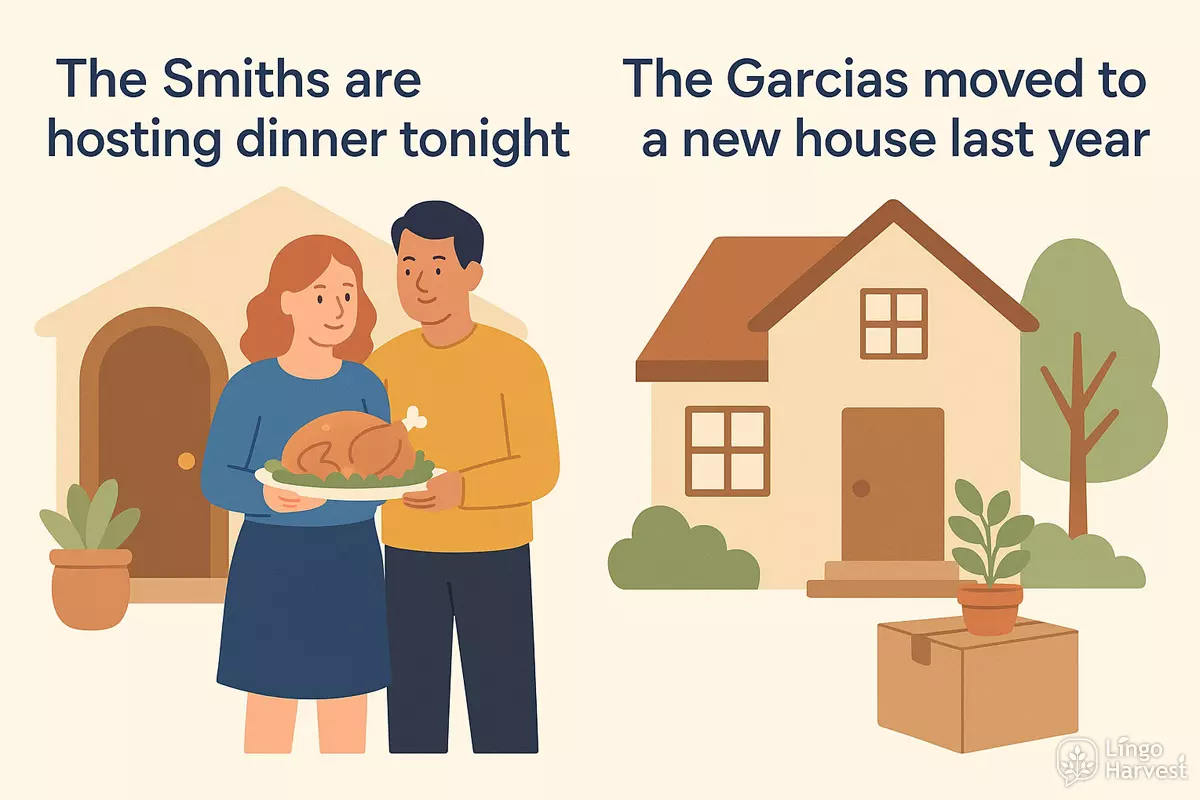
- The Smiths → The Smiths are hosting dinner tonight.
- The Garcias → The Garcias moved to a new house last year.
- The Joneses → The Joneses go hiking every weekend.
- The O’Malleys → The O’Malleys invited everyone to the wedding.
- The Wangs → The Wangs run a small restaurant downtown.
- The Foxes → The Foxes adopted a dog from the shelter.
- The Irvings → The Irvings spend their summers by the lake.
- The Churches → The Churches are known for their charity work.
- The Torreses → The Torreses celebrated a family reunion.
- The Harrisons → The Harrisons live next door to us.
- The Williamses → The Williamses travel abroad every year.
- The Kennedys → The Kennedys played an important role in U.S. history.
- The Browns → The Browns are renovating their kitchen.
- The Martinezes → The Martinezes own a bookstore.
- The Lees → The Lees arrived early for the event.
- The Rodriguezes → The Rodriguezes support the local team.
- The Murphys → The Murphys are planning a surprise party.
- The Davises → The Davises welcomed a new baby.
Grammatical usage and agreement
When a family name is used in this way, it takes a plural verb, just like any other plural noun. For example, “The Parkers are on vacation.” Here, “are” matches the plural subject. This usage helps clarify that the statement is about the whole group, not an individual.
Common mistakes and tips
Some confusion arises when people try to use apostrophes with plural family names. Remember, the apostrophe is only needed to show possession, not to form the plural. For example:
- Correct plural: The Thompsons are neighbors. ✅
- Incorrect plural: The Thompson’s are neighbors. ❌
- Correct possessive: The Thompsons’ house is blue. ✅
Summary: Family names as group identifiers
Using surnames in their plural form lets us refer to a group of people sharing the same last name as a single unit. This collective usage is a practical and widely accepted part of English grammar, helping speakers efficiently refer to entire households or family groups in conversation and writing.
Forming plural surnames ending in -s, -x, and -ch
When you're writing about families whose last names finish with -s, -x, or -ch, regular pluralization rules don't always apply. Instead of just adding “s,” English typically uses “-es” for these endings to make pronunciation easier and maintain clarity. This is especially true in invitations, cards, and any context where you refer to an entire family.
Why Add “-es” Instead of Just “-s”?
Adding only “s” to names like “Harris” or “Fox” can look awkward and sound odd when spoken. The “-es” ending helps the plural form flow naturally in speech and writing. For example, “The Harris family” becomes “the Harrises,” not “the Harris’s” or “the Harris.”
Common Patterns for Pluralizing Surnames
You can follow a simple guideline for these tricky endings:
- -s → add -es (e.g., Jones → Joneses)
- -x → add -es (e.g., Knox → Knoxes)
- -ch (when pronounced like “church”) → add -es (e.g., Finch → Finches)
Note: For names ending in “-ch” pronounced like “k” (e.g., “Bach”), you usually just add “s” (Bachs).
Examples of Pluralized Family Names
Here are some examples to illustrate how surnames with these endings are made plural in English:
- Harris → Harrises
- Jones → Joneses
- Evans → Evanses
- Lois → Loises
- Fox → Foxes
- Knox → Knoxes
- Marx → Marxes
- Rich → Riches
- Finch → Finches
- Church → Churches
- French → Frenches
- Bach (pronounced “k”) → Bachs
- March → Marches
- Glass → Glasses
- Ross → Rosses
Quick Reference: Surname Plurals
| Singular Surname | Plural Family Name |
|---|---|
| Harris | Harrises |
| Fox | Foxes |
| Church | Churches |
| Jones | Joneses |
| Knox | Knoxes |
| French | Frenches |
| Glass | Glasses |
| Ross | Rosses |
| Finch | Finches |
| Marx | Marxes |
What to Avoid
Using an apostrophe to form family name plurals is a frequent mistake. For instance, “the Harris’s” is incorrect if you mean more than one Harris; that form is possessive, not plural. Stick to “the Harrises” for the whole family. In summary, when making family names plural, especially those ending in -s, -x, or -ch, add “-es” to ensure the form is both readable and correct. This small change helps your writing stay clear and professional.
Using the with plural family names
When referring to an entire family as a group, English speakers typically use "the" plus the plural form of the family’s surname. This pattern helps clarify that you mean all members of the family, rather than one individual. For example, “the Smiths” refers to everyone in the Smith family, while “Smith” alone might refer to a single person.
How to form the plural of a family name
Most family names become plural simply by adding -s or -es. No apostrophe is needed. The rules are straightforward:
- Add -s to most names: the Parkers, the Millers
- Add -es to names ending in -s, -x, -z, -ch, or -sh: the Joneses, the Foxes, the Marches, the Bushes
- Do not use an apostrophe for the plural form: the Smiths ✅ vs. the Smith’s ❌
Examples of correct usage
Here are some common ways families are referenced in English:
- We’re having dinner with the Browns tonight.
- The Rodriguezes sent us a holiday card.
- The Changs are on vacation.
- Did you meet the Kennedys?
- Every summer, the Thompsons host a barbecue.
- The Lopezes moved to a new city.
- The Murphys invited us over.
- We watched a movie with the O’Briens.
- The children played with the Lees.
- Our neighbors are the Garcias.
Common mistakes to avoid
- Don’t use an apostrophe to make a surname plural: the Smith’s ❌ (incorrect)
- Don’t use “the” with a singular surname to refer to the whole family: the Smith (unclear or incorrect)
- Be careful with irregular or unusual surname spellings—check the correct pluralization if unsure.
Summary Table: Pluralizing Family Names
| Singular Surname | Plural Family Reference |
|---|---|
| Smith | the Smiths |
| Jones | the Joneses |
| Bush | the Bushes |
| Garcia | the Garcias |
| Lopez | the Lopezes |
| Murphy | the Murphys |
| Lee | the Lees |
| O’Brien | the O’Briens |
| Fox | the Foxes |
| March | the Marches |
Using “the” with the correct plural form of a surname is a simple way to refer to a whole family in English. This convention is widely accepted in both spoken and written communication, making your meaning clear and polite.
Talking about families as social groups
When we refer to families in conversation or writing, we often treat them as collective units rather than just a collection of individuals. This is why you’ll hear phrases like “The Smiths are coming over for dinner” instead of listing each person’s name. Using the family name in its plural form signals that we’re talking about the group as a whole, not just one member.
In English, this practice is practical and common, especially for social gatherings, community events, or when discussing shared characteristics. For example, saying “The Johnsons love hiking” quickly communicates that hiking is a family activity or trait.
How family names become group labels
To talk about a family as a group, we usually add -s or -es to the surname. This plural form functions much like other group nouns, indicating all members of the family. Here are some typical ways this is used:
- The Browns are hosting the barbecue.
- We invited the Garcias to the wedding.
- The Wangs just moved in next door.
- The O’Malleys have a tradition of Sunday brunch.
When to use plural family names
This group label is used for:
- Invitations (“Are the Parkers coming?”)
- Neighborhood or school events
- Talking about family traits (“The Lees are very musical.”)
- Holiday cards (“Happy Holidays from the Martins!”)
- Social media posts or captions
Examples of plural family names
Here’s how some common surnames are made plural to refer to the family as a group:
- The Walkers → The Walkers moved into the neighborhood last spring.
- The Williamses → The Williamses are hosting a family barbecue.
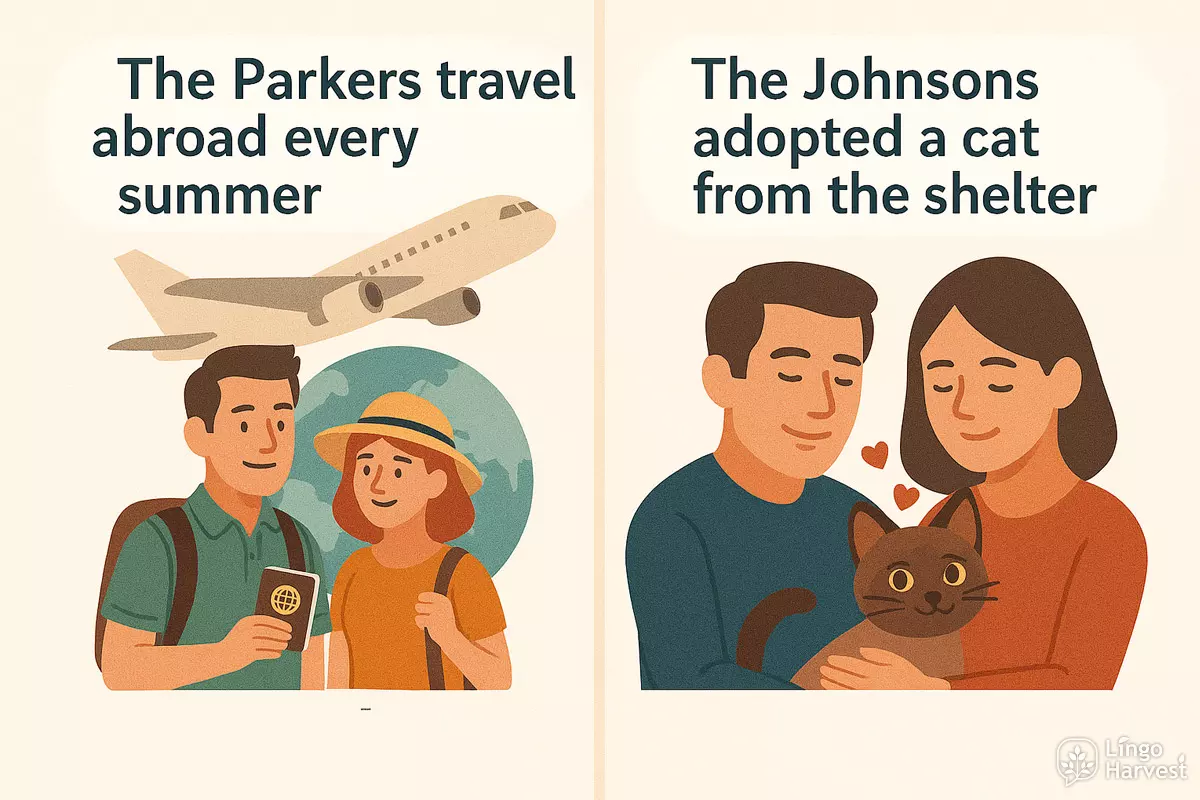
- The Parkers → The Parkers travel abroad every summer.
- The Johnsons → The Johnsons adopted a cat from the shelter.
- The Rodriguezes → The Rodriguezes run a small café downtown.
- The Millers → The Millers renovated their old house.
- The Changs → The Changs invited friends over for dinner.
- The Murphys → The Murphys are planning a holiday trip.
- The Thompsons → The Thompsons arrived late to the party.
- The Garcias → The Garcias celebrated a wedding anniversary.
- The Browns → The Browns live across the street.
- The O’Connors → The O’Connors enjoy weekend hikes.
- The Patels → The Patels opened a new grocery store.
- The Wus → The Wus moved back to the city.
- The Martins → The Martins host game nights on Fridays.
- The Evanses → The Evanses welcomed a new baby.
- The Andersons → The Andersons sold their old car.
- The Robinsons → The Robinsons are known for their garden.
Singular vs. plural: what changes?
Notice the difference in meaning:
- The Clark (could refer to one person, or sound unusual)
- The Clarks (clearly refers to the whole Clark family)
Using the plural is the standard way to talk about a family group in social contexts.
Plural forms by surname ending
| Surname ending | Plural form example | Group mention |
|---|---|---|
| Ends with most consonants | Smith → Smiths | The Smiths are here. |
| Ends with -s, -x, -z, -ch, -sh | Jones → Joneses | The Joneses are on vacation. |
| Ends with -y | Murphy → Murphys | The Murphys joined us. |
| Ends with -o | Picasso → Picassos | The Picassos moved in. |
Understanding these patterns helps you refer to families smoothly in conversation, invitations, or writing, making your English sound more natural and clear.
Differences between singular surname and family reference
When talking about surnames in English, there’s a clear difference between using a last name as a label for one person and referring to a whole group or family. This distinction often shows up in both grammar and meaning, especially in writing invitations, naming households, or talking about family traditions.
Singular Surname: Referring to One Person
A surname in its basic, singular form—like Smith or Johnson—identifies an individual. For example, “Mr. Smith” or “Jane Johnson” uses the last name to point to one specific person. No pluralization or article is needed in these cases.
- Used for a single individual
- No “the” before the name
- Example: “Ms. Brown is here.”
- Does not indicate a group or family
Family Reference: Pluralizing the Surname
When you want to refer to all the members of a family, the surname is made plural, and usually the definite article “the” is added. This turns “Smith” into “the Smiths,” meaning everyone in the Smith family. It’s a way to collectively talk about the household or group, not just one individual.
- Refers to multiple people sharing the last name
- Usually preceded by “the”
- Example: “The Garcias are coming to dinner.”
- Indicates a group (family unit)
Common Patterns and Examples
Here are some typical transformations when shifting from a single last name to a family reference:
- Smith → the Smiths
- Jones → the Joneses
- Williams → the Williamses
- Murphy → the Murphys
- Fox → the Foxes
- Lee → the Lees
- Berry → the Berrys
- Church → the Churches
- Ross → the Rosses
- Kennedy → the Kennedys
- Harris → the Harrises
- Thomas → the Thomases
- Fernandez → the Fernandezes
- Wolf → the Wolfs or Wolves (rare: Wolves is less common)
- King → the Kings
- Clark → the Clarks
- Evans → the Evanses
- Lopez → the Lopezes
- Reed → the Reeds
- Ng → the Ngs
Main Usage Differences
| Form | Typical Use | Example Sentence |
|---|---|---|
| Singular Surname | Refers to one individual | “Ms. Patel arrived early.” |
| Plural Surname (“the” + plural) | Refers to the entire family or group | “The Patels love traveling.” |
| Singular Surname with “the” | Rare, sometimes used for businesses or titles | “The Smith Gallery hosts art shows.” |
| Plural Surname without “the” | Unusual, not standard for family reference | “Smiths live here.” ❌ |
Quick Tips
- Don’t add an apostrophe to make a surname plural (write “the Browns,” not “the Brown’s”).
- For names ending in s, x, z, ch, or sh, add -es (“the Foxes,” “the Marshes”).
- Always use “the” when referring to a family as a group.
Understanding when to use the singular or plural form helps keep your English clear, especially in social contexts and formal writing.
Common learner mistakes with plural family names
Many English learners get tripped up when turning last names into plurals, often because the rules differ from regular noun pluralization. These errors can lead to awkward or incorrect forms, especially when writing about families or sending invitations. Below, we’ll highlight some typical confusion points and show you how to avoid them.
Adding an apostrophe by mistake
One frequent error is using an apostrophe before the s when making a surname plural, like The Smith's instead of The Smiths. Remember, apostrophes show possession, not plurality.
- ❌ The Brown's are coming to dinner.
- ✅ The Browns are coming to dinner.
Incorrect endings for tricky surnames
Names ending in -s, -x, -z, -ch, or -sh cause confusion. Learners often add just -s instead of -es, or try to change the spelling unnecessarily. For these endings, always add -es to form the plural.
| Incorrect Plural | Correct Plural |
|---|---|
| the Jones | the Joneses |
| the Bushs | the Bushes |
| the Foxs | the Foxes |
| the Sanchez' | the Sanchezes |
| the Marchs | the Marches |
Changing the spelling or pronunciation unnecessarily
Some learners try to apply regular noun rules, like changing -y to -ies or -f to -ves. Family names don’t follow these changes—simply add -s or -es as needed, without altering the root.
- ❌ The Murphies → ✅ The Murphys
- ❌ The Wolfs → ✅ The Wolfs (not Wolves)
- ❌ The Kennedyies → ✅ The Kennedys
Using lowercase or omitting “the”
Capitalization matters: surnames should always be capitalized, and when referring to a family group, use the before the plural name. Skipping “the” or using lowercase makes the sentence look informal or incorrect.
- ❌ smiths are here.
- ✅ The Smiths are here.
Quick reference: Common slip-ups
- Using an apostrophe before s for plural forms
- Forgetting to add -es for names ending in s, x, z, ch, sh
- Changing the spelling of the surname (e.g., -y to -ies)
- Missing capitalization or omitting “the”
- Mixing up plural and possessive forms (e.g., The Smith's house vs. The Smiths' house)
- Using foreign pluralization rules for English names
- Applying irregular noun patterns to last names
- Adding extra letters (e.g., The Harrisess instead of The Harrises)
- Confusing singular and plural forms in context
- Forgetting that family names don’t take articles in some languages, but do in English
By watching out for these mistakes, you’ll be able to write about families and their names more accurately and naturally in English.
Practice: form correct plural family names in context
Understanding how to pluralize surnames is essential for writing invitations, addressing cards, or referring to families in conversation and writing. Below, you’ll find clear examples and practical exercises to help you master these forms in realistic settings.
Common Patterns for Pluralizing Family Names
- Add -s to most names without special endings: Smith → Smiths, Carter → Carters
- If the name ends in -s, -x, -z, -ch, or -sh, add -es: Jones → Joneses, Church → Churches
- Do not use an apostrophe when making a family name plural: NOT "Smith's" or "Jones's"
- If the name ends in -y, do not change the y: Kennedy → Kennedys
- For names ending in -f or -fe, simply add -s: Leaf → Leafs (not "Leaves" for surnames)
Practice: Choose the Correct Plural Form
- We're having dinner with the Lopez tonight. Should it be "Lopezs" or "Lopezes"?
- The Murphy are hosting the barbecue. What is the correct plural?
- Send the invitations to the Fox.
- The Lewis family just moved in next door.
- We visited the Church last weekend.
- Welcome to the home of the Berry.
- The Bush donated to the fundraiser.
- The Wolf are away on vacation.
Show answers
- Lopezes
- Murphys
- Foxes
- Lewises
- Churches
- Berrys
- Bushes
- Wolfs
Table: Surname Endings and Their Plural Forms
| Singular Surname | Plural Form | Rule Applied |
|---|---|---|
| Smith | Smiths | Add -s |
| Jones | Joneses | Add -es (ends with -s) |
| Bush | Bushes | Add -es (ends with -sh) |
| Kennedy | Kennedys | Add -s (no change to y) |
| Fox | Foxes | Add -es (ends with -x) |
| Lopez | Lopezes | Add -es (ends with -z) |
| Berry | Berrys | Add -s (no change to y) |
| Wolf | Wolfs | Add -s |
Quick Check: Which Are Correct?
- The Carters ✅ The Carter's ❌
- The Williamses ✅ The Williams' ❌
- The Foxes ✅ The Fox's ❌
- The Kennedys ✅ The Kennedy's ❌
With these examples and exercises, you’ll be able to confidently handle plural forms of family names in any context, from formal announcements to everyday notes.