Possessive Forms with Names Ending in -s Explained Clearly

 Here we rules for making possessives with names ending in -s, explains when to use apostrophe + s or just an apostrophe, discusses pronunciation and style differences, addresses issues with classical and modern names, and includes practice exercises.
- Rules for forming possessives with names ending in -s
- Using apostrophe + s vs apostrophe only
- Pronunciation of possessive forms ending in -s
- Style differences in possessive spelling conventions
- Possessives with classical and modern names
- Common learner confusion with apostrophe placement
- Practice: add correct possessive forms to given names
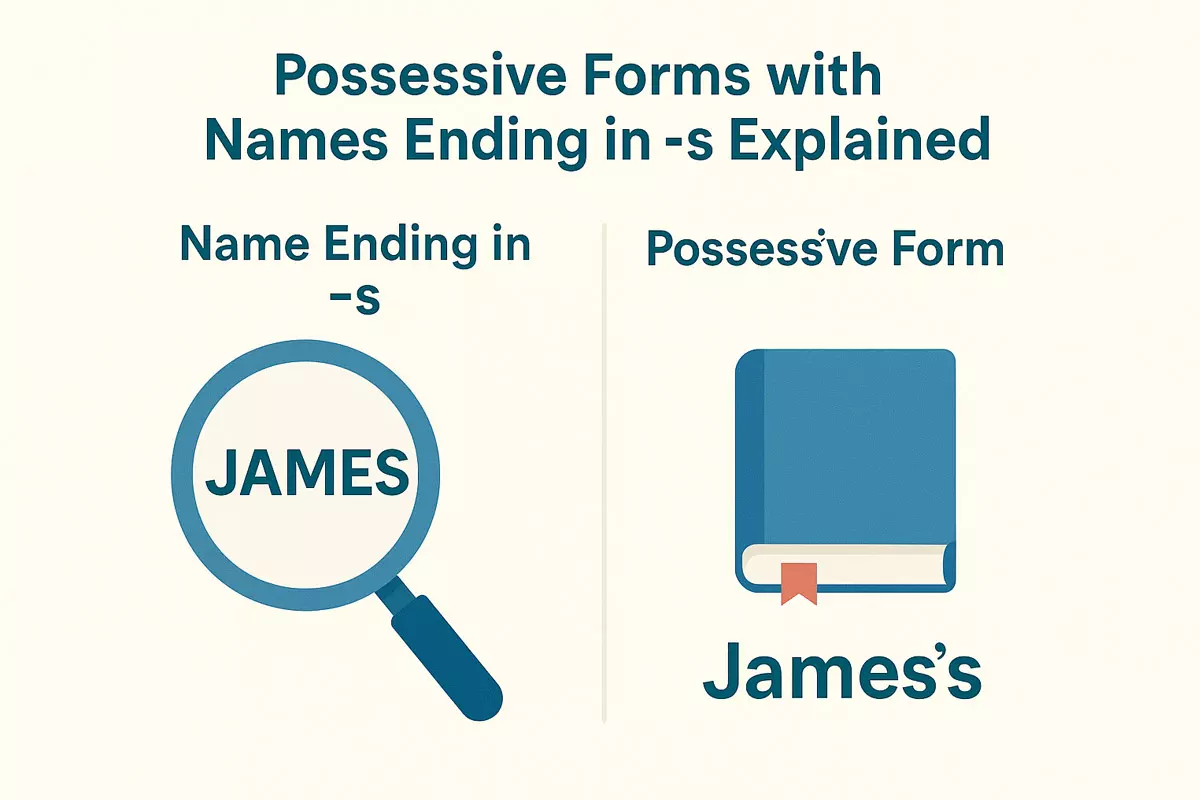
Writers often feel uncertain about how to correctly show ownership with names ending in -s, but mastering this rule can make your writing clearer and more professional. Typically, you form the possessive by adding an apostrophe followed by an s, as in Charles’s book or James’s car. However, some style guides accept just an apostrophe after the s, especially for classical or biblical names, like Socrates’ philosophy. Knowing which form to use depends on the style guide you follow, but consistency is key for polished writing.
Rules for forming possessives with names ending in -s
Understanding how to indicate possession with proper names that end in -s can be confusing, since both traditional and modern style guides offer different recommendations. In most cases, you have two valid formatting options: add only an apostrophe after the -s (James’ book), or add an apostrophe plus another s (James’s book). Which form you choose often depends on the chosen style guide (such as AP, Chicago, or MLA), regional usage, or even personal preference.
The general principle is to ensure clarity and ease of pronunciation. Some styles favor adding only an apostrophe for classical or biblical names (like Moses’ law), but recommend ’s for most modern names. Consistency within a document is usually more important than the specific choice.
Common patterns and examples
- Charles’s car (or Charles’ car)
- Jess’s notebook (or Jess’ notebook)
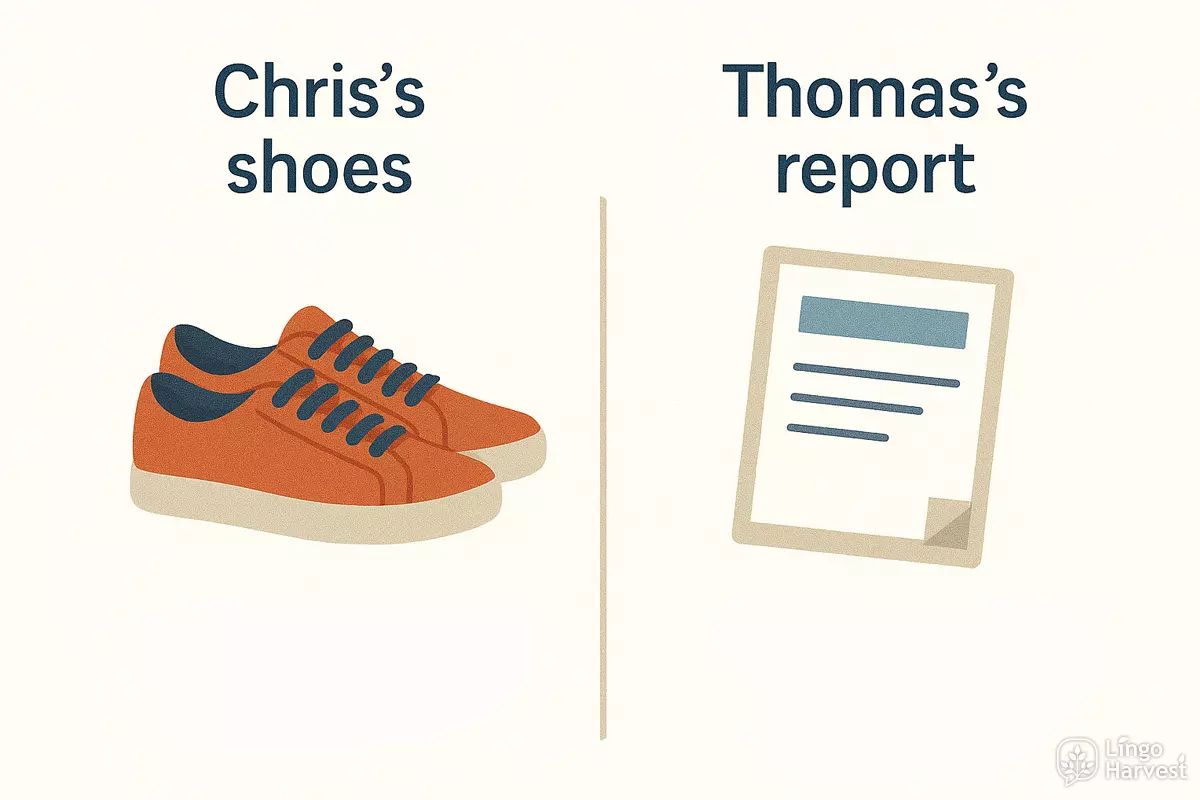
- Chris’s shoes (or Chris’ shoes)
- Thomas’s report (or Thomas’ report)
- Lucas’s idea (or Lucas’ idea)
- Alexis’s phone (or Alexis’ phone)
- James’s guitar (or James’ guitar)
- Doris’s garden (or Doris’ garden)
- Francis’s hat (or Francis’ hat)
- Marcos’s schedule (or Marcos’ schedule)
- Jesus’ teachings (traditional form, no extra s)
- Moses’ staff (traditional form, no extra s)
Style guide preferences
Different style guides have their own preferences for possessive forms:
| Style Guide | Preferred Possessive Form |
|---|---|
| Chicago Manual of Style | Usually adds ’s (James’s), except for ancient or biblical names |
| Associated Press (AP) | Adds only an apostrophe (James’) |
| Modern Language Association (MLA) | Favors ’s (Charles’s) |
| Traditional/Biblical Names | Usually just an apostrophe (Jesus’, Moses’) |
Tips for consistency
- Pick a style (such as always using ’s or only an apostrophe) and use it throughout your writing.
- If following a specific guide (for academic or journalistic work), check their rules before finalizing possessive forms.
- When in doubt, read the phrase aloud: if adding another s makes it awkward, consider dropping it.
Remember, the most important factor is clarity for your reader. Both forms are widely accepted, but sticking to one approach makes your writing look polished and professional.
Using apostrophe + s vs apostrophe only
When forming the possessive with names ending in -s, English offers two main conventions: adding just an apostrophe after the final s, or adding both an apostrophe and another s. Which form you choose often depends on style guides, pronunciation, and personal or regional preference.
General Guidelines
- Traditionally, many style guides recommend adding ’s to any singular name, even if it ends in s (e.g., James’s book).
- Some prefer only an apostrophe after names ending in s for a simpler look (e.g., James’ book).
- Plural possessives almost always use only the apostrophe (e.g., the Joneses’ house).
- Pronunciation can influence your choice: if you say an extra "iz" sound, ’s is often clearer.
Common Examples
Here’s how these two approaches typically appear with common names:
| Name | Apostrophe + s | Apostrophe only |
|---|---|---|
| James | James’s hat | James’ hat |
| Chris | Chris’s car | Chris’ car |
| Lucas | Lucas’s idea | Lucas’ idea |
| Jess | Jess’s phone | Jess’ phone |
| Charles | Charles’s shoes | Charles’ shoes |
| Harris | Harris’s dog | Harris’ dog |
| Thomas | Thomas’s laptop | Thomas’ laptop |
| Lois | Lois’s keys | Lois’ keys |
| Alexis | Alexis’s project | Alexis’ project |
| Briggs | Briggs’s report | Briggs’ report |
Which Form Should You Choose?
The best choice often comes down to your audience or the style guide you follow. For example, Chicago Manual of Style recommends using ’s for most singular names, while Associated Press prefers just the apostrophe for names ending in s. If you’re unsure, stay consistent throughout your writing.
- If clarity or pronunciation is a concern, add ’s (e.g., Lucas’s).
- If following a specific style guide (like AP), use only the apostrophe (e.g., Lucas’).
- Plural names almost always take just the apostrophe: the Joneses’ garden.
Above all, consistency is key when using apostrophes for names ending in -s. Pick a style and stick with it in your document.
Pronunciation of possessive forms ending in -s
Understanding how to say possessive forms for names ending with -s can be confusing, but there are clear patterns that native speakers typically follow. The way the possessive is pronounced often depends on the speaker's accent, regional habits, and the specific name involved.
General Pronunciation Patterns
When adding an apostrophe + s ('s) to a name ending in -s, most speakers pronounce an extra syllable: /ɪz/ or /əz/. For example, “James’s book” is usually pronounced as “James-iz book.” In contrast, some style guides allow just the apostrophe (James’), but the pronunciation often remains the same in speech.
- James’s (James-iz) → James’s car is parked outside.
- Chris’s (Chris-iz) → Chris’s idea impressed the team.
- Jess’s (Jess-iz) → Jess’s phone is on the table.
- Charles’s (Charles-iz) → Charles’s speech was very clear.
- Lucas’s (Lucas-iz) → Lucas’s project won first place.
- Thomas’s (Thomas-iz) → Thomas’s answer was correct.
- Lois’s (Lois-iz) → Lois’s bag is under the chair.
- Gus’s (Gus-iz) → Gus’s bike is new.
- Ross’s (Ross-iz) → Ross’s apartment is nearby.
- Francis’s (Francis-iz) → Francis’s opinion matters.
- Doris’s (Doris-iz) → Doris’s voice sounds calm.
- Alexis’s (Alexis-iz) → Alexis’s presentation was excellent.
Exceptions and Variations
Some speakers, especially in journalistic or formal contexts, may drop the extra syllable and simply pronounce the base name, especially with classical or biblical names (e.g., “Moses’ law” is often said as “Moses law”). However, for most modern, everyday names, the extra /ɪz/ sound is preferred.
Comparison of Pronunciations
Below is a structured look at how possessive forms are pronounced versus their written forms for names ending in -s:
| Name (Possessive Written) | Common Pronunciation |
|---|---|
| James’s / James’ | James-iz |
| Chris’s / Chris’ | Chris-iz |
| Lois’s / Lois’ | Lois-iz |
| Thomas’s / Thomas’ | Thomas-iz |
| Charles’s / Charles’ | Charles-iz |
| Francis’s / Francis’ | Francis-iz |
Quick Tips
- Adding an /ɪz/ sound is almost always correct for modern names.
- Some classical or biblical names may drop the extra syllable in formal speech.
- Written forms may vary, but spoken English generally favors the added syllable for clarity.
In summary, when in doubt, pronounce the possessive of names ending in -s with an extra syllable: /ɪz/. This approach is widely accepted and ensures your meaning is clear.
Style differences in possessive spelling conventions
Writers often encounter varying guidance on how to form possessives with names ending in -s, and different style manuals sometimes recommend distinct approaches. The core issue centers on whether to add only an apostrophe or both an apostrophe and an extra s, and which approach is considered correct or preferred in formal writing.
Common Approaches by Major Style Guides
Some style guides, such as The Chicago Manual of Style, typically suggest adding both an apostrophe and an s to singular names ending in -s (e.g., Charles’s book). Others, like the Associated Press (AP) style, favor just an apostrophe for such cases (Charles’ book). The choice often depends on the audience, publication, or personal preference, but consistency is key.
| Style Guide | Recommended Possessive Form |
|---|---|
| Chicago Manual of Style | James’s car |
| Associated Press (AP) Style | James’ car |
| Modern Language Association (MLA) | James’s car |
| New York Times Style | James’ car |
| Oxford Style | James’s car |
| Australian Government Style Manual | James’ car |
Other Influences on Spelling Choices
Pronunciation can also play a role: if the possessive is pronounced with an extra syllable (“-iz”), some prefer to write the extra s, while for silent or classical names, only the apostrophe may be used. For example:
- Jesus’ teachings (not Jesus’s, to reflect traditional usage)
- Moses’ laws
- Chris’s idea → pronounced “Chris-iz”
- Ross’s shoes
- Achilles’ heel (classical or historical names often omit the extra s)
Quick Reference: Typical Patterns
Writers can refer to these patterns for clarity:
- Add apostrophe + s for most modern names: Thomas’s, Jess’s
- Use only apostrophe for ancient or biblical names: Jesus’, Moses’, Socrates’
- Follow your organization’s or publisher’s guide for consistency
- When in doubt, check if adding an extra syllable feels natural in speech
- Avoid mixing styles within the same document
Understanding these conventions helps ensure clarity and professionalism in writing, especially when dealing with names that end in -s. Consistency within your document or organization is more important than following any single rule, as preferences may shift depending on context or regional standards.
Possessives with classical and modern names
When it comes to forming possessives with names ending in -s, usage often differs depending on whether the name is considered classical (such as those from ancient Greece or Rome) or modern. The conventions for these two categories have evolved over time, and modern style guides may offer different recommendations.
Classical names: Traditional conventions
Writers and editors often follow a special rule for ancient names. Generally, the possessive is formed by simply adding an apostrophe after the final -s, without an extra -s. This approach is rooted in longstanding English tradition and is meant to maintain a smooth pronunciation.
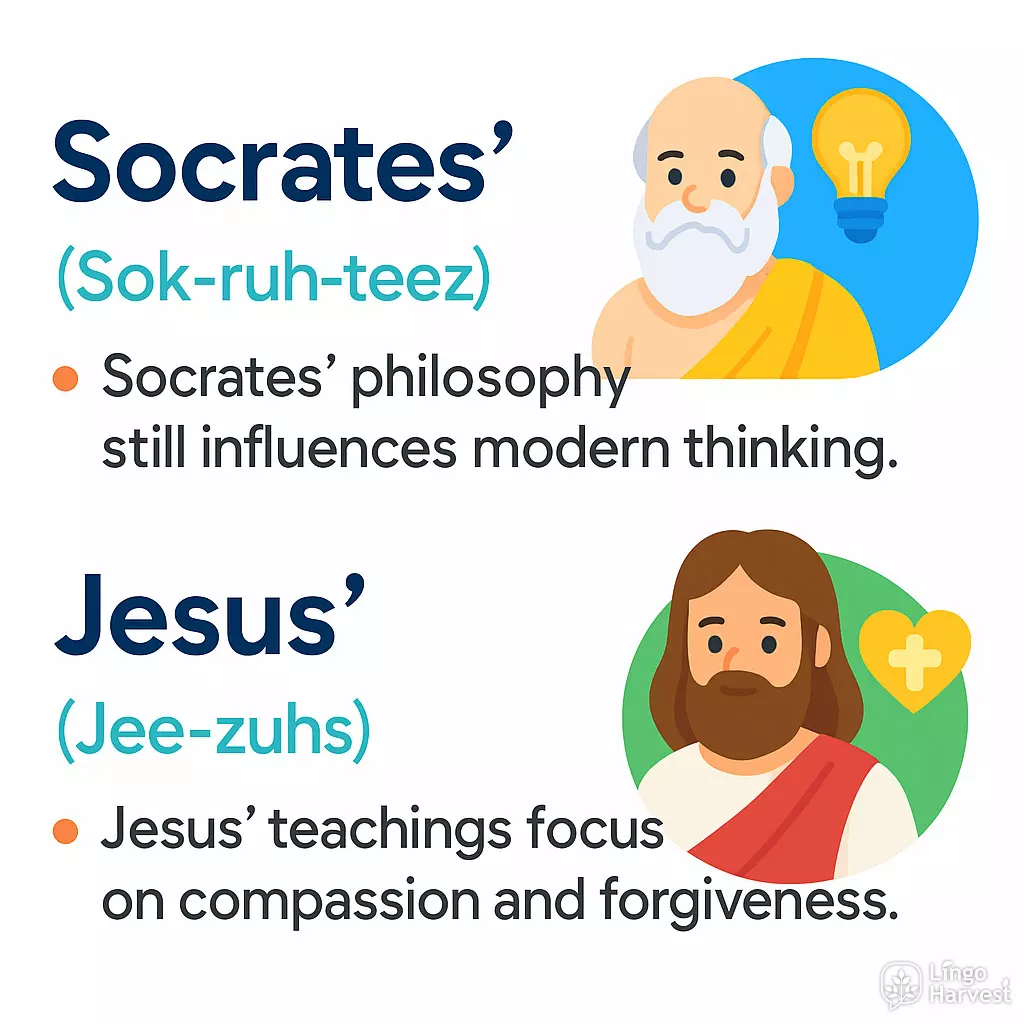
- Socrates’ philosophy → Socrates’ philosophy still influences modern thinking.
- Jesus’ teachings → Jesus’ teachings focus on compassion and forgiveness.
- Moses’ law → Moses’ law shaped early religious traditions.
- Achilles’ heel → His pride became his Achilles’ heel.
- Odysseus’ journey → Odysseus’ journey lasted many years.
- Euripides’ plays → Euripides’ plays often explore human emotion.
- Aristophanes’ comedies → Aristophanes’ comedies use satire and humor.
- Herodotus’ histories → Herodotus’ histories describe ancient cultures.
- Cyrus’ empire → Cyrus’ empire stretched across vast territories.
- Perseus’ quest → Perseus’ quest required courage and skill.
This tradition is most consistently applied to biblical and ancient figures.
Modern names: Current practice
For contemporary names ending in -s, most modern style guides now recommend adding both the apostrophe and an extra -s, even if it results in a double -s sound. This change helps clarify pronunciation and grammatical intent.
- James’s book → James’s book became a bestseller.
- Chris’s car → Chris’s car is parked outside.
- Alexis’s idea → Alexis’s idea solved the problem.
- Ross’s apartment → Ross’s apartment overlooks the river.
- Lucas’s guitar → Lucas’s guitar sounds amazing.
- Jess’s notebook → Jess’s notebook is full of sketches.
- Lois’s garden → Lois’s garden is full of roses.
- Charles’s decision → Charles’s decision surprised everyone.
- Frances’s report → Frances’s report was clear and detailed.
- Dallas’s skyline → Dallas’s skyline looks impressive at night.
However, some publications and individuals may still prefer the simpler apostrophe-only version, especially to avoid awkwardness in speech or writing.
Comparison of possessive forms for -s names
The following table summarizes the differences in forming possessives for classical versus modern names ending in -s.
| Name Type | Recommended Possessive Form | Example |
|---|---|---|
| Classical (ancient, biblical) | [Name]’ | Socrates’ wisdom, Jesus’ parables |
| Modern (contemporary) | [Name]’s | Chris’s laptop, James’s hat |
| Alternative (some style guides) | [Name]’ or [Name]’s (author’s choice) | Ross’/Ross’s plan, Frances’/Frances’s essay |
In summary, whether you add just an apostrophe or apostrophe plus -s depends on the origin of the name and the guidance you choose to follow. Consistency in your approach—especially within the same document—is key.
Common learner confusion with apostrophe placement
Many English learners find it tricky to decide how to form the possessive with names ending in -s. The rules can seem inconsistent, especially since both spoken and written English offer some flexibility. The main confusion often centers around whether to add just an apostrophe (') or an apostrophe plus s ('s), and how pronunciation or style guides might influence this choice.
Frequent issues and misunderstandings
- Assuming all names ending in -s follow the same rule (they don’t—usage varies).
- Believing that pronunciation always dictates spelling.
- Mixing up plural possessives and singular possessives.
- Applying rules for regular plural nouns to proper names by mistake.
- Forgetting style guide differences (AP, Chicago, etc.).
- Uncertainty about what to do with ancient or classical names (like Jesus or Socrates).
- Overusing only the apostrophe, fearing “too many” s's.
- Adding an apostrophe to names that don’t need it (e.g., using "James'" for plural).
- Confusing contraction apostrophes with possessives.
- Trying to match the possessive form to how it “sounds” in speech, which isn’t always reliable.
- Omitting the apostrophe entirely (e.g., "Chris house" instead of "Chris’s house").
- Interpreting possessive forms as errors when they’re actually acceptable variants.
Comparing forms: Examples of correct and incorrect usage
| Name | Correct Possessive Form |
|---|---|
| James | James’s book ✅ James’ book ✅ (both acceptable, style-dependent) |
| Chris | Chris’s car ✅ Chris’ car ✅ (both forms seen) |
| Moses | Moses’ laws ✅ (traditional/religious names often drop extra s) |
| Boss | Boss’s office ✅ Boss’ office ✅ (less common, but sometimes seen) |
| Plural: The Joneses | The Joneses’ house ✅ (never "Jones’s" for the plural family) |
| Plural: The class | The class’s project ✅ The class’ project ✅ (both seen, but "class's" is more common in American English) |
Key points to remember
- Both 's and just an apostrophe are often correct for singular names ending in -s; check your style guide or stay consistent.
- For plural possessives, add only an apostrophe after the s (e.g., the Joneses’ car).
- Some traditional or classical names usually take just an apostrophe (e.g., Jesus’ teachings).
- Pronunciation does not always match spelling. For example, "Chris’s" is pronounced the same as "Chris’" in most dialects.
- When in doubt, write out the full form and check if it feels natural or consult a trusted style guide.
Trying to memorize one “universal” rule leads to mistakes. Instead, focus on the patterns and exceptions, and remember that clarity and consistency matter more than absolute uniformity.
Practice: add correct possessive forms to given names
Understanding how to show possession with names, especially those ending in -s, can be tricky. Below, you'll find practical exercises designed to help you apply the correct possessive form to a variety of names. Remember: for most modern English usage, both -’s and just an apostrophe (’) are accepted for names ending in -s, but style guides may differ. Pay attention to context and consistency.
Task: Rewrite with the correct possessive form
Add the correct possessive to each name so the phrase shows ownership. Try to decide if you would use -’s or just ’ after the name (both are often correct, but some styles prefer one).
- James ____ car
- Chris ____ book
- Charles ____ idea
- Jess ____ shoes
- Alexis ____ coat
- Lucas ____ phone
- Francis ____ report
- Lois ____ advice
- Thomas ____ brother
- Ross ____ guitar
- Dennis ____ office
- Doris ____ painting
- Rhys ____ project
- Harris ____ backpack
- Silas ____ drawing
Show answers
- James’s car (or James’ car)
- Chris’s book (or Chris’ book)
- Charles’s idea (or Charles’ idea)
- Jess’s shoes (or Jess’ shoes)
- Alexis’s coat (or Alexis’ coat)
- Lucas’s phone (or Lucas’ phone)
- Francis’s report (or Francis’ report)
- Lois’s advice (or Lois’ advice)
- Thomas’s brother (or Thomas’ brother)
- Ross’s guitar (or Ross’ guitar)
- Dennis’s office (or Dennis’ office)
- Doris’s painting (or Doris’ painting)
- Rhys’s project (or Rhys’ project)
- Harris’s backpack (or Harris’ backpack)
- Silas’s drawing (or Silas’ drawing)
Quick check: spot the correct possessive
Choose which version is correct (or if both are acceptable):
- Is it Chris's bike or Chris' bike?
- Should you write Lois's hat or Lois' hat?
- Which is better: Thomas's bag or Thomas' bag?
- Is Ross's team or Ross' team preferred?
- Is James's office or James' office correct?
- Should it be Lucas's guitar or Lucas' guitar?
- Is Alexis's opinion or Alexis' opinion better?
- Which form is preferred: Charles's speech or Charles' speech?
- Is it Frances's report or Frances' report?
- Should you write Dallas's skyline or Dallas' skyline?
Show answers
- Both forms are correct; usage depends on the style guide.
- Both forms are accepted in modern English.
- Both are common; Thomas's is more frequent in US English.
- Both are acceptable; Ross's is preferred in current usage.
- Both forms are correct; James's is more common in US English.
- Both are acceptable; Lucas's is generally preferred.
- Both forms are correct; consistency matters more than the choice.
- Both are used; Charles's is preferred in most modern guides.
- Both are acceptable; Frances's is less common but correct.
- Both forms are correct; place names often use -’s in US English.
Summary Table: Possessive Forms for Names Ending in -s
| Name | Standard Possessive | Alternative (also accepted) |
|---|---|---|
| James | James’s | James’ |
| Chris | Chris’s | Chris’ |
| Charles | Charles’s | Charles’ |
| Lois | Lois’s | Lois’ |
| Thomas | Thomas’s | Thomas’ |
| Ross | Ross’s | Ross’ |
| Alexis | Alexis’s | Alexis’ |
| Dennis | Dennis’s | Dennis’ |
| Francis | Francis’s | Francis’ |
| Silas | Silas’s | Silas’ |
Working through these examples will help you get comfortable with forming possessives for names ending in -s. Practice with names from your own life and notice style differences in various texts.