Reduced Noun Phrases in Headlines and Media Writing

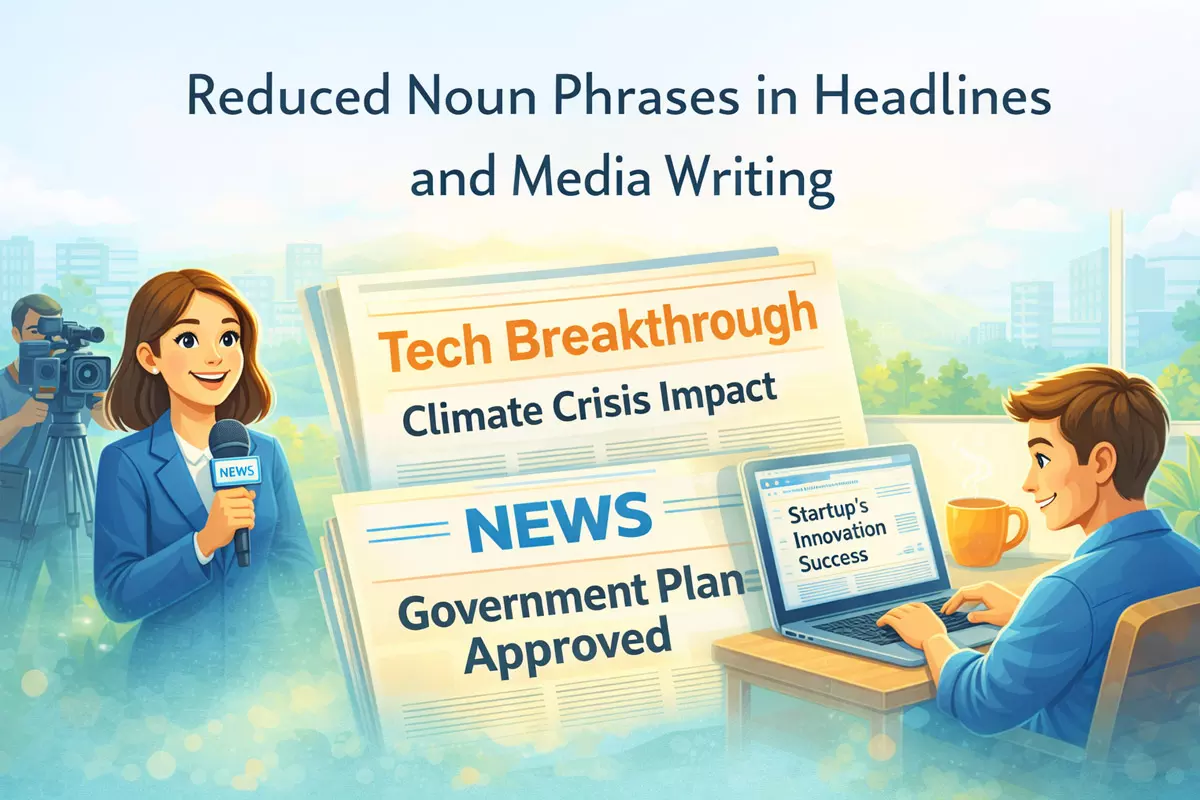 Here we why headlines use reduced noun phrases, how articles and verbs are left out, the role of time and event nouns, possible ambiguities, differences from full sentences, typical learner errors, and includes practice converting sentences.
- Why reduced noun phrases are used in headlines
- Omission of articles and verbs in headline noun phrases
- Time, event, and action nouns in compressed form
- Ambiguity created by excessive noun reduction
- Differences between headline style and full sentences
- Typical learner errors with headline-style noun phrases
- Practice: convert full sentences into reduced headlines
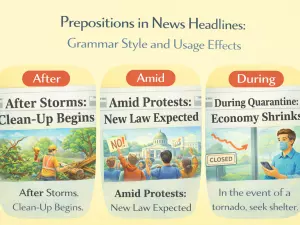
News headlines are increasingly adopting a concise and impactful style, using shorter phrases and omitting unnecessary words to quickly capture readers’ attention. This trend not only makes stories stand out amid the constant flow of information but also ensures that essential details are communicated efficiently. By focusing on brevity and clarity, news outlets adapt to readers’ limited time and shortened attention spans, making it easier for audiences to stay informed in a fast-paced digital environment.
Why reduced noun phrases are used in headlines
Editors and writers often favor shortened noun phrases in headlines to pack more information into a limited space. Headlines must grab attention quickly and deliver key details at a glance, so trimming unnecessary words is essential. Reduced forms—like “COVID spike fears” instead of “Fears about a spike in COVID cases”—help maximize impact while conserving space.
Clarity and Brevity
Using condensed noun phrases allows media outlets to convey complex stories more efficiently. Readers scanning headlines can instantly grasp the subject and main action without wading through extra words. This streamlined approach is especially useful for mobile devices and digital platforms, where space is tight and attention spans are short.
Examples of Reduced Noun Phrases in Headlines
- Election results shock
- Climate change summit debate
- City council tax hike
- Sports star injury fears
- Job market growth slowdown
- Budget cuts protest
- Weather alert issued
- Housing crisis talks
- School funding controversy
- Technology merger announcement
- Travel ban confusion
- Healthcare reform backlash
- Trade deal negotiations
- Stock market rally
- Airport security concerns
- Wildfire evacuation order
- Immigration policy review
- Film festival lineup
- Education standards overhaul
- Public transport strike
Benefits for Journalists and Readers
Shortened constructions not only save space but also create a punchier, more dynamic tone. This style helps headlines fit on small screens without awkward breaks or truncations, making news more accessible and skimmable. For journalists, these compact structures enable them to include more stories on a single page or feed.
How Reduced Noun Phrases Differ from Full Phrases

| Full Phrase | Reduced Noun Phrase |
|---|---|
| Debate about the climate change summit | Climate change summit debate |
| Announcement of a technology merger | Technology merger announcement |
| Concerns about airport security | Airport security concerns |
| Order to evacuate due to wildfire | Wildfire evacuation order |
| Shock at the results of the election | Election results shock |
Ultimately, compressed noun phrases are a practical tool in headline writing, helping both journalists and readers navigate the fast-moving world of news.
Omission of articles and verbs in headline noun phrases
Writers often streamline headlines by leaving out articles (a, an, the) and sometimes verbs, creating compact noun phrases that deliver information quickly. This stylistic choice improves scannability and saves space, but it also changes the rhythm and sometimes the clarity of the phrase compared to standard English sentences.
Why headlines drop articles and verbs
Headlines are designed to grab attention and convey meaning efficiently. Eliminating function words like articles and auxiliary verbs helps make headlines more concise. Readers are accustomed to this compressed style, so they can infer the missing elements from context.
Common patterns in reduced noun phrases
You’ll notice certain structures repeat across news and media writing. Here are frequent patterns where words are omitted:
- Adjective + Noun (e.g., "Global Markets Surge")
- Noun + Noun (e.g., "Election Results Unclear")
- Noun + Past Participle (e.g., "Bridge Collapsed")
- Adjective + Noun + Noun (e.g., "New Vaccine Rollout")
- Number + Noun (e.g., "Five Injured")
- Noun + Prepositional Phrase (e.g., "Fire in Downtown")
- Verb-less Phrases (e.g., "Weather Alert")
- Omission of “be” verb (e.g., "Mayor Under Investigation")
- Lack of “the” or “a/an” (e.g., "Dog Saves Child")
- Compound Noun Phrases (e.g., "Tech Stocks Rally")
- Time + Event (e.g., "Morning Commute Chaos")
- Place + Incident (e.g., "Park Shooting")
- Person + Achievement (e.g., "Student Wins Award")
- Organization + Action (e.g., "Council Approves Plan")
- Quote Fragment (e.g., "'Miracle' Rescue")
- Topic + Statistic (e.g., "Inflation at 8%")
- Subject + Adjective (e.g., "Roads Slippery")
- Possessive + Noun (e.g., "Mayor’s Statement Released")
- Event + Location (e.g., "Festival Downtown")
- Title + Name (e.g., "President Biden Visit")
Comparing full sentences and headline-style reductions
To illustrate, compare how everyday statements are shortened for headlines. Notice how articles and verbs are omitted, yet the essential meaning is preserved:
| Full Sentence | Headline Noun Phrase |
|---|---|
| The mayor is under investigation. | Mayor Under Investigation |
| A fire broke out in the downtown area. | Fire in Downtown |
| The students have won awards. | Students Win Awards |
| There is a weather alert for tomorrow. | Weather Alert Tomorrow |
| The council approved the plan. | Council Approves Plan |
| The inflation rate is at 8 percent. | Inflation at 8% |
| Five people were injured in the accident. | Five Injured in Accident |
| The president will visit the city. | President Visit City |
Potential ambiguities and reader expectations
While this condensed style is efficient, it can sometimes create ambiguity or require readers to fill in the gaps. For example, omitting articles may make it unclear whether a noun is specific or general. However, experienced readers of headlines are skilled at interpreting these cues based on context and placement. In summary, removing articles and verbs in headline noun phrases is a practical approach that balances brevity with clarity, relying on reader familiarity with news conventions.
Time, event, and action nouns in compressed form
Writers often use shortened noun phrases to pack more information into headlines, blurbs, and news tickers. This technique lets editors communicate complex updates quickly, often by relying on single nouns that suggest a broader story or sequence of events. In these cases, the noun stands in for a full clause or action, saving space and grabbing attention.
Common compressed noun uses in headlines
Certain types of nouns are especially useful for this kind of compression. Time references, events, and actions are frequently reduced to their base forms—often a single noun or a noun with modifiers—without supporting verbs or articles. This approach is particularly common in English-language media, but it appears in many languages. Here are some typical examples:
- Election results – Final vote counts show a narrow victory for the incumbent party.
- Budget cuts – Officials confirm reduced funding for public programs next year.
- Flood aftermath – Residents assess severe damage after days of heavy rain.
- Strike threat – Workers warn they may walk out if talks fail.
- Winter storm warning – Meteorologists predict heavy snow and strong winds overnight.
- Rescue efforts – Teams work around the clock to find missing hikers.
- Policy shift – The government announces a new direction on immigration rules.
- Launch delay – The company postpones its satellite mission due to technical issues.
- Market rally – Stock prices jump after positive economic forecasts.
- Holiday closures – Several businesses plan to shut down early for the festival period.
- Outage update – Engineers say power should be restored within hours.
- Summit talks – Leaders meet to discuss climate cooperation goals.
- Recall notice – Car maker issues recall over a brake system defect.
- Protest turnout – Thousands gather downtown to demand new reforms.
- Merger rumors – Analysts speculate about a major corporate deal.
- Arrest report – Police confirm the arrest of a suspect in the robbery case.
- Breakthrough discovery – Scientists reveal a promising new cancer treatment.
- Shutdown extension – Officials announce the facility will remain closed through next week.
How compressed forms shape meaning
By using these condensed noun phrases, headlines can suggest a whole narrative or sequence of actions without spelling out every detail. For example, "Election results" implies that votes have been cast and counted, and now the outcome is available. "Rescue efforts" hints at an ongoing emergency and the work being done to address it. This efficient packaging is key to headline writing.
Comparing full and compressed forms
To see how this works in practice, compare traditional sentences with their compressed headline counterparts:
| Full Sentence | Compressed Headline Form |
|---|---|
| The results of the election have been announced. | Election results |
| Officials warn about a possible strike. | Strike threat |
| There will be closures during the holiday period. | Holiday closures |
| Efforts to rescue trapped miners continue. | Rescue efforts |
| A delay has been announced for the rocket launch. | Launch delay |
Writers rely on readers to fill in the missing verbs or context. This style is efficient, but it assumes some shared background knowledge. In summary, compressed time, event, and action nouns are a powerful tool for clear, rapid communication in news and media writing.
Ambiguity created by excessive noun reduction
Reducing noun phrases in headlines often makes them snappier, but it can also cause confusion. When writers cut out too many words, readers may struggle to determine the exact meaning or relationship between the remaining nouns. This issue is especially common in news headlines, where space is limited and every word counts. The drive for brevity sometimes sacrifices clarity, leading to multiple possible interpretations.
How shortened noun phrases cause confusion
When modifiers or linking words are dropped, the connection between nouns may become unclear. For example, "City council budget cuts protest" could mean a protest about budget cuts by the city council, or a protest organized by the city council about other budget cuts. Without helping words, readers must guess the intended meaning based on context—which isn’t always possible.
Common ambiguous patterns in headlines
- Compound nouns strung together with no clear hierarchy
- Missing prepositions that indicate relationships (e.g., “for,” “over,” “by”)
- Adjectives used as nouns, making roles unclear
- Unclear agents (who is doing what to whom?)
- Overlapping noun modifiers
- Multiple nouns with possible alternative groupings
- Headlines omitting verbs, leaving actions ambiguous
- Lack of punctuation to signal grouping
- Abbreviations that resemble other words
- Stacked possessives or genitives
- Ambiguous reference—does a modifier apply to one noun or the whole phrase?
- Elliptical structures that drop too much context
Examples of ambiguity from noun stacking
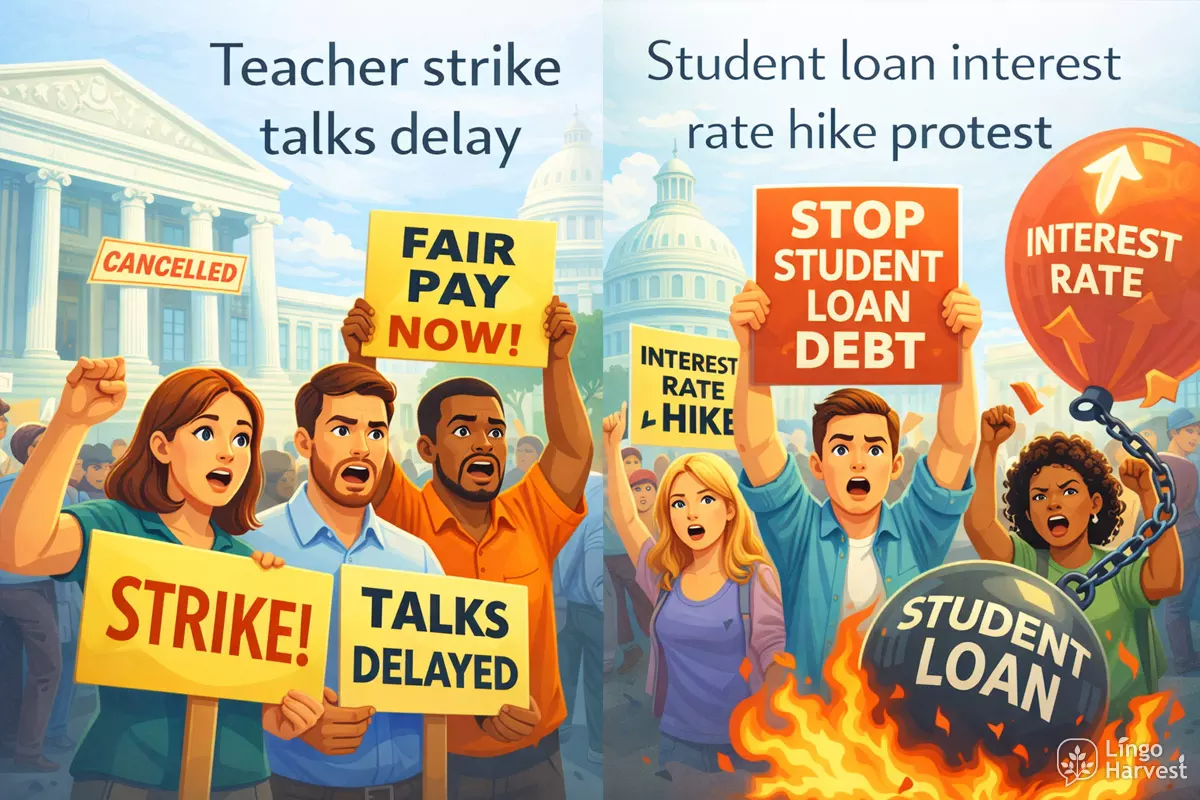
- “Teacher strike talks delay” (Who is delaying? Is it a delay in talks, or talks about a delay?)
- “Student loan interest rate hike protest” (Is it a protest about a hike, or a protest causing a hike?)
- “Health care reform debate coverage” (Coverage of the debate, or a debate about coverage?)
- “Police officer shooting suspect arrest” (Is the suspect a shooter, or was a suspect shot?)
- “Government tax relief program announcement” (Is it an announcement of a program, or a program for announcements?)
- “Mayor election result dispute” (Is the result being disputed, or is it a dispute about the election?)
- “School board meeting violence report” (Reporting violence at a meeting, or violence in a report?)
- “Court ruling appeal deadline extension” (Extension of a deadline, or a deadline for an extension?)
- “Firefighter pension fund investigation” (Investigation into the fund, or by the fund?)
- “Bank fraud suspect arrest warrant issued” (Who is being arrested, who is issuing?)
Strategies to avoid confusion
Writers can clarify meaning by:
- Adding key prepositions or conjunctions (e.g., “over,” “after,” “as”)
- Reintroducing essential modifiers or verbs
- Using punctuation for grouping
- Choosing more specific or less stacked nouns
- Testing headlines with readers unfamiliar with the story
Excessive condensation can be tempting for brevity, but prioritizing clear communication helps ensure headlines inform rather than puzzle. Readers appreciate when meaning comes first.
Differences between headline style and full sentences
In news writing, headlines often follow a distinct set of rules that set them apart from standard grammatical sentences. These conventions are designed for brevity, impact, and clarity at a glance. Full sentences, by contrast, aim for completeness and grammatical accuracy, prioritizing reader understanding and narrative flow.
Key Distinctions in Structure and Usage
- Subject omission: Headlines may drop articles (“a,” “an,” “the”) and sometimes even the subject if context is clear. Full sentences require explicit subjects and articles for grammaticality.
- Verb forms: Headlines frequently use the simple present or bare infinitive (“Mayor resigns,” “Council to vote”), while sentences use tense to convey time more precisely (“The mayor has resigned.”).
- Reduced noun phrases: Headlines often compress information by stacking nouns (“City budget cuts debate”), whereas sentences unpack relationships (“There is a debate about cuts to the city budget.”).
- Punctuation and conjunctions: News titles avoid conjunctions and complex punctuation, while sentences rely on them for cohesion.
Common Patterns in Headline Noun Phrase Reduction
Reducing noun phrases helps headlines communicate more information in fewer words. Here are some typical patterns:
- Adjective + noun + noun (e.g., “School funding crisis”)
- Noun modifiers stacked (“Police corruption probe”)
- Possessives omitted (“Teacher strike talks” instead of “Talks about the teachers’ strike”)
- Prepositions dropped (“Airport security review”)
- Gerunds as nouns (“Spending freeze debate”)
- Compound nouns (“Drug policy reform”)
- Location reduced (“Paris summit outcome”)
- Time or date fronted (“Monday meeting chaos”)
- Organization names as modifiers (“UN peace mission”)
- Quantifiers omitted (“Budget cut protest” instead of “A protest against budget cuts”)
Direct Comparison: Headlines vs. Full Sentences
Below is a structured comparison showing how the same idea appears in both forms:
| Headline Style | Full Sentence |
|---|---|
| Mayor Resigns Amid Scandal | The mayor has resigned amid a scandal. |
| School Budget Cuts Protest | There was a protest against cuts to the school budget. |
| Health Officials Issue Warning | Health officials have issued a warning. |
| City Council To Vote Monday | The city council will vote on Monday. |
| Airport Security Review Ordered | A review of airport security has been ordered. |
| Drug Policy Reform Debate | There is a debate about reforming drug policy. |
Why These Differences Matter
Understanding the contrast between compressed headline constructions and standard sentences is crucial for writers and editors. Headlines prioritize speed, impact, and space, often at the expense of grammatical completeness. Full sentences, however, emphasize detail, clarity, and context, which are essential for comprehensive reporting and reader understanding. Both forms serve different, complementary roles in media writing.
Typical learner errors with headline-style noun phrases
Many English learners struggle with the compact, elliptical noun phrases found in headlines and news writing. These constructions often omit articles, auxiliary verbs, and other elements, making them tricky to interpret and reproduce accurately. Below are some of the most frequent missteps and misunderstandings that arise.
Confusing or Missing Articles
Writers new to headline conventions often add unnecessary articles (the, a, an) or leave them out where standard English would require them. In headlines, articles are usually dropped to save space, but this can feel unnatural for learners.
- Adding "the": The government budget cuts debate ❌ instead of Government budget cuts debate ✅
- Omitting when needed in regular sentences: President visits hospital is fine for headlines, but not for standard writing.
Misplaced Modifiers and Word Order
The stacking of nouns and modifiers in headline phrases can confuse learners, leading to incorrect word order or ambiguity.
- Teacher strike talks progress (Is "talks" a noun or a verb?)
- City council tax rise (Who is rising? Is it the council or the tax?)
Overusing Verbs or Including Unnecessary Words
Headlines often use noun phrases to summarize stories, but learners may accidentally include verbs, articles, or prepositions, breaking the concise style.
- Police arrest suspect in robbery ❌ (full sentence)
- Robbery suspect arrest ✅ (headline noun phrase)
Ambiguity and Lack of Clarity
Reduced noun phrases can be ambiguous, especially for those unfamiliar with the conventions. Learners may not recognize which noun modifies which, or how to interpret stacked nouns.
| Ambiguous Headline Phrase | Possible Interpretations |
|---|---|
| Teacher strike talks progress | Are talks about a teacher strike progressing? Or is it progress in teacher strike talks? |
| City council tax rise | Is the council's tax rising, or is the council itself rising? |
| Hospital staff shortage crisis | Is there a crisis due to a staff shortage at hospitals, or is it a shortage of crisis staff? |
| School bus safety review | Is it a review about school bus safety, or is someone reviewing the safety of a school bus? |
List: Common Learner Errors in Headline Noun Phrases
- Inserting unnecessary articles ("the", "a")
- Using full sentences instead of reduced phrases
- Incorrect noun stacking (wrong word order)
- Misinterpreting noun relationships
- Using verbs where only nouns should appear
- Omitting key nouns, making the phrase unclear
- Overusing prepositions (e.g., "of", "in")
- Failing to recognize compound nouns
- Applying standard grammar rules rigidly
- Confusing plural and singular forms
- Misreading headlines as complete sentences
- Translating headline style phrases too literally from their own language
Understanding these patterns is crucial for both interpreting news headlines accurately and producing clear, concise headline-style phrases in English media writing.
Practice: convert full sentences into reduced headlines
Reducing full sentences to concise headlines is a core skill in media writing. This exercise focuses on transforming detailed statements into compact, noun phrase-driven headlines that still communicate the main idea. Practicing this will help you recognize how journalists omit articles, auxiliary verbs, and sometimes even the subject, while focusing on the most newsworthy nouns and descriptors.
Instructions
Below are several full-sentence news items. Your task: rewrite each one as a reduced, headline-style noun phrase. Focus on keeping key information, omitting unnecessary words, and using strong, specific nouns and adjectives.
- The city council has approved a new plan to expand public transportation in the downtown area.
- A major storm caused significant damage to homes and businesses last night.
- Scientists have discovered a new species of frog in the Amazon rainforest.
- The local bakery is celebrating its 50th anniversary with special events and discounts.
- Police are investigating a series of car thefts in suburban neighborhoods.
- The school district will implement a new remote learning policy next semester.
- Health officials report a rise in flu cases across the region.
- Firefighters rescued three people from a burning apartment building early this morning.
- A technology company announced plans to open a new headquarters in the city.
- Residents protest proposed increase in property taxes.
Show answers
- City Council OKs Downtown Transit Expansion
- Storm Damage Hits Homes, Businesses
- New Amazon Frog Species Discovered
- Bakery Marks 50th Anniversary, Specials Planned
- Suburban Car Thefts Under Police Investigation
- School District Adopts Remote Learning Policy
- Regional Flu Cases on the Rise
- Firefighters Rescue Three from Apartment Blaze
- Tech Firm to Open City Headquarters
- Residents Protest Property Tax Hike
Common Patterns in Reduced Headlines
- Omit articles: (“The,” “A,” “An”)
- Drop auxiliary verbs: (is, have, will)
- Use strong nouns and adjectives: (damage, protest, increase)
- Prefer present tense or bare infinitive: (“Council OKs,” “District Adopts”)
- Compress time or location: (“Downtown,” “This Morning”)
- Convert actions to noun phrases: (“Policy Implementation,” “Species Discovery”)
- Highlight the main agent or event: (“Firefighters Rescue,” “Residents Protest”)
- Use short, punchy words: (“Storm Hits,” “Tax Hike”)
- Combine details for brevity: (“Homes, Businesses Damaged”)
- Favor specific over general terms: (“Amazon Frog Species,” not just “Animal”)
Quick Practice: Identify Reduced Noun Phrases
For each headline below, pick out the reduced noun phrase(s) used.
- City Approves School Renovation Plan
- Wildfire Evacuation Orders Issued
- Mayor Faces Ethics Investigation
- Vaccine Rollout Delays Frustrate Residents
- Tech Company Announces Massive Layoffs
- New Public Transit Route Launches Downtown
- Severe Drought Impacts Local Farmers
- Hospital Reports Data Breach Incident
- University Implements Tuition Freeze
- Sports Arena Construction Nears Completion
Show answers
- School Renovation Plan
- Wildfire Evacuation Orders
- Ethics Investigation
- Vaccine Rollout Delays
- Company Layoffs
- Transit Route Launch
- Drought Impact
- Hospital Data Breach
- Tuition Freeze
- Arena Construction