Nouns with Embedded Questions in Formal English Structures

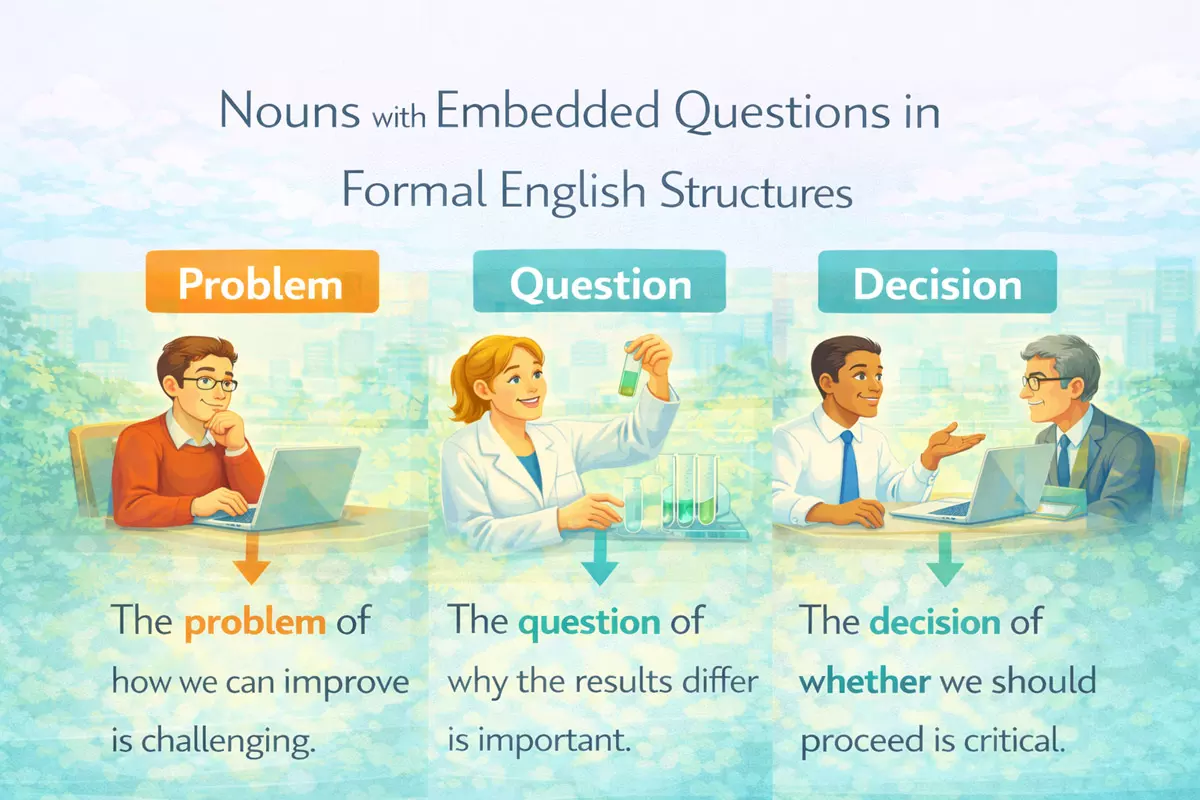 The article explains which nouns can introduce embedded questions, reviews the correct word order for these structures, contrasts them with direct questions, covers formal style and punctuation, and points out common mistakes with inversion and tense.
- What embedded questions are after nouns
- Common nouns that introduce embedded questions
- Word order in noun + embedded question structures
- Differences between direct and embedded questions
- Formal register and punctuation with embedded questions
- Typical learner mistakes with inversion and tense
- Practice: rewrite direct questions as embedded structures
Have you ever wondered how English sentences can smoothly incorporate questions within nouns, especially in formal contexts? Mastering the art of embedding interrogative content into noun-based structures not only enhances clarity but also adds a layer of sophistication to advanced writing. This technique allows writers to present complex ideas succinctly and elegantly, making their arguments more persuasive and their language more precise. By learning to use such constructions effectively, you can significantly improve the quality and impact of your academic or professional communication.
What embedded questions are after nouns
In formal English, it is common to encounter sentences where a noun is immediately followed by an embedded question. This structure allows the sentence to include indirect questions or unknown information as part of a larger clause. The noun acts as a reference point, while the embedded question supplies extra detail or specifies the nature of the information involved. For example, consider nouns like "question," "issue," "fact," or "decision." These are often followed by clauses introduced by interrogative words (who, what, when, where, why, how, whether, if). Such constructions are typical in academic, legal, and professional writing, where clarity and detail are essential.
Common nouns followed by embedded questions
- Question: The question of whether we should proceed remains unresolved.
- Fact: The fact that she arrived late surprised everyone.
- Issue: The issue of how to allocate resources is still open.
- Decision: His decision about what to study was difficult.
- Problem: The problem of where to meet was easily solved.
- Uncertainty: There is some uncertainty about who will attend.
- Discussion: We had a discussion about when to schedule the event.
- Debate: The debate over which policy to choose continues.
- Concern: Their concern about whether it would rain was justified.
- Knowledge: Our knowledge of how the process works is limited.
- Understanding: The team's understanding of why the change was needed improved.
- Choice: The choice of what to order was difficult.
- Prediction: His prediction about when the results would arrive was accurate.
- Explanation: Her explanation of how the system failed was thorough.
- Agreement: The agreement on who should lead the project was unanimous.
- Argument: The argument about whether to invest now was heated.
- Assumption: The assumption that he would accept was incorrect.
- Proposal: The proposal of where to hold the conference was accepted.
- Discovery: Their discovery that the data was flawed changed the plan.
- Observation: His observation of what caused the error was insightful.
How embedded questions function after nouns
Embedded questions after nouns typically serve to provide essential information or clarify the nature of the noun. They do not use direct question word order (no subject-auxiliary inversion) and do not end with a question mark unless the whole sentence is a question. For instance:
- Direct question: Where did she go?
- Embedded (after noun): The question of where she went is still unanswered.
Patterns and structure
The general pattern involves a noun, sometimes followed by a preposition (of, about, over, etc.), and then a clause introduced by an interrogative or the word "that." Here’s a summary of common patterns:
- Noun + of/about/over + wh- clause: The issue of why sales declined is important.
- Noun + that-clause: The fact that he resigned shocked everyone.
- Noun + whether/if clause: The concern whether this will work is valid.
Comparison: Direct vs. Embedded Questions
| Direct Question Form | Embedded Question After Noun |
|---|---|
| What time will it start? | The question of what time it will start is unresolved. |
| Who is responsible? | The issue of who is responsible remains open. |
| Why did she leave? | The reason why she left is unclear. |
| Will they agree? | The uncertainty whether they will agree persists. |
By recognizing these structures, you can analyze and construct more precise sentences, especially in contexts where nuanced reporting or indirect reference is required. This approach is particularly valuable for advanced academic or professional communication.
Common nouns that introduce embedded questions
Certain nouns in English serve as gateways for embedded questions, especially in formal or academic writing. These nouns help turn direct questions into indirect statements or queries, which often makes language sound more polite or sophisticated. Understanding which nouns function this way is essential for constructing precise and nuanced sentences.
Typical nouns used with embedded clauses

Many nouns can introduce a clause that provides extra information about something unknown, uncertain, or to be discovered. Here are some frequently used options:
- question → The question is whether the plan will work.
- issue → The issue is that funding is running out.
- problem → The problem is that deadlines are too tight.
- idea → His idea is that students learn faster in groups.
- point → Her point is that clearer rules are needed.
- fact → The fact is that sales have fallen this year.
- concern → Their concern is that costs may rise again.
- matter → The matter is that no one replied to the email.
- argument → The argument is that online education is more flexible.
- reason → The reason is that the team lacked resources.
- possibility → The possibility is that the event will be postponed.
- decision → The decision is that the office will close early.
- knowledge → His knowledge is that the system needs updating.
- explanation → The explanation is that the files were corrupted.
- evidence → The evidence is that results improved over time.
- proposal → The proposal is that we merge both departments.
- suggestion → Her suggestion is that more training be provided.
- debate → The debate is whether the rule should change.
- uncertainty → The uncertainty is that the data may be incomplete.
- assumption → The assumption is that demand will stay high.
These nouns are often followed by a clause starting with words like “whether,” “if,” “who,” “what,” “how,” or “why.” For example: “The question of whether we should proceed remains unanswered.”
Usage patterns and sentence structure
When using these nouns, the embedded clause usually clarifies or specifies the noun. For instance:
- There is a debate about whether the policy is effective.
- His explanation of how the error occurred was unclear.
- The issue of who is responsible needs addressing.
Comparing direct and embedded forms
To illustrate how embedded questions differ from direct ones, consider the following:
| Direct Question | Embedded Form with Noun |
|---|---|
| What caused the delay? | The reason for what caused the delay is unknown. |
| Who will lead the project? | The question of who will lead the project remains. |
| Is the proposal feasible? | The issue of whether the proposal is feasible is under discussion. |
| Why did she resign? | The explanation for why she resigned was not provided. |
This structure is particularly common in formal reports, academic texts, and professional correspondence. Using such nouns with embedded clauses allows for precise reference to unknowns or topics under consideration without resorting to direct questioning. This approach also helps maintain an objective or neutral tone, which is often preferred in formal English.
Word order in noun + embedded question structures
Understanding how to arrange words when a noun is followed by an embedded question is key for clear and formal English. In these constructions, a noun—such as “question,” “idea,” “fact,” or “issue”—is immediately followed by a clause that acts as an indirect question. The structure differs from both direct questions and standard noun phrases, and obeys strict rules in formal contexts.
Basic Principles
The noun comes first, directly followed by an embedded (indirect) question. Importantly, the embedded clause uses statement (not question) word order. For example:
- “The fact that she left early surprised everyone.”
- “His question whether the meeting was necessary sparked debate.”
Notice that in the embedded part, the subject precedes the verb—just like in a regular statement.
Common Nouns Used with Embedded Questions
A variety of nouns can introduce these structures. Here are some typical examples:
- discussion → The discussion is whether remote work increases productivity.
- dispute → The dispute is that two departments claim ownership of the data.
- observation → The observation is that attendance drops on Fridays.
- understanding → The understanding is that deadlines will remain flexible.
- truth → The truth is that mistakes were made during testing.
- interpretation → The interpretation is that the results show improvement.
- evaluation → The evaluation is that the program needs revision.
- perspective → The perspective is that teamwork creates better outcomes.
- implication → The implication is that more funding will be required.
- theme → The theme is that technology shapes identity.
- hypothesis → The hypothesis is that stress affects memory.
- interpretation → The interpretation is that the market is stabilizing.
- prediction → The prediction is that sales will double next year.
- finding → The finding is that older students perform better online.
- claim → The claim is that the treatment works faster.
- viewpoint → The viewpoint is that exams should be optional.
- proposal → The proposal is that we restructure the schedule.
- statement → The statement is that no files were deleted.
- announcement → The announcement is that the project will start Monday.
- report → The report is that several staff members are leaving.
Statement Word Order in Embedded Clauses
Unlike direct questions, embedded clauses after nouns require a subject-verb-object (SVO) order, never the inversion typical of questions. Compare these forms:
| Direct Question | Embedded Clause (after noun) |
|---|---|
| Where is the station? | The question of where the station is |
| Why did she leave? | The issue of why she left |
| What will happen next? | The matter of what will happen next |
| Who was responsible? | The debate about who was responsible |
Key Patterns and Variations
You may encounter several prepositions linking the noun and the embedded clause, such as “about,” “of,” “whether,” or “as to.” The choice depends on the noun and the intended nuance:
- the question of whether we should proceed
- the issue about how funds are allocated
- the discussion as to who will lead
- the uncertainty regarding when results will be published
Avoid direct question structure (verb before subject) in these embedded contexts—using it is considered incorrect in formal writing. For example: ❌ “the question of where is the station”.
Summary Tips
- Always use statement order (subject before verb) in the embedded clause.
- Choose the noun and preposition carefully for the intended meaning.
- Do not use question order after the noun; this is a common mistake.
Mastering these patterns adds clarity and precision to formal English writing, particularly in academic and professional settings.
Differences between direct and embedded questions
Direct questions and embedded questions serve different roles in English, especially when paired with nouns in formal structures. Understanding how they differ is essential for clarity and correctness in both writing and speech. Direct questions are straightforward inquiries, while embedded questions are part of larger statements or questions, often following certain nouns like "question," "idea," or "fact."
Form and Structure
One of the main distinctions lies in word order and punctuation. Direct questions invert the subject and auxiliary verb, and they typically end with a question mark. In contrast, embedded questions use the word order of statements and often follow an introductory clause, usually ending with a period.

| Direct Question | Embedded Question (with Noun) |
|---|---|
| What time is it? | I have no idea what time it is. |
| Where did she go? | We discussed the question of where she went. |
| Why are they late? | The reason why they are late is unclear. |
| Who will attend? | He explained who would attend the meeting. |
| How does this work? | They described how this works. |
Key Differences Summarized
- Word Order: Direct questions invert the subject and auxiliary; embedded questions revert to statement order.
- Punctuation: Direct ones end with a question mark; embedded forms usually end with a period.
- Function: Direct questions seek information directly; embedded forms often report or reflect on a question.
- Common Nouns: Words like "question," "fact," "issue," "matter," "reason," "decision," "doubt," "problem," "understanding," and "discussion" frequently introduce embedded questions.
- Politeness: Embedded constructions are generally more formal and polite, especially in academic or professional writing.
Examples of Nouns Used with Embedded Questions
- the idea that he will join
- the fact that prices are rising
- the question of whether we should leave
- the issue of how to proceed
- the reason why she left early
- the decision about who will lead
- the doubt whether it is possible
- the problem of what to do next
- the understanding of why this happens
- the discussion about when to start
In summary, recognizing the difference between these two types of questions allows for more precise and nuanced English, especially when constructing sentences with nouns that introduce indirect queries or reported information.
Formal register and punctuation with embedded questions
In formal English writing, embedded questions within noun phrases require careful attention to both structure and punctuation. These constructions often arise in academic, professional, or official contexts, where clarity and precision are essential. Unlike direct questions, embedded interrogatives do not invert the subject and auxiliary verb, nor do they require a question mark at the end of the sentence.
Key principles for embedding questions in nouns
- Maintain declarative word order (subject before verb).
- Do not use a question mark unless the overall sentence is a direct question.
- Use "whether," "if," or a wh-word (what, who, how, etc.) to introduce the embedded clause.
- Ensure verb tense and formality match the context.
- Keep the punctuation consistent with a statement, even if the embedded element is interrogative.
Common noun phrases with embedded questions
- the question of whether he will attend
- an explanation of why the results changed
- her knowledge of how the system operates
- the issue of what was agreed upon
- an understanding of who was responsible
- the decision about when to proceed
- his consideration of where improvements are needed
- the uncertainty regarding if funds are available
- the debate on whether measures are sufficient
- your insight into why errors occurred
- the discussion of what steps should follow
- their concern about how the policy is implemented
- the inquiry into who authorized the change
- the determination of when results will be published
- the assessment of how well objectives were met
Punctuation patterns for embedded questions
When noun clauses contain indirect questions, the punctuation reflects the sentence type, not the embedded query. For clarity, compare how punctuation and word order differ between direct and embedded forms:
| Direct Question | Embedded Question (Noun Clause) |
|---|---|
| What caused the delay? | The report addresses what caused the delay. |
| Is the proposal feasible? | The committee discussed whether the proposal is feasible. |
| Who approved the budget? | There is uncertainty about who approved the budget. |
| When will the meeting start? | The agenda includes when the meeting will start. |
| How should we proceed? | The question of how we should proceed remains open. |
Summary: Dos and Don’ts
- ✅ Use statement punctuation for sentences with noun-based embedded questions.
- ✅ Retain standard word order (no subject-auxiliary inversion).
- ❌ Avoid question marks unless the entire sentence is interrogative.
- ❌ Don’t treat embedded clauses as direct questions in terms of grammar or punctuation.
Typical learner mistakes with inversion and tense
Many English learners get confused when embedded questions are used as nouns in formal structures. A common pitfall is treating these noun clauses like direct questions, leading to unnecessary word order changes and tense shifts. For example, learners often invert the subject and auxiliary verb, or forget that the clause is part of a larger statement, not a question itself.
Inversion errors in embedded noun clauses
When using embedded questions as nouns, the word order must stay as in a standard statement. Learners often mistakenly apply question syntax, which is incorrect outside direct questions. Here are some frequent inversion issues:
- ❌ I wonder what is he doing. → ✅ I wonder what he is doing.
- ❌ They did not know where was the meeting. → ✅ They did not know where the meeting was.
- ❌ Please tell me how can I help. → ✅ Please tell me how I can help.
Tense confusion in embedded noun clauses
Another source of mistakes is tense consistency. Learners might shift tenses unnecessarily or use the wrong tense in the embedded clause. The tense should reflect the time of the embedded action, not the reporting verb.
- ❌ He asked what do I want. → ✅ He asked what I wanted.
- ❌ She wondered why does he leave. → ✅ She wondered why he left.
- ❌ I don't know where did she go. → ✅ I don't know where she went.
Common patterns of error and correction
Learners benefit from seeing a range of typical patterns. Here’s a comparison of incorrect and correct forms in embedded noun clauses:
| Incorrect Form | Correct Form |
|---|---|
| Do you know where is the station? | Do you know where the station is? |
| I don't remember what did she say. | I don't remember what she said. |
| Can you tell me when will it start? | Can you tell me when it will start? |
| He asked how does it work. | He asked how it works. |
| They want to know why did you leave. | They want to know why you left. |
Summary of frequent mistakes
- Inverting subject and verb in embedded questions
- Using question word order after reporting verbs
- Applying the present tense when the past is needed (or vice versa)
- Omitting the subject in the embedded clause
- Forgetting that embedded questions are statements within a sentence
- Adding auxiliary verbs (do, does, did) unnecessarily
- Confusing direct and indirect question forms
- Neglecting sequence of tenses with reporting verbs
- Translating directly from native language structures
- Leaving out necessary question words in the noun clause
By staying aware of these patterns, learners can avoid the most common errors and use embedded noun clauses accurately in formal English.
Practice: rewrite direct questions as embedded structures
When using nouns that introduce indirect or embedded questions in formal English, the sentence structure changes significantly compared to direct questions. Instead of asking directly, we embed the question within a declarative sentence, often after nouns like "question," "fact," "issue," or "problem." Practicing this skill can help you write more formally and accurately.
How to Transform Direct Questions
To convert a direct question into an embedded structure, follow these steps:
- Remove inversion (the subject comes before the verb in embedded questions).
- Do not use a question mark at the end of the embedded question.
- Introduce the embedded question with an appropriate noun or phrase (e.g., "the question of," "the issue of," "the fact that").
- If the direct question uses "do/does/did" for emphasis, omit it in the embedded form.
Examples: Direct vs. Embedded
Below are several examples showing the transformation from direct questions to embedded question structures with nouns:
- Direct: Where does she live?
Embedded: The question of where she lives remains unanswered. - Direct: What time will the meeting start?
Embedded: The issue of what time the meeting will start is still unclear. - Direct: Who broke the window?
Embedded: The mystery of who broke the window has not been solved. - Direct: Why did he resign?
Embedded: The reason why he resigned is still unknown. - Direct: How much does this cost?
Embedded: The question of how much this costs was never addressed. - Direct: When will you arrive?
Embedded: The matter of when you will arrive is important. - Direct: Which method is better?
Embedded: The debate over which method is better continues. - Direct: How did the mistake happen?
Embedded: The explanation of how the mistake happened is complicated. - Direct: Who will lead the team?
Embedded: The uncertainty about who will lead the team is worrying. - Direct: Whether he will attend?
Embedded: The question of whether he will attend was discussed.
Practice Task: Rewrite the Direct Questions
Try rephrasing these direct questions using embedded structures with nouns. Consider which noun fits best for each context.
- What caused the delay?
- When did the package arrive?
- Where will the conference be held?
- Who approved this document?
- Why was the decision made?
- How will the funds be allocated?
- Which option is the most efficient?
- How many people attended the event?
Show answers
- The question of what caused the delay is under investigation.
- The matter of when the package arrived was clarified in the report.
- The issue of where the conference will be held has not been settled.
- The fact of who approved this document should be confirmed.
- The reason why the decision was made was explained in the meeting.
- The method of how the funds will be allocated remains undecided.
- The debate over which option is the most efficient continues among the team.
- The question of how many people attended the event is still being calculated.