Question Formation in Academic and Written English

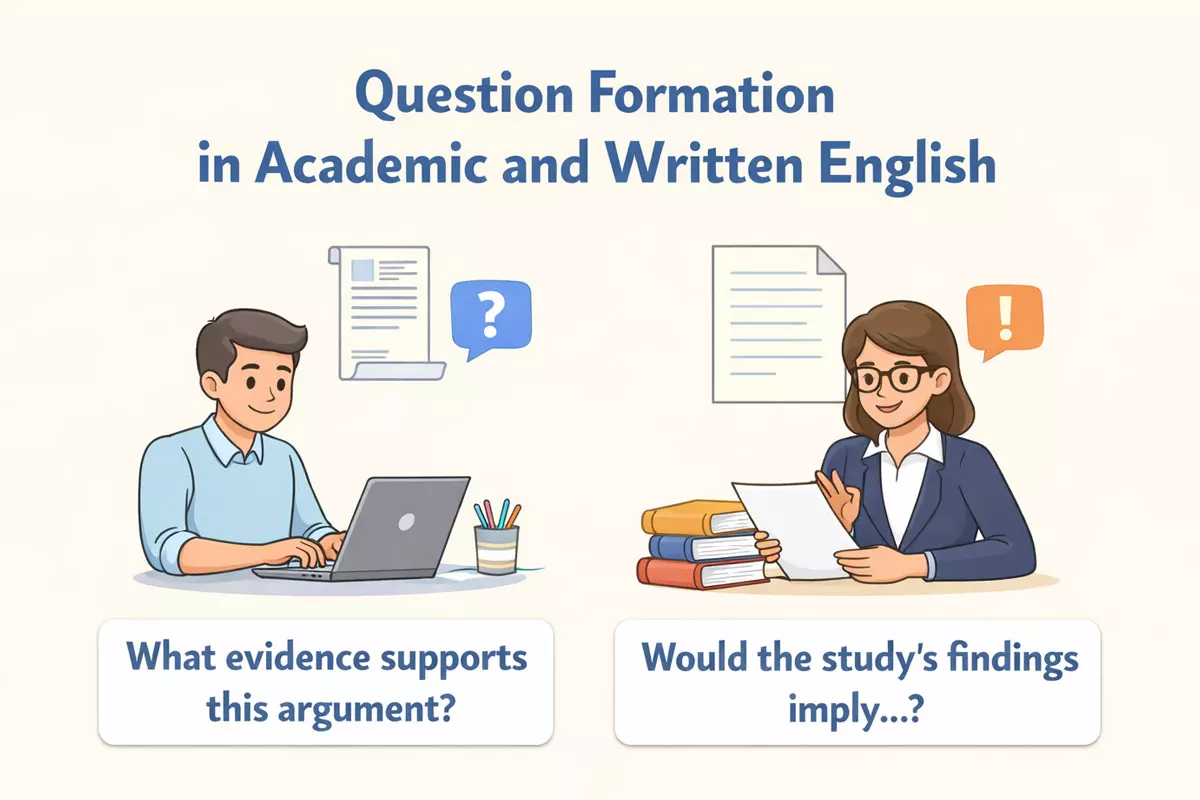 Here we how to use effective question styles in academic English, including formal and indirect structures. It discusses proper question use in essays, assignments, and exams, highlights common mistakes, and offers practice exercises for improvement.
Formulating effective questions is an essential skill in academic and formal writing, but many students struggle to construct them properly. Developing this ability not only clarifies the writer’s intent but also strengthens the overall quality of scholarly communication. By practicing how to pose precise and thoughtful inquiries, learners can engage more critically with their subjects and contribute to more meaningful discussions within their fields.
Question Style in Academic English
Academic writing often relies on precise question forms to encourage critical thinking, clarify arguments, and guide readers through complex ideas. Unlike casual conversation, scholarly questions tend to be more formal and structured, reflecting the conventions of written English. Understanding how to frame effective questions is essential for writers aiming to engage with academic audiences and present research or analysis clearly.
Common Types of Academic Questions
Writers use a variety of question types in scholarly settings, each serving distinct purposes. Some questions prompt reflection, while others test understanding or introduce new topics. Here are some common categories and their functions:
- Open-ended questions: Invite detailed responses and analysis (e.g., "What factors contribute to climate change?").
- Closed questions: Elicit brief, often factual answers (e.g., "Is the hypothesis supported by the data?").
- Rhetorical questions: Encourage readers to reflect, without expecting a direct answer (e.g., "How can we ignore these results?").
- Clarifying questions: Seek further explanation (e.g., "In what ways does this theory differ from previous models?").
- Comparative questions: Ask about similarities or differences (e.g., "How does this approach compare to traditional methods?").
- Evaluative questions: Require judgment or assessment (e.g., "To what extent is this solution effective?").
Features of Effective Academic Questions
Formulating questions for academic contexts involves several stylistic choices. The following characteristics are especially important:
- Use of formal language and precise vocabulary
- Clear, unambiguous structure
- Focus on critical engagement, not just factual recall
- Alignment with the topic and purpose of the writing
- Appropriate level of complexity for the intended audience
- Integration with surrounding argument or discussion
Comparing Direct and Indirect Question Forms

Academic English frequently alternates between direct and indirect question structures, depending on tone and context. Here's a comparison of common forms:
| Direct Question | Indirect Question |
|---|---|
| What are the implications of this finding? | It is important to consider what the implications of this finding are. |
| How did the researchers collect the data? | One might ask how the researchers collected the data. |
| Why is this method preferred? | An interesting question is why this method is preferred. |
| Has the theory been supported by evidence? | The question arises whether the theory has been supported by evidence. |
Useful Academic Question Starters
Writers often begin questions with specific phrases to ensure clarity and formality. The following list provides a range of starters commonly used in scholarly texts:
- To what extent…?
- How does…?
- What are the implications of…?
- In what ways…?
- Why is… significant?
- Is it possible that…?
- What evidence supports…?
- How might… be interpreted?
- What factors influence…?
- Can it be argued that…?
- What are the limitations of…?
- How does this relate to…?
- What assumptions underlie…?
- In comparison to…?
- What conclusions can be drawn from…?
- What alternative explanations are there for…?
- How reliable is…?
Mastering the style and structure of academic questions not only improves clarity but also fosters a more thoughtful and engaging written discussion. Choosing the right question form can help writers lead readers through complex arguments and encourage deeper exploration of the subject matter.
Formal Question Structures
When writing or speaking in academic settings, questions are often constructed with particular attention to word order, auxiliary verbs, and subject-verb agreement. The goal is clarity and precision, making it essential to understand the standard ways questions are formed in formal English.
Common Patterns in Academic Question Formation
English questions in formal contexts usually follow predictable structures. Most involve inverting the subject and auxiliary verb, or using a question word at the beginning. These forms help signal that a response or elaboration is expected.
- Do/Does/Did + Subject + Base Verb (e.g., "Does this argument hold?")
- Is/Are/Was/Were + Subject + Complement (e.g., "Is the data reliable?")
- Has/Have/Had + Subject + Past Participle (e.g., "Have the results been verified?")
- Modal + Subject + Base Verb (e.g., "Should further research be conducted?")
- Wh- word + Auxiliary + Subject + Verb (e.g., "Why has this method been chosen?")
- What/Which + Noun + Auxiliary + Subject + Verb (e.g., "Which variables were controlled?")
- To what extent + Auxiliary + Subject + Verb (e.g., "To what extent does the evidence support the claim?")
- How + Adjective/Adverb + Auxiliary + Subject + Verb (e.g., "How significant is the difference?")
- In what ways + Auxiliary + Subject + Verb (e.g., "In what ways can this theory be applied?")
- Why/How/When + Modal + Subject + Base Verb (e.g., "How might these results be interpreted?")
- Is it possible + to-infinitive (e.g., "Is it possible to replicate this experiment?")
- What are the implications of + noun/gerund (e.g., "What are the implications of adopting this approach?")
- Under what conditions + Auxiliary + Subject + Verb (e.g., "Under what conditions does this phenomenon occur?")
- Who/Whom/Whose + Verb + Subject (e.g., "Whose hypothesis was supported?")
Direct and Indirect Question Forms
In scholarly writing, both direct and indirect questions are common. Direct questions ask for information straightforwardly, while indirect forms are often used for politeness or complexity.
| Direct Question | Indirect Question |
|---|---|
| What does the data suggest? | Could you explain what the data suggests? |
| Why was the method chosen? | I would like to know why the method was chosen. |
| Is this approach effective? | It is important to determine whether this approach is effective. |
| When will the results be published? | Please indicate when the results will be published. |
Features of Well-Formed Academic Questions
Effective questions in academic English are typically unambiguous and precise. They avoid slang, contractions, and overly informal phrasing. Additionally, such questions often target analysis, evaluation, or explanation rather than simple facts.
- Use of appropriate auxiliaries (do, does, has, can, should, etc.)
- Clear reference to specific ideas or data
- Logical sequencing of question words and verbs
- Preference for complete sentences over fragments
- Neutral, objective tone
Developing a solid understanding of these structures not only improves clarity but also demonstrates command of academic conventions. Mastery of these patterns is a key part of effective scholarly communication.
Indirect Questions in Writing
Writers often use indirect forms when they wish to sound more formal, polite, or tentative—qualities highly valued in academic and professional texts. Instead of posing a direct question, the writer embeds the query within a statement or another question. This approach softens the tone and allows for greater nuance.
Common Structures and Phrases
Indirect queries are usually introduced by phrases such as Could you tell me, I wonder, or Do you know. The word order also changes: unlike direct forms, indirect ones follow standard subject-verb-object structure without subject-auxiliary inversion.
- Do you know where the library is?
- I wonder if the results are significant.
- Could you explain why this method was chosen?
- I would like to know what the main argument is.
- Can you tell me how the process works?
- Please let me know whether you have any questions.
- It is unclear when the meeting will begin.
- I am not sure who approved the changes.
- They asked if the deadline had changed.
- We need to find out why the data was excluded.
- She wondered how the survey was conducted.
- He inquired if the manuscript had been reviewed.
- The report does not state who was responsible.
- Could you specify what resources are required?
- I am interested in knowing when the results will be published.
- We are unsure whether this approach is effective.
Direct vs. Indirect: Key Differences
The switch from direct to indirect question forms involves changes in word order, punctuation, and, often, the level of formality. For clarity, compare the following patterns:
| Direct Question | Indirect Form |
|---|---|
| What time does the seminar start? | Could you tell me what time the seminar starts? |
| Is the article available online? | I wonder if the article is available online. |
| When will the results be published? | Do you know when the results will be published? |
| Who approved the proposal? | It is not clear who approved the proposal. |
Usage Tips for Academic Contexts
Writers should choose indirect forms when seeking to avoid imposing on readers or when expressing uncertainty. This is particularly useful in introductions, literature reviews, or when discussing limitations and open questions. Remember:
- Do not use question marks after indirect forms unless the entire sentence is a question.
- Maintain declarative word order (subject before verb).
- Favor indirect phrasing for requests, inquiries, or speculation in formal writing.
- Use introductory phrases to clarify tone and intent.
Mastering these structures helps writers achieve both clarity and the appropriate level of formality expected in academic English.
Avoiding Informal Question Forms
Academic and formal writing typically favors precise, grammatically complete questions. Using conversational or colloquial question structures can undermine the credibility of your writing, making it sound less authoritative. Instead of relying on the relaxed forms common in speech or casual communication, it’s important to adopt standard question patterns that clearly signal inquiry and respect the norms of written English.
Common Informal Question Patterns to Avoid
Writers often slip into using informal question forms, especially when they mirror spoken English. Here are some of the most frequent patterns to watch out for:
- Dropping auxiliary verbs (e.g., “You coming?” instead of “Are you coming?”)
- Using tag questions for uncertainty (“You read the article, right?”)
- Omitting subjects (“Finished the assignment?” instead of “Have you finished the assignment?”)
- Beginning with “So,” as in “So, what happened?”
- Adding filler words (“Like, what’s the answer?”)
- Using fragments or incomplete sentences (“Questions?” instead of “Do you have any questions?”)
- Employing double negatives (“You don’t know nothing?”)
- Using “gonna,” “wanna,” or other contractions (“You gonna join?”)
- Leaving out the subject-verb inversion (“She is coming?” instead of “Is she coming?”)
- Asking with “Can you tell me…” but not completing the question (“Can you tell me what time?” instead of “Can you tell me what time it starts?”)
Formal vs. Informal Question Forms
Understanding the difference between casual and academic question structures helps ensure your writing remains suitable for scholarly contexts. Below is a comparison of typical informal and formal versions:
| Informal Form | Formal/Academic Form |
|---|---|
| You done? | Have you finished? |
| What’s up with that? | What is the reason for that? |
| Gonna start soon? | Are you going to start soon? |
| Any updates? | Are there any updates? |
| She’s coming, right? | Is she coming? |
| Questions? | Do you have any questions? |
| How come? | Why is that? |
| You ready? | Are you ready? |
| Can you tell me what time? | Can you tell me what time it will begin? |
| Where you at? | Where are you? |
Tips for Polished Academic Questions
- Always use auxiliary verbs and subject-verb inversion: “Is the data reliable?”
- State the full subject and predicate; avoid fragments.
- Choose precise, formal vocabulary (e.g., “What evidence supports this claim?”)
- Eliminate filler words and casual expressions.
- Review for completeness and clarity before finalizing your questions.
By paying attention to these guidelines, your questions will consistently reflect the standards expected in academic and professional writing.
Questions in Essays and Research Papers
Including questions in academic writing can sharpen your argument, guide your reader, or open up avenues for critical discussion. In essays, well-placed interrogatives often serve as transitions or prompts for deeper analysis. In research papers, questions help frame the scope of inquiry, clarify objectives, or signal gaps in existing knowledge. However, the type and placement of these questions should align with academic conventions and the writer’s goals.
Purposes of Using Questions
- Introducing a Topic: Rhetorical questions can introduce central themes or issues.
- Highlighting Uncertainty: Direct questions may expose unresolved debates or unknowns.
- Structuring Arguments: Questions can segment complex ideas and guide readers through logical steps.
- Engaging the Reader: Thought-provoking queries can stimulate interest and invite reflection.
- Framing Research: In scholarly papers, research questions define the focus and boundaries of the study.
Common Types of Questions Used
- Rhetorical (to provoke thought, not answer)
- Open-ended (inviting discussion or analysis)
- Closed-ended (yes/no, for clarifying points)
- Direct (posed to the reader or audience)
- Research (explicitly stated as the focus of investigation)
Placement and Tone
In essays, questions often appear in introductions or at the start of new sections. In research writing, the research question is usually found in the introduction or literature review and is often reformulated as a statement in the conclusion. The tone should remain formal and objective—avoid overly casual or leading questions.
Examples of Effective Question Use
- What factors contribute to climate change in urban environments?
- How do different teaching methods impact student motivation?
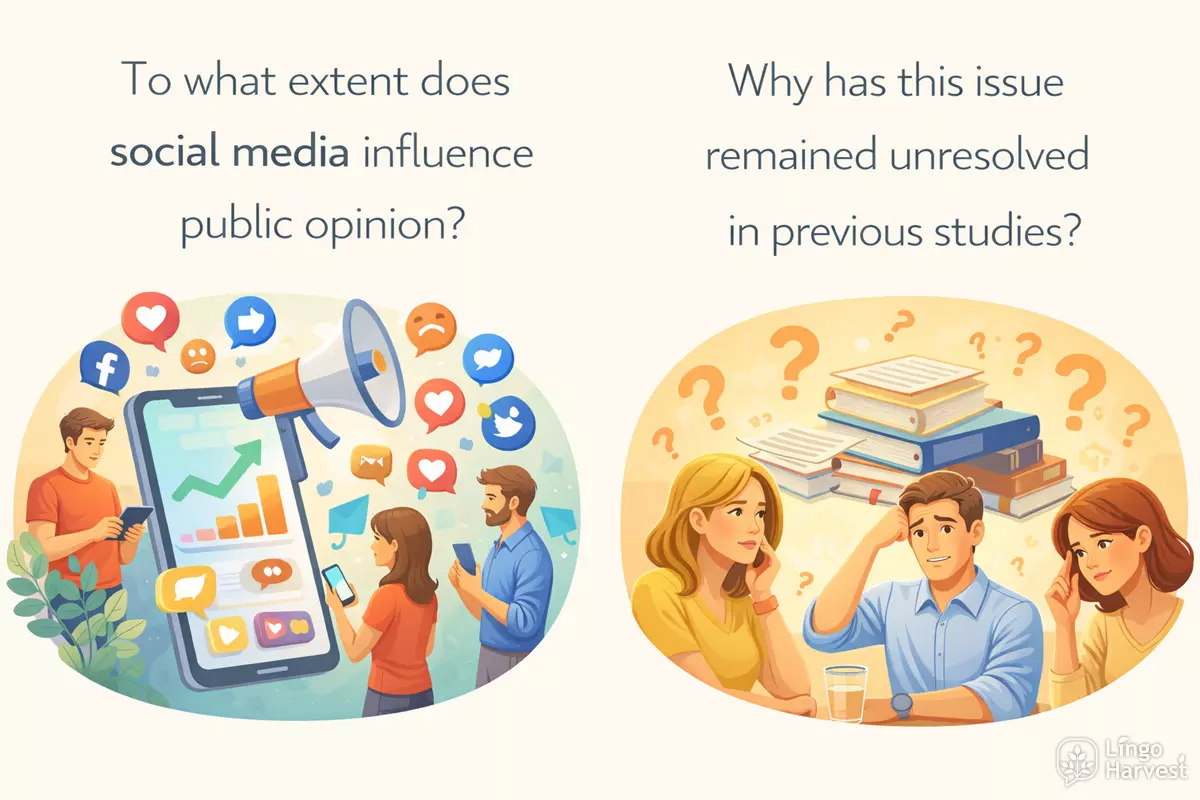
- To what extent does social media influence public opinion?
- Why has this issue remained unresolved in previous studies?
- Is there a correlation between exercise frequency and cognitive performance?
- Can artificial intelligence replace human creativity?
- In what ways does globalization affect cultural identity?
- Should governments regulate online content more strictly?
- How reliable are current data collection methods in this field?
- What implications do these findings have for future research?
Comparing Question Types in Academic Writing
| Question Type | Purpose/Best Use |
|---|---|
| Rhetorical | Stimulate thought or emphasize a point without expecting an answer |
| Research | Define the scope and direction of a scholarly study |
| Clarifying | Seek specific information or clarify ambiguity for readers |
| Analytical | Encourage deeper exploration and critical thinking about the topic |
In summary, strategically crafted questions can enhance clarity, argumentation, and engagement in academic texts. Using varied forms and placing them thoughtfully will support both the writer’s intent and the reader’s understanding.
Questions in Exams and Assignments
When it comes to academic evaluations, the ability to form and interpret questions is essential. Instructors use a variety of question types to test comprehension, critical thinking, and written communication skills. Understanding the conventions and expectations behind these questions helps students respond more effectively and avoid common pitfalls.
Common Types of Academic Questions
Educators employ a range of question forms to elicit specific kinds of responses. Some of the most frequent types include:
- Multiple choice – Selecting the correct answer from several options.
- Short answer – Responding in a sentence or two, often to define or explain a concept.
- Essay – Developing an argument or analysis over several paragraphs.
- True/False – Indicating whether a statement is accurate.
- Matching – Pairing terms with their definitions or related ideas.
- Fill-in-the-blank – Supplying missing words or phrases in a sentence.
- Problem-solving – Applying knowledge to calculate, deduce, or resolve a scenario.
- Data interpretation – Analyzing graphs, tables, or figures to answer targeted questions.
- Compare/contrast – Highlighting similarities and differences between concepts.
- Critical response – Evaluating or critiquing a statement, argument, or source.
Question Words and Patterns
The structure of a question often signals the expected depth and style of response. Academic prompts commonly begin with words such as:
- What
- How
- Why
- Describe
- Explain
- Discuss
- Compare
- Evaluate
- Summarize
- Interpret
- Illustrate
- Outline
- Assess
- Justify
- Analyze
Each prompt word guides the kind of answer required, from simple recall to in-depth analysis.
Direct vs. Indirect Question Forms
Academic writing tends to favor direct questions for clarity, but indirect forms appear in assignment instructions or research contexts. Consider the following comparison:
| Direct Question | Indirect Question |
|---|---|
| What are the main causes of climate change? | Discuss the main causes of climate change. |
| How does photosynthesis work? | Explain how photosynthesis works. |
| Why did the Roman Empire fall? | Analyze the reasons for the fall of the Roman Empire. |
| Who developed the theory of relativity? | Identify the scientist who developed the theory of relativity. |
Tips for Responding Effectively
- Read each prompt carefully to identify keywords and required actions (e.g., compare, justify).
- Organize responses according to the question’s structure, addressing all parts.
- Use evidence and examples where appropriate to strengthen your answer.
- Pay attention to verb tense and subject-verb agreement in your responses.
- When in doubt, rephrase the question to clarify your understanding before answering.
Mastering question formation and response strategies is a practical skill that pays off across all academic disciplines.
Common Academic Writing Mistakes
Writers often encounter pitfalls when constructing questions in academic and formal written English. These errors can impact clarity, tone, and even the credibility of the argument. Recognizing and addressing these issues is essential for anyone aiming to write at a scholarly level.
Frequent Errors in Question Structure
- Using direct question forms inappropriately within formal prose
- Omitting auxiliary verbs in yes/no questions (e.g., "You know the answer?" instead of "Do you know the answer?")
- Misplacing question words (e.g., "What you are suggesting?" instead of "What are you suggesting?")
- Overusing rhetorical questions, which can weaken academic arguments
- Failing to observe subject-verb inversion in interrogative sentences
- Mixing up embedded and direct question structures
- Forgetting to adjust verb tense in indirect questions
- Neglecting punctuation rules, such as missing question marks or incorrect use in indirect questions
- Using informal question tags (e.g., "right?" or "okay?") in scholarly writing
- Creating double-barreled questions that confuse the reader
- Making questions too vague or ambiguous for the academic context
- Relying on colloquial expressions or filler phrases in questions
- Incorrectly capitalizing question words mid-sentence
- Forming run-on questions that lack focus or precision
- Using elliptical questions without clear context
Direct vs. Indirect Questions: Typical Confusion
Writers frequently mix up direct and indirect question patterns, especially in formal reports or essays. The following table highlights some typical differences and common mistakes:
| Direct Question | Indirect Question |
|---|---|
| What is the main argument? | Could you explain what the main argument is? |
| Where did the study take place? | I wonder where the study took place. |
| Did the results support the hypothesis? | Please state whether the results supported the hypothesis. |
| Why was the sample size so small? | The report does not clarify why the sample size was so small. |
Overusing Rhetorical and Leading Questions
While questions can guide a reader’s attention, excessive use—especially of rhetorical or leading types—can undermine the objective tone expected in academic writing. Instead, writers should strive for precision and relevance, ensuring each question serves a clear analytical or explanatory purpose.
Punctuation and Capitalization
- Direct questions require a question mark; indirect questions do not.
- Do not capitalize question words in the middle of sentences unless they begin a new sentence.
- Be careful not to use exclamation points after academic questions.
By remaining aware of these recurring issues, writers can refine their question formation and enhance the clarity and professionalism of their academic work.
Practice Exercises and Self-Check
Test your understanding of forming questions in formal and academic English with the following activities. These exercises include both transformation and error correction, as well as opportunities to practice creating your own examples. Focusing on a range of structures, from yes/no questions to embedded queries, will help reinforce your skills.
1. Transform Statements into Questions
Rewrite each statement as a question. Pay attention to subject-verb inversion, auxiliary verbs, and appropriate punctuation.
- The researchers published their findings in a journal.
- She can attend the conference next month.
- The experiment was successful.
- Students completed the assignment on time.
- This method improves accuracy.
Show answers
- Did the researchers publish their findings in a journal?
- Can she attend the conference next month?
- Was the experiment successful?
- Did students complete the assignment on time?
- Does this method improve accuracy?
2. Identify and Correct the Errors
Each sentence below contains one mistake in question formation. Identify and correct it.
- Why you chose this topic for your thesis?
- Did the participants understand what is expected?
- What the results indicate about the hypothesis?
- Is the data are consistent across all groups?
- How many subjects did participated in the study?
Show answers
- Why did you choose this topic for your thesis?
- Did the participants understand what was expected?
- What do the results indicate about the hypothesis?
- Are the data consistent across all groups?
- How many subjects participated in the study?
3. Practice with Embedded Questions
Convert the following direct questions into embedded questions suitable for academic writing.
- Where is the main office?
- Why did the experiment fail?
- When will the results be published?
- How does this theory apply to real-world situations?
Show answers
- Could you tell me where the main office is?
- I would like to know why the experiment failed.
- It is unclear when the results will be published.
- The report discusses how this theory applies to real-world situations.
4. Question Types at a Glance
Review the main types of interrogative forms commonly used in academic writing. This table summarizes core structures and example starters for each type.
| Type | Example Starters | Typical Use |
|---|---|---|
| Yes/No | Is, Are, Do, Does, Did, Can, Will | Seeking confirmation or denial |
| Wh- Questions | What, When, Where, Why, Who, How | Requesting specific information |
| Choice | Which, Would you prefer, Either/Or | Offering alternatives |
| Embedded | Could you tell me, I wonder, It is unclear | Indirect, formal inquiries |
5. Compose Your Own Academic Questions
Write two original questions suitable for a research paper or scholarly discussion. Try to use varied structures (e.g., one direct, one embedded).
Show answers
- Possible direct: Does the data support the initial hypothesis?
- Possible embedded: The study aims to determine whether this intervention is effective.
Reviewing and practicing these different forms will help you build confidence in constructing precise and appropriate questions for academic contexts. Try to identify the patterns and apply them in your own writing for clarity and formality.