Nouns with Appended Relative Clauses in Academic Writing

 Here we how relative clauses after nouns improve clarity in academic writing. It explains restrictive and non-restrictive clauses, relative pronoun choice, punctuation, common learner mistakes, and provides practice with adding correct clauses.
- Role of relative clauses after nouns in academic texts
- Restrictive vs non-restrictive relative clauses after nouns
- Choosing who, which, and that in noun modification
- Punctuation rules for noun + relative clause structures
- Information focus and precision using relative clauses
- Typical learner mistakes with relative pronouns
- Practice: add correct relative clauses to given noun phrases
Academic prose frequently uses complex sentence structures, particularly by expanding nouns with descriptive clauses, to convey nuanced and detailed information. Developing proficiency in these constructions allows writers to express ideas with greater clarity and depth, which is essential for effective scholarly communication. By mastering such techniques, academic writers can present their arguments and analyses more precisely, facilitating a deeper understanding for readers and contributing to the overall quality of academic discourse.
Role of relative clauses after nouns in academic texts
Relative clauses that follow nouns play a significant part in academic writing by providing precise descriptions and additional information about key terms, concepts, or entities. These clauses help clarify which particular person, thing, or idea is being referred to, reducing ambiguity and supporting clear, rigorous argumentation. Academic writers often rely on such constructions to present definitions, specify conditions, or distinguish between closely related ideas.
Functions in Scholarly Discourse
Relative clauses serve several functions in scholarly prose:
- Defining terms: They help specify exactly which item or concept is meant (e.g., "the method that was applied in this study").
- Adding contextual detail: Authors can expand on a noun with essential or supplementary background (e.g., "the participants who completed the survey").
- Distinguishing subgroups: Such clauses allow precise reference to subsets within broader categories (e.g., "students who achieved the highest scores").
- Integrating evidence: They facilitate the inclusion of supporting data or sources, as in "the theory that Smith (2019) proposed."
- Clarifying relationships: Relative clauses can make logical connections explicit, linking causes, effects, or processes.
Patterns and Examples

Writers in academic contexts frequently use particular patterns with relative clauses. Here are some common examples:
- the data that were collected
- the hypothesis which was tested
- the results that indicate a correlation
- the researcher who conducted the experiment
- the approach that differs from previous studies
- the process which involves several steps
- the model that predicts outcomes
- the subjects who participated voluntarily
- the variables which were controlled
- the phenomenon that has been observed
- the evidence which supports the claim
- the framework that underpins the analysis
- the solutions which address the issue
- the findings that contradict prior research
- the materials which were provided
Defining vs. Non-defining Clauses
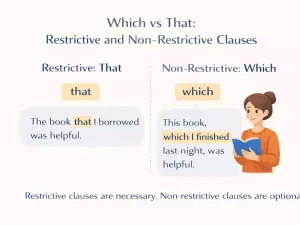
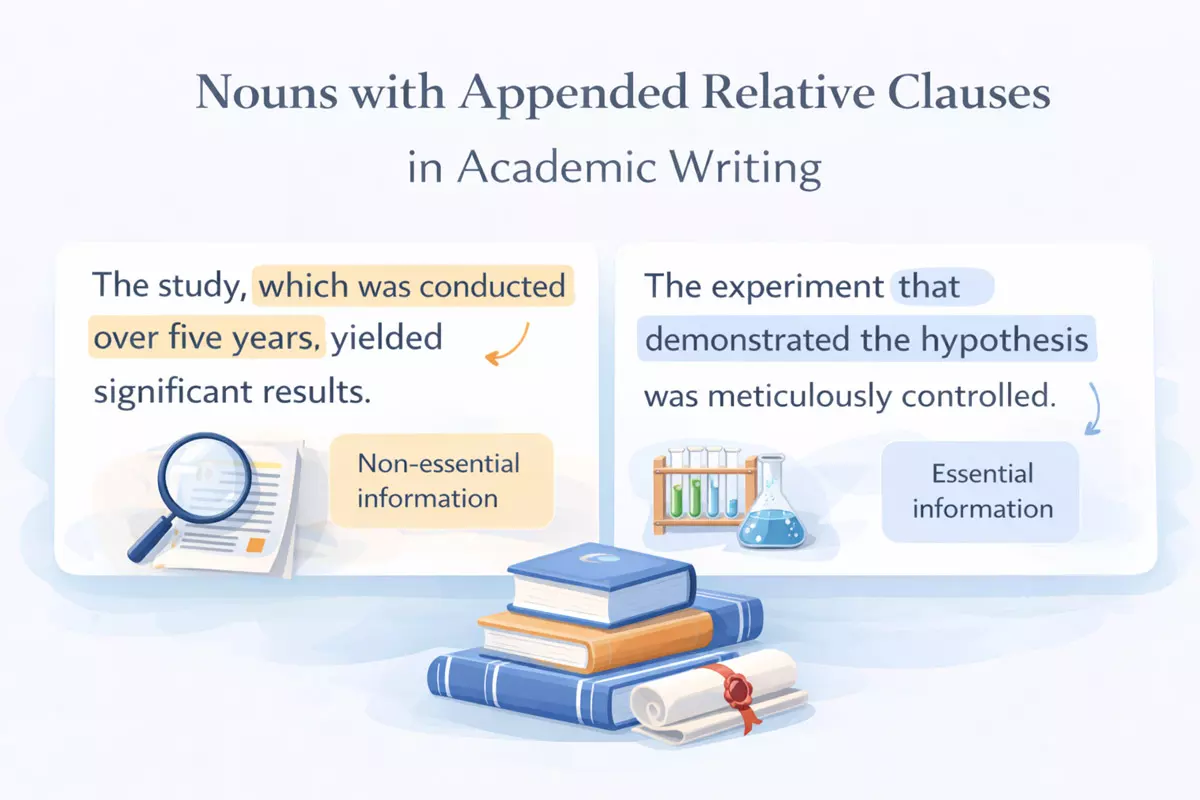
Understanding the distinction between defining (restrictive) and non-defining (non-restrictive) relative clauses is crucial for academic clarity. Defining clauses specify exactly which noun is meant and are essential to the meaning, while non-defining clauses add extra, non-essential information.
| Type | Function & Example |
|---|---|
| Defining | Limits the meaning of the noun; essential to understanding Example: "The participants who completed the training showed improvement." |
| Non-defining | Adds extra information; not essential; commas used Example: "The participants, who were all volunteers, received a certificate." |
Impact on Academic Style
These structures contribute to the precision and formality expected in scholarly writing. By carefully appending relative clauses to nouns, authors can avoid vagueness, demonstrate nuanced understanding, and build more logically organized arguments. Effective use of these clauses enhances both readability and credibility, which are vital for academic communication.
Restrictive vs non-restrictive relative clauses after nouns
Understanding the difference between defining and non-defining relative clauses is crucial in academic writing, as the choice shapes both the meaning and clarity of your sentences. Relative clauses provide extra information about a noun, but the way this information is presented—whether essential or additional—affects the structure and punctuation of your writing.
Defining (Restrictive) Relative Clauses
Restrictive clauses specify which particular noun is meant, limiting or narrowing the reference. They are not set off by commas, and omitting them would fundamentally change the meaning of the sentence. In academic contexts, these clauses often help clearly identify specific concepts, studies, or data.
- The results that support the hypothesis are shown in Table 2. ✅
- The students who completed the survey were included in the analysis.
- The article that was published last year received significant attention.
- The theory which underpins this model is widely accepted.
Non-defining (Non-restrictive) Relative Clauses
Non-restrictive clauses add extra, non-essential information about a noun that is already clearly identified. These are always separated by commas, and their removal does not alter the sentence’s core meaning. In academic writing, non-defining clauses often provide supplementary details or context.
- The experiment, which was conducted in 2020, yielded unexpected results. ✅
- Dr. Lee, who is an expert in biochemistry, reviewed the manuscript.
- The conference, which takes place annually, attracts international scholars.
- The dataset, which was made publicly available, contains over 10,000 entries.
Key Differences at a Glance
| Feature | Restrictive Clause | Non-restrictive Clause |
|---|---|---|
| Purpose | Identifies or restricts the noun | Adds extra, non-essential information |
| Punctuation | No commas | Set off by commas |
| Relative Pronouns | that, who, which | who, which (never "that") |
| Effect of Removal | Sentence meaning changes | Sentence remains clear |
Common Patterns and Pitfalls
Writers sometimes confuse the two types, leading to ambiguity or grammatical errors. Watch for these issues:
- Using "that" in non-defining clauses (incorrect: The author, that won the award, ... ❌)
- Omitting necessary commas in non-restrictive clauses
- Adding commas in restrictive clauses, which changes the intended meaning
- Overusing non-defining clauses, making sentences unnecessarily long
Mastering the distinction between these clause types ensures precision and readability, essential qualities in scholarly communication.
Choosing who, which, and that in noun modification
When adding relative clauses to nouns in academic writing, the choice between "who," "which," and "that" depends on both grammar and style conventions. Each word serves a distinct purpose for modifying different types of nouns, and understanding these distinctions helps clarify your sentences and maintain a formal, precise tone.
Distinguishing between "who," "which," and "that"
The pronoun you select for a relative clause is determined by the noun being described. "Who" is generally reserved for people, "which" for things or animals, and "that" can refer to people or things but is often preferred in restrictive clauses. Academic writing typically avoids ambiguity by following these conventions closely.
- "Who" – used exclusively for human antecedents.
Example: The researcher who conducted the experiment presented the findings. - "Which" – used for non-human antecedents (objects, concepts, animals).
Example: The article which discusses climate change was cited extensively. - "That" – can refer to both people and things, but in formal writing, it usually introduces restrictive clauses.
Example: The data that were collected support the hypothesis.
Restrictive vs. Non-restrictive Clauses
Relative clauses are either essential (restrictive) or additional (non-restrictive) to the meaning of the noun. "That" is typically used for restrictive clauses, while "which" is used for non-restrictive ones. Commas set off non-restrictive clauses, but not restrictive ones.
| Relative Pronoun | Type of Noun Modified | Clause Type & Example |
|---|---|---|
| who | People | Restrictive: The author who won the award Non-restrictive: Dr. Lee, who teaches physics, |
| which | Things, animals | Restrictive: The theory which explains gravity Non-restrictive: The book, which was published in 2020, |
| that | People, things (restrictive only) | Restrictive: The experiment that failed ❌ Not used for non-restrictive clauses |
Common pitfalls and best practices
Writers often mistakenly use "which" in restrictive clauses or "that" in non-restrictive clauses. In formal contexts, prefer "that" for essential information and "which" for additional, non-essential details. Consistency in applying these rules increases clarity.
- Avoid using "which" without commas for essential clauses: Incorrect: The model which predicts outcomes. ❌
- Use "who" for individuals, not organizations or objects.
- Do not use "that" for non-restrictive clauses: Incorrect: The author, that wrote the article, ... ❌
- Remember that some style guides (e.g., APA, Chicago) may have specific preferences; check if in doubt.
Expanded examples for clarity
Here are more examples to illustrate proper usage in academic contexts:
- The participants who completed the survey provided valuable insights.
- The instrument which measures pressure was calibrated daily.
- The study that examined sleep patterns found significant results.
- The committee, which meets monthly, approved the proposal.
- Students who excel in mathematics often pursue engineering.
- The hypothesis that was tested proved correct.
- The document, which is over 100 pages, outlines the methodology.
- The cells that responded to the treatment were analyzed further.
- The professor, who has published extensively, is leading the seminar.
- The journal which published the article is highly regarded.
In summary, choosing the correct relative pronoun in noun modification clarifies relationships and enhances the precision of your academic writing. Following these guidelines ensures your work is both clear and professionally presented.
Punctuation rules for noun + relative clause structures
Understanding how to punctuate sentences with relative clauses is essential for clear academic writing. These clauses, often introduced by words like “who,” “which,” or “that,” add detail to a noun. The presence or absence of commas can significantly alter meaning or clarity, so it’s important to distinguish between restrictive and non-restrictive relative clauses.
Restrictive vs. Non-Restrictive Clauses
Restrictive clauses provide essential information about the noun; non-restrictive clauses offer extra, non-essential details. Only non-restrictive clauses are set off with commas.
- Restrictive (no commas): The book that she recommended was fascinating.
- Non-restrictive (with commas): The book, which she recommended, was fascinating.
Common Punctuation Patterns
Writers often struggle with when to use commas, especially with complex noun phrases. Below is a summary of the most frequent punctuation rules for noun + relative clause structures in academic contexts.
| Type of Clause | Punctuation Example |
|---|---|
| Restrictive (Defining) | No commas The experiment that failed was repeated. |
| Non-restrictive (Non-defining) | Commas before and after the clause The experiment, which failed, was repeated. |
| Relative clause after a proper noun | Usually requires commas Dr. Carter, who leads the project, will present the findings. |
| Omitting “that”/“who” in restrictive clauses | No change in punctuation The data (that) we collected support the hypothesis. |
Key Guidelines for Academic Writing
- Use commas to set off non-essential clauses; omit them for essential information.
- Never use a comma before “that” in relative clauses.
- After a specific name or title, use commas with “which” or “who” if the clause is non-essential.
- If the relative clause is needed to specify which person or thing you mean, do not use commas.
- Do not separate a restrictive clause from its noun with a comma.
- When a relative clause ends a sentence, place the period after the final word of the clause, not after the noun.
- In lists, punctuate each clause as you would in a single sentence.
- For academic clarity, prefer “which” for non-restrictive and “that” for restrictive clauses.
- Relative clauses can follow compound nouns; apply the same punctuation rules.
- Be cautious with long noun phrases; misplaced commas can confuse readers.
- When in doubt, read the sentence aloud to check if the clause is essential or extra information.
Common Pitfalls
- Using commas with restrictive clauses (incorrect: The student, who scored highest, was awarded.)
- Omitting commas with non-restrictive clauses (incorrect: The student who scored highest, was awarded.)
- Confusing “which” and “that” in American academic English.
Applying these punctuation conventions helps ensure your academic writing is both precise and professional.
Information focus and precision using relative clauses
Academic writing often requires writers to add detail to nouns in order to clarify meaning, restrict reference, or introduce essential background. Relative clauses serve as a key tool for this, allowing authors to append extra information directly to a noun phrase. This structure not only improves specificity, but also helps guide readers’ attention to the most relevant aspects of the subject under discussion.
Enhancing clarity and narrowing reference

Relative clauses help distinguish between general and particular items or concepts. For example, compare "the method" with "the method that was validated in 2022." The appended clause provides crucial information, making the noun more precise and relevant to the context.
- the data which were collected in summer
- the students who completed the survey
- the hypothesis that was proposed by Smith
- the process which involves multiple stages
- the results that support our argument
- the variables which influence the outcome
- the participants who met the criteria
- the sources that are considered reliable
- the framework which underpins the analysis
- the theory that has gained wide acceptance
- the experiment which yielded unexpected results
- the approach that was adopted in previous studies
- the findings which contradict earlier research
- the model that predicts growth rates
- the instruments which were calibrated regularly
- the sample that was selected randomly
- the criteria which define success
- the literature that addresses this gap
Types of relative clauses and their functions
Writers choose between defining (restrictive) and non-defining (non-restrictive) clauses depending on whether the extra information is essential or additional. Defining clauses narrow the noun’s reference, while non-defining clauses add supplementary detail.
| Clause Type | Function & Example |
|---|---|
| Defining (Restrictive) | Limits the noun’s reference. The article that discusses climate change is recent. |
| Non-defining (Non-restrictive) | Adds non-essential information. The article, which discusses climate change, is recent. |
| Reduced Relative | Streamlines information. The data collected in 2021 were analyzed. |
| Zero Relative | Omission for brevity (spoken/written informally). The methods we used were effective. |
Strategic use for academic impact
Selecting the right type of relative clause can help writers foreground new findings, clarify relationships, and avoid ambiguity. For instance, using a restrictive clause can prevent misinterpretation, while non-restrictive clauses allow for smooth integration of secondary details. By mastering these structures, academic authors achieve greater control over the presentation and focus of their arguments.
Typical learner mistakes with relative pronouns
Many writers encounter difficulties when combining nouns with appended relative clauses, especially in academic contexts. The most frequent issues involve choosing incorrect pronouns, omitting necessary elements, or misplacing clauses, which can lead to ambiguity or grammatical errors.
Common errors in relative clause usage
- Using who for objects or things instead of people (e.g. The experiment who… ❌).
- Applying which to refer to people (e.g. The researcher which… ❌).
- Leaving out the relative pronoun when it is required for clarity (The method used was effective, led to better results ❌).
- Misplacing the relative clause so it attaches to the wrong noun (Students discussed the article in the seminar that was controversial → Was the article or the seminar controversial?).
- Confusing whose with who’s (The scientist who’s results were published… ❌).
- Overusing that when which is required for non-defining clauses (The theory, that was proposed in 1990, is widely accepted ❌).
- Omitting commas in non-defining relative clauses (The data which was collected in 2019 is reliable instead of The data, which was collected in 2019, is reliable).
- Using where or when for abstract nouns (The idea where… ❌).
- Incorrectly repeating the subject or object inside the relative clause (The process that it uses… ❌).
- Applying whom in subject position (The participant whom completed the survey… ❌).
- Mixing up restrictive and non-restrictive clauses, leading to confusion about meaning.
- Using that after a preposition (The method by that… ❌; should be by which).
Relative pronoun selection at a glance
| Pronoun | Used for | Example |
|---|---|---|
| who | People (subject) | The author who wrote the article |
| whom | People (object, formal) | The colleague whom I consulted |
| which | Things, animals, clauses | The theory which explains the phenomenon |
| that | People or things (restrictive) | The method that was tested |
| whose | Possession (people/things) | The researcher whose results… |
| where | Places | The laboratory where the tests were conducted |
| when | Times | The year when the study began |
How to avoid typical pitfalls
To write clear academic sentences with relative clauses, always check that the pronoun matches the noun it refers to, and that the clause is placed directly after the noun it modifies. Remember to use commas for non-defining clauses, and avoid omitting necessary pronouns if the sentence becomes unclear. Proofreading for these issues can greatly improve the quality of your academic writing.
Practice: add correct relative clauses to given noun phrases
Working with noun phrases modified by relative clauses is a key skill in academic writing. Relative clauses provide essential or additional information about a noun, making your ideas clearer and more precise. Below, you'll find exercises to help you practice adding appropriate relative clauses to various noun phrases commonly encountered in scholarly contexts.
Exercise: Expand the Noun Phrases
For each noun phrase below, add a suitable relative clause to clarify or specify the noun. Think about academic contexts such as research articles, reports, or essays.
- The theory
- The data
- The researcher
- The experiment
- The method
- The students
- The hypothesis
- The results
- The book
- The conference
- The variables
- The journal
- The sample
- The institution
- The model
Show answers
- The theory that explains language acquisition
- The data which were collected during the 2022 survey
- The researcher who developed the new analysis technique
- The experiment that failed to produce significant results
- The method which is widely used in psychology
- The students who participated in the study
- The hypothesis that was tested in the second phase
- The results which support the initial assumptions
- The book that was referenced in the introduction
- The conference where the findings were presented
- The variables that influence the outcome
- The journal which published the article
- The sample that included 150 participants
- The institution where the research was conducted
- The model which predicts future trends
Relative Clause Patterns in Academic Writing
Academic English often uses certain patterns for relative clauses, especially to provide precise information about people, objects, or concepts. Here are some useful structures:
- Noun + that + verb (for essential information): the process that leads to errors
- Noun + which + verb (for additional, non-essential information): the article, which was published last year,
- Noun + who + verb (for people): the author who proposed the theory
- Noun + where (for places): the laboratory where the tests were carried out
- Noun + whose (for possession): the researcher whose data were lost
Task: Identify the Function of Each Relative Clause
Read the following sentences and decide if the relative clause is giving essential (defining) or additional (non-defining) information.
- The article that discusses this issue is widely cited.
- The findings, which were unexpected, led to further research.
- The students who submitted their work early received feedback first.
- The conference, which takes place annually, attracts many experts.
- The theory that explains memory formation has been revised.
- The book, which was published last year, became a bestseller.
- The participants who completed the survey were entered into a draw.
- The project, which began in 2020, is still ongoing.
- The scientist who discovered the formula received an award.
- The results, which confirmed our prediction, were published yesterday.
Show answers
- Essential (defining)
- Additional (non-defining)
- Essential (defining)
- Additional (non-defining)
- Essential (defining)
- Additional (non-defining)
- Essential (defining)
- Additional (non-defining)
- Essential (defining)
- Additional (non-defining)