How to Use Commas in English: The Complete Beginner’s Guide

 This article explains how to use commas in lists, with FANBOYS conjunctions, after introductory words, around nonessential clauses, and in direct address or dates. It also helps you avoid comma splices and offers practice sentences to fix.
Understanding punctuation rules can seem daunting, particularly when dealing with the small marks that help organize ideas and clarify meaning in your writing. However, learning the fundamental rules of comma usage is essential for improving your writing skills and ensuring your sentences are clear and effective. By mastering where and when to use commas, you will be better equipped to convey your thoughts accurately and make your communication in English more precise and professional.
What a Comma Does
A comma is a small punctuation mark that helps make writing clearer and easier to read. Its main job is to separate parts of a sentence, showing where ideas pause, divide, or connect. By breaking up long sentences and organizing lists, commas prevent confusion and guide the reader through the flow of information.
Why Commas Matter in English
Without commas, sentences can run together and become hard to understand. These marks help signal short pauses or breaks, making your meaning clearer. They also help avoid misunderstandings, such as telling the reader who is being addressed or which items belong together in a list.
Main Functions of the Comma
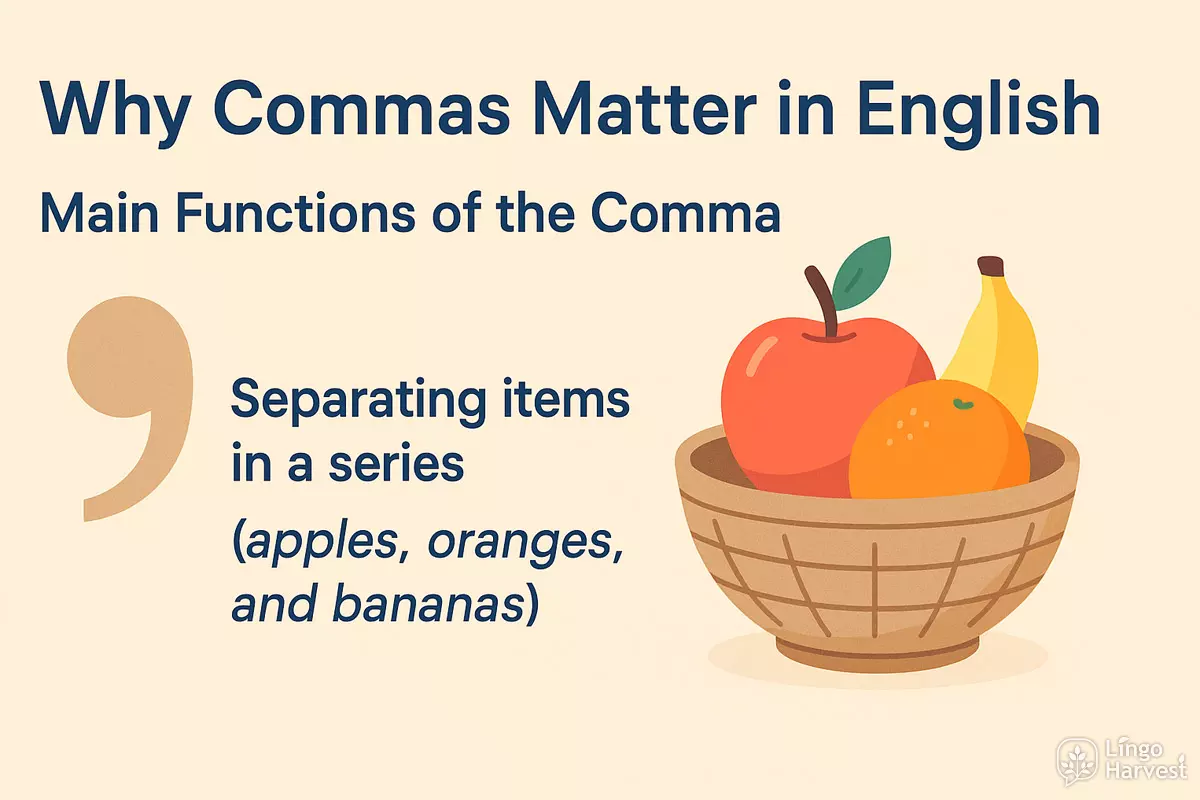
- Separating items in a series (apples, oranges, and bananas)
- Joining two independent clauses with a coordinating conjunction (She smiled, and he waved.)
- Setting off introductory words or phrases (After the meeting, we went home.)
- Enclosing extra information or non-essential words (My brother, who lives in Canada, is visiting.)
- Dividing adjectives that equally describe a noun (It was a long, tiring journey.)
- Marking direct address (Lisa, could you help me?)
- Separating contrasting parts (He wanted coffee, not tea.)
- Indicating yes or no (Yes, I agree.)
- Breaking up numbers for clarity (1,000 or 2,500,000)
- Clarifying dates and places (On July 4, 2024, the city held a parade.)
- Setting off quotes (She said, "Let’s begin.")
- Highlighting tag questions (You’re coming, aren’t you?)
- Separating repeated words (Whatever, whatever you say.)
- Indicating omitted words (She likes pizza; he, pasta.)
How Commas Change Meaning
Sometimes, a simple comma can change the entire sense of a sentence. Compare the following examples:
- Let’s eat, Grandma! → (inviting Grandma to eat)
- Let’s eat Grandma! → (suggesting eating Grandma!)
This shows how important it is to use commas correctly—they can help avoid some very funny or embarrassing mistakes.
Quick Reference: When to Use a Comma
| When to Use | Example |
|---|---|
| Separating items in a list | I bought bread, cheese, and milk. |
| Joining two complete sentences with "and," "but," etc. | She was tired, but she finished the project. |
| After introductory words or phrases | However, I still agree with you. |
| Setting off extra information | My car, which is new, runs well. |
| Direct address or interjections | No, thanks. |
| Dates, addresses, or numbers | April 12, 2023 |
In summary, commas are essential for organizing thoughts and making your writing clearer. Knowing when and how to use them will help you communicate more effectively in English.
Commas in Simple Lists
When you want to mention several items together in English, you’ll often separate them with commas. This is a basic use of punctuation that helps your reader see where one thing ends and another begins. For lists of three or more, commas help avoid confusion and make your meaning clear.
How to Separate Items
Place a comma between each item except for the last two, which are usually separated by and or or. Here are some typical settings where this pattern appears:
- I bought apples, oranges, and bananas.
- She likes reading, cooking, and hiking.
- Please bring your notebook, pen, and calculator.
- We visited London, Paris, Rome, and Berlin.
- The bag contains a wallet, keys, phone, and lipstick.
- For breakfast, he had eggs, toast, and coffee.
- They invited Tom, Jerry, and Alice to the party.
- You can choose red, blue, green, or yellow.
- The dessert has chocolate, nuts, and berries.
- My favorite seasons are spring, summer, and autumn.
- She speaks English, French, and Spanish.
- Remember to pack socks, shoes, and a jacket.
- We saw lions, tigers, and bears at the zoo.
- He ordered pizza, salad, and lemonade.
- Bring scissors, tape, and wrapping paper.
- The menu offers soup, sandwiches, and desserts.
Should You Use the Oxford Comma?
The Oxford comma (also called the serial comma) is the comma before the last item in a list. For example: milk, bread, and cheese. In American English, it is common and often recommended, especially to avoid ambiguity. In British English, it is less standard and sometimes omitted.
| With Oxford Comma | Without Oxford Comma |
|---|---|
| We invited the dancers, Anna, and Paul. | We invited the dancers, Anna and Paul. |
| She packed sandwiches, juice, and fruit. | She packed sandwiches, juice and fruit. |
| My heroes are my parents, Superman, and Wonder Woman. | My heroes are my parents, Superman and Wonder Woman. |
| I love cats, dogs, and rabbits. | I love cats, dogs and rabbits. |
Quick Tips
- Use commas for lists of three or more items.
- Do not use a comma between only two items (e.g., apples and oranges).
- Be consistent with your comma style, especially in formal writing.
- Always check if your list could be misunderstood without the extra comma.
Mastering this aspect of punctuation makes your writing clearer and easier to follow, especially when you’re listing multiple things.
Commas with FANBOYS Conjunctions
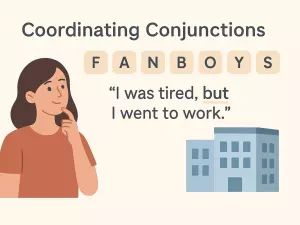
When you join two independent clauses (complete sentences) with a coordinating conjunction, a comma usually appears before the conjunction. The most common coordinating conjunctions in English are remembered by the acronym FANBOYS: For, And, Nor, But, Or, Yet, So. Each of these words connects ideas, but the rules for punctuation are consistent: if both parts could stand alone as separate sentences, place a comma before the FANBOYS word.
Identifying Independent Clauses
An independent clause contains a subject and a verb and expresses a complete thought. For example:
- She wanted to go for a walk
- It started to rain
If you join these with a coordinating conjunction, you get:
She wanted to go for a walk, but it started to rain.
Where to Put the Comma
The comma goes right before the FANBOYS conjunction, but only if both sides are independent clauses. If one side is not a complete sentence, you usually skip the comma.
Common Patterns and Examples
- I finished my homework, and I watched a movie.
- He didn’t study, so he failed the test.
- You can call me, or you can send an email.
- She is allergic to nuts, but she loves chocolate.
- We could go hiking, or we could stay home.
- He was tired, yet he kept working.
- They won’t join us, nor will they explain why.
- It was raining, for the sky was dark and cloudy.
- She tried her best, but she didn’t succeed.
- We need more time, so let’s postpone the meeting.
- I like tea, and my brother prefers coffee.
- He can come with us, or he can stay at home.
- I don’t eat meat, nor do I drink milk.
- She wanted to help, yet she didn’t know how.
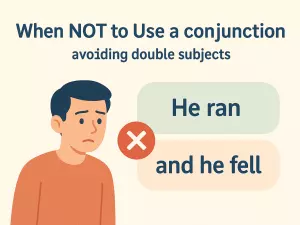
When NOT to Use a Comma
If the second clause is not independent (it lacks a subject), the comma is usually omitted:
- I finished my homework and watched a movie.
- He didn’t study so failed the test. ❌ (Incorrect, but you’ll see it in informal writing.)
Only use the comma if both parts could stand alone as sentences.
Quick Reference: FANBOYS Comma Usage
| Conjunction | Use a Comma? | Example |
|---|---|---|
| For | Yes, if both clauses are independent | She was tired, for she had worked all night. |
| And | Yes, with two independent clauses | He opened the window, and the cat jumped in. |
| Nor | Yes, when both sides could be sentences | She didn’t call, nor did she write. |
| But | Yes, if joining two complete ideas | I want to go, but I have no time. |
| Or | Yes, if both are independent | You can start now, or you can wait. |
| Yet | Yes, with two full clauses | The task was hard, yet he finished it. |
| So | Yes, when both sides are sentences | It was late, so we went home. |
Summary
To sum up: insert a comma before a FANBOYS word only when you are joining two independent clauses. This rule is a foundation of clear, correct writing in English. If in doubt, check if each part could stand alone as a sentence. If yes, add the comma!
After Introductory Words and Phrases
When you start a sentence with a word or phrase that introduces the main idea, it’s standard to separate that element from the rest of the sentence with a comma. This small pause helps readers quickly understand the structure and meaning. Introductory elements can be single words, short phrases, or even full clauses.
Common Types of Introductory Elements
- Single adverbs: Generally, However, Unfortunately, Interestingly,
- Prepositional phrases: In the morning, After a long day, On the other hand,
- Dependent clauses: If you look closely, While she was away, Although it rained,
- Transitional phrases: For example, In fact, As a result,
- Interjections and mild exclamations: Oh, Well, Yes, No,
Examples of Correct Comma Use
- First, read the instructions carefully.
- After dinner, we went for a walk.
- If it rains, we’ll stay inside.
- Luckily, everyone arrived on time.
- To be honest, I didn’t enjoy the movie.
- Of course, you can join us.
- When you’re ready, let me know.
- For instance, many birds migrate in winter.
- Yes, I have finished my homework.
- On the contrary, he prefers to stay home.
- During the meeting, please silence your phones.
- Although it was late, she kept working.
- Well, that was unexpected.
- After a few minutes, the bus finally arrived.
When a Comma Is Optional
If the introductory phrase is very short (fewer than four words) and there’s no risk of confusion, the comma can sometimes be omitted. However, adding it is usually clearer, especially in formal writing.
- Yesterday(,) we went to the park.
- In 2020(,) many events were canceled.
Quick Reference: Introductory Elements and Commas
| Introductory Word or Phrase | Example Sentence |
|---|---|
| However | However, the results were surprising. |
| After the storm | After the storm, the sun came out. |
| If you agree | If you agree, please sign below. |
| On the other hand | On the other hand, she might be right. |
| Well | Well, that’s all for today. |
| To summarize | To summarize, all points were addressed. |
| When you’re finished | When you’re finished, let me know. |
| For example | For example, lions live in Africa. |
| Although it was cold | Although it was cold, we went outside. |
| In the end | In the end, everyone was happy. |
Remember, placing a comma after an introductory word or phrase helps clarify your meaning and makes your writing easier to follow. As you get more comfortable, using commas in these situations will become second nature.
Around Nonessential Clauses
Commas are essential for setting off information that isn’t strictly required for the core meaning of a sentence. These extra details—also known as nonrestrictive or nonessential clauses—add helpful context, but the sentence would still make sense if you removed them. Using commas correctly helps readers distinguish between necessary and additional information.
What Are Nonessential Clauses?
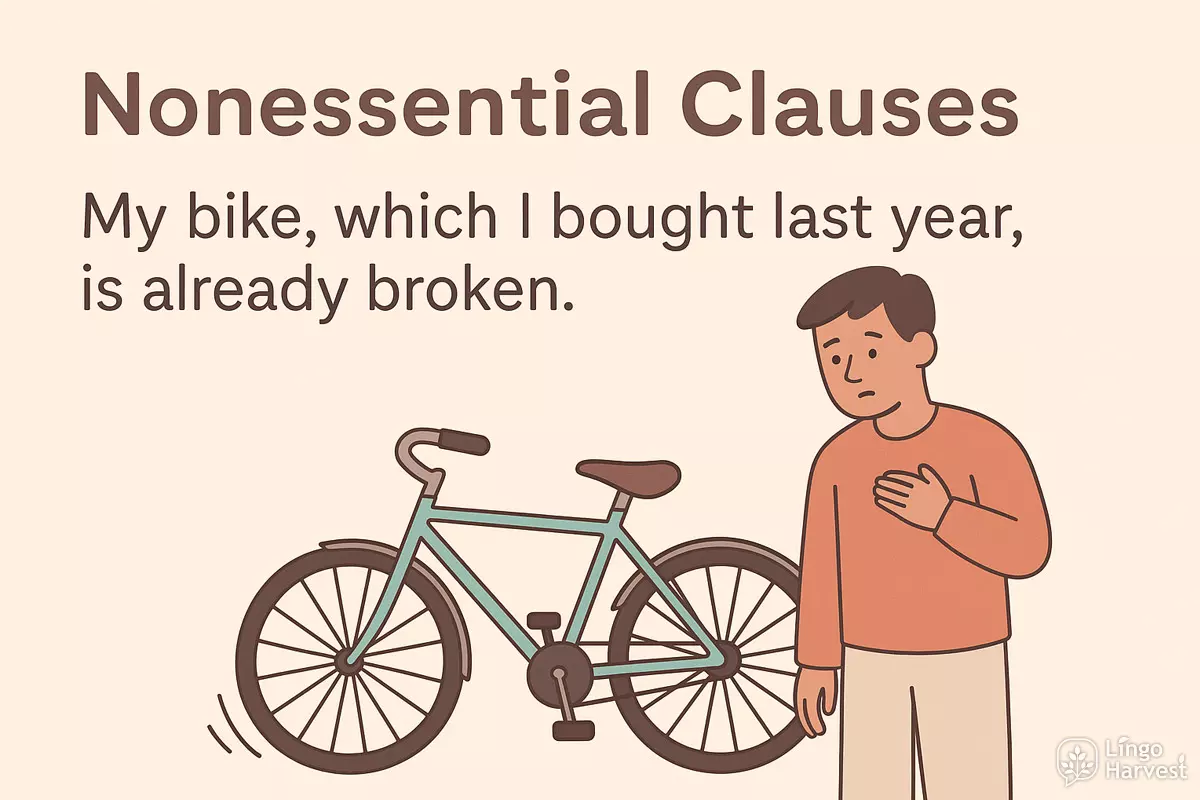
A nonessential clause gives extra details about a noun, but it doesn’t define or limit which person or thing you’re talking about. If you take out the clause, the main point remains clear. These clauses are often introduced by words like “which,” “who,” or “whose.”
- My bike, which I bought last year, is already broken.
- My brother, who lives in Canada, is visiting this summer.
- The book, whose cover is blue, is on the table.
In each example, the information between commas could be omitted without changing the basic meaning.
How to Punctuate Nonessential Clauses
Always place a comma before and after a nonessential clause, unless it’s at the very end of a sentence—then you just need a comma before it. This punctuation signals to the reader that the extra information is not crucial for identifying the subject.
- Sarah, who loves painting, attends art classes every week.
- The concert, which was sold out, started late.
- My laptop, which is brand new, stopped working.
- The teacher, whose lessons are popular, is leaving soon.
- This recipe, which takes only 20 minutes, is perfect for busy days.
- The movie, which I watched last night, was fantastic.
- Our cat, who is very shy, finally met the neighbors.
- The museum, which opened recently, has free admission.
- Her jacket, which she bought in Paris, is missing.
- Tim, whose car broke down, took the bus to work.
Nonessential vs. Essential Clauses
It’s important to know the difference between nonessential (extra) and essential (defining) clauses, because only nonessential clauses use commas. Essential clauses identify exactly which person or thing you mean and are not separated by commas.
| Nonessential Clause (Use Commas) | Essential Clause (No Commas) |
|---|---|
| The car, which is red, is parked outside. (We already know which car; “which is red” is extra info.) |
The car that is red is parked outside. (“That is red” tells us which car.) |
| Lisa, who is my cousin, called me. (Lisa is already identified; “who is my cousin” adds info.) |
The woman who is my cousin called me. (“Who is my cousin” identifies which woman.) |
| The house, which has a green door, is old. (There’s only one house; “which has a green door” adds detail.) |
The house that has a green door is old. (“That has a green door” tells us which house.) |
| My phone, which I use for work, is charging. (“Which I use for work” is not needed to identify the phone.) |
The phone that I use for work is charging. (“That I use for work” identifies which phone.) |
Quick Tips
- Use “which” (not “that”) for nonessential clauses, and always add commas.
- If the sentence doesn’t need the clause to be clear, add commas to separate it.
- Read the sentence aloud—if you pause naturally, a comma might be needed.
Mastering commas with extra clauses helps your writing flow smoothly and avoids confusion for your readers.
In Direct Address and Dates
Commas play a crucial role when you mention someone directly in a sentence or when you write dates. Understanding these patterns helps your writing sound natural and prevents confusion.
Commas in Direct Address
When talking to someone or calling their name, use a comma to separate the name or title from the rest of the sentence. This signals who you’re talking to, which can completely change the meaning.
- Lisa, could you help me with this?
- Could you, Lisa, help me with this?
- Could you help me with this, Lisa?
- Let’s eat, grandma! ✅
- Let’s eat grandma! ❌ (This means something very different!)
- Yes, sir, I understand.
- Thank you, everyone, for coming.
- Don’t worry, my friend.
- Be careful, guys!
- Doctor Smith, your patient is waiting.
Using Commas in Dates
Commas also help clarify dates in written English, especially when the day, month, and year all appear together. The typical American format includes a comma between the day and year.
- May 5, 2024, is a holiday. ✅
- She was born on July 12, 1999.
- On January 1, 2020, we celebrated.
- He moved here in June 2015. (No comma needed—year only)
- On 6 October 2023 we met. (British style—no comma)
- Friday, October 13, 2023, was unlucky for some.
Quick Reference: Comma Placement Patterns
| Pattern | Example |
|---|---|
| Direct address at the start | Anna, could you call me? |
| Direct address in the middle | Could you, Anna, call me? |
| Direct address at the end | Could you call me, Anna? |
| Full date (US style) | April 15, 2022, was sunny. |
| Date without day (no comma) | He left in August 2021. |
| British date format (no comma) | 15 April 2022 was sunny. |
Remember, leaving out these commas can make your sentence confusing or even change its meaning. Paying attention to these details will make your English clearer and more natural.
Avoiding Comma Splices
One of the most common punctuation mistakes in English is using a comma incorrectly to join two independent clauses. This error is known as a comma splice. In simple terms, a comma splice happens when two complete sentences are joined only with a comma, which is not grammatically correct.
What Is a Comma Splice?
A comma splice occurs when two independent clauses (each could stand alone as a sentence) are linked together by a comma without the proper conjunction or punctuation. For example:
- I finished my homework, I watched TV. ❌
- She loves chocolate, she eats it every day. ❌
How to Fix Comma Splices
There are several ways to correct this mistake. Here are the most common solutions:
- Use a period to separate the clauses into two sentences.
Example: I finished my homework. I watched TV. ✅ - Add a coordinating conjunction (for, and, nor, but, or, yet, so) after the comma.
Example: I finished my homework, and I watched TV. ✅ - Replace the comma with a semicolon if the clauses are closely related.
Example: I finished my homework; I watched TV. ✅ - Use a subordinating conjunction to make one clause dependent.
Example: After I finished my homework, I watched TV. ✅
Common Coordinating Conjunctions
Remember the acronym FANBOYS for the most common coordinating conjunctions:
- For
- And
- Nor
- But
- Or
- Yet
- So
Comma Splice Correction Methods Compared
| Incorrect Example | Corrected Example | Correction Method |
|---|---|---|
| I am tired, I will go to bed. | I am tired. I will go to bed. |
Period |
| It's raining, we can’t go outside. | It's raining, so we can’t go outside. | Coordinating Conjunction |
| He likes tea, she prefers coffee. | He likes tea; she prefers coffee. | Semicolon |
| The meeting ended, everyone left. | After the meeting ended, everyone left. | Subordinating Conjunction |
Quick Tips to Prevent This Mistake
- Read your sentences aloud. If you hear a natural pause and both parts can stand alone, check your punctuation.
- Look for two subjects and two verbs separated only by a comma.
- When in doubt, split long sentences into shorter ones.
- Use conjunctions wisely to connect ideas smoothly.
Mastering this aspect of punctuation helps your writing become clearer and more professional. With practice, you’ll spot and fix these errors with ease.
Practice: Fix the Sentences
Want to improve your comma usage? Try correcting these sentences. Each one contains a mistake with commas—sometimes a missing one, sometimes an extra. Read carefully, decide how you would fix each, and check your answers at the end.
Spot the Comma Errors
Below are sentences with errors related to comma placement. Rewrite each sentence so it uses commas correctly.
- After lunch we went to the park and played soccer.
- He loves reading cooking and hiking.
- My friend Julia who lives next door is coming over.
- Yes I would like some tea.
- She was tired, but she finished her homework.
- Because it was raining we stayed inside.
- Tom brought his laptop, his notebook his pen, and his charger.
- No I haven’t seen that movie.
- We visited Paris London, and Rome last summer.
- The big fluffy dog barked loudly.
- First we need to buy eggs then we can bake the cake.
- I enjoy listening to jazz, when I want to relax.
- My sister, and I went shopping.
- Although she was late she still caught the bus.
- Wait for me Sarah!
Common Comma Mistakes: Quick Reference
Here are some typical mistakes beginners make with punctuation marks. Review these to help you avoid similar errors in your writing:
- Forgetting a comma after introductory words or phrases
- Omitting commas in a list of three or more items
- Unnecessary commas between a subject and verb
- Missing commas with direct address (naming someone you are speaking to)
- Leaving out commas with non-essential information (extra details that can be removed)
- Adding commas before every “and” or “but,” even when not needed
- Using a comma to join two sentences without a conjunction
Check Your Answers
Show answers
- After lunch, we went to the park and played soccer.
- He loves reading, cooking, and hiking.
- My friend Julia, who lives next door, is coming over.
- Yes, I would like some tea.
- She was tired but she finished her homework. (No comma needed before "but" as both clauses are short.)
- Because it was raining, we stayed inside.
- Tom brought his laptop, his notebook, his pen, and his charger.
- No, I haven’t seen that movie.
- We visited Paris, London, and Rome last summer.
- The big, fluffy dog barked loudly.
- First, we need to buy eggs, then we can bake the cake.
- I enjoy listening to jazz when I want to relax. (Remove the comma.)
- My sister and I went shopping. (Remove the comma.)
- Although she was late, she still caught the bus.
- Wait for me, Sarah!