Nouns in Legal and Policy Language with Formal Structures

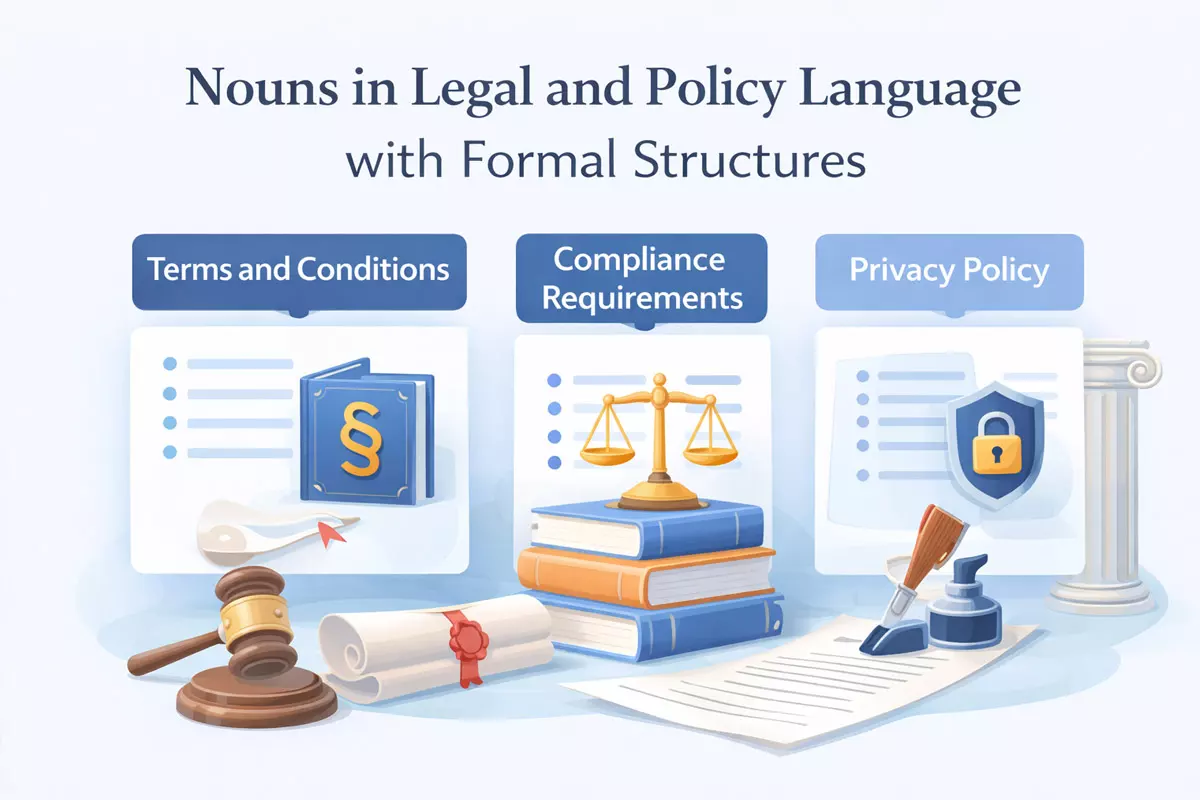 Here we why legal and policy writing relies on abstract nouns, details common legal noun types, shows how precise meaning is achieved, explains set legal phrases, compares legal to everyday language, and provides practice simplifying legal nouns.
- Why legal and policy writing relies on abstract nouns
- Common legal and policy noun categories
- Precision and scope created by noun-heavy structures
- Fixed legal noun phrases and formal collocations
- Differences between legal and general public usage
- Typical learner errors with legal-style nouns
- Practice: simplify legal-style noun expressions
The choice and organization of words in legal and policy documents are crucial for conveying precise meaning and avoiding ambiguity. Carefully selected terminology and structured language help clarify complex concepts, making it easier for readers to interpret the intent and application of the document. This attention to detail supports consistency, reduces misunderstandings, and ensures that the document’s provisions are understood as intended by all parties involved.
Why legal and policy writing relies on abstract nouns
Legal and policy documents frequently use abstract nouns to achieve precision, generality, and consistency. These texts often address concepts—such as “liability,” “compliance,” or “jurisdiction”—that do not refer to physical objects but rather to intangible ideas, rights, obligations, and processes. By employing such nouns, drafters can encapsulate complex principles and relationships in a single term, making rules applicable to a wide range of scenarios without constant repetition or ambiguity.
Functions of Abstract Nouns in Legal and Policy Contexts
Abstract nouns serve several practical functions in formal language:
- Generalization: They make it possible to discuss broad categories (e.g., “property,” “authority”) that cover many specific instances.
- Impersonality: Using concepts instead of people or things helps maintain an objective tone and avoid unnecessary personalization.
- Stability: Abstract terms are less likely to change in meaning over time compared to more concrete expressions.
- Efficiency: One abstract noun can replace a lengthy descriptive phrase, streamlining the text.
- Consistency: Standardized terms ensure uniform interpretation across cases and jurisdictions.
Common Abstract Nouns in Legal and Policy Language
Writers often rely on a core vocabulary of abstract terms. These include:
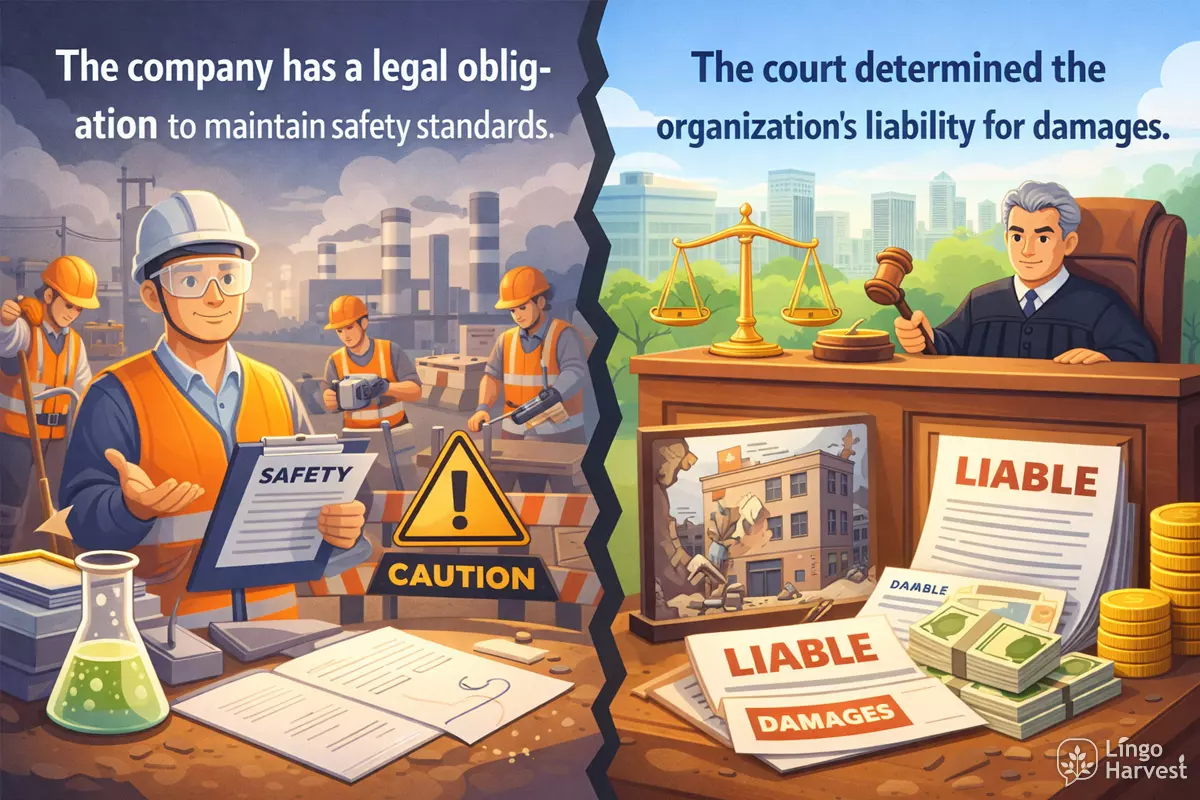
- Obligation → The company has a legal obligation to maintain safety standards.
- Liability → The court determined the organization’s liability for damages.
- Compliance → Full compliance with regulations is required by law.
- Jurisdiction → The dispute falls under federal jurisdiction.
- Consent → Written consent must be obtained before data collection.
- Ownership → Ownership of the land was transferred to the new buyer.
- Authority → Only the board has the authority to approve major decisions.
- Validity → The validity of the contract was questioned in court.
- Responsibility → It is the researcher’s responsibility to protect participant privacy.
- Sanction → The violation resulted in a financial sanction.
- Enforcement → Enforcement of the new law begins next month.
- Provision → This provision allows employees to work remotely.
- Interpretation → Differences in interpretation led to legal ambiguity.
- Limitation → One limitation of the study is its small sample size.
- Exemption → Students may apply for exemption from the final exam.
- Procedure → The procedure must be followed exactly to ensure accuracy.
- Remedy → The proposed remedy addressed the core issue effectively.
- Breach → The breach of contract resulted in costly litigation.
- Admissibility → The admissibility of the evidence was challenged by the defense.
- Immunity → Diplomatic immunity protected the official from prosecution.
Abstract Nouns and Formal Structure
The use of abstract nouns is closely tied to formal structures in legal drafting. Such nouns are often embedded in set phrases, definitions, or recurring syntactic patterns, which help create documents that are both precise and enforceable.
| Abstract Noun | Example Phrase |
|---|---|
| Obligation | The obligation to pay taxes arises annually. |
| Jurisdiction | This court has jurisdiction over civil matters. |
| Enforcement | Enforcement of the contract is subject to these terms. |
| Liability | Liability for damages rests with the manufacturer. |
| Validity | The validity of the agreement is disputed. |
Benefits and Drawbacks
While abstract nouns promote clarity and universality, they can sometimes result in dense, difficult prose. The key is to balance abstraction with sufficient explanation or context so the intended meaning remains accessible to all intended readers.
Common legal and policy noun categories
Understanding the types of nouns frequently used in legal and policy documents is essential for grasping both meaning and structure. Different noun categories serve distinct purposes, from identifying parties and objects to specifying abstract concepts or procedural steps. This section outlines major classes of nouns commonly found in legal and policy language, highlighting their roles and providing illustrative examples.
Core noun categories in legal and policy texts
Legal and policy writing relies on a range of noun types, each contributing to the precision and clarity of formal documents. Here are some principal groups:
- Actors: person, party, agent, beneficiary, authority, representative
- Objects: property, asset, document, instrument, evidence, record
- Abstract concepts: liability, obligation, right, duty, consent, compliance, jurisdiction
- Processes and events: transfer, breach, amendment, execution, enforcement, settlement
- Time and scope terms: period, duration, term, limitation, extent, commencement
- Conditions and exceptions: condition, proviso, exception, requirement, contingency
- Quantities and measures: amount, sum, portion, share, percentage, threshold
- Statuses and roles: status, position, capacity, title, standing
- Relationships: agreement, contract, arrangement, partnership, affiliation
- Jurisdictions and authorities: court, tribunal, agency, commission, regulator
- Documents and references: clause, section, schedule, annex, appendix
- Remedies and penalties: remedy, sanction, penalty, relief, damages
Comparison of selected noun categories
Some noun classes in formal language can appear similar but have distinct legal implications. The table below compares several commonly encountered categories:
| Noun Category | Typical Functions and Examples |
|---|---|
| Actors | Identify participants (e.g., plaintiff, defendant, agent, principal) and allocate responsibilities. |
| Abstract Concepts | Define legal relationships and obligations (e.g., liability, consent, compliance). |
| Processes/Events | Describe actions or procedural steps (e.g., execution of contract, breach, amendment, enforcement). |
| Objects | Refer to tangible or intangible items affected by rules (e.g., property, asset, document, evidence). |
Why noun categories matter in formal drafting
Selecting precise noun types is crucial in legal and policy drafting. The choice can affect interpretation, scope of application, and enforceability. For example, using "party" versus "person" might change who is bound by an agreement, while specifying "asset" instead of "property" can narrow or broaden what is covered. Understanding these categories enables drafters to construct clear, unambiguous provisions and helps readers navigate complex documents with confidence.
Precision and scope created by noun-heavy structures
Legal and policy documents often rely on dense nominal phrases to achieve clarity and limit ambiguity. By stringing together multiple nouns, these texts can specify relationships, define categories, and set boundaries with a level of detail that would be difficult to accomplish using only verbs or adjectives. This approach allows for concise references to complex concepts, reducing the risk of misinterpretation in high-stakes contexts.
How noun-dense phrasing clarifies meaning
Using sequences of nouns enables the creation of technical terms, such as data processing agreement or employee misconduct investigation report. Each noun in the chain narrows or specifies the reference, ensuring that the reader understands exactly what is at stake. In regulatory writing, this technique helps to anchor obligations and rights precisely to defined entities or actions.
- Clarity: Noun clusters reduce vagueness by accumulating qualifiers.
- Conciseness: Complex ideas are expressed in fewer words.
- Consistency: Repeated nominal patterns support cross-referencing and definitions.
- Authority: Formal structures project objectivity and rigor.
Examples of noun-heavy structures in context
Below is a list of common nominal patterns found in legal and policy writing, illustrating how each component adds to the meaning:
- Data retention policy
- Intellectual property rights assignment
- Payment dispute resolution clause
- Shareholder meeting notification
- Environmental impact assessment report
- Privacy breach notification requirement
- Contractual liability limitation provision
- Employment termination procedure
- Tax compliance documentation
- Consumer protection regulation
- Supply chain management agreement
- Freedom of information request
- Product safety certification process
- Risk mitigation strategy statement
- Access control policy statement
- Government procurement guideline
- Non-disclosure agreement clause
- Workplace harassment complaint form
Comparing noun-heavy vs. verb-focused constructions
| Nominal Structure | Verb-Focused Equivalent |
|---|---|
| Contract termination notice | Notice to terminate the contract |
| Data protection regulation | Regulation that protects data |
| License renewal application | Application to renew a license |
| Employee performance evaluation | Evaluating an employee's performance |
| Conflict of interest disclosure | Disclosing a conflict of interest |
By favoring nominal expressions, legal and policy language can encapsulate intricate ideas in stable, repeatable forms. This structural choice not only enables precise delineation of obligations and rights, but also supports the systematic organization of complex regulatory frameworks.
Fixed legal noun phrases and formal collocations
Legal and policy texts frequently rely on set expressions—structured noun groups and formulaic combinations—that convey specific meanings not easily paraphrased. These established patterns help ensure precision, reduce ambiguity, and maintain consistency across documents and jurisdictions. Understanding these standard groupings is essential for interpreting statutes, contracts, and official communications.
Common patterns in legal wording
Many legal noun combinations are not simply a matter of vocabulary, but reflect centuries-old traditions and the need for clarity. For instance, certain nouns are almost always paired with particular modifiers or legal terms, forming collocations that rarely change.
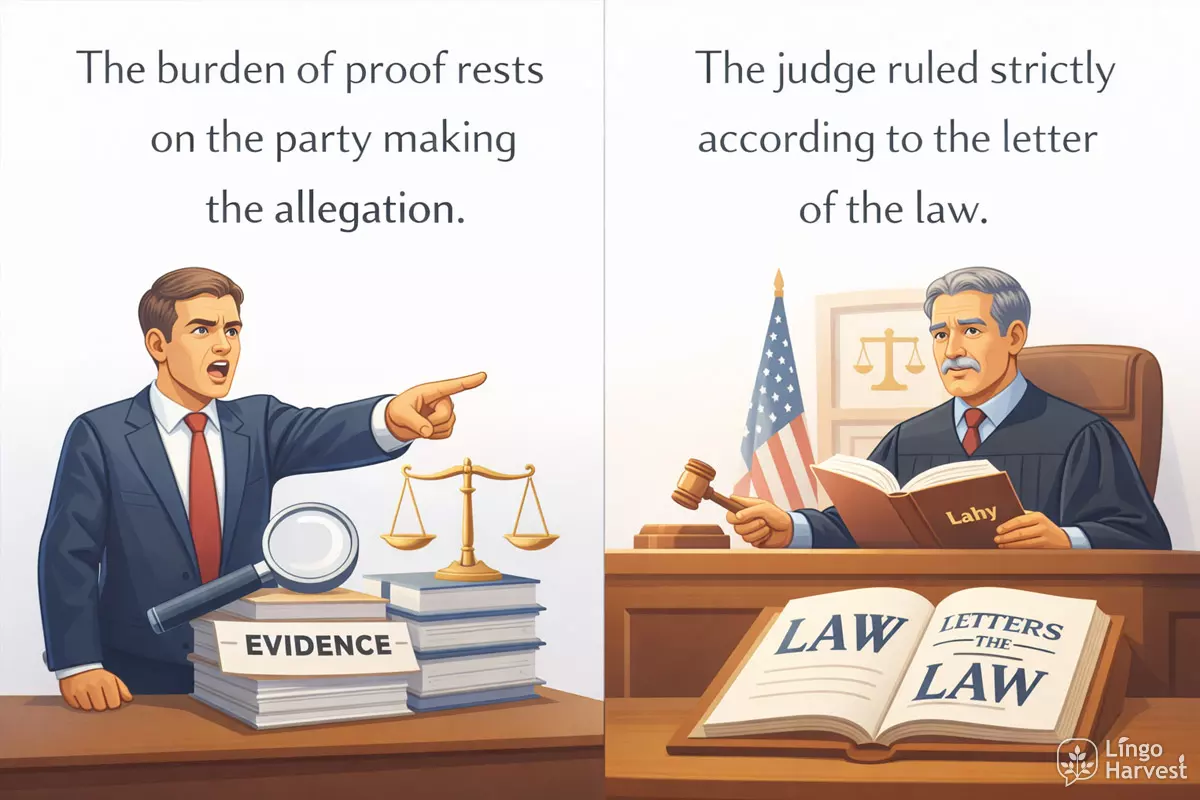
- burden of proof → The burden of proof rests on the party making the allegation.
- letter of the law → The judge ruled strictly according to the letter of the law.
- terms and conditions → Users must accept the terms and conditions before accessing the service.
- statute of limitations → The claim was dismissed because the statute of limitations expired.
- power of attorney → She granted power of attorney to her son during the operation.
- force majeure clause → The contract included a force majeure clause to cover natural disasters.
- notice of termination → The company issued a notice of termination to multiple employees.
- fiduciary duty → Directors must act in accordance with their fiduciary duty to shareholders.
- class action lawsuit → The company faced a class action lawsuit for misleading advertising.
- due diligence → Investors conducted due diligence before acquiring the firm.
- prima facie case → The evidence established a prima facie case of negligence.
- summary judgment → The court granted summary judgment due to lack of dispute over facts.
- material breach → Failure to deliver on time constituted a material breach of contract.
- joint venture agreement → Both companies signed a joint venture agreement to share resources.
- legal entity → The business was registered as a separate legal entity.
- remedy at law → The plaintiff sought a remedy at law for financial damages.
- restrictive covenant → The restrictive covenant prevented employees from joining competitors.
- statutory interpretation → The appeal relied on principles of statutory interpretation.
- public policy exception → The court applied a public policy exception to protect workers.
- conflict of interest → The lawyer withdrew due to a conflict of interest.
Features of formal collocations in legal context
Legal collocations often involve abstract nouns combined with legal qualifiers. These are not always intuitive to non-specialists, and their meaning may depend on precedent or context. This set phrasing helps signal the function of a concept within a document—whether it denotes an obligation, right, limitation, or procedure.
Comparison of formal noun patterns
Below is a structured comparison of some common legal noun structures, illustrating the difference between general and legal-specific usage:
| General Usage | Legal/Policy-Specific Collocation |
|---|---|
| decision | binding decision |
| agreement | memorandum of understanding |
| contract | contract of adhesion |
| case | test case |
| party | third party beneficiary |
| interest | equitable interest |
Why these structures matter
The use of fixed expressions and formal noun patterns helps legal professionals avoid misinterpretation. For translators, students, and practitioners, familiarity with these forms is vital: literal translation or misuse can lead to significant misunderstanding or even legal risk. Recognizing these set phrases and their roles within broader legal argumentation or procedural frameworks is a key part of legal literacy.
Differences between legal and general public usage
Legal language relies on nouns with precise, formal definitions, while the general public often uses the same words more loosely or with broader interpretations. This gap can lead to misunderstandings, especially when policy documents or statutes are interpreted outside of legal contexts. In legal texts, nouns are frequently defined at the outset to ensure clarity and consistency throughout the document. In contrast, everyday conversation values flexibility and context-driven meaning over strict definitions.
Precision and Ambiguity
In statutes and contracts, nouns are chosen for unambiguous reference. For example, the term “person” in law can include corporations and associations, not just individual humans. The general public, however, typically interprets “person” as meaning a human being. This difference underpins many legal disputes and policy debates.
- “Property”: In legal language, includes tangible and intangible assets; publicly, often thought of as land or houses.
- “Consideration”: Legally refers to something of value exchanged in a contract; in common speech, means careful thought.
- “Liability”: In statutes, denotes a legal obligation; in everyday use, may simply mean responsibility.
- “Agent”: For lawyers, a person authorized to act for another; in general use, might mean a secret agent or a representative.
- “Party”: In legal texts, one side in a case or contract; commonly, a social gathering.
- “Instrument”: Legally, a formal written document; elsewhere, a tool or musical device.
- “Capacity”: In law, one’s legal ability; generally, the amount something can hold.
- “Action”: Legal usage means a lawsuit; in everyday speech, any deed or movement.
- “Minor”: In statutes, someone under legal age; in public use, anything of lesser importance.
- “Statute”: Refers specifically to written law; outside legal circles, sometimes confused with “statue.”
- “Affidavit”: A sworn written statement in law; rarely used outside legal contexts.
- “Trust”: A legal arrangement for managing assets; elsewhere, simply confidence in someone.
- “Execution”: In legal texts, means carrying out a court order; generally, might be understood as performing any task or, historically, capital punishment.
- “Settlement”: In law, resolution of a dispute; elsewhere, a place where people live.
Structural Features
Legal and policy documents often introduce defined terms at the beginning, capitalizing them to signal their formal status. Such conventions are rare outside legal writing, where capitalization and definition are less rigid.
| Term | Legal Usage | General Public Usage |
|---|---|---|
| Person | Any legal entity, including humans and organizations | Individual human being |
| Consideration | Something of value exchanged in a contract | Thoughtful reflection |
| Instrument | Formal legal document | Tool or musical device |
| Action | Legal proceeding or lawsuit | Any deed or act |
| Trust | Fiduciary arrangement for asset management | Confidence in reliability |
Understanding these distinctions is crucial for accurate interpretation and application of legal and policy language, especially when formal structures lead to meanings that diverge from everyday expectations. This awareness can help prevent confusion and foster clearer communication when legal terms enter public discourse.
Typical learner errors with legal-style nouns
Learners often struggle with the conventions and nuances of legal and policy-related nouns. These challenges can stem from the formal structures, abstract meanings, and unique collocations that are common in legal documents. Below are some of the most frequent pitfalls encountered when working with such nouns, along with practical tips for avoiding them.
Common Problems in Usage
Misapplication of legal nouns frequently arises from confusion over countability, misuse of fixed phrases, or misunderstanding subtle distinctions in meaning. For example, mixing up "evidence" (uncountable) with "an evidence," or confusing "obligation" with "obligations" in the wrong context, can affect clarity and accuracy.
- Using uncountable nouns as countable (e.g., "an information" ❌ instead of "information" ✅)
- Confusing similar nouns (e.g., "assent" vs "consent")
- Incorrect noun forms (e.g., "applicancy" ❌ instead of "application" ✅)
- Omitting necessary modifiers (e.g., "the contract" vs. "a contract" where specificity is required)
- Overusing nominalizations, making sentences unnecessarily complex
- Failing to use set collocations (e.g., "breach of contract" instead of "break of contract")
- Inconsistent pluralization ("statute" vs "statutes")
- Misplacing prepositions in noun phrases ("compliance to" ❌ instead of "compliance with" ✅)
- Mixing up abstract and concrete meanings ("consideration" in law vs daily English)
- Using archaic or overly formal terms inappropriately ("herein," "thereof")
- Translating directly from other languages, leading to non-standard structures
- Relying on synonyms that are not precise in legal contexts
- Forgetting definite articles in established legal terms ("the Hague Convention")
- Confusing institutional nouns ("court," "tribunal," "board")
- Misusing collective nouns ("the police is" ❌ vs "the police are" ✅)
- Omitting reference to parties ("the claimant," "the respondent")
- Using "law" and "right" interchangeably
- Inappropriate capitalization of legal terms
- Incorrect plural of Latin-derived nouns ("criteria" vs "criterion")
- Neglecting agreement in complex noun phrases ("terms and condition" ❌ vs "terms and conditions" ✅)
Subtle Differences and Confusing Pairs
Many legal nouns appear similar but carry distinct meanings depending on the context. Recognizing these distinctions is essential for precise communication. Consider the following table, which highlights frequent confusions and their correct usage:
| Often Confused Noun | Correct Context/Meaning |
|---|---|
| Assent vs. Consent | Assent: formal agreement; Consent: permission, especially after consideration. |
| Evidence vs. Proof | Evidence: information supporting a fact; Proof: conclusive demonstration. |
| Statute vs. Regulation | Statute: law enacted by legislature; Regulation: rule issued by an authority under a statute. |
| Obligation vs. Liability | Obligation: duty to do/not do something; Liability: legal responsibility for something. |
| Claim vs. Complaint | Claim: assertion of a right; Complaint: formal legal accusation. |
| Judgment vs. Verdict | Judgment: court's final decision; Verdict: formal finding by a jury. |
| Consideration (legal) vs. Consideration (general) | Legal: something of value in a contract; General: careful thought. |
| Right vs. Privilege | Right: legal entitlement; Privilege: special advantage not enjoyed by all. |
| Party vs. Participant | Party: legal entity involved in a case; Participant: anyone taking part. |
| Sentence vs. Sentencing | Sentence: penalty given by a court; Sentencing: the process of assigning a sentence. |
Tips for Avoiding Mistakes
To overcome these stumbling blocks, familiarize yourself with standard collocations, pay attention to context, and review model legal texts. Double-check countability, article usage, and plural forms, especially with abstract or Latin-based nouns. Consulting authoritative sources and glossaries can also help reinforce correct patterns and foster precision in legal writing.
Practice: simplify legal-style noun expressions
Legal and policy writing often relies on dense noun phrases, making texts harder to follow. Being able to break down complex noun expressions into clear, active sentences is a crucial skill for improving readability and precision. This practice section provides a set of exercises and examples to help you recognize and simplify such structures.
Common Patterns in Legal Noun Expressions
Many legal documents use long noun strings instead of verbs or clauses. Here are typical patterns you might encounter:
- Use of multiple nouns in a row (e.g., “employee misconduct investigation procedure”)
- Abstract nouns ending in -tion, -ment, -ance, -ity (e.g., “implementation,” “compliance”)
- Noun modifiers stacked before a main noun (“data protection policy review process”)
- Passive constructions hidden in nominalizations (“The approval of the contract by the committee…”)
- Unnecessary repetition or redundancy (“the provision of information provision policies”)
Exercise: Rewrite for Clarity
Rewrite each legal-style noun phrase as a clearer, more direct sentence or phrase. Aim to use verbs and break up long noun chains.
- The contract termination notification process
- Compliance monitoring obligations
- Data retention policy requirements
- Risk assessment documentation submission
- Dispute resolution mechanism implementation
- Employee performance evaluation results
- Third-party service provider approval
- Intellectual property rights assignment procedure
- Customer identification verification method
- Financial statement audit preparation
- Environmental impact assessment report
- Shareholder voting rights allocation
- Privacy breach notification obligation
- Legal representation authorization form
- Contractual obligation fulfillment timeline
Show answers
- Notify about terminating the contract.
- Obligations to monitor compliance.
- Requirements for the data retention policy.
- Submit the risk assessment documents.
- Implement the dispute resolution mechanism.
- Results of how the employee performed were evaluated.
- Approve the third-party service provider.
- Procedure for assigning intellectual property rights.
- Method to verify customer identity.
- Prepare the financial statement audit.
- Report assessing the environmental impact.
- Allocate voting rights to shareholders.
- Obligation to notify about a privacy breach.
- Form authorizing legal representation.
- Timeline for fulfilling contractual obligations.
Before and After: Simplification Comparison
Below is a table showing how legal noun expressions can be rewritten for clarity. The left column presents the original phrase, while the right column offers a simplified alternative.
| Legal Noun Expression | Clear Alternative |
|---|---|
| Contract amendment agreement execution | Execute the agreement to amend the contract |
| Policy violation investigation procedure | Procedure for investigating policy violations |
| Shareholder meeting attendance confirmation | Confirm attendance at the shareholder meeting |
| Vendor qualification assessment report | Report assessing vendor qualifications |
| Insurance coverage limitation notice | Notice about limits to insurance coverage |
| Annual financial reporting obligation | Obligation to report finances annually |
| Workplace safety compliance review | Review of compliance with workplace safety rules |
| Loan repayment schedule modification request | Request to modify the loan repayment schedule |
| Employee grievance resolution process | Process for resolving employee grievances |
| Data access authorization form | Form to authorize access to data |
Tips for Simplifying Legal Noun Chains
- Identify the core action and use a verb.
- Break up long noun strings into shorter, clearer phrases.
- Replace abstract nouns with concrete actions where possible.
- Check for redundancy and remove unnecessary modifiers.
- Ask: “Who is doing what?” and recast the sentence accordingly.
By practicing these techniques, you can make legal and policy documents much more accessible to a wider audience.