Noun Choice Errors in Academic Writing and How to Fix Them

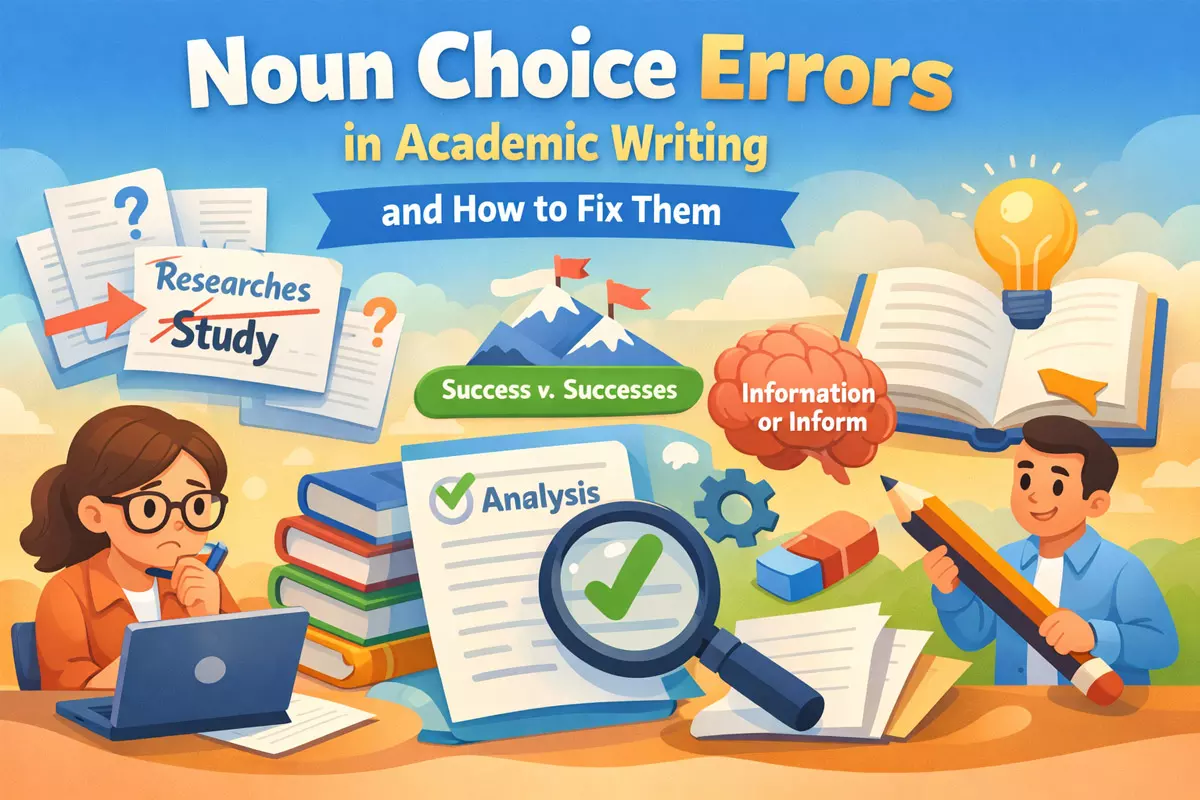 Here we the importance of precise noun choice in academic writing, common problems such as vague or overly general nouns, countable versus uncountable nouns, collocation errors, and offers strategies and practical editing exercises for better noun usage.
- Why noun choice matters in academic writing
- Vague vs precise noun selection problems
- Overuse of general abstract nouns in essays
- Confusion between countable and uncountable academic nouns
- Collocation errors with academic nouns
- Strategies for revising noun choice in drafts
- Practice: edit an academic paragraph for noun precision
Choosing appropriate nouns in academic writing can be challenging, sometimes resulting in unclear or awkward sentences. Being aware of and addressing these frequent issues is important because it helps improve both the clarity and professionalism of the text. Careful selection of naming words not only ensures precision but also makes arguments more persuasive and easier for readers to understand. By paying attention to the use of nouns, writers can communicate their ideas more effectively and avoid misunderstandings that may arise from vague or unsuitable word choices.
Why noun choice matters in academic writing
Selecting the right nouns is crucial for expressing ideas with precision and clarity in scholarly texts. The specific words chosen can affect not only the meaning but also the tone and formality of an argument. When writers use vague, generic, or incorrect nouns, their work can seem imprecise or even misleading, making it harder for readers to follow the intended message.
Impact on clarity and meaning
Academic writing often deals with complex concepts, so the nouns used must accurately reflect those ideas. Choosing an imprecise or ambiguous term can distort the intended meaning and confuse the audience. For example, using "thing" instead of "variable" in a scientific context results in lost specificity.
- “Thing” vs. “phenomenon”
- “Stuff” vs. “material”
- “People” vs. “participants” or “subjects”
- “Result” vs. “finding” or “outcome”
- “Area” vs. “field” or “discipline”
- “Change” vs. “modification” or “transformation”
- “Idea” vs. “hypothesis” or “theory”
- “Use” vs. “application”
- “Part” vs. “component”
- “Way” vs. “method” or “approach”
Formality and tone
Academic prose usually requires a formal tone. Informal or colloquial nouns can undermine credibility and distract from the seriousness of the discussion. For instance, using "kids" instead of "children" or "youths" in a research paper can make the writing appear less professional.
Examples: Precise vs. Vague Nouns

| Vague/Informal Noun | Precise/Formal Alternative | Example Sentence |
|---|---|---|
| Thing | Variable, factor, element | The main factor influenced student performance. |
| Stuff | Substance, material, data | The material used in the experiment was highly reactive. |
| Guy | Individual, participant, subject | Each participant completed a survey about motivation. |
| Kids | Children, adolescents, minors | The study examined how children learn new vocabulary. |
| Area | Field, domain, discipline | The research contributes to the field of psychology. |
| Change | Alteration, modification, transformation | The modification increased system accuracy. |
| Thing | Concept, phenomenon, entity | The phenomenon requires further investigation. |
| Part | Component, section, segment | This component controls the device’s temperature. |
| Result | Outcome, finding, conclusion | The outcome confirmed the hypothesis. |
| Way | Method, approach, procedure | The method improved data collection efficiency. |
In summary, careful selection of nouns sharpens arguments, supports nuanced reasoning, and demonstrates mastery of academic conventions. Overlooking this aspect can result in misinterpretation, reduced credibility, and weaker communication overall.
Vague vs precise noun selection problems
Precision in noun selection can greatly impact clarity and professionalism in academic writing. When writers choose nouns that are too broad or imprecise, readers may struggle to understand the intended meaning. On the other hand, overly specific nouns can sometimes distract or create unnecessary complexity. Striking the right balance ensures the message is both clear and appropriately detailed.
Common issues with imprecise noun use
Writers often fall into the habit of selecting general nouns out of convenience or uncertainty. This can make arguments less convincing and weaken analysis. For example, using "thing" instead of a more descriptive term leaves the reader guessing about the subject. Consider these typical vague nouns that frequently cause trouble:
- thing → This thing plays a crucial role in the system.
- stuff → The report avoids informal stuff and uses precise terminology.
- area → This area requires further research to confirm the findings.
- aspect → One important aspect of the study is data reliability.
- factor → Temperature is a major factor influencing reaction speed.
- issue → The main issue was the lack of reliable information.
- part → This part of the model focuses on energy efficiency.
- problem → The problem was caused by inaccurate measurements.
- way → The team found a new way to improve performance.
- result → The result confirmed the original hypothesis.
- element → Each element of the structure serves a unique purpose.
- type → This type of material is commonly used in construction.
- case → In this case, additional testing was necessary.
- field → The field of neuroscience is rapidly expanding.
- effect → The effect of light intensity was significant.
- method → This method increases accuracy in measurements.
- process → The process requires several steps to complete.
- point → One key point supports the conclusion strongly.
- item → Each item on the checklist must be verified.
- instance → In this instance, the model failed to predict outcomes.
Avoiding these generic words when a more exact noun is available can make writing more authoritative and easier to follow.
Why precision matters
Selecting the most accurate noun for each context helps prevent ambiguity. For instance, instead of saying "the thing that causes pollution," specifying "the emission of nitrogen oxides" provides the reader with concrete information. This level of detail is especially important in research, where readers expect specificity.
Comparing vague and precise noun choices
When deciding between a general and a specific noun, consider whether your reader will know exactly what you mean. The following comparison illustrates how vague nouns can be replaced with precise alternatives to enhance clarity:
| Vague Noun | Precise Alternative |
|---|---|
| thing | device, variable, phenomenon, mechanism |
| area | discipline, region, field, domain |
| problem | obstacle, challenge, complication, issue (if more specific) |
| aspect | feature, component, characteristic, dimension |
| way | method, approach, strategy, technique |
| type | category, class, form, variant |
| result | outcome, finding, consequence, effect |
| method | procedure, protocol, technique, process |
| effect | impact, influence, consequence, outcome |
| item | object, artifact, entry, component |
Tips for improving noun precision
- Ask yourself what exactly you mean: is there a more descriptive word?
- Use discipline-specific terminology when appropriate.
- Replace placeholders like "thing" or "stuff" with the actual object or concept.
- Check if your noun conveys quantity, quality, or function clearly.
- Edit sentences to clarify what each noun refers to, especially in complex arguments.
Choosing nouns thoughtfully transforms writing from vague to authoritative. In academic contexts, this skill not only clarifies your argument but also demonstrates your understanding of the subject matter.
Overuse of general abstract nouns in essays
Academic writing often relies heavily on abstract nouns such as “development,” “importance,” or “effectiveness.” While these words can be useful, excessive reliance on them can make essays vague and impersonal. Instead of clarifying ideas, too many broad nouns may obscure meaning and weaken arguments. Readers may struggle to identify the specific actions, agents, or contexts being discussed.
Why abstract nouns become a problem
Writers frequently choose abstract terms because they sound formal or academic. However, these nouns often lack concrete reference, which leads to sentences that feel empty or overly general. For example, “The implementation of solutions leads to improvement in outcomes” could be made clearer by specifying who is implementing what solutions and how.
Common examples of general abstract nouns
Some of the most overused abstract terms in essays include:
- Development → The development of new technology improved data accuracy.
- Importance → The importance of clear communication cannot be overstated.
- Effectiveness → The effectiveness of the method was proven through testing.
- Impact → The impact of climate change is becoming more evident each year.
- Change → A major change occurred in consumer behavior.
- Process → The process requires careful planning and timing.
- Result → The result confirmed the success of the intervention.
- Influence → Social media has a strong influence on public opinion.
- Issue → The main issue involved inconsistent data reporting.
- Situation → The situation improved after additional training.
- Progress → Significant progress was made during the first phase.
- Growth → The company saw rapid growth in the last decade.
- Advancement → Recent advancement in robotics increased automation.
- Factor → Time is a crucial factor in patient recovery.
- Condition → The condition of the samples affected the results.
- Solution → The new design offered a simple solution to the problem.
- Problem → The problem led to delays in production.
- Challenge → Adapting to new software can be a challenge.
- Success → The project was a success for the entire team.
- Failure → The failure highlighted weaknesses in the design.
How abstract nouns can weaken writing
Sentences overloaded with such nouns often lack clarity about who is doing what. Consider the difference:
- Vague: The improvement of communication led to better results.
- Clear: When team members communicated directly, their project outcomes improved.
The second example uses active voice and specifies agents, making the idea more vivid and precise.
Strategies to reduce overuse
To make writing more effective, try these approaches:
- Replace abstract nouns with more concrete or specific terms where possible.
- Use active verbs and identify agents (who is acting).
- Break up long noun phrases to clarify relationships.
- Balance generalization with concrete examples or details.
Abstract vs. Concrete: Example Comparison
| General Abstract Noun Usage | Revised, Concrete Version |
|---|---|
| The implementation of policies improved the situation. | City officials enforced new recycling rules, reducing litter in public parks. |
| The importance of education cannot be overstated. | Access to quality schools helps children gain essential skills for adulthood. |
| The problem was solved through collaboration. | Researchers and engineers worked together to design a safer bridge. |
| There was a significant impact on the community. | The new community center provided after-school programs for 200 local children. |
Key takeaways
Choosing more precise, concrete nouns and specifying agents or actions makes academic writing clearer and more engaging. By reducing the frequency of general abstract terms, writers can strengthen their arguments and connect more effectively with readers.
Confusion between countable and uncountable academic nouns
Grasping the difference between nouns that can be counted and those that cannot is a frequent challenge for academic writers, especially for those using English as an additional language. Mistakes often occur when writers use plural forms or articles incorrectly, which can lead to awkward or even unclear sentences in research papers, essays, and reports.
Common Mistakes in Academic Contexts

Writers frequently add "s" to words that are only used in singular form or attach "a/an" to nouns that are not countable. Conversely, they may forget to pluralize nouns that require it or omit needed determiners. These errors can undermine the professionalism of academic writing.
- Incorrect: The research provided many informations. ❌
- Correct: The research provided much information. ✅
- Incorrect: We collected several datas. ❌
- Correct: We collected several data points. ✅
- Incorrect: An advice was given. ❌
- Correct: Some advice was given. ✅
Typical Academic Nouns: Countable vs. Uncountable
Some scholarly terms are almost always uncountable, while others are typically countable. Knowing which is which helps writers avoid unnecessary errors.
| Usually Countable | Usually Uncountable |
|---|---|
| experiment | research |
| theory | evidence |
| result | information |
| method | progress |
| analysis (analyses) | equipment |
| hypothesis (hypotheses) | advice |
| factor | data (in modern usage, often uncountable) |
| approach | literature (as a body of work) |
| variable | knowledge |
| sample | feedback |
Tips to Avoid Mixing Up Forms
- Consult a reputable academic word list or dictionary to check countability.
- Remember, uncountable nouns don’t take “a/an” or plural endings.
- Use quantifiers like “some,” “much,” or “a piece of” for uncountable nouns.
- For countable nouns, use “a/an,” numbers, or “many.”
- Practice with real academic texts to see correct usage in context.
Accurate noun form selection is essential for clear, authoritative academic writing. Paying close attention to whether a term is countable or not will help avoid typical mistakes and improve overall readability.
Collocation errors with academic nouns
Choosing the right combination of nouns and their partner words is essential for clear academic writing. Many writers, especially non-native speakers, struggle with word pairings that sound unnatural or incorrect to experienced readers. These mismatches can make arguments harder to follow and weaken the professional impression of your work.
Common issues with noun word partners
Academic vocabulary often follows specific patterns, and some nouns consistently appear with particular verbs, adjectives, or prepositions. Using the wrong combination can result in awkward phrasing or even change the meaning of a sentence. For example, we say “make a decision” rather than “do a decision,” and “pose a question” instead of “ask a question” in formal contexts.
Frequent miscollocations with scholarly nouns
Below is a list of typical academic nouns with their appropriate collocates. Watch out for these combinations in your own writing:
- Conduct research (not “make research”) → The team conducted research to explore consumer behavior.
- Draw a conclusion (not “do a conclusion”) → They drew a conclusion based on the collected evidence.
- Provide evidence (not “give evidence” in formal writing) → The results provided evidence supporting the hypothesis.
- Reach an agreement (not “make agreement”) → Both sides reached an agreement after negotiations.
- Present an argument (not “show argument”) → She presented an argument to defend her viewpoint.
- Raise an issue (not “lift issue”) → The article raised an issue about data validity.
- Offer an explanation (not “give explanation”) → The authors offered an explanation for the unexpected results.
- Address a problem (not “answer problem”) → The new approach addressed a problem in the system.
- Make an observation (not “do observation”) → The researcher made an observation during the trial.
- Formulate a hypothesis (not “make hypothesis”) → They formulated a hypothesis to guide the study.
- Reach a consensus (not “do consensus”) → The committee reached a consensus after discussion.
- Pose a question (not “ask question” in academic writing) → The speaker posed a question to the audience.
- Advance a theory (not “move theory”) → The scientist advanced a theory about memory formation.
- Support a claim (not “prove claim” unless you have absolute proof) → The data supported a claim made earlier in the paper.
- Take a stance (not “make stance”) → The author took a stance on climate policy.
- Offer a perspective (not “give perspective” in formal texts) → The book offered a perspective on cultural identity.
- Reach a conclusion (not “get conclusion”) → The study reached a conclusion after months of testing.
- Present data (not “show data” in formal contexts) → The team presented data during the conference.
Typical noun collocation mistakes: Correct vs. Incorrect
| Incorrect Usage | Preferred Academic Usage |
|---|---|
| make a research | conduct research |
| do a conclusion | draw a conclusion |
| give an evidence | provide evidence |
| make a hypothesis | formulate a hypothesis |
| show an argument | present an argument |
| lift an issue | raise an issue |
| do a consensus | reach a consensus |
| move a theory | advance a theory |
How to fix noun collocation mistakes
Improving noun and verb combinations starts with exposure: read published academic articles and note how key terms are paired. Use learner dictionaries or academic phrasebooks to verify uncertain combinations. When editing, look for awkward or unfamiliar word pairings, and compare them with trusted sources. Over time, your writing will sound more natural and precise.
Strategies for revising noun choice in drafts
Carefully reviewing noun selection can significantly improve clarity and precision in academic writing. Often, first drafts contain vague, repetitive, or incorrect nouns that obscure meaning. Revising for optimal noun use involves both identifying problematic words and considering alternatives that better fit the context.
Common Issues to Watch For
Writers frequently encounter several pitfalls when using nouns in academic texts. These include:
- Overusing abstract nouns where concrete ones would clarify meaning
- Choosing general terms instead of specific, discipline-appropriate vocabulary
- Incorrect singular/plural forms
- Unnecessary repetition of the same noun
- Using non-count nouns incorrectly
- Confusing similar nouns (e.g., “effect” vs. “affect”)
- Inconsistent noun forms (e.g., switching between “analysis” and “analyses”)
Revision Techniques
Effective revision starts with a systematic approach. Consider these steps:
- Read aloud to catch awkward or unclear noun usage.
- Highlight all nouns in a paragraph to spot overuse or repetition.
- Ask “Which noun is most precise here?” and replace vague terms with discipline-specific vocabulary.
- Check for consistency in singular and plural forms throughout the section.
- Replace general nouns (e.g., “thing,” “area,” “aspect”) with more specific alternatives.
- Consult a glossary or subject dictionary for accurate technical terms.
Examples: Vague vs. Specific Nouns
Selecting the most suitable noun can transform a sentence. Below are examples of common general nouns and more precise alternatives commonly used in academic writing:
- thing → variable, factor, phenomenon, item
- area → field, discipline, domain, region
- aspect → feature, element, component, dimension
- problem → issue, challenge, limitation, obstacle
- people → participants, subjects, respondents, population
- result → outcome, finding, consequence, implication
- change → modification, adjustment, transition, shift
- effect → impact, influence, consequence, outcome
- method → approach, procedure, technique, strategy
- data → dataset, statistics, measurements, observations
- study → investigation, experiment, survey, analysis
- system → framework, network, structure, mechanism
- increase → growth, rise, expansion, escalation
- decrease → reduction, decline, drop, contraction
- support → evidence, justification, rationale, validation
- goal → objective, aim, target, purpose
- way → manner, method, process, route
- part → section, segment, component, portion
- group → cohort, category, class, subset
- use → application, utilization, deployment, implementation
Checklist for Reviewing Noun Use
Before finalizing a draft, use the following checklist to ensure nouns are accurate and effective:
- ✅ Are nouns specific and precise?
- ✅ Is there unnecessary repetition?
- ✅ Are singular/plural forms consistent and correct?
- ✅ Do terms match the conventions of your discipline?
- ✅ Have vague nouns been replaced with clearer alternatives?
- ✅ Are technical terms used accurately?
Quick Comparison: General vs. Specific Noun Choices
| General Noun | More Specific Alternative |
|---|---|
| thing | variable, phenomenon, item |
| area | field, domain, discipline |
| result | finding, outcome, implication |
| method | procedure, technique, approach |
| problem | issue, challenge, limitation |
By applying these revision strategies, writers can ensure their academic work is both clear and persuasive, leveraging the power of precise noun choice to convey complex ideas effectively.
Practice: edit an academic paragraph for noun precision
Editing for precise nouns sharpens academic writing, making arguments clearer and more professional. Many writers unintentionally use vague or generic nouns, which can weaken their claims or obscure their meaning. The following exercise will help you recognize and revise imprecise noun usage in a typical academic paragraph.
Task: Identify and Improve Imprecise Nouns
Read the paragraph below. Find all the nouns that are too general or unclear, and suggest more specific alternatives. Consider context—think about what exactly the writer is referring to and how to make it more concrete.
Original Paragraph:
The issue of technology in education has caused many problems for students and teachers. The use of things like computers can have effects on learning, both positive and negative. Some people believe that the increase in devices leads to distractions, while others think it provides opportunities for improvement. The situation shows the importance of making good decisions about the role of technology.
Step-by-Step Instructions
- Highlight every vague or general noun.
- Suggest a more precise noun or phrase for each.
- Rewrite the paragraph using your improved choices.
Common Vague Nouns to Watch For
- people → People responded positively to the new policy.
- situation → The situation changed after the intervention.
- decision → The decision affected future planning.
- change → A sudden change influenced the results.
- impact → The impact of training was substantial.
- matter → The matter requires further discussion.
- place → This place is known for innovation.
- relationship → A strong relationship exists between the variables.
- model → The model predicted outcomes accurately.
- concept → The concept provides a new approach to analysis.
- theory → The theory explains the observed behavior.
- context → The context of the study is crucial.
- evidence → The evidence supports the main argument.
- variable → Each variable was controlled during testing.
- trend → A rising trend was detected over time.
- pattern → The pattern emerged after visual analysis.
- resource → Additional resources increased productivity.
- topic → The topic generated broad academic interest.
- methodology → The methodology improved study reliability.
- framework → The framework guided the entire research process.
Before and After: Sample Revision Table
| Vague Noun in Original | More Precise Alternative |
|---|---|
| issue | integration |
| things like computers | digital devices such as laptops and tablets |
| problems | challenges |
| effects | outcomes |
| people | educators and policymakers |
| devices | mobile phones, tablets, and laptops |
| opportunities for improvement | opportunities for personalized learning |
| situation | debate |
| decisions | policies |
| role | function |
Rewrite Exercise
Now, use your improved noun choices to revise the paragraph for clarity and specificity.
Show answers
- Revised Paragraph:
The integration of technology in education has created several challenges for students and teachers. The use of digital devices such as laptops and tablets can have varied outcomes on learning, both positive and negative. Some educators and policymakers believe that the increase in mobile phones and other devices leads to distractions, while others argue it provides opportunities for personalized learning. This debate highlights the importance of making informed policies regarding the function of technology in classrooms. - Identified vague nouns and suggested replacements:
- issue → integration
- problems → challenges
- things like computers → digital devices such as laptops and tablets
- effects → outcomes
- people → educators and policymakers
- devices → mobile phones and other devices
- opportunities for improvement → opportunities for personalized learning
- situation → debate
- decisions → policies
- role → function
Practicing with real examples helps develop an eye for specificity. The more you revise for precise noun choice, the more persuasive and credible your academic writing becomes.