Prepositions in TOEFL Integrated Tasks: Usage, Examples and Tips

 Here we effective preposition use in TOEFL Integrated writing, including strategies for connecting ideas, expressing contrast, using reporting verbs, paraphrasing, templates, source attribution, error correction, scoring, and timed practice.
- The mechanics of synthesis: Prepositions for connecting reading and listening points
- Contrast and Concession: Mastering 'in contrast to', 'conversely', and 'on the contrary'
- Reporting verbs with fixed prepositions: 'The lecturer disagrees with', 'The author provides evidence for'
- Paraphrasing accurately: Changing parts of speech while maintaining prepositional logic
- Template mastery: High-scoring prepositional phrases for introduction and transitions
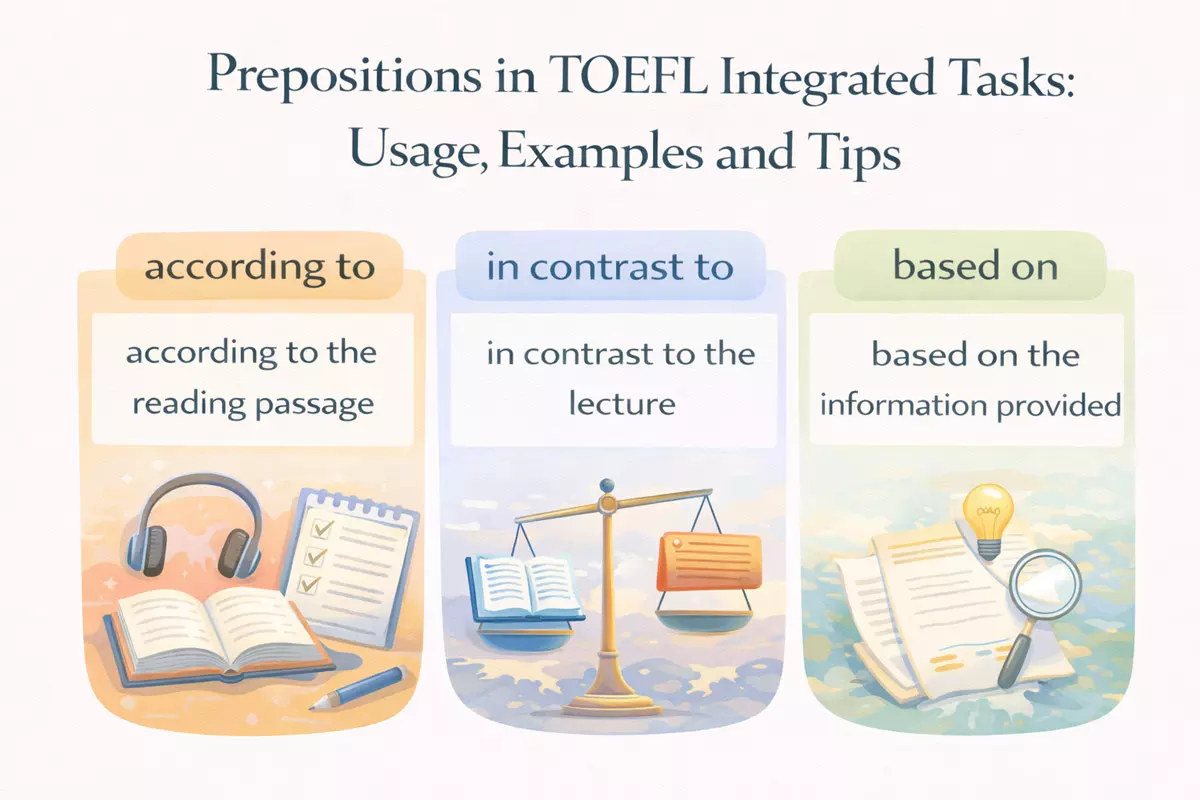
- Data and source attribution: Using 'according to', 'based on', and 'as stated in'
- Avoiding 'transfer errors': Fixing common mistakes during rapid note-taking to writing
- Scoring rubric alignment: How prepositional variety affects the Lexical Resource score
- Timed Practice: Integrated writing simulation with a focus on prepositional accuracy
Mastering the use of linking words significantly improves your TOEFL performance, particularly during integrated tasks where clear and accurate communication is essential. By effectively connecting your ideas with appropriate transitions, your responses become more organized and coherent, allowing your thoughts to flow smoothly. This not only enhances the clarity of your answers but also helps you sound more natural and confident, which can positively impact your overall score on the test.
The mechanics of synthesis: Prepositions for connecting reading and listening points
Understanding how to link ideas from the reading passage and the listening excerpt is a core skill for integrated TOEFL tasks. Prepositions play a major role in showing relationships between information from both sources. By using precise prepositions, you can clearly express comparisons, contrasts, and causes, as well as transitions between the two texts.
Common Prepositions for Integration
Certain prepositions are especially useful when you need to synthesize content. They help signal how information relates and allow your answer to flow logically. Here are some of the most frequently used prepositions for connecting points from reading and listening passages:
- According to – to attribute ideas or facts to a source
- In contrast to – to highlight differences
- Unlike – to show a clear distinction
- As opposed to – to present an alternative or opposing view
- In addition to – to add supporting details
- Because of – to explain reasons or causes
- Due to – another way to express causality
- Whereas – to introduce a contrast within one sentence
- While – to compare simultaneous or opposing situations
- Despite – to show something happens regardless of a condition
- Instead of – to show preference or substitution
- Unlike – to compare differences directly
- Following – to indicate sequence or consequence
- After – for chronological order
- Before – to show a previous event or point
- Between – to compare two items or ideas
- Among – when discussing more than two sources or points
- With – to connect accompanying information
- Without – to signal absence
- Through – to show method or process
Patterns for Connecting Reading and Listening
To craft clear, concise responses, it’s helpful to use patterns that combine prepositions and structure. Here are some templates you might use:
- According to the reading, ..., whereas the lecture states ...
- The reading claims ..., but in contrast, the speaker argues ...
- While the passage suggests ..., the listening passage provides ...
- Due to ..., the lecturer believes ...
- In addition to ..., the professor mentions ...
- Despite the reading’s point that ..., the lecture maintains ...
- Instead of ..., the speaker proposes ...
- Following the information in the passage, ...
Comparing Prepositions in Context

The right preposition can subtly change meaning. See how these prepositions shift focus depending on usage:
| Preposition | Example in TOEFL Integrated Task |
|---|---|
| According to | According to the reading, deforestation is the main cause of habitat loss. |
| In contrast to | In contrast to the reading, the lecturer suggests climate change is a bigger factor. |
| Because of | The lecturer disagrees with the passage because of new research findings. |
| Despite | Despite the reading’s claim, the speaker provides evidence to the contrary. |
| Whereas | The reading focuses on economic benefits, whereas the lecture discusses environmental costs. |
Tips for Effective Use
- Choose prepositions based on the relationship you want to show, such as contrast, addition, cause, or sequence.
- Avoid overusing one preposition, as variety improves clarity and flow.
- Double-check that the preposition accurately matches the meaning you intend.
- Practice paraphrasing ideas from both sources using different prepositions to increase flexibility.
- Mastering which prepositions to use and how to use them will make your integrated writing and speaking responses clearer and more convincing.
- With consistent practice, you will connect ideas smoothly and demonstrate strong synthesis skills.
Contrast and Concession: Mastering 'in contrast to', 'conversely', and 'on the contrary'
Understanding how to show differences and opposites is essential for clarity, especially in TOEFL integrated writing and speaking. Expressions like in contrast to, conversely, and on the contrary help you highlight distinctions between ideas, which is often required when summarizing reading and lecture points or comparing perspectives.
When and How to Use These Expressions
Use contrastive linkers to make opposing information stand out. Each has a slightly different usage:
- In contrast to: Used to directly compare two things, often at the start of a sentence. The phrase is followed by a noun or noun phrase.
- Conversely: Introduces an opposite situation; it usually connects two sentences and is less direct than "in contrast to."
- On the contrary: Used to refute or correct a previous statement, showing the complete opposite is true.
Examples in TOEFL Context
Notice how these expressions clarify relationships between ideas:
- In contrast to the reading, which claims that coal is a clean energy source, the lecture argues it causes significant pollution.
- The reading suggests the policy is effective. Conversely, the professor believes it fails to address the main issue.
- Some might think animals cannot learn language. On the contrary, the lecture provides evidence that certain primates can communicate using symbols.
Common Patterns and Vocabulary for Contrast and Concession
Here are some useful phrases and patterns to enrich your writing and speaking:
- Unlike the reading, the lecture argues that the theory lacks practical evidence.
- However, the speaker challenges this conclusion with recent research findings.
- Nevertheless, the overall argument remains unconvincing due to limited data.
- Whereas the passage focuses on economic factors, the lecture emphasizes social influences.
- While the passage argues that the method is reliable, the speaker questions its accuracy.
- In opposition to the reading, the lecturer presents an alternative explanation.
- Despite the claim, no concrete evidence is provided to support the argument.
- Although the theory appears logical, it fails to explain several key outcomes.
- On the other hand, the lecture offers a more practical interpretation of the results.
- Yet the data presented does not fully support this position.
- Contrary to the statement, recent studies suggest a different conclusion.
- Instead, the speaker proposes a revised model based on new findings.
- In spite of the initial assumptions, the experiment produced unexpected results.
- But this explanation does not address the core issue.
- Even so, the argument remains influential in academic discussions.
- Still, several questions remain unanswered.
- Nonetheless, the lecture successfully refutes the main point of the reading.
- Rather than supporting the original claim, the evidence points to an alternative conclusion.
Quick Comparison of Usage
| Expression | Typical Use in TOEFL Tasks | Example |
|---|---|---|
| In contrast to | Comparing two ideas, facts, or sources directly | In contrast to the lecture, the reading supports nuclear power. |
| Conversely | Presenting an opposite result or situation | The reading claims funding is sufficient. Conversely, the professor says it is inadequate. |
| On the contrary | Correcting or strongly opposing a previous point | Some believe the law is unpopular. On the contrary, surveys show wide support. |
Tips for Effective Use
- Choose the phrase that best fits the relationship you want to express.
- Vary your connectors—don’t rely on just one.
- Practice by rewriting sample TOEFL answers, swapping in different contrast expressions.
- Check that your sentence structure matches the connector (e.g., "in contrast to" + noun, "conversely" at the sentence start).
Mastering these prepositions and connectors helps you clearly organize opposing points, which is critical for high-level TOEFL responses.
Reporting verbs with fixed prepositions: 'The lecturer disagrees with', 'The author provides evidence for'
In TOEFL Integrated tasks, students frequently summarize contrasting or supporting viewpoints from reading and listening passages. Many academic verbs—like “disagree,” “argue,” or “provide”—require specific prepositions to connect smoothly with their objects. Using these verb-preposition combinations correctly is essential for clarity and accuracy in your responses.
Common reporting verbs and their fixed prepositions
Some verbs nearly always pair with the same preposition. These patterns are not optional; they are set phrases in academic English. Mastering them helps you avoid awkward or incorrect sentences.
- agree with (The professor agrees with the author.)
- disagree with (The lecturer disagrees with the reading.)
- argue for (The author argues for stricter regulations.)
- argue against (The speaker argues against the proposed solution.)
- provide evidence for (The author provides evidence for this claim.)
- refer to (The passage refers to recent studies.)
- object to (The lecturer objects to the plan.)
- respond to (The professor responds to the criticism.)
- comment on (The speaker comments on the issue.)
- focus on (The reading focuses on environmental impacts.)
- insist on (The author insists on the importance of research.)
- base on (The argument is based on recent data.)
- result in (The policy resulted in improvements.)
- lead to (This change leads to confusion.)
- believe in (The speaker believes in the benefits of teamwork.)
- depend on (The outcome depends on several factors.)
- criticize for (The lecturer criticizes the author for ignoring evidence.)
- support with (The writer supports his view with statistics.)
Typical mistakes and how to avoid them
Learners often omit the preposition or choose the wrong one. For example, “The lecturer disagrees the author” is incorrect; you must use “with.” Similarly, “provides evidence to” is not standard; “for” is required.
Quick reference: Reporting verbs and their prepositions
| Verb | Preposition | Example |
|---|---|---|
| disagree | with | The lecturer disagrees with the author. |
| provide evidence | for | The author provides evidence for his theory. |
| argue | against / for | The speaker argues against the plan. |
| object | to | The lecturer objects to the proposal. |
| refer | to | The text refers to earlier research. |
| respond | to | The professor responds to the criticism. |
| support | with | The author supports his idea with examples. |
| criticize | for | The lecturer criticizes the author for being vague. |
Tips for TOEFL Integrated writing and speaking tasks
Use these verb-preposition pairs to clearly show relationships between sources. Practice with varied reporting verbs, and double-check your sentences for missing or incorrect prepositions. This attention to detail will make your summaries more precise and academic.
Paraphrasing accurately: Changing parts of speech while maintaining prepositional logic
Understanding how to rephrase sentences by shifting parts of speech—while keeping prepositional meaning intact—is a useful skill for TOEFL Integrated Tasks. This approach lets you show flexibility with language, especially when you need to avoid repetition or express ideas more naturally in your own words.
Why change parts of speech?
Switching between nouns, verbs, adjectives, and adverbs lets you reformulate information from reading or listening passages. However, it’s essential to preserve the logical relationship conveyed by prepositions. For example, a noun phrase with a preposition (“the effect of pollution”) can often be restated as a verb with a prepositional phrase (“pollution affects…”), but you must ensure the preposition still fits.
Examples: Transforming parts of speech with prepositions
It’s common to see the same idea expressed in multiple grammatical forms. Here are several ways you might encounter or use such patterns in TOEFL tasks:
- Interest in art → People are interested in art
- Responsibility for the project → She is responsible for the project
- Advantage of exercise → Exercise is advantageous for health
- Effect on the environment → This affects the environment
- Participation in the event → They participated in the event
- Dependence on technology → They depend on technology
- Contribution to science → They contributed to science
- Preparation for exams → They prepared for exams
- Belief in progress → They believe in progress
- Increase in temperature → The temperature increased
- Solution to the problem → They solved the problem
- Influence on society → It influences society
- Awareness of risks → They are aware of the risks
- Difficulty in understanding → It is difficult to understand
- Access to information → They have access to information
- Preference for tea → They prefer tea
- Reaction to changes → They reacted to changes
- Transition from childhood to adulthood → Children transition to adulthood
Common pitfalls to avoid
When reformulating, don’t drop or substitute prepositions carelessly. Each preposition expresses a specific logical connection. For instance, “effect on” cannot become “effect for” without changing the meaning. Always double-check that your new sentence preserves the original relationship.
Comparison: Noun vs. Verb Structures with Prepositions
| Nominal Structure | Verbal Structure |
|---|---|
| the impact of tourism on wildlife | tourism impacts wildlife |
| concern about climate change | people are concerned about climate change |
| discussion about solutions | people discuss solutions |
| support for the new policy | many support the new policy |
| opposition to the proposal | they oppose the proposal |
Tips for maintaining prepositional logic
- Identify the core relationship the preposition expresses (e.g., cause, effect, possession).
- When converting a noun phrase to a verb or adjective, keep the preposition if the logical connection remains.
- Consult lists of verb-preposition or adjective-preposition collocations if unsure.
- Practice paraphrasing sentences from reading/listening sources, focusing on keeping the preposition’s meaning.
By mastering these transformations, you’ll improve both your paraphrasing and your overall coherence in TOEFL Integrated responses.
Template mastery: High-scoring prepositional phrases for introduction and transitions
Effective use of prepositional phrases can instantly raise the quality of your TOEFL Integrated Task responses. These phrases not only add clarity and sophistication, but also help to smoothly connect ideas and structure your answer logically. Mastering a range of introductory and transitional expressions is essential for demonstrating academic writing skills and impressing examiners.
Useful prepositional phrases for introductions

Starting your response with a well-chosen prepositional phrase provides context and sets a formal tone. Here are several options, each adaptable to various prompts:
- In the reading passage, the author discusses the long-term impact of technological innovation on social behavior.
- According to the lecture, it is suggested that the proposed theory lacks sufficient empirical support.
- In contrast to the text, the speaker claims that the historical evidence has been misinterpreted.
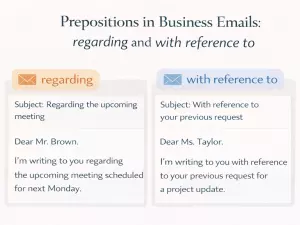
- With regard to the topic, both sources present differing views on the effectiveness of the policy.
- In response to the question, the lecturer provides evidence that challenges the main argument of the reading.
- From the author’s perspective, the main point is that economic factors play a decisive role in the outcome.
- In summary, the passage outlines the key reasons for the decline in public trust.
- In the context of the discussion, the reading and lecture disagree on the interpretation of the data.
- With reference to the information provided, it becomes clear that further research is required.
- On the basis of the lecture, it can be inferred that the original hypothesis is no longer valid.
Transition prepositional phrases for connecting ideas
Transitions help you move smoothly between points, making your writing easier to follow. Using prepositional phrases in these moments signals relationships between ideas.
- In addition to this, the lecturer mentions several practical limitations of the approach.
- In contrast, the passage states that the method has been successfully applied in similar cases.
- In light of the evidence, it is clear that the conclusion requires revision.
- With respect to this point, both sources agree on the underlying assumptions.
- In support of this argument, the speaker provides multiple real-world examples.
- In opposition to the reading, the lecturer argues that the results are context-dependent.
- As a result of the information, we can conclude that the original claim is overstated.
- In comparison with the lecture, the reading offers a more theoretical explanation.
- By contrast, the passage highlights the practical implications of the issue.
- In summary, these points demonstrate a clear divergence between the two sources.
Comparing prepositional phrase usage: Introduction vs. Transition
| Introductory Phrase | Transitional Phrase |
|---|---|
| In the reading passage, | In contrast, |
| With regard to the topic, | In addition to this, |
| According to the lecture, | In light of the evidence, |
| From the author’s perspective, | As a result of the information, |
Tips for using prepositional phrases effectively
- Vary your prepositional phrases throughout your response to avoid repetition.
- Choose phrases that match the logical relationship you want to express (contrast, addition, result, etc.).
- Be concise—avoid overly long phrases that may confuse your main point.
- Practice combining prepositional phrases with other linking devices for a more natural flow.
Incorporating a diverse set of prepositional phrases at key points in your TOEFL Integrated Task response can greatly improve coherence and readability. With regular practice, these patterns will become a natural part of your academic writing toolkit.
Data and source attribution: Using 'according to', 'based on', and 'as stated in'
Attributing information to a source is a common requirement in TOEFL Integrated Writing and Speaking tasks. This involves signaling where your information comes from, which helps demonstrate your ability to synthesize details from lectures and readings. Three of the most useful prepositional phrases for this are “according to,” “based on,” and “as stated in.” Each has its own nuance and preferred usage.
How to Use 'According to'
“According to” is used to reference the origin of information, often when summarizing or paraphrasing. It is neutral in tone and does not imply agreement or disagreement.
- According to the reading, the main cause of the decline was pollution.
- According to the professor, the hypothesis lacks sufficient evidence.
- According to recent research, students benefit from group work.
Applying 'Based on'
“Based on” highlights the foundation or source of a conclusion, argument, or action. It often introduces the reasoning or evidence behind a statement.
- Based on the lecture, the new policy should reduce costs.
- Based on the data presented, the results are inconclusive.
- Based on the reading, several factors influence migration patterns.
Using 'As stated in'
“As stated in” is slightly more formal and points directly to something explicitly mentioned in the source. It is useful when you want to highlight a specific claim or quote.
- As stated in the passage, the invention had a significant impact on society.
- As stated in the lecture, climate change is accelerating at an unprecedented rate.
- As stated in the article, only 10% of participants completed the survey.
Comparing Usage of Attribution Phrases
| Phrase | Usage Example | Function | Formality |
|---|---|---|---|
| According to | According to the reading, urbanization increased rapidly. | Reporting information or opinions from a source | Neutral |
| Based on | Based on the lecture, the solution is not effective. | Presenting conclusions or reasoning from evidence | Neutral |
| As stated in | As stated in the article, the experiment failed to prove the theory. | Quoting or referencing a specific statement | More formal |
Tips for TOEFL Integrated Tasks
- Vary your attribution phrases to avoid repetition and show language range.
- Use “according to” for general summaries, “as stated in” for direct references, and “based on” for conclusions or reasoning.
- Check that your attribution matches the source (reading, lecture, etc.).
- Keep your sentences clear; don’t overload with multiple attributions.
- Practice transforming notes into sentences using these prepositions.
Mastering these attribution prepositions not only clarifies the source of your information but also demonstrates your ability to integrate and synthesize material effectively—an essential skill for high TOEFL scores.
Avoiding 'transfer errors': Fixing common mistakes during rapid note-taking to writing
When moving from fast note-taking to writing your TOEFL integrated response, it’s easy to make small mistakes, especially with prepositions. These "transfer errors" often happen when students jot down phrases in shorthand or skip prepositions to save time, then forget to add them back in during writing. Being aware of these pitfalls and knowing how to address them can make your answers clearer and more accurate.
Common Preposition Mistakes During Transfer
Many errors stem from habits formed under time pressure. Here are typical issues:
- Omitting necessary prepositions: E.g., writing "depend result" instead of "depend on the result."
- Using incorrect prepositions: Confusing "in" and "on" (e.g., "in the article" vs. "on the article").
- Direct translation from your native language: Some languages use different prepositions or none at all.
- Misplacing prepositional phrases: Placing "according to the lecture" in the wrong part of the sentence.
- Forgetting fixed expressions: Missing "at risk of," "in contrast to," or "responsible for."
Strategies to Reduce Preposition Errors
- Review common prepositional collocations before the exam (see list below).
- Develop shorthand symbols for prepositions during note-taking (e.g., ↑ for "on," → for "to").
- Leave space in notes to add missing words during review.
- After drafting, read each sentence and check for missing or awkward prepositions.
- Practice rewriting notes into full sentences before the test.
Useful Prepositional Patterns (TOEFL-Style)
- agree with → Most experts agree with this conclusion.
- according to → According to the report, sales increased last year.
- be responsible for → She is responsible for managing the project.
- result in → Poor planning can result in serious delays.
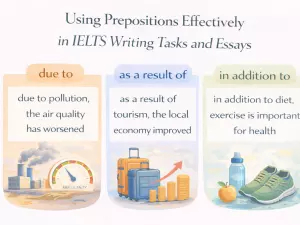
- as a result of → The event was canceled as a result of bad weather.
- contrast with → His opinion contrasts with the official statement.
- focus on → The lecture focuses on climate change.
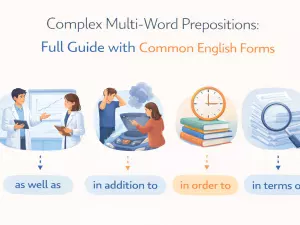
- in addition to → In addition to cost, quality must be considered.
- be based on → The theory is based on recent research.
- be related to → This issue is closely related to public safety.
- be similar to → This model is similar to the previous version.
- difference between → There is a clear difference between theory and practice.
- lead to → This decision may lead to further complications.
- opposed to → Many residents are opposed to the proposal.
- be involved in → She is involved in several research projects.
- be composed of → The committee is composed of five members.
- participate in → Students are encouraged to participate in discussions.
- at risk of → The species is at risk of extinction.
- in contrast to → In contrast to the reading, the lecture presents new data.
- in favor of → The majority voted in favor of the plan.
Checklist for Reviewing Your Writing
Before submitting your integrated task, quickly ask yourself:
- Did I restore any missing prepositions from my notes?
- Are all prepositional phrases in the correct place in the sentence?
- Have I checked for fixed expressions that require a specific preposition?
- Do my sentences sound natural when I read them aloud?
Paying attention to prepositions during the transition from notes to writing helps prevent common errors and improves the clarity of your TOEFL response. The more you practice converting shorthand notes into complete, accurate sentences, the more confident and precise your writing will become.
Scoring rubric alignment: How prepositional variety affects the Lexical Resource score
A wide range of prepositions in TOEFL Integrated Writing and Speaking tasks can signal a strong command of English vocabulary. The official scoring criteria for Lexical Resource emphasize not only accuracy but also flexibility and diversity in word choice, including prepositional usage. Examiners look for candidates who use prepositions appropriately and avoid over-reliance on basic forms like “in,” “on,” or “at.”
Why prepositional variety matters
Using different prepositions demonstrates that you understand subtle differences in meaning and can express complex relationships. For example, “concern about,” “interest in,” and “responsible for” are not interchangeable. Examiners reward those who select prepositions precisely and vary their use, as this reflects a broader vocabulary and deeper understanding of English.
Common pitfalls and how to avoid them
Many test-takers repeat simple prepositions or make errors with phrase patterns. This affects the perception of range and accuracy. To avoid these issues:
- Learn which prepositions naturally follow key verbs, adjectives, and nouns.
- Practice paraphrasing sentences to use different prepositional phrases.
- Be aware of common collocations and idiomatic expressions.
Examples of varied prepositional phrases
Expanding your range involves more than just switching out “in” for “on.” Here are some useful patterns to incorporate:
- in addition to → In addition to the written report, a presentation was required.
- with respect to → With respect to your request, further approval is needed.
- in terms of → The proposal is strong in terms of cost efficiency.
- by means of → The data was collected by means of online surveys.
- as opposed to → The study focuses on long-term outcomes as opposed to short-term results.
- in light of → In light of recent findings, the policy will be revised.
- in favor of → The committee voted in favor of the new regulations.
- on behalf of → She spoke on behalf of the entire research team.
- for the sake of → For the sake of clarity, the procedure was simplified.
- in charge of → He is in charge of coordinating the project.
- regardless of → The rule applies regardless of previous experience.
- in accordance with → The report was prepared in accordance with official guidelines.
- at risk of → Coastal areas are at risk of flooding.
- in response to → In response to public concern, changes were implemented.
- in line with → The results are in line with earlier studies.
- with regard to → With regard to the schedule, minor adjustments are required.
- apart from → Apart from minor errors, the analysis is accurate.
- contrary to → Contrary to expectations, the outcome was positive.
- due to → The delay was due to technical issues.
- according to → According to the author, further research is necessary.
How prepositional variety influences scoring
Using a mix of accurate and sophisticated prepositional phrases can elevate your Lexical Resource score, especially if you avoid repetition and demonstrate flexibility. Conversely, frequent mistakes or limited variety can restrict your mark, as it suggests a narrower vocabulary range.
| Prepositional Variety | Impact on Lexical Resource Score |
|---|---|
| High: Wide range & accurate usage | Strong impression of vocabulary range; likely to score at the top of the Lexical Resource band. |
| Moderate: Some variety, minor errors | Generally positive, but may not stand out; small errors may slightly lower the score. |
| Low: Repetitive or incorrect prepositions | Noticeably reduces perceived language control; can significantly limit the Lexical Resource score. |
| Minimal: Basic, limited prepositions | Suggests restricted vocabulary; unlikely to achieve a high score for Lexical Resource. |
Tips for boosting your Lexical Resource band
To perform well, aim to:
- Review common TOEFL topics and collect prepositional phrases relevant to each.
- Practice rewriting sentences using alternative prepositions.
- Check your writing for repeated structures and replace with less common options where appropriate.
- Read high-scoring sample responses and note their use of varied prepositional patterns.
In summary, mastering a diverse set of prepositional phrases not only helps you convey meaning precisely but also aligns closely with the expectations of the TOEFL scoring rubrics for Lexical Resource.
Timed Practice: Integrated writing simulation with a focus on prepositional accuracy
Practicing prepositions under time pressure is an effective way to prepare for TOEFL Integrated Writing tasks. In this simulation, you’ll read a short passage, listen to a related lecture summary, and then write a brief response—making sure to pay close attention to your use of prepositions throughout.
Step 1: Read the Short Passage
Carefully review the following passage. Try to notice the use of prepositions in context.
“Many universities have begun to implement recycling programs on campus. According to a recent study, recycling bins placed near student housing increased participation by 25%. However, some critics argue that these programs are not effective in reducing overall waste.”
Step 2: Listen to the Lecture Summary
- The professor discusses the results of similar recycling initiatives in other institutions.
- She mentions that, in addition to placing bins in convenient locations, educational campaigns about proper sorting are important.
- She concludes that programs are most successful when students are informed about why recycling matters.
Step 3: Writing Task (10 minutes)
Write a short response (about 100–120 words) summarizing the main points from both the passage and the lecture. Focus on expressing relationships and contrasts clearly using accurate prepositions. Set a timer for 10 minutes to simulate real test conditions.
Quick Preposition Check: Spot the Error
Identify the incorrect preposition in each sentence and suggest the correct one:
- Students participated on the recycling program enthusiastically.
- The bins were placed at the entrance the dormitory.
- The professor talked for the benefits of recycling.
- Recycling programs have increased for 20%.
- Many students are interested on environmental issues.
- The campaign focused in reducing plastic waste.
- The results are consistent to previous research.
- They were responsible of organizing the event.
- In addition of the lecture, there was a short workshop.
- The study was based in a large set of survey data.
Show answers
- on → in the recycling program
- at → at the entrance of the dormitory
- for → about the benefits
- for → by 20%
- on → in environmental issues
- in → on reducing plastic waste
- to → with previous research
- of → for organizing the event
- of → to the lecture
- in → on a large set of survey data
Prepositional Usage Table: Common Mistakes vs. Correct Forms
| Mistake | Correct Form |
|---|---|
| depend in something | depend on something |
| discuss about a topic | discuss a topic |
| similar with something | similar to something |
| responsible for do something | responsible for doing something |
| increase of 10% | increase by 10% |
Tips for Improving Prepositional Accuracy Under Time Pressure
- Read sample responses and highlight prepositions in context.
- Practice rewriting sentences by changing the prepositions to see how meaning shifts.
- Keep a personal list of tricky prepositional phrases and review it regularly.
- When editing, check each preposition: Is it the best choice for this idea?
- Familiarize yourself with common TOEFL task patterns that require specific prepositions (e.g., “agree with,” “result in”).