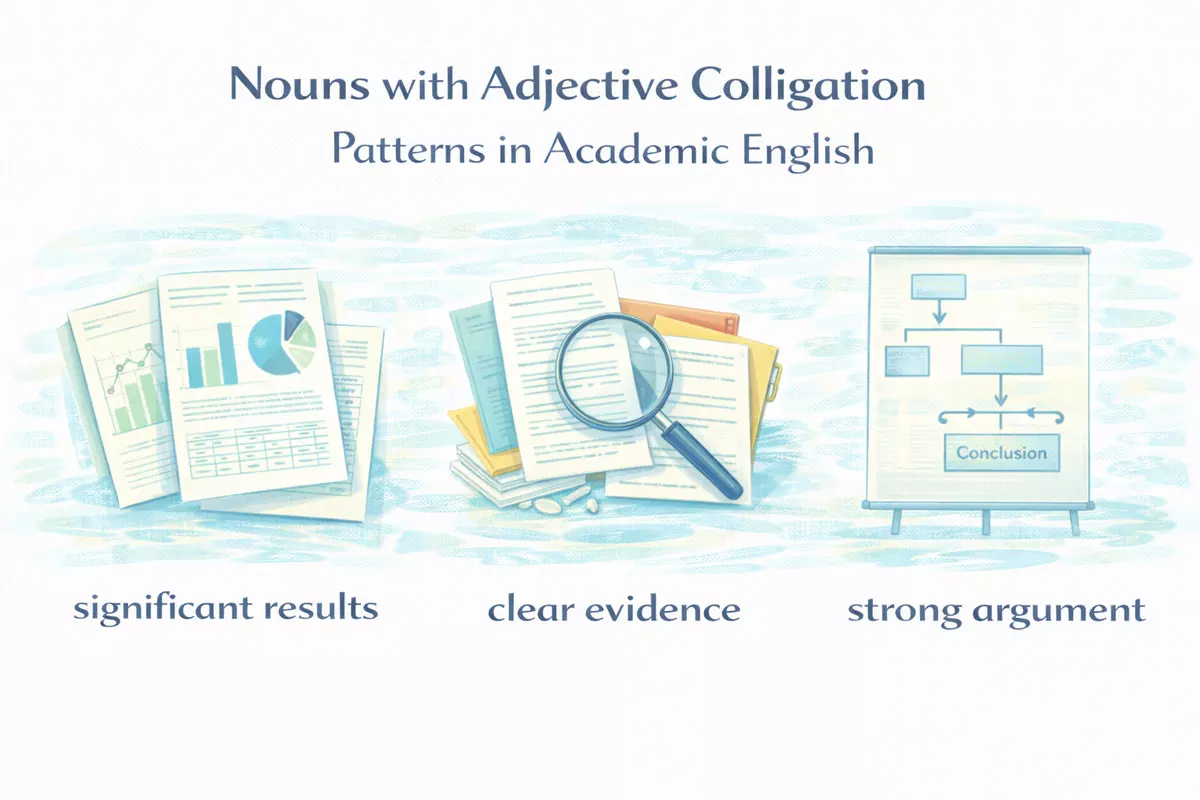
Nouns with Adjective Colligation Patterns in Academic English

 The article explains what adjective–noun colligation means in academic English, outlines common and discipline-specific patterns, explores meaning shifts, warns about translation errors, and provides learning strategies and practice matching adjectives with academic…
- What adjective–noun colligation means in academic English
- High-frequency academic adjective–noun patterns
- Meaning shifts based on adjective choice
- Discipline-specific adjective–noun pairings
- Errors caused by literal translation of collocations
- Learning strategies for academic noun collocations
- Practice: match adjectives with correct academic nouns
Understanding how descriptive words connect with naming words is essential for mastering scholarly writing, as these combinations form the backbone of clear academic expression. This article examines typical patterns in which adjectives and nouns interact in academic English, highlighting common structures and offering practical examples. By recognizing and applying these patterns, writers can improve the clarity, precision, and overall effectiveness of their scholarly communication, making their arguments more compelling and accessible to readers.
What adjective–noun colligation means in academic English
In academic contexts, the term "adjective–noun colligation" refers to the recurring and somewhat predictable ways adjectives combine with nouns. These combinations are not random; rather, they reflect patterns that are typical in scholarly communication. Understanding these patterns helps writers produce more natural, precise, and credible academic texts.
Defining Colligation in Grammar
Colligation is a grammatical concept that describes how certain word classes, like adjectives, tend to co-occur with specific grammatical structures or other word classes, such as nouns. In academic English, this often means recognizing which adjectives are commonly paired with which types of nouns to convey nuanced or formal meanings.
Why Adjective–Noun Linking Matters
Mastering these adjective–noun pairings is crucial for several reasons:
- It allows for clearer, more concise expression of complex ideas.
- Native-like usage of these patterns enhances the credibility of academic writing.
- It reduces ambiguity by matching adjectives to nouns in ways that are expected by academic readers.
- Writers can avoid awkward or unidiomatic combinations that may undermine their arguments.
Common Colligation Patterns in Academic English

Some adjective–noun pairings are especially frequent in scholarly texts. Here are examples of typical patterns:
- significant difference → There was a significant difference between the two test groups.
- theoretical framework → The study is based on a solid theoretical framework.
- statistical analysis → The statistical analysis confirmed the accuracy of the results.
- empirical evidence → We need more empirical evidence to support this claim.
- substantial contribution → Her research made a substantial contribution to the field of psychology.
- potential risk → The report highlights a potential risk to public health.
- primary source → We used an old diary as a primary source for our project.
- relevant data → Only relevant data was included in the final report.
- academic discipline → Linguistics is an academic discipline that studies language.
- methodological issue → The researchers discovered a methodological issue during the review.
- critical review → She wrote a critical review of the book for a journal.
- practical implication → This experiment has practical implication for everyday medicine.
- ethical consideration → Ethical consideration must be taken when working with animals.
- quantitative approach → The team used a quantitative approach to measure performance.
- key factor → Cost was the key factor in their final decision.
- global perspective → We need a global perspective to understand climate change fully.
- distinct category → These objects fall into a distinct category of artifacts.
- central theme → Freedom is the central theme of the novel.
- limited scope → The research had a limited scope due to time restrictions.
- complex system → The human brain is a highly complex system.
How Colligation Differs from Collocation
While both terms refer to word partnerships, colligation is about grammatical patterns (such as adjective + noun), whereas collocation involves specific word pairings (like "strong argument"). Colligation thus focuses on the structural relationship, while collocation is about habitual lexical combinations.
Benefits for Academic Writers
Developing an awareness of adjective–noun colligation patterns enables academic writers to:
- Produce more idiomatic and accepted formulations.
- Tailor their writing to disciplinary conventions.
- Strengthen arguments by using well-established language patterns.
Achieving proficiency with these patterns is a step toward writing that is both precise and authoritative in academic settings.
High-frequency academic adjective–noun patterns
Academic writing is characterized by particular combinations of adjectives and nouns that recur across genres and disciplines. These pairings help convey precision, stance, and subtle evaluation, supporting clear argumentation and nuance. Recognizing and mastering these lexical bundles can improve both comprehension and production of scholarly texts.
Commonly Occurring Combinations
Certain adjective–noun pairings appear repeatedly in research articles, textbooks, and academic reports. These collocations often encapsulate complex ideas efficiently. Here are some of the most frequent and useful examples:
- notable variation → There was a notable variation in student test results across regions.
- recent study → A recent study suggests a link between sleep and memory strength.
- main factor → Motivation was the main factor behind the team's success.
- previous research → Previous research supports the idea that diet affects mood.
- potential impact → The potential impact of climate change is enormous.
- key issue → Funding remains the key issue for the project.
- global context → The topic must be understood in a global context.
- conceptual framework → The theory fits into a broader conceptual framework.
- data analysis → Data analysis revealed several hidden patterns.
- practical application → The invention has strong practical application in medicine.
- major challenge → Finding enough participants was a major challenge.
- negative effect → Smoking has a negative effect on the heart and lungs.
- positive outcome → Their combined effort led to a positive outcome.
- original source → We checked the original source to verify the information.
- supporting data → The report lacks supporting data for its claims.
- overall trend → The overall trend shows that prices are rising steadily.
- social implications → The study raised important social implications for education.
- peer review → The article went through a strict peer review process.
- economic factor → Inflation is a major economic factor influencing the market.
- ethical concern → Testing on animals remains a serious ethical concern.
Patterns and Functions
These adjective–noun patterns serve several functions in academic discourse:
- Evaluation: Phrases like significant difference or major challenge express judgment or highlight importance.
- Attribution: Expressions such as previous research or recent study attribute information or findings to a specific timeframe or source.
- Specification: Combinations like theoretical framework or statistical analysis clarify the type or scope of a concept.
Variation Across Disciplines
While many adjective–noun collocations are broadly used in academic English, some are discipline-specific. For example, statistical analysis is frequent in social sciences, whereas molecular structure is more common in chemistry.
| Discipline | Typical Adjective–Noun Pairs |
|---|---|
| Social Sciences | statistical analysis, social implications, major challenge, relevant data |
| Linguistics | lexical item, syntactic structure, semantic field, pragmatic function |
| STEM | theoretical framework, experimental results, molecular structure, potential impact |
| Humanities | critical review, primary source, cultural context, ethical concern |
Implications for Academic Writing
Awareness of these recurring adjective–noun combinations helps writers produce more natural, credible, and precise academic texts. Incorporating established patterns can also enhance clarity for international readers and support genre conventions. For learners, focusing on these pairings provides a practical route to expanding academic vocabulary and improving text cohesion.
Meaning shifts based on adjective choice
Choosing different adjectives to pair with a noun can subtly or dramatically alter the nuance, focus, or even the overall interpretation of that noun in academic English. For instance, the word “evidence” can be modified by “anecdotal,” “empirical,” or “overwhelming,” each shifting the reader’s expectations about its reliability, scope, or significance.
Adjective selection and interpretive nuance
The particular adjective attached to a noun frequently signals the writer’s stance or the nature of the data. For example, “preliminary results” suggests findings are early and possibly tentative, while “definitive results” implies a much higher level of certainty. This pattern occurs across a wide array of academic vocabulary, influencing how arguments are perceived.
- Significant difference → statistical importance
- Marginal difference → minimal or borderline importance
- Robust evidence → strong, reliable support
- Contradictory evidence → evidence that opposes other findings
- Novel approach → new or innovative method
- Conventional approach → standard or widely used method
- Critical issue → essential or urgent problem
- Peripheral issue → minor or less relevant problem
- Positive outcome → beneficial or desirable result
- Unintended outcome → result not originally sought
- Substantial impact → major or considerable effect
- Negligible impact → minor or barely noticeable effect
- Explicit statement → clearly expressed
- Ambiguous statement → open to multiple interpretations
- Comprehensive review → covers all aspects
- Selective review → focuses on certain aspects
- Isolated incident → rare or unique event
- Frequent incident → occurs regularly
Comparing adjective-noun pairings
To highlight how the choice of modifier can shape meaning, consider the following table of common academic collocations. Notice how each pairing can suggest a different degree of certainty, scope, or emphasis:
| Noun | Adjective Collocation & Implied Meaning |
|---|---|
| Evidence | Anecdotal (personal stories, less scientific) Empirical (data-based, scientific) |
| Results | Preliminary (early, tentative) Conclusive (final, certain) |
| Data | Raw (unprocessed) Aggregated (summed, compiled) |
| Findings | Unexpected (not predicted) Consistent (matches previous work) |
| Method | Qualitative (descriptive) Quantitative (numerical) |
| Sample | Representative (typical, generalizable) Biased (unbalanced, skewed) |
Implications for academic clarity
Writers should pay careful attention to adjective selection, as it can guide interpretation, signal caution or confidence, and frame the relevance or scope of their claims. This awareness is especially crucial in peer-reviewed writing, where precision and nuance carry significant weight.
Discipline-specific adjective–noun pairings
Academic English often relies on precise adjective–noun combinations that are characteristic of individual fields. These fixed word pairs reflect the specialized concepts and communicative needs of each discipline, making them essential for clear and accurate scholarly writing. Recognizing these patterns helps learners and researchers produce more authentic and effective texts.
Common Pairings Across Disciplines

Some collocations frequently appear in multiple fields, while others are almost exclusive to a particular subject. For instance, "statistical analysis" is widespread in sciences and social sciences, but "critical theory" is mostly found in humanities contexts.
- empirical evidence → The researchers found empirical evidence supporting their hypothesis.
- theoretical framework → The argument fits within a well-established theoretical framework.
- statistical significance → The results showed statistical significance at the 0.05 level.
- qualitative data → The interviews provided valuable qualitative data about student behaviour.
- experimental design → The experimental design ensured every participant received equal treatment.
- computational model → Scientists used a computational model to predict climate patterns.
- critical review → She wrote a critical review of the latest publication in the field.
- peer review → The article must undergo peer review before publication.
- clinical trial → The new drug performed well in its first clinical trial.
- linguistic feature → Word stress is a key linguistic feature in English pronunciation.
- economic policy → The government introduced a new economic policy to reduce inflation.
- chemical reaction → Heat caused a fast chemical reaction inside the container.
- historical context → To understand the novel, you must know its historical context.
- social construct → Some people argue that gender roles are a social construct.
- legal precedent → The judge relied on legal precedent to make the decision.
- mathematical proof → She completed a complex mathematical proof in her thesis.
- biological process → Photosynthesis is a biological process essential for plant life.
- technological innovation → Smartphones are a major technological innovation of the 21st century.
- cultural norm → Greeting strangers politely is a cultural norm in many places.
- environmental impact → The company reduced its environmental impact by recycling waste.
Variation by Academic Field
Different disciplines favor unique adjective–noun pairings, shaping the "lexical fingerprint" of each area. For example, "controlled variable" is prevalent in laboratory sciences, while "narrative voice" is a staple in literary studies.
| Field | Typical Adjective–Noun Pairings |
|---|---|
| Physics | gravitational force, inertial mass, quantum state, kinetic energy |
| Linguistics | phonological process, syntactic structure, lexical item, pragmatic function |
| Economics | monetary policy, fiscal deficit, marginal cost, comparative advantage |
| Medicine | chronic condition, acute infection, genetic disorder, therapeutic intervention |
| Literature | narrative perspective, metaphorical language, poetic device, symbolic meaning |
Why These Pairings Matter
Mastering discipline-oriented adjective–noun combinations boosts both comprehension and credibility in academic writing. Using the right pairings signals subject mastery and helps avoid ambiguity. Learners benefit from studying these patterns, as they often differ from general English collocations and may not be intuitive.
Errors caused by literal translation of collocations
Translating adjective-noun combinations directly from a first language into English often leads to awkward or incorrect usage. In academic English, certain nouns frequently occur with particular adjectives, and these pairings do not always have direct equivalents in other languages. When learners rely on word-for-word translation, the resulting expressions can sound unnatural or even change the original meaning.
Common pitfalls in translating adjective-noun pairs
Literal translation can produce non-native collocations that are grammatically correct but not idiomatic. This is especially problematic in academic writing, where precision and conventional usage matter. Some typical mistakes occur when adjectives that make sense in one language do not typically modify the same noun in English, or when the adjective order is incorrect.
- Using strong rain instead of heavy rain
- Writing big attention instead of close attention or great attention
- Translating hard problem when the standard is difficult problem
- Confusing high temperature with hot temperature (the former is preferred)
- Using deep explanation instead of thorough explanation
- Saying serious mistake (correct) but also heavy mistake (incorrect, literal from some languages)
- Writing strong evidence instead of compelling evidence
- Choosing big influence over significant influence
- Using hard work (correct) but also difficult work (possible, but less common in some senses)
- Translating actual problem instead of real problem (false friend with "aktuell"/"actual" in other languages)
- Writing high possibility instead of strong possibility
- Using important question (correct) but also big question (less formal/academic)
- Translating strong necessity when great necessity or urgent necessity is more idiomatic
- Confusing high cost (correct) with big cost (incorrect)
- Using deep knowledge (correct) but also profound knowledge (more formal/academic)
- Writing strong solution instead of effective solution
- Choosing sharp contrast (correct) but also strong contrast (possible, but less natural)
- Translating fast decision instead of quick decision
- Using rich experience (correct) but also wide experience (less common)
- Writing clear explanation (correct) but also lucid explanation (more advanced/academic)
Why literal translation fails in academic contexts
Academic English tends to rely on established combinations of adjectives and nouns. These patterns are not always logical from a learner’s perspective. For example, “heavy rain” is idiomatic, while “strong rain” is not, even though “strong wind” is correct. Such mismatches can confuse readers or signal non-native proficiency, which is particularly significant in scholarly writing.
Comparison: Literal vs. Conventional Collocations
| Direct Translation | Natural Academic English |
|---|---|
| strong rain | heavy rain |
| big influence | significant influence |
| hard problem | difficult problem |
| actual problem | real problem |
| fast decision | quick decision |
| deep explanation | thorough explanation |
| high cost | high cost |
| strong evidence | compelling evidence |
Improving awareness of these patterns is crucial for clear and effective academic writing. Exposure to authentic texts and practice with set adjective-noun pairings helps learners avoid these translation-based pitfalls.
Learning strategies for academic noun collocations
Developing a strong command of academic noun-adjective combinations is crucial for clear scholarly writing and comprehension. Rather than memorizing isolated words, focusing on how nouns frequently pair with certain adjectives can improve both fluency and accuracy in academic contexts.
Contextual learning and noticing patterns
Reading academic texts with attention to common noun and adjective pairings helps internalize typical collocation patterns. As you read, highlight or note down recurring combinations such as “significant result,” “theoretical framework,” or “empirical evidence.” This awareness builds an intuitive sense for what sounds natural.
Practice through production and analysis
Regularly using new noun-adjective pairings in your own writing or speech strengthens recall. Try rewriting sentences from textbooks by substituting synonyms or creating new sentences using the same collocation. Analyzing sample academic texts and paraphrasing them also deepens understanding.
Organizing vocabulary by collocation
Instead of traditional word lists, group nouns with their typical adjective partners. This approach is especially effective for academic English, where specific combinations recur. Consider creating your own reference chart, or using digital tools to sort and review these pairs.
| Adjective | Academic Noun Example |
|---|---|
| empirical | evidence, data, research |
| theoretical | framework, perspective, construct |
| significant | difference, result, impact |
| statistical | analysis, significance, method |
| practical | application, implication, challenge |
| systematic | review, approach, error |
| potential | benefit, risk, outcome |
| primary | source, objective, concern |
| global | trend, context, perspective |
| key | factor, finding, issue |
| complex | system, problem, interaction |
| random | sample, assignment, variable |
Engaging with exercises and feedback
Gap-fill activities, matching tasks, and error correction exercises focused on noun-adjective pairings reinforce learning. Getting feedback from peers or instructors on your use of collocations helps identify patterns and areas for improvement.
Tips for long-term retention
- Review collocation lists regularly, focusing on usage in authentic context. - Create flashcards with both correct and incorrect pairings (e.g., ✅ “empirical evidence” ❌ “empirical suggestion”). - Use new combinations in your academic writing and seek feedback. - Listen for these pairings in lectures or academic podcasts to reinforce recognition. By combining exposure, practice, organization, and feedback, learners can steadily build a repertoire of natural-sounding academic noun-adjective collocations, greatly enhancing both written and spoken academic communication.
Practice: match adjectives with correct academic nouns
Understanding which adjectives naturally combine with academic nouns helps improve both academic writing and reading comprehension. In this exercise, you will see how certain descriptive words frequently appear with specific nouns in scholarly texts. This awareness can support more precise and natural-sounding academic English.
Task: Choose the best adjective for each academic noun
Below is a list of academic nouns. For each, select the most suitable adjective from the options provided. Some adjectives may fit more than one noun, but focus on the most common combinations seen in academic discourse.
- ____ analysis
- a) rigorous
- b) fluent
- c) portable
- ____ evidence
- a) preliminary
- b) spontaneous
- c) hesitant
- ____ hypothesis
- a) plausible
- b) edible
- c) circular
- ____ approach
- a) empirical
- b) nostalgic
- c) saturated
- ____ data
- a) raw
- b) gentle
- c) audible
- ____ results
- a) conclusive
- b) aromatic
- c) whimsical
- ____ framework
- a) theoretical
- b) edible
- c) vivid
- ____ variable
- a) independent
- b) musical
- c) narrow
- ____ literature
- a) relevant
- b) edible
- c) saturated
- ____ review
- a) comprehensive
- b) edible
- c) circular
Collocation Patterns: Common Academic Adjective-Noun Pairs
Here are some frequently used adjective-noun combinations in academic contexts. Notice how each adjective provides a specific nuance to the noun, making the phrase more precise and natural in scholarly writing.
- rigorous analysis
- preliminary evidence
- plausible hypothesis
- empirical approach
- raw data
- conclusive results
- theoretical framework
- independent variable
- relevant literature
- comprehensive review
- key findings
- statistical significance
- critical perspective
- quantitative method
- systematic investigation
- robust model
- valid argument
- ethical considerations
- primary source
- substantial contribution
Show answers
- rigorous analysis
- preliminary evidence
- plausible hypothesis
- empirical approach
- raw data
- conclusive results
- theoretical framework
- independent variable
- relevant literature
- comprehensive review