Gerunds vs Nouns: Grammar and Meaning Differences Explained

 Here we how gerunds differ from true nouns, compares their sentence roles, and explains how objects, modifiers, and articles are used with each. It also highlights meaning shifts, common mistakes, and includes practice choosing the right form.
- Difference between gerunds and true nouns
- Form and function comparison in sentences
- Objects and modifiers after gerunds and nouns
- Article use with gerunds vs nouns
- Meaning shifts between action and concept
- Common learner mistakes with gerunds and nouns
- Practice: choose correct form in mixed structures
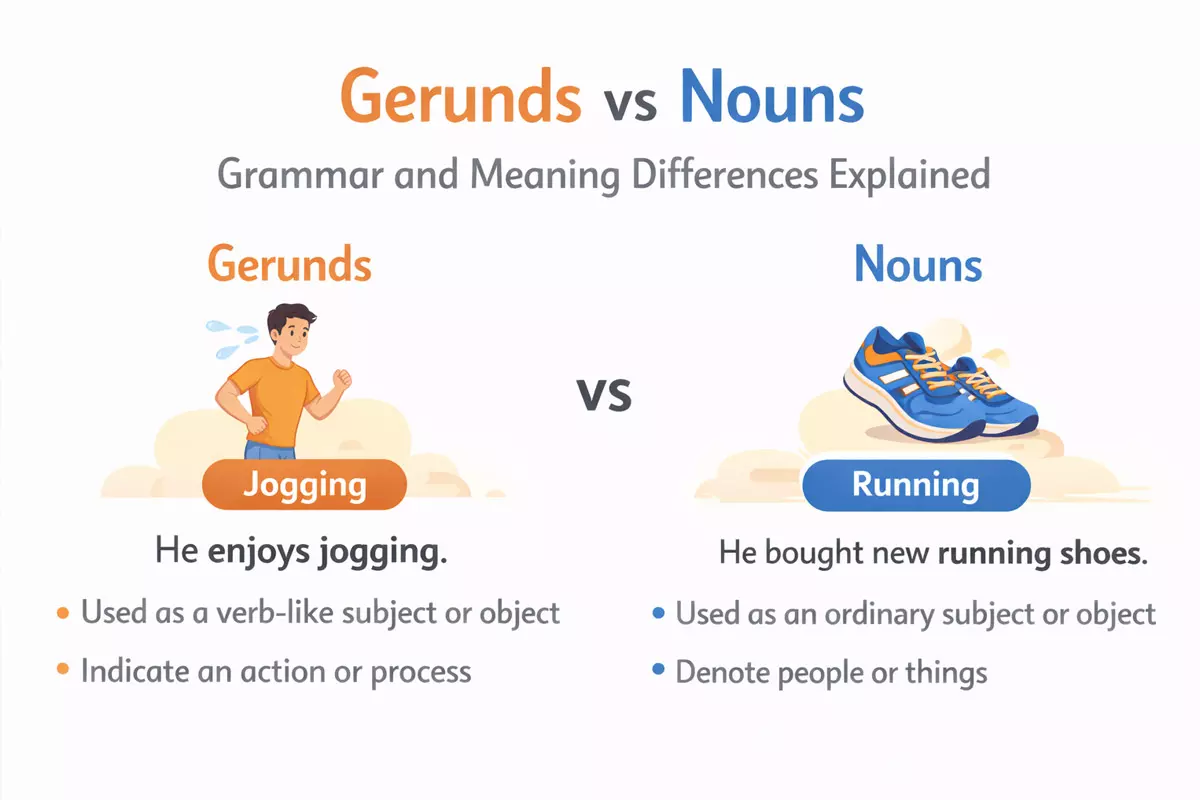
Confusing words ending in -ing with regular nouns is a common challenge, even for experienced English speakers. While both may function as nouns in sentences, -ing forms, known as gerunds, originate from verbs and often convey actions or processes, whereas standard nouns typically refer to people, places, or things. Recognizing this distinction can greatly improve both clarity and accuracy in your writing and communication, ensuring your intended meaning is effectively conveyed to your audience.
Difference between gerunds and true nouns
Understanding how gerunds and standard nouns function helps clarify their unique roles in English grammar. While both can often act as subjects or objects, they originate from different sources and follow distinct patterns in meaning and usage.
Origin and Structure
Gerunds are formed by adding -ing to a verb (e.g., swimming, reading). They maintain a verbal character, often expressing actions or processes. In contrast, true nouns are independent words that refer to people, places, things, or ideas (book, happiness, teacher).
Functional Differences
- Modifiers: Gerunds can take objects and adverbial modifiers, much like verbs (Reading quickly improves comprehension). True nouns use adjectives, not objects or adverbs (quick reading is possible, but not reading quickly book).
- Pluralization: Standard nouns can be pluralized (books, ideas). Gerunds are rarely used in the plural since they express general activities or concepts.
- Possessives: Gerunds often follow possessive forms (her singing), while nouns are preceded by determiners or adjectives (her song).
Common Usage Patterns

Below is a comparison showing how gerunds and true nouns differ in typical sentences:
| Gerund Example | True Noun Example |
|---|---|
| Swimming is fun. | The pool is fun. |
| He enjoys reading novels. | He enjoys novels. |
| Her singing surprised everyone. | Her voice surprised everyone. |
| Running daily keeps me healthy. | Exercise keeps me healthy. |
| They discussed building a bridge. | They discussed the bridge. |
Summary of Key Points
- Gerunds express actions or processes; nouns name things or ideas.
- Only gerunds can take direct objects (writing a letter), while nouns cannot (letter alone).
- Standard nouns can be counted and pluralized, unlike gerunds.
- Both can be modified, but the type of modifier differs (adjectives for nouns, adverbs/objects for gerunds).
Recognizing these distinctions makes it easier to choose the correct form in different grammatical contexts.
Form and function comparison in sentences
Understanding how gerunds and standard nouns behave in actual sentences makes their differences clear. Gerunds, which are verb forms ending in -ing that function as nouns, often appear where an activity or process is being discussed. In contrast, regular nouns denote people, places, things, or ideas and can represent both tangible and abstract entities.
Structural differences in use
Gerunds and nouns may occupy similar positions in a sentence, such as subject or object, but they bring subtle differences in meaning and grammatical behavior:
- Gerund as subject: Swimming is good exercise. (Focuses on the activity itself.)
- Noun as subject: The pool is crowded. (Refers to a thing.)
- Gerund as object: She enjoys reading. (Activity or process is enjoyed.)
- Noun as object: She enjoys books. (Actual items are enjoyed.)
Comparison of form and function
Below is a structured comparison highlighting the main similarities and contrasts between gerunds and nouns in sentence roles and their grammatical properties.
| Feature | Gerund | Standard Noun |
|---|---|---|
| Typical Ending | -ing (e.g., running) | Varied (book, happiness, etc.) |
| Can take an object? | Yes (e.g., reading books) | No (usually cannot take an object) |
| Describes | Action or process | Thing, person, idea |
| Modified by | Adverbs (quickly running) | Adjectives (large building) |
| Plural form? | Rarely (learnings is uncommon) | Common (dogs, ideas) |
Examples in context
To further clarify, consider these sentences:
- Jogging every morning improves health. ✅ (Gerund as subject)
- My habit is jogging. ✅ (Noun as subject, gerund as object)
- I like painting landscapes. (Gerund as object with its own object)
- The painting on the wall is beautiful. (Noun referring to an object)
- They discussed building a bridge. (Gerund phrase as object)
- The building collapsed. (Noun as subject)
- Traveling can be expensive. (Gerund as subject)
- Her travels have inspired many stories. (Noun in plural form)
- He dislikes waiting. (Gerund as object)
- She brought a gift. (Noun as object)
In summary, gerunds and standard nouns often appear in similar grammatical slots, but their form, what they describe, and their ability to take modifiers or objects set them apart in English sentences.
Objects and modifiers after gerunds and nouns
When using gerunds or nouns, the words that come after them—such as objects, adjectives, or adverbs—can change both the structure and meaning of your sentence. Understanding how these elements attach to gerunds and nouns helps you construct clear and natural English.
After gerunds: direct objects and adverbs
A gerund often acts like a verb in disguise, so it can take a direct object or be modified by adverbs. For example, in "Reading books improves knowledge," "books" is the object of the gerund "reading." Similarly, adverbs can modify gerunds to describe how the action is performed: "Quickly running increases your heart rate."
- Eating ice cream makes me happy. (object)
- Swimming every morning is healthy. (adverbial phrase)
- Writing clearly helps others understand. (adverb)
- Solving complex problems requires patience. (object + adjective)
- Studying hard pays off. (adverb)
- Collecting rare coins is his hobby. (object + adjective)
- Driving in heavy traffic stresses me out. (adverbial phrase)
- Painting realistically takes skill. (adverb)
- Fixing broken machines takes time. (object + adjective)
- Listening carefully is essential. (adverb)
After nouns: adjectives and prepositional phrases
Nouns, unlike gerunds, cannot take direct objects. Instead, they are typically modified by adjectives or followed by prepositional phrases that add detail, such as "of," "for," or "in." For instance, "The reading of books is enjoyable" uses a prepositional phrase to clarify what is being read.
- The quick decision (adjective)
- A delicious meal (adjective)
- The study of languages (prepositional phrase)
- The painting of landscapes (prepositional phrase)
- A collection of stamps (prepositional phrase)
- An impressive performance (adjective)
- The repair of engines (prepositional phrase)
- A thorough investigation (adjective)
- The discussion about plans (prepositional phrase)
- The introduction to chemistry (prepositional phrase)
Comparison: Gerund phrases vs. Noun phrases
To make the differences clear, see how gerund phrases and noun phrases build meaning with their modifiers and objects.
| Gerund Phrase | Noun Phrase |
|---|---|
| Reading mystery novels is fun. (object) |
The reading of mystery novels is fun. (prepositional phrase) |
| Fixing old cars takes patience. | The fixing of old cars takes patience. |
| Learning quickly is valuable. (adverb) |
Quick learning is valuable. (adjective) |
| Running marathons requires training. | The running of marathons requires training. |
In summary, gerunds typically take objects and adverbs, reflecting their verb-like qualities, while nouns are modified by adjectives or followed by prepositional phrases. Recognizing these patterns can help you choose the correct structure and avoid common mistakes.
Article use with gerunds vs nouns
English treats gerunds and regular nouns differently when it comes to definite and indefinite articles (the, a, an). Understanding these differences helps avoid awkward or incorrect phrasing.
Articles with gerunds: general rules
Typically, gerunds—verbs ending in -ing that act as nouns—do not take an article. When you talk about an activity in general, you usually omit "the" or "a":
- Swimming is good exercise. ✅
- The swimming is good exercise. ❌
- A swimming is good exercise. ❌
However, if a gerund phrase is made specific, sometimes "the" is used:
- He dislikes the running in the morning at school. ✅
Articles with nouns: a different pattern
Regular nouns often require an article or determiner, depending on whether the noun is countable or uncountable, and whether it’s specific or general:
- I bought a book.
- She loves the music in this movie.
- Coffee is popular worldwide. (No article for uncountable nouns when speaking in general.)
Side-by-side examples
Below is a comparison of article usage with gerunds and their noun counterparts in similar contexts:
| Pattern with Gerund | Pattern with Noun |
|---|---|
| Reading is fun. (No article) |
A book is fun to read. (Indefinite article) |
| He enjoys cooking. (No article) |
He enjoys the meal. (Definite article) |
| Swimming relaxes her. (No article) |
She likes the pool. (Definite article) |
| The running in the park is tiring. (Definite article for specific gerund phrase) |
The race in the park is tiring. (Definite article for specific noun) |
| Listening helps improve vocabulary. (No article) |
The lesson helps improve vocabulary. (Definite article) |
Summary tips
- Most gerunds in general statements use no article.
- Regular nouns often need "a," "an," or "the," depending on context.
- Specific gerund phrases can take "the" for clarity.
- Uncountable nouns may be used without an article for general ideas, similar to gerunds.
By noticing these patterns, you can choose the correct article—or none at all—when switching between gerunds and nouns.
Meaning shifts between action and concept
When using gerunds and nouns, it’s important to recognize how the meaning can move between describing an ongoing activity and referring to an abstract idea or object. Gerunds, which are -ing forms functioning as nouns (like running or reading), typically highlight the process or the act itself. In contrast, standard nouns tend to point to the result, product, or general idea, often losing the sense of action.
How context changes interpretation
Context determines whether we focus on the act or the concept. For example, “Swimming is fun” means that the activity itself is enjoyable. If you say “the swimming was exhausting,” you’re still talking about the process. But in “the swimming pool was crowded,” swimming acts as an adjective, and the focus is on a place, not the action.
Common patterns: action vs. concept
| Form | Meaning | Example sentence |
|---|---|---|
| Reading (gerund) | the act of interpreting text | Reading academic articles helps improve your writing. |
| A reading (noun) | a specific session or event where text is read | We will discuss a reading on climate policy in tomorrow’s class. |
| Building (gerund) | the process of constructing | Building strong arguments is essential in academic essays. |
| A building (noun) | a physical structure | The library is a historic building in the city center. |
| Painting (gerund) | the act of applying paint | Painting large murals requires careful planning. |
| A painting (noun) | a finished artwork | The museum bought a painting by a contemporary artist. |
| Drawing (gerund) | the act of sketching | Drawing diagrams can make complex processes easier to follow. |
| A drawing (noun) | the picture produced | The report includes a drawing of the proposed design. |
| Writing (gerund) | the act of putting words together | Writing every day helps students develop their academic style. |
| A writing (noun) | a piece of written work | This article is a writing that summarizes recent research. |
| Meeting (gerund) | the act of assembling | Meeting new colleagues can lead to future collaborations. |
| A meeting (noun) | an organized event | The department held a meeting to review the results. |
| Setting (gerund) | the act of placing or preparing | Setting clear expectations at the beginning of the course is important. |
| A setting (noun) | the environment or background | The study was conducted in a classroom setting. |
| Recording (gerund) | the process of capturing audio or video | Recording interviews allows researchers to analyse responses later. |
| A recording (noun) | the captured material | We listened to a recording of the lecture before the exam. |
| Finding (gerund) | the act of discovering | Finding reliable sources is a key part of the research process. |
| A finding (noun) | a discovered fact or result | One important finding was that motivation increased over time. |
| Beginning (gerund) | the process of starting | Beginning a new project often requires careful planning. |
| A beginning (noun) | the initial part of something | The beginning of the article introduces the main concepts. |
Comparison of action vs. object focus
| Form | Typical meaning in context |
|---|---|
| Gerund (e.g. “Running”) | Emphasizes the activity or process itself (e.g., “Running helps me relax.”) |
| Noun (e.g. “A run” or “A building”) | Refers to the result, object, or a specific event (e.g., “I went for a run.” / “The building is tall.”) |
| Gerund phrase (“Watching movies”) | Focuses on the enjoyment or action of doing something (e.g., “Watching movies is my hobby.”) |
| Noun phrase (“A movie watching”) | Describes an event or occasion (e.g., “We organized a movie watching.”) |
Understanding these nuances helps you use gerunds and nouns more precisely. The difference often comes down to whether you want to highlight the process or refer to a concrete thing or result. This distinction is especially important for clarity in both spoken and written English.
Common learner mistakes with gerunds and nouns
Learners often have trouble distinguishing when to use a gerund (the -ing form acting as a noun) and when to use a regular noun. This confusion can lead to awkward sentences or even changes in meaning. Below are some typical areas where mistakes happen and tips to avoid them.
Using gerunds after certain verbs
Some verbs require a gerund as the object, while others need a noun or a different structure. For example, "enjoy" takes a gerund: I enjoy swimming (✅), not I enjoy swim (❌). Mixing these up is a frequent issue.
Confusing gerunds with present participles
Because both gerunds and present participles use the -ing form, it’s easy to mix them up. Remember: gerunds function as nouns, while participles act as adjectives or form continuous tenses. For example, in Swimming is fun, "swimming" is a gerund (subject); in The swimming child, it’s a participle (describing the child).
Choosing between a gerund and a noun form

Sometimes both a gerund and a related noun exist. The choice can change the nuance or correctness of a sentence. Here are some common mix-ups:
- Advice: He gave me some advice (noun, ✅), not He gave me some advising (❌).
- Decision: Making a decision is difficult (gerund + noun, ✅), but Making a deciding (❌) is incorrect.
- Practice: Practice makes perfect (noun, ✅); Practicing makes perfect (gerund, also ✅), but Practice makes perfecting (❌) is wrong.
- Meeting: We had a meeting (noun, ✅); We had meeting (❌); We had meeting someone (❌).
- Understanding: Understanding grammar is important (gerund, ✅); An understanding of grammar is important (noun phrase, ✅).
- Beginning: The beginning of the story (noun, ✅); Beginning the story (gerund, ✅).
- Learning: Learning English is fun (gerund, ✅); The learning process (noun, ✅).
- Explanation: He gave an explanation (noun, ✅); He gave explaining (❌).
- Reading: Reading improves vocabulary (gerund, ✅); A reading assignment (noun, ✅).
- Research: Doing research (noun, ✅); Researching the topic (gerund, ✅); Doing researching (❌).
Incorrect preposition use with gerunds
Prepositions are always followed by a noun or gerund, never a verb in its base form. For example, She is interested in learning (✅), not She is interested in learn (❌).
Mixing up subject and object roles
Learners sometimes use a noun where a gerund is needed as the subject or object of a sentence, which can sound unnatural or be grammatically incorrect. Consider:
- Swimming helps me relax (gerund as subject, ✅)
- The swim helps me relax (noun as subject, ✅ but different meaning)
- Swim helps me relax (❌)
Summary Table: Gerund vs Noun Usage
| Sentence Context | Correct Form |
|---|---|
| After prepositions | He is good at drawing (not "draw") |
| As the subject | Reading helps me relax (not "Read helps me relax") |
| With certain verbs | She enjoys singing (not "enjoys sing") |
| With abstract ideas | Patience is important (not "Patient is important") |
| Describing a process/activity | Running every morning is healthy (not "Run every morning is healthy") |
By paying close attention to these patterns, you can avoid the most frequent pitfalls with gerunds and nominal forms, and express yourself more naturally in English.
Practice: choose correct form in mixed structures
Understanding when to use a gerund versus a noun can be tricky, especially when both forms seem possible but only one fits the structure or meaning. Below you'll find practical exercises and examples to help you distinguish between these forms in real sentences. Pay attention to how meaning and grammar interact in each scenario.
Choose the Correct Form
For each sentence, decide whether a gerund or a noun is appropriate. Consider the verb, preposition, or context for clues. Select the right word or form from the options in parentheses.
- She is interested in (paint / painting) landscapes.
- (Swimming / Swim) is a great way to stay healthy.
- The (opening / open) of the store was delayed by a week.
- He enjoys (travel / travelling) to new countries.
- Our main concern is the (increase / increasing) of costs.
- I heard about your (promotion / promoting) at work—congratulations!
- (Reading / Read) before bed helps me relax.
- The company's (expansion / expanding) into Asia was successful.
- They discussed (moving / move) to a bigger office.
- The (closing / close) of the museum disappointed many visitors.
Show answers
- painting
- Swimming
- opening
- travelling
- increase
- promotion
- Reading
- expansion
- moving
- closing
Common Mixed Structure Patterns
Some expressions require a gerund, while others need a noun. Here's a quick reference for typical scenarios:
- After prepositions: use a gerund (She left without saying goodbye).
- As a subject: both can be used, but meaning changes (Swimming is fun vs. The swimming was canceled).
- After certain verbs: use gerunds (enjoy, avoid, consider).
- For events or results: use nouns (The meeting was long).
- With articles or adjectives: typically nouns (an opening, a quick decision).
- As general activities: gerunds (Jogging helps clear my mind).
- To name specific things: nouns (Her drawing is on the wall).
- As modifiers (before nouns): use nouns (the swimming pool).
- With possessive forms: usually gerunds (His singing annoys me).
- Describing processes: gerunds (Learning takes time).
Spot the Difference: Meaning and Function
Some words look alike but serve different grammatical functions depending on their form. Compare the following:
| Gerund (Activity/Action) | Noun (Object/Result/Event) |
|---|---|
| Running is good for your health. | The running was difficult to watch. |
| He stopped smoking. | The smoking in this area is prohibited. |
| She loves drawing. | Her drawing won a prize. |
| They discussed moving. | The moving took all day. |
| Learning never ends. | The learning was intense. |
Show answers
- Left column: action or process (gerund); right column: event, thing, or result (noun).
Review these patterns and examples to strengthen your ability to distinguish between gerunds and nouns in various sentence structures. Practice often to build confidence and accuracy.