Light Nouns in Spoken English Like Thing, Stuff, Kind

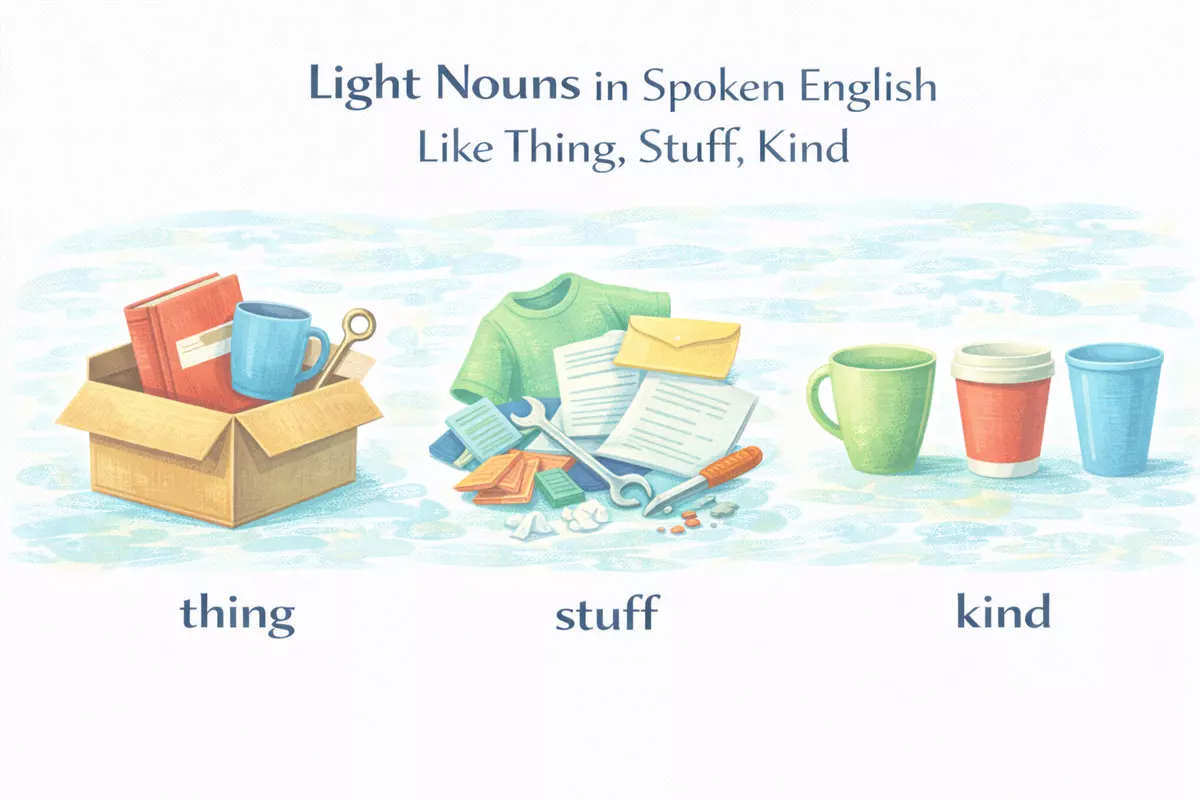 Here we what light nouns are in everyday spoken English, lists common examples like thing and stuff, explains why people use them, their impact on tone and informality, the risks of vagueness, and how to replace them with stronger nouns.
- What light nouns are in everyday spoken English
- Common light nouns like thing, stuff, and kind
- Why speakers choose light nouns instead of specific ones
- Tone and informality created by light nouns
- Risks of vagueness and overuse
- Replacing light nouns with precise alternatives
- Practice: rewrite sentences using stronger nouns
Everyday English conversations often rely on vague words like thing, stuff, and kind when we cannot recall or do not need specific terms. These general nouns help keep our speech flowing naturally, allowing us to communicate even when details are missing or unimportant. By using such flexible language, speakers can focus on the broader meaning or maintain the pace of a conversation, making these words an essential part of how we express ourselves in real time.
What light nouns are in everyday spoken English
Light nouns are common words that carry only a vague or general meaning by themselves. In conversation, they often act as placeholders or “containers” for more specific ideas. Instead of giving detailed information, these words let speakers stay flexible or informal, especially when the details are unimportant, unknown, or obvious from context.
Typical light nouns you’ll hear in conversation
You probably come across these vague nouns every day, even if you haven’t noticed. Here are some of the most frequent ones:
- thing – “Can you pass me that thing?”
- stuff – “There’s a lot of stuff on my desk.”
- kind – “What kind of music do you like?”
- way – “There’s no way I’m doing that.”
- sort – “It’s a sort of tradition.”
- place – “Let’s go to that place again.”
- person – “She’s not that kind of person.”
- area – “I’m not an expert in that area.”
- type – “He’s not my type.”
- part – “That’s the best part.”
- point – “You missed the point.”
- bit – “Can I have a bit?”
- piece – “Give me a piece of that.”
- case – “In that case, let’s wait.”
- matter – “It’s a tricky matter.”
- issue – “That’s not the real issue.”
- thingy (informal) – “Where’s the thingy for the TV?”
- deal – “What’s the deal with this?”
- topic – “Let’s change the topic.”
Why do people use light nouns?
These generic nouns help speakers:
- Keep the conversation relaxed or informal
- Avoid repeating details everyone already knows
- Fill gaps when they can’t remember a specific word
- Refer to abstract or broad categories
Patterns and phrases with light nouns
You’ll notice patterns like “kind of,” “sort of,” “a piece of,” or “that stuff” in everyday English. These light nouns often combine with adjectives or modifiers to get more specific, but the noun itself stays unspecific.
Comparing light nouns and specific nouns
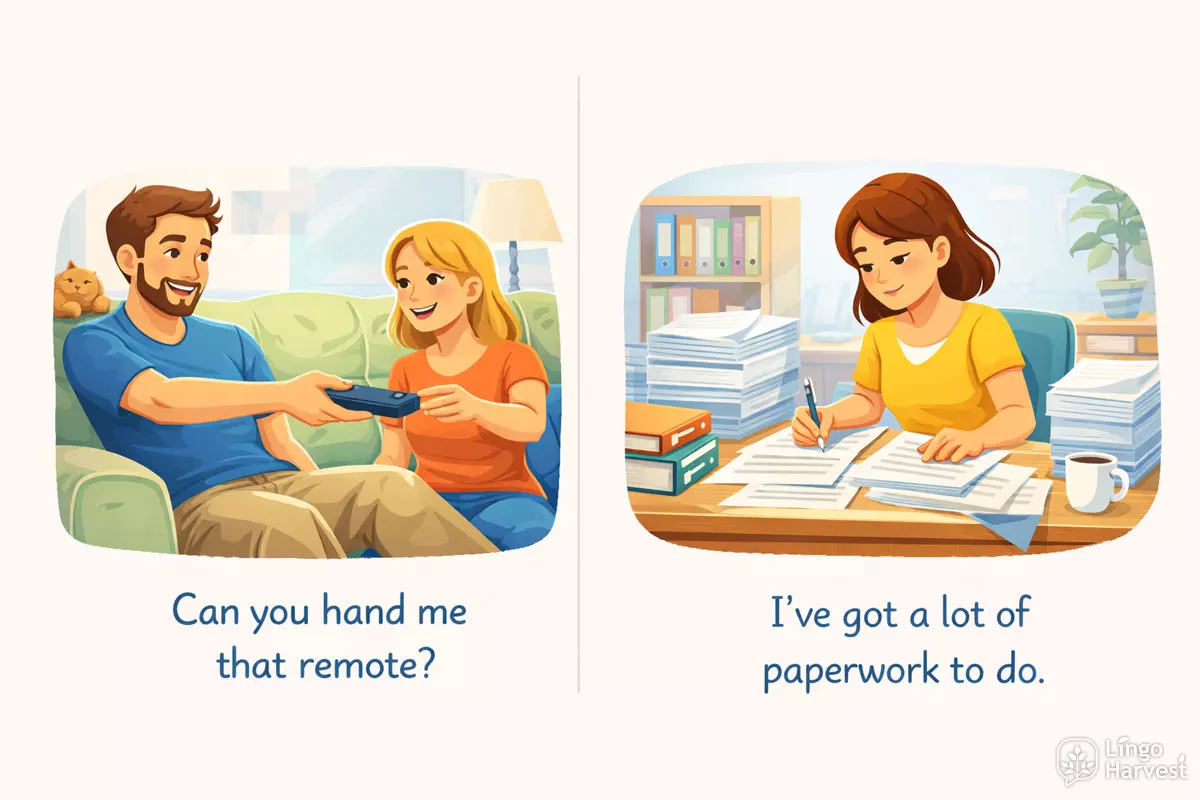
| Light Noun Example | More Specific Alternative |
|---|---|
| Can you hand me that thing? | Can you hand me that remote? |
| I’ve got a lot of stuff to do. | I’ve got a lot of paperwork to do. |
| What kind of food do you like? | Do you like Italian food? |
| Is that your thing? | Is that your hobby? |
In short, light nouns are everywhere in spoken English. They help keep conversations moving, especially when precision isn’t necessary, and let speakers focus on the flow rather than the details.
Common light nouns like thing, stuff, and kind
Light nouns—sometimes called “general” or “empty” nouns—are especially frequent in casual conversation. Words such as thing, stuff, and kind don’t point to a specific object or substance. Instead, they help speakers talk about topics when details are unknown, unimportant, or unnecessary. These words make speech more flexible and allow people to express uncertainty, generalization, or approximation.
How light nouns work in conversation
Speakers often use these general terms when they can’t recall a precise word or when the category is more important than the actual item. For example, “Can you pass me that thing?” or “There’s some stuff on the table.” Here, the listener uses context to guess the intended meaning.
Typical uses and patterns
You’ll hear these general-purpose nouns in a range of everyday expressions:
- “What’s that thing you use to open bottles?”
- “I’ve got so much stuff to do today.”
- “That kind of music isn’t my style.”
- “Can you grab those things over there?”
- “He always says weird stuff.”
- “It’s a different kind of problem.”
- “She bought some new things for her apartment.”
- “All kinds of stuff happened at the party.”
- “This thing keeps breaking.”
- “Do you like this kind of food?”
- “There’s a lot of stuff in my bag.”
- “Is that your thing?”
- “He collects that kind of thing.”
- “Let’s get rid of some of this stuff.”
- “What kind of things do you like?”
- “That’s not my kind of thing.”
- “You know, the thing we talked about.”
- “It’s just random stuff.”
Differences among thing, stuff, and kind
Although these words overlap in function, they aren’t interchangeable:
- Thing is countable and refers to objects, actions, or ideas.
- Stuff is uncountable, used for collections or substances, often when details aren’t specified.
- Kind acts as a classifier, grouping similar items or types (“kind of movie,” “that kind of behavior”).
Comparison of light noun usage
| Light noun | Typical spoken English usage |
|---|---|
| thing | “Can you hand me that thing?” – refers to a specific but unnamed object or concept. |
| stuff | “There’s too much stuff here.” – collective, uncountable, often for miscellaneous items. |
| kind | “What kind of coffee do you want?” – classifies or groups items by type or category. |
Why are these words so common?
People rely on these “light” terms for efficiency and social smoothness. They help keep conversations moving without pausing for exact vocabulary. This vagueness is useful in storytelling, giving instructions, or expressing opinions when specifics are unnecessary or unavailable. In summary, these general nouns are a core part of everyday spoken English, making language more adaptable and inclusive.
Why speakers choose light nouns instead of specific ones
Speakers often reach for general terms like “thing,” “stuff,” or “kind” in conversation when they want to keep communication smooth, flexible, or informal. These light nouns let people refer to objects, ideas, or categories without naming them precisely. This can be useful for a range of social and cognitive reasons, especially in spontaneous speech.
Reasons for using light nouns in conversation
- Uncertainty or vagueness: When a speaker doesn’t know the exact word or detail, using “thing” or “stuff” avoids awkward pauses.
- Efficiency: Light nouns are quick and easy, helping speech flow more naturally, especially when details aren’t important to the point.
- Shared knowledge: If listeners already understand the context, a generic term is often enough.
- Politeness: Sometimes people avoid specifics to be indirect or soften statements (e.g., “Can you move your stuff?” instead of naming items).
- Generalization: Terms like “kind” or “type” allow speakers to talk about groups or categories without listing every member.
- Word retrieval difficulty: In fast or stressful situations, speakers might default to a light noun because it’s easier to access.
- Focus on action, not object: When the object isn’t central to the conversation, using a light noun keeps attention on what’s happening.
Examples of light nouns in everyday English
- “Can you hand me that thing on the table?”
- “I’ve got a lot of stuff to do today.”
- “What kind of music do you like?”
- “He said all sorts of things.”
- “She brought some weird stuff from the store.”
- “This is the kind of thing I worry about.”
- “Put your things in the bag.”
- “Let’s talk about that kind of issue later.”
- “There’s stuff everywhere in here!”
- “That’s not my thing.”
- “He’s into that sort of stuff.”
- “Do you have anything to add?”
- “What’s that thing called?”
- “All kinds of things can go wrong.”
- “She’s got her own stuff to deal with.”
- “I need to get my things together.”
- “It’s the kind of stuff you see in movies.”
- “Grab your things, we’re leaving.”
Light nouns vs. specific nouns: When and why?
Choosing between a non-specific term and a precise noun can depend on what the speaker wants to achieve. Here’s a quick comparison:
| Light Noun Usage | Specific Noun Usage |
|---|---|
| “Can you move your stuff?” (general, polite, avoids detail) |
“Can you move your backpack and books?” (clear, detailed, direct) |
| “I bought some things.” (vague, not important to specify) |
“I bought apples and bread.” (informs listener exactly) |
| “That kind of thing happens.” (generalizes, covers many cases) |
“An accident like that happens.” (refers to a specific event) |
| “What’s that thing?” (when the name is unknown/forgotten) |
“What’s that device?” (more precise, but still somewhat general) |
In summary, opting for light nouns is a natural, practical choice that reflects how people actually communicate—balancing clarity, efficiency, and social nuance. These words help keep conversations flowing, especially when specifics aren’t needed or available.
Tone and informality created by light nouns
Everyday spoken English often feels relaxed and approachable, thanks in part to the use of words like "thing," "stuff," and "kind." These light nouns help speakers keep conversations casual, avoid sounding too formal or technical, and smoothly navigate topics when precise vocabulary isn’t necessary or available.
How light nouns set the mood

Light nouns act as conversational shortcuts. Instead of specifying, speakers use these words to generalize or refer to something shared in context. For example, "Could you pass me that thing?" is much softer and more informal than naming the object directly. This flexibility allows interactions to flow naturally and avoids putting pressure on exactness.
- thing – “Can you grab that thing for me?”
- stuff – “I’ve got a lot of stuff to do.”
- kind – “It’s a kind of dessert, I think.”
- bit – “Let me tell you a bit about it.”
- piece – “He gave me a piece of advice.”
- part – “That’s the best part.”
- type – “What type of music do you like?”
- sort – “It’s some sort of problem.”
- place – “Let’s meet at the usual place.”
- way – “Is there a way to fix this?”
- deal – “What’s the deal with that?”
- point – “You make a good point.”
- area – “I’m not an expert in that area.”
- thingy – “Pass me the thingy over there.”
- stuff like that – “We talked about movies and stuff like that.”
- kind of – “I’m kind of tired.”
- something – “Let’s do something fun.”
- someone – “Someone called for you.”
- anything – “Is there anything I can help with?”
- nothing – “It’s nothing important.”
Softening, hedging, and social connection
Using these general nouns not only reduces formality, but also softens statements and helps speakers hedge when uncertain. For instance, "It’s kind of strange" is less direct than "It’s strange," making it easier to express opinions without sounding blunt. This style is especially common among friends, family, and colleagues who value ease and politeness in conversation.
Comparing light nouns and precise nouns in conversation
| Light Noun Example | Precise Alternative |
|---|---|
| “Can you hand me that thing?” | “Can you hand me that screwdriver?” |
| “I’ve got some stuff to finish.” | “I’ve got some reports to finish.” |
| “It’s a kind of fruit.” | “It’s a persimmon.” |
| “We need that piece.” | “We need that resistor.” |
| “That sort of thing happens.” | “Mistakes like that happen.” |
Why speakers choose light nouns
People reach for these flexible words when they want to sound friendly, avoid being too direct, or when the exact term isn’t known or isn’t important. This habit builds rapport and keeps exchanges easy-going. In summary, these general terms are a key ingredient in making English conversations sound natural and relatable.
Risks of vagueness and overuse
Frequent reliance on words like thing, stuff, or kind can make spoken communication less precise. While these light nouns are handy for quick conversations or when details are irrelevant, they can also obscure meaning, especially in more formal or technical discussions.
When does using light nouns cause problems?
People often turn to generic terms when they're unsure of the exact word, trying to be casual, or avoiding specifics. However, overusing such vocabulary can lead to misunderstandings, as listeners may not know exactly what is being referenced. This is especially true when the context is unclear or when multiple possible meanings exist.
- Ambiguity: The listener may not understand what is being referred to.
- Lack of detail: Important information might be omitted.
- Impression of uncertainty: Speakers may seem unprepared or uninformed.
- Reduced credibility: In professional situations, overuse can make speech sound less authoritative.
- Difficulty in follow-up: Listeners may struggle to ask clarifying questions.
- Barriers to learning: Language learners may default to these words instead of expanding their vocabulary.
- Overgeneralization: Nuanced differences between objects or ideas can be lost.
- Weak storytelling: Narratives may become bland or confusing.
- Repetition fatigue: Excessive repetition of generic words can be distracting.
- Loss of engagement: Listeners might tune out due to lack of specificity.
Common scenarios of overuse
Some situations in which these generic nouns frequently appear include:
- Describing objects without naming them (“Pass me that thing.”)
- Summarizing events (“A lot of stuff happened.”)
- Classifying types or categories vaguely (“It’s a kind of tool.”)
- Discussing feelings or opinions in a non-committal way (“I have a thing about heights.”)
Clarity vs. convenience
There is a trade-off between the ease of using these placeholder nouns and the clarity they provide. In casual speech, their convenience is often acceptable. In contrast, in academic, business, or instructional settings, more precise language is usually expected and appreciated.
Alternatives to light nouns
To avoid the pitfalls of vagueness, speakers can substitute more descriptive terms. Here are some alternatives:
- Object → She placed the object gently on the table for everyone to see.
- Item → This item is listed as out of stock on the website.
- Device → The device can track your heartbeat throughout the day.
- Gadget → He bought a new gadget that turns lights on with voice commands.
- Material → The material used for the roof is extremely durable.
- Substance → We tested the substance to determine if it was toxic.
- Concept → The concept behind the project is simple but effective.
- Tool → This tool will help you measure the results more accurately.
- Category → That book doesn’t fit into any single category.
- Example → Here is an example of how the formula should be applied.
- Type → This type of fabric absorbs moisture quickly.
- Option → We chose the best option available to us.
- Component → The battery is the most expensive component in the device.
- Instance → In this instance, we will accept late submissions.
- Topic → The next topic focuses on social trends.
- Aspect → One important aspect of the job is communication.
- Feature → The new phone has a feature that improves photo quality.
- Element → Trust is a key element in any strong relationship.
Ultimately, being mindful of how often and in what contexts you use these general terms improves both the effectiveness and the reception of your spoken English.
Replacing light nouns with precise alternatives
Many people use general words like thing, stuff, or kind in daily conversation, especially when they can’t recall or don’t want to specify a more detailed term. While these light nouns make speech quick and easy, they often leave listeners guessing about the exact meaning. Swapping them for more specific vocabulary can make your spoken English clearer and more engaging.
Why use more specific nouns?
Choosing precise vocabulary helps your listener understand exactly what you mean. For example, saying “Can you pass me that thing?” is much less helpful than “Can you pass me the stapler?” This is particularly important in professional or academic settings, but it also improves clarity in casual conversations.
Common light nouns and more precise options
Below are some typical light nouns and suggestions for what you might say instead in various situations:
- thing → device, tool, object, item, gadget, instrument, part
- stuff → materials, belongings, equipment, supplies, ingredients, possessions, documents
- kind → type, variety, category, brand, species, model, style
- place → restaurant, office, store, park, neighborhood, venue, site
- person → colleague, neighbor, friend, manager, customer, guest, expert
- problem → issue, error, challenge, obstacle, setback, malfunction, dispute
- area → region, section, zone, district, field, department, territory
- way → method, approach, technique, manner, process, strategy, style
- part → section, component, segment, portion, element, fragment, piece
- thingy → (be specific: remote, charger, adapter, handle, switch, connector, lid)
Comparing vague and precise speech
To see the difference, compare these common sentences using light nouns with their more detailed alternatives:
| Vague Expression | Precise Alternative |
|---|---|
| Can you hand me that thing? | Can you hand me that wrench? |
| I need to get my stuff from the car. | I need to get my groceries from the car. |
| What kind of thing is this? | What model is this device? |
| Let’s go to that place we like. | Let’s go to that café we like. |
| She’s having some problems at work. | She’s having some conflicts with her manager at work. |
Tips for developing a more specific vocabulary
- Pause briefly to think of a more exact word before speaking.
- Read and listen to a variety of topics to expand your vocabulary.
- Practice replacing light nouns in your own sentences.
- Ask for clarification if someone uses a vague word and you’re unsure what they mean.
- Keep a personal list of useful nouns related to your interests or field.
By gradually building the habit of choosing precise terms, your spoken English will become more vivid and easier for others to follow.
Practice: rewrite sentences using stronger nouns
Everyday English often uses vague words like "thing," "stuff," or "kind," especially in conversation. However, swapping these "light nouns" for more precise vocabulary can make your speech clearer and more professional. Let’s look at practical ways to strengthen your sentences by choosing specific nouns.
Common examples of light nouns in context
Here are some sample sentences that use general words. Try replacing the underlined word with something more descriptive.
- I need to buy some stuff at the store.
- Can you pass me that thing on the table?
- She said a lot of things during the meeting.
- This is a kind of thing I don’t understand.
- He brought a bunch of stuff to the party.
- That’s not my kind of thing.
- What’s that thing you’re holding?
- There’s some stuff in the box.
- He gave me a thing for my birthday.
- She likes this kind of music.
Rewrite practice: Replace light nouns with stronger choices
Below is a list of sentences and recommended improvements. Notice how more specific nouns clarify the meaning and create a stronger impression.
- I need to buy some groceries at the store. → (instead of "stuff")
- Can you pass me that notebook on the table? → ("thing")
- She said a lot of ideas during the meeting. → ("things")
- This is a kind of problem I don’t understand. → ("thing")
- He brought a bunch of snacks to the party. → ("stuff")
- That’s not my kind of activity. → ("thing")
- What’s that device you’re holding? → ("thing")
- There’s some clothing in the box. → ("stuff")
- He gave me a book for my birthday. → ("thing")
- She likes this genre of music. → ("kind")
Quiz: Strengthen these sentences
Try rewriting the sentences below by replacing the bolded word with a more precise noun.
- I have to finish this thing before I leave.
- There’s some stuff on your shirt.
- He collects all kinds of things.
- This is the kind of thing that makes me nervous.
- I lost that thing you gave me yesterday.
- She bought some stuff at the market.
- This thing is heavier than it looks.
- They packed all their things and moved out.
- Do you remember the thing we talked about?
- There’s too much stuff in this drawer.
- I don’t understand this thing at all.
- That thing you said really helped me.
Show answers
- I have to finish this assignment (or project, task) before I leave.
- There’s some lint (or dirt, stain) on your shirt.
- He collects all kinds of antiques (or coins, stamps, memorabilia).
- This is the kind of situation (or event, challenge) that makes me nervous.
- I lost that object (or item, gift) you gave me yesterday.
- She bought some groceries (or vegetables, supplies) at the market.
- This object (or device, tool) is heavier than it looks.
- They packed all their belongings and moved out.
- Do you remember the topic (or idea, plan) we talked about?
- There’s too much junk (or clutter, material) in this drawer.
- I don’t understand this concept (or idea, principle) at all.
- That advice (or comment, suggestion) you said really helped me.
Developing the habit of swapping vague nouns for specific ones will help you communicate more effectively, especially in formal or academic settings. Consider practicing with your own sentences and notice how your language becomes more engaging and precise.