Vague Nouns and How to Replace Them in Formal Writing

 The article defines vague nouns, shows how they reduce clarity and precision, and lists common examples from student and professional writing. It also covers their effect on tone, learner mistakes, and strategies for using more specific nouns.
- What vague nouns are and why they weaken writing
- Common vague nouns used in student and professional texts
- How vague nouns reduce clarity and precision
- Strategies for replacing vague nouns with specific ones
- Impact of precise nouns on formal tone
- Typical learner mistakes with vague reference
- Practice: revise sentences by replacing vague nouns
Unclear word choices can undermine the impact of formal writing and leave readers confused or uninterested. To strengthen your communication, it is important to recognize and replace vague or ambiguous terms with more precise language. Doing so not only clarifies your ideas but also helps establish your credibility and authority on the subject. By consistently choosing accurate words, you ensure that your message is understood and that your writing leaves a lasting, positive impression on your audience.
What vague nouns are and why they weaken writing
Vague nouns are general or ambiguous words that don’t specify exactly what you mean. In formal writing, these imprecise terms can make your arguments unclear and your statements less persuasive. When you use a word like “thing,” “stuff,” or “situation,” readers must guess at your intended meaning, which can cause confusion or weaken your credibility.
Common examples of imprecise nouns

Writers often fall back on broad nouns when they can’t quickly recall a more precise term. Here are some of the most frequent offenders in academic and professional documents:
- thing – The only thing I regret is not starting earlier.
- stuff – I have so much stuff to do before the meeting.
- aspect – One important aspect of this problem is cost.
- area – This is an area we still need to improve.
- issue – The main issue here is a lack of communication.
- factor – Price is a key factor in the final decision.
- matter – It’s a serious matter that we can’t ignore.
- element – Trust is an essential element of any relationship.
- point – That’s a good point, I hadn’t thought of that.
- feature – Dark mode is my favorite feature of this app.
- part – This part of the project took the longest.
- type – He’s not the type of person who gives up easily.
- kind – What kind of job are you looking for?
- case – In this case, we should wait for more information.
- subject – The subject of today’s meeting is budget planning.
- topic – Let’s move on to the next topic.
- object – The object of the game is to score more points.
- event – The event attracted hundreds of visitors.
How lack of specificity affects clarity
Using general nouns muddies your message. Readers are left to interpret what “aspect” or “factor” you mean, which can result in miscommunication. Precise vocabulary, on the other hand, helps convey your ideas exactly as intended and supports stronger, more direct arguments.
| Vague Noun | Precise Alternative |
|---|---|
| thing | method, device, concept, item |
| issue | problem, conflict, question, challenge |
| area | field, discipline, region, sector |
| aspect | feature, dimension, characteristic, perspective |
| stuff | materials, belongings, substances, data |
| part | component, section, segment, element |
| type | category, variety, genre, class |
| case | example, instance, occurrence, situation |
Why precision matters in formal writing
Clear and accurate nouns help readers follow your logic and trust your analysis. When you replace broad terms with specific ones, you make your writing more engaging and easier to understand. This attention to detail signals professionalism and improves the overall quality of your work.
Common vague nouns used in student and professional texts
Writers in both academic and workplace settings often rely on general nouns that can obscure meaning or weaken arguments. These "empty" words tend to be overused when the writer is unsure, lacks specific evidence, or wants to avoid committing to a clear statement. While these terms may seem convenient, they often leave readers guessing about precise intent or details.
Frequent examples of imprecise nouns
Here are some of the most commonly encountered ambiguous nouns in essays, reports, and business communications. Swapping them for more concrete language can add clarity and persuasiveness to your writing:
- Thing(s) – Overly broad; can refer to anything, making meaning unclear.
- Stuff – Informal and vague; lacks specificity.
- Aspect(s) – Non-descriptive; does not specify which parts or features are meant.
- Issue(s) – Can mean problem, topic, or simply something under discussion, leading to confusion.
- Situation – Fails to clarify what circumstances or events are involved.
- Area(s) – Could mean subject, location, or field; context is often too broad.
- Factor(s) – Does not indicate what is influencing the outcome.
- Element(s) – General; does not specify which components or ingredients are relevant.
- Problem(s) – Lacks detail on the nature or cause of the difficulty.
- Case(s) – Ambiguous; could refer to examples, situations, or legal matters.
- Type(s) – Non-specific; does not clarify categories or characteristics.
- Method(s) – General; does not describe the actual process or approach.
- Way(s) – Vague stand-in for manner, solution, or path.
- Topic(s) – Unspecific; does not identify the actual subject matter.
- Result(s) – Leaves out what outcome or consequence is meant.
- Effect(s) – Unclear without detail about what is being affected and how.
- Point(s) – Unclear if referring to arguments, ideas, or locations.
- Change(s) – Does not specify the nature, direction, or impact of alteration.
- Objective(s) – Lacks detail about what is actually being aimed for.
- Resource(s) – Could mean materials, people, time, or money; needs clarification.
Why these nouns cause problems
When these unspecific words are used, readers may not fully understand the writer's message. For example, saying "This issue is important" doesn't tell the audience what the problem is, why it matters, or what action should be taken. In formal writing, choosing more exact language helps you convey your point with authority and precision.
Quick reference: vague nouns and their improved alternatives
| Vague Noun | Specific Alternative |
|---|---|
| Thing | Device, concept, policy, artifact, variable (as appropriate) |
| Issue | Challenge, controversy, malfunction, dispute, topic |
| Area | Discipline, sector, department, topic, region |
| Factor | Cause, contributor, determinant, variable, influence |
| Method | Procedure, technique, approach, process, strategy |
| Way | Manner, solution, approach, route, means |
| Change | Increase, decrease, modification, shift, transition |
| Result | Outcome, consequence, product, finding, effect |
| Element | Component, ingredient, feature, aspect, item |
| Resource | Staff, funding, material, data, tool |
By identifying and replacing these general nouns with more descriptive terms, your writing will become clearer, more engaging, and far more effective in conveying your intended meaning.
How vague nouns reduce clarity and precision
Using imprecise nouns in formal writing can make arguments harder to follow and weaken the reader's understanding. When terms like "thing," "stuff," or "aspect" appear, they leave too much open to interpretation, forcing the audience to guess the intended meaning. This ambiguity often leads to confusion, especially in academic or professional contexts where accuracy is crucial.
Why imprecise nouns cause problems
General nouns fail to specify details, so they obscure who or what is being discussed. Readers may have different interpretations, making the message inconsistent or unreliable. For example, saying "The thing improved" offers no insight into what was improved or how, while "The process improved" provides more direction.
- Ambiguity: Vague words create uncertainty about the subject or object.
- Lack of detail: General terms omit specific characteristics or functions.
- Reduced credibility: Imprecise language can make arguments appear weak or unsupported.
- Difficulty in analysis: Readers cannot easily evaluate or critique unclear statements.
Common vague nouns to watch for
Writers frequently fall back on certain nouns that lack concrete meaning. Here are examples that often appear in essays, reports, or proposals:
- concept → This concept is difficult to define precisely.
- situation → In this situation, honesty is very important.
- context → You need to understand the context before making a decision.
- aspect → One important aspect of this problem is time.
- issue → The main issue is a lack of clear communication.
- factor → Price is a key factor in choosing a product.
- element → Trust is a crucial element of any relationship.
- part → This part of the report needs more detail.
- matter → It’s a serious matter that we must discuss.
- item → This item is not included in the discount.
- point → That’s a good point you made in the meeting.
- object → The main object of the game is to score points.
- component → This component connects the two systems.
- problem → The biggest problem is the lack of time.
- case → In this case, we should wait for more data.
- affair → The whole affair damaged the company’s reputation.
- feature → This feature makes the app easier to use.
- instance → This is just one instance of many similar errors.
- topic → Today’s topic is effective communication at work.
- field → She is an expert in the field of psychology.
Impact on reader comprehension
The more general the noun, the harder it is for a reader to visualize or analyze the subject. This can make formal writing feel superficial or incomplete. In contrast, replacing imprecise terms with specific ones clarifies arguments and strengthens communication.
| Vague Noun Example | More Precise Alternative |
|---|---|
| The thing that caused the delay was unexpected. | The equipment failure caused the delay. |
| This aspect needs improvement. | This communication strategy needs improvement. |
| There are several issues with the plan. | There are several budgetary constraints with the plan. |
| The area has many problems. | The research methodology has many problems. |
| We need to address this matter soon. | We need to address this compliance requirement soon. |
In summary, relying on unspecific nouns makes written work less effective. By choosing clearer, more descriptive terms, writers help readers grasp the intended meaning and follow the logic of the discussion.
Strategies for replacing vague nouns with specific ones
Choosing precise nouns can make formal writing clearer and more persuasive. Instead of using generic terms like “thing,” “area,” or “factor,” writers can strengthen their arguments by selecting nouns that pinpoint exactly what they mean. This section offers practical approaches for identifying and substituting imprecise nouns in academic or professional contexts.
Identify the context and intent
Start by determining what the vague noun refers to within your sentence. Ask yourself: What am I really describing? For example, does “thing” refer to a device, a concept, or an event? Pinpointing the intended meaning is the first step toward greater clarity.
Replace general nouns with concrete or technical terms
Whenever possible, swap out ambiguous words in favor of terminology relevant to your field or topic. For instance:
- “Thing” → “device,” “method,” “result,” “policy”
- “Area” → “department,” “region,” “discipline,” “sector”
- “Issue” → “challenge,” “controversy,” “malfunction,” “concern”
- “Aspect” → “feature,” “component,” “element,” “attribute”
- “Factor” → “variable,” “influence,” “condition,” “determinant”
- “People” → “participants,” “citizens,” “stakeholders,” “researchers”
- “Problem” → “obstacle,” “deficiency,” “complication,” “error”
- “Stuff” → “materials,” “resources,” “supplies,” “data”
- “Result” → “outcome,” “finding,” “consequence,” “effect”
- “Situation” → “incident,” “case,” “scenario,” “context”
- “Change” → “modification,” “adjustment,” “transition,” “alteration”
- “Data” (if vague) → “survey responses,” “experimental results,” “demographic statistics”
Use descriptive modifiers
Adding adjectives or specific descriptors can help clarify meaning. For example, instead of “the process,” consider “the approval process” or “the manufacturing process.” This technique narrows the reference and reduces ambiguity.
Consult discipline-specific vocabulary
In formal writing, especially in academic or technical fields, using the appropriate jargon or terminology demonstrates expertise and precision. Refer to glossaries, textbooks, or style guides relevant to your field for suitable alternatives.
Common vague nouns and their specific replacements
Below is a table that pairs some frequently used ambiguous nouns with more precise alternatives that could be adopted in various contexts.
| Vague Noun | Specific Alternatives |
|---|---|
| Thing | Instrument, mechanism, concept, artifact, parameter |
| Area | Field, discipline, region, zone, department |
| Issue | Discrepancy, dispute, malfunction, concern, barrier |
| Aspect | Feature, facet, element, attribute, component |
| Factor | Variable, cause, determinant, influence, condition |
| People | Employees, participants, stakeholders, respondents, citizens |
| Problem | Obstacle, deficiency, complication, error, challenge |
| Stuff | Materials, resources, supplies, equipment, substances |
| Result | Outcome, finding, consequence, effect, product |
| Change | Modification, adjustment, revision, transformation, transition |
Review and revise
After drafting, review your text for any lingering ambiguous nouns. Reading aloud or using the “find” function to search for common vague terms can help you spot and refine them. Replacing these with more exact language will improve both the professionalism and readability of your writing.
Impact of precise nouns on formal tone
Using specific nouns instead of vague ones immediately elevates the clarity and professionalism of academic and business writing. When writers choose words like legislation instead of thing or procedure instead of stuff, their ideas become more concrete and credible. This shift not only helps readers understand the intended message but also signals that the author has a strong grasp of the subject.
Clarity and Authority
Selecting accurate nouns reduces ambiguity. For example, referring to a contract rather than a document narrows down the meaning and leaves less room for misinterpretation. This precision demonstrates attention to detail, which is highly valued in formal contexts.
- Research vs. work
- Hypothesis vs. idea
- Analysis vs. thing
- Proposal vs. plan
- Data vs. information
- Policy vs. rule
- Outcome vs. result
- Methodology vs. way
- Evidence vs. proof
- Findings vs. things found
How Specific Nouns Shape Tone
When writers substitute generic words with more descriptive terms, the overall impression shifts from casual to authoritative. This is especially important in documents like reports, proposals, or academic essays, where the audience expects a certain level of formality and precision.
| Vague Noun | Precise Replacement |
|---|---|
| thing | component, aspect, factor, element |
| stuff | materials, supplies, equipment, resources |
| area | field, sector, domain, region |
| people | participants, stakeholders, employees, researchers |
| problem | issue, challenge, obstacle, complication |
| result | outcome, finding, conclusion, consequence |
Ultimately, stronger noun choices contribute to a more polished style. The use of targeted vocabulary signals to readers that the content is trustworthy and thoughtfully composed, which is essential for any formal document.
Typical learner mistakes with vague reference
Many learners struggle to avoid unclear language in their formal writing, often because they rely on imprecise words or leave out necessary details. This can confuse readers or weaken the argument. Most often, the problem arises when a noun or pronoun does not clearly indicate what it is referring to, or when broad terms are used instead of specific ones.
Common patterns that lead to unclear reference
- Using “thing” or “stuff” instead of precise nouns
- Replacing a full subject with “it,” “this,” or “they” without making the reference obvious
- Introducing “people,” “someone,” or “something” without specifying who or what
- Overusing “this” or “that” without a noun for clarity (e.g., “This is important” instead of “This result is important”)
- Making general statements with “there is/are” followed by a vague noun (e.g., “There are issues”)
- Using “problem,” “situation,” or “aspect” as placeholders without explanation
- Leaving out context when switching topics, making pronouns ambiguous
- Referencing previous ideas with “such” or “those” when multiple possible antecedents exist
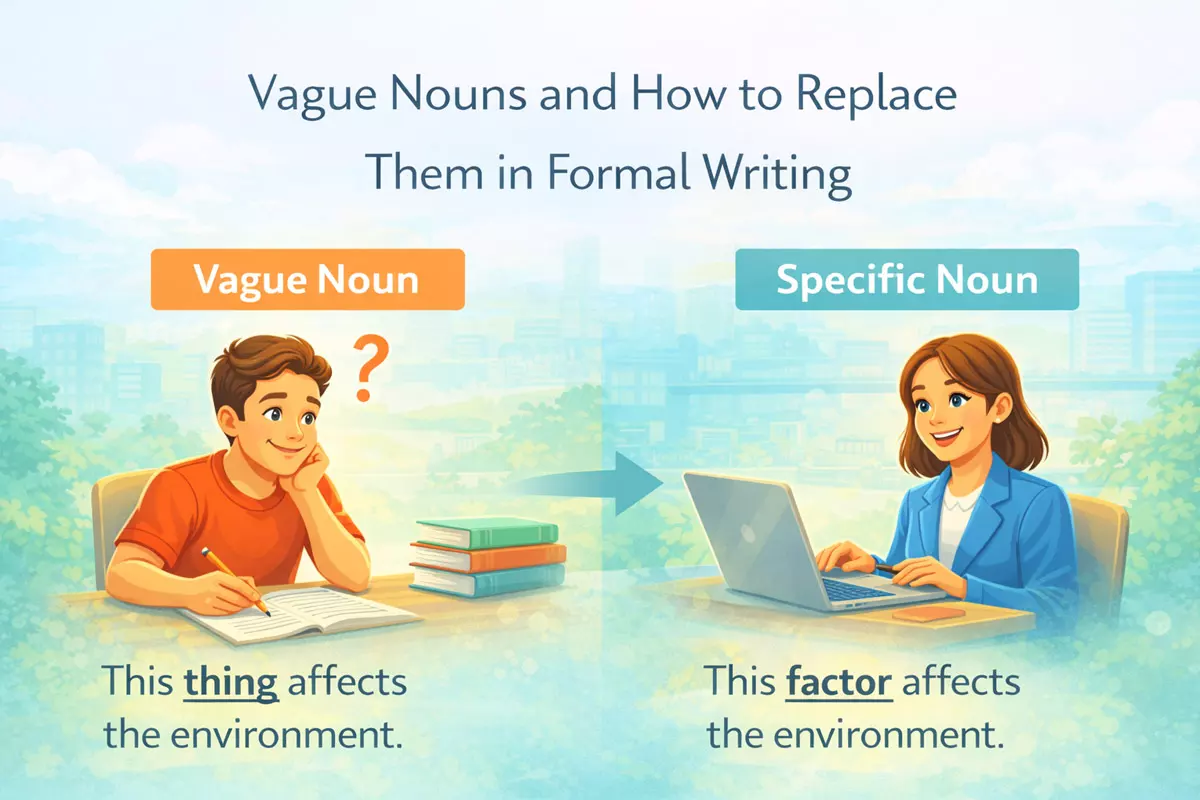
- Combining several broad terms in one sentence (e.g., “This thing affects that area”)
- Using “one” or “ones” without clear context
- Failing to specify which group is meant by “they,” “we,” or “people”
- Using “it” to refer to an entire idea or process rather than a specific noun
- Assuming the reader knows what “the issue,” “the case,” or “the process” refers to
Vague reference in context: before and after
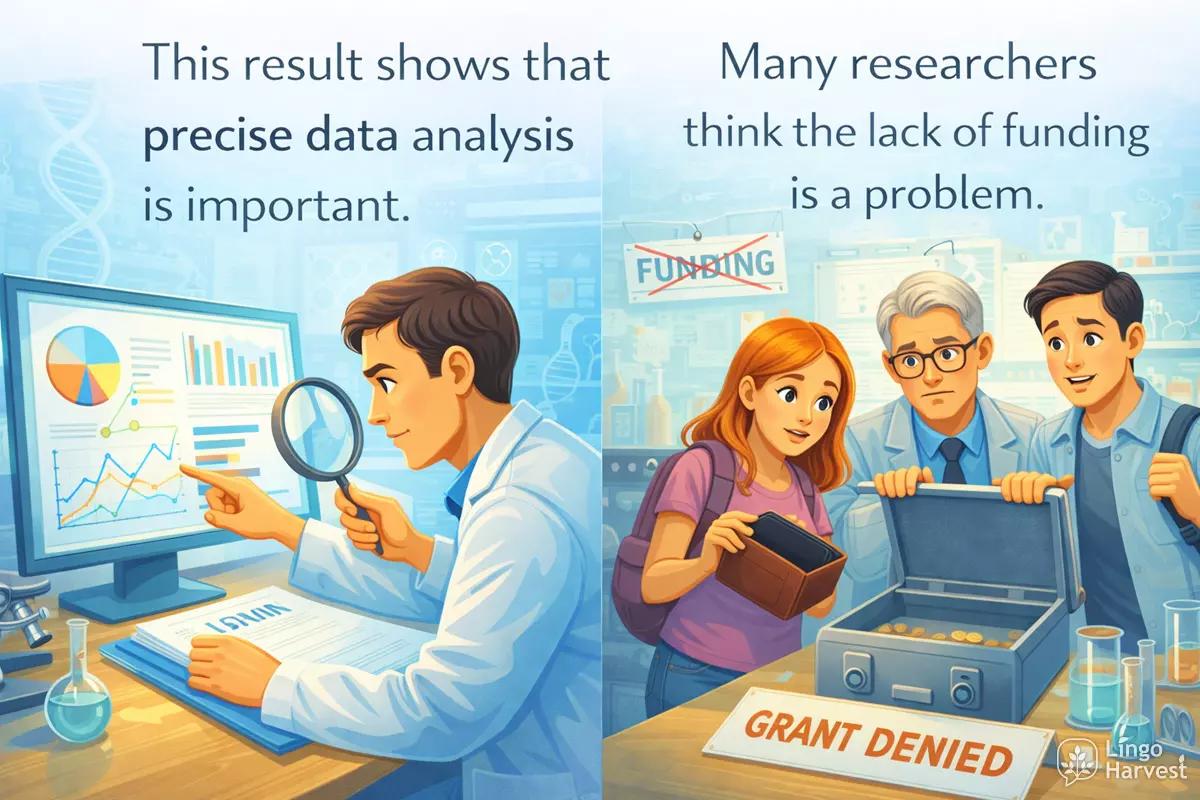
Below are examples of non-specific reference alongside improved versions that clarify meaning. Notice how specifying nouns or repeating key terms can make writing much clearer.
| Unclear Example | Clear Revision |
|---|---|
| This shows that it is important. | This result shows that precise data analysis is important. |
| People think this is a problem. | Many researchers think the lack of funding is a problem. |
| There are things to consider. | There are several factors to consider, such as cost and availability. |
| It affects them a lot. | The new policy affects local businesses a lot. |
| This made it worse. | The delay in delivery made the situation worse. |
How to avoid unclear reference
- Replace general words with specific nouns whenever possible
- Repeat the key term if a pronoun could be ambiguous
- Add a noun after “this,” “that,” or “these” (e.g., “this issue” instead of just “this”)
- Check that every pronoun clearly connects to a single noun
- Reread sentences to see if someone unfamiliar with the topic would understand the reference
By recognizing these patterns and practicing more precise language, writers can make their formal writing clearer and more effective.
Practice: revise sentences by replacing vague nouns
Clear and precise language makes formal writing stronger. Vague nouns—such as "thing," "stuff," "area," and "aspect"—often weaken academic or professional writing by making ideas less specific. Practicing how to identify and replace them helps develop more effective sentences.
Exercise: Make sentences more precise
Below are sentences containing imprecise nouns. Try to rewrite each one by substituting the vague word with a more specific term or phrase. This will help clarify meaning and improve overall quality.
- The thing that surprised me was the outcome of the experiment.
- She has a lot of stuff on her desk.
- This area of the report needs more detail.
- One aspect of the proposal is unclear.
- There are several factors to consider before making a decision.
- He discussed the issue during the meeting.
- We need to address this point in our analysis.
- This type of behavior is unacceptable.
- That matter should be resolved quickly.
- The field has changed rapidly in recent years.
Show answers
- The result that surprised me was the outcome of the experiment.
- She has a lot of documents and supplies on her desk.
- This section of the report needs more detail.
- One requirement of the proposal is unclear.
- There are several criteria to consider before making a decision.
- He discussed the budget concern during the meeting.
- We need to address this argument in our analysis.
- This form of behavior is unacceptable.
- That dispute should be resolved quickly.
- The discipline has changed rapidly in recent years.
Sample revisions: before and after
Compare original sentences containing vague nouns with their improved versions. Notice how the revised sentences are clearer and more informative.
| Original sentence | Revised sentence |
|---|---|
| The thing I liked most was the presentation. | The feature I liked most was the visual design of the presentation. |
| There are many issues to solve. | There are many technical problems to solve. |
| This aspect needs attention. | This timeline needs attention. |
| We studied different types of responses. | We studied different categories of survey responses. |
| She brought some stuff for the project. | She brought some reference books and materials for the project. |
| That area is important for our research. | That methodology is important for our research. |
| This element is missing from the plan. | This risk assessment is missing from the plan. |
| One part of the document is confusing. | One paragraph of the document is confusing. |
| The way they solved the problem was creative. | The approach they used to solve the problem was creative. |
| The subject needs to be explored further. | The impact of climate change needs to be explored further. |
Tips for replacing vague nouns
- Ask yourself what the vague word refers to—replace it with a precise term.
- Use vocabulary specific to your topic or field.
- If the noun is broad, specify its category (e.g., replace "issue" with "budget concern").
- When in doubt, rephrase to clarify the exact meaning you intend.
Regularly practicing how to refine sentences by specifying nouns will help you write with greater clarity and professionalism in all formal contexts.