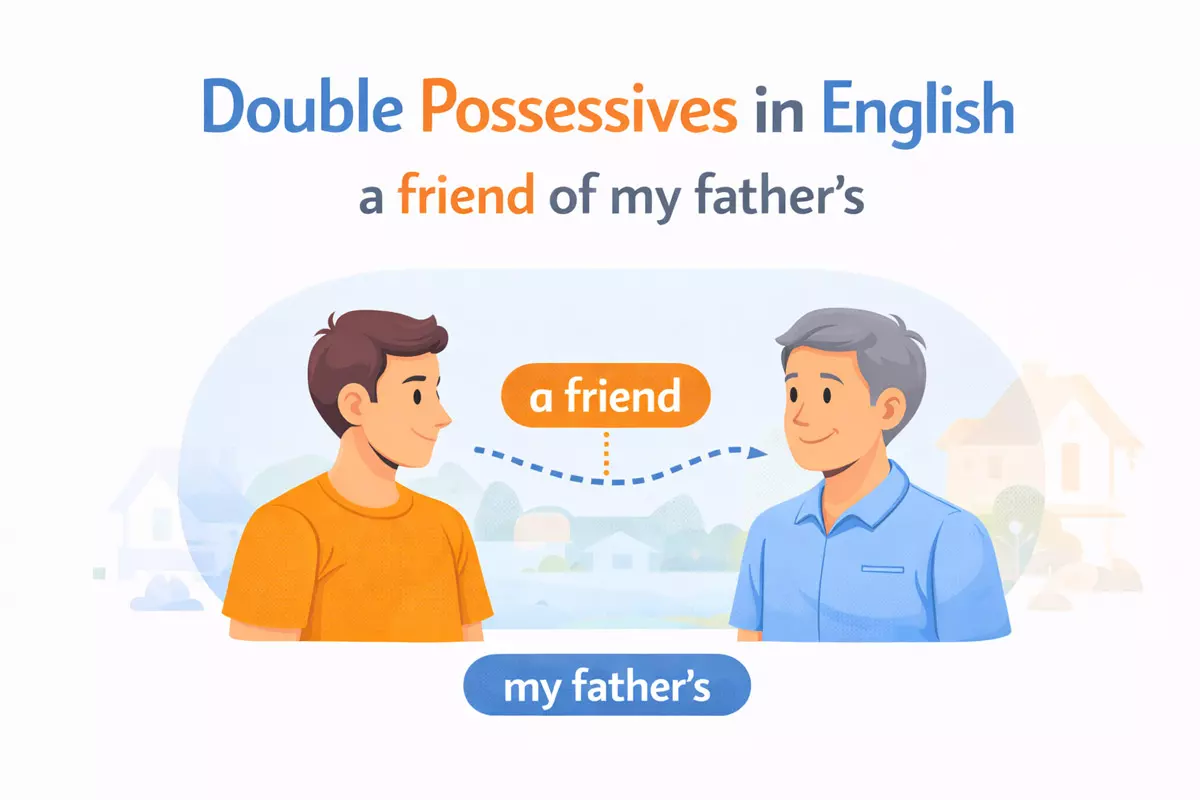
Double Possessives in English Like A Friend of My Father’s

 The article explains double possessives in English grammar, such as a friend of my father’s, and compares them to regular of-phrases. It also covers their meaning, usage, register, common learner mistakes, and offers practice on rewriting phrases.
- What double possessives are in English grammar
- Structure of forms like a friend of my father’s
- Difference between double possessives and of-phrases
- Meaning focus and selection in double possessives
- Register and frequency in modern usage
- Common learner errors with double possessives
- Practice: rewrite phrases using correct double possession
Have you ever noticed how English sometimes uses both "of" and an apostrophe-s to show possession, as in saying someone is an acquaintance of your brother’s? This construction, known as the double possessive, has an interesting history and serves a specific function in the language. It often helps clarify meaning, especially when talking about relationships or membership within a group, distinguishing between general and specific references, and adding nuance to how we express ownership or association.
What double possessives are in English grammar
Double possessives, sometimes called "double genitives," combine both the preposition "of" and the possessive ’s (apostrophe s) to show a relationship between two nouns. You’ll see this construction in sentences like "a friend of my father’s" or "a photo of John’s." Instead of simply using "my father's friend" or "John's photo," the double possessive adds an extra layer, often for clarity or emphasis.
How double possessives are formed
The pattern is straightforward: of + possessive noun/pronoun with ’s. This means you take a noun phrase, add "of," and then use a possessive form:
- a colleague of Sarah’s → A colleague of Sarah’s joined the project last week.
- a neighbor of ours → A neighbor of ours adopted a rescue dog yesterday.
- an old habit of his → An old habit of his returned during stressful times.
- a painting of the artist’s → A painting of the artist’s was displayed at the gallery.
- a suggestion of theirs → A suggestion of theirs helped improve the final design.
- a favorite book of mine → A favorite book of mine inspired my research topic.
- a photograph of the family’s → A photograph of the family’s was used in the presentation.
- a student of the professor’s → A student of the professor’s won a national award.
- a song of Bob Dylan’s → A song of Bob Dylan’s played softly in the background.
- a friend of theirs → A friend of theirs is moving abroad next month.
- a story of my grandmother’s → A story of my grandmother’s taught me patience and kindness.
- a discovery of Newton’s → A discovery of Newton’s changed how we understand physics.
- a former teacher of mine → A former teacher of mine encouraged me to study languages.
- a classmate of ours → A classmate of ours became a successful engineer.
- a pet of the neighbor’s → A pet of the neighbor’s barked all night.
- a comment of yours → A comment of yours made the audience laugh.
- a child of the couple’s → A child of the couple’s was born last winter.
- a fan of the team’s → A fan of the team’s shouted loudly during the match.
When and why double possessives are used
This structure is especially useful when you want to clarify that the noun is just one of many possible items or people related to the possessor. For example, "a friend of my father’s" means one among several friends belonging to your father, not his only friend. It can also help distinguish between meanings; for instance, "a photo of John" could mean a photo showing John, but "a photo of John’s" means a photo that John owns or took.
Key features of double possessives
- They are almost always used with animate possessors (people or animals), not inanimate ones.
- The construction can be used with both proper nouns and pronouns (e.g., "a friend of mine," "a cousin of Peter’s").
- Using the double genitive can avoid ambiguity and make sentences more precise.
Common mistakes to avoid
- ❌ Using with inanimate objects: "the handle of the door’s" is incorrect.
- ❌ Omitting the possessive ’s: "a friend of my father" is grammatical but does not use the double possessive.
- ❌ Redundancy: Don’t use it where a single possessive is clearer or where it adds confusion.
Structure of forms like a friend of my father’s
The double possessive construction, as seen in phrases such as “a friend of my father’s,” combines both the preposition “of” and the possessive ’s. This structure is distinct from standard possessives (“my father’s friend”) and simple “of” constructions (“a friend of my father”). It’s especially common when referring to one among several people or items connected to the possessor. The pattern typically follows: indefinite article + noun + of + possessive noun/pronoun + ’s.
Key elements of the double possessive
- Requires a possessive noun or pronoun (e.g., my father’s, John’s, hers).
- Usually used with a non-specific noun (a friend, a book, a cousin).
- Implies one of several, not the only one.
- Cannot be used for inanimate objects (❌ “a leg of the table’s”).
- Often conveys informality or familiarity.
Common patterns and variations

The double genitive appears with both people and certain animals, but rarely with things. Here are several examples that illustrate how this form is used in natural English:
- a colleague of Jane’s → A colleague of Jane’s helped organize the conference.
- an idea of yours → An idea of yours could improve the whole project.
- a neighbor of ours → A neighbor of ours invited us to a barbecue.
- a photograph of the children’s → A photograph of the children’s was displayed in the hallway.
- a story of his → A story of his inspired many young readers.
- a classmate of mine → A classmate of mine published a research article this year.
- a painting of Sarah’s → A painting of Sarah’s was featured in the exhibition.
- a friend of the teacher’s → A friend of the teacher’s visited the school today.
- a suggestion of theirs → A suggestion of theirs solved the scheduling problem.
- a relative of ours → A relative of ours works for an international bank.
- a former student of Dr. Lee’s → A former student of Dr. Lee’s became a professor.
- a dog of the neighbor’s → A dog of the neighbor’s escaped into our garden.
- a client of Mr. Brown’s → A client of Mr. Brown’s requested additional information.
- a partner of hers → A partner of hers attended the event with her.
- a book of Tom’s → A book of Tom’s won a regional award.
- a rival of the champion’s → A rival of the champion’s challenged him to a rematch.
- an acquaintance of my mother’s → An acquaintance of my mother’s recommended this doctor.
- a supporter of the team’s → A supporter of the team’s bought season tickets.
Comparing double possessive to other possessive constructions
The table below shows the difference between double possessive structures, simple possessives, and “of” phrases, highlighting their use and subtle differences in meaning.
| Form | Example | Typical Meaning |
|---|---|---|
| Double Possessive | a friend of my father’s | One of several friends belonging to my father |
| Simple Possessive | my father’s friend | Usually a specific friend; possibly the only one meant |
| Of-phrase (no possessive ’s) | a friend of my father | More formal or literary; less common in modern English |
When to use this form
Double genitives are most natural when you want to emphasize that the relationship or item is one among several, or when the possessor is a pronoun or a proper name. This structure is rarely used with inanimate objects or abstract nouns, and tends to sound awkward if forced into those contexts. For clarity and naturalness, reserve it for people, animals, or groups with multiple possible connections.
Difference between double possessives and of-phrases
Understanding how double possessives work compared to simple “of” constructions can help clarify meaning and avoid ambiguity. While both forms express relationships—often ownership or association—they aren’t always interchangeable, and each tends to be used in different contexts.
When to Use Double Possessives
Double possessives (such as “a friend of my father’s”) combine “of” with a possessive form (like “my father’s”). This structure is commonly used when talking about one among several possible items or people connected to someone. It emphasizes selection or membership in a group, not unique ownership.
- “A painting of John’s” (one of the paintings belonging to John)
- “A colleague of Sarah’s” (one of Sarah’s colleagues)
- “A suggestion of the committee’s” (one among several suggestions from the committee)
- “A photo of Lisa’s” (one of Lisa’s photos)
- “A neighbor of ours” (one of our neighbors)
- “A story of Mark’s” (one of Mark’s stories)
- “A student of Dr. Lee’s” (one of Dr. Lee’s students)
- “A habit of his” (one of his habits)
- “A discovery of theirs” (one of their discoveries)
- “A friend of the family’s” (one of the family’s friends)
Using Simple “Of” Phrases
Of-phrases (like “the color of the car”) are more direct and usually indicate a specific, unique relationship or a part-whole connection. They don’t use the possessive form with “’s” and tend to sound more formal or neutral.
- The roof of the house → The roof of the house needs repair after the storm.
- The end of the movie → The end of the movie surprised everyone in the audience.
- The price of the ticket → The price of the ticket increased this year.
- The name of the city → The name of the city comes from an ancient language.
- The legs of the chair → The legs of the chair are made of solid wood.
- The pages of the book → The pages of the book turned yellow over time.
- The manager of the store → The manager of the store hired three new employees.
- The history of the school → The history of the school dates back to 1890.
- The cover of the magazine → The cover of the magazine features a famous athlete.
- The flavor of the soup → The flavor of the soup improved after adding spices.
Key Distinctions
The main distinction is that double possessives highlight that the noun is one among several, whereas “of” phrases often imply uniqueness or a defining characteristic. Double possessives are typically used with people or animate nouns, and rarely with inanimate objects.
| Structure | Typical Use & Example |
|---|---|
| Double Possessive (of + possessive ’s) |
Emphasizes one among several associated items or people. “A friend of my father’s” (one of his friends) |
| Simple Of-Phrase (of + noun) |
Indicates direct relationship or unique association. “The door of the house” (the house’s door) |
Summary
In summary, double possessives are best for highlighting non-unique relationships, especially with people, while of-phrases are more suitable for unique or defining characteristics. Choosing the right structure helps make your meaning clear and natural in English.
Meaning focus and selection in double possessives
Double possessives in English, such as “a friend of my father’s,” highlight a nuanced relationship between the possessor and the possessed. This construction is used when speakers want to emphasize one among several possible items or people associated with the possessor. For instance, “a picture of John’s” suggests one picture that belongs to John, possibly among several, and subtly shifts attention to the item as part of a set.
Focus on specificity and indefiniteness
This structure typically appears with indefinite determiners (“a,” “some,” “any”) and when the noun refers to one of multiple possible entities. The double possessive is rarely used with unique or singular relationships, where the ownership or association is exclusive.

- A colleague of mine (one among several colleagues I have)
- Some ideas of hers (not all her ideas, but a subset)
- Any students of Professor Lee’s (any, not necessarily all, students taught by Professor Lee)
- A piece of cake of yours (one piece from your cake, possibly among others)
- A friend of theirs (one friend, not the only one)
- Some books of Tom’s (part of Tom’s collection, not the whole)
- A suggestion of yours (one suggestion you gave)
- An enemy of the king’s (one among several enemies)
- A photograph of Anna’s (one photograph owned by Anna)
- A teacher of ours (one of our teachers)
- A neighbor of theirs (not their only neighbor)
- Some paintings of Picasso’s (some, not all, paintings by Picasso)
Comparison with single possessives
While both single (“my father’s friend”) and double possessives can refer to the same relationship, their focus is slightly different. The single form often implies a more definite, possibly unique connection, while the double structure tends to highlight selection among a group or set.
| Form | Typical Focus | Example |
|---|---|---|
| Single Possessive | Definite, possibly unique | My father’s friend (the friend we know or have mentioned) |
| Double Possessive | Indefinite, one among several | A friend of my father’s (one of his friends, not unique) |
| Single Possessive | Whole set or unique item | Picasso’s paintings (all paintings by Picasso) |
| Double Possessive | Subset or selection | Some paintings of Picasso’s (a selection from his works) |
Summary of selection and meaning
Double possessives are especially useful for drawing attention to a particular member of a group, emphasizing that the relationship is not exclusive. They often carry a nuance of partiality or selection, making them valuable for situations where speakers want to avoid implying uniqueness or totality. The choice between single and double possessive forms depends on whether you want to express a specific, unique relation or highlight one entity among several possibilities.
Register and frequency in modern usage
Double possessives, such as “a friend of my father’s,” remain common in everyday English, especially in informal spoken and written contexts. This construction is often preferred for clarity and emphasis, particularly when the possessor is a person and the relationship is specific or familiar. Although sometimes considered redundant, double possessives are rarely marked as incorrect by native speakers, and their use persists in both American and British English.
Contexts and registers
The double possessive tends to appear more in casual conversation, personal letters, and informal writing. In contrast, formal academic or legal texts may favor alternative structures (“a friend of my father” or “my father’s friend”) to avoid redundancy or perceived informality. However, even in professional environments, you’ll still encounter this pattern, especially when the speaker wants to highlight one among several possible relationships.
- Spoken English: “That’s a cousin of Sarah’s.”
- Emails and messages: “A neighbor of mine is moving.”
- Literature: Double possessives are found in both classic and contemporary works.
- Academic writing: Less frequent, but not absent—sometimes used for stylistic variety.
- Journalism: Occasionally appears, often in quotations or informal columns.
Frequency and variation
Corpus studies suggest that double possessives are especially popular when the possessed noun is indefinite (“a friend of John’s”) or where ambiguity might arise without the possessive form. The construction is less frequent with inanimate objects or abstract nouns.
| Example | Register / Notes |
|---|---|
| A friend of mine | Very common in spoken and informal writing |
| A colleague of hers | Frequent in professional but friendly contexts |
| A painting of Picasso’s | Used for works by people; less formal than “a painting by Picasso” |
| A theory of Darwin’s | Occasional in academic writing, emphasizes selection among several |
| A neighbor of ours | Typical in everyday conversation |
Common patterns and alternatives
Writers and speakers often choose between double possessives and simpler forms based on context and clarity. Here are some typical scenarios:
- To specify one among several: “a student of the professor’s” (vs. “a student of the professor” which might imply belonging or relation)
- With personal pronouns: “a friend of mine” (preferred over “my friend” when the person is not unique)
- To avoid ambiguity: “a painting of John’s” (a painting owned/created by John, not a painting depicting John)
- With plural possessors: “a friend of the Smiths’”
- Rare with inanimates: “a leg of the table” (not “a leg of the table’s” ❌)
Overall, double possessives are an active and flexible part of contemporary English, valued for their ability to convey nuance and precise relationships, especially in less formal registers.
Common learner errors with double possessives
Learners of English often trip up on double possessive structures because they seem redundant or because the pattern doesn’t exist in their native language. Confusion can arise over word order, unnecessary repetition, and knowing when the construction is actually required. Sometimes, people even try to use double possessives with non-personal nouns or with pronouns, which leads to unnatural or incorrect sentences.
Typical Mistakes and Misunderstandings
- Omitting the apostrophe-s (’s) after the possessor: a friend of my father instead of a friend of my father’s.
- Adding double possessives to inanimate objects: a leg of the table’s (incorrect).
- Using the structure with pronouns that don’t allow it: a friend of mine’s (incorrect), instead of a friend of mine.
- Doubling the possessive unnecessarily: a friend of my father’s friend’s.
- Confusing meaning: believing a picture of my sister and a picture of my sister’s always mean the same thing (they often don’t).
- Forgetting that not all nouns take double possessives (especially abstract or collective nouns).
- Applying the pattern to place names or organizations: a member of the London’s (incorrect).
- Translating literally from another language, leading to unidiomatic English.
- Mixing up “of” phrases with possessive ’s: the car of John’s vs. John’s car.
- Using double possessives with definite articles: a friend of the teacher’s (sometimes correct, but learners often misuse it).
- Attempting double possessives with plural possessors incorrectly: a friend of the Smiths’ (correct), but a friend of the Smith’s (incorrect for plural).
- Leaving out the article “a”: friend of my father’s instead of a friend of my father’s.
- Constructing ambiguous sentences by misplacing possessives: a story of Mark’s brother (unclear meaning).
Double Possessive vs. Other Possessive Forms
Learners sometimes wonder when to use a double possessive and when a simple possessive or “of” structure is enough. The table below compares similar expressions to highlight when double possessives are natural and when they’re not:
| Expression | Typical Usage & Notes |
|---|---|
| a friend of my father’s | One of my father’s friends; double possessive is natural and common. |
| a picture of my sister | The picture shows my sister’s image (not owned by her necessarily). |
| a picture of my sister’s | A picture belonging to my sister; double possessive shows possession, not subject. |
| a leg of the table | Correct for inanimate objects; never use double possessive here. |
| a friend of mine | Correct with pronouns; do not add another ’s (a friend of mine’s is wrong). |
Tips for Avoiding Errors
When in doubt, remember that double possessives are almost always used with people or animals, rarely with objects or places. If you can replace “of” with “belonging to,” the double possessive might be correct. With pronouns, skip the extra ’s. Pay attention to context and meaning, not just the structure.
Practice: rewrite phrases using correct double possession
Understanding how to use double possessives correctly takes practice. Below, you’ll find exercises to help you transform common phrases into their proper double possessive forms. This section uses a mix of examples and guided tasks to reinforce the pattern: “a [noun] of [possessive noun/pronoun]’s.”
Transform the following phrases
Rewrite each phrase so it uses a double possessive structure. Remember, the pattern is usually: a/an/the + noun + of + possessive noun/pronoun + ’s.
- A friend belonging to my brother
- The idea proposed by Susan
- An old photograph owned by my grandparents
- The novel written by Charles
- A painting from Anna
- The advice that came from my uncle
- A story told by one of the children
- The bag that belongs to Jane
- A suggestion from your colleague
- A book that is part of the library’s collection
Show answers
- A friend of my brother’s
- An idea of Susan’s
- An old photograph of my grandparents’
- A novel of Charles’s (or Charles’)
- A painting of Anna’s
- Advice of my uncle’s
- A story of one of the children’s
- A bag of Jane’s
- A suggestion of your colleague’s
- A book of the library’s
Identifying incorrect forms
Check which sentences below do not use the double possessive correctly. If it’s correct, mark ✅; if not, mark ❌.
- A photo of my friend’s
- A friend of my friend
- A story of my father’s
- A brother of John
- A neighbor of Sarah’s
- A colleague of Emma
- A painting of the artist’s
- A student of the professor
- A cousin of Mark
- A song of the band’s
Show answers
- A photo of my friend’s ✅
- A friend of my friend ❌ (should be: a friend of my friend’s)
- A story of my father’s ✅
- A brother of John ❌ (should be: a brother of John’s)
- A neighbor of Sarah’s ✅
- A colleague of Emma ❌ (should be: a colleague of Emma’s)
- A painting of the artist’s ✅
- A student of the professor ❌ (should be: a student of the professor’s)
- A cousin of Mark ❌ (should be: a cousin of Mark’s)
- A song of the band’s ✅
Common patterns: double possessive forms
Here are several typical structures you’ll encounter. Study these to help recognize and use the pattern naturally:
- A colleague of hers
- A student of the professor’s
- A cousin of ours
- A business partner of Tom’s
- A friend of the family’s
- A neighbor of theirs
- A client of the company’s
- A classmate of mine
- A favorite painting of his
- An invention of Edison’s
- A suggestion of yours
- A pet of the children’s
- A teacher of Emma’s
- A supporter of the team’s
- A member of the board’s
Practice by creating your own sentences using these models, and pay attention to how double possession clarifies ownership or association.