Abstract Nouns of Obligation and Permission in Formal English

 The article clarifies the meaning of abstract obligation and permission nouns such as requirement, duty, consent, and authorization, compares them to verb-based forms, discusses their use in legal writing, highlights typical errors, and provides sentence practice.
- What abstract obligation and permission nouns express
- Common obligation nouns like requirement and duty
- Permission-related nouns like consent and authorization
- Difference between noun-based and verb-based obligation
- Use of these nouns in legal and formal writing
- Typical learner mistakes with obligation nouns
- Practice: form formal sentences using obligation and permission nouns
Grasping how duty and allowance are conveyed through abstract concepts can significantly improve your mastery of formal English. By examining these nuanced terms, you gain insight into the delicate balance between obligation and permission that shapes communication in professional and academic settings. This understanding enables you to interpret and construct language with greater precision, ensuring your messages are both clear and appropriately aligned with the expectations of formal discourse.
What abstract obligation and permission nouns express
Abstract nouns like obligation, duty, permission, and authorization allow us to talk about rules, requirements, and allowances in a formal or impersonal way. Instead of focusing on who must or may do something, these nouns highlight the state or condition itself. This can make statements sound more objective, which is especially useful in legal, academic, or official contexts.
How these nouns function in sentences
Nouns of necessity and allowance serve to generalize or formalize statements. For example, instead of saying, "You must submit the form," one might write, "Submission of the form is a requirement." This shifts the focus from the person to the action or rule itself, creating a sense of impartiality.
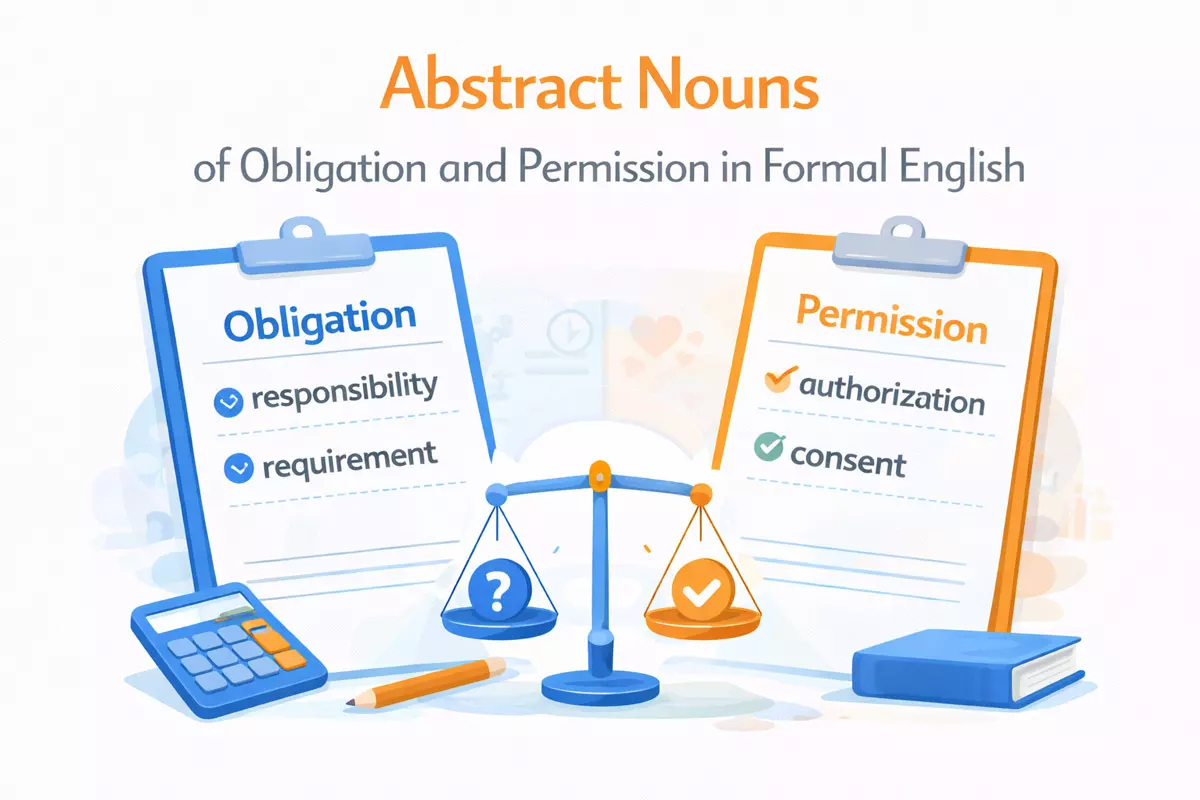
- Obligation: requirement, necessity, duty, mandate, compulsion
- Permission: authorization, allowance, consent, license, approval
- Prohibition: restriction, ban, exclusion, disallowance, denial
Expressing levels of formality and authority
The choice of noun can indicate how strong or official the rule is. For instance, obligation suggests a binding requirement, while permission signals the presence of an official allowance. These nouns are often paired with verbs like grant, impose, fulfill, or require to further clarify the relationship.
| Noun | Typical Usage in Formal English |
|---|---|
| Obligation | There is an obligation to report all incidents. |
| Permission | Permission for access must be obtained in advance. |
| Requirement | Completion of the course is a requirement for graduation. |
| Authorization | Authorization is required before proceeding. |
| Prohibition | The prohibition of smoking is strictly enforced. |
| Consent | Written consent is necessary for participation. |
Summary of communicative effects
Using abstract nouns for necessity or allowance helps writers and speakers distance themselves from commands or permissions. This approach reduces personal involvement and often increases the perceived authority of the statement. It is common in contracts, policy documents, academic writing, and regulations, where clarity and neutrality are valued.
Common obligation nouns like requirement and duty
In formal English, certain abstract nouns express the idea of obligation—something that must be done, expected by rules, laws, or ethical standards. Words such as requirement, duty, obligation, and responsibility are frequently used in professional, legal, and academic contexts to describe what is necessary or expected.
Typical nouns expressing obligation
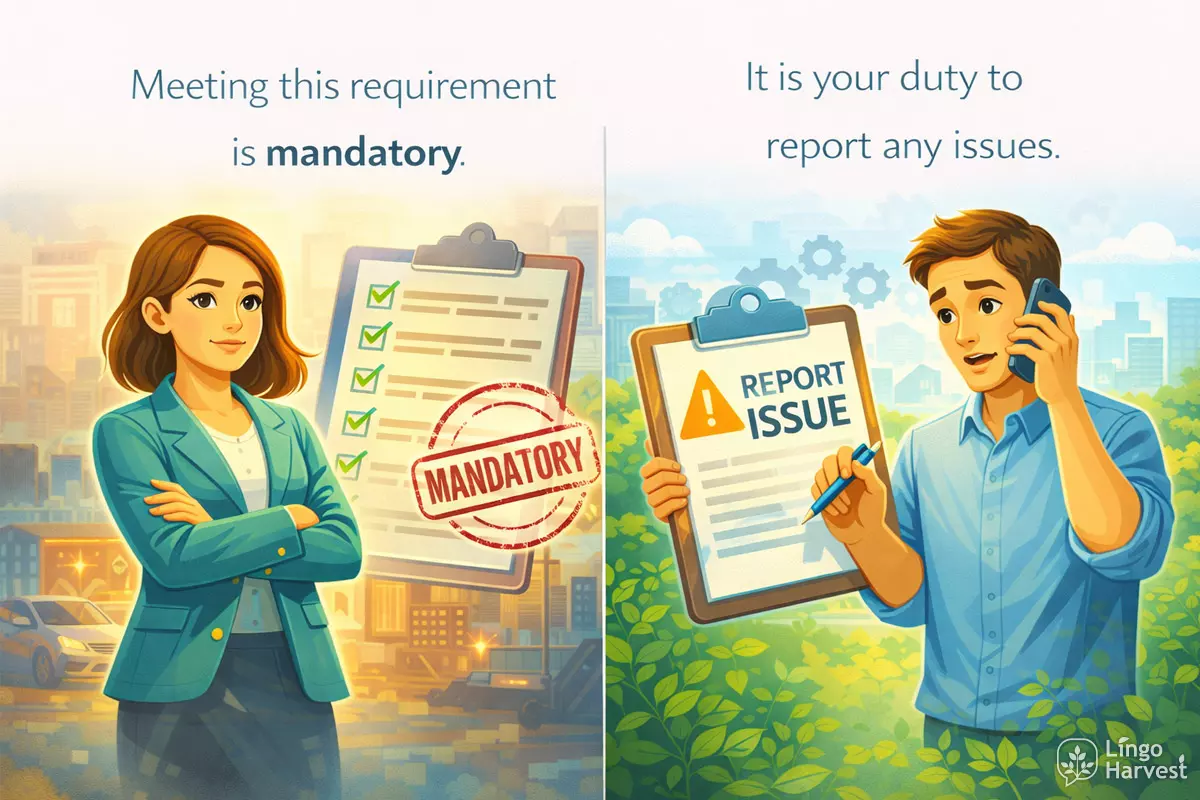
- Requirement: A condition or rule that must be satisfied (e.g., "Meeting this requirement is mandatory.").
- Duty: A moral or legal task, often tied to a role (e.g., "It is your duty to report any issues.").
- Obligation: A binding commitment, sometimes resulting from a contract or law (e.g., "The company has an obligation to protect data.").
- Responsibility: Accountability for a task or decision (e.g., "You bear responsibility for ensuring safety.").
- Mandate: An official order or commission (e.g., "The new mandate requires annual audits.").
- Liability: Legal responsibility for something, especially damages (e.g., "There is liability for any breaches.").
- Commitment: A promise or firm decision to act (e.g., "Her commitment to the project is clear.").
- Burden: Something difficult or unpleasant that one is expected to bear (e.g., "The burden of proof lies with the prosecution.").
- Charge: An assigned duty or responsibility (e.g., "He was given charge of the investigation.").
- Onus: The responsibility for something (e.g., "The onus is on the applicant to provide evidence.").
How obligation nouns function in sentences
These nouns often appear with verbs like have, bear, fulfill, or meet. They can be the subject ("The requirement is clear.") or the object ("She fulfilled her obligation."). The phrase "It is the duty of..." is common in formal writing.
Comparison of common obligation nouns
| Noun | Typical Context | Example Sentence |
|---|---|---|
| Requirement | Rules, conditions, regulations | There is a requirement to submit the form by Friday. |
| Duty | Moral, legal, professional roles | It is the duty of every citizen to obey the law. |
| Obligation | Contracts, law, agreements | The company has an obligation to pay severance. |
| Responsibility | Accountability, tasks, management | Supervisors have responsibility for safety checks. |
| Mandate | Official orders, policy | The new mandate prohibits plastic bags. |
| Liability | Legal, financial | Failure to comply creates liability for damages. |
| Onus | Legal, formal argument | The onus is on the defendant to provide evidence. |
Patterns and usage tips
- Use requirement for official rules or technical standards.
- Duty and obligation often suggest moral or ethical necessity.
- Responsibility is broader and applies to tasks, roles, or general accountability.
- In legal writing, liability and onus are common for describing who is answerable.
Learning to distinguish and use these nouns accurately helps make your formal English precise and effective, especially when discussing rules, expectations, or required actions.
Permission-related nouns like consent and authorization
Nouns that express the idea of permission serve a crucial role in formal English, especially in legal, academic, and official contexts. These nouns encapsulate the granting or withholding of approval, and they often appear in policies, agreements, and institutional communications. Understanding the nuances of these terms helps clarify who has the power to allow or deny actions, and under what circumstances.
Common permission-based abstract nouns
Several nouns are used to convey the concept of allowing or authorizing an action. Each has its own shade of meaning and typical contexts:
- Consent – voluntary agreement or permission, often personal or legal
- Authorization – official approval, usually from an authority or institution
- Permission – general allowance to do something
- Approval – positive assessment permitting an action
- License – formal, often legal, permission (e.g., driver’s license)
- Accreditation – official recognition of ability or status
- Endorsement – public or formal support allowing an action
- Exemption – official permission not to follow a rule
- Clearance – authorization after checks or reviews
- Warrant – formal written authorization, often legal
- Admission – permission to enter or join
- Sanction – official permission, or sometimes a penalty depending on context
- Leave – formal permission to be absent (e.g., “leave of absence”)
- Privilege – a special right or permission granted to some
- Dispensation – special exemption from a general rule
- Allowance – permitted amount or permission to do something
Subtle distinctions in usage
While many of these words overlap in meaning, their use depends on context and formality. For example, consent emphasizes voluntary agreement, often in personal or medical scenarios, while authorization typically refers to official, institutional approval. License and permit both indicate formal permission, but a license often implies ongoing permission, whereas a permit might be temporary or specific.
| Noun | Typical Context/Example |
|---|---|
| Consent | “Parental consent is required for minors.” ✅ Voluntary, often legal or medical. |
| Authorization | “You need authorization to access this area.” ✅ Institutional or official. |
| License | “She obtained a driver’s license.” ✅ Formal, often ongoing permission. |
| Exemption | “An exemption from taxes was granted.” ✅ Permission not to comply with a rule. |
| Clearance | “Security clearance is mandatory.” ✅ Approval after a review process. |
| Leave | “He requested leave of absence.” ✅ Permission to be away from duties. |
| Privilege | “Library privileges have been revoked.” ✅ Special permission, sometimes conditional. |
| Sanction | “The project received official sanction.” ✅ Formal approval (can also mean penalty). |
Patterns and collocations
These nouns often appear in set phrases and collocations. For example:
- Seek authorization → Researchers must seek authorization before accessing confidential records.
- Grant consent → Participants can grant consent by signing the online form.
- Obtain a license → The company must obtain a license to operate in this region.
- Request permission → Students need to request permission to use the laboratory after hours.
- Receive clearance → The team cannot begin the trial until they receive clearance from the ethics committee.
- Apply for exemption → Small businesses may apply for exemption from the new tax rules.
- Issue a permit → Local authorities issue a permit for all construction projects.
- Withhold approval → The review board decided to withhold approval until further data are provided.
Recognizing the subtle differences among these abstract nouns ensures clarity and precision in formal English, especially when defining rights, responsibilities, and boundaries.
Difference between noun-based and verb-based obligation
Understanding how English expresses obligation can help you choose the most precise or formal style for your message. Two main approaches are common: using abstract nouns (such as “obligation,” “requirement,” or “duty”) and using modal verbs or verb phrases (like “must,” “have to,” or “be required to”). Each method creates a different tone, level of formality, and sometimes clarity.
Noun-based obligation: Abstract and formal
Noun-based forms typically rely on abstract nouns to express the idea of necessity or duty. These structures are frequent in legal, academic, and official documents because they add formality and often depersonalize responsibility. For example:
- There is an obligation to submit the form on time.
- The requirement for safety equipment is strict.
- Your duty is to report any incidents.
- Compliance with the rules is mandatory.
Noun-based expressions often use passive voice, which can make statements less direct but more objective.
Verb-based obligation: Direct and flexible

Verb-based constructions use modals, phrasal verbs, or other verbal forms to indicate necessity. These are common in everyday conversation and less formal writing. They are generally more direct and can be personalized easily:
- You must submit the form on time.
- Employees have to wear safety equipment.
- You are required to report any incidents.
- Everyone should comply with the rules.
Verb-based forms are often clearer about who holds the responsibility, making them practical for instructions and spoken English.
Comparing structures and usage
The table below summarizes some key contrasts between these two approaches, focusing on structure, tone, and typical contexts.
| Feature | Noun-based obligation | Verb-based obligation |
|---|---|---|
| Typical structure | Subject + abstract noun + (to-infinitive or clause) e.g. “The obligation to…” |
Subject + modal/verb phrase + base verb e.g. “You must…” |
| Formality | More formal, impersonal | Less formal, direct |
| Common contexts | Legal, academic, policies | Instructions, conversation |
| Clarity of agent | Often ambiguous or general | Usually clear and specific |
Summary of key patterns
Here are some frequently used patterns and vocabulary for each style: Noun-based:
- There is an obligation to… → There is an obligation to protect participants’ personal data.
- The requirement for… → The requirement for written consent is clearly stated in the guidelines.
- A duty to… → Universities have a duty to provide a safe learning environment.
- Compliance with… → Compliance with ethical standards is essential in medical research.
- Responsibility for… → The responsibility for data security lies with the research team.
- Necessity of… → The necessity of regular monitoring has been widely recognised.
- Expectation of… → There is an expectation of transparency in public spending.
- Mandate to… → The committee has a mandate to review all new proposals.
- Prohibition against… → The policy includes a prohibition against sharing login details.
- Permission for… → Permission for recording interviews must be obtained in advance.
- Authorization to… → Authorization to use the database is granted by the institution.
- Entitlement to… → Employees have an entitlement to paid annual leave.
Verb-based:
- Must → All participants must sign the consent form before the study begins.
- Have to → Researchers have to follow strict safety procedures in the lab.
- Should → Students should reference all sources accurately in their essays.
- Ought to → The government ought to prioritise investment in public health.
- Need to → We need to update the policy to reflect recent changes.
- Be required to → Staff are required to complete the training every year.
- Be supposed to → The survey responses are supposed to remain anonymous.
- Be allowed to → Participants are allowed to withdraw from the study at any time.
- May → Researchers may request additional funding if necessary.
- Can → Students can submit their assignments through the online platform.
- Be expected to → Supervisors are expected to provide regular feedback.
Choosing between these forms depends on your audience and purpose. Use noun-based expressions for formal or impersonal contexts, and verb-based forms for directness and clarity.
Use of these nouns in legal and formal writing
Abstract nouns related to obligation and permission are central to the language of statutes, contracts, and official documents. Words such as "requirement," "authorization," "prohibition," and "entitlement" allow writers to express complex legal concepts concisely and with precision. These terms help distinguish between what is mandatory, what is optional, and what is forbidden, ensuring clarity and reducing ambiguity in legal contexts.
Common abstract nouns for obligation and permission
Writers in legal and formal fields rely on a set of standard nouns to define duties and permissions. Here are some frequently used examples:
- Obligation → The organisation has an obligation to protect users’ personal information.
- Requirement → Meeting the language requirement is essential for admission to the programme.
- Permission → Written permission is needed to use these materials in a public presentation.
- Authorization → Authorization from the ethics committee is required before data collection begins.
- Prohibition → The policy includes a strict prohibition on sharing confidential records.
- Entitlement → Employees have an entitlement to receive clear information about their contracts.
- Exemption → Certain charities may receive an exemption from paying this type of tax.
- Restriction → There is a restriction on the number of participants who can join the study.
- Consent → Informed consent must be obtained from all participants.
- Compliance → Full compliance with safety regulations is monitored regularly.
- Mandate → The agency’s mandate is to ensure fair treatment for all applicants.
- Liability → The company accepts liability for any damage caused by faulty equipment.
- Discretion → The committee has discretion to extend the deadline in special cases.
- Sanction → Failure to follow the code of conduct may result in a formal sanction.
- Waiver → Participants signed a waiver acknowledging the potential risks.
- Accord → The two countries signed an accord to strengthen economic cooperation.
- Immunity → Diplomatic immunity protects certain officials from local prosecution.
- Forbearance → The bank showed forbearance by delaying repayment during the crisis.
- Obedience → Obedience to the court’s order was strictly enforced.
- Privilege → Access to these internal documents is a limited privilege.
These nouns often appear in legal documents as subjects or objects, forming the backbone of many clauses and stipulations.
Typical sentence patterns in legal drafting
Writers tend to use fixed structures when incorporating these nouns into formal texts. For example:
- "The obligation to pay shall arise on delivery."
- "No permission is granted for commercial use."
- "Failure to meet the requirement results in exclusion."
- "The authorization must be in writing."
- "Any prohibition must be expressly stated."
Such patterns help make documents easier to interpret and enforce.
Comparison of obligation and permission nouns
Below is a structured overview of how nouns denoting obligation differ from those indicating permission, including sample contexts:
| Obligation Nouns | Permission Nouns | Typical Context |
|---|---|---|
| Obligation | Permission | Contracts, policies |
| Requirement | Authorization | Licensing, compliance |
| Mandate | Exemption | Statutory provisions |
| Liability | Privilege | Legal rights and duties |
| Compliance | Consent | Regulatory frameworks |
| Prohibition | Waiver | Restrictions, exceptions |
Nuances in usage
Precision is crucial when choosing between these nouns. For instance, "requirement" implies a condition that must be met, while "authorization" grants a specific right or power. Misuse can lead to legal disputes or misinterpretation, so legal drafters select terms with care to match the intended meaning. In summary, abstract nouns of obligation and permission are foundational to legal and formal English, enabling the accurate articulation of duties, rights, restrictions, and allowances. Their correct application ensures legal texts remain clear, enforceable, and unambiguous.
Typical learner mistakes with obligation nouns
Misusing nouns related to duty and necessity is common for English learners, especially in more formal contexts. Many confuse which abstract noun fits a sentence, or mix up countable and uncountable forms. Problems also appear with article usage and prepositions. Understanding these pitfalls helps achieve more accurate and natural expression.
Common issues with abstract nouns of duty
Learners often select the wrong noun for a situation, such as using "obligation" when "duty" or "requirement" is more appropriate. Another frequent error is treating uncountable nouns as if they were countable, or vice versa. For instance, "an obligation" is correct, but "a necessity" often is not, unless referring to a specific item.
- Using "a necessity" for general needs:
Incorrect: "You have a necessity to follow the rules."
Correct: "You have a duty/obligation to follow the rules." / "It is necessary to follow the rules." - Mixing up "responsibility" and "obligation":
Incorrect: "He took the obligation for the project."
Correct: "He took responsibility for the project." - Plurals for uncountable nouns:
Incorrect: "They have many responsibilities and obligationses."
Correct: "They have many responsibilities and obligations." - Forgetting articles with countable nouns:
Incorrect: "Obligation to pay taxes is clear."
Correct: "The obligation to pay taxes is clear." - Confusing "requirement" with "request":
Incorrect: "The request to submit documents is strict."
Correct: "The requirement to submit documents is strict." - Wrong prepositions:
Incorrect: "Obligation for pay taxes."
Correct: "Obligation to pay taxes." - Redundant constructions:
Incorrect: "It is an obligation necessary to..."
Correct: "It is necessary to..." or "There is an obligation to..." - Using "must" or "should" where a noun is needed:
Incorrect: "Your must to attend is appreciated."
Correct: "Your obligation to attend is appreciated." - Confusing "necessity" with "need":
Incorrect: "There is a necessity for a break."
Correct: "There is a need for a break." - Overusing "obligation" in informal settings when "responsibility" or "task" fits better.
Comparing similar nouns: subtle distinctions
Many abstract nouns of duty look interchangeable but are not. For example, "obligation" often implies a formal or legal requirement, while "responsibility" refers to a moral or assigned role. "Requirement" signals an external rule, and "necessity" refers to something essential, not always imposed by rules.
| Term | Typical Use/Meaning | Example Sentence |
|---|---|---|
| Obligation | Formal, legal or moral duty | You have an obligation to pay taxes. |
| Responsibility | Moral or assigned duty | It is your responsibility to lock the door. |
| Requirement | Something officially demanded | Attendance is a requirement for passing. |
| Necessity | Something essential, not always imposed | Food is a necessity for survival. |
Summary of trouble spots
To avoid mistakes, pay attention to countability, article use, prepositions, and the subtle differences in meaning among these nouns. Practice with real examples helps reinforce correct usage and prevents common errors.
Practice: form formal sentences using obligation and permission nouns
When writing in formal English, abstract nouns such as "obligation," "requirement," "permission," and "authorization" are often used to express necessity or allowability in a precise, impersonal way. Practicing these structures helps you develop a more academic and professional tone.
Sample Sentence Patterns
- There is an obligation to comply with all safety regulations.
- Entry is subject to authorization by the security office.
- The use of mobile phones is under strict prohibition in the laboratory.
- No permission has been granted for late submissions.
- Access to confidential files requires consent from the manager.
- Payment of fees is a requirement for enrollment.
- Smoking is not allowed due to health restrictions.
- There is no allowance for personal exceptions.
- Attendance at the meeting is a necessity for all staff.
- Leaving the premises without notice is a violation of company policy.
- Guests may only enter with proper authorization.
- The compulsion to report incidents is outlined in the handbook.
Task: Transform Informal to Formal Using Nouns
Rewrite the following informal sentences using an appropriate obligation or permission noun:
- You must wear a helmet in the factory.
- We can use the meeting room after 5 PM.
- Do not eat in the computer lab.
- They need to submit the report by Monday.
- You are not allowed to park here.
- Students may access the database from home.
- Employees must follow the safety guidelines at all times.
- Visitors should not enter the laboratory without a supervisor.
- Researchers have to obtain approval from the ethics committee.
- Participants can withdraw from the study at any time.
Show answers
- There is an obligation to wear a helmet in the factory.
- Permission has been granted to use the meeting room after 5 PM.
- There is a prohibition against eating in the computer lab.
- Submission of the report by Monday is a requirement.
- There is a restriction on parking here.
- Students have permission to access the database from home.
- There is an obligation for employees to follow the safety guidelines at all times.
- There is a prohibition on visitors entering the laboratory without a supervisor.
- Approval from the ethics committee is a requirement.
- Participants have the right to withdraw from the study at any time.
Comparing Obligation and Permission Nouns
| Obligation Noun Example | Permission Noun Example |
|---|---|
| There is a requirement to submit identification. | Authorization is needed for access to the files. |
| Obligation to report all incidents is clearly stated. | Permission to enter the premises was denied. |
| Compulsion to attend the seminar is outlined in the policy. | Consent from the supervisor is necessary for overtime work. |
| Necessity for regular maintenance is recognized. | Allowance for remote work depends on department approval. |
Quick Practice: Identify the Noun
Choose the correct abstract noun to complete each sentence.
- __________ is required before any changes are made to the schedule.
- There is a strict __________ on bringing outside food into the venue.
- All employees have an __________ to maintain confidentiality.
- __________ for the use of this software must be obtained in advance.
- Completion of all training sessions is a __________ for contract renewal.
- Written __________ to access the archive is granted only to senior staff.
- Small businesses may apply for an __________ from certain local taxes.
- There is a strict __________ on the use of personal devices during the exam.
- Regular audits ensure __________ with international safety regulations.
- If an accident occurs, the company may face legal __________.
Show answers
- Consent
- prohibition
- obligation
- Authorization
- requirement
- permission
- exemption
- restriction
- compliance
- liability