Prepositions of Contrast and Concession: despite, unlike, contrary to

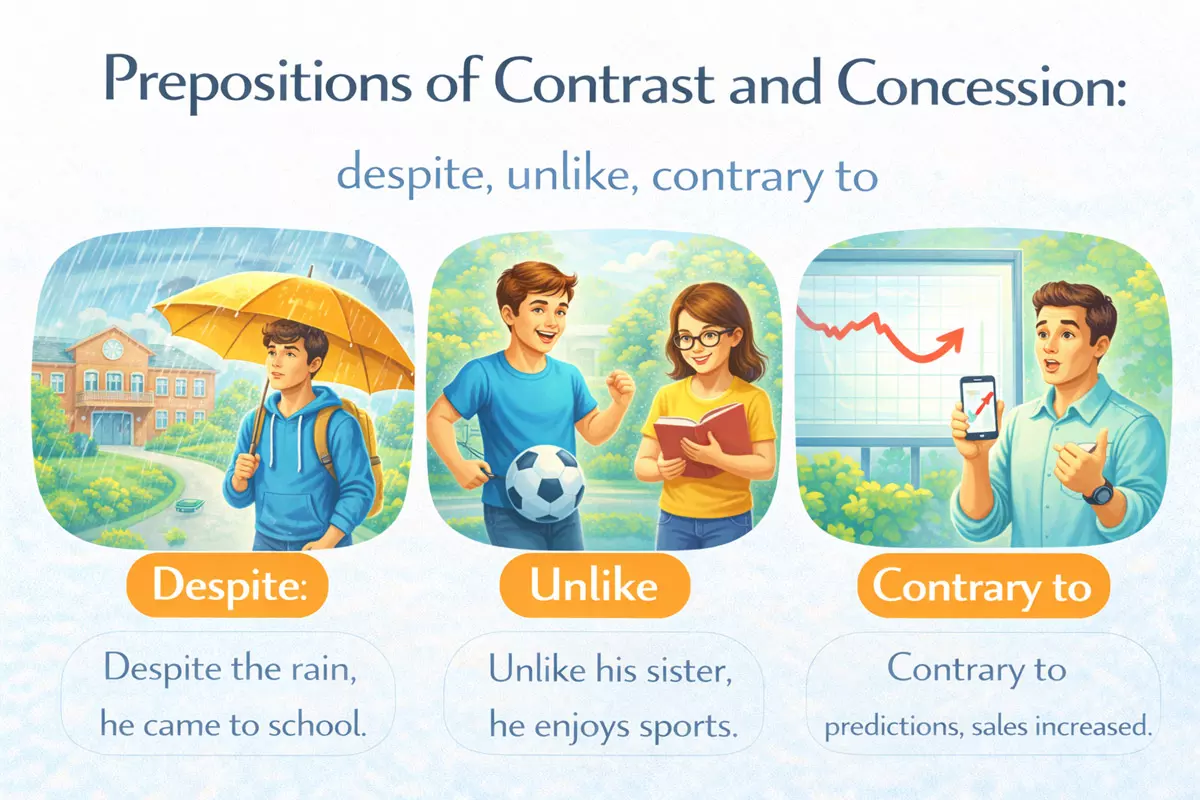 This article explains how to use despite, in spite of, unlike, and contrary to for expressing obstacles, strong differences, or challenging expectations. It covers grammar rules, rhetorical impact, register, and tips for clearer, stronger arguments.
- Concessive Logic: 'Despite' and 'in spite of' for acknowledging obstacles in results
- Comparative Distinction: Using 'unlike' for direct, high-impact differences between nouns
- Oppositional Framing: 'Contrary to' for challenging expectations or debunking theories
- Syntactic Requirements: Managing noun phrases and gerunds after concessive markers
- Strategic Contrast: Positioning 'contrary to popular belief' for rhetorical effect
- Register Shifts: Comparing 'unlike' (general) with 'in contrast to' (academic/data-driven)
- Practice: Strengthening arguments by integrating precise contrastive and concessive prepositions
Expressing differences and unexpected twists in English often depends on using specific linking words that highlight contrast or concession within a sentence. Words such as however, although, yet, and nevertheless are commonly used to signal a shift in ideas or to introduce opposing points of view. By mastering these connectors, you can make your communication clearer and more engaging, allowing your writing and speech to flow more smoothly while effectively presenting complex or nuanced thoughts.
Concessive Logic: "Despite" and "in spite of" for acknowledging obstacles in results
When presenting results or outcomes, English speakers often need to recognize that something happened even though there were challenges or barriers. This is where concessive expressions like despite and in spite of become essential. They help writers and speakers show contrast between an obstacle and a result, highlighting resilience, persistence, or unexpected outcomes.
How "despite" and "in spite of" function
Both expressions introduce information that could have prevented the main result, but did not. They are followed by a noun, pronoun, or gerund phrase—not a full clause. This structure is particularly useful in academic, scientific, and everyday contexts when reporting findings or experiences.
- Despite the rain, the concert continued as planned.
- In spite of feeling tired, she finished the marathon.
- Despite limited resources, the team achieved their goals.
- In spite of his injury, he played the whole match.
- Despite heavy traffic, we arrived on time.
- In spite of the noise, she managed to study.
- Despite the late start, they completed the project.
- In spite of the criticism, her ideas were adopted.
- Despite the risk, they proceeded with the experiment.
- In spite of his lack of experience, he succeeded.
- Despite the bad weather, the flight was not delayed.
- In spite of missing some data, the analysis was accurate.
Key points: usage and common mistakes
- Do not use 'of' after 'despite'. It is correct to say despite the difficulty, not despite of.
- Both 'despite' and 'in spite of' are interchangeable in meaning, though 'despite' is slightly more formal and concise.
- Follow these prepositions with a noun phrase or gerund: despite the delay, in spite of working late.
- To introduce a full clause (subject + verb), use 'although', 'even though', or 'though' instead.
Comparing "despite" and "in spite of"

| Expression | Example |
|---|---|
| despite | Despite the cold, they went swimming. |
| in spite of | In spite of the cold, they went swimming. |
| despite + gerund | Despite feeling nervous, he performed well. |
| in spite of + gerund | In spite of feeling nervous, he performed well. |
Summary
Using despite and in spite of allows you to recognize obstacles while emphasizing the result. These forms offer a clear, concise way to present contrasts in outcomes, especially when discussing research, reporting news, or sharing personal achievements. Mastering these patterns will help you express nuanced contrasts and acknowledge challenges effectively in English.
Comparative Distinction: Using "unlike" for direct, high-impact differences between nouns
When you want to highlight a clear and strong difference between two nouns, “unlike” is the best preposition to use. It sets up a direct comparison by drawing attention to a particular trait or quality that separates one noun from another. The effect is typically immediate and noticeable, making it ideal for statements where the contrast is significant and leaves little room for ambiguity.
How "unlike" Works in Sentences
“Unlike” is used at the beginning of a clause or phrase, followed by the first noun, then the contrasting noun or phrase. This structure helps make the distinction between the two items unmistakably clear. It’s especially useful in both spoken and written English when you want to avoid vague or subtle contrasts.
- Unlike cats, dogs often enjoy swimming.
- Unlike her brother, Maria prefers quiet evenings at home.
- Unlike last year, this winter has been unusually mild.
- Unlike traditional phones, smartphones can access the internet.
- Unlike his colleagues, Steve arrives early every day.
- Unlike many cities, Oslo is known for its clean air.
- Unlike the previous manager, the new boss encourages creativity.
- Unlike most fruits, avocados are high in healthy fats.
- Unlike their neighbors, the Smiths recycle diligently.
- Unlike paper maps, GPS navigation offers real-time updates.
- Unlike her usual style, she wore bright colors to the party.
- Unlike the rest of the group, Tom was not interested in hiking.
- Unlike winter sports, summer activities require little equipment.
- Unlike other solutions, this method is both simple and effective.
- Unlike the old model, the new car has improved safety features.
Common Patterns and Usage Tips
- “Unlike” is always followed by a noun or noun phrase, not a clause.
- It is used to compare two separate entities, not to express a general contrast.
- For softer or less direct contrasts, consider alternatives like “in contrast to” or “whereas.”
- “Unlike” does not require inversion or special punctuation.
Direct Contrasts: “Unlike” vs. Other Prepositions
To see how “unlike” stands out compared to similar prepositions, consider the following structured comparison:
| Preposition | Typical Use & Example |
|---|---|
| Unlike | Highlights a strong, direct difference between nouns. Unlike tea, coffee contains more caffeine. |
| Despite | Shows concession, often followed by a noun or gerund. Despite the rain, the match continued. |
| Contrary to | Used to challenge an expectation or belief. Contrary to popular belief, bats are not blind. |
| In contrast to | Draws a comparison, usually more formal. In contrast to his sister, he is very outgoing. |
In summary, use “unlike” when you want to make a bold, high-impact comparison between nouns, ensuring your contrast is immediately clear and easy to understand.
Oppositional Framing: "Contrary to" for challenging expectations or debunking theories
When writers or speakers want to highlight a strong opposition to common beliefs, predictions, or established theories, "contrary to" is a reliable phrase. It introduces information that directly contradicts what someone might assume or expect. This structure is especially useful in academic, scientific, or analytical contexts, where challenging assumptions is a regular part of discussion.
How 'Contrary to' Functions in Contrast
"Contrary to" sets up a clear contrast by referencing a specific expectation or claim, then introducing a fact or viewpoint that opposes it. Unlike "despite" or "unlike," which can soften differences or simply note them, this phrase emphasizes a direct challenge. It often appears in sentences that aim to debunk myths, question common sense, or present surprising research results.
- Contrary to popular belief, bats are not blind.
- Contrary to initial reports, the experiment succeeded.
- Contrary to expectations, the new policy reduced costs.
- Contrary to the theory, results showed no correlation.
- Contrary to what many people think, gold is not the rarest metal.
- Contrary to predictions, sales increased during the winter.
- Contrary to his reputation, he was very cooperative.
- Contrary to earlier assumptions, the process is reversible.
- Contrary to the forecast, the weather remained dry.
- Contrary to her fears, the exam was manageable.
- Contrary to conventional wisdom, multitasking can reduce productivity.
- Contrary to the common narrative, the crisis was avoidable.
- Contrary to the rules, he was allowed to participate.
- Contrary to all odds, the team won the championship.
- Contrary to the announcement, the event was not canceled.
Typical Patterns and Usage Tips
"Contrary to" is almost always followed by a noun, noun phrase, or clause that represents the expectation being challenged. This is then contrasted with the actual situation or fact. The phrase works well for both spoken and written English, especially when the goal is to highlight a surprising or unexpected reality.
| Pattern | Example |
|---|---|
| Contrary to + noun | Contrary to predictions, the test was easy. |
| Contrary to + noun phrase | Contrary to popular belief, lightning can strike twice. |
| Contrary to + clause | Contrary to what was expected, attendance was high. |
| Contrary to + adjective phrase | Contrary to common assumptions, the solution is simple. |
When to Use "Contrary to"?
Choose this structure when you need to stress the opposition between reality and expectation. It's particularly effective in essays, reports, and debates where you want to underscore that evidence or outcomes go against the grain. While "despite" and "unlike" also convey contrast, "contrary to" is the go-to for highlighting a reversal or refutation of widely held ideas.
Syntactic Requirements: Managing noun phrases and gerunds after concessive markers
Understanding what comes after concessive prepositions like "despite," "unlike," and "contrary to" is essential for accurate and natural English. These markers typically require either noun phrases or gerunds, and using a full clause is not standard. Let's unpack how each preposition works and what types of words or structures can follow them.
Acceptable Structures After Concessive Prepositions

Most contrastive prepositions are followed by a noun, pronoun, noun phrase, or gerund (the -ing form of a verb acting as a noun). Using a subject + verb clause directly after these prepositions is incorrect.
- Despite the rain, the match continued. ✅
- Despite it raining, the match continued. ✅
- Despite that it was raining, the match continued. ❌
- Unlike his brother, Tom enjoys chess. ✅
- Unlike playing chess, Tom prefers football. ✅
- Unlike that Tom plays chess, his brother doesn't. ❌
- Contrary to expectations, she arrived early. ✅
- Contrary to what was expected, she arrived early. ✅
- Contrary to she was expected, she arrived early. ❌
Comparing Noun Phrases and Gerunds
Noun phrases and gerunds are both suitable after these prepositions, but their use depends on the intended meaning. A gerund emphasizes the action, while a noun phrase focuses on the object or concept.
| Preposition | Example (Noun Phrase or Gerund) |
|---|---|
| Despite | Despite the noise / Despite living abroad |
| Unlike | Unlike her sister / Unlike studying alone |
| Contrary to | Contrary to popular belief / Contrary to hoping for rain |
| Contrary to (with clause) | Contrary to what he said (use a noun phrase or relative clause, not a full sentence) |
Common Patterns and Pitfalls
When you use these prepositions, avoid inserting a full clause (subject + verb) directly after them. If you need to use a clause, rephrase it as a noun clause or use a gerund.
- Use: Despite feeling tired (gerund)
- Use: Despite her tiredness (noun phrase)
- Avoid: Despite she was tired (incorrect)
- Use: Unlike last year (noun phrase)
- Use: Unlike working from home (gerund phrase)
- Avoid: Unlike he works from home (incorrect)
- Use: Contrary to our agreement (noun phrase)
- Use: Contrary to what I expected (noun clause)
- Avoid: Contrary to I expected (incorrect)
Summary Tips
- Stick to noun phrases, pronouns, gerunds, or noun clauses after these prepositions.
- To express a full idea, rephrase clauses as gerunds or noun clauses.
- Watch out for the temptation to use a full sentence after "despite," "unlike," or "contrary to." If in doubt, simplify the structure.
Mastering these patterns will make your use of concessive and contrastive prepositions more fluent and accurate.
Strategic Contrast: Positioning 'contrary to popular belief' for rhetorical effect
Writers and speakers often use the phrase contrary to popular belief to introduce information that challenges common assumptions. This structure signals that what follows will contradict or question widely held views, making it a powerful tool for drawing attention and encouraging critical thinking. Placing this phrase at the start of a sentence or clause creates a clear rhetorical contrast, inviting the audience to reconsider what they thought they knew.
Why Use 'Contrary to Popular Belief'?
Opening with this expression is more than just a stylistic choice; it preps your audience for a shift in perspective. It suggests that the following statement may surprise or inform, and it can add authority or credibility by implying that the speaker is about to reveal lesser-known facts.
- Highlights unexpected facts
- Challenges stereotypes or generalizations
- Encourages the reader to question assumptions
- Creates a memorable introduction to new information
Common Patterns and Placement
The phrase is typically positioned at the beginning of a sentence, but it can also appear mid-sentence for stylistic variety. Here are some common ways to use it:
- Contrary to popular belief, bats are not blind.
- Many assume chameleons change color to match their surroundings, contrary to popular belief, they do so mainly for communication.
- Contrary to popular belief, lightning can strike the same place twice.
Expanded Examples: Effective Usage
Here are more examples showcasing how this phrase can strategically introduce contrast in writing or speech:
- Contrary to popular belief, goldfish do not have a three-second memory.
- Contrary to popular belief, Vikings did not wear horned helmets.
- Contrary to popular belief, Napoleon was not particularly short for his time.
- Contrary to popular belief, sugar does not cause hyperactivity in children.
- Contrary to popular belief, ostriches do not bury their heads in the sand.
- Contrary to popular belief, cracking your knuckles does not cause arthritis.
- Contrary to popular belief, shaving does not make hair grow back thicker.
- Contrary to popular belief, toilets do not flush in different directions in the northern and southern hemispheres.
- Contrary to popular belief, bats are excellent pollinators.
- Contrary to popular belief, carrots do not significantly improve night vision.
- Contrary to popular belief, humans use more than 10% of their brains.
- Contrary to popular belief, Mount Everest is not the closest point on Earth to the moon.
Summary Table: 'Contrary to' vs. Other Contrast Prepositions
Using different prepositions of contrast can subtly shift the tone and focus of your message. Here’s a structured comparison of 'contrary to', 'despite', and 'unlike' in context:
| Phrase | Function & Example |
|---|---|
| Contrary to | Introduces information that opposes expectations or beliefs. Contrary to expert predictions, the event was a success. |
| Despite | Shows something happened even though there was an obstacle. Despite the rain, the match continued. |
| Unlike | Highlights a difference between two things. Unlike her brother, she prefers tea over coffee. |
By understanding how to position phrases like 'contrary to popular belief', you can enhance the impact of your statements and guide your audience to new insights. This strategic use of contrast is an effective rhetorical device for both written and spoken communication.
Register Shifts: Comparing 'unlike' (general) with 'in contrast to' (academic/data-driven)
Switching between informal and academic writing often means choosing the right comparative expressions. While both "unlike" and "in contrast to" express difference, they suit different contexts and tones. "Unlike" is favored in everyday conversation and informal writing due to its brevity and directness. "In contrast to," on the other hand, signals a more formal or analytical register, frequently appearing in research papers, reports, and structured argumentation.
Usage Differences
- "Unlike" is concise and typically used in speech, emails, and informal essays.
- "In contrast to" introduces a more deliberate comparison, often followed by supporting data or analysis.
- Register choice affects the perceived seriousness and clarity of your message.
Examples in Context
- Unlike her brother, Sarah enjoys classical music.
- In contrast to the previous year, sales increased by 20%.
- Unlike most mammals, whales live their entire lives in water.
- In contrast to popular belief, lightning can strike the same place twice.
- Unlike John, Maria prefers to work in silence.
- In contrast to urban areas, rural regions often lack public transportation.
- Unlike last summer, this year has been unusually cool.
- In contrast to the control group, the experimental group showed significant improvement.
- Unlike traditional methods, this approach saves time.
- In contrast to earlier studies, the recent data suggests a different trend.
Comparing Form and Register
| Expression | Typical Register | Example |
|---|---|---|
| Unlike | General, informal, spoken, casual writing | Unlike Tom, Jane studies French. |
| In contrast to | Academic, data-driven, formal writing | In contrast to last year, profits rose sharply. |
Choosing the Right Expression
- For casual comparisons or when writing in a personal style, "unlike" feels natural and efficient.
- When emphasizing data, research findings, or structured argumentation, "in contrast to" offers clarity and formality.
- Mixing registers within the same text can confuse readers or undermine your argument’s credibility.
Understanding these register shifts helps writers adapt their language to suit both audience and purpose, ensuring clear and appropriate communication whether discussing simple differences or analyzing complex data.
Practice: Strengthening arguments by integrating precise contrastive and concessive prepositions
When crafting persuasive or analytical writing, using contrastive and concessive prepositions such as despite, unlike, and contrary to helps clarify differences and acknowledge opposing points. These prepositions enable you to present nuanced arguments, highlight exceptions, and compare ideas or facts more effectively.
Integrating Contrast and Concession in Sentences
To develop stronger arguments, familiarize yourself with common patterns for these prepositions. Below is a list of sentence structures and example phrases:
- Despite + noun/gerund: Despite the rain, the match continued.
- Unlike + noun/pronoun: Unlike her brother, Maria enjoys classical music.
- Contrary to + noun/phrase: Contrary to popular belief, bats are not blind.
- Despite + possessive: Despite their efforts, they lost the game.
- Unlike + plural noun: Unlike most animals, octopuses have three hearts.
- Contrary to + expectation: Contrary to expectations, the plan succeeded.
- Despite + adjective + noun: Despite severe criticism, the artist persisted.
- Unlike + group: Unlike the others, he arrived early.
- Contrary to + previous statement: Contrary to what was said earlier, the results were positive.
- Despite + fact: Despite the fact that it was late, she kept working.
Comparing Usage: Precision in Argumentation
For clarity, see how these prepositions function side by side:
| Preposition | Example & Usage |
|---|---|
| despite | Despite limited resources, the team achieved its goals. (Acknowledges an obstacle but shows a contrasting result.) |
| unlike | Unlike last year, this winter has been unusually warm. (Directly compares two differing situations or entities.) |
| contrary to | Contrary to initial reports, the event was well-attended. (Refutes or opposes a previously stated idea or assumption.) |
| despite | Despite her lack of experience, she performed admirably. (Shows concession: the result is unexpected given the circumstance.) |
| unlike | Unlike his colleagues, John prefers to work alone. (Highlights a difference between people or groups.) |
| contrary to | Contrary to our fears, the transition was smooth. (Emphasizes an outcome against expectations.) |
Practice: Apply the Right Preposition
Choose the appropriate preposition (despite, unlike, or contrary to) for each sentence below:
- __________ his reputation, the manager was friendly and approachable.
- __________ the warnings, many people ignored the evacuation order.
- __________ her classmates, Anna completed the assignment early.
- __________ the cold weather, the flowers bloomed.
- __________ popular opinion, the film was not a box office success.
- __________ the forecast, it did not rain all day.
- __________ the other candidates, he spoke calmly and clearly.
- __________ the high cost, the product sold out quickly.
- __________ common belief, the solution was surprisingly simple.
- __________ her brother, Maya enjoys waking up early.
Show answers
- Contrary to
- Despite
- Unlike
- Despite
- Contrary to
- Contrary to
- Unlike
- Despite
- Contrary to
- Unlike
Task: Strengthen These Arguments
Rewrite each pair of simple sentences as a single, more compelling sentence using a contrastive or concessive preposition:
- It was raining. We went for a walk.
- Tom likes coffee. Sarah prefers tea.
- Everyone expected failure. The project succeeded.
- She had little training. She performed well.
- The instructions were unclear. He completed the task correctly.
- Many people disagreed. The decision was approved.
- He felt nervous. He gave a confident presentation.
- The road was blocked. They arrived on time.
- She is younger. She has more experience.
- The budget was limited. The team delivered high-quality results.
Show answers
- Despite the rain, we went for a walk.
- Unlike Tom, Sarah prefers tea.
- Contrary to everyone’s expectations, the project succeeded.
- Despite having little training, she performed well.
- Despite the unclear instructions, he completed the task correctly.
- Despite widespread disagreement, the decision was approved.
- Despite feeling nervous, he gave a confident presentation.
- Despite the blocked road, they arrived on time.
- Unlike her, she has more experience.
- Despite the limited budget, the team delivered high-quality results.
Practicing these patterns will help you present arguments that are not only clear but also sophisticated, increasing the impact of your writing.