What Are Nouns? Full Definition

 This article explains what nouns are, their main functions, and typical meanings. It shows how to identify nouns in sentences, compares them to other word classes, highlights common beginner mistakes, and includes a quick practice section.
Naming people, objects, and ideas is a fundamental part of how we communicate every day, shaping the way we express ourselves and understand each other. By learning how these names, or nouns, function in language, we gain valuable tools for clearer and more effective communication. This understanding not only helps us convey our thoughts more precisely but also allows us to interpret what others mean with greater accuracy, making daily interactions smoother and more meaningful for everyone involved.
Basic Definition of a Noun
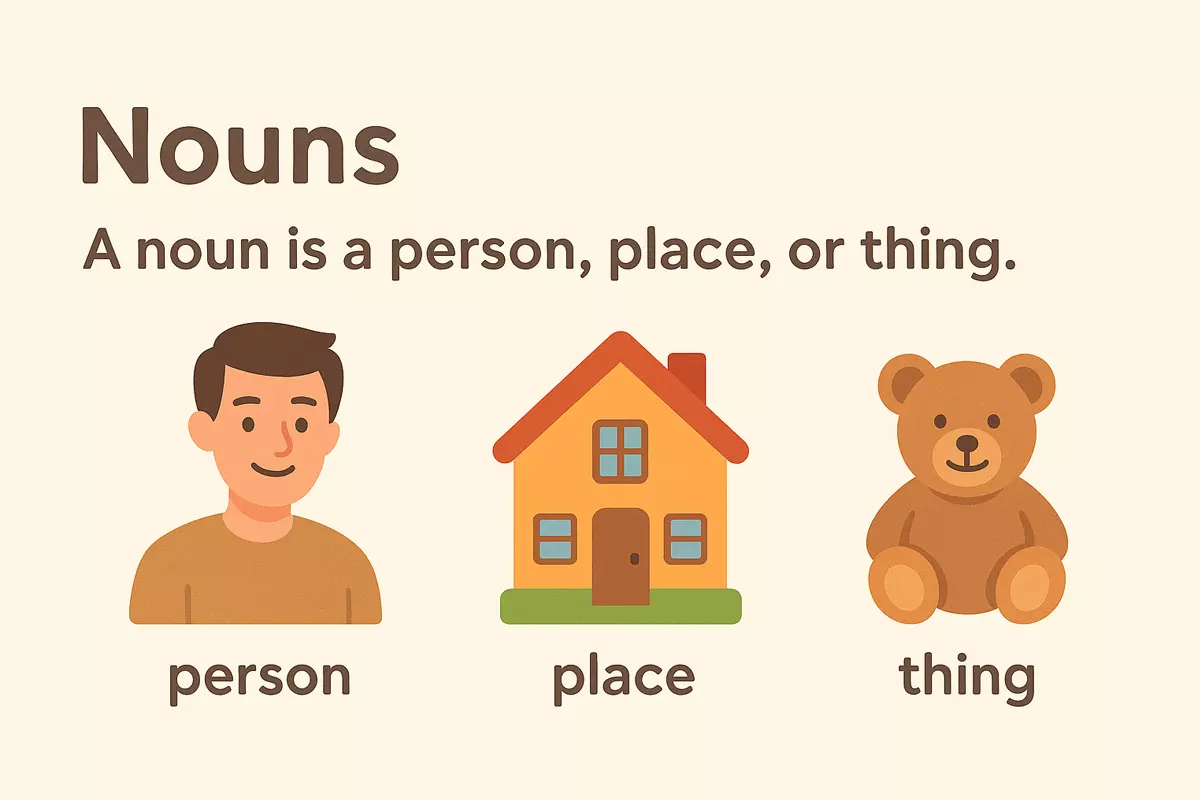
Nouns are words that identify people, places, things, or ideas. In English, these words function as the names for everything we can think of, from concrete objects like "table" to abstract concepts such as "freedom." Because they serve as the building blocks for most sentences, understanding their role is essential for clear communication.
What Do Nouns Represent?
Nouns can refer to a wide variety of entities. Here are some typical categories:
- People: doctor, teacher, child, Maria
- Places: city, school, Paris, mountain
- Things: book, car, apple, phone
- Animals: dog, elephant, butterfly, fox
- Ideas: happiness, strength, democracy, freedom
- Events: festival, meeting, war, celebration
- Groups: team, audience, family, committee
- Materials: water, gold, air, plastic
- Times: morning, year, Monday, century
- Activities: swimming, reading, running, singing
Main Functions in Sentences
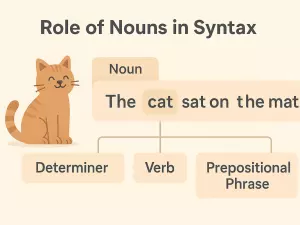
Nouns often act as the subject or object within a sentence. For example, in "The cat sleeps," "cat" is the subject. In "She reads a book," "book" is the object. They can also show possession ("Lisa's pencil") or follow prepositions ("on the table").
Common Noun Types

There are several important categories to be aware of:
- Common nouns: Refer to general items (car, city, dog)
- Proper nouns: Name specific individuals or places (London, Sarah, Amazon)
- Abstract nouns: Express ideas or qualities (love, courage)
- Concrete nouns: Name things that can be touched or seen (stone, tree)
- Collective nouns: Refer to groups (team, flock, jury)
- Countable nouns: Can be counted (apple, chair)
- Uncountable nouns: Cannot be counted individually (sand, information)
Examples of Nouns in Use
To understand how these words appear in sentences, here are some simple examples:
- The dog barked.
- We visited Italy last summer.
- Friendship is important.
- She bought a new computer.
- The jury reached a decision.
- Do you like music?
- My brother plays football.
- The river flows quickly.
- Our team won the match.
- He showed great patience.
Quick Comparison: Common vs. Proper Nouns
| Type | Examples |
|---|---|
| Common Nouns | city, teacher, river, car |
| Proper Nouns | London, Mrs. Smith, Nile, Toyota |
| Abstract Nouns | happiness, freedom, beauty, courage |
| Collective Nouns | team, flock, group, committee |
Nouns are at the core of language, helping us label, describe, and discuss everything imaginable. Recognizing their role makes both writing and understanding English much easier.
Main Functions of Nouns
Nouns play several essential roles in sentences. At their core, they identify people, places, things, and ideas, allowing us to communicate clearly and specifically. Without these words, sentences would lack subjects and objects, making it difficult to express even basic thoughts.
Subjects in Sentences
The subject is often the focus of a statement or question. In English, this typically comes at the beginning of the sentence and tells us who or what is performing the action. For example:
- The cat sleeps.
- Honesty is important.
- Mountains inspire awe.
Objects of Verbs and Prepositions
Nouns frequently act as objects, receiving the action of the verb or following prepositions. This helps clarify what the subject is acting upon, or where, when, or to whom something happens.
- She reads books.
- They walked to the store.
- He is afraid of spiders.
Possessive Relationships
Showing ownership or association is another job for these words. Possessive forms indicate who or what something belongs to:
- Sarah’s bicycle
- The dog’s collar
- Children’s toys
Predicative Nouns (Subject and Object Complements)
Sometimes, a noun follows linking verbs like “be,” “become,” or “seem” to rename or describe the subject or object. This function provides more information or clarifies identity.
- George is a musician.
- The winner was Maria.
- They elected her president.
Apposition
Appositive nouns further explain or identify another noun right beside them. This adds detail or clarification:
- My friend, Alice, is visiting.
- The city London attracts tourists.
Noun Functions at a Glance
| Role | Example |
|---|---|
| Subject | Dogs bark. |
| Direct Object | She found a key. |
| Indirect Object | Give children time. |
| Object of Preposition | Under the table |
| Possessive | Teacher’s advice |
| Appositive | My brother, Sam |
| Predicate Noun | My dream is freedom. |
Summary of Usage
Whether acting as the subject, the object, or in a supporting role, these words are the backbone of clear and meaningful communication. By recognizing how they function in different contexts, you can construct sentences that are both precise and expressive.
Typical Noun Meanings
Nouns generally refer to people, places, things, or abstract concepts. They function as the names for anything we can identify, discuss, or imagine. While the most familiar examples might include objects or living beings, this word class also covers intangible ideas, feelings, and qualities.
Common Categories of Noun Referents
Nouns can be grouped based on what they represent. Here are several broad types:
- People: teacher, friend, doctor, musician
- Places: city, park, country, kitchen
- Objects: book, computer, chair, apple
- Animals: dog, elephant, sparrow, dolphin
- Ideas: freedom, happiness, justice, knowledge
- Events: celebration, meeting, war, festival
- Times: morning, year, minute, era
- Groups: team, family, crowd, committee
- Materials: water, wood, iron, sand
- Activities: reading, swimming, negotiation, travel
Concrete vs. Abstract
Some nouns describe things you can experience with your senses (concrete), while others refer to things you cannot physically touch or see (abstract). For example, "table" and "mountain" are concrete, while "love" and "truth" are abstract.
Countable and Uncountable Nouns
Nouns also differ in whether they can be counted. Countable nouns (like "apple" or "car") have both singular and plural forms, while uncountable nouns (like "information" or "rice") are treated as singular and do not have a plural form.
| Type | Examples |
|---|---|
| People | pilot, artist, child, guest |
| Places | museum, island, suburb, hospital |
| Things/Objects | pencil, mirror, phone, bicycle |
| Ideas/Concepts | courage, peace, beauty, hope |
| Events | interview, earthquake, concert, tournament |
Nouns are remarkably flexible, allowing us to name and talk about nearly everything in our world and beyond. From describing physical objects to expressing emotions or denoting groups, this word class is at the core of communication.
Nouns in Everyday Sentences
Understanding how nouns work in real-world communication helps clarify their function in language. Nouns serve as the names of people, places, things, and ideas, acting as the building blocks of clear and meaningful sentences. Whether you’re talking about your favorite book or describing a bustling city, these words allow us to specify subjects, objects, and concepts.
Common Ways Nouns Appear in Sentences
Nouns can function in multiple roles within a sentence. Here are some typical patterns:
- Subject: Cats sleep all day.
- Object: She read the book.
- Indirect Object: He gave his friend a gift.
- Object of a Preposition: The keys are on the table.
- Predicate Noun: My brother is a doctor.
Examples of Nouns in Action
Here are some sentences showing different types of nouns at work:
- The dog barked loudly.
- Maria visited France last summer.
- We admire honesty in others.
- A team won the championship.
- The river flows through the valley.
- He bought a new laptop.
- The committee reached a decision.
- Joy filled the room.
- The mountains are covered with snow.
- She enjoys reading poetry.
- Children play in the park after school.
- The sun was shining brightly.
Comparing Types of Nouns in Context
| Type of Noun | Example Sentence |
|---|---|
| Proper Noun | London attracts millions of tourists each year. |
| Common Noun | The car is parked outside. |
| Abstract Noun | His bravery was admirable. |
| Collective Noun | A flock of birds flew overhead. |
In summary, using nouns effectively allows you to communicate specific information, describe people and objects, and express ideas with clarity. By observing how these words function in context, you can improve both your understanding and your use of language.
How to Recognize Nouns
Identifying nouns in sentences can be straightforward once you know what to look for. Nouns are words that typically name people, places, things, animals, or abstract ideas. They often serve as the subject or object in a sentence, and many can take both singular and plural forms.
Common Clues That Signal a Noun
- They often answer the questions "who?" or "what?" in a sentence.
- Many can be preceded by articles (a, an, the).
- They may appear after quantifiers or numbers (e.g., three apples).
- Nouns can follow possessive words (my, Sarah’s, their).
- They are modified by adjectives: red car, tall building.
- Some end with typical noun suffixes like -ment, -ness, -tion, -ity.
- They are often the "doers" or "receivers" of actions in sentences.
Typical Noun Endings
Many nouns share common endings. Here are some frequent patterns:
- -ment (agreement, development)
- -ness (happiness, kindness)
- -tion / -sion (action, decision)
- -ity (curiosity, activity)
- -ance / -ence (importance, experience)
- -er / -or (teacher, actor)
- -ism (realism, optimism)
- -age (courage, village)
- -ship (friendship, leadership)
- -hood (childhood, neighborhood)
Examples in Context
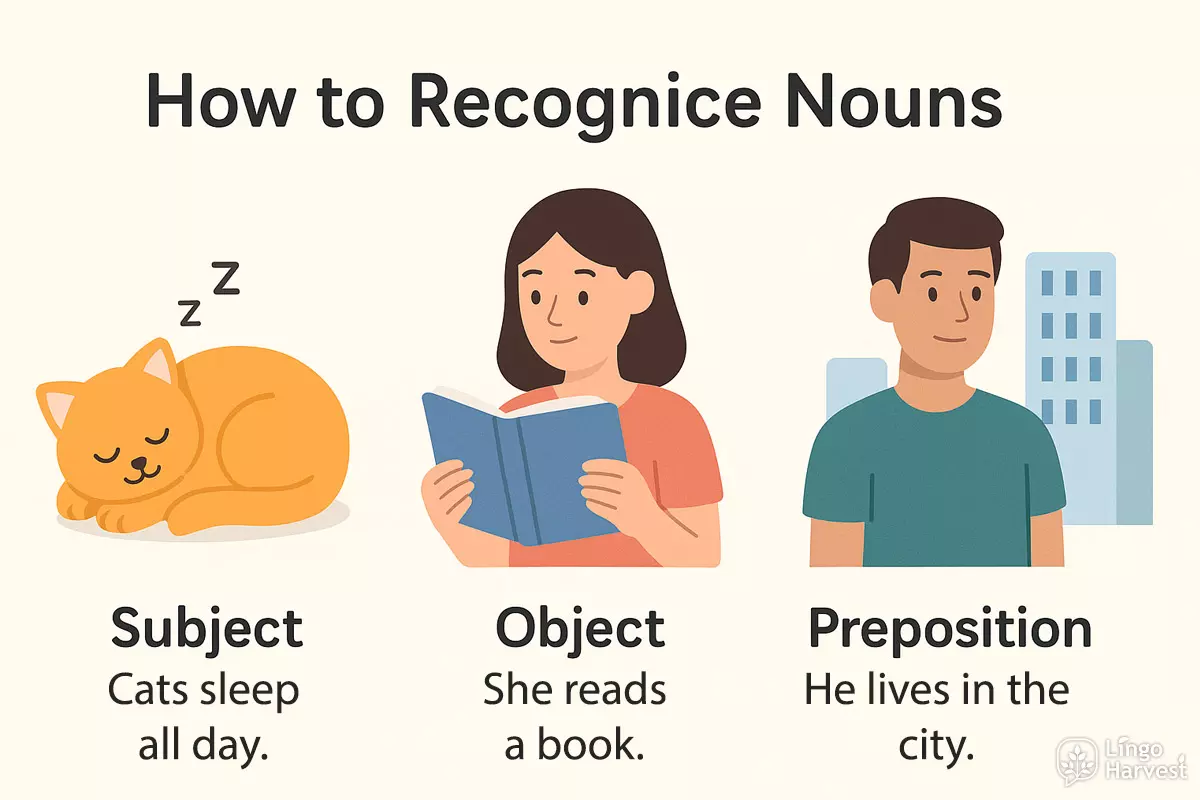
Nouns can play different roles in sentences:
- Subject: Cats sleep all day.
- Object: She reads a book.
- Object of a preposition: He lives in the city.
- With possessive: Maria’s bicycle is new.
- Modified by an adjective: The old house is empty.
Distinguishing Nouns from Other Parts of Speech
It can help to compare nouns with words that look or sound similar but serve different grammatical roles. For instance, the word "run" can be a noun or a verb, depending on context. See the table below for how context changes the function:
| Word in Context | Part of Speech |
|---|---|
| She went for a run. | Noun (thing/activity) |
| They run every morning. | Verb (action) |
| The light is bright. | Noun (thing) |
| Please light the candle. | Verb (action) |
With practice, spotting nouns becomes second nature. Look for the words in a sentence that label people, objects, places, qualities, or concepts, and notice how they interact with articles, adjectives, and verbs.
Nouns vs Other Word Classes
Nouns have a unique role in language: they typically name people, places, things, or ideas. However, English includes several other major word groups, each with its own function. Understanding how nouns differ from verbs, adjectives, adverbs, and pronouns helps clarify their purpose in sentences.
How Nouns Stand Apart
Unlike verbs, which express actions or states, nouns serve as the subject or object within a sentence. Adjectives describe qualities or attributes, often modifying nouns, while adverbs mostly alter verbs, adjectives, or other adverbs. Pronouns, on the other hand, substitute directly for nouns to avoid repetition.
Common Confusions and Overlaps
Some words shift between categories. For example, “run” can be a verb (to run) or a noun (a run in the park). This flexibility is called “conversion” or “zero-derivation.” Certain endings also signal word class: nouns often end in -ment, -tion, or -ness, while adjectives may end in -ous, -ive, or -al.
Quick Comparison of Major Word Classes
| Word Class | Main Function | Typical Examples | Sample Sentence |
|---|---|---|---|
| Noun | Names a person, place, thing, or idea | dog, London, happiness, book | The dog barked loudly. |
| Verb | Describes action or state | run, is, think, write | They run every morning. |
| Adjective | Describes or modifies a noun | blue, quick, happy, large | She wore a blue dress. |
| Adverb | Modifies verbs, adjectives, or other adverbs | quickly, very, well, often | He sang well. |
| Pronoun | Replaces a noun | she, it, they, who | They are late. |
Examples of Nouns vs. Other Words
- Book (noun) vs. read (verb)
- Happiness (noun) vs. happy (adjective)
- Runner (noun) vs. runs (verb)
- Information (noun) vs. informative (adjective)
- City (noun) vs. urban (adjective)
- Decision (noun) vs. decide (verb)
- Strength (noun) vs. strong (adjective)
- Child (noun) vs. childish (adjective)
- Teacher (noun) vs. teaches (verb)
- Freedom (noun) vs. free (adjective)
Recognizing these distinctions makes it easier to identify nouns and understand their role compared to other types of words. While some words may look or sound similar, their grammatical function in a sentence is what truly sets them apart.
Common Beginner Mistakes with Nouns
Understanding how to use nouns correctly can be tricky for language learners. Early errors often come from confusion between countable and uncountable forms, irregular pluralization, or misuse in context. Let’s look at typical stumbling blocks and how to recognize them.
Mixing Up Countable and Uncountable Nouns
A frequent source of confusion is knowing which things can be counted individually and which cannot. For instance, “information” is uncountable, so saying “an information” is incorrect. The same goes for “furniture” or “advice.” On the other hand, “apple” is countable: you can have one apple, two apples, and so on.
- Incorrect: I need some informations. ❌
- Correct: I need some information. ✅
- Incorrect: She gave me a good advice. ❌
- Correct: She gave me good advice. ✅
Irregular Plurals and Spelling Errors
Not all nouns form their plural by simply adding -s or -es. Some change spelling, while others remain the same in both singular and plural. Beginners often regularize irregular forms or forget to change them at all.
| Singular | Common Incorrect Plural | Correct Plural |
|---|---|---|
| child | childs | children |
| person | persons | people |
| foot | foots | feet |
| mouse | mouses | mice |
| sheep | sheeps | sheep |
Confusing Possessive and Plural Forms
Another pitfall is mixing up the apostrophe for possession and the -s for plurals. For example, “the boy’s books” (books belonging to one boy) versus “the boys’ books” (books belonging to several boys). Leaving out or misplacing the apostrophe can change the meaning entirely.
- Incorrect: The dogs bone is missing.
- Correct: The dog’s bone is missing.
- Incorrect: The girls bag is red.
- Correct: The girl’s bag is red.
Using Articles Incorrectly
Learners often struggle with when to use “a,” “an,” or “the” before nouns. Some languages don’t use articles, so it’s easy to drop them in English. For example, “I have cat” instead of “I have a cat.”
Common Examples of Noun Mistakes
Below are more examples of typical errors involving naming words:
- Incorrect: She has many luggages.
- Correct: She has much luggage.
- Incorrect: Please give me a bread.
- Correct: Please give me a piece of bread.
- Incorrect: I have three childrens.
- Correct: I have three children.
- Incorrect: The informations are useful.
- Correct: The information is useful.
- Incorrect: These news are good.
- Correct: This news is good.
- Incorrect: My family are coming.
- Correct: My family is coming.
Paying attention to these patterns helps avoid the most frequent mistakes when working with nouns. With practice, recognizing these issues becomes much easier.
Quick Practice: Find the Nouns
Identifying nouns in sentences is a practical way to reinforce your understanding of what nouns are and how they function. Nouns typically represent people, places, things, or ideas. In the following exercises, read the sentences and try to pick out all the words that serve as nouns. Some sentences contain more than one noun, so look carefully!
Practice Sentences
- The cat chased a mouse around the garden.
- Books and magazines filled the shelf.
- My friend visited Italy last summer.
- The teacher handed out assignments to the class.
- Happiness is an important feeling.
Show answers
- Sentence 1: cat, mouse, garden
- Sentence 2: Books, magazines, shelf
- Sentence 3: friend, Italy, summer
- Sentence 4: teacher, assignments, class
- Sentence 5: Happiness, feeling
Common Types of Nouns
Nouns can be sorted into several categories based on what they name. Here is a list highlighting different types:
- Person: doctor, child, artist, neighbor
- Place: park, city, library, mountain
- Thing: book, phone, chair, pencil
- Animal: dog, elephant, eagle, fish
- Idea: freedom, love, knowledge, belief
- Event: birthday, concert, meeting, festival
- Quality: honesty, courage, patience, wisdom
Mini Challenge: Spot the Nouns
For another exercise, underline or list the nouns in each short phrase:
- Summer vacation
- Shiny apple
- Team spirit
- Historic castle
Show answers
- Summer, vacation
- Apple
- Team, spirit
- Castle
Practicing with real sentences and word lists helps solidify your ability to recognize and use nouns confidently in any context. Try creating your own sentences and see how many different nouns you can include!