Compound Nouns: Formation Patterns

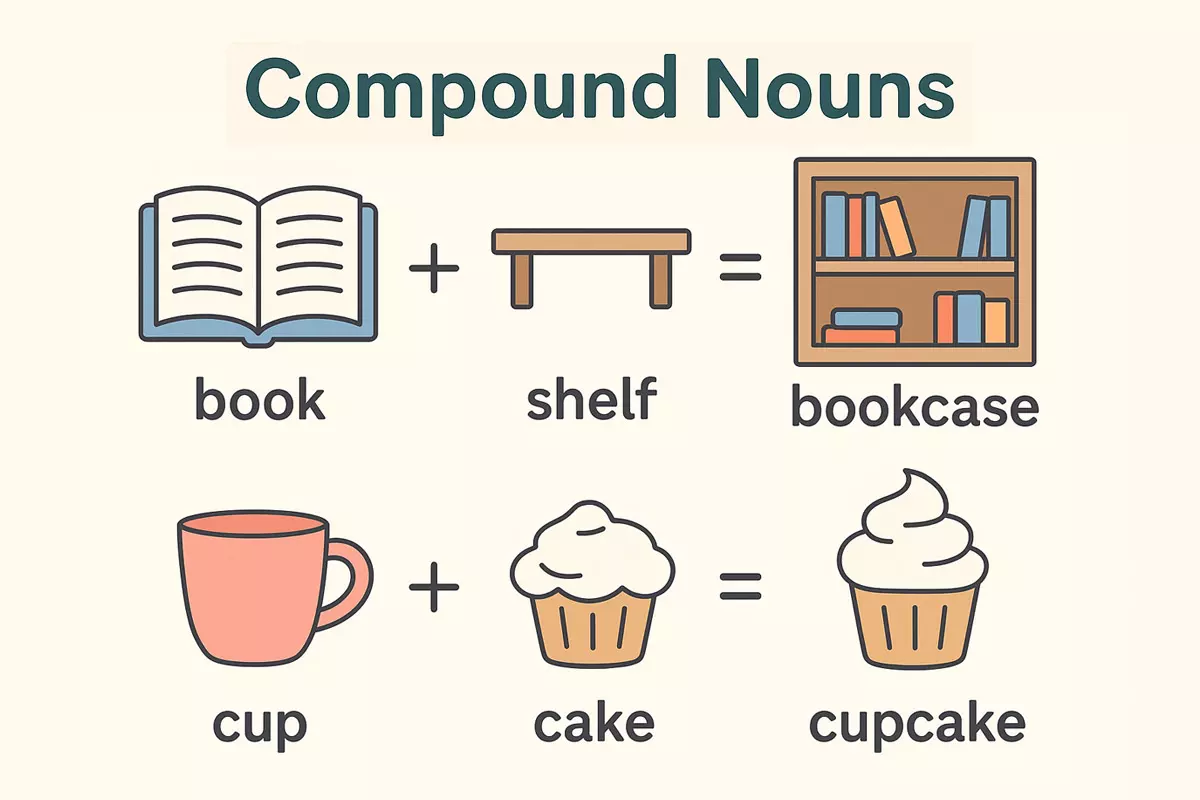 The article defines compound nouns, outlines how they are formed—such as through noun plus noun and other combinations—details spelling and stress patterns, explains how meanings can change, and provides practice in making new compound nouns.
Have you ever wondered how words such as toothbrush or rainbow are formed? In English, combining shorter words to create new ones is a common and intriguing process. These compound words often describe objects or concepts more precisely and efficiently than single words alone. By understanding how these blends are constructed, we gain insight into the flexibility and creativity of the language, as well as how communication evolves to meet our everyday needs.
What Is a Compound Noun?
A compound noun is a single concept formed by joining two or more words together, often creating a new meaning that is distinct from the individual words. These combinations can be written as single words, hyphenated forms, or as separate words used together. In English, this process allows for concise and vivid expressions, such as toothpaste or bus stop.
Compound nouns typically consist of nouns, adjectives, verbs, or prepositions in various pairings. The most common pattern is noun + noun, but other combinations exist as well. The meaning of the compound often cannot be guessed just by knowing the meanings of the individual parts, which makes them an essential feature to master for clear communication.
Common Features
- Usually stress falls on the first part in speech (e.g., blackboard).
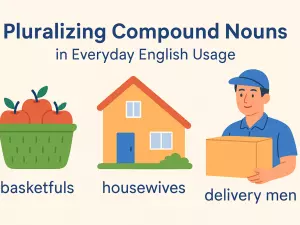
- Pluralization typically affects the final word (toothbrushes, not
teethbrushes). - May be open (two words), closed (one word), or hyphenated (swimming pool, notebook, mother-in-law).
- Often used for professions, places, objects, and new inventions.
Examples of Compound Nouns
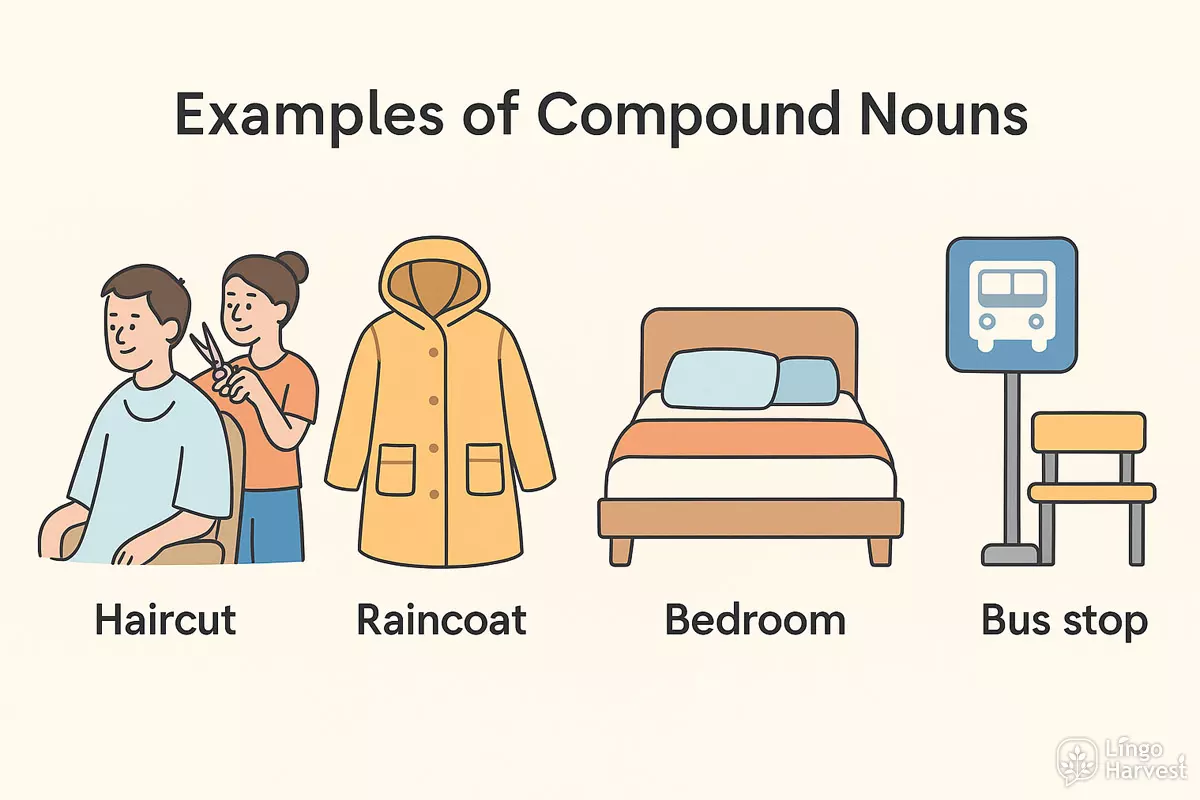
- Haircut
- Raincoat
- Bedroom
- Bus stop
- Football
- Toothpaste
- Sunflower
- Firefighter
- Mother-in-law
- Swimming pool
- Newspaper
- Bookcase
- Airport
- Dining room
- Babysitter
- Snowman
- Mailbox
- Check-in
Main Types of Compound Noun Formation
| Pattern | Example |
|---|---|
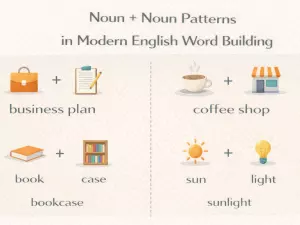
| Noun + Noun | Bedroom, toothpaste, football |
| Adjective + Noun | Greenhouse, blackboard, software |
| Verb + Noun | Swimming pool, washing machine, driving license |
| Noun + Verb | Haircut, sunrise, rainfall |
| Preposition + Noun | Overcoat, underpass, input |
| Noun + Preposition | Passer-by, hanger-on, runner-up |
Understanding how compound nouns are formed helps in both recognizing and correctly using them in writing and speech. Their structure and meaning are key in expanding vocabulary and expressing complex ideas efficiently.
Main Patterns of Formation
When exploring how compound nouns are created, several common structures emerge. Most compound words in English are formed by combining two words, but the nature of those words—whether nouns, adjectives, verbs, or prepositions—varies. Understanding these typical arrangements helps decode and build new compounds.
Noun + Noun Compounds
One of the most frequent structures is a noun followed by another noun, where the first word often acts as a modifier. For example:
- toothpaste
- football
- raincoat
- classroom
- laptop
- bookcase
- sunflower
- haircut
- notebook
- bedroom
Adjective + Noun Compounds
Another typical pattern involves an adjective describing the noun that follows. This structure is especially common for objects or roles:
- blackboard
- greenhouse
- software
- hardcover
- full moon
- whiteboard
Verb-Based Compounds
Compounds can also involve verbs, usually combined with nouns or prepositions. These often describe actions, tools, or places:
- swimming pool
- washing machine
- checking account
- drinking water
- running shoes
- breakfast (break + fast)
Other Combination Patterns
Some less frequent, but still productive, structures include:
- Preposition + Noun: overcoat, underpass
- Noun + Verb(-ing): rainfall, hairdressing
- Adjective + Verb(-ing): dry-cleaning
- Adverb + Noun: overload
- Noun + Preposition: hanger-on
Open, Hyphenated, and Closed Forms
The way these combinations are written can differ:
| Form Type | Examples |
|---|---|
| Open (two words) | ice cream, post office, swimming pool |
| Hyphenated | mother-in-law, dry-cleaning, check-in |
| Closed (single word) | toothbrush, notebook, greenhouse |
Semantic Relationships
The meaning of a compound is not always a direct sum of its parts. Sometimes, it expresses a new idea:
- Blackboard: not just a board that is black, but a surface for writing in classrooms
- Bookworm: not a literal worm, but a person who loves reading
- Butterfly: does not relate directly to butter or flies
By recognizing these patterns—word types, spelling forms, and semantic relationships—you can better understand how new compound nouns are formed and interpreted.
Noun + Noun Combinations
Pairing two nouns together is a fundamental way to create compound words in English. This pattern is especially common when describing objects, places, roles, or concepts that naturally go together. Typically, the first noun acts as a descriptor or modifier for the second, indicating type, purpose, or material. For example, in “toothbrush,” the first word tells us what kind of brush it is. Some of these pairings are written as single words (e.g., “notebook”), others as hyphenated (“mother-in-law”), and some as two separate words (“ice cream”). The structure and spelling often depend on how established or familiar the combination has become.
Common Patterns and Meanings
Noun-noun compounds often fall into a few broad categories:
- Material + Thing (e.g., glass bottle)
- Purpose/Function + Object (e.g., coffee maker)
- Place + Object (e.g., office chair)
- Time + Event (e.g., summer vacation)
- Person + Role/Relation (e.g., bus driver)
Examples of Two-Noun Compounds
These combinations are everywhere in daily English. Here’s a selection to illustrate the variety and logic behind them:
- raincoat
- passport
- laptop
- classroom
- football
- haircut
- sunflower
- bookcase
- airport
- newspaper
- teacup
- shoelace
- schoolbag
- birthday
- handshake
- waterfall
- bedroom
- firefighter
- snowman
- workplace
How Meaning Changes
The meaning of the whole compound is not always a simple sum of its parts. For instance, a “chicken soup” is soup made with chicken, while a “chicken farmer” is a person who raises chickens. The relationship between the two parts can be one of material, function, possession, or another logical link.
| First Noun (Modifier) | Second Noun (Head) | Compound Meaning |
|---|---|---|
| tooth | brush | a brush for teeth |
| snow | man | a figure made from snow |
| news | paper | a paper containing news |
| bed | room | a room with a bed (for sleeping) |
| sun | flower | a flower resembling the sun |
Word Stress and Pronunciation
In most noun compounds, primary stress falls on the first noun. For example, in “GREENhouse” (a building for plants), the stress is on “green,” distinguishing it from “green HOUSE” (a house painted green).
Summary
Pairing two nouns is a flexible way to create new meanings in English, often resulting in concise, descriptive terms. Understanding these combinations helps you both decode unfamiliar compounds and create your own with confidence.
Other Common Combinations
Many compound nouns are built from patterns that go beyond the most basic noun-noun structures. These forms often appear in everyday English, reflecting how flexible and creative the language can be. Let’s look at several frequent pairings, along with some typical examples and tips for identifying them.
Adjective + Noun Compounds
Combinations of an adjective followed by a noun are prevalent. The first word describes a quality or characteristic of the second, forming a single concept. Some familiar examples include:
- blackboard
- greenhouse
- fast food
- full moon
- hotspot
- redhead
- highway
- softball
- hardcover
- whiteboard
Notice that these combinations can be written as one word, two words, or hyphenated, depending on convention.
Verb + Noun Compounds
Another productive pattern involves a verb (often in the -ing form or the base form) followed by a noun. These typically indicate a tool, place, or person associated with the action.
- swimming pool
- washing machine
- drinking water
- walking stick
- running shoes
- turntable
- pickpocket
- flyover
- playground
- breakfast
In many cases, the first element specifies what the second is used for or what it does.
Noun + Verb Compounds
Sometimes, a noun is followed by a verb, forming a single idea. These are less common, but still notable:
- sunrise
- haircut
- rainfall
- snowdrop
- handshake
These compounds often describe an event or result involving the noun and the verb.
Preposition + Noun Patterns
Some set expressions begin with a preposition and are followed by a noun. These tend to be fixed phrases:
- overcoat
- underpass
- byproduct
- outcome
- upbringing
While less productive than other patterns, these are still important to recognize.
Comparing Compound Types
For a clear overview, here’s a table contrasting several frequent structures and their typical meanings:
| Structure | Example & Meaning |
|---|---|
| Adjective + Noun | greenhouse → a glass building for plants |
| Verb + Noun | washing machine → a device for washing clothes |
| Noun + Verb | sunrise → the sun rising above the horizon |
| Preposition + Noun | underpass → a road or path below another |
Understanding these construction patterns can help you recognize and use compound nouns with confidence in both writing and conversation. Sometimes, the meaning is clear from the parts; other times, it requires memorization. Either way, awareness of these patterns will boost your vocabulary and comprehension.
Spelling: One Word, Hyphen, or Two Words
How you write compound nouns depends on convention, clarity, and sometimes historical usage. English offers three main spelling patterns for these constructions: closed (single word), hyphenated, and open (two separate words). Understanding when to use each form can help you avoid confusion and communicate more clearly.
Closed Compounds
Closed compounds are written as a single word, with no spaces or hyphens. These tend to be well-established in the language or have evolved from hyphenated forms over time. Examples include:
- notebook
- toothpaste
- sunflower
- keyboard
- blackboard
- haircut
- bookstore
- rainfall
- snowman
- backpack
Hyphenated Compounds
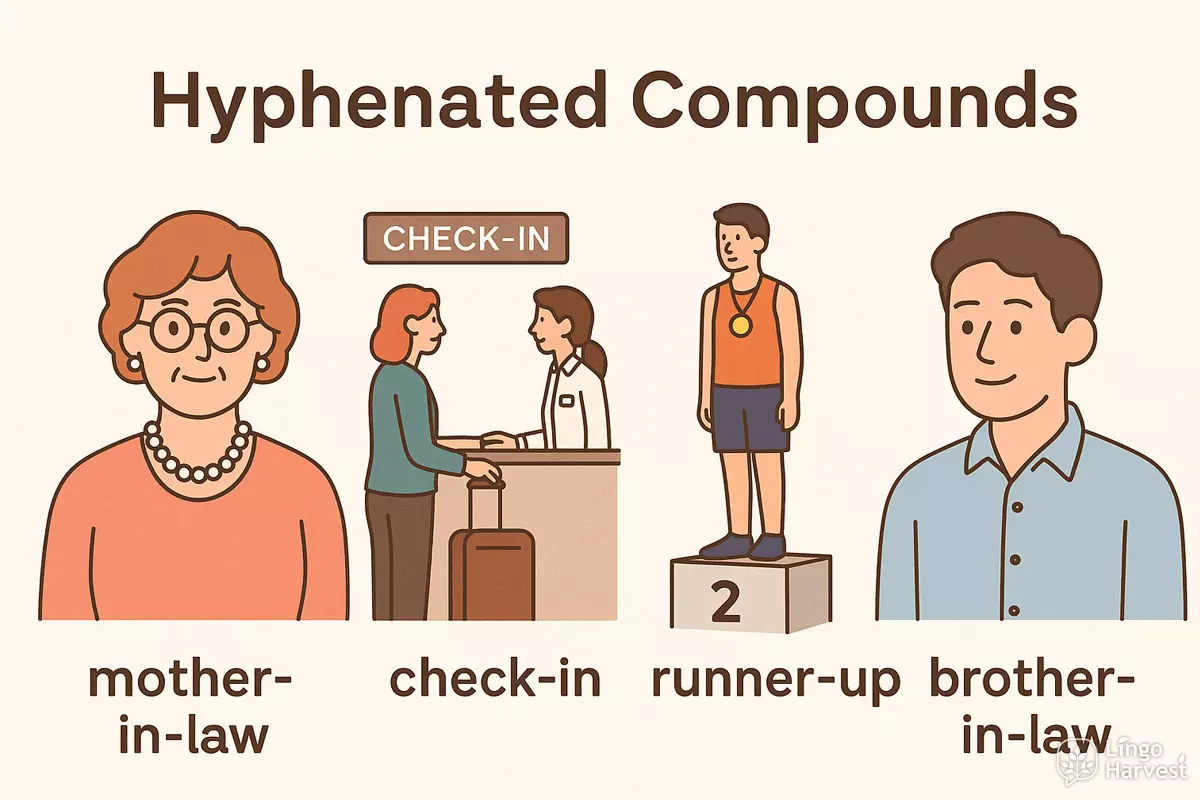
Hyphenation is common when clarity is needed, especially with new or less familiar terms, or when the meaning could be ambiguous. Temporary compounds, as well as those with two equal elements, often use a hyphen. Examples are:
- mother-in-law
- check-in
- runner-up
- brother-in-law
- editor-in-chief
- passer-by
- self-esteem
- well-being
- son-in-law
- dry-cleaning
Open Compounds
Some compounds remain as two separate words, even though they represent a single idea. These are especially common with noun + noun or adjective + noun combinations. For instance:
- post office
- ice cream
- high school
- living room
- coffee table
- swimming pool
- bus stop
- data center
- police station
- science fiction
Comparing Spelling Patterns
Writers sometimes struggle with compounds that change form as they become more common, or when style guides differ. Here’s a quick comparison of some compounds in their various forms:
| Closed (One Word) | Hyphenated | Open (Two Words) |
|---|---|---|
| notebook | mother-in-law | post office |
| toothpaste | check-in | ice cream |
| snowman | runner-up | living room |
| haircut | self-esteem | bus stop |
| keyboard | well-being | coffee table |
Tips for Deciding on the Form
- Consult a reliable dictionary if unsure; usage can change over time.
- Follow your style guide’s recommendations for consistency.
- Hyphenate for clarity, especially if misreading is possible.
- Be aware that some compounds evolve: “e-mail” is now often “email.”
- Compound adjectives before a noun are usually hyphenated (e.g., “well-known author”).
In summary, the way compound nouns are written reflects both convention and the need for clarity. Familiarity with these patterns helps you adapt as language evolves.
Stress Patterns in Compound Nouns
Understanding how stress falls in compound nouns is essential for clear and natural English pronunciation. In English, compound nouns—words formed by joining two or more words together—typically have a distinct pattern: the primary stress usually lands on the first word, while the second word receives less emphasis. This subtle shift in pronunciation helps listeners distinguish between compound nouns and simple noun phrases.
General Rule for Stress Placement
Most compound nouns in English are stressed on the first component. For example, in the word toothbrush, the stress is on "tooth" rather than "brush." This pattern helps differentiate a compound noun from a phrase where each word might carry equal weight, such as "black board" (a board that is black) versus "blackboard" (the object used in classrooms).
Examples of Stress Patterns
Here are several common compound nouns with their typical stress patterns. The stressed syllable is indicated in bold:
- TAblecloth
- POSTman
- FOOTball
- NEWspaper
- HAIRcut
- BOOKstore
- BIRTHday
- KEYboard
- NOTEbook
- SUNlight
- CLASSroom
- RAILway
- SUITcase
- SEAfood
- PASsport
- WORKplace
- TEAcup
- GREENhouse
- SNOWball
- HANDbag
Exceptions and Special Cases
While the first-word stress is the norm, some compounds—especially those borrowed from other languages or those with certain structures—may have different patterns. For example, compounds where the second element is more important for meaning, or where the compound is relatively new, can sometimes take stress on the second word. However, these are less common.
Comparison: Compound Noun vs. Noun Phrase
To make the distinction clear, here is a comparison of stress patterns between compound nouns and similar noun phrases:
| Compound Noun (First-word stress) |
Noun Phrase (Second-word stress) |
|---|---|
| GREENhouse (a glass building for plants) |
green HOUSE (a house that is green) |
| BLACKbird (a type of bird) |
black BIRD (a bird that is black) |
| TOOTHbrush | tooth BRUSH |
| POSTman | post MAN |
Correctly placing the stress is crucial for being understood, as it can change the meaning of the phrase entirely. Practicing with these examples will help develop a more natural and accurate pronunciation when using compound nouns in conversation.
Meaning Changes in Compounds
When two words are joined to form a compound noun, the overall meaning often shifts from the sum of its parts. Sometimes, the new word gains a specific or even unexpected sense that differs from the literal interpretation of each component. These semantic shifts can range from subtle nuance changes to completely new meanings that are not predictable from the individual words.
Types of Semantic Shifts
Compounds may develop meanings that are:
- Literal: The new word means exactly what its parts suggest (e.g., "toothbrush" – a brush for teeth).
- Figurative: The meaning is metaphorical or idiomatic, not directly tied to the components (e.g., "butterfly" – not related to butter or flies).
- Restricted: The compound refers to a specific type or instance, not all possible combinations (e.g., "blackboard" – not any black board, but a specific classroom item).
- Extended: The word’s meaning broadens beyond the original scope (e.g., "headquarters" – not just the chief’s quarters, but the main office of an organization).
Examples of Meaning Evolution in Compound Nouns
Below are common compound nouns where the meaning has shifted or specialized in interesting ways:
- Greenhouse → Not a house that is green, but a building for growing plants.
- Blackmail → Refers to extortion, not a dark-colored letter.
- Bookworm → A person who loves reading, not a worm in a book.
- Football → A sport, not just any ball for the foot.
- Deadline → The final time for something, not a physical line.
- Hotdog → A food item, not a dog that is hot.
- Butterfly → An insect, not butter or a fly.
- Sunflower → A specific type of flower, not just any flower in the sun.
- Skyscraper → A tall building, not something scraping the sky literally.
- Handbag → A purse, not a bag shaped like a hand.
- Fireman → A firefighter, not a man made of fire.
- Keyboard → Input device, not a board made of keys.
- Starfish → An animal, not a fish from a star.
- Snowball → A ball made from snow, but also used figuratively (e.g., "snowball effect").
- Notebook → A book for notes, not a note in the form of a book.
- Rattlesnake → A specific species of snake, not a snake that simply rattles.
- Teacup → A cup for tea, but also sometimes used to refer to a small dog breed ("teacup poodle").
- Raincoat → A coat for rain, not a coat made of rain.
- Mailbox → A container for mail, not a box made out of mail.
- Eggplant → A vegetable, not a plant that produces eggs.
Comparing Literal and Non-Literal Meanings
Some compounds are transparent, while others have meanings that are less obvious. Here’s a comparison:
| Compound | Meaning |
|---|---|
| Bedroom | A room for sleeping (literal) |
| Butterfly | An insect (non-literal, unrelated to butter or fly) |
| Footprint | The mark left by a foot (literal and extended—also used metaphorically) |
| Deadline | The last possible time for completion (figurative, not a physical line) |
| Bookworm | Someone who reads a lot (figurative, not a literal worm) |
| Greenhouse | A building for growing plants (specialized meaning) |
Understanding these shifts is important for both language learners and those interested in word formation. Recognizing how meanings evolve helps in interpreting unfamiliar compounds and appreciating the creativity of language.
Practice: Build New Compound Nouns
Exploring how to create new compound nouns is a key skill in mastering their formation patterns. By combining different types of words—nouns, adjectives, verbs—you can generate a wide range of expressions. Below, you’ll find hands-on activities and ideas to deepen your understanding.
Task 1: Combine and Create
Try making fresh compound nouns by joining the items in each pair. Some pairs may have more than one possible answer, or you can invent your own!
- snow + man
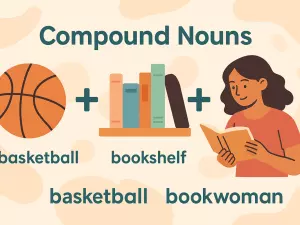
- book + shelf
- tooth + brush
- rain + coat
- fire + fighter
- sun + flower
- table + cloth
- shoe + lace
- hair + cut
- foot + ball
- hand + bag
- news + paper
Show answers
- snowman
- bookshelf
- toothbrush
- raincoat
- firefighter
- sunflower
- tablecloth
- shoelace
- haircut
- football
- handbag
- newspaper
Task 2: Identify the Pattern
Look at the following compound nouns and decide what type of words are being combined (noun+noun, adjective+noun, verb+noun, etc.). Write your answers for each.
- blackboard
- swimming pool
- laptop
- greenhouse
- washing machine
- bedroom
- playground
- keyboard
Show answers
- blackboard – adjective + noun
- swimming pool – verb + noun
- laptop – noun + noun
- greenhouse – adjective + noun
- washing machine – verb + noun
- bedroom – noun + noun
- playground – verb + noun
- keyboard – noun + noun
Pattern Reference Table
The table below summarizes some common ways to form compound nouns. Notice how different combinations create new meanings.
| Pattern | Example | Meaning |
|---|---|---|
| noun + noun | toothpaste | paste for cleaning teeth |
| adjective + noun | blackboard | a board that is black |
| verb + noun | swimming pool | pool for swimming |
| noun + verb(ing) | haircut | the act of cutting hair |
| verb + preposition | checkout | the place to check out (in a store) |
Task 3: Invent Your Own
Challenge yourself by inventing three original compound nouns. Use the patterns above or experiment with new combinations. Write down the new word and its meaning.
Show answers
- Examples: moonlight (light from the moon), smartphone (phone with smart features), rainboots (boots for rain).
- Your own creations may vary!
Practice with these activities to boost your ability to recognize and form compound nouns naturally in English.