Possessive Nouns: Structural Overview

 Here we how to express possession in English, including rules for using apostrophes with singular and plural nouns, irregular plurals, and double possessives. It also highlights common apostrophe mistakes and provides practice exercises.
Understanding how to show ownership in English is essential for clear communication, as using the correct forms to indicate possession makes your writing more precise and effective. Typically, English expresses possession through the use of apostrophes with nouns, such as in "the student's book," or by using possessive pronouns like "my," "your," "his," "her," "our," and "their." Recognizing when to use each form helps avoid confusion and ensures your meaning is clear to readers. Mastering these structures will improve both your writing and speaking skills.
What Is Possession in Grammar?
In grammar, possession refers to the way language shows that something belongs to or is associated with someone or something. This relationship can express ownership, relationships, parts of a whole, or even more abstract connections. For example, in the phrase the dog’s collar, the collar is linked to the dog, indicating that the collar belongs to or is worn by the dog.
How Possession Is Expressed
Languages use different strategies to indicate possession. In English, the most common methods are possessive nouns, possessive pronouns, and possessive adjectives. Possessive forms help clarify who owns or is connected to the noun that follows.
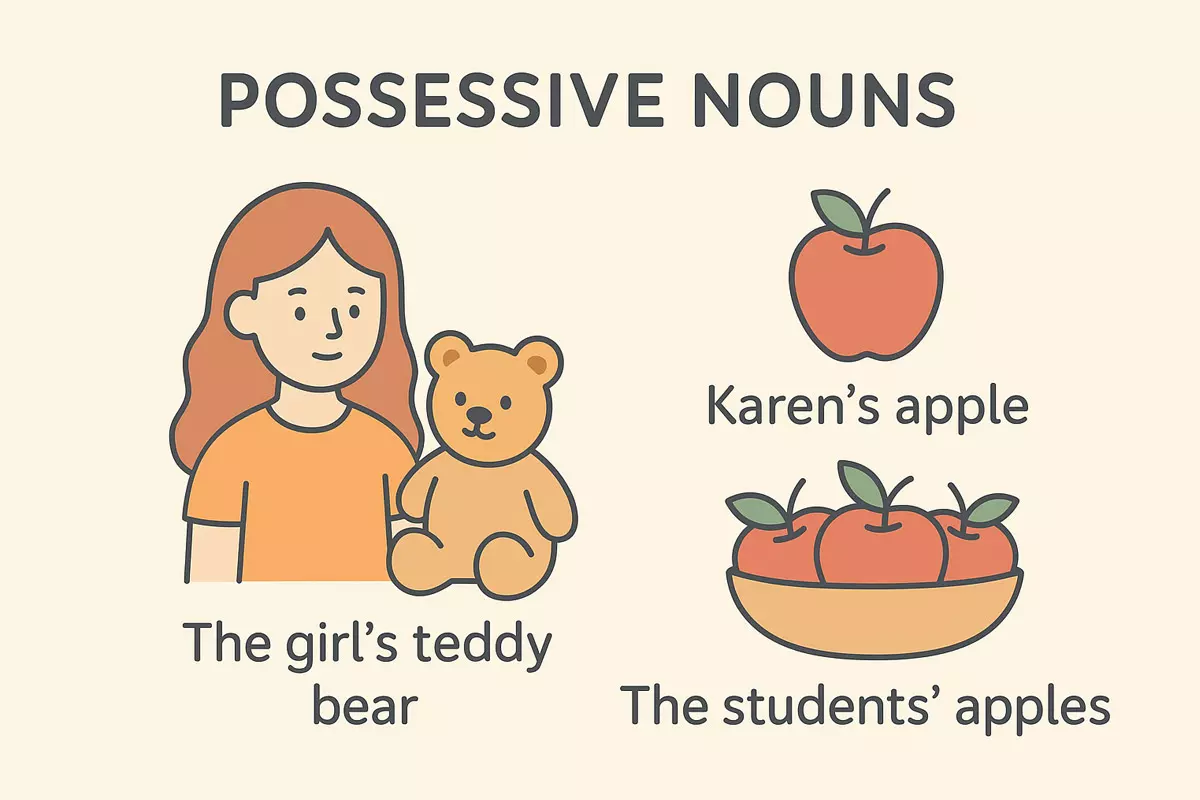
- Possessive Nouns: Add an apostrophe + s (’s) or just an apostrophe for plural possessors ending in s (the cat’s toy, the teachers’ lounge).
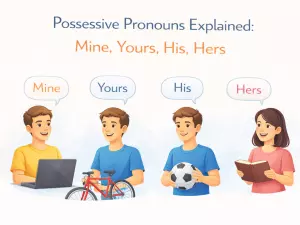
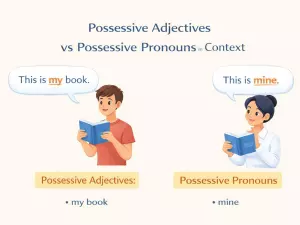
- Possessive Pronouns: Stand alone to show ownership (mine, yours, hers, theirs).
- Possessive Adjectives: Used before a noun to show belonging (my book, your car).
Types of Possessive Relationships
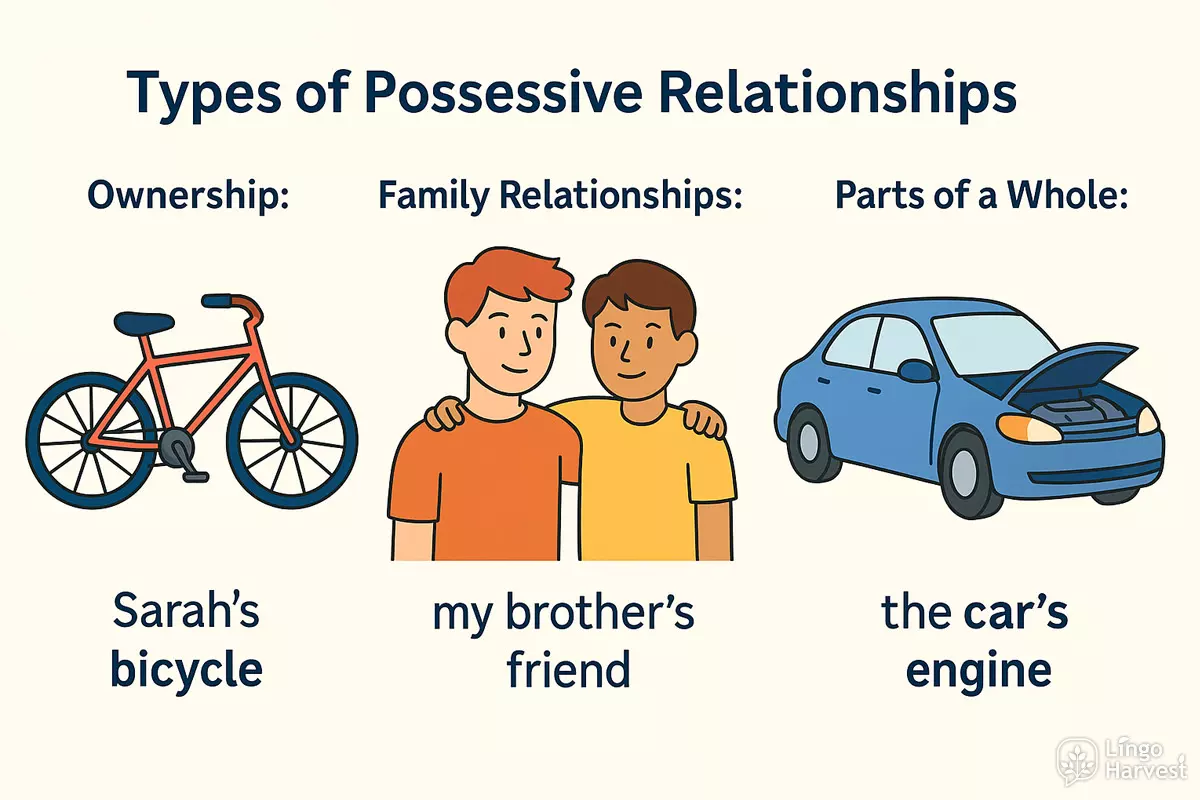
Not all possession is about literal ownership. Some common types include:
- Ownership: Sarah’s bicycle (Sarah owns the bicycle)
- Family Relationships: my brother’s friend
- Parts of a Whole: the car’s engine
- Characteristics: the city’s charm
- Time Expressions: a day’s work
- Origin: Italy’s wines
- Measurement: an hour’s drive
- Roles/Associations: the company’s CEO
- Abstract Relationships: the project’s success
- Descriptions: the dog’s bark
Identifying Possession in Sentences
To spot possession, look for forms that signal a relationship between two nouns or between a noun and a pronoun. Often, the possessor comes before the object possessed. Here are a few patterns commonly used in English:
- child’s toy (possessive noun)
- my bag (possessive adjective)
- theirs is red (possessive pronoun)
- the legs of the table (using of for possession)
Quick Comparison: Possessive Forms in English
| Form | Example | Usage |
|---|---|---|
| Noun + ’s / ’ | the teacher’s desk the students’ books |
Shows ownership or relationship; singular/plural |
| Possessive Pronoun | mine, yours, hers, ours | Replaces a noun phrase; no object needed |
| Possessive Adjective | my, your, his, her, its, our, their | Comes before a noun; modifies the noun |
| of-construction | the color of the sky | Often used for inanimate objects or abstract relationships |
Understanding how possession works in grammar helps make writing and speech clearer, showing exactly how things or people are related. Whether describing ownership, characteristics, or relationships, these grammatical forms play a key role in accurate communication.
The Apostrophe and -s Form
Understanding how to indicate ownership in English often starts with mastering the use of apostrophes combined with the letter "s." This construction is the most common way to show that something belongs to someone or something. The pattern is straightforward: add an apostrophe followed by "s" to the end of a singular noun. For plural nouns ending in "s," only an apostrophe is typically added.
Basic Rules for Forming Possessives
- Add 's to singular nouns: the cat's toy
- For plural nouns ending in s, add just an apostrophe: the teachers' lounge
- For irregular plurals not ending in s, use 's: the children's books
- With names ending in s, both James's car and James' car are accepted, though style guides may vary
Common Examples
- dog's collar
- parents' meeting
- boss's office
- students' assignments
- Chris's hat
- women's restroom
- children's playground
- the city's skyline
- the Smiths' house
- the mouse's hole
- men's jackets
- the geese's migration
- the actor's lines
- my friend's advice
- the company’s policy
- the boys’ soccer team
Comparison: Singular vs. Plural Possessive Forms
| Singular Noun | Plural Noun | Possessive Example |
|---|---|---|
| girl | girls | the girl's book → the girls' books |
| child | children | the child's toy → the children's toys |
| man | men | the man's hat → the men's hats |
| teacher | teachers | the teacher's desk → the teachers' desks |
| fox | foxes | the fox's den → the foxes' dens |
Special Notes
Some names and words ending in s can take either 's or just an apostrophe. For example, both Lucas's book and Lucas' book are correct, depending on the chosen style guide. Additionally, avoid using apostrophes for possessive pronouns like its, yours, or theirs.
Applying these patterns lets you form possessives accurately and clearly, making your writing both precise and easy to read.
Singular Noun Possessives
Understanding how to show ownership or association with single nouns is central to clear communication in English. For most cases, adding an apostrophe followed by the letter "s" (‘s) to a noun signals possession. This construction applies whether the noun ends with a consonant or a vowel, and it helps clarify relationships between people, places, and things.
Forming the Possessive: Basic Rules
The standard method involves attaching ‘s directly to the end of the word. For example, “the dog’s leash” indicates that the leash belongs to the dog. If the noun already ends in "s," traditional style still adds ‘s (“the boss’s office”), but some style guides allow just an apostrophe (“the boss’ office”). Consistency within a piece of writing is more important than strict adherence to one version.
Common Patterns and Examples
Ownership can be shown for a wide range of singular nouns. Here are several everyday examples:
- the child’s toy
- the artist’s studio
- the country’s flag
- the city’s skyline
- the bird’s nest
- the teacher’s desk
- the neighbor’s car
- the woman’s idea
- the student’s answer
- the cat’s whiskers
- the company’s policy
- the author’s book
- the president’s speech
- the computer’s screen
- the doctor’s advice
Irregular Forms and Proper Nouns
Some singular nouns have irregular spellings or pronunciation. For example, “child” becomes “child’s,” not “childs’s.” With proper names ending in "s," either ‘s or just an apostrophe is accepted: “James’s hat” or “James’ hat.” The choice often depends on style preference or pronunciation ease.
Comparing Possessive and Non-Possessive Forms
To avoid confusion, it helps to compare the possessive form with the non-possessive. Notice how the meaning changes:
| Noun | Possessive Example |
|---|---|
| the cat | the cat’s tail |
| the manager | the manager’s report |
| the building | the building’s entrance |
| the planet | the planet’s atmosphere |
| the chef | the chef’s recipe |
Usage Tips and Common Errors
Apostrophe mistakes are frequent—forgetting the ‘s or placing it incorrectly can change the meaning. For singular nouns, always use ‘s for possession, not just an apostrophe. Do not use an apostrophe for plurals unless showing ownership. For example, "the cats" (more than one cat) is not the same as "the cat’s" (something belonging to one cat). Mastering these patterns will help you express relationships and ownership with accuracy and clarity.
Plural Noun Possessives
Understanding how to show ownership when more than one person, animal, or thing is involved can be a bit tricky. The rules are straightforward once you know what to look for: the spelling of the plural form determines the possessive structure. Most plural nouns in English end with "s," but there are exceptions. The placement of the apostrophe is key to clarity and correctness.
General Rules for Plural Possessives
For regular plurals ending in "s," simply add an apostrophe after the "s." For irregular plurals that do not end in "s," add an apostrophe followed by "s." This distinction helps avoid confusion and keeps writing precise.
- dogs’ collars (collars belonging to several dogs)
- teachers’ lounge (lounge for multiple teachers)
- children’s toys (toys belonging to several children)
- men’s shoes (shoes for men)
- girls’ soccer team (team of several girls)
- geese’s migration (migration of geese)
- parents’ meeting (meeting for parents)
- women’s restroom (restroom for women)
- students’ grades (grades belonging to students)
- mice’s tails (tails of mice)
- friends’ reunion (reunion of friends)
- bosses’ decisions (decisions made by bosses)
- children’s playground (playground for children)
- police officers’ duties (duties of police officers)
- judges’ robes (robes worn by judges)
- members’ votes (votes of members)
- neighbors’ garden (garden shared by neighbors)
- cities’ skylines (skylines of cities)
- families’ traditions (traditions of families)
- heroes’ welcome (welcome for heroes)
Comparison: Regular vs. Irregular Forms
The difference between regular and irregular forms becomes clear when you look at how the possessive is created. Regular plurals, which end in "s," only need an apostrophe, while irregular plurals need both an apostrophe and "s." Here’s a quick overview:
| Plural Noun | Correct Possessive Form |
|---|---|
| dogs | dogs’ |
| teachers | teachers’ |
| children | children’s |
| men | men’s |
| women | women’s |
| bosses | bosses’ |
| geese | geese’s |
| students | students’ |
Common Pitfalls and Tips
Writers often accidentally place apostrophes before the "s" in regular plural possessives, or forget to add "’s" for irregular plurals. Always check if the plural form ends with "s." If it does, just add an apostrophe. If not, use "’s." Keeping these patterns in mind helps ensure your writing remains clear and accurate.
Irregular Plurals and Possession
English has many nouns that don’t follow the standard plural rules, and showing ownership with these words can be tricky. Instead of just adding ’s as with regular plurals, you need to pay attention to the unique forms of these nouns. Understanding how to form the possessive case for words like "children," "men," or "geese" is essential for clear and correct writing.
Forming the Possessive with Irregular Plurals
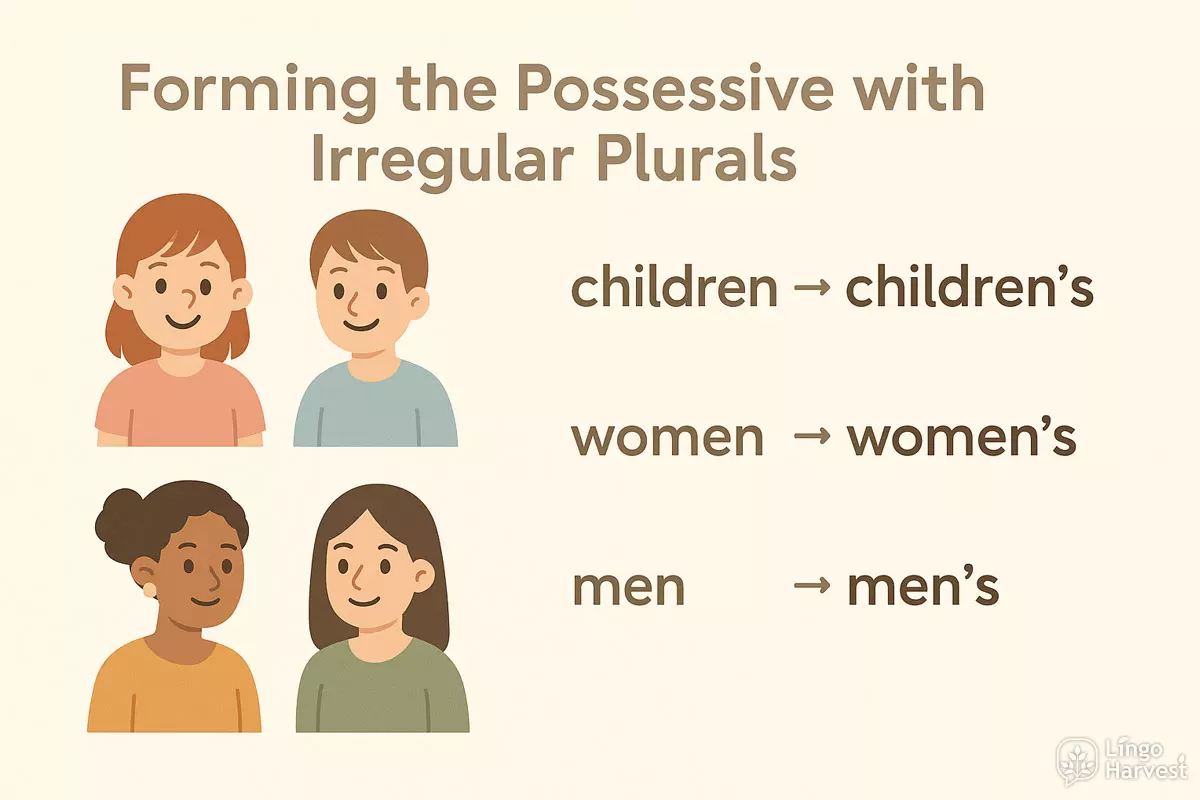
Most irregular plural nouns become possessive by adding an apostrophe + s, even when the plural doesn’t end in "s." For example, "children’s toys" (not "childrens’ toys") and "men’s restroom" (not "mens’ restroom"). The key is to identify the correct plural form before adding the possessive ending.
- children → children’s
- women → women’s
- men → men’s
- geese → geese’s
- mice → mice’s
- feet → feet’s
- teeth → teeth’s
- people → people’s
- cacti → cacti’s
- alumni → alumni’s
- oxen → oxen’s
- data → data’s (when treated as plural)
- criteria → criteria’s
- dice → dice’s
- sheep → sheep’s (same singular/plural form)
- deer → deer’s (same singular/plural form)
- fish → fish’s (same singular/plural form)
- aircraft → aircraft’s (same singular/plural form)
Common Mistakes with Irregular Forms
Writers sometimes add an apostrophe after the "s" even when the irregular plural doesn’t end in "s." For example, "childrens’ books" is incorrect; it should be "children’s books." The same applies to "mens’" and "womens’," which should be "men’s" and "women’s."
Comparison: Regular vs. Irregular Plural Possessives
To clarify the difference between regular and irregular plural possessive formation, here’s a comparison:
| Plural Noun | Possessive Form |
|---|---|
| dogs | dogs’ (the dogs’ collars) |
| children | children’s (the children’s playground) |
| women | women’s (the women’s conference) |
| geese | geese’s (the geese’s migration) |
| men | men’s (the men’s locker room) |
Summary Tips
- Always start with the correct plural form.
- Add ’s to plural nouns not ending in "s" (children’s, women’s).
- For regular plurals ending in "s," just add an apostrophe (dogs’).
- Watch out for nouns that don’t change at all in plural form (sheep’s, deer’s).
Mastering these patterns helps ensure that your writing is accurate and easy to understand, especially when expressing ownership with unusual plural nouns.
Double Possessive Structures
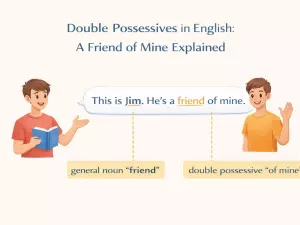
Many English sentences use both a possessive marker and the preposition "of" to clarify relationships, especially when referring to people or emphasizing a specific member of a group. This construction, often called a "double genitive," is especially common in everyday conversation. For example, "a friend of my brother's" points not just to any friend, but specifically to one belonging to the brother's circle.
How It Works
The pattern usually combines "of" with a possessive noun or pronoun. This form helps avoid ambiguity, making it clear that the possessor is part of a larger group and only one is meant. It is most often used with people, but sometimes appears with certain animals or personified things.
- That’s a painting of John’s. (One of the paintings that belong to John)
- She is a colleague of mine. (One of my colleagues)
- He borrowed a book of Mary's. (One of the books that Mary owns)
- They are friends of ours. (Some friends belonging to us)
- Is that a photograph of yours?
- He's a student of Dr. Smith's.
- I met a neighbor of theirs.
- That's an idea of Tom's.
- She admired a sculpture of the artist's.
- Have you seen a cat of theirs?
- There's a letter of yours on the table.
- He’s a classmate of my sister’s.
- She’s a fan of the band’s.
- That’s a suggestion of yours I like.
- We visited a relative of my mother’s.
- He found a jacket of his.
- They’re cousins of ours.
- She met a teacher of her brother’s.
When to Use (and Avoid) the Construction
This structure is preferred when the noun is indefinite (a/an, some) and the possessor is specific. It is less common or even ungrammatical with inanimate objects or when the noun is definite and unique (e.g., "the roof of the house" not "the roof of the house's"). For clarity, avoid using this form with non-personal nouns unless the context allows personification.
Comparison: Single vs. Double Genitive
To highlight the difference, consider the following:
- Single genitive: Mary's book (the book owned by Mary)
- Double genitive: a book of Mary's (one of the books owned by Mary, not necessarily all of them)
The double form is especially useful when you want to point out one among many possible items belonging to someone. This subtlety is often lost with the single possessive.
Common Errors with Apostrophes
Misplacing or omitting apostrophes often leads to confusion in written English, especially with possessive forms. Many writers struggle with when to use an apostrophe for ownership versus when a word is simply plural or a contraction. Understanding these patterns helps clarify meaning and avoids ambiguity.
Frequent Mistakes in Possessive Forms
Writers sometimes insert apostrophes where they aren’t needed or forget them when showing possession. Below are some widespread pitfalls to watch for:
- Using an apostrophe to make regular plurals (e.g., apple’s instead of apples)
- Confusing its (possessive) and it’s (it is or it has)
- Placing the apostrophe incorrectly with plural possessives (e.g., the dog’s collars vs. the dogs’ collars)
- Adding ’s to possessive pronouns (e.g., her’s instead of hers)
- Omitting the apostrophe in contractions (e.g., dont instead of don’t)
- Misplacing apostrophes in last names (e.g., The Smith’s house instead of The Smiths’ house)
- Using apostrophes with decades or abbreviations (e.g., 1980’s instead of 1980s)
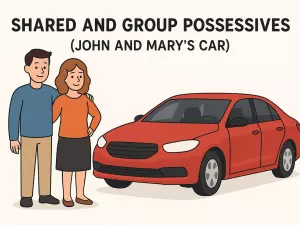
- Incorrectly forming joint possession (e.g., John’s and Mary’s car for one shared car)
- Forgetting the apostrophe in time expressions (e.g., a days work instead of a day’s work)
- Placing apostrophes after the ‘s’ in singular nouns (e.g., Charles’ book vs. Charles’s book)
Comparison Table: Correct vs. Incorrect Apostrophe Usage
| Incorrect Form | Correct Form |
|---|---|
| the cat’s toys (for several cats) | the cats’ toys |
| its’ color is bright | its color is bright |
| the teachers lounge | the teachers’ lounge |
| the Jones’s house (for the Jones family) | the Joneses’ house |
| the dog lost it’s collar | the dog lost its collar |
| 1980’s music | 1980s music |
| hers’ is red | hers is red |
| dont worry | don’t worry |
| John’s and Mary’s car (for one car they share) | John and Mary’s car |
| three days work | three days’ work |
Tips to Avoid Apostrophe Mistakes
- Remember: Apostrophes do not make words plural.
- Check if a word is a contraction or shows possession before adding an apostrophe.
- Possessive pronouns (yours, theirs, its, ours, hers) never take apostrophes.
- For plural possessives, put the apostrophe after the ‘s’ unless the plural is irregular (e.g., children’s books).
Careful attention to these details helps writers use apostrophes accurately, ensuring that meaning remains clear and professional.
Practice: Rewrite with Possessive Nouns
Understanding how to transform ordinary noun phrases into their possessive forms is essential for clarity and precision in writing. In this activity, you'll practice converting sentences by using possessive structures, focusing on both singular and plural nouns, as well as irregular forms.
Instructions
For each item below, rewrite the phrase or sentence by using a possessive noun. Pay attention to apostrophe placement and the difference between singular and plural possessive forms.
- The car of the teacher
- The toys of the children
- The house of my parents
- The wings of the bird
- The office of Mr. Smith
- The bark of the dogs
- The homework of the students
- The color of the sky
- The decision of the committee
- The uniform of the players
- The laughter of the girls
- The handle of the suitcase
- The leg of the table
- The fur of the cat
- The performance of the actors
- The pages of the book
- The tail of the horse
- The shoes of the man
- The garden of our neighbors
- The names of the winners
Show answers
- The teacher's car
- The children's toys
- My parents' house
- The bird's wings
- Mr. Smith's office
- The dogs' bark
- The students' homework
- The sky's color
- The committee's decision
- The players' uniform
- The girls' laughter
- The suitcase's handle
- The table's leg
- The cat's fur
- The actors' performance
- The book's pages
- The horse's tail
- The man's shoes
- Our neighbors' garden
- The winners' names
Common Patterns: Singular vs. Plural Possessives
Review the table below for common patterns in forming possessive nouns, especially how the apostrophe is placed for singular and plural nouns.
| Phrase | Possessive Form |
|---|---|
| The hat of the boy | The boy's hat |
| The backpacks of the girls | The girls' backpacks |
| The kennel of the dog | The dog's kennel |
| The desks of the teachers | The teachers' desks |
| The bicycle of James | James's bicycle (or James' bicycle) |
| The classroom of the children | The children's classroom |
Tips for Forming Possessive Nouns
- Add 's for most singular nouns (e.g., the cat's food).
- Add only an apostrophe (') after plural nouns ending in -s (e.g., the teachers' lounge).
- Irregular plural nouns not ending in -s take 's (e.g., the children's games).
- For names ending in s, both 's and ' are acceptable (e.g., James's or James' book).