Possessive Pronouns Explained: Mine, Yours, His, Hers

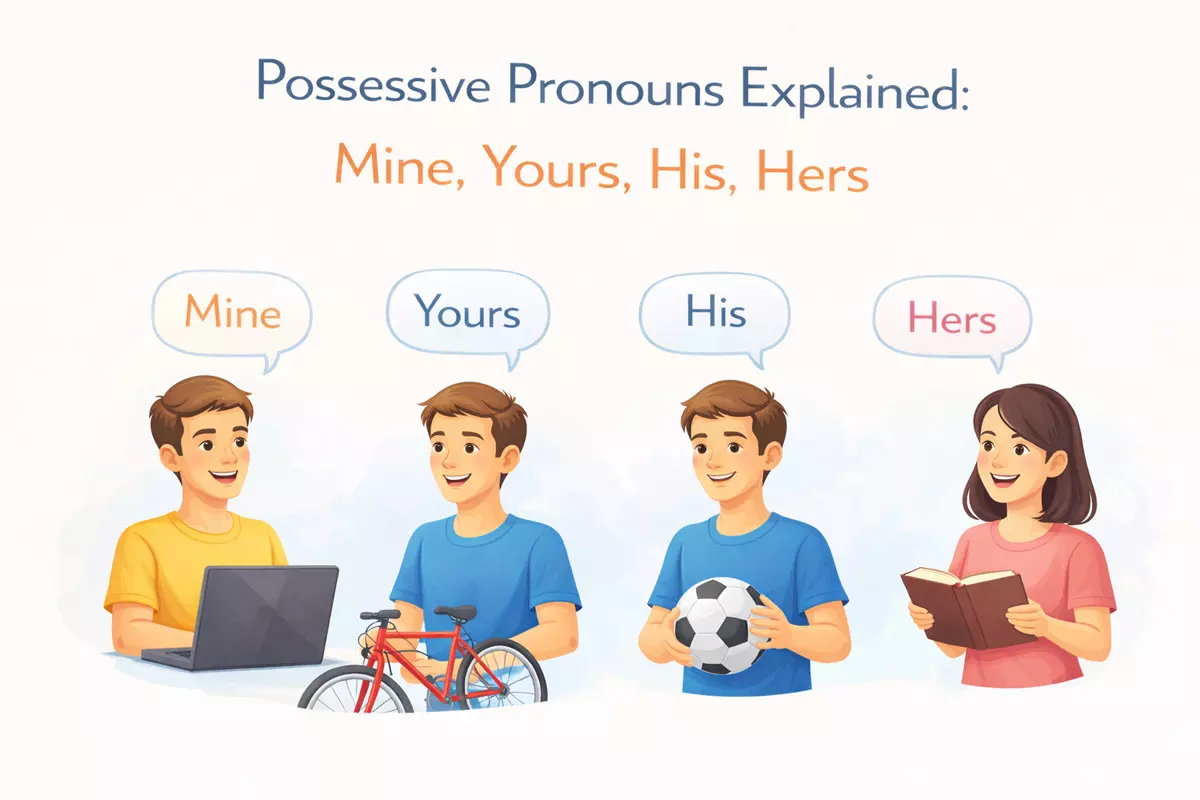 Here we the difference between possessive pronouns and adjectives, lists all possessive pronouns, explains how to use them naturally in sentences and short answers, warns about mistakes like its vs it’s, and gives rewrite practice.
- Possessive pronouns vs possessive adjectives (mine vs my)
- Full set and meaning: mine, yours, his, hers, its, ours, theirs
- Using possessive pronouns to avoid repetition
- Whose questions and short answers: It’s mine
- Common mistake: confusing its and it’s
- Possessive pronouns with one/ones: mine vs mine one
- Natural spoken patterns: a friend of mine, yours too
- Practice: rewrite sentences using possessive pronouns
In English, we use words like mine, yours, his, hers, ours, and theirs to show ownership without repeating names, making our sentences clearer and more concise. These possessive pronouns help us indicate who something belongs to, so instead of saying "That is Sarah's book," we can simply say "That book is hers." This not only avoids repetition but also improves the flow of conversation and writing. Using these forms correctly allows us to communicate more efficiently, ensuring our meaning is easily understood in everyday interactions.
Possessive pronouns vs possessive adjectives (mine vs my)
Understanding how to use forms like mine and my can make your English sound much more natural. The main distinction lies in how these words interact with nouns in a sentence. One group replaces nouns, while the other modifies them.
Key differences in usage
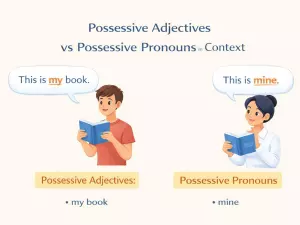
Possessive pronouns such as mine, yours, his, hers, ours, theirs stand alone and refer to something already mentioned or obvious from context. In contrast, possessive adjectives—including my, your, his, her, our, their—must come before a noun, showing ownership directly. Here are some quick examples to illustrate:
- This is my book. (possessive adjective + noun)
- This book is mine. (possessive pronoun, no noun after)
- Is this your pen? (adjective)
- No, it’s hers. (pronoun)
Comparison chart: forms and examples
| Possessive Adjective (before noun) |
Possessive Pronoun (replaces noun) |
|---|---|
| my car | The car is mine. |
| your idea | The idea was yours. |
| his jacket | The jacket is his. |
| her phone | The phone is hers. |
| our house | The house is ours. |
| their dog | The dog is theirs. |
When to use each form
Choose the adjective form when a noun follows directly: “That’s my seat.” Use the pronoun form when the noun is not repeated: “That seat is mine.” Mixing these up can lead to awkward or incorrect sentences, such as “That seat is my” ❌.
Common errors to avoid
- Don’t use a possessive pronoun before a noun (“mine book” ❌).
- Don’t use a possessive adjective alone without a noun (“This is my” ❌).
- Remember: adjectives always need a noun partner; pronouns stand alone.
Mastering the difference between these forms helps you express ownership clearly and correctly, both in writing and conversation.
Full set and meaning: mine, yours, his, hers, its, ours, theirs
Understanding possessive pronouns helps clarify who owns or is associated with something. These words replace nouns to show belonging, making sentences shorter and clearer. For example, instead of saying "the book of Sarah," you can simply say "hers."
What each pronoun means
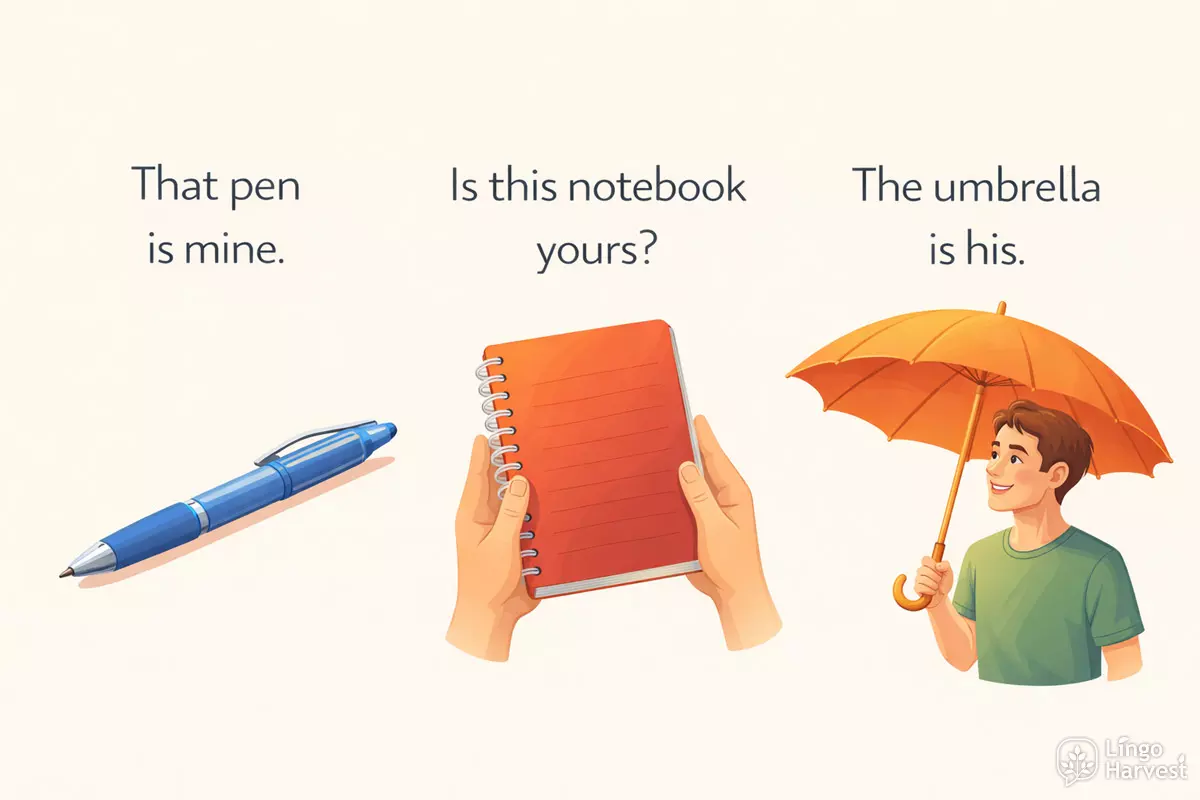
Each possessive pronoun expresses ownership for a specific person or group:
- Mine – shows something belongs to the speaker (I): "That pen is mine."
- Yours – refers to the person spoken to (you): "Is this notebook yours?"
- His – indicates possession by a male person: "The umbrella is his."
- Hers – indicates possession by a female person: "The idea was hers."
- Its – refers to a thing, animal, or concept (rarely used): "Every dog has its day."
- Ours – shows something belongs to the speaker and others (we): "The victory was ours."
- Theirs – indicates possession by other people or things: "The choice was theirs."
Usage in sentences
Possessive pronouns stand alone—they don’t need a noun after them. This makes them different from possessive adjectives like "my" or "your." For example:
- "This seat is mine." (not "mine seat")
- "Those keys are yours."
- "That house is theirs."
Quick comparison of possessive pronouns
The table below summarizes the different forms and the owner each one refers to:
| Pronoun | Who it refers to |
|---|---|
| Mine | Speaker (I) |
| Yours | Person spoken to (you) |
| His | Male person |
| Hers | Female person |
| Its | Thing/animal |
| Ours | We/us (group including speaker) |
| Theirs | Other people/things |
Common mistakes and tips
- Don’t use an apostrophe in "its" when it shows possession ("its color" ✅, not "it's color" ❌).
- Possessive pronouns never come before a noun: say "This is hers," not "hers book."
- Use these words to avoid repeating nouns: "My phone is new. Yours is old."
These pronouns make English more concise and clear, especially when you need to show who owns or is connected to something. Practice using them in different contexts for natural communication.
Using possessive pronouns to avoid repetition
Repeating the same nouns or names in a conversation can make speech sound awkward and cumbersome. This is where possessive pronouns are especially useful: they allow us to refer to objects, ideas, or people without constantly restating ownership. Instead of repeating “John’s book” or “my coat,” we can simply use “his” or “mine.”
Why use possessive pronouns?
Possessive pronouns like mine, yours, his, hers, ours, theirs help make sentences smoother and more concise. They clarify who owns or is connected to something without unnecessary repetition.
- “This pencil is mine.” (instead of “This pencil is my pencil.”)
- “Is that seat yours?” (avoids “Is that your seat?” when it’s clear from context)
- “The red scarf is hers.” (no need to say “The red scarf is her scarf.”)
- “These keys are ours.”
- “That decision was theirs.”
- “This one is his, not mine.”
- “Is this umbrella yours or mine?”
- “My phone is new. Yours looks older.”
- “Our house is blue. Theirs is green.”
- “His answer was correct, but hers was even better.”
Common situations for possessive pronouns
You’ll often use these pronouns when comparing or contrasting ownership, or when the item in question is already clear. Some typical examples:
- After verbs like is, are, was, were: “The choice is yours.”
- When responding to questions: “Whose bag is this?” – “It’s mine.”
- To avoid repeating nouns in lists: “Jack brought his lunch. Anna brought hers.”
- Clarifying possession in group settings: “Those seats are ours.”
Comparison: Possessive Pronouns vs. Possessive Adjectives
Sometimes, it’s easy to confuse possessive pronouns with possessive adjectives (like my, your, his, her). The table below highlights key differences and examples for clarity.
| Possessive Adjective | Possessive Pronoun | Example Sentence |
|---|---|---|
| my | mine | This is my bag. / This bag is mine. |
| your | yours | Is that your seat? / Is that seat yours? |
| his | his | That is his book. / That book is his. |
| her | hers | This is her jacket. / This jacket is hers. |
| our | ours | That is our house. / That house is ours. |
| their | theirs | Those are their coats. / Those coats are theirs. |
By using these pronouns thoughtfully, you can make your English more natural and avoid unnecessary repetition in both writing and speech.
Whose questions and short answers: It’s mine
Questions starting with “Whose” are used to find out who owns or possesses something. The answer often uses possessive pronouns like “mine,” “yours,” “his,” or “hers” for clarity and brevity. This structure is common in both spoken and written English, especially when the context makes the noun clear and repetition is unnecessary.
How to ask about possession with “Whose”
To ask who something belongs to, simply use “Whose” followed by the item. The answer can be a full sentence or a short reply with a possessive pronoun. For example:
- Whose book is this? – It’s mine.
- Whose keys are on the table? – They’re hers.
- Whose jacket is this? – That’s his.
Short answers with possessive pronouns
Short answers avoid repeating the object. Instead of saying “The book is my book,” just say “It’s mine.” This is both natural and efficient in English conversation. Here are several examples of short answers using different possessive pronouns:
- It’s mine. → Don’t touch it, it’s mine.
- It’s yours. → This seat is yours.
- It’s his. → The blue jacket is his.
- It’s hers. → The final decision is hers.
- It’s ours. → The responsibility is ours.
- It’s theirs. → The mistake was theirs.
- They’re mine. (for plural items) → The keys on the table are mine.
- Those are yours. → Those bags are yours, not mine.
- This one is hers. → You can keep this one, it’s hers.
- Those are ours. → The front seats are ours.
- That’s theirs. → That idea is theirs.
- These are his. → These documents are his.
Patterns and usage tips
- Use “Whose” + noun to ask about ownership.
- Reply with “It’s” or “They’re” + possessive pronoun for short answers.
- In formal writing, you can also use “It belongs to me,” but “It’s mine” is more common in conversation.
Common mistakes ❌ and correct forms ✅
- ❌ It’s my. → ✅ It’s mine.
- ❌ This bag is belong to me. → ✅ This bag is mine.
- ❌ These are hers books. → ✅ These are her books. or They’re hers.
Quick reference for “Whose” questions and short answers
| Question | Short Answer |
|---|---|
| Whose pen is this? | It’s mine. |
| Whose shoes are these? | They’re yours. |
| Whose phone is on the desk? | It’s hers. |
| Whose car is outside? | It’s his. |
| Whose bags are those? | They’re ours. |
| Whose books are on the shelf? | They’re theirs. |
Using these patterns will help you sound more natural and confident when talking about ownership in English.
Common mistake: confusing its and it’s
Mixing up its and it’s is one of the most persistent errors in English, even for experienced writers. The confusion arises because they look almost identical, but their meanings and uses are quite different. Understanding the distinction is essential, especially when discussing possessive pronouns, since its follows a unique pattern compared to others like mine or yours.
Why are its and it’s so easily mixed up?
The root of the problem is that apostrophes usually signal possession (like John’s book). However, with its, the apostrophe actually creates a contraction, not a possessive. This breaks the usual pattern and trips up many writers.
- Its (no apostrophe): the possessive form of it, used to show belonging or association. Example: The dog wagged its tail.
- It’s (with apostrophe): a contraction of it is or it has. Example: It’s raining outside.
Quick ways to remember the difference
- If you can replace the word with it is or it has, use it’s.
- If you’re showing ownership or a relationship, use its (no apostrophe).
- Remember: None of the other possessive pronouns (mine, yours, his, hers, ours, theirs) require an apostrophe.
Common examples
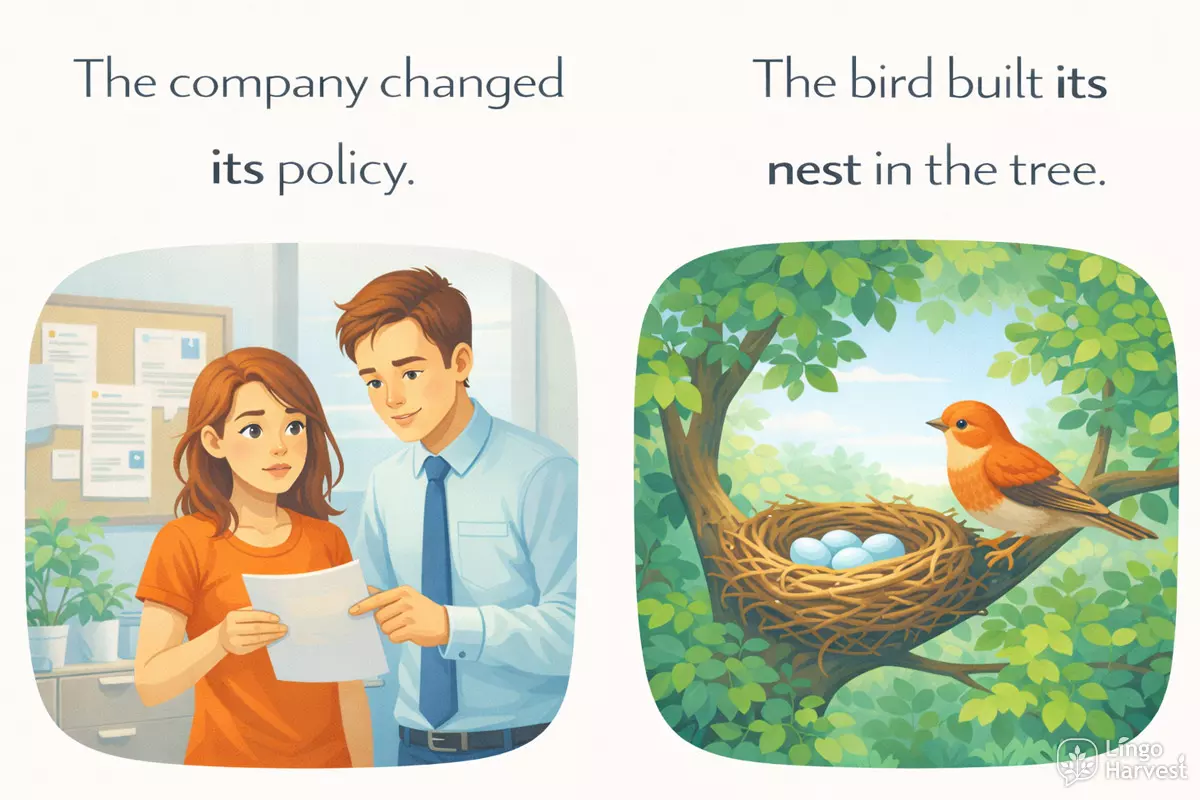
- ✅ The company changed its policy.
- ✅ The bird built its nest in the tree.
- ❌ The cat chased it’s tail. (Incorrect: should be its)
- ✅ It’s been a long day. (Short for it has)
- ✅ It’s cold today. (Short for it is)
- ❌ The team lost it’s chance to win. (Incorrect: should be its)
- ✅ The software needs its update.
- ✅ It’s your turn.
- ✅ The tree lost its leaves in autumn.
- ❌ The dog licked it’s paw. (Incorrect: should be its)
Comparing possessive pronouns
Unlike its, all other possessive pronouns are formed without apostrophes. See how its fits into the broader pattern:
- mine → This notebook is mine.
- yours → Is this seat yours?
- his → The black backpack is his.
- hers → That decision was hers.
- its → The company changed its policy.
- ours → The responsibility is ours.
- theirs → The final choice was theirs.
- its → possessive form (shows ownership) and is used before a noun.
- it’s → contraction of it is or it has.
- its → The phone lost its charger.
- its → The company changed its policy.
- it’s (= it is) → It’s cold today.
- it’s (= it has) → It’s been a long day.
- Incorrect: The dog wagged it’s tail.
- Correct: The dog wagged its tail.
- Incorrect: Its raining again.
- Correct: It’s raining again.
Notice that none of these use an apostrophe, which is a helpful clue for remembering the correct form of its as a possessive pronoun.
Quick self-check
When in doubt, try expanding it’s to it is or it has in your sentence. If the sentence still makes sense, the contraction is correct. If not, you need the possessive form. This simple trick can help avoid one of the most common slip-ups in English writing.
Possessive pronouns with one/ones: mine vs mine one
Understanding how possessive pronouns interact with “one” and “ones” can help you sound more natural in English. Native speakers use “mine,” “yours,” “his,” “hers,” and so on, to avoid repeating nouns. However, phrases like “mine one” or “mine ones” are incorrect and not found in standard English.
Why “mine one” is not used
When you want to refer to something already mentioned, you can use “one” or “ones” for countable nouns, but you do not combine it with a possessive pronoun. Instead, the possessive pronoun stands alone and replaces both the noun and “one/ones.” For example:
- Do you have a pen? Yes, I have mine. ✅
- Do you have a pen? Yes, I have mine one. ❌
The word “mine” already includes the idea of “my one,” so adding “one” is redundant and incorrect.
Correct patterns with "one/ones" and possessives
If you want to use “one” or “ones” for clarity or contrast, pair them with possessive adjectives (my, your, his, her, etc.), not possessive pronouns (mine, yours, his, hers, etc.). Here’s how it works:
- This is my book, and that is your one. ❌ (unnatural)
- This is my book, and that is yours. ✅
- Which shoes are hers? The red ones are hers. ✅
- Which is your mug? The blue one is mine. ✅
Quick reference: Acceptable vs. Unacceptable Usage
- That umbrella is mine. ✅
- That umbrella is mine one. ❌
- Those are my ones. ❌
- Those are mine. ✅
- This bag is hers. ✅
- This bag is her one. ❌
- Are these keys yours? ✅
- Are these keys your ones? ❌
- The black gloves are mine. ✅
- The black gloves are my ones. ❌
Summary Table: "Mine" vs. "Mine one"
| Form | Example in a Sentence |
|---|---|
| mine | That book is mine. |
| mine one | Incorrect: That book is mine one. |
| my one | Rare/unnatural: That is my one. |
| my | This is my book. |
Takeaway
Whenever you want to refer to something as belonging to you or someone else, just use the possessive pronoun alone—never combine it with “one” or “ones.” These forms are already complete and don’t need extra help from “one.” This rule keeps your English both correct and natural in conversation.
Natural spoken patterns: a friend of mine, yours too
When people talk informally, they often use phrases like “a friend of mine” or “a colleague of hers” instead of more formal possessive forms. This structure is especially common in everyday English, making conversations sound more natural and fluent. Rather than saying “my friend” every time, speakers use “of mine” to subtly emphasize the relationship or to sound less repetitive.
How the “of + possessive pronoun” pattern works
This pattern combines the preposition “of” with a possessive pronoun (mine, yours, his, hers, ours, theirs). It’s used after an indefinite noun:
- a friend of mine → A friend of mine lives in Singapore.
- a neighbor of yours → A neighbor of yours left this package.
- a cousin of his → A cousin of his works at the airport.
- a teacher of hers → A teacher of hers recommended this book.
- a classmate of ours → A classmate of ours joined the project.
- a teammate of theirs → A teammate of theirs got injured yesterday.
This style is especially useful when the noun is not unique—when you have more than one friend, for example, and want to refer to one of them.
Common examples in real-life conversations
- That’s a favorite book of mine.
- He’s an old friend of hers from college.
- Is this a suggestion of yours?
- They invited a relative of ours to the reunion.
- She’s a colleague of his at the company.
- It’s not a habit of mine to be late.
- Is this a photo of yours?
- We met a neighbor of theirs at the party.
- That’s a problem of his, not mine.
- She’s a client of ours.
- He borrowed a book of mine last week.
- That’s not a decision of hers to make.
- Is this a pen of yours?
- She’s a cousin of his.
- That’s a story of theirs.
Why choose this pattern?
Using “of mine,” “of yours,” and similar forms adds nuance. It can be less direct than “my friend,” and often sounds softer or more personal. Native speakers use this structure to talk about one among several people or things they are connected to.
For comparison, here’s how the pattern differs from more direct possessive forms:
| Direct Possessive | "Of" + Possessive Pronoun |
|---|---|
| my friend | a friend of mine |
| your neighbor | a neighbor of yours |
| her teacher | a teacher of hers |
| their teammate | a teammate of theirs |
| his cousin | a cousin of his |
Both forms are correct, but the “of + possessive pronoun” version is especially common in casual speech and storytelling. It’s a helpful pattern to recognize and use if you want your English to sound more natural.
Practice: rewrite sentences using possessive pronouns
Understanding how to substitute possessive adjectives and nouns with possessive pronouns is essential for clear and concise communication. Let’s work on recognizing when and how to use forms like “mine,” “yours,” “his,” “hers,” “ours,” and “theirs” in everyday sentences.
Instructions
Below, you'll find several sentences that use possessive adjectives or nouns. Your task is to rewrite each one, replacing the possessive part with the correct possessive pronoun. This exercise will help you internalize the forms and when to use them in context.
- This book is my book.
- That phone is her phone.
- Their car is parked outside.
- This umbrella is your umbrella.
- Our house is next to the park.
- His jacket is on the chair.
- My keys are on the table.
- Your coffee is cold.
- The cats are their cats.
- Her shoes are under the bed.
Show answers
- This book is mine.
- That phone is hers.
- The car is theirs.
- This umbrella is yours.
- The house is ours.
- The jacket is his.
- The keys are mine.
- The coffee is yours.
- The cats are theirs.
- The shoes are hers.
Common Possessive Pronouns: Quick Reference
Here's a handy reference to help you remember the correct forms. Notice how each pronoun replaces both the noun and the possessive adjective.
| Possessive Adjective + Noun | Possessive Pronoun |
|---|---|
| my book | mine |
| your pen | yours |
| his bag | his |
| her coat | hers |
| our idea | ours |
| their room | theirs |
Extra Challenge
Try rewriting these sentences on your own, and check your answers below:
- Is this pencil your pencil or my pencil?
- The sandwiches are our sandwiches.
- These seats are their seats.
- That laptop is his laptop.
- Is this bag her bag or your bag?
- The responsibility is our responsibility.
- Those jackets are their jackets.
- This decision is my decision.
- Is that phone your phone or his phone?
- The mistake was their mistake.
Show answers
- Is this pencil yours or mine?
- The sandwiches are ours.
- These seats are theirs.
- That laptop is his.
- Is this bag hers or yours?
- The responsibility is ours.
- Those jackets are theirs.
- This decision is mine.
- Is that phone yours or his?
- The mistake was theirs.
Practicing with real examples helps you master possessive pronouns and use them naturally in conversation and writing.