Possessive Adjectives vs Possessive Pronouns in Context

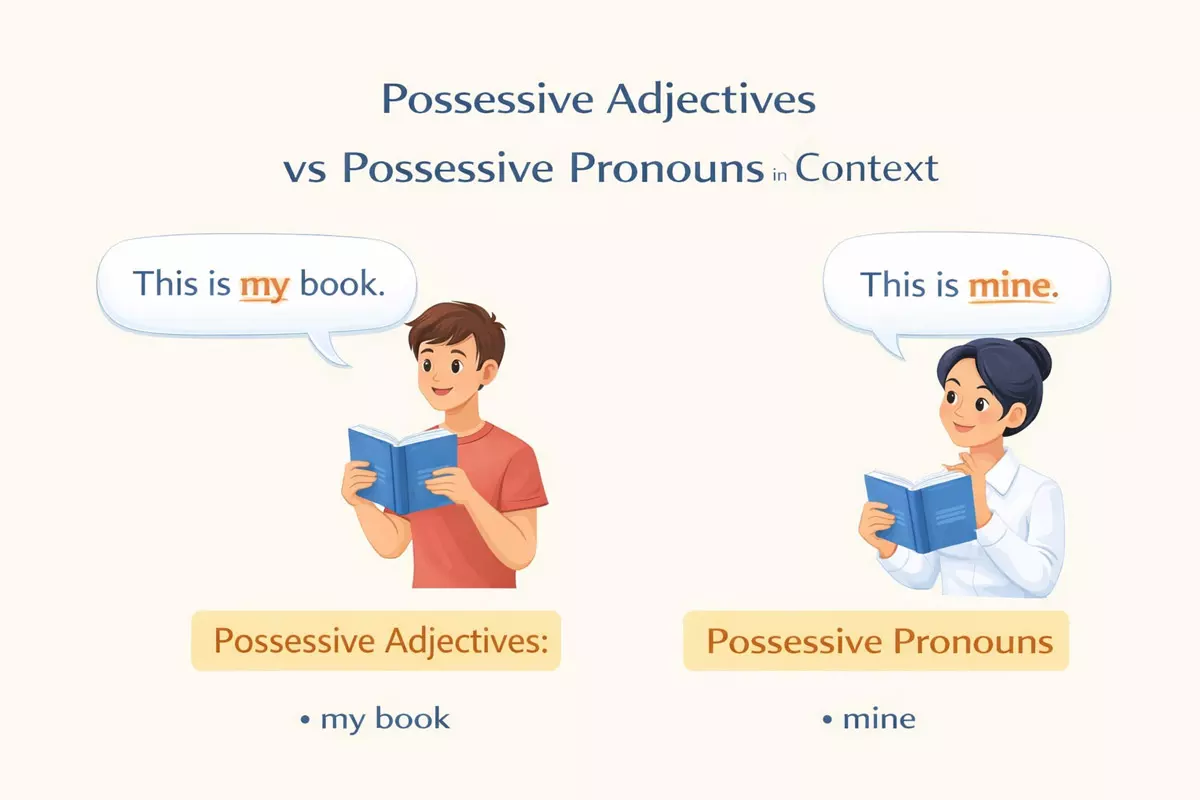 Here we how to distinguish possessive adjectives from pronouns, compares forms like my vs mine and your vs yours, explains when to use each in conversation, addresses common errors, and includes practice choosing the correct possessive form.
- Difference between possessive adjectives and pronouns
- Form overview: my vs mine, your vs yours
- Using possessive pronouns to avoid repetition
- Whose questions and short answers
- Context-based choice in conversation
- Common learner errors with possessives
- Spoken vs written usage patterns
- Practice: choose the correct possessive form
Expressing ownership in English can be challenging, particularly when deciding whether to use words that directly show possession or those that replace longer phrases indicating ownership. Knowing when to use terms like my, your, or their, as opposed to mine, yours, or theirs, helps make your speech and writing more accurate. By learning these distinctions and practicing their correct use, you can improve your ability to communicate clearly and avoid misunderstandings about what belongs to whom.
Difference between possessive adjectives and pronouns
Understanding how possessive adjectives and possessive pronouns function helps clarify both meaning and sentence structure in English. Although both types of words indicate ownership or relationship, they serve different grammatical roles and appear in different positions within a sentence.
Function and Placement
Possessive adjectives (also called possessive determiners) always come before a noun and describe to whom something belongs. In contrast, possessive pronouns replace a noun phrase altogether, standing alone without a noun directly after them. This distinction changes how sentences are constructed and can help avoid redundancy.
| Possessive Adjective | Possessive Pronoun | Example Sentence |
|---|---|---|
| my | mine | This is my book. / This book is mine. |
| your | yours | Is this your car? / Is this car yours? |
| his | his | That is his jacket. / That jacket is his. |
| her | hers | Her phone is new. / The new phone is hers. |
| its | — | The dog lost its collar. (No possessive pronoun for "its") |
| our | ours | Our house is big. / The big house is ours. |
| their | theirs | Their project succeeded. / The successful project is theirs. |
Key Points to Remember
- Possessive adjectives must be followed by a noun: my keys, your idea, their plan.
- Possessive pronouns replace the noun: Those keys are mine, The idea is yours, The plan is theirs.
- There is no possessive pronoun form for "its"; only the adjective is used.
- Using both forms together is incorrect: ✗ That is mine book (Incorrect).
Common Mistakes ❌
- Don’t use a possessive adjective and a noun together with a possessive pronoun: This is my pen; this pen is mine (not mine pen).
- Remember that "his" acts as both adjective and pronoun, but "its" is never a pronoun.
In summary, choose possessive adjectives to modify nouns directly, and use possessive pronouns when you want to avoid repeating the noun. This distinction makes your sentences clearer and more concise.
Form overview: my vs mine, your vs yours
Understanding the difference between “my” and “mine,” as well as “your” and “yours,” is essential for expressing possession correctly in English. These pairs belong to two distinct grammatical categories: possessive adjectives and possessive pronouns. Each serves a unique function in a sentence, and knowing when to use each form helps avoid common mistakes.
Possessive adjectives vs possessive pronouns
Possessive adjectives (“my,” “your”) always come before a noun, modifying it to show who owns something. In contrast, possessive pronouns (“mine,” “yours”) stand alone and replace both the adjective and the noun, making the sentence less repetitive.
Usage patterns and examples
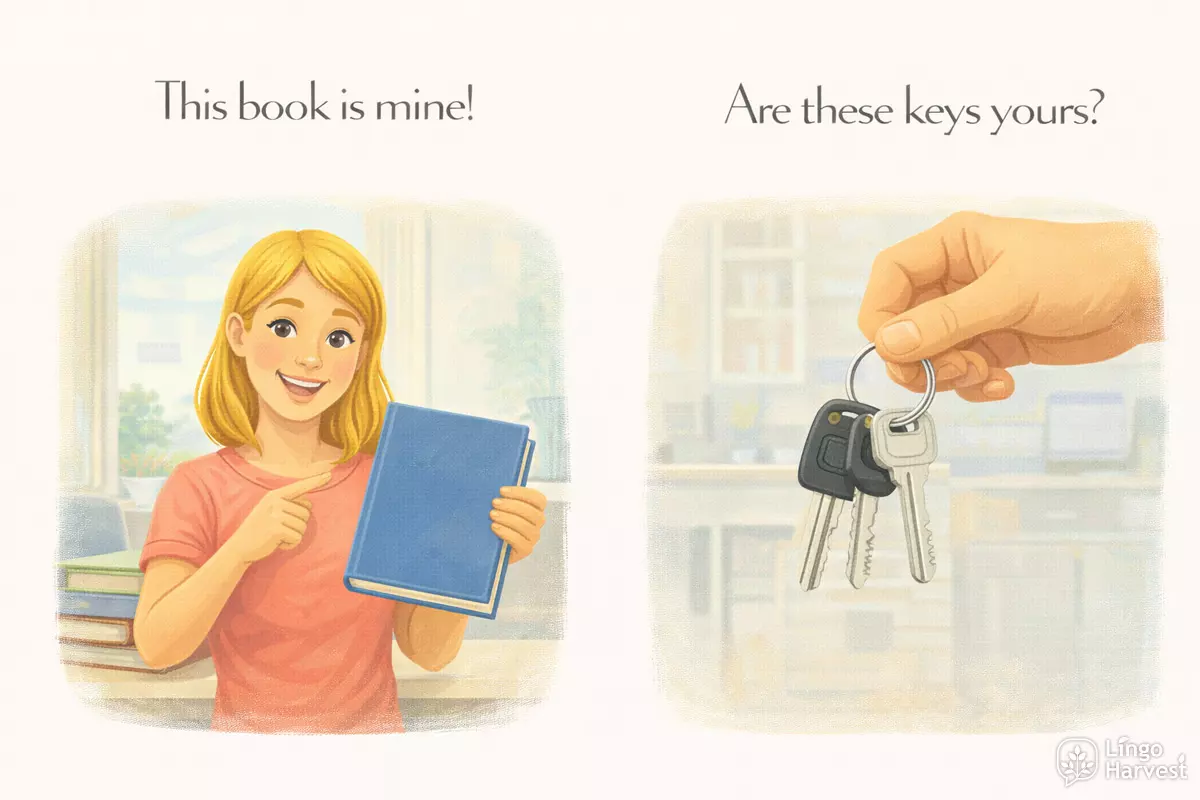
Let’s look at how these forms function in sentences. Notice the placement and what each word refers to:
- my book → The book belongs to me.
- This book is mine → The book is owned by me.
- your keys → The keys belong to you.
- Are these keys yours? → Do the keys belong to you?
- our house → The house belongs to us.
- The house on the corner is ours.
- his idea → The idea belongs to him.
- The idea was his.
- her car → The car belongs to her.
- That car is hers.
- their dog → The dog belongs to them.
- The dog is theirs.
Quick tips for remembering the forms
- Use the adjective form before a noun: “my bag,” “your phone.”
- Use the pronoun form without a noun, often after the verb “be”: “Is this yours?” “That’s mine.”
- Never use “mine” or “yours” directly before a noun (❌ “mine book,” “yours keys”).
- “Its” does not have a possessive pronoun form; we use only “its” as an adjective.
Choosing between these forms depends entirely on whether you need to modify a noun or stand in for a noun phrase. Recognizing the difference makes your English clearer and more natural in both writing and conversation.
Using possessive pronouns to avoid repetition
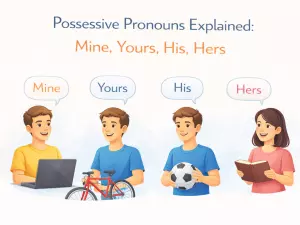
Possessive pronouns are especially useful for making sentences less repetitive and more natural. Instead of repeating a noun that has already been mentioned, you can replace it with a possessive pronoun like mine, yours, his, hers, ours, or theirs. This helps keep communication clear and concise, especially when discussing ownership or relationships between people and things.
How possessive pronouns streamline sentences
When you want to refer back to something already mentioned, a possessive pronoun can stand alone, replacing both the noun and the possessive adjective. Compare these two sentences:
- That is my book. This is your book.
- That book is mine; this one is yours.
Notice how the second example avoids repeating the word "book," making the sentence flow better.
Common situations where they help
You’ll often see these pronouns used in everyday conversation, especially when discussing personal items, responsibilities, or relationships. Here are some typical contexts:
- Comparing possessions: "My keys are on the table. Where are yours?"
- Clarifying ownership: "Is this seat taken, or is it yours?"
- Talking about shared things: "We brought our jackets, but they forgot theirs."
- Distinguishing between people: "Her suggestion was accepted, but his was not."
- Family relationships: "My brother is older than hers."
- Describing preferences: "I like my coffee strong, but she likes hers sweet."
- In responses: "Is this your umbrella?" "No, it's not mine."
- In instructions: "Take your seats. I'll take mine."
- Comparing experiences: "Your trip sounded fun. Ours was too."
- Referring to groups: "Their project was finished before ours."
Possessive adjectives vs. possessive pronouns at a glance
Sometimes it’s helpful to see the forms side by side. Here’s a quick reference showing how each subject pronoun corresponds to its possessive adjective and possessive pronoun:
| Subject Pronoun | Possessive Adjective | Possessive Pronoun |
|---|---|---|
| I | my | mine |
| you | your | yours |
| he | his | his |
| she | her | hers |
| it | its | — |
| we | our | ours |
| they | their | theirs |
Quick tips for natural use
- Always use a possessive pronoun when replacing both the noun and its owner.
- Don’t add another noun after a possessive pronoun (say "That pen is mine," not "That pen is mine pen").
- Remember that "its" as a possessive pronoun is rarely used in modern English; "its" is mainly a possessive adjective.
By using these pronouns thoughtfully, you can avoid awkward repetition and make your speech or writing sound smoother and more fluent.
Whose questions and short answers
Understanding how to ask and respond to questions about ownership is essential when distinguishing between possessive adjectives and possessive pronouns. The word whose is commonly used to inquire about possession, and the answer can involve either form depending on the context. Let's look at how these structures work in practical conversation.
How to ask about possession with "whose"
To find out who something belongs to, we typically start with Whose followed by a noun. The response can use possessive adjectives (my, your, his, her, its, our, their) or possessive pronouns (mine, yours, his, hers, ours, theirs), depending on whether you mention the noun again.
- Whose book is this? → It’s mine.
- Whose shoes are those? → They’re hers.
- Whose idea was it? → It was his.
- Whose car is parked outside? → It’s theirs.
- Whose keys did you find? → I found Anna’s keys.
- Whose jacket is on the chair? → It’s my jacket.
- Whose phone keeps ringing? → It’s Tom’s phone.
- Whose backpack is this? → It’s ours.
- Whose pen did you borrow? → I borrowed Sarah’s pen.
- Whose turn is it? → It’s your turn.
Short answers: possessive adjectives vs possessive pronouns
When answering, use a possessive adjective if you repeat the noun, or a possessive pronoun if you don't. Here are some typical patterns:
| Question | Short Answer (Adjective/Pronoun) |
|---|---|
| Whose bag is this? | It's my bag. / It's mine. |
| Whose jacket is on the sofa? | It's her jacket. / It's hers. |
| Whose pencils are these? | They're our pencils. / They're ours. |
| Whose house is next door? | It's their house. / It's theirs. |
| Whose dog is barking? | It's his dog. / It's his. |
Tips for clear answers
- Use a possessive adjective when you want to specify both the owner and the object: That's my coat.
- Use a possessive pronoun for shorter answers when the object is already known: It's mine.
- Be sure the pronoun matches the owner: hers (not her's), ours, theirs.
- For inanimate objects or animals, its is rarely used as a possessive pronoun in short answers.
Mastering these patterns will make your English conversations about ownership much smoother and more natural. Practice forming both questions and brief responses to reinforce the difference between possessive adjectives and possessive pronouns in real-life contexts.
Context-based choice in conversation
Choosing between possessive adjectives and possessive pronouns depends greatly on what has already been mentioned in the dialogue and the need for clarity or emphasis. When the noun being possessed is clear or previously stated, a possessive pronoun (like mine, yours, theirs) avoids repetition. In contrast, possessive adjectives (such as my, your, their) are used when the noun must be named for clarity, especially at the start of a conversation or when introducing new information.
Typical conversational scenarios
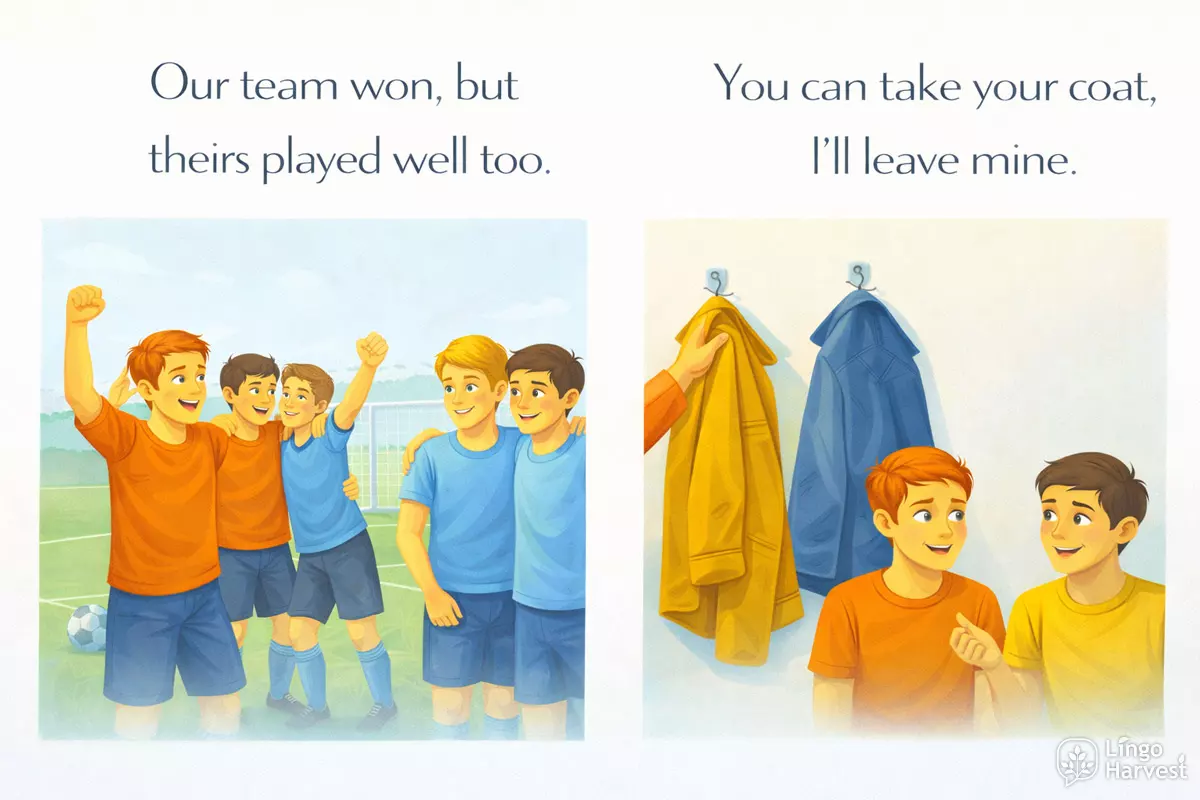
- Introducing new objects: "This is my book."
- Clarifying ownership: "Is this your pen or mine?"
- Responding with emphasis: "That’s not my problem, it’s theirs."
- Comparisons: "Her idea is better than his."
- Questions about possession: "Where is your bag?" – "Mine is over there."
- Alternating between speakers: "Our team won, but theirs played well too."
- Expressing exclusion: "You can take your coat, I’ll leave mine."
- Describing shared items: "Our house is bigger than theirs."
- Correcting misunderstandings: "No, that’s not your seat. Yours is here."
- Giving instructions: "Bring your passport and don’t forget hers."
- Indicating absence: "She forgot her keys, but I have mine."
- Identifying items: "Which jacket is yours?" – "The blue one is mine."
- Referring to a group: "Their answers were different from ours."
- Stating preferences: "I prefer my coffee black, but she likes hers with milk."
Factors influencing the choice
Speakers often select between these forms based on what’s already clear to listeners. If the item in question is visible or has just been mentioned, pronouns make the exchange smoother. However, when introducing something new or when there’s potential for confusion, adjectives plus the noun are preferred. Register and formality also matter—possessive pronouns tend to sound more direct, while adjectives can soften a statement.
| Possessive Adjective Example | Possessive Pronoun Example | Typical Context |
|---|---|---|
| This is my seat. | This seat is mine. | Introducing or claiming an object |
| Is that your bag? | Is that yours? | Asking about ownership |
| Our house is on the left. | The house on the left is ours. | Describing location or comparison |
| She lost her keys. | She lost hers. | Referring back to a previously mentioned noun |
| Take your umbrella. | Take yours. | Instructions or reminders |
In sum, context guides whether speakers use possessive adjectives or pronouns. The main goal is to keep communication efficient, avoid ambiguity, and match the flow of conversation. Being sensitive to what’s already known or visible helps in making the right choice naturally.
Common learner errors with possessives
Learners often mix up possessive adjectives and possessive pronouns, especially when both forms look or sound similar. This confusion can lead to sentences that sound odd or are grammatically incorrect in English. The difference may seem subtle, but choosing the wrong word changes the sentence’s meaning or structure.
Mixing up adjective and pronoun forms
The most frequent issue is using a possessive adjective (“my”, “your”, “his”, “her”, “its”, “our”, “their”) where a possessive pronoun (“mine”, “yours”, “his”, “hers”, “its”, “ours”, “theirs”) is needed, or vice versa. This happens because some forms (like “his” and “its”) look the same in both roles, but others do not.
| Incorrect Example | Corrected Form |
|---|---|
| This is my book. That is your. | This is my book. That is yours. |
| Is this pen your? | Is this pen yours? |
| Our house is bigger than their. | Our house is bigger than theirs. |
| This bag is hers bag. | This bag is her bag. / This bag is hers. |
| Is this your car or my? | Is this your car or mine? |
| These are ours friends. | These are our friends. |
| His dog is cute. My is bigger. | His dog is cute. Mine is bigger. |
| Is this hers coat? | Is this her coat? |
| This is theirs house. | This is their house. |
| That cat is its. | That cat is its. |
Other typical issues
- Adding an extra noun after a possessive pronoun (e.g. “This is mine book” instead of “This is my book” or “This is mine”).
- Confusing “it’s” (it is) with “its” (possessive adjective).
- Using apostrophes in possessive adjectives or pronouns (“her’s” instead of “hers”).
- Translating directly from a first language, leading to unnatural structures (“the book of me” instead of “my book”).
- Forgetting to use a possessive word at all (“Is this car yours?” ➔ “Is this car you?”).
Tips to avoid mistakes
- Remember: possessive adjectives come before nouns (“my car”), but possessive pronouns stand alone (“mine”).
- Don’t use a noun after a possessive pronoun.
- Check for apostrophes: “its” never has one when showing possession.
- Practice with common sentence patterns to build confidence.
Being aware of these pitfalls helps learners use possessive forms more accurately in both speech and writing.
Spoken vs written usage patterns
When comparing how possessive adjectives and possessive pronouns appear in speech versus writing, clear trends emerge. In conversational English, speakers tend to favor brevity and clarity, often choosing forms that are faster to say and less likely to interrupt the flow. Written English, on the other hand, allows for more precise reference and often prefers structures that avoid ambiguity, even if they are slightly longer or more formal.
Frequent choices in conversation
- Possessive adjectives (my, your, his, her, its, our, their) are used heavily in spoken language because they attach directly to nouns, making it easy to specify ownership without breaking the rhythm.
- Possessive pronouns (mine, yours, his, hers, ours, theirs) appear in speech, but usually when the noun is already clear from context or to emphasize contrast.
- Redundancy is common in speech: "Is this your pen?" "Yes, that's my pen."
- Ellipsis happens frequently: "Whose book is this?" "Mine."
- Speakers sometimes double up: "That's her bag, not my one."
Patterns in formal and informal writing
- In formal texts, possessive pronouns are often used to avoid repetition: "The results were compared with theirs."
- Writers avoid ambiguity by restating the noun if needed: "Her proposal was accepted, but his proposal was not."
- Possessive adjectives may be repeated for clarity in longer sentences.
- Pronouns are favored in lists or where the noun is obvious from previous context.
- Redundant forms (like "my own") are less common in writing, unless for emphasis.
| Context | Typical Usage |
|---|---|
| Casual speech | "That's my seat." → "No, it's mine." |
| Formal writing | "The committee accepted her recommendation over his." |
| Informal writing (messages, notes) | "Your keys are here. Mine are missing." |
| Academic or technical text | "Their results differed from ours." |
Common usage examples
- Is that your umbrella? → No, it's hers.
- My phone is charging. Yours is on the table.
- That’s our project, not their project.
- This seat is mine.
- Her answer was correct, but his was not.
- Our team won, but theirs played well too.
- Is this your notebook or mine?
- That’s not my idea; it’s his.
- The cat licked its paw.
- Those are their jackets.
- Our house is bigger than theirs.
- Whose bag is this? → It's mine.
- This isn’t your fault—it's ours.
In summary, spoken English leans toward simplicity and immediacy, with possessive adjectives dominating for directness. Written forms, especially in formal settings, prioritize clarity and variety by balancing both possessive adjectives and pronouns. Understanding these tendencies helps learners choose the most natural form for any context.
Practice: choose the correct possessive form
Understanding the difference between possessive adjectives and possessive pronouns is crucial for clear communication. Let’s work through some exercises that highlight how each form is used in context. As you complete these tasks, pay attention to whether a word describes a noun (adjective) or replaces a noun (pronoun).
Fill in the blanks
Choose the correct possessive adjective or pronoun for each sentence below. Consider the information given and decide if you need to describe a noun or replace it entirely.
- This is _____ (I) book. _____ (mine/my) is on the table.
- Those are _____ (she) shoes, but the red ones are ____ (her/hers).
- We brought _____ (we) lunches, but they forgot ____ (their/theirs).
- Is this _____ (you) pen, or is it ____ (your/yours)?
- The cat licked _____ (it) paw before eating.
- He left _____ (he) phone at home, so he borrowed ____ (my/mine).
- They sold _____ (they) house, but ____ (our/ours) is still for sale.
- She likes _____ (she) job, but ____ (his/her) is more stressful.
- I forgot _____ (I) keys, but she remembered ____ (her/hers).
- This seat is _____ (we), not ____ (their/theirs).
Show answers
- my; mine
- her; hers
- our; theirs
- your; yours
- its
- his; mine
- their; ours
- her; hers
- my; hers
- ours; theirs
Identify the form
Decide whether the bolded word is a possessive adjective or a possessive pronoun:
- This is our classroom.
- The blue backpack is yours.
- Her answers were correct.
- The final decision is theirs.
- Is this your notebook?
- This seat is mine.
- Their project was submitted early.
- The responsibility is his.
- My phone is out of battery.
- This choice is ours, not theirs.
Show answers
- Possessive adjective
- Possessive pronoun
- Possessive adjective
- Possessive pronoun
- Possessive adjective
- Possessive pronoun
- Possessive adjective
- Possessive pronoun
- Possessive adjective
- Possessive pronoun
Practicing these distinctions helps you use the right form naturally in conversation and writing. If you’re unsure, check whether the word is directly attached to a noun (adjective) or stands alone (pronoun).