Double Possessives in English: A Friend of Mine Explained

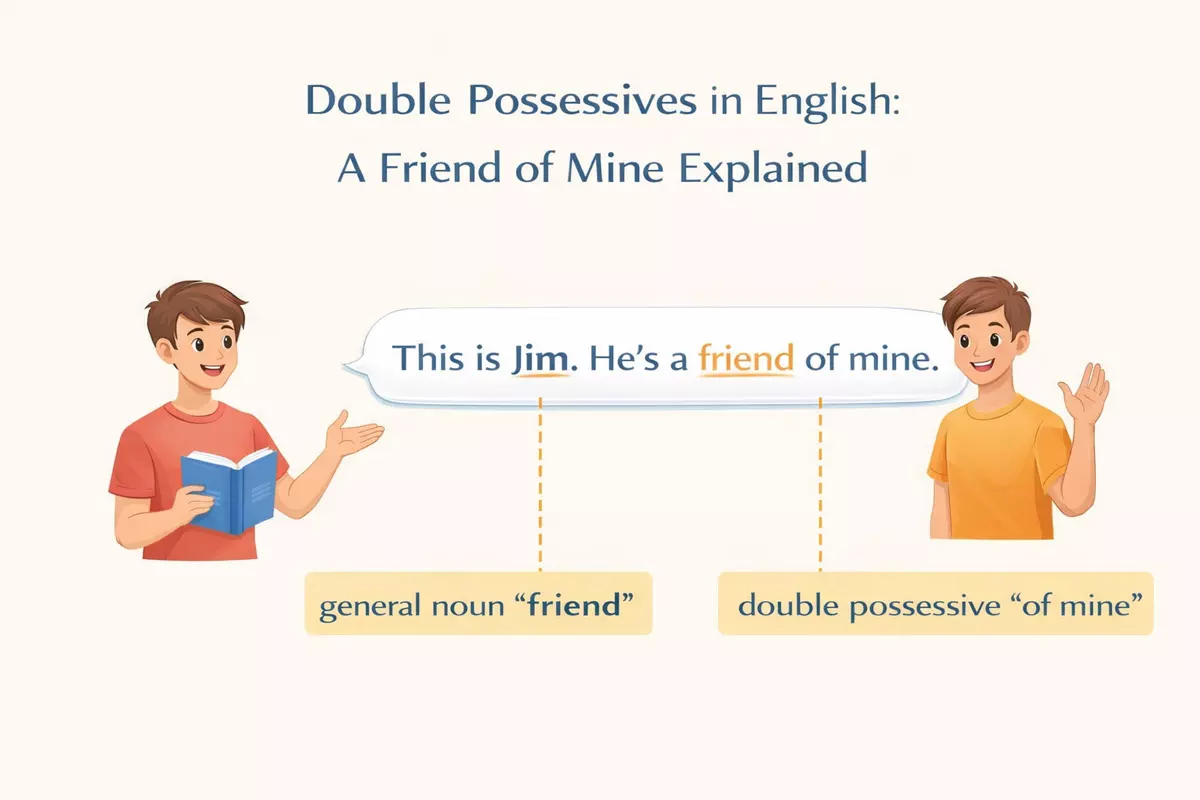 Here we what double possessives are, their common forms like a friend of mine, how they differ from simple possession, when they sound natural, usage restrictions, typical mistakes, spoken versus written preferences, and practice sentences.
- What double possessives are
- Form patterns: a friend of mine, that idea of yours
- Meaning difference vs simple possession
- When double possessives sound natural
- Restrictions on usage with specific nouns
- Common learner mistakes
- Spoken vs written preferences
- Practice: rewrite sentences using double possessives
Have you ever wondered why we sometimes say one of my friends instead of simply my friend? This subtle feature in English, called the double genitive, helps us express relationships and ownership more precisely. By using phrases like one of my friends, we clarify that the person is part of a larger group associated with us, rather than implying we have just one friend. This construction allows for greater nuance in conversation, making our language more flexible and expressive when describing connections with people or possessions.
What double possessives are
A double possessive is a construction in English where both the preposition of and a possessive form (like a possessive pronoun or noun with ’s) are used together to indicate ownership or association. You’ll see this pattern in phrases such as “a friend of mine” or “a picture of John’s.” This structure might sound unusual at first, but it’s a standard and natural part of everyday English.
Unlike simple possessives, which use either the possessive form or the of construction, this combination helps clarify meaning. For example, “a friend of Mary’s” specifically means one of Mary’s friends, not just any friend who happens to be associated with Mary in some way. The double possessive is especially helpful when talking about one among several possible possessions or relationships.
How to recognize double possessives
Double possessives always include two features:
- The preposition of
- A possessive form (like my, your, his, her, our, their, its, or a noun with ’s)
This pattern is not used with inanimate objects—only with people, animals, or sometimes personified things.
Common patterns and examples
You’ll encounter this construction most often with the following patterns:
- a friend of mine
- a colleague of hers
- a neighbor of theirs
- a former student of Mr. Smith’s
- an idea of yours
- a painting of Monet’s
- a classmate of ours
- a decision of the committee’s
- a song of the band’s
- a suggestion of yours
- a photo of Anna’s
- a cousin of his
- a book of the author’s
- a pet of the family’s
- a favorite movie of mine
- a habit of his
- a supporter of the team’s
- a teacher of mine
Double possessive vs. other possessive forms
Sometimes it’s helpful to compare this structure with other ways of showing possession. Here’s a quick overview:
| Structure | Example |
|---|---|
| Simple possessive | Mary’s friend |
| Of + noun | The friend of Mary |
| Double possessive | A friend of Mary’s |
| Double possessive (pronoun) | A friend of mine |
Each form has its own nuance. Double possessives usually refer to one of several items or people belonging to someone, while the other forms may sound more formal or ambiguous.
Form patterns: a friend of mine, that idea of yours
Double possessives, also called double genitives, combine a possessive form (like "my," "your," "his," "her," "their," or "our") with "of" plus a noun or pronoun. This pattern allows you to specify one among a group, highlight relationships, or emphasize shared possession. For example, "a friend of mine" means one friend out of several that belong to me. These constructions are especially common in everyday English to express nuance and clarity.
Common structures and examples

The typical structure is: article + noun + of + possessive pronoun Examples include:
- A friend of mine helped me move last weekend.
- An idea of yours could actually solve the problem.
- A colleague of hers recommended this software.
- That neighbor of ours always complains about the noise.
- Some students of theirs won the national competition.
- This book of his is signed by the author.
- A favorite song of mine just came on the radio.
- Those cousins of yours visited us last summer.
- An old teacher of hers inspired her to study science.
- A photograph of ours was published in the newspaper.
- One suggestion of yours really improved the plan.
- Several projects of theirs were delayed due to funding issues.
- A memory of his still makes him smile.
- An old friend of mine reached out after many years.
- A classmate of yours asked about the reunion.
- One wish of hers finally came true.
- That pet of ours loves sleeping in the sun.
- A neighbor of theirs offered to help with the repairs.
Double possessive vs. simple possessive
The double form is not always interchangeable with a simple possessive. For example, "a friend of mine" (one of several friends) is not quite the same as "my friend" (possibly the only one, or more specific). The double possessive is especially helpful when you want to stress that the noun is just one among many.
| Double Possessive | Simple Possessive |
|---|---|
| a friend of mine | my friend |
| an idea of yours | your idea |
| that neighbor of ours | our neighbor |
| some students of theirs | their students |
When to use double possessives
Use these forms when you want to:
- Emphasize that something is one of several (e.g., "a suggestion of hers" implies she has more than one suggestion).
- Distinguish among multiple owners (e.g., "a friend of John's" could mean one friend among several John has).
- Express relationships in a less direct or more nuanced way.
This structure is especially natural with people and relationships, but you may also see it with objects or abstract nouns. It’s a flexible pattern that adds subtlety to how we talk about ownership and belonging in English.
Meaning difference vs simple possession
English allows us to express ownership or relationship in more than one way, and double possessives like “a friend of mine” have a distinct nuance compared to straightforward possessive forms such as “my friend.” These two structures are not always interchangeable, and the choice between them can subtly shift the meaning of a sentence.
Double possessive vs simple possessive: what’s the difference?
A double possessive combines a possessive pronoun (like “mine,” “yours,” or “his”) with “of” and a noun. For example, “a colleague of hers.” In contrast, a simple possessive uses a possessive adjective or an apostrophe: “her colleague” or “John’s colleague.” The distinction often lies in specificity and inclusiveness.
| Form | Typical Meaning |
|---|---|
| my friend | Implies a specific, possibly unique, friend from my circle |
| a friend of mine | One among several friends I have; emphasizes membership in a group |
| her painting | The painting she owns, created, or is associated with (exact ownership or connection) |
| a painting of hers | One painting out of several that belong to her |
| his student | Specifically the student who is associated with him (could be unique or well-known) |
| a student of his | Any one of several students he teaches or mentors |
When to use each construction
- Use the double possessive when you want to highlight that the noun is one among several (e.g., “a client of mine” implies you have multiple clients).
- Choose the simple possessive when referring to a specific, perhaps unique, relationship (“my boss” usually means your only boss, or the one most relevant in context).
- Double possessives are common with indefinite articles (“a/an”), but rare with definite articles (“the friend of mine” is awkward; “the friend of mine who called” is sometimes possible but formal).
- The simple form can sometimes sound possessive or exclusive, while the double form is more neutral or inclusive.
Examples showing the subtle contrast
- “She is a cousin of mine.” → One among several cousins I have.
- “She is my cousin.” → Implies a direct, possibly unique relationship.
- “That’s a suggestion of his.” → One of many suggestions he has made.
- “That’s his suggestion.” → The suggestion he made (possibly the only one).
- “A neighbor of ours just moved in.” → We have several neighbors; this is one of them.
- “Our neighbor just moved in.” → The person who lives next to us, with a sense of uniqueness.
- “A painting of hers won an award.” → She has multiple paintings; one won.
- “Her painting won an award.” → The painting she created or owns, likely known in context.
- “A teacher of theirs is retiring.” → Out of several teachers, one is retiring.
- “Their teacher is retiring.” → The main teacher they have is retiring.
In summary, the double possessive points out one example among several, while the straightforward possessive often singles out a specific or primary connection. This distinction can be subtle, but it’s useful for precise communication, especially when you want to avoid suggesting exclusivity.
When double possessives sound natural
English speakers often use structures like “a friend of mine” or “that book of hers” without a second thought. These “double possessive” forms combine “of” with a possessive pronoun or noun (e.g., “of mine,” “of John’s”). They don’t work in every situation, but they sound especially natural when you want to talk about one example out of a group that belongs to someone, or to clarify which specific person or thing you mean.
Typical situations where double possessives fit smoothly
- Referring to an unspecified member of a group: She’s a colleague of ours.
- Highlighting personal relationships: That’s a neighbor of theirs.
- Describing possessions among several: This is a painting of my father’s.
- Indicating a type, not a unique item: He’s a student of Dr. Carter’s.
- Clarifying ownership when the noun is non-unique: Is that a photo of yours?
- Distinguishing among several possible owners: That’s a suggestion of Emily’s.
- Expressing relationships that aren’t exclusive: He’s a friend of mine.
- Talking about parts belonging to a whole: It’s a habit of his.
- When the noun is indefinite but connected to someone: She’s a cousin of his.
- Describing works by creators: Have you read that novel of Austen’s?
- Referring to pets among several: That’s a cat of theirs.
- Indicating ideas or suggestions: That was an idea of mine.
- Describing items among many: This is a notebook of Sarah’s.
- Talking about feelings: It’s a fear of his.
- With names: She’s a friend of John’s.
- Using plural possessives: He’s a classmate of ours.
- Referring to interests or hobbies: That’s a passion of hers.
- Describing skills: It’s a talent of his.
Why these forms sound right
These patterns generally feel right because they signal that the person or thing mentioned is one among several. Saying “a friend of mine” is less definite than “my friend,” which often implies exclusivity or a specific friend the listener already knows. The double possessive keeps things open-ended and natural in conversation.
Natural alternatives and comparisons
Sometimes, you can use either a double possessive or a simple possessive, but the nuance changes. Here are some common pairs:
| Double Possessive | Simple Possessive |
|---|---|
| a friend of mine | my friend |
| a painting of his | his painting |
| a suggestion of yours | your suggestion |
| a neighbor of theirs | their neighbor |
| a novel of Austen’s | Austen’s novel |
| a colleague of ours | our colleague |
In summary, these forms feel most at home when you’re referring to one among several possible people or things that belong to someone, especially in informal conversation. They help avoid ambiguity and make speech sound more idiomatic.
Restrictions on usage with specific nouns
When using the double possessive structure (such as “a friend of mine”), there are certain nouns and contexts where this construction is either not possible or sounds unnatural. Double possessives work well with a subset of nouns, particularly those referring to people or animals, but not all nouns are compatible.
Types of nouns that allow double possessives
Personal relationships and animate objects are the most common nouns that fit naturally with this possessive form. For instance, you can say “a colleague of hers” or “a neighbor of ours.” The construction carries a sense of selection or membership within a group.
Nouns that generally do NOT allow double possessives
Many nouns, especially those referring to unique entities, non-countable items, or abstract concepts, are not used with double possessives. The following list gives some common categories and examples:
- Unique objects: a sun of ours ❌ → the sun ✅
- Proper names: a New York of mine ❌ → New York ✅
- Abstract ideas: a happiness of his ❌ → his happiness ✅
- Uncountable nouns: a water of theirs ❌ → their water ✅
- Body parts: an arm of mine ❌ → my arm ✅
- Materials: a gold of ours ❌ → our gold ✅
- General categories: a furniture of yours ❌ → your furniture ✅
- Places: a school of hers ❌ → her school ✅
- Time periods: a morning of mine ❌ → my morning ✅
- Natural phenomena: a rain of yours ❌ → the rain ✅
Comparing allowed and disallowed uses
Below is a comparison of nouns that do and do not work with double possessives:
| Acceptable Double Possessive | Unacceptable Usage |
|---|---|
| a friend of mine | *a table of mine (for “my table”) |
| a student of hers | *a happiness of his |
| a colleague of ours | *a water of theirs |
| a neighbor of yours | *a gold of ours |
| a dog of theirs | *an arm of mine |
Summary of patterns
To sum up, double possessives are appropriate with countable, animate nouns (usually people or animals) and when referring to one among several. They are not suitable for unique, abstract, or mass nouns, nor for most inanimate objects. When in doubt, try rephrasing with a simple possessive (like “my table”) or consult native speaker usage.
Common learner mistakes
Learners often find double possessives confusing, especially when deciding whether to use "of" or "'s" constructions. One frequent issue is misunderstanding when "a friend of mine" is required instead of "my friend". These two expressions are not always interchangeable, and this can lead to awkward or incorrect sentences.
Mixing up "of mine" with simple possessives
Many English learners mistakenly use "my friend" in contexts where a double possessive is actually needed. For example, "He is a friend of mine" is different from "He is my friend". The first suggests one of several friends, while the second is more definite or exclusive. This subtle distinction is often missed.
Omitting necessary possessive pronouns
Another problem is leaving out the possessive pronoun after "of", resulting in incomplete phrases like "a friend of" without the final "mine", "yours", etc. This makes the sentence unclear or grammatically incorrect.
Incorrect use with inanimate objects
Double possessives are generally used with people or sometimes animals, but not with things. For instance, "a leg of the table" is correct, but "a leg of the table's" is not. Learners sometimes extend the pattern to inanimate nouns by mistake.
- Wrong: a friend of me ❌ → Correct: a friend of mine ✅
- Wrong (unique object): a book of John’s ❌ → Correct: John’s book ✅
- Wrong (meaning unclear): a friend of my sister ❌ → Correct: a friend of my sister’s ✅
- Wrong (things do not take double possessives): a page of the book’s ❌ → Correct: a page of the book ✅
- Wrong (missing article): friend of mine ❌ → Correct: a friend of mine ✅
- Wrong (confusing pronoun form): He is friend mine ❌ → Correct: He is a friend of mine ✅
- Unclear style: the house of John’s ⚠️ → Preferred: John’s house ✅
- Potentially correct but confusing: a friend of the teachers’ ⚠️ (only if you mean one of several teachers’ friends)
- Wrong word order: of mine a friend ❌ → Correct: a friend of mine ✅
Use double possessives (a friend of mine, a photo of hers) only with people and only when you mean “one of several.” Do not use them with things or unique objects.
Comparing forms: double possessive vs. simple possessive
Learners sometimes confuse when to use the double possessive or a simple possessive. The chart below shows common patterns and their correct uses:
| Expression | Correct Usage |
|---|---|
| a friend of mine | One of my friends (unspecified, among several) |
| my friend | A specific friend, or someone known to both speakers |
| a photo of John's | One of several photos that belong to John |
| John's photo | A specific photo belonging to John (often unique) |
| a leg of the table | Correct for things; do not use double possessive here |
Summary tips
Pay attention to context, use double possessives with people (not things), and remember to include the possessive pronoun (mine, yours, theirs, etc.) after "of". Reviewing these common pitfalls can help you sound more natural and avoid misunderstandings.
Spoken vs written preferences
How people use double possessives like “a friend of mine” often depends on whether they’re speaking or writing. In everyday conversation, these constructions sound natural and help clarify meaning. Speakers tend to use double possessives when they want to be friendly, informal, or emphasize the personal connection—saying “a colleague of hers” or “an idea of yours” feels more relatable than just “her colleague” or “your idea.”
Everyday usage and tone
In spoken English, these structures are common for expressing relationships, ownership, or part-whole ideas. They’re especially popular when the group is indefinite or when the speaker wants to avoid ambiguity. For example, “a picture of John’s” is more likely in conversation if the speaker means “one of John’s pictures,” not a photo showing John.

- A friend of mine recommended this course.
- An old teacher of ours emailed us last week.
- A neighbor of theirs offered to help with the repairs.
- A classmate of his moved to another city.
- A favorite book of yours is on my reading list now.
- A suggestion of hers made the plan much simpler.
- A cousin of theirs is visiting this weekend.
- A project of mine was accepted for the conference.
- An idea of his solved the problem quickly.
- A colleague of hers works in the same department.
- A photo of ours was posted online.
- A habit of his annoys everyone in the office.
- A relative of mine lives abroad.
- A friend of yours asked about the event.
- An example of theirs helped me understand the rule.
Written language: formality and clarity
In formal writing, double possessives are less frequent. Writers often choose more direct structures (“my friend,” “our picture”) unless they need to highlight that the subject is just one among several (“a student of mine” instead of “my student”). Academic or professional texts often prefer clarity and brevity, so alternatives may be favored. However, double possessives still appear in written English, especially in narratives or when emphasizing personal association.
| Context | Preferred Form |
|---|---|
| Casual conversation | Double possessive (“a friend of mine”) |
| Formal writing | Simple possessive (“my friend”) |
| Emphasizing one among many | Double possessive (“a colleague of hers”) |
| Describing specific ownership | Simple possessive (“his idea”) |
To sum up, double possessives tend to feel friendlier and more personal in speech, while written English often leans toward straightforward possessives unless nuance or emphasis is needed. The choice reflects both the level of formality and the intent behind the message.
Practice: rewrite sentences using double possessives
Understanding how to use double possessives helps clarify relationships and ownership in English. In this exercise, you’ll transform sentences to include structures like “a friend of mine” or “an idea of hers.” This not only improves fluency but also makes your language sound more natural.
Instructions
Below are several sentences that express possession in a straightforward way. Your task is to rewrite each one using a double possessive (of + possessive pronoun/noun). This pattern is especially common when talking about relationships, possessions, or characteristics that belong to one of several possible people or things.
- This is my friend.
- That is her photo.
- He’s one of your colleagues.
- We visited John’s house.
- She borrowed my book.
- This was their suggestion.
- I met his cousin.
- You heard our idea.
- They saw Lisa’s painting.
- He used your pen.
Show answers
- This is a friend of mine.
- That is a photo of hers.
- He’s a colleague of yours.
- We visited a house of John’s.
- She borrowed a book of mine.
- This was a suggestion of theirs.
- I met a cousin of his.
- You heard an idea of ours.
- They saw a painting of Lisa’s.
- He used a pen of yours.
Common Double Possessive Patterns
Here are some typical forms you’ll encounter and use:
- a friend of mine/yours/hers/his/ours/theirs
- an idea of hers/his
- a book of John’s/Lisa’s
- a colleague of yours
- a suggestion of theirs
- a painting of Lisa’s
Comparison: Simple Possessive vs. Double Possessive
The table below contrasts basic possessive forms with their double possessive equivalents for clarity.
| Simple Possessive | Double Possessive |
|---|---|
| my friend | a friend of mine |
| her photo | a photo of hers |
| John’s house | a house of John’s |
| their suggestion | a suggestion of theirs |
| Lisa’s painting | a painting of Lisa’s |
Notice how the double possessive often emphasizes that the person has more than one of the item, or that the item is just one among several possibilities.