Noun Gender in Modern English

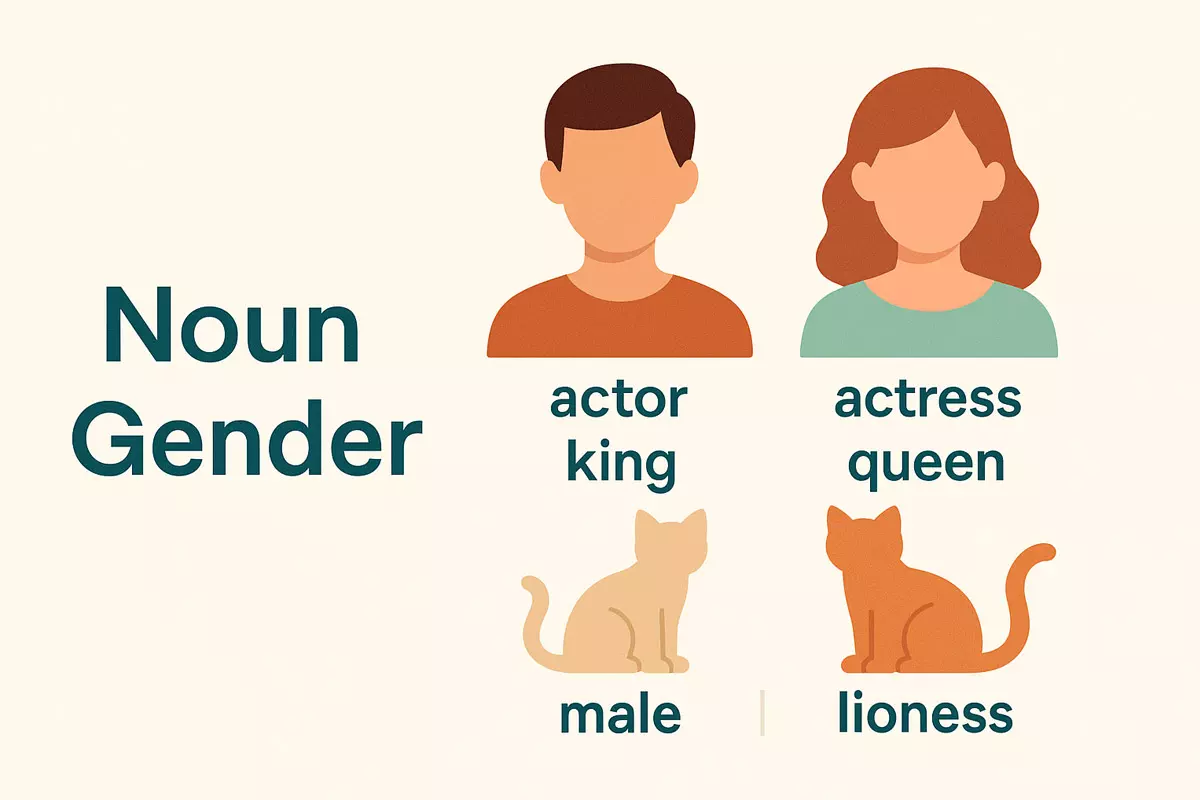 Here we grammatical gender in English, why gender marking is limited, and how gender applies to people and animals. It also discusses traditional gendered nouns, neutral alternatives, pronoun choices, recent changes, and includes practice choosing forms.
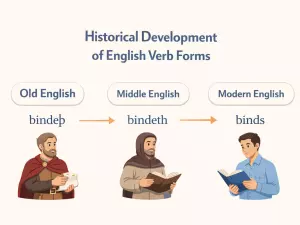
Have you ever wondered why some languages assign masculine or feminine labels to objects, while English generally treats most nouns as neutral? Unlike languages such as French or Spanish, where every noun is classified by gender, English has mostly moved away from this practice over time. Historically, Old English did have grammatical genders, but as the language evolved, these distinctions faded, leaving most English nouns without gendered labels. This shift is one of the reasons English is often considered simpler in terms of grammar compared to other languages.
What Is Grammatical Gender?
Grammatical gender is a system in which nouns are grouped into categories like masculine, feminine, or sometimes neuter. These categories often affect how other words in a sentence—such as adjectives, articles, or pronouns—change form to agree with the noun. The concept is not about biological sex, but rather a traditional classification that varies across languages. In many languages, this system is deeply ingrained. For example, in French, a table is feminine (la table), while a book is masculine (le livre). This means that any adjectives or articles used with these nouns must match their gender. In contrast, English has mostly moved away from this structure, especially in its modern form.
How Gender Works in Language
Some languages use gender for nearly every noun, while others have dropped it almost entirely. The effects can be seen in sentence construction, with word endings and agreements shifting based on the noun’s classification.
- Masculine: Often refers to male people or animals, but can include inanimate objects.
- Feminine: Typically associated with female beings, yet also applies to certain objects or concepts.
- Neuter: Used for things without biological gender, like objects or abstract ideas.
Examples from Other Languages
The following list shows how various languages categorize common nouns:
- Spanish: el sol (the sun, masculine), la luna (the moon, feminine)
- German: der Tisch (table, masculine), die Tür (door, feminine), das Buch (book, neuter)
- Russian: стол (table, masculine), книга (book, feminine), окно (window, neuter)
- French: le chat (cat, masculine), la voiture (car, feminine)
- Italian: il libro (book, masculine), la casa (house, feminine)
- Portuguese: o carro (car, masculine), a mesa (table, feminine)
- Polish: pies (dog, masculine), kobieta (woman, feminine), dziecko (child, neuter)
- Arabic: kitāb (book, masculine), sayyārah (car, feminine)
- Greek: ο ήλιος (the sun, masculine), η θάλασσα (the sea, feminine), το σπίτι (the house, neuter)
- Hindi: लड़का (boy, masculine), लड़की (girl, feminine)
Grammatical Gender vs. Natural Gender
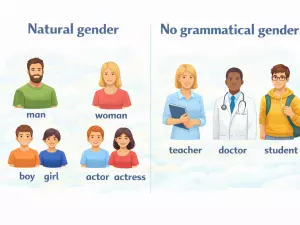
It is important to distinguish between grammatical classification and biological sex. While some nouns align with natural gender (like “man” or “woman”), many do not. For instance, inanimate objects may be labeled as masculine or feminine for grammatical reasons, not because they possess any biological attributes. Languages that use these categories often require speakers to memorize the gender of each noun. In English, however, this system has largely disappeared, making it simpler for learners but also less expressive in certain ways.
Quick Comparison: Gender Agreement
| Language | Does Gender Affect Articles/Adjectives? | Example |
|---|---|---|
| French | Yes | un livre vert (a green book, masculine) une pomme verte (a green apple, feminine) |
| German | Yes | der kleine Hund (the small dog, masculine) die kleine Katze (the small cat, feminine) |
| English | No | the green book / the green apple (no change) |
| Spanish | Yes | el chico alto (the tall boy, masculine) la chica alta (the tall girl, feminine) |
Overall, grammatical gender is a linguistic tool that shapes how sentences are built and words interact. While it remains central in many world languages, English now uses it mainly in specific pronouns or traditional expressions.
Why English Has Little Gender Marking
Unlike many other Indo-European languages, English rarely indicates grammatical gender on nouns. This feature sets it apart from languages like French, German, or Spanish, where gender is a central aspect of grammar and affects articles, adjectives, and even verb forms. In English, most nouns are not marked as masculine or feminine, and there is no neuter category for inanimate objects.
Historical Background
The roots of this minimal gender marking can be traced back to Old English, which did have grammatical gender. Over centuries, however, English underwent major changes: inflectional endings were lost, and the system of noun classes simplified. The Norman Conquest, increased language contact, and a move toward analytic grammar all contributed to the erosion of gender distinctions.
Current Patterns in English
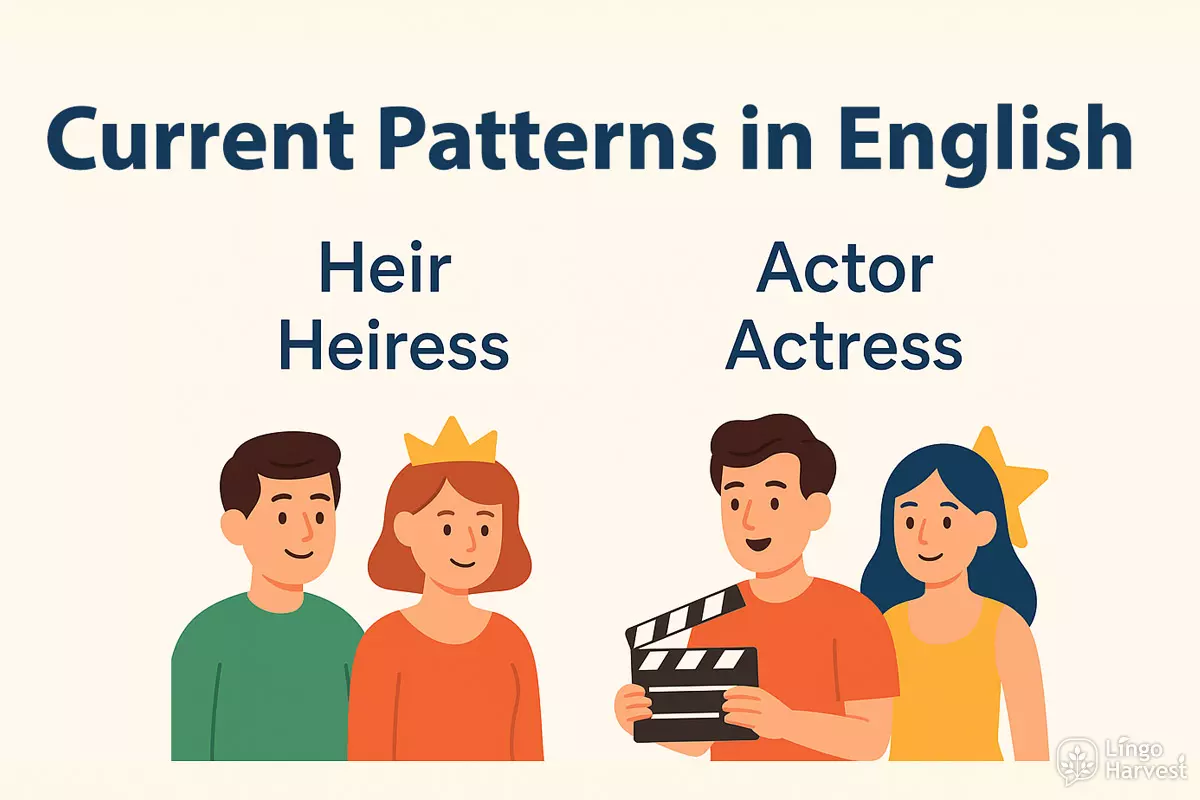
Today, English mainly marks gender in a handful of cases, such as specific personal nouns or pronouns. Most common nouns are neutral and do not require gender agreement with other words. This makes English more straightforward for learners compared to languages with extensive gender systems.
- Heir / Heiress
- Actor / Actress
- Waiter / Waitress
- Prince / Princess
- King / Queen
- Father / Mother
- Brother / Sister
- Wizard / Witch
- Host / Hostess
- Lord / Lady
- Son / Daughter
- Bull / Cow
- Rooster / Hen
- Duke / Duchess
- Uncle / Aunt
- Sir / Madam
- Groom / Bride
- Stallion / Mare
- Drake / Duck
- Fox / Vixen
Pronouns and Gender
While nouns are usually gender-neutral, English does retain gender distinctions in personal pronouns: he (male), she (female), and it (neuter or non-personal). However, even here the system is quite simple compared to other languages.
| Language | Gender Marking on Nouns | Gendered Articles/Adjectives | Example |
|---|---|---|---|
| English | ❌ (rare, mostly for people/animals) | ❌ | the cat, the actor |
| French | ✅ | ✅ | le chat (m.), la chatte (f.) |
| German | ✅ | ✅ | der Hund (m.), die Katze (f.) |
| Spanish | ✅ | ✅ | el niño (m.), la niña (f.) |
Why the Change?
English’s simplification of gender likely resulted from a combination of language contact, social change, and the natural tendency toward analytic structures. The loss of inflectional endings made gender harder to distinguish, and as English speakers interacted with speakers of other languages, especially during the Norman and Viking periods, gender marking became less useful and eventually faded from most everyday usage.
For modern speakers, this means less memorization and fewer agreement rules. Gender in English is now largely a matter of biological sex or social identity, rather than a grammatical requirement.
Natural Gender with People and Animals
In modern English, gender for nouns relating to humans and animals is based on actual biological sex, not grammatical rules. This means that when we refer to individuals, the pronouns and some noun forms change depending on whether the person or animal is male or female. For most professions and general terms, English uses the same word for all genders, but there are still traditional pairs and pronouns that signal biological sex.
Gendered Pronouns and Nouns for People
Personal pronouns reflect natural gender: he for males, she for females, and they (singular) for cases where gender is unknown or unspecified. Some nouns also have gendered forms, though many are now considered outdated or are used less frequently in favor of gender-neutral alternatives.
- man / woman
- boy / girl
- brother / sister
- father / mother
- son / daughter
- husband / wife
- actor / actress (increasingly just "actor" for all)
- waiter / waitress (often replaced by "server")
- prince / princess
- king / queen
- uncle / aunt
- nephew / niece
- hero / heroine (now often just "hero")
Gendered Terms for Animals
Animal nouns can also vary by sex, especially for domesticated or familiar species. In everyday English, the general term is often used unless the sex is relevant, but there are specific words for male and female animals in many cases.
- bull / cow (cattle)
- stallion / mare (horse)
- rooster / hen (chicken)
- dog / bitch (dog, though "bitch" is now rarely used outside breeding)
- lion / lioness
- drake / duck
- boar / sow (pig)
- gander / goose
- ram / ewe (sheep)
- tom / queen (cat, with "queen" used for breeding females)
Summary Table: Gendered Noun Pairs
| Masculine | Feminine | Common/Neutral |
|---|---|---|
| brother | sister | sibling |
| father | mother | parent |
| son | daughter | child |
| waiter | waitress | server |
| actor | actress | actor (neutral) |
| king | queen | monarch |
| bull | cow | cattle |
| stallion | mare | horse |
| rooster | hen | chicken |
| boar | sow | pig |
It's important to note that English has moved toward more neutral vocabulary, especially for professions and roles. In many contexts, the gender of the person or animal is only specified if it's relevant, and default terms are increasingly unmarked for gender. However, understanding traditional pairs can still be useful for reading literature, understanding idioms, or when precision is necessary.
Traditional Gendered Noun Pairs
Distinctions between masculine and feminine forms in English nouns were once far more common than they are today. Many pairs of words historically reflected the gender of the person being described, especially for roles, titles, and family relations. While a neutral approach is now preferred in most contexts, these paired forms still appear in literature, legal documents, and discussions of English history.
Common Masculine and Feminine Noun Forms
Some gendered noun forms are still familiar, while others have faded from everyday speech. Here are some well-known examples:
- Actor → Actress
- Waiter → Waitress
- Prince → Princess
- Host → Hostess
- Steward → Stewardess
- Hero → Heroine
- Duke → Duchess
- King → Queen
- Emperor → Empress
- God → Goddess
- Monk → Nun
- Wizard → Witch
- Father → Mother
- Son → Daughter
- Brother → Sister
- Uncle → Aunt
- Lord → Lady
- Widower → Widow
Patterns in Gendered Noun Formation
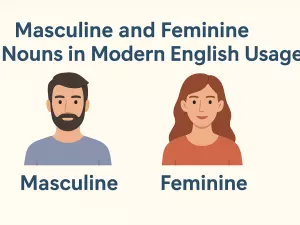
These pairs often use specific suffixes to indicate gender. The endings -ess (as in "waitress," "actress") and -ine ("heroine") are especially common for feminine forms. In some cases, a completely different root word is used, such as "bull" and "cow" or "wizard" and "witch."
Comparison Table: Masculine and Feminine Forms
| Masculine Form | Feminine Form |
|---|---|
| Actor | Actress |
| Prince | Princess |
| Host | Hostess |
| Emperor | Empress |
| God | Goddess |
| Hero | Heroine |
| Duke | Duchess |
| Waiter | Waitress |
| Monk | Nun |
| King | Queen |
Modern Usage and Shifting Preferences
Today, many people prefer gender-neutral language, especially for professions and roles. Words like "actor" and "waiter" are often used regardless of gender, reflecting social changes and efforts to avoid unnecessary distinctions. Some traditional forms, however, remain standard in specific contexts or retain cultural significance.
Neutral and Inclusive Alternatives
In modern English, speakers and writers often look for ways to avoid gender-specific nouns, especially in professional, academic, and public contexts. This shift supports clarity, equality, and respect for individuals who may not identify with traditional gender roles. Many traditional job titles, familial terms, and general nouns once marked by gender now have widely accepted neutral replacements.
Common Gender-Neutral Terms
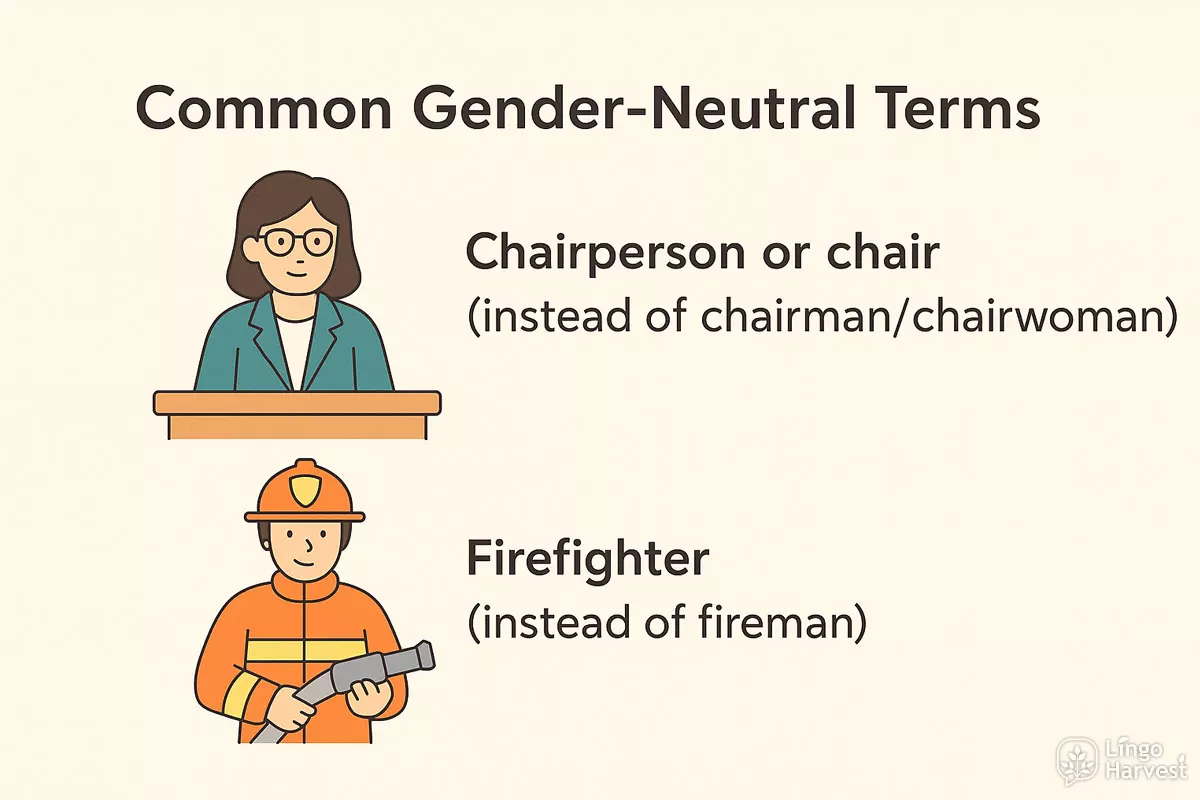
Replacing gendered language with neutral forms is straightforward in many cases. Here are some prevalent examples:
- Chairperson or chair (instead of chairman/chairwoman)
- Firefighter (instead of fireman)
- Police officer (instead of policeman/policewoman)
- Flight attendant (instead of steward/stewardess)
- Server or waitstaff (instead of waiter/waitress)
- Spouse or partner (instead of husband/wife)
- Parent (instead of mother/father when the gender is irrelevant)
- Sibling (instead of brother/sister)
- Humankind or humanity (instead of mankind)
- Actor (now widely used for all genders, replacing actress)
- Salesperson or sales representative (instead of salesman/saleswoman)
- Ancestor (instead of forefather)
- Individual or person (instead of man/woman as a generic)
- They/them as singular pronouns (instead of he/she when gender is unknown or unspecified)
Pronoun Choices and Inclusive Language
Singular "they" is increasingly recognized as the default for referring to a person whose gender is unknown, unspecified, or non-binary. Many organizations and style guides now recommend using "they" instead of defaulting to "he" or "he/she" constructions. Some people also choose neopronouns (like "ze/zir"), though these are less common.
Comparing Gendered and Neutral Forms
The following table presents common examples of traditional gender-marked nouns alongside their inclusive alternatives.
| Gendered Term | Gender-Neutral Equivalent |
|---|---|
| Chairman / Chairwoman | Chair / Chairperson |
| Steward / Stewardess | Flight attendant |
| Policeman / Policewoman | Police officer |
| Waiter / Waitress | Server |
| Salesman / Saleswoman | Salesperson |
| Husband / Wife | Spouse / Partner |
| Brother / Sister | Sibling |
| Forefathers | Ancestors |
| Manpower | Workforce / Staff |
| Mankind | Humankind / Humanity |
Strategies for Inclusive Communication
When striving for more inclusive language, consider these approaches:
- Default to neutral job titles and roles.
- Use "they" for unknown or non-binary individuals.
- Ask for and use people’s preferred pronouns when possible.
- Choose terms like "parent," "child," or "partner" to avoid assumptions.
- Revise forms and documents to remove unnecessary gender fields or binaries.
By adopting these alternatives, English continues to evolve toward greater inclusivity and precision, reflecting the diversity of its speakers.
Pronoun Choice and Gender
English no longer assigns grammatical gender to nouns as many other European languages do, but gender still affects how speakers select pronouns. Instead of gendered noun forms, English relies on pronouns to reflect natural gender, or sometimes to avoid specifying gender entirely. Understanding how and why a particular pronoun is used can help clarify the relationship between language and gender identity.
Traditional Patterns
Historically, pronouns like he and she were matched to the perceived gender of a person or animal, while it was used for objects, abstract concepts, or animals of unknown sex. This approach worked when gender was seen as binary, but language use has evolved to reflect more nuanced realities.
- he – used for male people or animals
- she – used for female people or animals
- it – used for objects, places, ideas, or non-gendered animals
- they – used for groups, or as a singular pronoun when gender is unknown or unspecified
- ze/zie, xe, etc. – gender-neutral pronouns sometimes preferred by non-binary individuals
Singular "They" and Modern Usage
The singular use of they has gained widespread acceptance, especially when referring to someone whose gender is unknown, irrelevant, or non-binary. This shift helps avoid assumptions and supports inclusivity in language.
| Pronoun | Example Usage | Typical Context |
|---|---|---|
| he/him | He lost his keys. | Male person or animal |
| she/her | She found her book. | Female person or animal |
| they/them | Someone left their umbrella. | Unknown, non-binary, or general |
| it/its | The cat licked its paw. | Object or animal (non-gendered) |
| ze/hir | Ze finished hir work. | Non-binary (preferred pronoun) |
Respecting Personal Pronouns
Choosing the correct pronoun is part of respecting individual identity. Many people now share their pronouns in introductions or email signatures. If unsure, it’s best to ask or use neutral language until you know someone’s preference. This approach fosters inclusion and clarity in communication.
- Ask politely if you are unsure of someone’s pronouns.
- Use gender-neutral language in group settings.
- Update pronoun usage if someone shares a change.
- Apologize and correct yourself if you make a mistake.
In summary, while English nouns themselves are not gendered, the choice of pronouns remains an important and evolving part of the language, reflecting both tradition and contemporary understanding of gender.
Changes in Modern Usage
English has largely moved away from grammatical gender, but traces remain in certain words and expressions. Today, the association of gender with nouns is much less rigid than in many other languages. Most objects and abstract concepts are now referred to using neutral pronouns like "it," while gender-specific terms are generally reserved for people or animals where sex is known or relevant.
Shifts Toward Gender Neutrality
Contemporary language trends show a strong preference for gender-neutral vocabulary. Occupation titles and terms that once had distinct masculine and feminine forms are increasingly unified under neutral options. This shift reflects a broader social movement toward inclusivity and equality in language.
| Traditional Gendered Term | Modern Gender-Neutral Equivalent |
|---|---|
| Stewardess | Flight attendant |
| Policeman / Policewoman | Police officer |
| Chairman / Chairwoman | Chairperson / Chair |
| Fireman | Firefighter |
| Actor / Actress | Actor (for all genders) |
| Mailman | Mail carrier |
| Waiter / Waitress | Server |
Pronoun Usage and Evolution
Another significant development is the use of pronouns. While "he" and "she" still refer to people of known gender, "they" has become widely accepted as a singular pronoun for individuals whose gender is unknown or non-binary. This adaptation is supported by major style guides and dictionaries, reflecting real-world linguistic change.
- Each student should bring their own laptop. ✅
- An applicant must submit their resume by Friday. ✅
- Someone left their umbrella here. ✅
Exceptions and Residual Usage
Despite these changes, some gendered terms persist, especially in traditional, historical, or poetic contexts. Ships, for example, are sometimes referred to as "she," and certain animal terms still distinguish between male and female.
- Ship: "She set sail at dawn."
- King / Queen
- Bull / Cow
- Rooster / Hen
- Wizard / Witch
In summary, English now favors neutral language, but a few gender-marked words and expressions remain, mainly for stylistic or cultural reasons. The ongoing evolution of terms and pronouns highlights the language's adaptability to social changes.
Practice: Choose Neutral or Gendered Forms
English nouns sometimes offer both neutral and gender-specific options. Choosing the appropriate form depends on context, audience, and evolving standards of inclusivity. This section provides practical exercises and clear examples to help you recognize and select between gendered and gender-neutral nouns in modern usage.
Common Pairs: Gendered vs. Neutral Nouns
Below is a comparison of several English nouns that traditionally had masculine and feminine forms, alongside their neutral alternatives. Notice how many modern professions and roles now favor neutral language.
| Gendered Form | Gender-Neutral Form |
|---|---|
| Actor / Actress | Actor |
| Waiter / Waitress | Server |
| Steward / Stewardess | Flight attendant |
| Policeman / Policewoman | Police officer |
| Chairman / Chairwoman | Chair / Chairperson |
| Fireman | Firefighter |
| Businessman / Businesswoman | Businessperson |
| Mailman | Mail carrier / Postal worker |
| Salesman / Saleswoman | Salesperson / Sales associate |
| Congressman / Congresswoman | Member of Congress / Legislator |
| Landlord / Landlady | Landlord (neutral in modern use) / Property owner |
| Manpower | Workforce / Staff |
| Spokesman / Spokeswoman | Spokesperson / Representative |
| Gentleman / Lady | Person / Guest / Individual |
| Hero / Heroine | Hero (increasingly neutral) |
| Boyfriend / Girlfriend | Partner / Significant other |
| Mother / Father | Parent |
| Son / Daughter | Child / Offspring |
| Brother / Sister | Sibling |
Exercise: Select the Most Inclusive Option
Read each sentence and choose the best noun for an inclusive, modern context.
- The _____ gave a speech at the conference. (Choices: chairman, chairperson, chair)
- Ask the _____ for your bill. (Choices: waiter, server, waitress)
- She works as a _____ on international flights. (Choices: stewardess, flight attendant, steward)
- The _____ responded quickly to the emergency. (Choices: fireman, firefighter)
- My _____ is coming to dinner tonight. (Choices: girlfriend, partner, boyfriend)
Show answers
- chair or chairperson
- server
- flight attendant
- firefighter
- partner
Additional Practice: Spot the Gendered Noun
- The policeman directed traffic during the parade.
- Our spokesman released a statement this morning.
- My sibling and I share a room.
- The salesperson helped me choose a laptop.
- The landlord fixed the heating last week.
Show answers
- Policeman – gendered; use "police officer" for neutral.
- Spokesman – gendered; use "spokesperson" for neutral.
- Sibling – neutral.
- Salesperson – neutral.
- Landlord – increasingly neutral in modern English, but historically gendered.
Paying attention to these patterns helps ensure your language is respectful and appropriate for diverse audiences. As English evolves, so does the use of neutral forms—especially for professions and roles. Practice with real-world examples to develop your awareness and flexibility.