What Are Pronouns? Complete Introduction

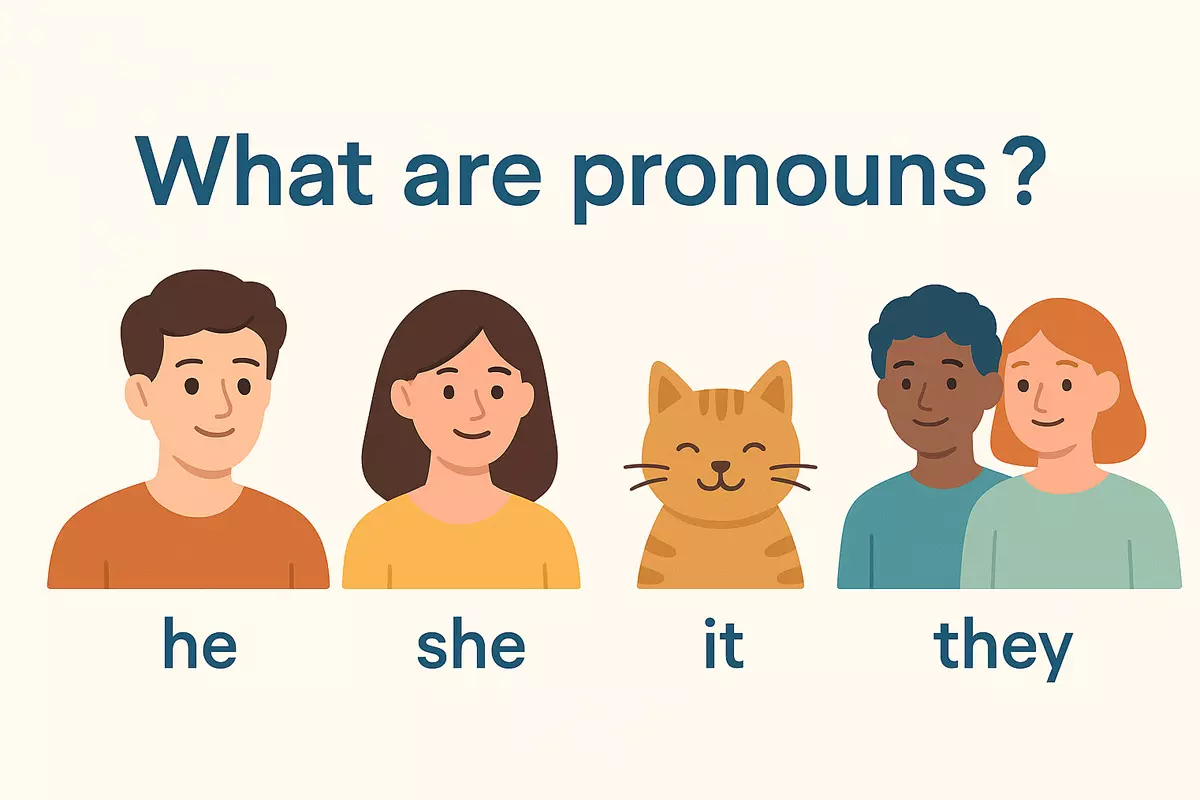 Here we what pronouns do, the main types, and how they replace nouns in sentences. It also explains pronoun agreement, points out common beginner mistakes, and provides quick practice tasks to help you master pronouns.
Have you ever thought about how we avoid repeating names in conversation? We use certain linguistic tools that help make our sentences smoother and more engaging. These tools, known as pronouns, allow us to refer to people or things without unnecessary repetition. Mastering the use of pronouns is essential for clear and effective communication, as it helps our speech and writing flow naturally while making our ideas easier to understand.
What Pronouns Do
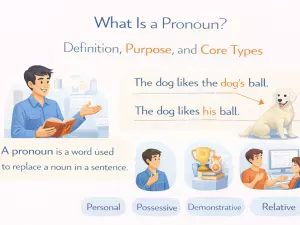
Pronouns serve as replacements for nouns, making sentences smoother and less repetitive. Instead of repeating names or objects over and over, these words let us refer back to something already mentioned or understood from context. This function is essential for both clarity and variety in speech and writing.
How Pronouns Streamline Language
When speaking or writing, constantly repeating a person's name or a thing's description can sound awkward and unnatural. Pronouns help avoid this by standing in for those nouns. For example, instead of saying "Maria saw Maria's book on Maria's desk," you can say "Maria saw her book on her desk." This makes communication both efficient and clear.
Main Functions of Pronouns
- Reference: Point to people, places, things, or ideas already mentioned (e.g., he, she, it).
- Substitution: Replace nouns to reduce repetition (e.g., "the car" becomes "it").
- Identification: Help clarify which person or thing is meant (e.g., this, those, who).
- Possession: Indicate ownership or association (e.g., mine, yours, theirs).
- Questioning: Ask about people or things (e.g., who, what, which).
- Connection: Link clauses or phrases for complex ideas (e.g., that, which, whose).
- Emphasis: Highlight or stress a particular noun (e.g., myself, itself).
- Indefiniteness: Refer to non-specific items or people (e.g., someone, anything, each).
- Reciprocity: Show a mutual relationship (e.g., each other, one another).
- Demonstration: Point out specific things (e.g., this, those).
Common Types and Examples
The range of pronoun types helps cover different situations in communication. Here are several categories with examples:
- Personal: I, you, she, it, we, they
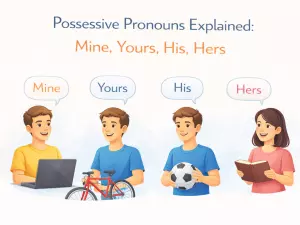
- Possessive: mine, yours, hers, ours
- Reflexive: myself, herself, themselves
- Relative: who, which, whose
- Demonstrative: this, that, those
- Indefinite: anyone, something, all, neither
- Interrogative: who, what, which
- Reciprocal: each other, one another
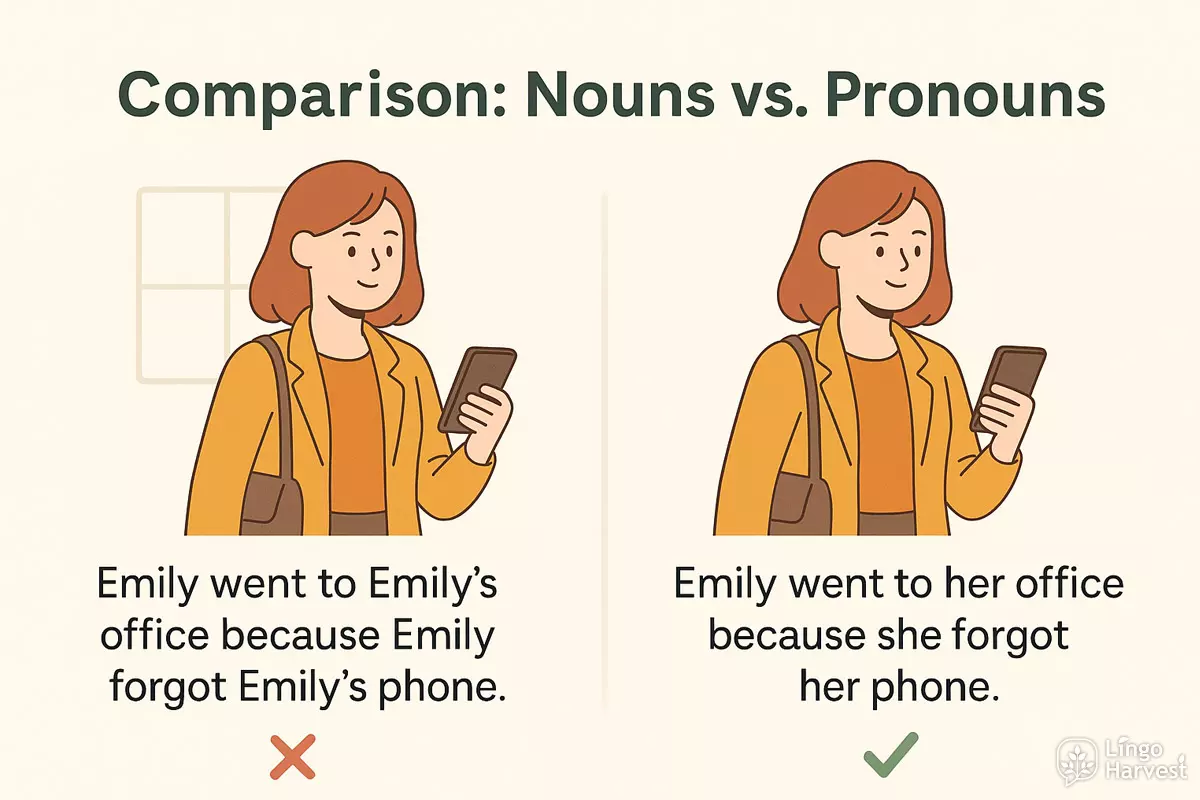
Comparison: Nouns vs. Pronouns
| Noun Example | Pronoun Replacement |
|---|---|
| Emily went to Emily's office because Emily forgot Emily's phone. | Emily went to her office because she forgot her phone. |
| The book is on the table. The book is red. | The book is on the table. It is red. |
| The students handed in the students' homework. | The students handed in their homework. |
| The dog chased the cat, and the dog caught the cat. | The dog chased the cat, and it caught it. |
Pronouns make communication more natural and less cumbersome. By using them, speakers and writers keep their language efficient, clear, and varied.
Main Pronoun Types
When learning about pronouns, it’s helpful to recognize the different groups they fall into, each serving a unique grammatical function. Understanding these categories makes it easier to use them correctly in sentences and to recognize patterns in language.
Personal Pronouns
Personal pronouns stand in for specific people or things. They change form depending on their role in a sentence (subject, object, or possessive). For example:
- I, you, he, she, it, we, they (subject forms)
- me, you, him, her, it, us, them (object forms)
- my, your, his, her, its, our, their (possessive adjectives)
- mine, yours, his, hers, ours, theirs (possessive pronouns)
Reflexive and Intensive Pronouns
These pronouns refer back to the subject of the sentence or add emphasis. They always end in -self or -selves:
- myself
- yourself
- himself
- herself
- itself
- ourselves
- yourselves
- themselves
Demonstrative Pronouns
Demonstrative pronouns point to specific things or people. The most common ones are:
- this
- that
- these
- those
Interrogative Pronouns
These are used to ask questions about people or things:
- who
- whom
- whose
- which
- what
Relative Pronouns
Relative pronouns connect clauses or phrases to nouns or pronouns. They introduce relative clauses:
- who
- whom
- whose
- which
- that
Indefinite Pronouns
Indefinite pronouns refer to non-specific people or things. Some of the most common include:
- everyone
- someone
- anyone
- no one
- everything
- something
- anything
- nothing
- each
- either
- neither
- few
- many
- several
- all
- some
- most
- none
Pronoun Forms Comparison
The following table shows how some personal pronouns change depending on their function in a sentence. This helps clarify subject, object, and possessive roles for the most common forms:
| Subject | Object | Possessive Adjective | Possessive Pronoun |
|---|---|---|---|
| I | me | my | mine |
| you | you | your | yours |
| he | him | his | his |
| she | her | her | hers |
| it | it | its | (none) |
| we | us | our | ours |
| they | them | their | theirs |
Many sentences rely on the correct use of these forms for clarity and precision. By recognizing the various categories and how each type functions, you’ll be better equipped to understand and use pronouns accurately in both speech and writing.
How Pronouns Replace Nouns
Pronouns serve as substitutes for nouns, making sentences less repetitive and easier to follow. Instead of repeating a person’s name or an object’s title, a pronoun can take its place. For example, “Maria went to the market. Maria bought apples” becomes “Maria went to the market. She bought apples.” This switch keeps communication clear and concise.
Why Use Pronouns?
Replacing nouns with pronouns helps:
- Avoid unnecessary repetition
- Make sentences smoother and shorter
- Clarify who or what is being discussed
- Show relationships between people or things
Common Examples of Noun Substitution
Below are some typical ways pronouns stand in for nouns in English sentences:
- John → He (“John likes music. He plays guitar.”)
- Susan and I → We (“Susan and I are friends. We study together.”)
- The book → It (“The book is new. It looks interesting.”)
- The children → They (“The children are outside. They are playing.”)
- My mother → She (“My mother is a teacher. She loves her job.”)
- Mr. Smith and his dog → They (“Mr. Smith and his dog walk daily. They enjoy the park.”)
- This pencil → It (“This pencil is sharp. It writes well.”)
- My friends and I → We (“My friends and I went hiking. We had fun.”)
- Jessica → She (“Jessica called. She left a message.”)
- The car → It (“The car was fast. It won the race.”)
Types of Pronouns Used in Place of Nouns
Different categories of pronouns can replace nouns, each serving a specific function:
- Personal pronouns: I, you, he, she, it, we, they
- Possessive pronouns: mine, yours, his, hers, ours, theirs
- Demonstrative pronouns: this, that, these, those
- Relative pronouns: who, whom, which, that
- Reflexive pronouns: myself, yourself, himself, herself, itself, ourselves, yourselves, themselves
Before and After: Noun and Pronoun Replacement
The following table shows how pronouns can take the place of nouns in sentences, making the language more natural:
| Original with Noun | With Pronoun |
|---|---|
| Lisa saw Lisa’s friend at the store. | Lisa saw her friend at the store. |
| The dogs barked because the dogs were hungry. | The dogs barked because they were hungry. |
| The computer is new. The computer works fast. | The computer is new. It works fast. |
| My brother and I finished my brother and I’s homework. | My brother and I finished our homework. |
By substituting pronouns for nouns, sentences become more fluid and less awkward, especially when the subject or object is mentioned more than once. This fundamental process is key to effective and natural communication in English.
Pronouns in Basic Sentences
Understanding how to use pronouns within simple statements is a key part of mastering clear communication. These words often stand in for nouns, making sentences less repetitive and more natural. In everyday language, pronouns replace people, things, or even ideas previously mentioned, so we don’t have to repeat the same nouns over and over.
How Pronouns Replace Nouns
A pronoun usually refers back to a noun already introduced. For example, instead of saying, "Maria likes Maria’s book," we can say, "Maria likes her book." This makes speech and writing smoother and easier to follow.
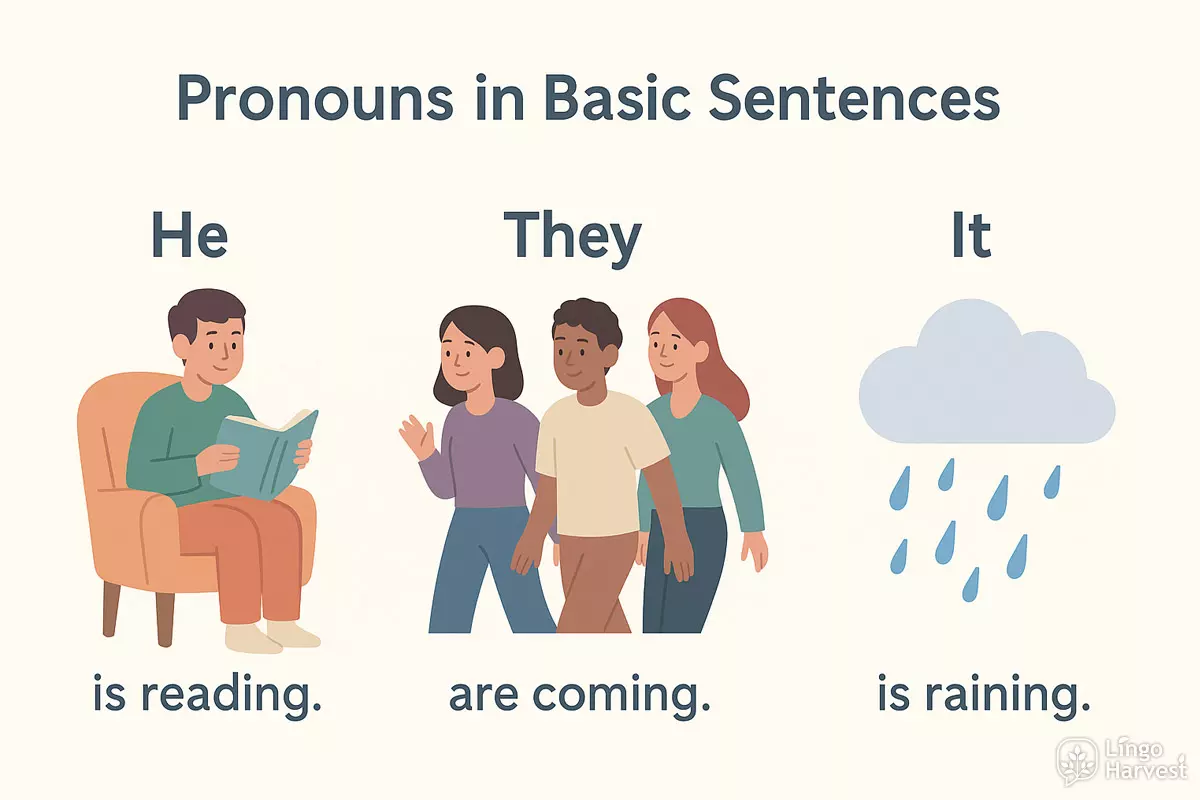
- He is reading. (Instead of "Tom is reading.")
- They are coming. (Instead of "The students are coming.")
- It is raining. (Instead of "The weather is raining.")
- We finished the project. (Instead of "My team and I finished the project.")
- You are invited. (Instead of "Sarah, you are invited.")
- She called earlier. (Instead of "Anna called earlier.")
- They won the match. (Instead of "The players won the match.")
- I made coffee. (Instead of "John made coffee" if you are John.)
- We agree. (Instead of "My friends and I agree.")
- It broke. (Instead of "The vase broke.")
Subject and Object Pronouns: Usage Patterns
The role a pronoun plays in a sentence matters. Some words act as the subject (doing the action), and others serve as the object (receiving the action). Compare these forms:
| Subject Form | Object Form | Example Sentence |
|---|---|---|
| I | me | I called him. |
| You | you | You saw me. |
| He | him | He visits us. |
| She | her | She joined them. |
| We | us | We invited you. |
| They | them | They greeted her. |
| It | it | It surprised me. |
Common Mistakes to Avoid
- ❌ Using a subject pronoun where an object is needed: Incorrect: "Me went to the store."
- ❌ Mixing up singular and plural forms: Incorrect: "They is happy."
- ✅ Always match the pronoun with the noun’s number and gender when possible.
To sum up, swapping nouns for the right pronouns streamlines conversation and writing. Practice identifying which pronoun fits based on the role in the sentence, and you’ll find your English becomes clearer and more concise.
Pronouns and Agreement
Getting pronouns to match other words in a sentence is essential for clear and correct communication. This matching process is known as agreement. In English, pronouns must agree with their antecedents—the words they replace—in number (singular or plural), gender (male, female, or neutral), and sometimes person (first, second, or third).
Number and Person Matching
A pronoun should reflect whether it refers to one person or thing, or more than one. For example, he is singular, while they is plural. The person of the pronoun (first, second, or third) also needs to match the subject or object it replaces.
- I (first person singular) matches with the speaker.
- We (first person plural) refers to a group including the speaker.
- You (second person, singular or plural) addresses the listener(s).
- He/She/It (third person singular) replaces a specific person or thing.
- They (third person plural, or singular for gender-neutral use) refers to multiple people or someone of unknown gender.
Gender and Pronoun Choice
English pronouns also reflect gender, though not as strictly as in some other languages. For human antecedents, he and she specify male and female, while they can be used for anyone regardless of gender. For objects and animals, it is common.
- Sarah forgot her keys. ✅
- The dog wagged its tail. ✅
- Each student must submit his or her work. (Or: their work, for gender neutrality)
Common Agreement Mistakes
Errors often occur when writers mismatch a pronoun with its antecedent, especially with collective nouns or indefinite pronouns. Here are some examples:
- Every student must bring their book. (Accepted in modern usage for gender neutrality, though traditionally "his or her" is used.)
- Neither of the boys brought their lunch. (Should be: "his lunch" in formal writing.)
- The team won its game. ✅ ("Team" is treated as singular.)
- The committee gave its decision. ✅
- The children finished their homework. ✅
Summary Table: Pronoun Forms by Number and Person
| Person | Singular Subject | Plural Subject | Singular Object | Plural Object | Possessive Adjective |
|---|---|---|---|---|---|
| First | I | We | me | us | my/our |
| Second | you | you | you | you | your |
| Third (male) | he | they | him | them | his/their |
| Third (female) | she | they | her | them | her/their |
| Third (neutral/object) | it | they | it | them | its/their |
In summary, making sure your pronouns match their antecedents in number, person, and gender is a key part of writing clear sentences. Careful attention to these details helps avoid confusion and keeps your language precise.
Common Beginner Mistakes
Mixing up different types of pronouns and misunderstanding their roles can create confusion for those new to the concept. Many learners accidentally use the wrong form, skip necessary words, or apply the rules inconsistently. Here are some frequent pitfalls and how to avoid them.
Confusing Subject and Object Forms
Using the incorrect form of a word that stands in for a noun is a classic error. For example, saying "Me went to the store" instead of "I went to the store." The subject form should be used when the word is the doer of the action, while the object form fits when it receives the action.
- Incorrect: "Her did it." ❌
- Correct: "She did it." ✅
- Incorrect: "Give the book to I." ❌
- Correct: "Give the book to me." ✅
Ambiguous Reference
Sometimes, it's unclear what or whom a pronoun refers to. This ambiguity can make sentences hard to follow.
- "Alex told Jordan that he was late." (Who was late?)
- To fix: "Alex told Jordan, 'You are late.'" or "Alex, who was late, told Jordan."
Overusing or Omitting Pronouns
Beginners might use too many or too few pronouns, leading to awkward or repetitive sentences.
- Too many: "Sarah she is my friend she is funny."
- Better: "Sarah is my friend. She is funny."
- Omitted: "Gave him the book." (Who gave?)
- Better: "I gave him the book."
Gender and Number Errors
Choosing the wrong gender or number is a common slip, especially when the noun being replaced is unclear or unknown.
| Incorrect Usage | Corrected Form |
|---|---|
| The student forgot their homework. (For one known male student) | The student forgot his homework. |
| Each of the girls brought his lunch. | Each of the girls brought her lunch. |
| Everyone must bring their pencil. (Informal, now widely accepted) | Everyone must bring his or her pencil. (More formal) |
| They is going to the party. | They are going to the party. |
Mixing Up Reflexive and Possessive Forms
Words like "myself" or "themselves" are often used incorrectly in place of possessives or standard forms.
- Incorrect: "Please give it to myself."
- Correct: "Please give it to me."
- Incorrect: "Theirselves" (should be "themselves")
Forgetting to Match Pronoun and Antecedent
A pronoun must agree in number and gender with the noun it replaces. Beginners might mismatch these, especially in longer sentences.
- Incorrect: "The team lost their game." (If "team" is considered singular)
- Correct: "The team lost its game."
These mistakes are common but can be overcome with careful attention to the role and agreement of each word that stands for a noun. Practice and review help solidify correct usage over time.
Quick Practice Tasks
Try these practical exercises to reinforce your understanding of pronouns and how they function in sentences. Each set focuses on a different aspect: identifying, choosing, or using pronouns effectively.
1. Identify the Pronoun
Read the sentences below and pick out all the pronouns:
- She went to the store because it was raining.
- They finished their homework before dinner.
- This is the book that I mentioned to you.
- Someone left his umbrella here.
- We saw ourselves in the mirror.
Show answers
- She, it
- They, their
- This, that, I, you
- Someone, his
- We, ourselves
2. Fill in the Blank
Choose the correct pronoun to complete each sentence:
- ___ forgot to bring ___ keys. (He/She/They; his/her/their)
- The cat chased ___ tail around the room. (its/it's)
- ___ are going to the park after school. (We/Us)
- Can you help ___ with this problem? (me/I)
- This is the person ___ called earlier. (who/whom)
Show answers
- He/She/They; his/her/their (Any matching pair is correct)
- its
- We
- me
- who
3. Pronoun Types: Quick Reference
Here’s a summary table of common pronoun categories with examples. Use it as a cheat sheet for practice and review.
| Type | Examples |
|---|---|
| Personal | I, you, he, she, it, we, they |
| Possessive | my, your, his, her, its, our, their |
| Reflexive | myself, yourself, himself, herself, itself, ourselves, themselves |
| Demonstrative | this, that, these, those |
| Interrogative | who, whom, whose, which, what |
| Relative | who, whom, whose, which, that |
| Indefinite | someone, anyone, everyone, none, few, many |
4. Rewrite Sentences Using Pronouns
Replace the nouns in the following sentences with suitable pronouns:
- Maria and I went to Maria and I’s favorite café.
- The dog barked at the mail carrier.
- The children played with the children’s toys.
- Mr. Smith gave Mr. Smith’s book to Sarah.
Show answers
- We went to our favorite café.
- It barked at the mail carrier.
- They played with their toys.
- He gave his book to her.
Practicing with these varied exercises will help you recognize and use different types of pronouns with confidence in your writing and conversation.