What Is a Pronoun? Definition, Purpose, and Core Types

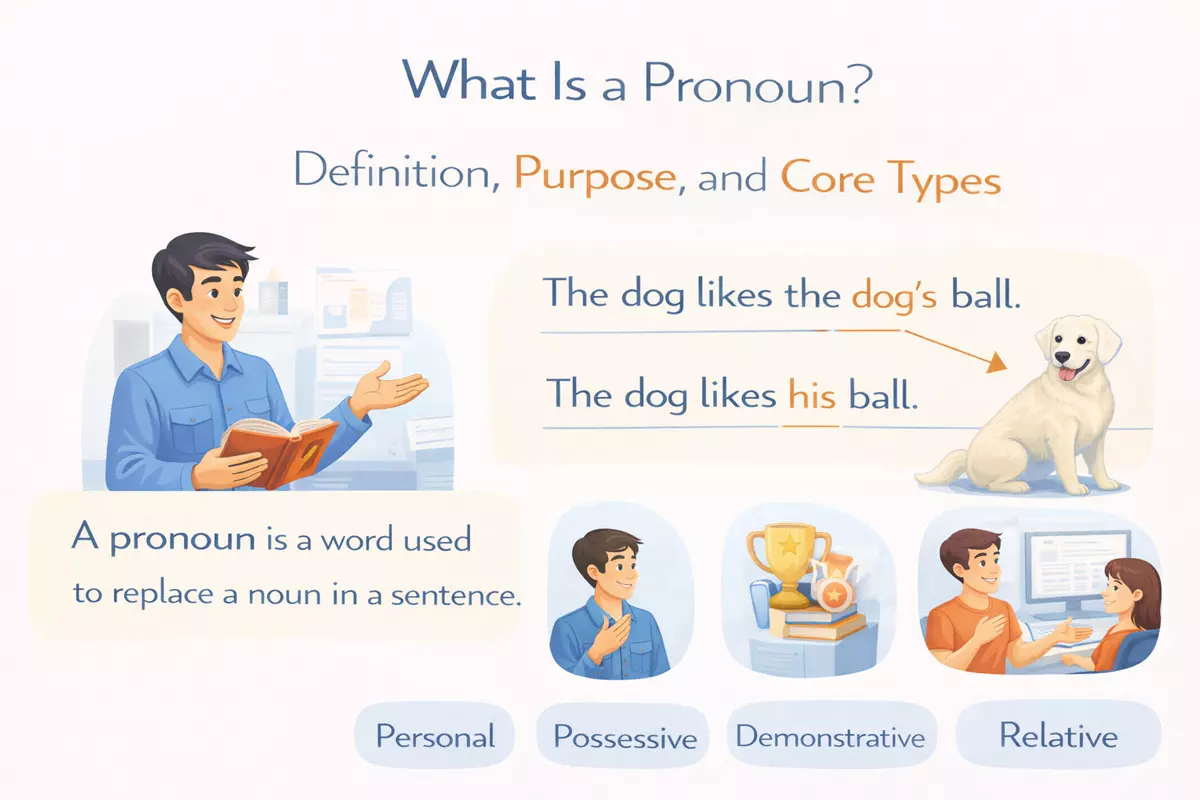 Here we what pronouns are, why English uses them, the main pronoun groups, and how pronouns replace nouns to avoid repetition. It also explains pronoun antecedents, subject vs object forms, common confusions, and includes a practice section.
- What a pronoun is and why English uses pronouns
- Main pronoun groups: personal, possessive, demonstrative, reflexive, relative, indefinite
- How pronouns replace nouns to avoid repetition
- Pronoun antecedents: what a pronoun refers to
- Subject vs object basics with quick examples
- Common beginner confusion: it, they, and you
- Choosing pronouns for people vs things
- Mini practice: replace nouns with pronouns correctly
Have you ever wondered how we keep our sentences flowing smoothly without constantly repeating the same names? Pronouns are the clever words that stand in for nouns, making our communication clearer and more efficient. By using pronouns such as he, she, it, they, and others, we avoid unnecessary repetition and maintain the natural rhythm of our speech and writing. Understanding the different types of pronouns—personal, possessive, reflexive, demonstrative, and more—helps us construct sentences that are both concise and easy to follow in everyday language.
What a pronoun is and why English uses pronouns
A pronoun is a word that stands in for a noun or noun phrase in a sentence. Instead of repeating the same name or object over and over, speakers and writers use pronouns for clarity and flow. For example, instead of saying "Maria saw Maria's friend and Maria waved," you can say "Maria saw her friend and she waved." This makes communication smoother and less repetitive.
How pronouns function in English
Pronouns help sentences sound natural and avoid awkward repetition. They refer back to previously mentioned people, places, or things (called antecedents), making it easy for listeners and readers to follow along. Pronouns can take the place of subjects, objects, possessives, and more, depending on their type and position in a sentence.
- She went to the store. (replaces a female person's name)
- I saw him at the park. (replaces a male person's name)
- Sam brought his umbrella. (shows possession)
- They are arriving soon. (refers to a group)
- Is this yours? (possessive form)
- Who is calling? (asks about a person)
- That is mine. (possessive pronoun)
- It is raining. (refers to the weather)
- Did you see them? (object pronoun for a group)
- Someone left their bag. (indefinite pronoun)
Why English relies on pronouns
Pronouns streamline sentences, making them less cumbersome and easier to understand. Without them, communication would be repetitive and confusing, especially in longer texts. By pointing back to nouns already mentioned, pronouns help maintain coherence and prevent ambiguity.
English uses a variety of pronoun types to cover different roles in conversation and writing. These include personal, possessive, reflexive, demonstrative, interrogative, relative, and indefinite pronouns. Each type serves a unique purpose, but all help connect ideas and clarify meaning.
Main pronoun groups: personal, possessive, demonstrative, reflexive, relative, indefinite
Understanding the primary categories of pronouns in English is essential for clear and precise communication. Each group serves a unique function, from standing in for people to indicating ownership or connecting clauses. Let’s explore these categories in detail, highlighting what sets each apart and providing common examples.
Personal Pronouns
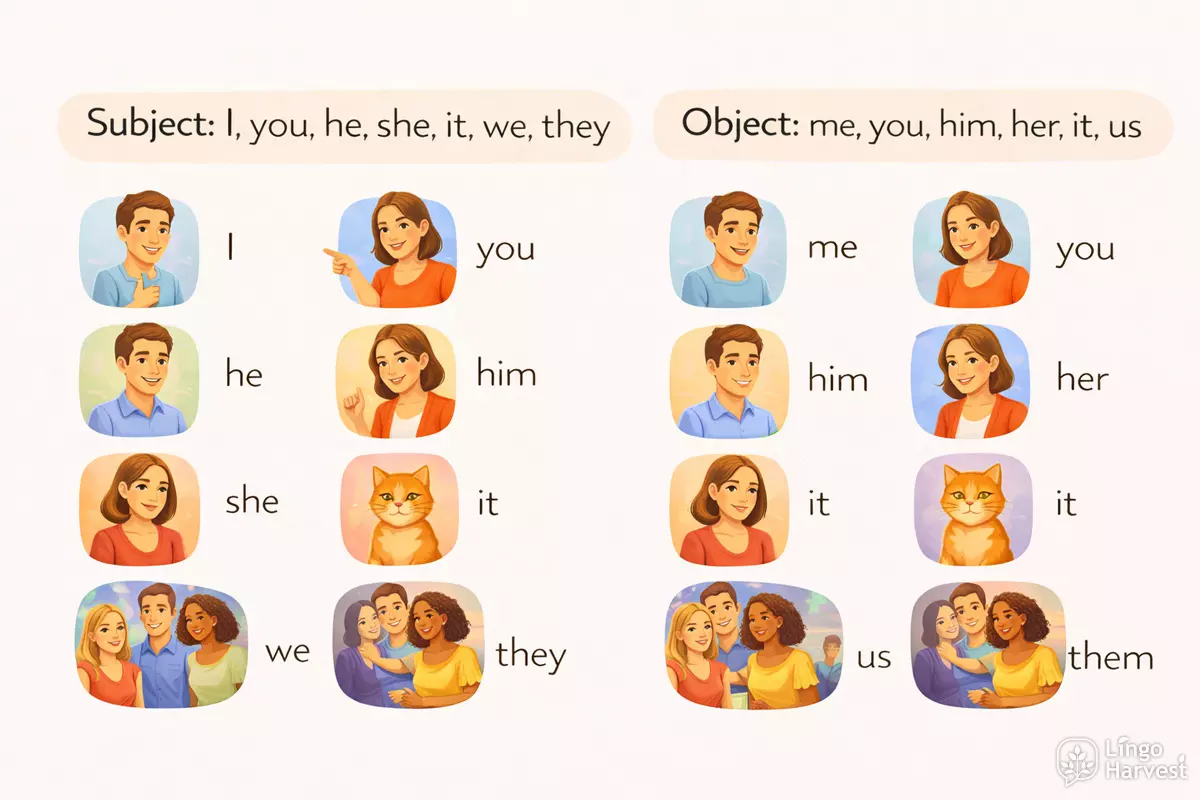
Personal pronouns refer directly to people or things and change depending on number, person, gender, and case. They include words like I, you, he, she, it, we, and they. These pronouns are used as subjects or objects in sentences.
- Subject: I, you, he, she, it, we, they
- Object: me, you, him, her, it, us, them
Possessive Pronouns
Possessive pronouns show ownership or relationship. They replace nouns to indicate who something belongs to, such as mine, yours, hers, ours, theirs. Unlike possessive adjectives (my, your), these pronouns stand alone.
- mine → This notebook is mine.
- yours → Is this seat yours?
- his → The blue jacket is his.
- hers → The final decision was hers.
- ours → The responsibility is ours.
- theirs → The victory was theirs.
Demonstrative Pronouns
Demonstrative pronouns point to specific things or people. English uses four main demonstratives: this, that, these, and those. They help clarify which item or group is being referred to, often based on proximity.
- this (singular, near)
- that (singular, far)
- these (plural, near)
- those (plural, far)
Reflexive Pronouns
Reflexive pronouns are used when the subject and object of a verb refer to the same person or thing. These pronouns end in -self (singular) or -selves (plural). They include myself, yourself, himself, herself, itself, ourselves, yourselves, and themselves.
- myself → I taught myself to cook.
- yourself → You should ask yourself this question.
- himself → He fixed the problem himself.
- herself → She introduced herself to the team.
- itself → The system updates itself automatically.
- ourselves → We prepared ourselves for the exam.
- yourselves → Please make yourselves comfortable.
- themselves → They explained themselves clearly.
Relative Pronouns
Relative pronouns connect clauses or phrases to nouns or pronouns. These words introduce relative clauses and provide more information about a noun. Common examples are who, whom, whose, which, and that.
- who → The teacher who helped me was very patient.
- whom → The colleague whom I met yesterday was friendly.
- whose → She’s the friend whose advice I trust.
- which → The book which you lent me was fascinating.
- that → The movie that we watched last night was interesting.
Indefinite Pronouns
Indefinite pronouns refer to non-specific people or things. They’re useful when the exact identity is unknown or unimportant. Examples include someone, anyone, everyone, no one, something, anything, nothing, everything, each, few, many, all, and none.
| Pronoun Type | Examples |
|---|---|
| Personal | I, you, he, she, it, we, they, me, him, her, us, them |
| Possessive | mine, yours, his, hers, ours, theirs |
| Demonstrative | this, that, these, those |
| Reflexive | myself, yourself, himself, herself, itself, ourselves, yourselves, themselves |
| Relative | who, whom, whose, which, that |
| Indefinite | someone, anyone, everyone, no one, something, anything, nothing, everything, each, few, many, all, none |
Each pronoun group helps make language more efficient and less repetitive, allowing us to refer to people, things, and ideas in flexible ways. Mastery of these categories is key to writing and speaking with clarity.
How pronouns replace nouns to avoid repetition
When writing or speaking, repeating the same name or object over and over quickly makes sentences sound awkward and redundant. Pronouns step in to keep language smooth and natural by standing in for nouns that have already been mentioned. This way, you can avoid constant repetition and make your sentences easier to follow.
Why this matters in sentences
Without pronouns, communication gets clunky. For example, consider the difference between these two sentences:
- Maria finished Maria’s homework because Maria wanted to watch Maria’s favorite show.
- Maria finished her homework because she wanted to watch her favorite show.
The second sentence is much clearer and less repetitive, thanks to the use of “her” and “she” instead of repeating “Maria.”
Common pronoun substitutions
Pronouns can replace different types of nouns, including people, places, things, and even ideas. Here are some typical swaps you might see:
- John → he, him, his
- Susan and I → we, us, our
- the dog → it, its
- the teachers → they, them, their
- the book → it
- my friends and I → we
- Sarah and Tom → they
- the building → it
- the children → they, them
- the cake → it
- the computer → it
- the students → they
- the city → it
- the keys → they, them
- my mother → she, her
- the bus → it
- the team → they, it (context-dependent)
- the movie → it
- the neighbors → they, them
- the river → it
How to choose the right pronoun
Selecting the correct substitute depends on what the original noun refers to:
- Use “he/him/his” for a male person.
- Choose “she/her/hers” for a female person.
- Pick “they/them/their” for groups or when gender is unknown.
- Go with “it/its” for objects, animals (when gender is not specified), or ideas.
Side-by-side comparison: Noun repetition vs. pronoun use
| Repetitive Noun Use | With Pronouns |
|---|---|
| Anna lost Anna’s keys, so Anna looked for Anna’s keys everywhere. | Anna lost her keys, so she looked for them everywhere. |
| The dog barked because the dog was hungry. | The dog barked because it was hungry. |
| Tom and Jerry finished Tom and Jerry’s project before Tom and Jerry went home. | Tom and Jerry finished their project before they went home. |
| The book was interesting, and the book had many pictures. | The book was interesting, and it had many pictures. |
By using pronouns to stand in for nouns, you streamline your writing and make your meaning clearer. This simple substitution keeps language from sounding repetitive and helps readers or listeners focus on the message rather than getting distracted by unnecessary repetition.
Pronoun antecedents: what a pronoun refers to
Understanding what a pronoun points back to is essential for clear writing. The noun or noun phrase that a pronoun stands in for is called its antecedent. Without a clear antecedent, sentences can become confusing or ambiguous for readers.
How pronouns and their antecedents work together
Pronouns rely on their antecedents for meaning. When you see a pronoun like she, they, or it, your mind automatically looks for the word it replaces. For example, in the sentence “Maria finished her homework,” the pronoun her refers to “Maria.” This connection helps avoid repetition and keeps sentences concise.
Common types of antecedents
An antecedent can be:
- A single noun: The dog barked because it was hungry.
- A noun phrase: The team of engineers finished their project.
- A previous sentence or idea: She missed the bus. This made her late.
Typical pronoun-antecedent patterns
Here are some examples showing how pronouns refer back to nouns or phrases:
- John lost his keys.
- The children forgot their lunches.
- The car needs its oil changed.
- Lisa and Mark said they would help.
- Someone left their umbrella.
- The committee reached its decision.
- The students finished their tests.
- The book lost its cover.
- Rachel knows she can succeed.
- After the movie, everyone clapped for it.
- Dogs often wag their tails.
- Each player must bring his or her own equipment.
- The cake was delicious, and it disappeared quickly.
- The workers completed their tasks.
- When the phone rang, it startled me.
- Both sisters lost their wallets.
- The painting was admired for its colors.
- Tom and I finished our chores.
Tips for clarity
Making sure every pronoun has a clear, unambiguous antecedent helps readers follow your meaning. Avoid sentences where it’s unclear what the pronoun refers to. For example:
- Unclear: When Sarah talked to Emily, she was upset. (Who was upset?)
- Clear: When Sarah talked to Emily, Emily was upset.
Summary
A pronoun’s meaning always depends on the word or idea it replaces. By matching each pronoun with a specific antecedent, your writing stays precise and easy to understand.
Subject vs object basics with quick examples
Understanding the difference between subjects and objects is essential for using pronouns correctly in English. The subject of a sentence is the person or thing performing the action, while the object receives the action. Pronouns change their form depending on their role, so knowing how to spot the subject and object helps you choose the right word.
What is a subject? What is an object?
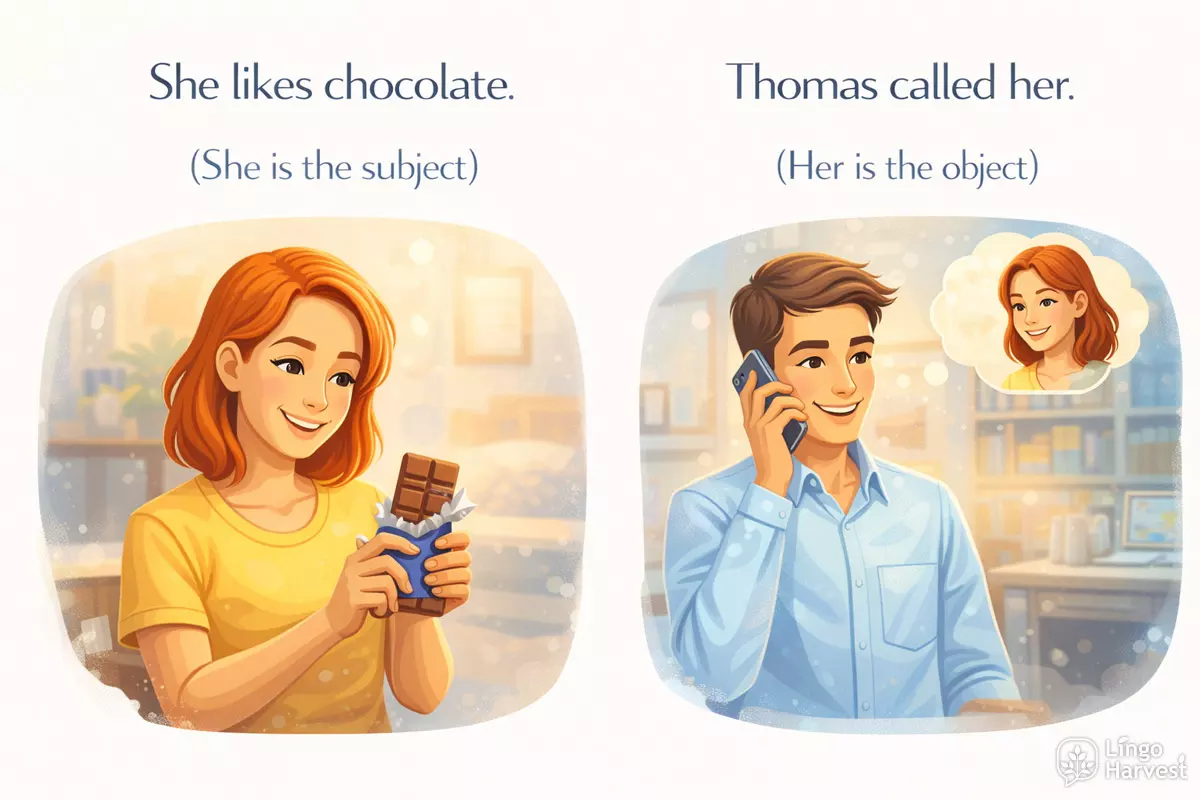
The subject usually comes before the verb and tells us who or what is doing something. The object, on the other hand, comes after the verb and shows who or what is affected by the action. For example:
- She likes chocolate. (She is the subject)
- Thomas called her. (Her is the object)
Common subject and object pronouns
Here are some of the most frequently used pronouns in subject and object positions:
- I / me
- you / you
- he / him
- she / her
- it / it
- we / us
- they / them
- ___ am ready to start the meeting. (I / me)
- Please send the document to ___. (I / me)
- ___ is waiting outside. (he / him)
- We invited ___ to join the project. (she / her)
- ___ works well under pressure. (they / them)
- The manager spoke to ___ after the call. (we / us)
- ___ is broken, so don’t use it. (it / it)
- Can you help ___ with this task? (they / them)
Show answers
- I am ready to start the meeting.
- Please send the document to me.
- He is waiting outside.
- We invited her to join the project.
- They work well under pressure.
- The manager spoke to us after the call.
- It is broken, so don’t use it.
- Can you help them with this task?
Quick examples in sentences
To make these distinctions clear, here are several sample sentences using subject and object pronouns:
- They are coming to the party. (subject)
- Did you see them at the store? (object)
- We finished our homework. (subject)
- The teacher helped us. (object)
- He runs every morning. (subject)
- The coach congratulated him. (object)
- I love pizza. (subject)
- She called me yesterday. (object)
- You look happy today. (subject)
- Can I sit with you? (object)
- It makes a funny noise. (subject)
- Have you seen it? (object)
- She is reading a book. (subject)
- John met her at the café. (object)
The form of the pronoun depends entirely on whether it’s acting as the “doer” or the “receiver” in the sentence. By paying attention to position and function, you can easily choose the correct pronoun form.
Common beginner confusion: it, they, and you
Many new English learners struggle with how and when to use the pronouns it, they, and you. These words may seem simple, but their meanings and uses can be surprisingly tricky, especially in sentences where context matters. Understanding the differences is key to speaking and writing clearly.
When to use it
It is usually used for things, animals (when gender is unknown or irrelevant), ideas, or as a placeholder for weather, time, and distances. It never refers to people.
- It is raining. (weather)
- It was late. (time)
- Where is my book? It is on the table. (object)
- I heard something. It was loud. (unknown thing)
When to use they
They can refer to more than one person or thing. Increasingly, they is also used as a singular pronoun to refer to someone whose gender is unknown or unspecified. This can be confusing, as the meaning depends on context.
- They are my friends. (plural people)
- They are on the table. (plural things)
- Someone left their keys. They will be back soon. (singular, gender-neutral)
- They said to call back later. (unknown person)
When to use you
You can refer to one person or more than one. In English, there is no difference between singular and plural you in standard usage (though some dialects use “y’all” or “you guys” for plural).
- You are my best friend. (singular)
- You all need to listen. (plural)
- Can you help me?
- Did you see the movie?
Quick comparison
The following table highlights the main differences and typical uses for these pronouns:
| Pronoun | Typical Use | Singular or Plural? | Example Sentence |
|---|---|---|---|
| it | Things, animals (unknown gender), ideas, weather, time | Singular | It is cold outside. |
| they | People or things (plural), a person of unknown gender (singular) | Plural or singular (gender-neutral) | They are waiting. / Someone called; they left a message. |
| you | The person or people spoken to | Singular or plural | You are welcome here. |
Common mistakes and tips
- Don’t use it for people: It is my friend ❌ He/She/They is my friend ✅
- Don’t use they for single, known-gender people unless they prefer it.
- Remember, you is both singular and plural—context will tell which.
- Use it for weather and time, not they or you.
- Practice by reading and listening to real conversations to see how these pronouns are used.
Mastering these small but important words will help you avoid confusion and communicate more naturally in English.
Choosing pronouns for people vs things
When selecting the correct pronoun, it’s important to consider whether you are referring to a person or an object. English makes a clear distinction between pronouns used for humans and those used for animals, objects, or abstract concepts. This helps avoid confusion and ensures your sentences make sense to readers and listeners.
Personal pronouns for people
We use specific pronouns to refer to individuals or groups. These pronouns reflect number, gender, and sometimes formality. Here are the most common ones:
- I (first person singular)
- you (second person singular/plural)
- he (third person singular, masculine)
- she (third person singular, feminine)
- they (third person singular for nonbinary or unspecified gender, and plural)
- we (first person plural)
- him, her, them (object forms)
- his, her, their (possessive forms)
Pronouns for things and animals
For objects, places, and most animals (unless the animal’s gender or name is known and relevant), English uses different pronouns. The most common are:
- it (subject and object form)
- its (possessive form)
- they (for plural things or animals)
- them (object form for plurals)
- their (possessive form for plurals)
Comparing pronoun choices
The distinction between human and non-human pronouns is especially important in writing and formal speech. See the table below for a side-by-side comparison of pronoun choices for people and things:
| Reference | Subject Pronoun | Object Pronoun | Possessive Pronoun |
|---|---|---|---|
| Person (male) | he | him | his |
| Person (female) | she | her | her |
| Person (nonbinary/plural/unknown) | they | them | their |
| Thing/animal (generic) | it | it | its |
| Things/animals (plural) | they | them | their |
Special notes and exceptions
Sometimes, animals are referred to as "he" or "she" if their gender is known or if the writer wants to personalize them, especially with pets. Ships, countries, and some vehicles are occasionally given feminine pronouns in poetic or traditional contexts, but "it" remains standard in modern usage. Choosing the right pronoun is not just about grammar—it also shows respect for people’s identities and maintains clarity in your writing. If you’re unsure, default to "they" for people when gender is unknown, and "it" for objects or animals unless context suggests otherwise.
Mini practice: replace nouns with pronouns correctly
Understanding how to substitute nouns with pronouns is essential for making sentences smoother and less repetitive. Let’s practice by reviewing sentences where you need to swap out the noun for an appropriate pronoun. Pay close attention to whether the noun is singular or plural, and its role in the sentence (subject, object, or possessive).
Practice: Swap nouns for pronouns
- Maria went to the store because Maria needed bread.
- The students finished the students' homework before class.
- The book is on the table, but the book is not mine.
- John and I saw John and I's favorite movie.
- The cat chased the dog, but the dog escaped.
- My brother and my sister are traveling. My brother and my sister are excited.
- The computer was expensive, so the computer was insured.
- Sarah gave the keys to Sarah's neighbor.
- The flowers are beautiful. The flowers are blooming.
- Tom forgot Tom's umbrella at home.
Quick reference: Common pronoun replacements
- Maria → she, her, hers
- The students → they, them, their(s)
- The book → it, its
- John and I → we, us, our(s)
- The cat → it, its
- The dog → it, its
- My brother and my sister → they, them, their(s)
- The computer → it, its
- Sarah → she, her, hers
- The keys → they, them, their(s)
- The flowers → they, them, their(s)
- Tom → he, him, his
- Umbrella → it, its
Show answers
- Maria went to the store because she needed bread.
- The students finished their homework before class.
- The book is on the table, but it is not mine.
- John and I saw our favorite movie.
- The cat chased the dog, but it escaped. (If referring to the dog, use "it".)
- My brother and my sister are traveling. They are excited.
- The computer was expensive, so it was insured.
- Sarah gave the keys to her neighbor.
- The flowers are beautiful. They are blooming.
- Tom forgot his umbrella at home.
Challenge: Replace the nouns in context
Rewrite these sentences, changing the repeated noun(s) to the correct pronoun:
- Lisa called Lisa’s friend because Lisa needed advice.
- The dogs barked when the dogs saw the mail carrier.
- My parents visited my parents’ favorite restaurant.
- The car was new, and the car ran smoothly.
- Anna and Mark picked up Anna and Mark’s tickets.
- David forgot David’s password, so David reset David’s account.
- The manager read the manager’s notes before the manager started the meeting.
- The students finished the students’ homework and handed the students’ homework in.
- The phone was on the desk, but the phone was not charging.
- Maria opened Maria’s laptop after Maria returned home.
Show answers
- Lisa called her friend because she needed advice.
- The dogs barked when they saw the mail carrier.
- My parents visited their favorite restaurant.
- The car was new, and it ran smoothly.
- Anna and Mark picked up their tickets.
- David forgot his password, so he reset his account.
- The manager read his notes before he started the meeting.
- The students finished their homework and handed it in.
- The phone was on the desk, but it was not charging.
- Maria opened her laptop after she returned home.
Pronoun replacement patterns
Here are some useful patterns to help decide which pronoun to use for different types of nouns:
- People (singular): he/him/his, she/her/hers
- People (plural): they/them/their(s)
- Animals or things: it/its (unless the animal’s gender is known)
- Possessive forms: my/mine, your/yours, our/ours, their/theirs, his, her/hers, its
Practicing these substitutions will help you write and speak more naturally, making your language flow better and sound less repetitive.