Possessive Pronouns: Mine, Yours, Ours

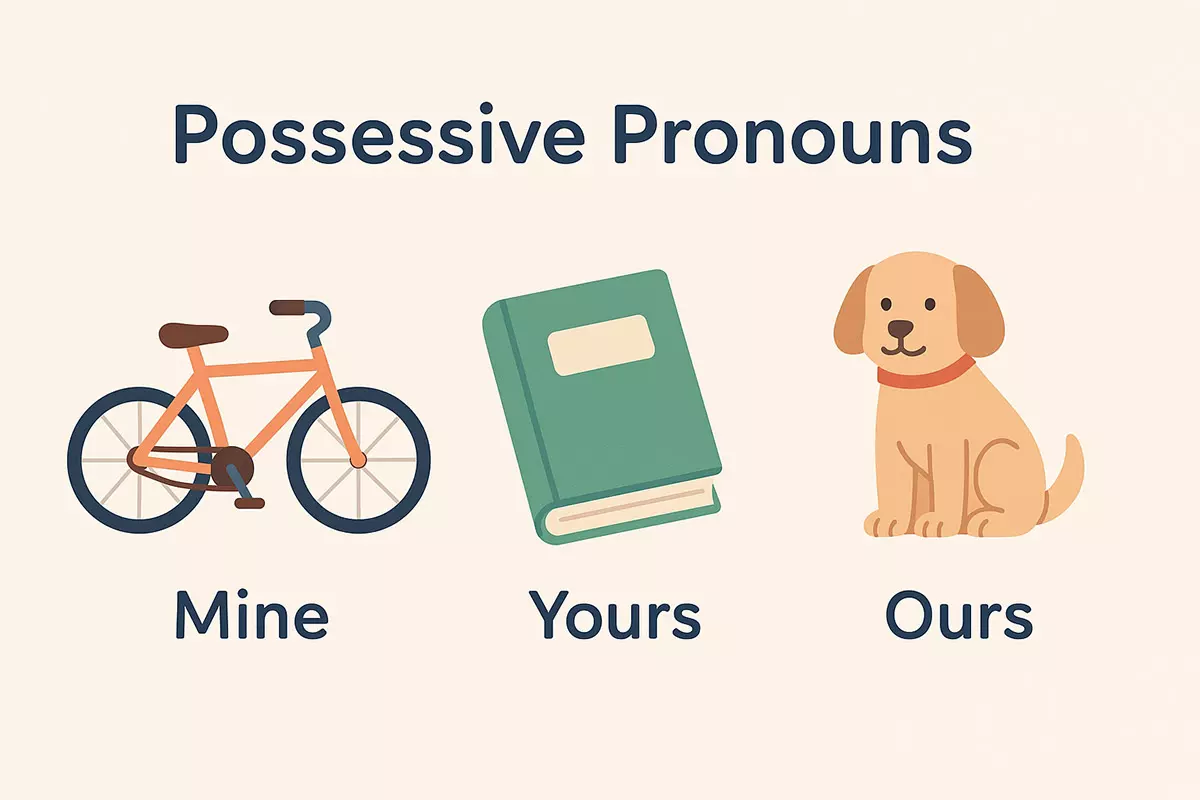 This article defines possession in English, provides a complete list of possessive pronouns, distinguishes them from possessive adjectives, demonstrates their use in sentences, discusses common confusions, and offers a short fill-in-the-blank practice.
Possessive pronouns like mine, yours, his, hers, ours, and theirs play an important role in English by making it easy to show who owns something without repeating nouns. For example, instead of saying this is my book and that is your book, you can simply say this is mine and that is yours. Using these pronouns helps conversations flow more smoothly and avoids unnecessary repetition. Understanding and using possessive pronouns correctly allows you to communicate ownership clearly and efficiently in both speaking and writing.
Meaning of Possession
When we talk about possessive pronouns such as "mine," "yours," or "ours," we're expressing ownership, association, or relationship between people and things. In English, these forms help us clarify who something belongs to without repeating the noun. This idea of holding or relating to something—whether an object, idea, or relationship—is at the heart of possessive forms.
How Possession Is Expressed in English
English uses a range of words and structures to indicate belonging. Sometimes this means showing clear ownership (as in "That pen is mine"), while other times it can signal a connection or shared responsibility ("The decision is ours"). Here are some common ways the language represents this concept:
- Using possessive pronouns (mine, yours, hers, ours, theirs, his, its)
- Adding 's to a noun (Sarah's book, the dog's collar)
- Using possessive adjectives (my, your, her, our, their, his, its)
- Combining prepositions with nouns (the keys of the car, the title of the movie)
Types of Belonging
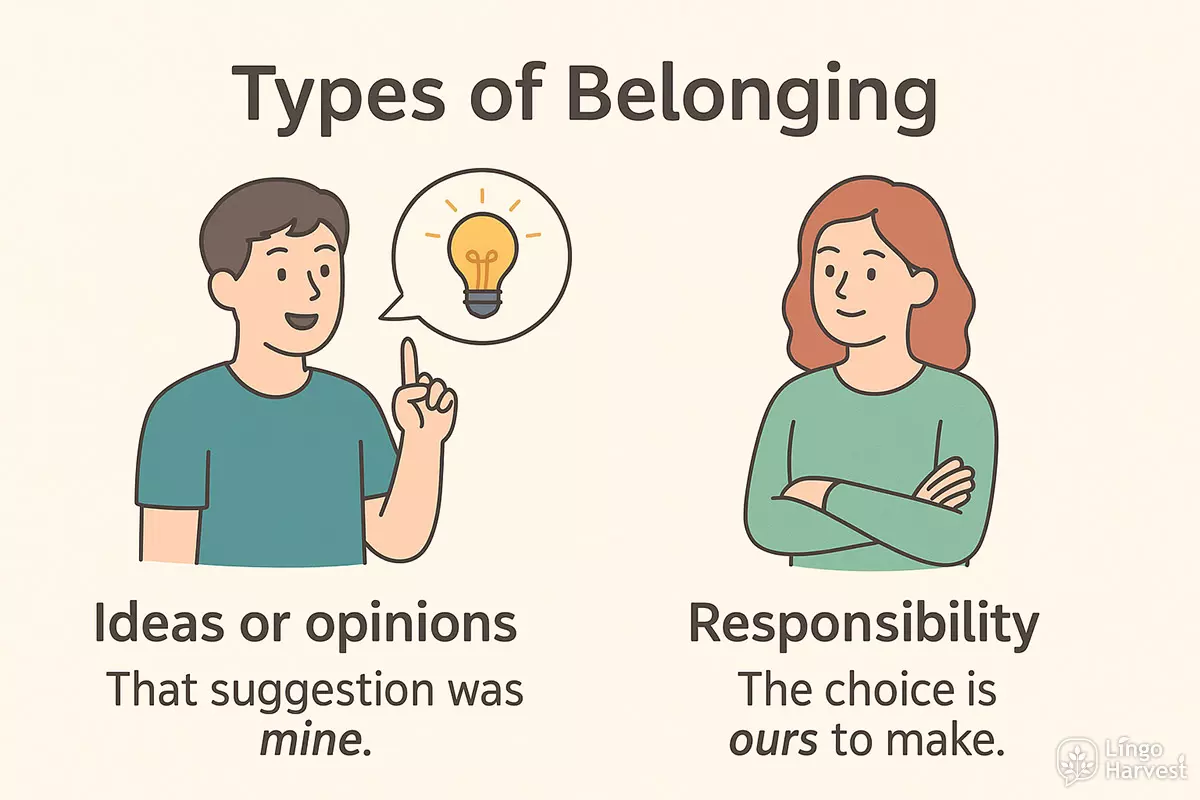
Ownership in language can be more than physical possession. It can also show relationships, affiliations, or even abstract connections. For instance:
- Physical objects: "Is this umbrella yours?"
- Ideas or opinions: "That suggestion was mine."
- Responsibility: "The choice is ours to make."
- Family or social ties: "She is a friend of mine."
- Membership: "The victory is theirs."
- Features or qualities: "Its color is bright."
- Emotional bonds: "Your happiness is important to me."
- Time or events: "That was our moment."
- Achievements: "The award is hers."
- Locations: "This seat is yours."
Possessive Pronouns vs. Possessive Adjectives
It's helpful to compare how English uses two related forms to show belonging. Possessive pronouns stand alone, while possessive adjectives modify a noun. Here’s a quick overview:
| Possessive Pronoun | Possessive Adjective | Example Sentence |
|---|---|---|
| mine | my | This book is mine. / This is my book. |
| yours | your | Is this pen yours? / Is this your pen? |
| ours | our | The house is ours. / That is our house. |
| theirs | their | The car is theirs. / That is their car. |
| hers | her | The idea was hers. / That was her idea. |
| his | his | The jacket is his. / That is his jacket. |
| its | its | The tail is its. / That is its tail. |
Understanding how English communicates belonging or connection helps you use pronouns and adjectives naturally, making your meaning clear in conversation and writing.
Full List of Possessive Pronouns
Understanding which words show ownership in English can clarify sentences and make communication smoother. Possessive pronouns replace nouns to indicate that something belongs to someone or something. Unlike possessive adjectives (like "my" or "your"), these pronouns stand alone and do not come before a noun.
Common Possessive Pronouns in English
Here are the primary words used to show possession without repeating the noun:
- mine
- yours
- his
- hers
- its (rarely used as a pronoun)
- ours
- theirs
These terms are used when the noun is already clear from context. For example: "This book is mine," or "The choice is yours."
Possessive Pronouns by Person and Number
To see how these words correspond to different grammatical persons, refer to the table below:
| Person | Possessive Pronoun |
|---|---|
| First person singular | mine |
| Second person singular/plural | yours |
| Third person singular (male) | his |
| Third person singular (female) | hers |
| Third person singular (neutral/thing) | its |
| First person plural | ours |
| Third person plural | theirs |
Quick Reference: Examples in Sentences
To help you see these in action, here are sample sentences:
- This cup is mine.
- Is this notebook yours?
- The jacket is his.
- The umbrella is hers.
- The responsibility is ours.
- Those keys are theirs.
These pronouns never come before a noun; instead, they replace the noun to avoid repetition and clarify ownership.
Pronouns vs Possessive Adjectives
Understanding the difference between possessive pronouns and possessive adjectives is essential for clear English communication. Both types show ownership, but they appear in different places within a sentence and serve specific roles. Possessive pronouns stand alone and replace nouns to show who owns something. For example, in "This book is mine," the word "mine" replaces "my book." In contrast, possessive adjectives come before a noun to modify it, as in "This is my book." The word "my" describes whose book it is but does not replace the noun itself.
Common Possessive Pronouns and Adjectives
Here’s a quick guide to some of the most frequently used forms:
- My (adjective) → Mine (pronoun)
- Your (adjective) → Yours (pronoun)
- His (adjective & pronoun) → His (pronoun)
- Her (adjective) → Hers (pronoun)
- Its (adjective) → (no pronoun form)
- Our (adjective) → Ours (pronoun)
- Your (plural adjective) → Yours (plural pronoun)
- Their (adjective) → Theirs (pronoun)
Usage Patterns and Examples
Possessive adjectives are always followed by a noun, while possessive pronouns never are. Notice the difference in these examples:
- My keys are on the table. ✅
- These keys are mine. ✅
- Her idea was interesting. ✅
- The idea was hers. ✅
- This is your seat. ✅
- This seat is yours. ✅
Quick Comparison Table
| Possessive Adjective | Possessive Pronoun | Example Sentence |
|---|---|---|
| my | mine | This is my pen. / This pen is mine. |
| your | yours | Their car or your car? That car is yours. |
| our | ours | Our house is big. / The big house is ours. |
| their | theirs | Is this their dog? No, it's theirs. |
| her | hers | This is her bag. / The bag is hers. |
| his | his | His shoes are new. / The new shoes are his. |
Summary
To sum up, possessive adjectives describe whose item it is and are always used with nouns, while possessive pronouns stand alone and replace both the noun and the possessive adjective. Choosing the right form helps your sentences sound natural and avoids repetition.
Using Possessive Forms in Sentences
Understanding how to include possessive pronouns like "mine," "yours," and "ours" in sentences helps make your writing and speech clearer and more natural. These words show ownership without repeating the noun, streamlining communication. For instance, instead of saying "This is my book," you can say, "This book is mine."
Common Patterns for Possessive Pronouns
Possessive pronouns are typically placed at the end of a sentence or clause, replacing the noun they refer to. Here are some patterns:
- Subject + verb + object + possessive pronoun (e.g., The red car is ours.)
- Question word + verb + possessive pronoun? (e.g., Whose keys are these? They are mine.)
- Comparisons: My phone is newer than yours.
Examples in Context
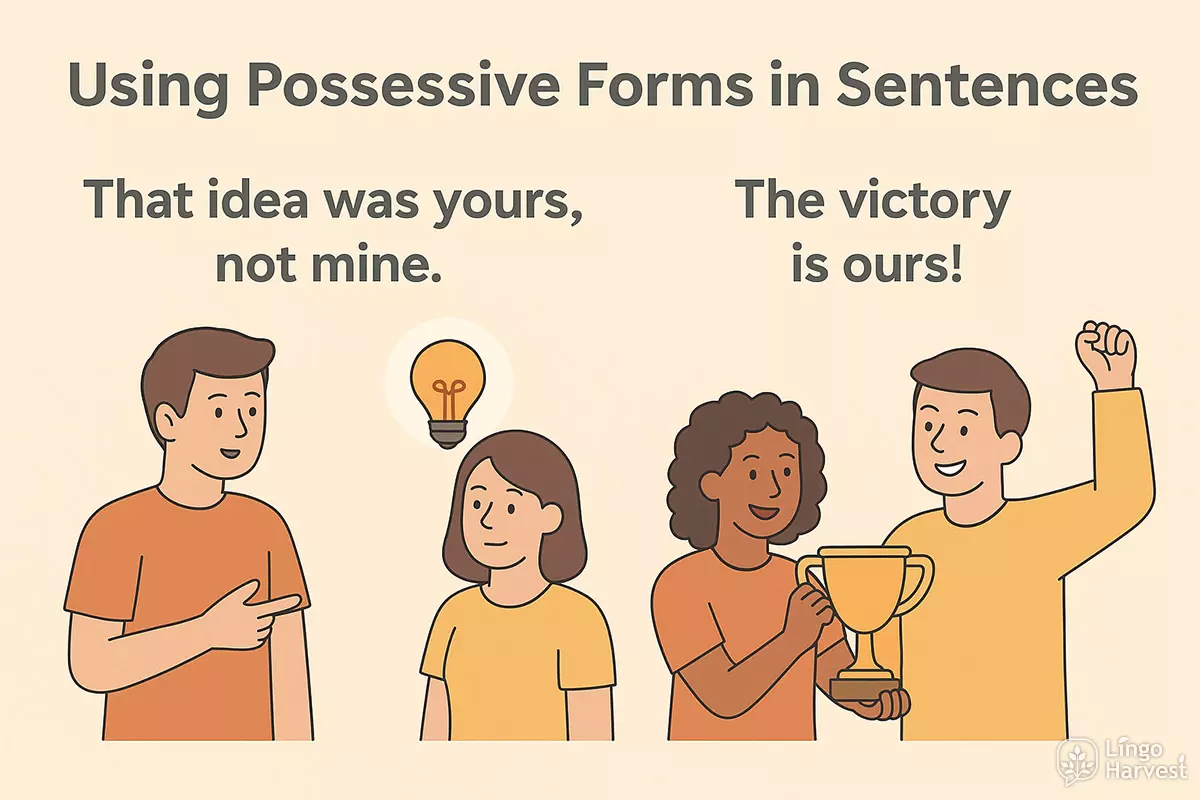
To see how these forms work, review the following examples:
- This umbrella is mine.
- Are these seats yours?
- The responsibility is ours.
- That idea was yours, not mine.
- The victory is ours!
- I thought the bag was mine, but it’s yours.
- Is this notebook yours or ours?
- Your answer was better than mine.
- The decision is ours to make.
- Whose shoes are these? — They’re mine.
- That seat is yours if you want it.
- All these books are ours.
- He found his keys, but I can’t find mine.
- This pen isn’t yours; it’s mine.
- The project is finally ours.
Comparison with Possessive Adjectives
It’s easy to mix up possessive pronouns with possessive adjectives (like "my," "your," "our"). The key difference is that possessive pronouns stand alone, while adjectives come before nouns.
| Possessive Adjective (before noun) |
Possessive Pronoun (replaces noun) |
|---|---|
| This is my chair. | This chair is mine. |
| Is that your bag? | Is that bag yours? |
| That’s our house. | That house is ours. |
| I forgot my keys. | I forgot mine. |
When constructing sentences, pick the form that fits the structure and avoids unnecessary repetition. Using these pronouns correctly not only clarifies ownership but also keeps language concise.
Common Confusions
Understanding the differences between possessive pronouns and other forms of possession in English can be tricky, especially when words look or sound similar. Many learners mix up possessive adjectives with possessive pronouns, or confuse possessive forms with contractions or plurals. Let’s clarify these distinctions to avoid frequent mistakes.
Possessive Pronouns vs. Possessive Adjectives
One frequent area of uncertainty is telling apart possessive pronouns (mine, yours, ours, etc.) from possessive adjectives (my, your, our, etc.). The key difference is their role in the sentence:
- Possessive pronouns stand alone: “This book is mine.”
- Possessive adjectives modify a noun: “This is my book.”
Pronouns vs. Contractions and Plurals
Another common pitfall is confusing possessive forms with contractions or plurals, especially in written English. For example, “its” (belonging to it) is often mixed up with “it’s” (it is).
Similar Sounding Forms
Some pairs look or sound very similar but have different uses. Here are some classic examples:
- your (belonging to you) vs. you’re (you are)
- its (belonging to it) vs. it’s (it is)
- their (belonging to them) vs. they’re (they are) vs. there (location)
Quick Reference: Pronoun Forms and Examples
Below is a comparison of possessive adjectives and possessive pronouns, along with sample sentences to illustrate their proper use.
| Possessive Adjective | Possessive Pronoun | Example Sentence |
|---|---|---|
| my | mine | That is my pen. / That pen is mine. |
| your | yours | Is this your seat? / This seat is yours. |
| our | ours | Here is our car. / The car outside is ours. |
| their | theirs | Those are their coats. / The coats are theirs. |
| his | his | This is his wallet. / The wallet is his. |
| her | hers | That’s her umbrella. / The umbrella is hers. |
| its | (none) | The cat licked its paw. / No possessive pronoun for “it”. |
Summary of Frequent Mix-Ups
To recap, the most typical confusions involve:
- Using a possessive adjective where a pronoun is needed, or vice versa
- Mixing up “its” with “it’s”, and “your” with “you’re”
- Forgetting that “its” does not have a possessive pronoun form
- Using apostrophes incorrectly in possessive pronouns (e.g., “your’s” ❌)
Clear understanding of these distinctions helps you communicate ownership and relationships in English accurately.
Short Practice: Fill in the Blank
To develop confidence with possessive forms like “mine,” “yours,” and “ours,” try the following fill-in-the-gap exercises. Each sentence is missing a possessive pronoun. Read carefully and decide which word completes each phrase.
Practice Sentences
Choose from: mine, yours, his, hers, ours, theirs.
- This book belongs to me. It is __________.
- These pencils are not ________; they belong to Anna.
- We finished our project. The success is __________.
- Is this umbrella ________ or does it belong to someone else?
- That car is __________; they just bought it yesterday.
- Her jacket is blue. The red one is __________.
- Are these seats __________ or can we sit here?
- This bag isn’t __________; I think it’s his.
- The house on the corner is __________.
- If this phone isn’t __________, whose is it?
Quick Reference List
- mine – used for “my” things
- yours – used for “your” (singular or plural) things
- his – used for “his” things
- hers – used for “her” things
- ours – used for “our” things
- theirs – used for “their” things
More Examples to Try
- This pen is __________ (I own it).
- Are these keys __________ (do they belong to you)?
- The responsibility is __________ (shared by us).
- That dog is __________ (it belongs to him).
- The mistake was __________ (it was her fault).
- The tickets are __________ (they belong to them).
- Is the decision __________ (it’s your group’s)?
- The choice is __________ (belongs to me).
- This seat is __________ (for you).
- The victory is __________ (for the whole team).
Show answers
- mine
- yours
- ours
- yours
- theirs
- hers
- yours
- mine
- ours
- yours
- mine
- yours
- ours
- his
- hers
- theirs
- yours
- mine
- yours
- ours