Indefinite Pronouns: Someone, Anything, Everybody

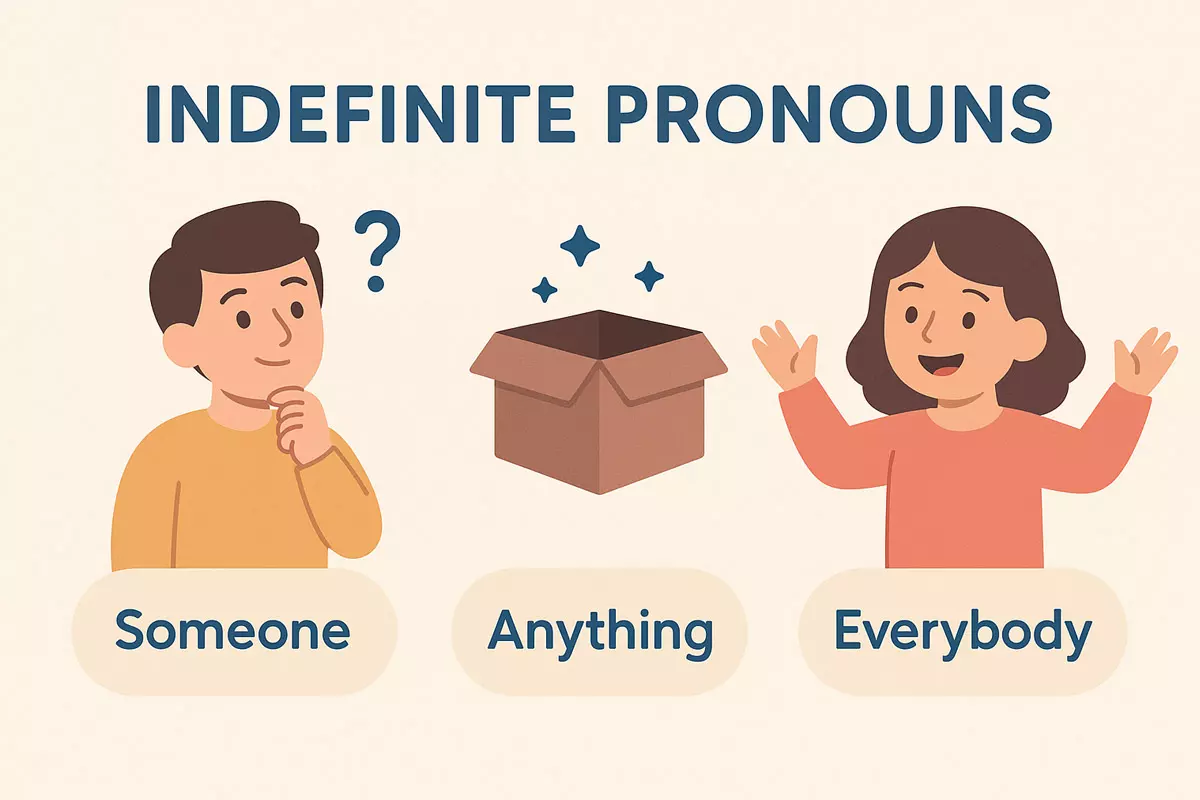 The article defines indefinite pronouns, explains how they refer to people, things, and quantities, and covers positive versus negative forms, verb agreement, differences between -one and -body endings, common learner errors, and includes practice exercises.
Indefinite pronouns such as someone, anything, and everybody are useful for referring to people or things in a general and non-specific way. These words allow us to discuss ideas, situations, or groups without naming exact individuals or objects, which makes our language more flexible and natural in everyday conversation. By using indefinite pronouns, we can speak more efficiently about general experiences or possibilities, making our statements broader and more inclusive.
What Indefinite Pronouns Mean
Indefinite pronouns are words used to refer to people, things, or amounts in a general or non-specific way. Rather than naming a particular person or object, they stand in for something unknown, unspecified, or not important to identify. Words like someone, anything, and everybody help us talk about groups or individuals without giving exact details.
General Reference and Uncertainty
These pronouns are useful when you don’t know exactly who or what you’re talking about, or when it simply doesn’t matter. For instance, if you say, “Someone left their umbrella,” you mean an unidentified person. Similarly, “Is anything wrong?” refers to any possible problem, not a specific one.
Common Indefinite Pronouns in English
- someone
- anyone
- everyone
- no one
- somebody
- anybody
- everybody
- nobody
- something
- anything
- everything
- nothing
- somewhere
- anywhere
- everywhere
- nowhere
Expressing Amount and Inclusivity
Indefinite pronouns can also show quantity or inclusion. For example, “Everybody enjoyed the party” means all people present, while “Anything is possible” refers to any possible thing without restriction.
Positive, Negative, and Neutral Forms
Some indefinite pronouns are used in positive statements, others in negatives or questions, and some are more neutral. Here’s how they typically function:
| Type | Examples |
|---|---|
| Positive | someone, somebody, something, somewhere |
| Negative | no one, nobody, nothing, nowhere |
| Universal | everyone, everybody, everything, everywhere |
| Open/Any | anyone, anybody, anything, anywhere |
Why Use Indefinite Pronouns?
They make sentences smoother and less repetitive. Instead of repeating nouns, these words let us speak efficiently about unknown, general, or collective people and things. In daily conversation, they are essential for polite requests, offers, and general statements.
Groups: People, Things, Quantity
Indefinite pronouns are handy for talking about people, objects, or amounts without being specific. Instead of naming exact individuals or items, English uses words like "someone," "anything," and "everybody" to refer to broader categories. This approach is common in everyday conversation when details are unknown or unimportant.
Referring to People
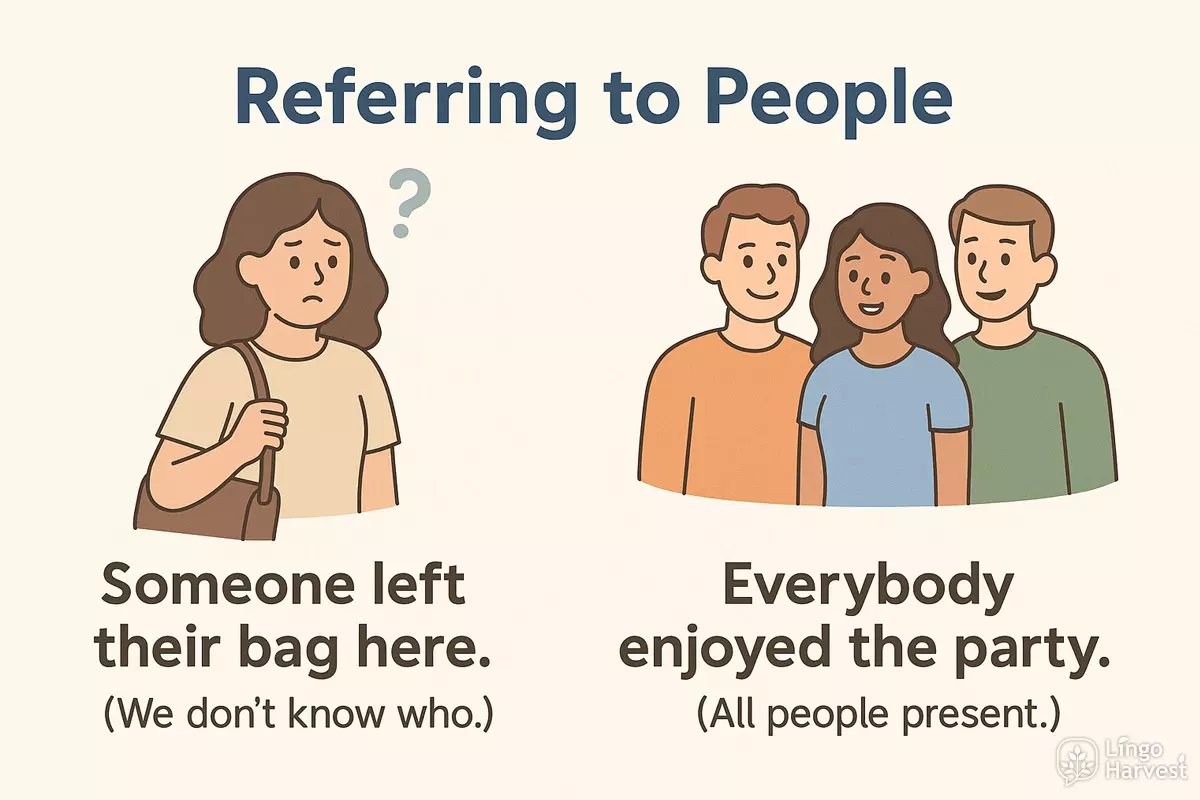
Words such as "someone," "anybody," "everyone," and "nobody" are used to talk about people in a general way. They let us include or exclude people without mentioning names. For example:
- Someone left their bag here. (We don’t know who.)
- Everybody enjoyed the party. (All people present.)
- Nobody answered the phone. (No person did.)
- Anybody can join the club. (Any person is allowed.)
Talking About Things
When discussing objects, we use pronouns like "something," "anything," "everything," and "nothing." These words help us make statements or ask questions without specifying the exact thing. Some examples:
- Is anything wrong?
- I heard something outside.
- She lost everything in the fire.
- There’s nothing in the fridge.
Expressing Quantity or Amount
To refer to quantities, indefinite pronouns such as "all," "some," "none," "many," and "few" are used. These words help us talk about amounts without being precise, which is useful when the exact number is unknown or not important.
- Some of the cookies are missing.
- All were invited.
- Many have tried, but few succeed.
- None of the answers were correct.
Overview: Indefinite Pronouns by Category
Below is a summary of common indefinite pronouns organized by what they refer to. This can help you choose the right word for people, things, or quantities in different situations.
| For People | For Things | For Quantity/Amount |
|---|---|---|
| someone | something | some |
| anyone | anything | all |
| everyone | everything | none |
| no one / nobody | nothing | many / few |
| each (person) | each (thing) | several |
| everybody | --- | most |
Key Points to Remember
- Use these pronouns to avoid repetition and when details are unknown.
- They help keep sentences natural and concise.
- Remember, the verb usually agrees with the pronoun: "Everybody is here," not "Everybody are here."
Using indefinite pronouns makes your language more flexible and efficient, especially in situations where details are vague or not essential.
Positive vs Negative Forms
Understanding how indefinite pronouns change depending on the statement’s meaning is essential for clear communication. Some words are typically used in affirmative contexts, while others fit best with negative or interrogative sentences. This distinction helps avoid double negatives and awkward phrasing.
Affirmative Uses
Indefinite pronouns such as someone, something, and everybody are most often used in positive statements. They suggest the presence or existence of people or things, but without specifying exactly who or what.
- Someone left their bag here. ✅
- Is there anything in the box? (interrogative, but not negative)
- Everybody enjoyed the concert. ✅
- Something smells delicious.
Negative and Interrogative Contexts
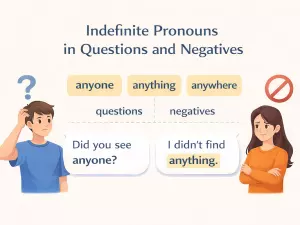
Words like anyone, anything, and nobody are commonly used in questions or negative sentences. They help express the absence of people or things, or to ask about possibilities.
- I don’t see anyone outside. ❌
- There isn’t anything to do here.
- Did anybody call me?
- Nobody answered the phone. ❌
Common Patterns
The choice of indefinite pronoun depends on sentence type. Here’s a quick guide to their typical uses:
| Type of Sentence | Usual Pronouns |
|---|---|
| Affirmative | someone, somebody, something, everybody, everyone |
| Negative | anyone, anybody, anything, nobody, nothing |
| Questions | anyone, anybody, anything, someone (offers/requests) |
| Offers/Requests | someone, somebody, something (e.g., "Would you like something to eat?") |
Examples in Context
To further clarify, here are varied sample sentences:
- Somebody forgot their umbrella.
- Has anybody seen my keys?
- Everyone needs to sign the form.
- Nothing was left on the table.
- Is there anything I can help you with?
- No one knows the answer.
- Did someone call for a taxi?
- I don’t want anything right now.
- Everybody should arrive on time.
- There’s something in your bag.
- Nobody came to the meeting.
- She didn’t say anything about the problem.
Choosing the right indefinite pronoun for the context ensures your meaning is clear and avoids confusion, especially in more complex sentences.
Agreement with Verbs
When using indefinite pronouns like someone, anything, and everybody, it's important to match them with the correct verb forms. Most of these pronouns are grammatically singular, even though they may refer to multiple people or things in meaning. This can sometimes feel counterintuitive, especially for learners who expect plural agreement.
Singular Verb Forms with Indefinite Pronouns
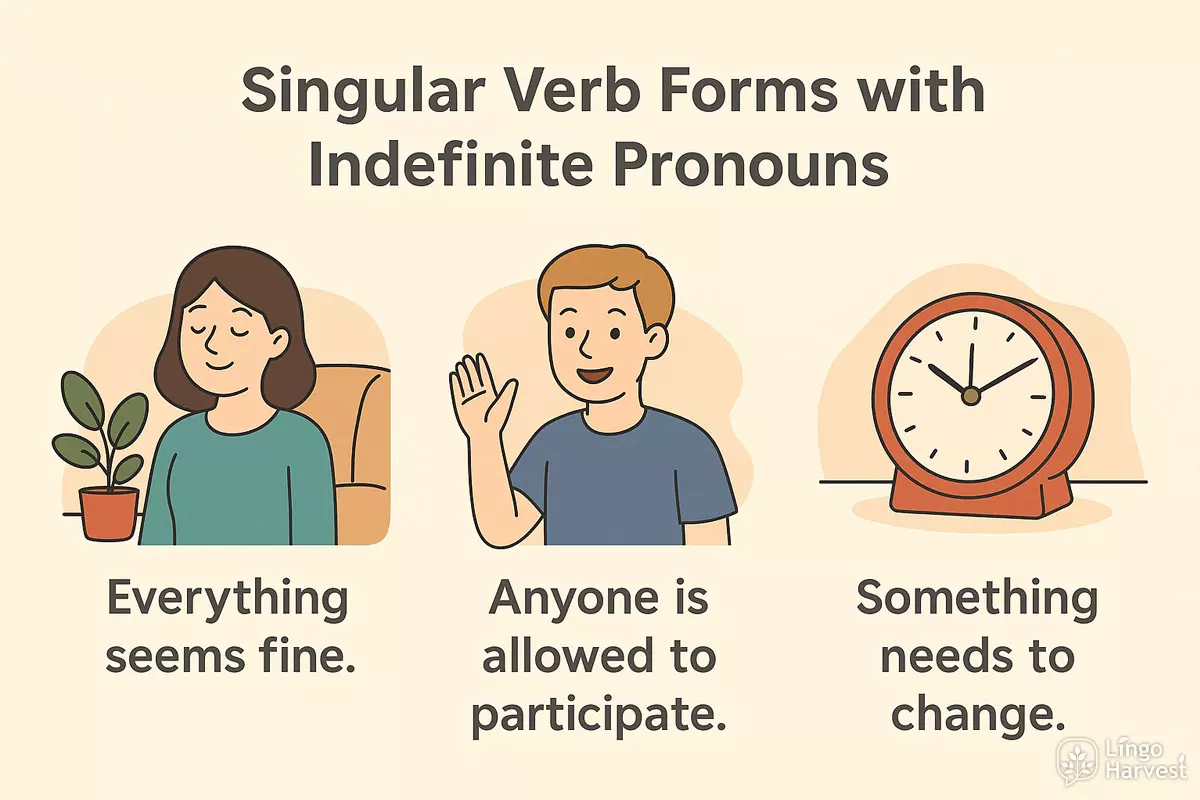
The majority of indefinite pronouns—such as everybody, anyone, nobody, someone, everything, and anything—take singular verbs:
- Everybody is welcome at the meeting.
- Someone has forgotten their keys.
- Nothing works in this old computer.
- Everything seems fine.
- Anyone is allowed to participate.
- Something needs to change.
- Nobody knows the answer.
- Each has a unique story.
- Anyone is free to leave early.
- No one was late today.
Common Mistakes to Avoid
A frequent error is using a plural verb with these pronouns because they seem to refer to multiple people or things. Remember, the verb should remain singular:
- ❌ Everybody are ready.
✅ Everybody is ready. - ❌ Someone have arrived.
✅ Someone has arrived.
Quick Reference Table
Below is a quick guide to how indefinite pronouns align with verb forms:
| Indefinite Pronoun | Correct Verb Form |
|---|---|
| Everybody | is (Everybody is here.) |
| Someone | has (Someone has called.) |
| Anything | is (Anything is possible.) |
| Nothing | was (Nothing was found.) |
| Anyone | can (Anyone can join.) |
| Everything | seems (Everything seems fine.) |
| No one | was (No one was hurt.) |
| Each | has (Each has a task.) |
Plural Meaning vs. Singular Grammar
Even though words like everybody and nobody refer to groups, they are treated as singular for verb agreement. If you need a plural verb, rephrase the sentence to use a plural noun: All people are welcome instead of Everybody is welcome.
Summary Tips
- Match indefinite pronouns with singular verbs.
- Check verb forms, especially in present tense ("is," "has," "does").
- Rephrase if you want to use a plural verb—switch to a plural noun.
- Be consistent, even when the pronoun “feels” plural in meaning.
Pronouns Ending in -one / -body
English uses several indefinite pronouns that end with -one or -body to refer to people in a general, non-specific way. These words are interchangeable in meaning, and both forms are widely used in everyday conversation and writing. They are always singular, even though they refer to an unspecified person, and they take singular verbs.
Common Examples and Usage
The two main sets—words ending in -one and those ending in -body—cover very similar meanings. Here’s a list of the most frequently used forms:
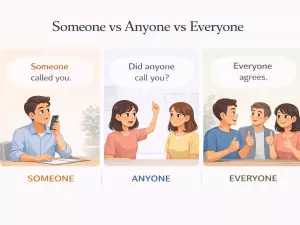
- someone / somebody – an unspecified person (positive or neutral)
- anyone / anybody – any person, no matter who (questions, negatives, and generalizations)
- everyone / everybody – all people in a group
- no one / nobody – not a single person
These pronouns are used when the speaker does not know, or does not want to specify, exactly who they are talking about.
Patterns and Differences
Both -one and -body forms mean the same thing, but -body is often considered slightly more informal or conversational. For most contexts, you can choose either form without changing the meaning of your sentence.
| -one Form | -body Form | Example Sentence |
|---|---|---|
| someone | somebody | Somebody left their bag here. |
| anyone | anybody | Is anyone home? |
| everyone | everybody | Everybody enjoyed the concert. |
| no one | nobody | No one knows the answer. |
Grammar Notes
Indefinite pronouns ending with -one or -body always take a singular verb:
- Everybody is ready. ✅
- Someone has called you. ✅
If you need to refer back to these pronouns with a possessive, use their for gender neutrality:
- Anyone can bring their own lunch.
In summary, these forms make it easy to talk about people in a general way, without specifying who you mean. They’re flexible, simple, and essential for everyday English.
Common Learner Problems
Many learners find it tricky to know when and how to use indefinite pronouns like someone, anything, and everybody. The rules can seem simple, but real-life usage often causes confusion. Below are some of the most frequent issues and mistakes that come up.
Confusing Similar Pronouns
It's easy to mix up words such as everyone and everybody, or someone and somebody. While they are usually interchangeable, some subtle differences exist in formality and context. Learners sometimes use the wrong pronoun for the situation, especially in writing versus conversation.
Negative and Positive Contexts
Another frequent difficulty is knowing which pronoun to use in negative, positive, or interrogative sentences. For example, learners might incorrectly use anything instead of something in a statement, or vice versa.
| Sentence Type | Typical Pronoun Choices | Example | Common Mistake |
|---|---|---|---|
| Affirmative | some-, every-, no- | Somebody is at the door. | ❌ Anybody is at the door. |
| Negative | any-, no- | I don't know anybody here. | ❌ I don't know nobody here. |
| Question | any-, some- (offers/requests) | Did you see anyone? | ❌ Did you see someone? (general question) |
| Offer/Request | some- | Would you like something to drink? | ❌ Would you like anything to drink? (not natural here) |
Double Negatives
Speakers often accidentally combine negative forms, especially with nobody, nothing, or nowhere. For example, saying I don't know nobody instead of the correct I don't know anybody or I know nobody. This is a common transfer from other languages or informal speech.
Pronoun Agreement
Matching verbs and possessive adjectives with indefinite pronouns can also be confusing. For instance, should it be Everyone has their book or Everyone has his book? While modern English accepts they/their as a gender-neutral singular pronoun, some learners feel unsure which to use.
Summary of Typical Issues
- Using anyone instead of someone when offering help
- Mixing up anything and nothing in answers
- Forgetting that pronouns like everybody take singular verbs
- Using no one as one word (noone, which is incorrect)
- Placing pronouns in the wrong position in a sentence
- Overusing any- forms in positive sentences
- Not recognizing that everyone and everybody mean the same thing
- Writing somebody's when the context needs someone's
- Confusing anywhere, somewhere, and everywhere
- Using plural verbs with everyone or nobody
By being aware of these common stumbling blocks, learners can better recognize and correct their mistakes when using indefinite pronouns in English.
Practice: Complete the Sentences
Explore your understanding of indefinite pronouns like "someone," "anything," and "everybody" by filling in the gaps in these sentences. These exercises will help you become more comfortable choosing the right word depending on the context—whether referring to people or things, and whether the meaning is positive, negative, or a question.
Read each sentence below and select the correct indefinite pronoun to complete it. Try to think about whether the sentence refers to people (someone, everyone, nobody, etc.) or things (anything, everything, nothing, etc.).
Fill in the blanks
- _______ left their bag in the classroom. Is it yours?
- I can't see _______ in the garden. It looks empty.
- Would you like _______ to drink?
- _______ knows the answer to this question.
- She didn’t tell _______ about her plans.
- If you need _______ help, just ask.
- _______ called while you were out, but they didn’t leave a message.
- Is there _______ interesting on TV tonight?
- _______ is ready for the meeting except Tom.
- I hope _______ goes wrong during the presentation.
- He will eat _______ you cook for him.
- _______ has to start, so I will do it.
- There isn’t _______ we can do now.
- Has _______ seen my keys?
- _______ wants to join the trip next week.
- My phone is missing! Did _______ take it?
- Don’t tell _______ about this surprise.
- There’s _______ in the box; it’s empty.
- _______ likes ice cream in summer.
- Would _______ like to volunteer?
Indefinite Pronouns Quick Reference
Here is a quick comparison of common indefinite pronouns, showing when to use each:
| Pronoun | Refers to | Example |
|---|---|---|
| someone / somebody | Person (unknown or unspecified) | Someone is at the door. |
| anyone / anybody | Person (any, usually in questions/negatives) | Is anyone home? |
| everyone / everybody | All people | Everybody enjoyed the party. |
| no one / nobody | No person | Nobody called me today. |
| something | Thing (unknown or unspecified) | There’s something in my shoe. |
| anything | Thing (any, usually in questions/negatives) | Do you want anything to eat? |
| everything | All things | Everything is ready. |
| nothing | No thing | There’s nothing here. |
Show answers
- Someone
- anyone / anybody
- anything
- Everybody / Everyone
- anyone / anybody
- any
- Someone / Somebody
- anything
- Everyone / Everybody
- nothing
- anything
- Someone / Somebody
- nothing
- anyone / anybody
- Everyone / Everybody
- Someone / Somebody
- anyone / anybody
- nothing
- Everyone / Everybody
- Anyone / Anybody
Review your answers and pay attention to how each pronoun fits the context. This will help you use indefinite references more naturally in both spoken and written English.