Someone vs Anyone vs Everyone: Meaning and Tone

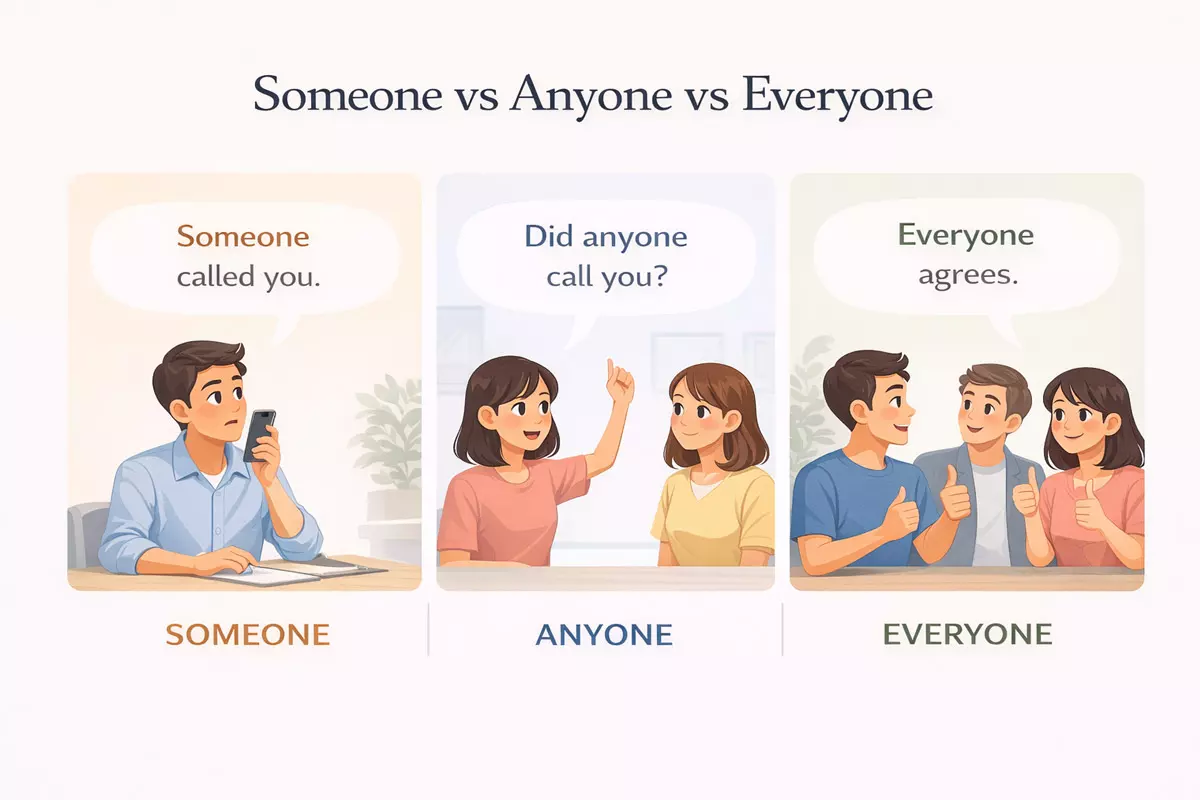 Here we the core meaning differences between someone, anyone, and everyone. It explains their use in statements, questions, and requests, discusses tone, formality, common learner errors, and offers context-based practice.
- Core meaning differences between someone, anyone, everyone
- Affirmative, negative, and question contexts
- Tone differences: expectation vs openness
- Polite requests and offers with anyone/someone
- Formal vs informal usage patterns
- Common learner substitutions and errors
- Context-driven meaning shifts
- Practice: select the best option for tone
Selecting the appropriate word to refer to people in general can be more challenging than it appears, since subtle differences among terms like somebody, anybody, and everybody influence both the meaning and tone of your message. Being aware of these distinctions is important, as it allows you to communicate your ideas more clearly and ensure that your intended message is accurately conveyed to your audience. Careful word choice not only improves clarity but also helps establish the precise mood you wish to create.
Core meaning differences between someone, anyone, everyone
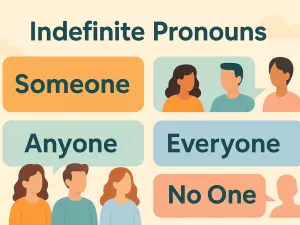
Understanding how "someone," "anyone," and "everyone" differ is essential for clear and precise English. Each word refers to people, but the scope and nuance of who is included change depending on which one you use.
Someone: A Specific But Unnamed Person
"Someone" points to a single, unspecified individual. It suggests there is at least one person in mind, though their identity is unknown or not mentioned. This word often implies that you, the speaker, believe a certain person exists or is involved, even if you can’t say who it is.
- Someone left their bag here.
- Can someone help me with this problem?
- I think someone is at the door.
Anyone: No Restrictions—Open to All
"Anyone" is more open-ended. It refers to any person at all, without pointing to a specific individual. This word is used when it truly does not matter who the person is, or when the answer could be nobody or everybody.
- Is anyone home?
- Anyone can join the club.
- Did anyone see my keys?
Everyone: All People in a Group

"Everyone" is inclusive and means every person within a particular group. There are no exceptions—it refers to all the people being considered.
- Everyone enjoyed the concert.
- Please make sure everyone gets a copy.
- Everyone must wear a badge.
| Word | Core Meaning | Example Sentence |
|---|---|---|
| Someone | One unidentified person | Someone called you earlier. |
| Anyone | No specific person; any individual | Can anyone answer this question? |
| Everyone | All people in a group | Everyone needs to sign in. |
Summary: Choosing the Right Word
Selecting between these words depends on whether you mean one unknown person, any person at all, or all people in a group. "Someone" hints at one, "anyone" is entirely open, and "everyone" is all-inclusive. Getting these distinctions right helps you express exactly what you mean, whether you are asking for help, giving instructions, or making observations.
Affirmative, negative, and question contexts
Choosing between “someone,” “anyone,” and “everyone” often depends on whether the sentence is positive, negative, or interrogative. Each word fits naturally into certain contexts, and using the wrong one can make your sentence sound odd or even change its meaning.
Affirmative statements
In positive sentences, “someone” and “everyone” are the most common. “Someone” refers to an unspecified person, while “everyone” means all people in the group. “Anyone” is rarely used in affirmative statements, except to emphasize that it does not matter who.
- Someone: Someone left their bag in the hallway.
- Everyone: Everyone enjoyed the concert last night.
- Anyone (special emphasis): Anyone can join the club (meaning there are no restrictions).
Negative sentences
When expressing negatives, “anyone” is preferred. “Someone” and “everyone” are generally not used in negative statements because they would give an unintended meaning.
- Anyone: I didn’t see anyone at the office.
- Someone: ❌ I didn’t see someone at the office. (incorrect in neutral English)
- Everyone: ❌ I didn’t see everyone at the office. (different meaning)
Explanation:
- Anyone is the correct choice in negative sentences.
- Someone is not normally used after negation and sounds unnatural in standard English.
- Everyone is grammatically correct, but it means you saw some people, just not all of them.
Questions
In questions, “anyone” is the default choice for general inquiries, while “someone” is used when the speaker expects an affirmative answer or knows a person exists. “Everyone” in questions asks about the whole group.
- Anyone: Has anyone seen my keys?
- Someone: Did someone call me?
- Everyone: Did everyone understand the instructions?
Quick comparison
The table below sums up the typical usage patterns for each word in different types of sentences:
| Sentence Type | Typical Choice | Example |
|---|---|---|
| Affirmative | Someone / Everyone | Someone knocked. / Everyone cheered. |
| Negative | Anyone | I don’t know anyone here. |
| Question | Anyone / Someone / Everyone | Has anyone called? / Did someone call? / Did everyone get it? |
Summary list of patterns
Here are some common sentence patterns with these words:
- Is anyone home?
- Can someone help me?
- Does everyone agree?
- No one saw anyone.
- Someone is waiting outside.
- Everyone needs to sign the form.
- I can’t find anyone to ask.
- I hope someone brings snacks.
- Did anyone finish early?
- Not everyone finished the test.
- If anyone calls, let me know.
- Someone should lock the door.
- Everyone laughed at the joke.
- Don’t tell anyone!
- Someone forgot their umbrella.
- Did everyone get the message?
- Anyone can participate.
- There isn’t anyone available now.
Understanding how “someone,” “anyone,” and “everyone” interact with positive, negative, and question forms will help you choose the right word and avoid common mistakes.
Tone differences: expectation vs openness
How we choose between "someone," "anyone," and "everyone" shapes not only meaning but also the mood and assumptions behind our words. Each option subtly signals what the speaker expects or how open they are to possibilities. These pronouns help listeners sense whether an action is likely, possible, or universal.
Expectation: "Someone" and certainty
Using "someone" often suggests the speaker expects that at least one person fits the description or will take action. There's an underlying assumption of existence or likelihood. For example:
- "Someone left their bag here." (The speaker is quite sure a specific person did this.)
- "Can someone help me?" (The speaker assumes help is available from at least one person.)
- "Someone in this room knows the answer." (Implies confidence that the right person is present.)
Openness: "Anyone" and possibility
"Anyone" is more open-ended and inclusive, suggesting the action or quality could apply to any member of a group, but not necessarily to a specific person. It removes expectation and highlights potential:
- "Can anyone help me?" (No assumptions about who might respond.)
- "Anyone can join." (All are welcome; no restrictions or expectations.)
- "Is anyone here?" (Uncertain if anyone is present at all.)
Universality: "Everyone" and inclusiveness
"Everyone" shifts the tone to totality. The speaker expects that all members of a group are included or affected. This word leaves no room for exceptions:
- "Everyone must sign in." (No one is excluded from this requirement.)
- "Everyone enjoyed the concert." (All participants are included in the positive experience.)
- "Does everyone understand?" (Checks that every person, not just some, is on board.)
Comparing tone and implication
Let’s compare these words side by side to see how their use changes both expectation and openness:
| Word | Implication |
|---|---|
| Someone | Implies the speaker believes at least one person fits; expectation is present. |
| Anyone | Opens the possibility to all; no assumption that anyone actually will. |
| Everyone | Includes the whole group; expectation is universal, no exceptions. |
Quick reference: Context cues
Here are extra cues that hint at tone and intent:
- Questions with "someone" often feel more hopeful; with "anyone," they sound more uncertain.
- Commands using "everyone" are absolute; using "anyone" makes invitations or offers.
- Negative sentences ("I don't see anyone") express possibility; ("I don't see everyone") means some are missing.
Understanding these subtle differences lets you tailor your message’s tone, whether you want to be specific, inclusive, or leave things open to chance.
Polite requests and offers with anyone/someone
When making requests or offers in English, the choice between "someone" and "anyone" can subtly affect the tone and meaning of your sentence. These words often appear in questions and polite expressions, but they aren't always interchangeable. Understanding when to use each can help you sound more natural and considerate in conversation.
How "someone" and "anyone" shape your requests
- Someone usually suggests you expect or hope for a specific person to help, even if you don't know who.
- Anyone is more open-ended and doesn’t imply a particular person—you’re inviting help from whoever is available.
For example, "Could someone help me with this box?" implies you think at least one person might be willing, perhaps even hoping a particular person will volunteer. "Could anyone help me with this box?" is broader and slightly more formal, indicating that help from any person present would be appreciated.
Typical phrases and patterns
Here are some common ways these words appear in polite requests and offers:
- Can someone give me a hand?
- Would someone mind closing the window?
- Could anyone tell me where the restroom is?
- Is anyone able to assist with the setup?
- Could someone explain this to me?
- Would anyone like some coffee?
- Can anyone help me with my luggage?
- Is someone available to take notes?
- Could someone open the door, please?
- Does anyone have a pen I could borrow?
- Would someone be willing to switch seats?
- Can anyone suggest a good restaurant nearby?
- Is anyone interested in joining us for dinner?
- Would anyone mind if I opened the window?
- Could someone pass the salt?
- Does anyone know the answer?
- Can someone help me find my keys?
- Is someone willing to volunteer?
Comparing "someone" and "anyone" in requests and offers
| Expression | Implication |
|---|---|
| Could someone help me? | You expect at least one person will assist; sounds a bit warmer. |
| Could anyone help me? | Open to help from any person; sometimes feels a bit more distant or formal. |
| Would someone like tea? | You’re offering to a specific but unknown person in the group. |
| Would anyone like tea? | Offering to the whole group, inviting anyone interested. |
| Is someone coming with us? | You're expecting a particular person might join. |
| Is anyone coming with us? | Open invitation; not directed at anyone in particular. |
Tips for sounding polite and natural
- Use "someone" when you want to sound a bit more personal or when you expect a positive response.
- Choose "anyone" for open offers, general requests, or when you truly don’t mind who responds.
- Adding "please" and using question forms (Could..., Would..., Can...) increases politeness.
- If you want to avoid putting pressure on a particular person, "anyone" is usually safer.
Selecting between "someone" and "anyone" can make your English sound more thoughtful and appropriate for the situation, especially in group settings or when you want to encourage participation without singling anyone out.
Formal vs informal usage patterns
Choosing between "someone," "anyone," and "everyone" often depends on the level of formality and the setting in which you're communicating. In academic writing, business emails, or official documents, word choice tends to be more precise and measured. In contrast, everyday conversation typically favors simpler, more relaxed phrasing.
Contexts and Preferences
In professional or formal settings, speakers and writers are more likely to select terms based on clarity and inclusivity. For example, "anyone" is commonly used in invitations and instructions, while "everyone" is favored when addressing a group collectively. "Someone" might be chosen for polite requests or when the identity is unknown or irrelevant. Informally, these pronouns are often used interchangeably, but subtle differences can affect the tone. "Someone" can sound more personal or direct, "anyone" more open-ended, and "everyone" more inclusive or emphatic.
Typical Usage Examples
- "Could someone help me with this report?" (polite, neutral—works in most settings)
- "If anyone has questions, please ask now." (formal or informal, open invitation)
- "Everyone must sign in at the front desk." (formal announcement or instruction)
- "Did someone call me?" (informal inquiry)
- "Is anyone here a doctor?" (urgent, but neutral in tone)
- "Everyone, please pay attention." (addressing a group, can be either context)
- "Can someone explain this to me?" (polite request, often informal)
- "Anyone can join the club." (inclusive, neutral)
- "Does everyone understand the assignment?" (group check-in, formal or informal)
- "Someone left their umbrella." (neutral, unknown person)
- "If anyone objects, speak now." (formal proceedings)
- "Everyone is welcome!" (friendly, inclusive, often informal)
Comparison by Register
The choice between these words can subtly shift the tone. Here’s a structured look at how each typically appears in different registers:
| Word | Common in Formal Contexts | Common in Informal Contexts | Typical Nuance |
|---|---|---|---|
| Someone | ✅ (for polite requests or when the person is unidentified) | ✅ (casual requests, mysteries, or jokes) | Specific but unknown individual |
| Anyone | ✅ (rules, instructions, invitations) | ✅ (open offers, challenges, questions) | Non-specific; open to all |
| Everyone | ✅ (announcements, directives, speeches) | ✅ (group encouragement, celebration) | All members of a group; inclusive |
Summary
Understanding how "someone," "anyone," and "everyone" are used in different registers can help you match the right word to the occasion. In formal writing or speech, clarity and appropriateness matter most, while informal contexts allow for more flexibility and personal tone. Adjusting your usage can make your communication sound more natural and effective, depending on your audience.
Common learner substitutions and errors
English learners often mix up "someone," "anyone," and "everyone" because their meanings can seem similar, but they create different tones and logic in sentences. Misusing these words can lead to confusion or unintended implications, especially in questions, negatives, and polite requests. Below, you'll find typical areas where mix-ups occur, with practical examples and explanations.
Frequent mix-ups and why they happen
Many people who are new to English substitute one of these pronouns for another, not realizing how much the meaning shifts. For example, using "anyone" instead of "someone" might make a sentence sound less friendly or more open-ended than intended.
- Question forms: Learners sometimes use "someone" in questions when "anyone" is more natural. For example, "Did someone call me?" (implies you expect a specific person) vs. "Did anyone call me?" (open to any person).
- Negatives: Using "someone" in negative sentences is incorrect. "I didn't see someone" should be "I didn't see anyone."
- Requests and offers: "Can someone help me?" (hoping for a specific helper) vs. "Can anyone help me?" (open to all, not specific).
- Statements about groups: Confusing "everyone" with "anyone." "Everyone can join" (all people) vs. "Anyone can join" (no restrictions, but not all must join).
- Formal vs. informal tone: "Anyone" can sound impersonal or even rude in requests, while "someone" is softer and more polite.
Typical learner errors

Below are examples of common mistakes, alongside the correct forms and brief explanations:
| Incorrect Usage | Correct Form & Explanation |
|---|---|
| Is someone here? | Is anyone here? → Use "anyone" for open questions about presence. |
| I don't know someone here. | I don't know anyone here. → Use "anyone" after negatives. |
| Everyone didn't finish the test. | Not everyone finished the test. → "Everyone didn't..." is rarely correct; use "not everyone" for partial negatives. |
| Can anyone pass me the salt? | Can someone pass me the salt? → "Someone" is more polite in direct requests. |
| If someone has questions, ask now. | If anyone has questions, ask now. → "Anyone" covers all possible people. |
| Anyone was late to the meeting. | Someone was late to the meeting. → "Someone" for a specific (unknown) individual. |
| Did everyone call you? | Did anyone call you? → "Anyone" for open questions; "everyone" implies all people should have called. |
| Someone can join the club. | Anyone can join the club. → "Anyone" means there are no restrictions. |
Summary: Key points to remember
- "Someone": Use when you mean a specific but unnamed person, often in positive sentences and polite requests.
- "Anyone": Use for open possibilities, questions, negatives, or when referring to any person at all.
- "Everyone": Refers to all people as a group; avoid using it for negatives.
- Be careful with tone—"anyone" in requests can sound less friendly than "someone."
- Check sentence logic: negative sentences rarely use "someone" or "everyone" correctly.
Understanding the subtle differences between these pronouns will help you communicate more clearly and avoid common pitfalls in English conversation and writing.
Context-driven meaning shifts
The subtle differences among "someone," "anyone," and "everyone" often depend on the situation in which they're used. These pronouns might appear interchangeable at first glance, but context quickly reveals distinctions in meaning and tone. For example, "anyone" can sound more open-ended or even dismissive, while "someone" tends to point to a specific—if unidentified—person, and "everyone" refers inclusively to all people in the group.
How context changes interpretation
A single sentence can take on a new shade of meaning depending on which pronoun is chosen. Consider how the intended audience, level of formality, and implied expectations all play a role. Using the wrong pronoun can unintentionally shift the mood from inviting to exclusive, or from polite to abrupt.
| Sentence | Likely Interpretation |
|---|---|
| Can someone help me? | Request for help from a specific, but unknown, person; polite and hopeful. |
| Can anyone help me? | Open call for assistance; sometimes implies doubt or desperation. |
| Can everyone help me? | Request directed at the whole group; may sound demanding or unrealistic. |
| Is someone there? | Checking for presence; expecting at least one person. |
| Is anyone there? | Broader inquiry; may suggest uncertainty or loneliness. |
| Everyone is here. | Confirms the presence of all expected people; inclusive and final. |
Common patterns and nuances
- Someone is used when the speaker believes at least one person fits the description: "Someone left their umbrella."
- Anyone works for general possibilities or permissions: "Anyone can join the club."
- Everyone signals total inclusion: "Everyone needs to sign the form."
- Changing "anyone" to "someone" can make a request feel more personal.
- Using "everyone" in instructions often signals group responsibility.
- Questions with "someone" expect a positive, specific response ("Did someone call me?").
- Questions with "anyone" are more open-ended and may expect a negative answer ("Did anyone call?").
- Negative sentences favor "anyone": "I don't see anyone outside."
- Affirmative sentences often use "someone": "Someone is waiting outside."
- "Everyone" rarely appears in negatives, but "Not everyone" is common ("Not everyone agreed.").
- Offers and suggestions tend to use "anyone" for inclusiveness ("Does anyone want tea?").
- Polite refusals or denials often use "anyone": "I don't think anyone is available."
- In formal situations, "anyone" can sound more impersonal than "someone."
- "Everyone" can be used for encouragement ("Everyone did great!").
- Warnings sometimes use "anyone": "If anyone is late, let me know."
- "Someone" is preferred when the speaker senses a specific, unknown person: "Someone's at the door."
- "Anyone" can convey skepticism: "I doubt anyone will come."
- "Everyone" emphasizes unity or consensus: "Everyone agreed on the plan."
Small changes in wording can dramatically affect how a message comes across. Paying close attention to these distinctions helps ensure your meaning and tone match your intent.
Practice: select the best option for tone
Understanding when to use "someone," "anyone," or "everyone" depends not just on grammar, but also on the feeling or attitude you want to convey. The words can be neutral, formal, informal, inclusive, or exclusive. Try the following practice tasks to test your intuition and see how each word shapes the tone of a sentence.
Choose the right word for the context
Read each sentence and select which word—"someone," "anyone," or "everyone"—creates the most suitable tone. Think about whether the situation is formal or casual, whether it is about one person or a group, and whether the mood is inviting, open, or specific.
- ____ is welcome to join the meeting if they are interested.
- A. Someone
- B. Anyone
- C. Everyone
- Can ____ help me with this heavy box?
- A. Someone
- B. Anyone
- C. Everyone
- ____ in the office must submit the form by Friday.
- A. Someone
- B. Anyone
- C. Everyone
- If ____ has questions, please ask now.
- A. Someone
- B. Anyone
- C. Everyone
- ____ left their umbrella here. Does it belong to you?
- A. Someone
- B. Anyone
- C. Everyone
- ____ can make mistakes, even experienced workers.
- A. Someone
- B. Anyone
- C. Everyone
- I think ____ is waiting for you outside.
- A. Someone
- B. Anyone
- C. Everyone
- ____ should wear an ID badge in this building.
- A. Someone
- B. Anyone
- C. Everyone
- Is ____ able to explain this rule clearly?
- A. Someone
- B. Anyone
- C. Everyone
- ____ forgot to turn off the lights last night.
- A. Someone
- B. Anyone
- C. Everyone
Show answers
- B. Anyone (open invitation, neutral tone)
- A. Someone (specific help expected, speaker hopes for a person)
- C. Everyone (rule applies to all)
- B. Anyone (open offer, polite and general)
- A. Someone (unknown but specific person)
- B. Anyone (general truth, no limitation)
- A. Someone (speaker believes a specific person is there)
- C. Everyone (formal rule, inclusive)
- B. Anyone (general question, no specific person)
- A. Someone (one unknown person did it)
Tone in context: What impression does each word give?
Below is a comparison of how each word alters the tone or mood of similar sentences. Review the table and notice the differences in formality, inclusivity, and specificity.
| Sentence | Tone/Impression |
|---|---|
| Could someone help me? | Polite, seeking a specific person but not naming who. |
| Could anyone help me? | Open, non-specific, suggests no preference or expectation of who. |
| Can everyone help me? | Inclusive, addresses the whole group, can sound demanding or urgent. |
| Everyone is required to attend. | Formal, authoritative, no exceptions. |
| If anyone has ideas, share them. | Inviting, open to all, informal to neutral. |
| Someone left a message for you. | Neutral, specific but unidentified person. |
Quick check: Match the situation to the most natural word
- Making an open offer in a group: Anyone
- Describing a rule that applies to all: Everyone
- Referring to an unknown individual: Someone
- Inviting all people to participate: Everyone
- Asking for help without targeting a specific person: Anyone
- Talking about one person whose identity is not known: Someone
- Stating that all members of a group are included: Everyone
- Making a general offer or suggestion: Anyone
- Believing one specific person did something: Someone
- Emphasizing that no one is excluded: Everyone
Show answers
- Anyone
- Everyone
- Someone
- Everyone
- Anyone
- Someone
- Everyone
- Anyone
- Someone
- Everyone