Relative Pronouns: Who, Which, That

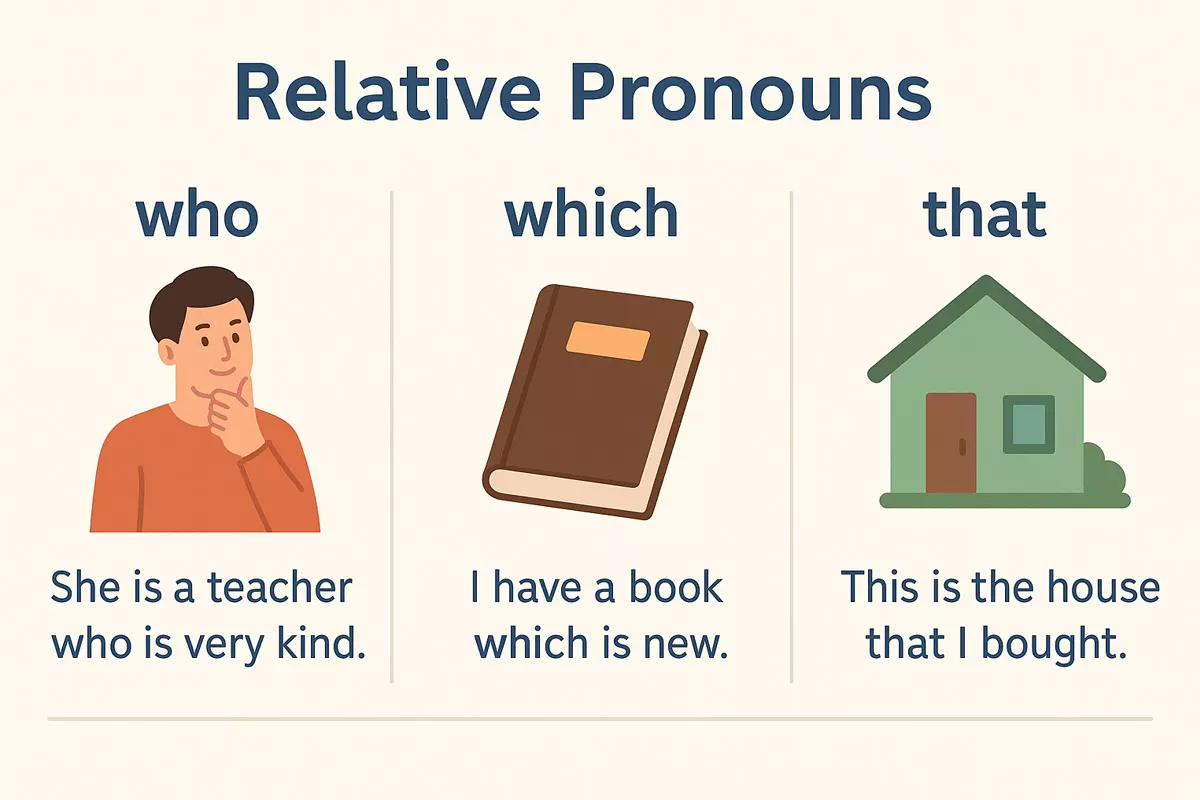 Here we the meaning of relative pronouns, explains how to use who, which, and that, and distinguishes between defining and non-defining clauses. It also details comma rules and provides practice for combining sentences.
Connecting ideas smoothly in English is essential for clear communication, and words like who, which, and that play a key role in linking different parts of a sentence. These connecting words, known as relative pronouns, help provide additional information without starting a new sentence, making writing more engaging and easier to understand. By mastering the use of these terms, you can enhance the flow of your writing, avoid repetition, and express complex ideas more effectively, resulting in stronger and more cohesive sentences.
Meaning of Relative Pronouns
Relative pronouns are special words that connect clauses or phrases to nouns or pronouns, providing more detail and helping sentences flow smoothly. They act as bridges, introducing additional information about a person, place, thing, or idea previously mentioned. This information is often essential for identifying what or whom the speaker is talking about, or it simply adds extra details.
Function and Purpose
These connecting words help avoid repetition by replacing nouns and letting us combine ideas. For example, instead of saying “I have a friend. My friend likes music,” we can use a relative pronoun: “I have a friend who likes music.” This makes sentences more concise and easier to read.
Common Relative Pronouns
The most frequently used relative pronouns in English are:
- Who – refers to people
- Which – refers to animals or things
- That – can refer to people, animals, or things
- Whom – used for people (formal or written English)
- Whose – shows possession for people or things
Examples in Context
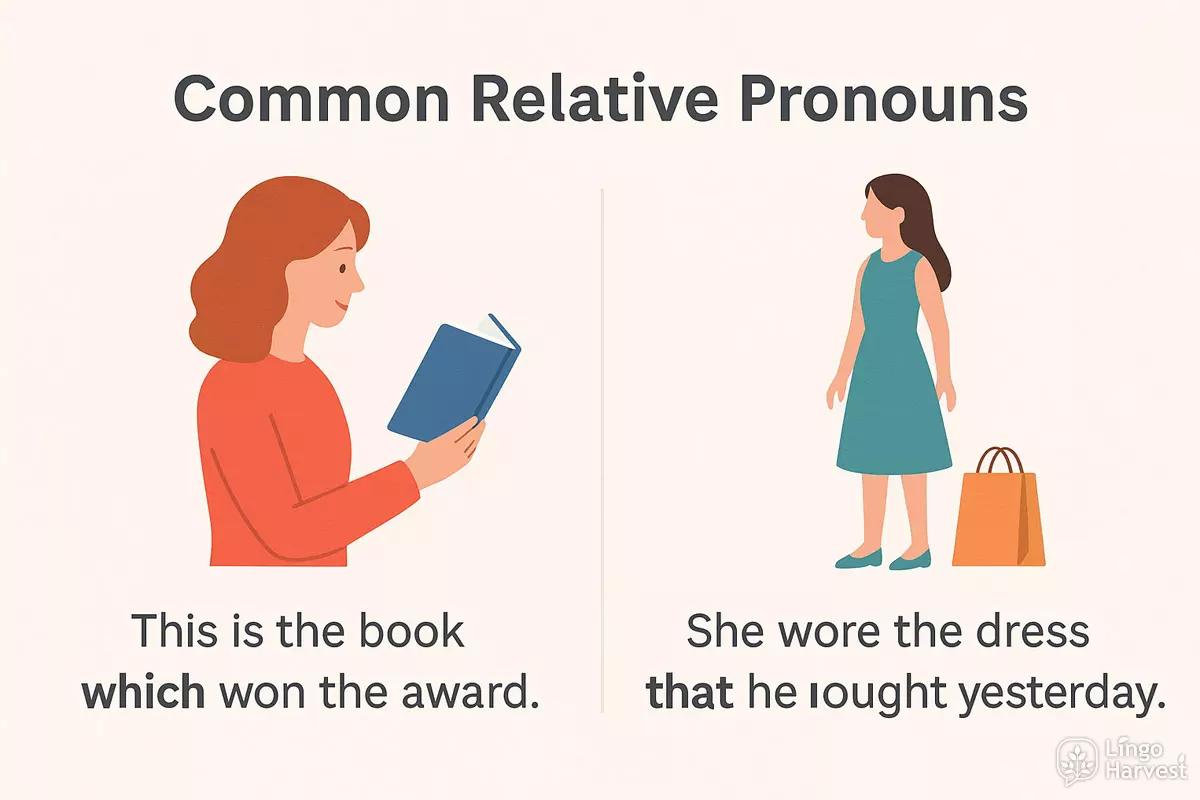
Here are some examples to show how these words function:
- The teacher who helped me was kind.
- This is the book which won the award.
- She wore the dress that she bought yesterday.
- The artist whose painting you liked is famous.
- The person whom you met is my cousin.
Choosing the Right Relative Pronoun
Selecting the appropriate word depends on what you are referring to. Here’s a simple guide:
| Relative Pronoun | Used For | Example |
|---|---|---|
| Who | People (subject) | The engineer who designed this bridge is talented. |
| Whom | People (object) | The person whom you called is busy. |
| Which | Animals/Things | The car which is red belongs to me. |
| That | People/Animals/Things | This is the movie that I mentioned. |
| Whose | Possession | The student whose bag is lost is waiting. |
Summary of Use
In summary, words like “who,” “which,” and “that” help join parts of a sentence, making speech and writing clearer. By using them, you can give precise information and create more interesting sentences.
Defining vs Non-defining Use
Understanding when to use relative pronouns in different types of clauses is essential for clear communication. In English, relative pronouns like "who," "which," and "that" introduce two main types of clauses: essential (defining) and additional (non-defining). Each serves a distinct purpose and follows specific punctuation and usage rules.
Defining (Restrictive) Clauses
Defining clauses provide crucial information about the noun they modify. Without this part of the sentence, the meaning would be incomplete or ambiguous. These clauses are not separated by commas. For example:
- The book that you lent me was fascinating.
- The person who called you is my friend.
- The car which broke down belongs to my neighbor.
Here, the clause identifies exactly which book, person, or car is meant.
Non-defining (Non-restrictive) Clauses
Non-defining clauses add extra, non-essential information. The sentence would still make sense without them. These are always set off with commas. Notably, "that" is never used in this type—only "who" or "which" are correct. For example:
- My father, who is a doctor, works at the city hospital.
- This painting, which was completed in 1889, is very famous.
- Sarah, who lives next door, is coming to dinner.
Removing the clause leaves the core meaning intact.
| Type | Key Features | Relative Pronouns Used | Example |
|---|---|---|---|
| Defining (Restrictive) |
|
|
The dog that barks loudly lives next door. |
| Non-defining (Non-restrictive) |
|
|
My sister, who is an engineer, loves to travel. |
Quick Reference: When to Use Each Form
- Use "that" only for essential information (never after a comma).
- Use "which" for both, but with a comma for extra detail.
- "Who" works for people in both clause types; add commas for extra info.
- Non-essential clauses always need commas.
- Do not use "that" in non-essential clauses.
Grasping these distinctions helps make your writing more precise and prevents misunderstandings.
Who for People
When referring to individuals in English, "who" is the standard relative pronoun to use. It connects a clause to a person, helping clarify which individual is meant. Unlike "which" (used for things) or "that" (used for both people and things, but less formal for people), "who" specifically signals that the reference is to a human being or sometimes an animal with a name or personified role.
How to Use "Who"
"Who" replaces a subject or object in a relative clause, providing more information about a person. For example:
- The teacher who helped me is very kind.
- She knows the artist who painted this picture.
- Anyone who wants to join should sign up here.
Common Patterns and Examples
Here are examples of sentences using "who" as a relative pronoun:
- Students who study hard succeed.
- The woman who called you is at the door.
- He is the engineer who designed the bridge.
- People who exercise regularly feel healthier.
- Anyone who disagrees may leave a comment.
- The friend who invited us is waiting.
- There are many doctors who work overseas.
- The child who lost his toy is crying.
- Those who arrived early got the best seats.
- The chef who made this dish is famous.
- Employees who are late must report to HR.
- The person who left this bag forgot it.
- Writers who inspire others are remembered.
- The musician who wrote this song lives nearby.
- Volunteers who helped were thanked.
Subject vs. Object Use
"Who" can serve as the subject or object of the relative clause. When "who" is the object, "whom" is technically correct, but in modern English, most people use "who" in both positions. For example:
- The man who called (subject)
- The man who we met (object; "whom" is also possible but less common)
Comparison: "Who" vs. "That" for People
| Relative Pronoun | Usage |
|---|---|
| Who | Used for people (formal and standard): “The girl who won the prize is my sister.” |
| That | Can refer to people or things (less formal for people): “The girl that won the prize is my sister.” |
| Which | Used only for things or animals (not for people): “The book which is on the table.” |
Key Points
- Use "who" to connect clauses about people.
- "Who" is clearer and more formal than "that" for individuals.
- In spoken English, "that" is often used for people, but "who" is always correct.
- "Who" can be both subject and object, though "whom" is used in formal writing as the object.
Which for Things
In English, “which” is used to refer to objects, animals, or ideas—not people. When you want to add extra information about something that is not a person, “which” is the standard choice in relative clauses. For example, you might say, “The car, which is red, belongs to my neighbor.” Here, “which is red” gives more details about the car.
How “which” Functions in Sentences
“Which” typically introduces non-defining (or non-restrictive) clauses, which are separated by commas. These clauses add extra, non-essential information. Removing the clause will not change the main meaning of the sentence. For example:
- The book, which I bought yesterday, is already sold out.
- Her house, which overlooks the lake, is very peaceful.
Common Uses and Patterns
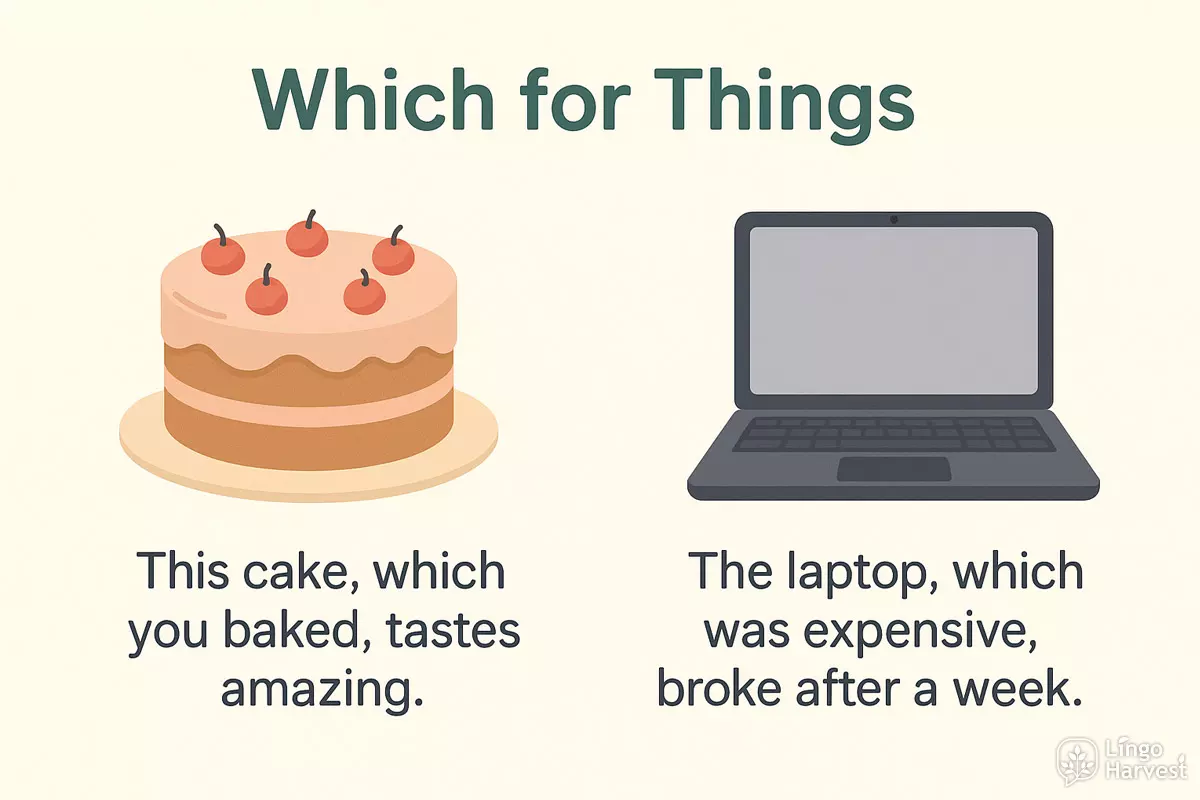
Here are several ways “which” appears in sentences:
- The letter, which arrived this morning, made me smile.
- My phone, which I lost last week, was found by a friend.
- This cake, which you baked, tastes amazing.
- The painting, which hangs in the gallery, is very famous.
- The keys, which were on the table, are now missing.
- Her answer, which surprised everyone, was correct.
- The laptop, which was expensive, broke after a week.
- The movie, which won several awards, is on TV tonight.
- The museum, which opened last year, is free on Sundays.
- The garden, which needs watering, is full of roses.
- The train, which leaves at 9 AM, is never late.
- The document, which you requested, is attached.
- The shoes, which are too small, will be returned.
- The plan, which we discussed, is ready to start.
- The package, which was delayed, finally arrived.
- The cat, which belongs to my sister, is very shy.
- The chair, which is broken, needs fixing.
- The email, which I sent yesterday, bounced back.
- The recipe, which uses fresh herbs, is delicious.
- The building, which is very old, was renovated.
When Not to Use “Which”
Never use “which” to refer to people. For people, use “who” or “that” instead. Also, in defining (restrictive) clauses, “that” is often preferred in everyday English, especially in American usage.
| Example | Explanation |
|---|---|
| The car, which is blue, is fast. | “Which is blue” adds extra info about the car; use commas. |
| The book that is blue is mine. | “That is blue” specifies which book; no commas, “that” is preferred. |
| The girl who is singing is my friend. | Use “who” for people, not “which.” |
| The dog, which barks a lot, lives next door. | “Which barks a lot” gives extra, non-essential information. |
To sum up, use “which” for non-essential information about things, animals, or ideas, and remember the commas. For people, stick to “who”—and for essential information about things, “that” is often more natural.
That as Flexible Option
Among English relative pronouns, that stands out for its versatility. Unlike who (used for people) and which (used for things), that can refer to both people and objects, making it a practical choice in many sentences. Its adaptability is especially useful in defining, or restrictive, clauses—those that are essential to the meaning of a sentence. For example, consider: “The book that you gave me is fascinating.” Here, the clause “that you gave me” identifies which book is being discussed.
When to Use "That"
Writers and speakers often select that in the following situations:
- To refer to people or things in restrictive clauses (essential for meaning)
- After superlatives and words like all, everything, nothing, something, anything, only, few, little, much
- When a sentence might sound awkward or ambiguous with which or who
- For smoother, more informal style, especially in spoken English
Examples of "That" in Context
Here are various ways this pronoun can be used in sentences:
- The car that won the race was electric.
- People that live here know the secret path.
- This is the best cake that I’ve ever tasted.
- Everything that matters is right here.
- She lost the keys that open the garage.
- All the books that you see are mine.
- The movie that made me cry is on tonight.
- Only the students that passed can attend the event.
- The ideas that changed history were once doubted.
- The team that scores first usually wins.
- Anything that helps is appreciated.
- The person that called didn’t leave a message.
- The shoes that fit best are sold out.
- The dog that barked all night kept me awake.
- The decision that matters most comes last.
Comparison: "That" vs. "Who" and "Which"
To highlight how this pronoun can be interchanged with others, see the table below. Note how that can replace who or which in restrictive clauses, but not always in non-restrictive ones (where commas are used).
| Relative Pronoun | Example | Can "That" Replace? |
|---|---|---|
| who | The teacher who helped me was kind. | ✅ The teacher that helped me was kind. |
| which | The book which is on the table is new. | ✅ The book that is on the table is new. |
| who (non-restrictive) | My brother, who lives in Paris, is visiting. | ❌ That cannot replace "who" here. |
| which (non-restrictive) | The car, which I bought last year, is fast. | ❌ That cannot replace "which" here. |
Key Points to Remember
- That is not used in non-restrictive clauses (those with commas).
- It is often omitted in spoken English if not the subject (“The book you gave me…”).
- Using that can make sentences less formal.
In summary, choosing that offers flexibility and efficiency, especially in defining clauses, but there are important limits on its use. Being mindful of these patterns will help you write and speak with greater clarity and precision.
Comma Rules
Understanding how to punctuate clauses with "who," "which," and "that" helps clarify meaning and keeps your writing smooth. The use or omission of punctuation depends on whether the clause is essential (restrictive) or additional (non-restrictive) to the sentence.
Essential vs. Non-Essential Clauses
Clauses introduced by these relative pronouns can be either necessary for understanding the noun they modify, or simply add extra information. Only non-essential clauses are set off by commas.
- Essential (restrictive) clauses—do not use commas. These clauses are vital to the sentence's meaning.
Example: The book that she recommended was fascinating. - Non-essential (non-restrictive) clauses—use commas. These add extra detail that can be omitted without changing the sentence's core meaning.
Example: My brother, who lives in Paris, is visiting next week.
Quick Reference for Punctuation
Here are some typical patterns to help you decide when to add a comma:
- "Which" usually introduces non-essential clauses and needs commas.
- "That" almost always introduces essential clauses and is never set off by commas.
- "Who" can introduce either type; use punctuation based on whether the information is extra or necessary.
Common Mistakes to Avoid
Writers often mix up when to use commas with these pronouns. Here are some examples of correct and incorrect punctuation:
- ✅ The car, which is red, belongs to Sarah.
- ❌ The car which is red, belongs to Sarah.
- ✅ The student who studies hard will succeed.
- ❌ The student, who studies hard will succeed.
- ✅ The house that Jack built is on the hill.
- ❌ The house, that Jack built, is on the hill.
Summary Table: Punctuation with Relative Pronouns
| Relative Pronoun | Comma Usage | Example |
|---|---|---|
| who | Commas for non-essential only | My friend, who is a doctor, helped me. / The girl who called you is here. |
| which | Always use commas (non-essential) | The cake, which she baked, was delicious. |
| that | Never use commas | The movie that we watched was exciting. |
Quick Tips
- If removing the clause changes the meaning, do not use commas.
- If the clause is extra information, add commas.
- Remember: "that" never takes commas, while "which" nearly always does.
By paying attention to whether information is essential or extra, you’ll punctuate sentences with "who," "which," and "that" clearly and correctly.
Practice: Combine Two Sentences
Combining two simple sentences into one with a relative pronoun is a practical way to make your writing more fluent and detailed. Below, you'll find a set of exercises where you can apply "who," "which," or "that" to link information about people, things, or animals. This practice will help you become more comfortable with relative clauses in real communication.
Instructions
Read each pair of sentences. Join them into a single sentence using an appropriate relative pronoun. Pay attention to whether the noun refers to a person (use "who" or "that"), a thing/animal (use "which" or "that"), and whether the information is essential or extra.
- The man is my teacher. He lives next door.
- I bought a book. The book was expensive.
- There is a dog. The dog is barking loudly.
- She has a friend. Her friend speaks five languages.
- We visited a museum. The museum was closed.
- This is the cake. I baked it yesterday.
- The girl won a prize. She wrote the best essay.
- I have a bicycle. It has a red frame.
- The movie was boring. We watched it last night.
- He met a woman. She is an engineer.
- The phone is broken. You gave it to me.
- My uncle lives in Canada. He is a doctor.
- The shoes are new. I am wearing them.
- We saw a bird. The bird was building a nest.
- The car is very fast. My father drives it.
Tips for Combining Sentences
- Use who or that for people.
- Use which or that for things or animals.
- Drop repeated nouns or pronouns when combining.
- Remember: "that" is often used in defining (essential) clauses; "which" is used in non-defining (extra) clauses (usually with a comma).
Show answers
- The man who lives next door is my teacher.
- I bought a book that was expensive.
- There is a dog which is barking loudly.
- She has a friend who speaks five languages.
- We visited a museum that was closed.
- This is the cake which I baked yesterday.
- The girl who wrote the best essay won a prize.
- I have a bicycle that has a red frame.
- The movie which we watched last night was boring.
- He met a woman who is an engineer.
- The phone that you gave me is broken.
- My uncle, who lives in Canada, is a doctor.
- The shoes which I am wearing are new.
- We saw a bird that was building a nest.
- The car that my father drives is very fast.