Reciprocal Pronouns: Each Other, One Another

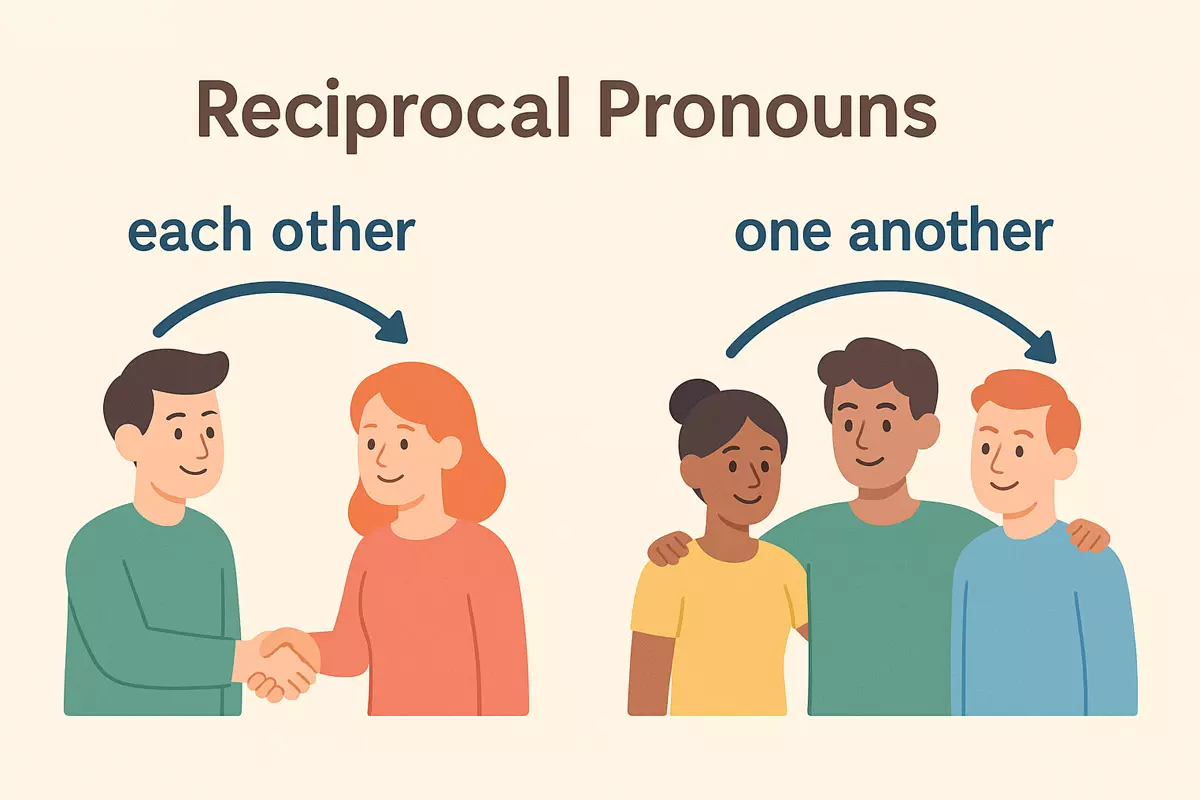 Here we what reciprocal pronouns mean, the differences between each other and one another, where to place them in sentences, typical examples, common mistakes, and offers a brief practice to correct sentences using these pronouns.
Expressing mutual actions or feelings in English can sometimes be challenging, particularly when you want to describe situations where people are interacting with each other. Using the correct phrases for shared experiences is important because it allows you to communicate your ideas more clearly and naturally. By learning and practicing these expressions, you can make your conversations smoother and more effective, ensuring that your meaning is understood by others in a way that feels natural and accurate.
What Reciprocal Pronouns Show
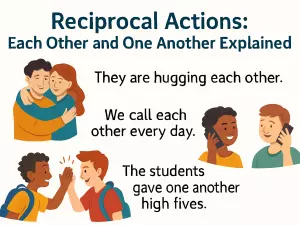
Reciprocal pronouns, such as "each other" and "one another," are used to indicate that two or more people or things are performing an action mutually. This means the action goes both ways—each participant does something to the others involved. These pronouns highlight shared actions, feelings, or relationships, emphasizing the idea of exchange or interaction.
Mutual Actions and Relationships
Whenever you want to express that people are doing something for or to one another, reciprocal pronouns come into play. They help clarify that the action is not one-sided. For example, in the sentence “The teammates congratulated each other after the win,” it’s clear that everyone was both giving and receiving congratulations.
Common Meanings Conveyed
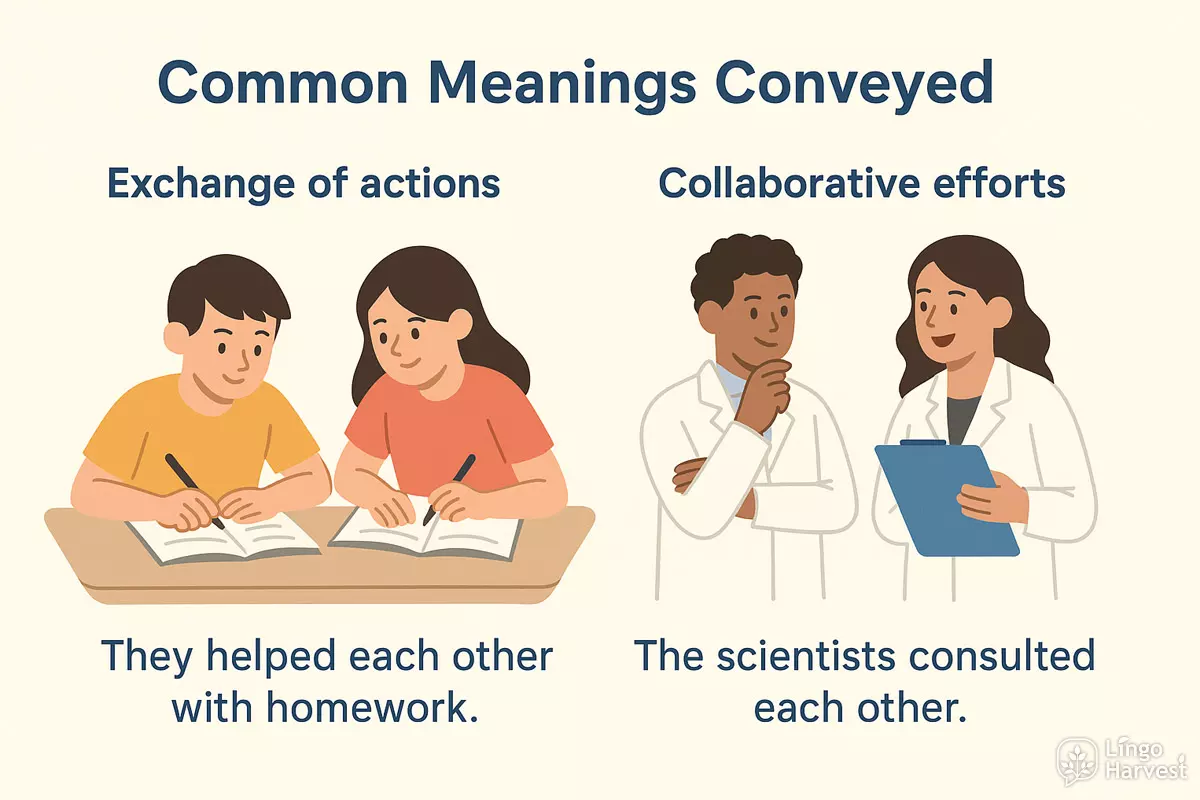
- Exchange of actions: "They helped each other with homework."
- Sharing feelings: "The friends trust one another."
- Mutual relationships: "The two countries respect each other."
- Joint activities: "We saw one another at the meeting."
- Collaborative efforts: "The scientists consulted each other."
- Interpersonal connections: "Neighbors greet each other every morning."
- Conflict or competition: "The teams competed against one another."
- Reciprocal communication: "They called each other every week."
- Physical interaction: "The children hugged each other."
- Emotional support: "Family members supported one another."
- Shared responsibility: "They blamed each other for the mistake."
- Reciprocal understanding: "The partners understood one another’s concerns."
Comparing "Each Other" and "One Another"
| Expression | Typical Use | Example Sentence |
|---|---|---|
| Each other | Usually for two people or things | Maria and John looked at each other. |
| One another | Often for groups of three or more | The students shared notes with one another. |
Key Takeaways
Reciprocal pronouns are essential for expressing actions or feelings that go in both directions within a group. They make it clear that the relationship or activity is shared, not one-sided. Whether describing cooperation, communication, or even disagreement, these pronouns help convey mutual involvement and connection.
Differences Between the Two Forms
While "each other" and "one another" both express reciprocal actions or feelings, their usage and nuances can differ based on tradition, context, and formality. Understanding these subtle distinctions helps you use them naturally in sentences.
Traditional Distinctions
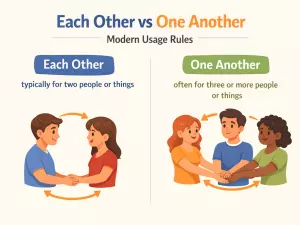
Traditionally, "each other" is used when referring to two people or things, while "one another" is reserved for three or more. For example:
- Anna and Ben looked at each other.
- The students congratulated one another after the performance.
However, modern English often uses both forms interchangeably, especially in informal contexts.
Formality and Style
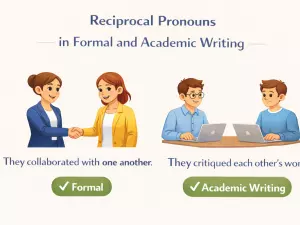
"One another" tends to sound a bit more formal or literary. You may encounter it more often in written English or formal speech, whereas "each other" is commonly used in everyday conversation.
Possessive Forms
Both expressions can be made possessive, but the forms differ:
- each other's (e.g., They borrowed each other's books.)
- one another's (e.g., The neighbors admired one another's gardens.)
Side-by-Side Comparison
| Feature | Each Other | One Another |
|---|---|---|
| Traditional Use | Between two people/things | Among three or more |
| Formality | More common, less formal | Slightly more formal/literary |
| Possessive Form | each other's | one another's |
| Modern Usage | Often used regardless of number | Also used regardless of number |
Summary List: When to Use Which
- Talking about two people? Use "each other" (traditional rule).
- Describing a group of three or more? "One another" is the classic choice.
- In casual speech, either is usually fine.
- For formal writing, consider the traditional distinction.
- Possessive forms follow the same pattern: "each other's" or "one another's".
- Both are reciprocal pronouns, showing mutual action or feeling.
- Neither form is used as a subject; both act as objects.
- Interchangeability is widely accepted in modern English.
- Some style guides still recommend the classic rules for clarity.
- Examples: "They hugged each other." / "They shared one another's ideas."
In summary, while there are traditional guidelines for using these two reciprocal pronouns, everyday English allows for flexibility. Choosing between them is rarely a strict rule and more a matter of style, context, and personal preference.
Sentence Position
Where you place reciprocal pronouns like "each other" and "one another" in a sentence can affect both clarity and correctness. Typically, these expressions follow the verb or the object in a sentence, rather than beginning a statement. This positioning helps avoid confusion about who is interacting and maintains the intended meaning.
Common Patterns
You'll most often see these pronouns used after action verbs. Here are some typical structures:
- Subject + verb + each other/one another
They hugged each other. - Subject + verb + object + each other/one another
The students helped one another with the project. - Subject + verb + preposition + each other/one another
We looked at each other and laughed.
Examples in Context
To illustrate, here are several sentences showing proper placement:
- The dogs chased each other around the yard.
- We gave one another gifts for the holidays.
- The twins often finish each other's sentences.
- After the meeting, the colleagues thanked each other.
- They waved at one another from across the street.
- The children blamed each other for the mess.
- The friends called one another every weekend.
- The birds sang to each other at dawn.
- The teams congratulated one another after the game.
- The neighbors greeted each other warmly.
- The writers critiqued one another's drafts.
- The players respected each other on the field.
Modifiers and Expanded Forms
Sometimes, you may want to add emphasis or detail. Modifiers like "with," "at," or possessive forms can be used, but the pronoun phrase still follows the main verb or object:
- They spoke quietly to each other.
- The rivals glared at one another across the table.
- We borrowed each other's books.
Incorrect Placement
Reciprocal pronouns should not be used as the subject at the beginning of a sentence. For example:
- ❌ Each other saw the movie.
- ❌ One another will travel to Spain.
These versions are ungrammatical because the pronoun does not function as a subject.
Summary Table: Placement Patterns
| Pattern | Example |
|---|---|
| After verb (no object) | They smiled at each other. |
| After verb + object | She handed the notes to one another. |
| After preposition | We talked with each other for hours. |
| Possessive form | They admired each other's work. |
| With modifiers | The kids played happily with each other. |
Remember, using "each other" and "one another" in the right place helps your sentences flow and makes your meaning clear. Avoid starting sentences with these phrases, and keep them close to the verb or object they refer to.
Typical Everyday Examples
In daily conversations, people naturally use words like "each other" and "one another" to describe actions or feelings shared between individuals or groups. These expressions help clarify that the action goes both ways, rather than just in one direction. Understanding how these terms work can make interactions clearer and more precise.
Common Situations Where They Appear
- Friends sharing secrets: "They trust each other with everything."
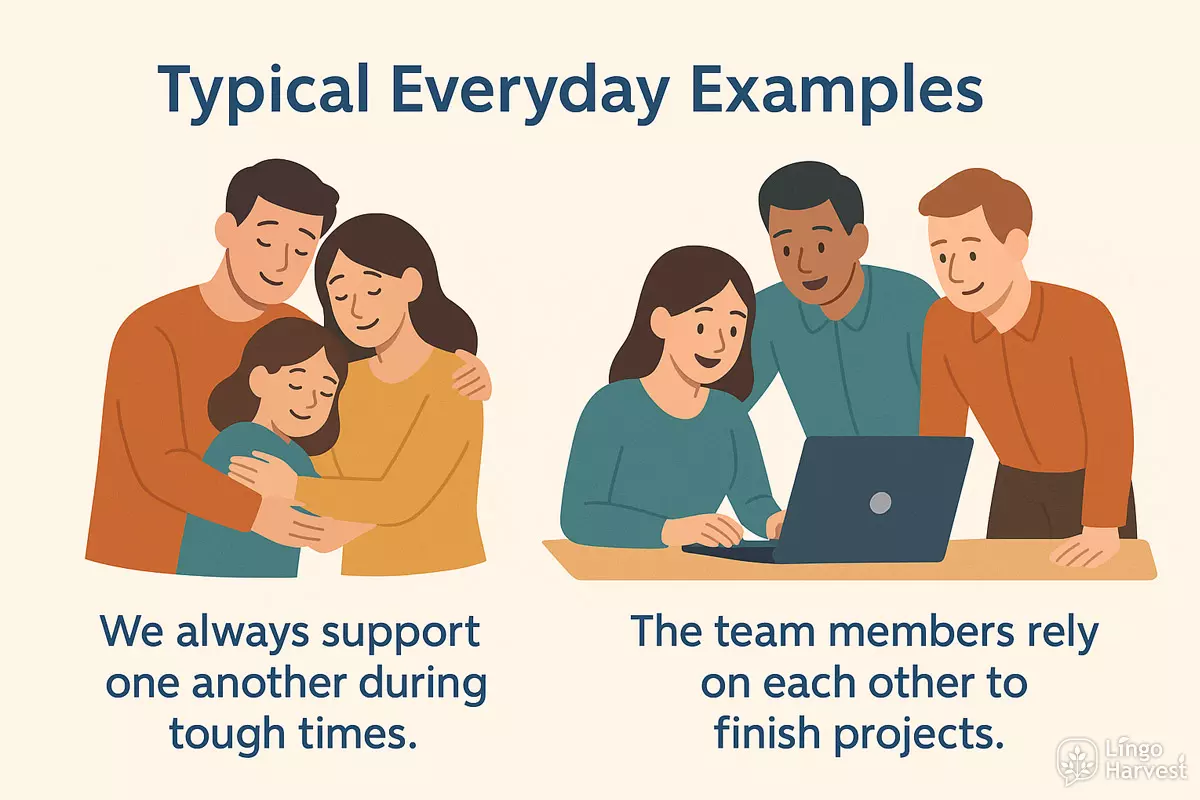
- Family members helping: "We always support one another during tough times."
- Colleagues cooperating: "The team members rely on each other to finish projects."
- Neighbors exchanging favors: "They water each other's plants when on vacation."
- Classmates studying: "Students quiz one another before exams."
- People greeting: "Everyone greeted each other warmly at the party."
- Couples showing affection: "They love one another deeply."
- Sports teams: "Players encourage each other on the field."
- Online communities: "Users help one another solve technical issues."
- Children sharing toys: "The kids share their toys with each other."
- Animals grooming: "The monkeys groom one another to stay clean."
- Siblings arguing: "They blame each other when something goes wrong."
- People exchanging gifts: "We give each other presents at the holidays."
- Travelers swapping stories: "They tell one another about their adventures."
- Roommates dividing chores: "We remind each other to take out the trash."
Comparing Usage in Context
| Example | Who is involved? |
|---|---|
| They hugged each other. | Usually two people |
| The classmates congratulated one another. | Three or more people |
| The dogs chased each other around the yard. | Pair of animals |
| The volunteers thanked one another for their help. | Group of several people |
Key Takeaways
Whether at home, work, or out with friends, these phrases help describe mutual actions between two or more parties. The choice between "each other" and "one another" is less strict in casual English, but both serve to highlight shared experiences or interactions.
Common Errors
Many English learners mix up reciprocal pronouns or apply them incorrectly. Understanding how to use “each other” and “one another” in context helps avoid confusion and awkward sentences. Below are several pitfalls and frequent mistakes to watch out for.
Mixing Up “Each Other” and “One Another”
While both forms are often used interchangeably in modern English, traditionally “each other” refers to two people or things, and “one another” to more than two. Some learners use them without considering the number involved, which can be seen as imprecise in formal writing.
- Incorrect: The three friends looked at each other. ❌
- Correct: The three friends looked at one another. ✅
- Incorrect: Jack and Jill helped one another. ❌
- Correct: Jack and Jill helped each other. ✅
Using With the Wrong Verb Form
A frequent issue is pairing reciprocal pronouns with verbs that do not take a reciprocal object, or forgetting that the action must be mutual.
- Incorrect: The players scored each other. ❌
- Correct: The players congratulated each other. ✅
Adding Extra Words or Redundant Phrases
Redundancy is a common problem—avoid phrases like “each other’s one another” or “each other to each other.”
- Incorrect: They talked to each other with one another. ❌
- Incorrect: The dogs chased each other mutually. ❌
- Correct: The dogs chased each other. ✅
Confusing Reciprocal and Reflexive Pronouns
Learners sometimes use “themselves” or “ourselves” when they mean “each other” or “one another,” but these serve different functions.
| Incorrect Usage | Correct Usage |
|---|---|
| They blamed themselves. | They blamed each other. |
| We called ourselves. | We called one another. |
| The twins hugged themselves. | The twins hugged each other. |
| You saw yourselves in the mirror. | You saw each other at the party. |
Punctuation and Word Order
Another issue is placing reciprocal pronouns incorrectly in a sentence, which can lead to ambiguity.
- Incorrect: Each other they admired. ❌
- Correct: They admired each other. ✅
- Incorrect: One another the students helped. ❌
- Correct: The students helped one another. ✅
Summary of Key Problems to Avoid
- Confusing the number of parties involved (“each other” for two, “one another” for more than two in traditional usage)
- Using reciprocal pronouns with non-mutual actions
- Mixing up reciprocal and reflexive forms
- Adding unnecessary words or doubling up pronouns
- Incorrect placement in sentences
Mastering these points will make your communication smoother and more precise when describing mutual actions or relationships.
Short Practice: Rewrite Correctly
When working with reciprocal pronouns, it's important to notice common mistakes and learn to use "each other" and "one another" accurately. Try rewriting the following sentences to use the correct form of the reciprocal pronoun. Pay close attention to subject-verb agreement and avoid unnecessary repetition.
Rewrite the Sentences
Below are some sentences that need adjustment. Replace the incorrect or missing reciprocal pronoun with the right one. If a sentence is already correct, leave it as is.
- Maria and Tom hugged themselves after the meeting.
- The students gave presents to one another at the party.
- The cats chased their own tails all afternoon.
- We should help each another when needed.
- The two friends always support themselves.
- The birds sang songs for each other every morning.
- All of the players congratulated one another after the game.
- My neighbors and I greeted themselves in the hallway.
- The twins looked at each other and laughed.
- The teammates encouraged themselves during the match.
Common Mistakes to Watch For
- Using reflexive pronouns (like "themselves") instead of reciprocal ones.
- Mixing up "each other" (usually for two) and "one another" (for more than two), though in modern English this distinction is often relaxed.
- Forgetting to use a reciprocal pronoun where it's needed.
Show answers
- Maria and Tom hugged each other after the meeting.
- The students gave presents to one another at the party. (Correct)
- The cats chased their own tails all afternoon. (No reciprocal pronoun needed; correct as is.)
- We should help each other when needed.
- The two friends always support each other.
- The birds sang songs for each other every morning.
- All of the players congratulated one another after the game. (Correct)
- My neighbors and I greeted each other in the hallway.
- The twins looked at each other and laughed. (Correct)
- The teammates encouraged one another during the match.
Quick Reference: Reciprocal Pronouns vs. Reflexive Pronouns
It's easy to confuse reciprocal and reflexive pronouns. Use the chart below to clarify their functions and correct forms.
| Reciprocal Pronoun | Reflexive Pronoun | Usage Example |
|---|---|---|
| each other | themselves | The friends called each other. |
| one another | ourselves | We congratulated one another. |
| – | myself | I hurt myself. |
| – | yourself | You taught yourself to swim. |