Case in English Pronouns: Subject vs Object

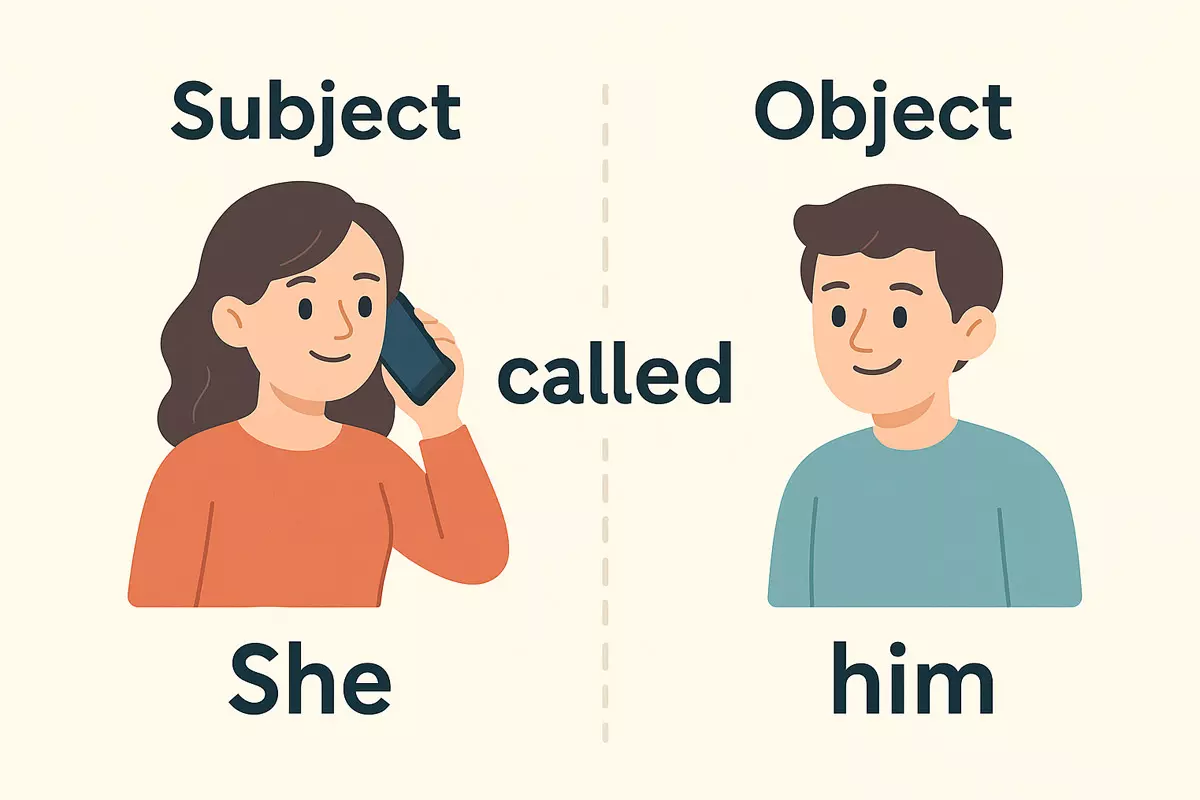 Here we when to use subject and object pronouns, how pronouns work after prepositions, and common mistakes in spoken English. It also provides quick tips and practice examples to help you master pronoun case.
Knowing when to use “I” versus “me” can be challenging, yet mastering this distinction is important for effective and accurate communication. “I” is used as the subject of a sentence, while “me” serves as the object. For example, in the sentence “I went to the store,” “I” is the subject performing the action. In “She gave the book to me,” “me” is the object receiving the action. Understanding these roles not only helps prevent common grammar mistakes but also ensures your English sounds natural and clear to others.
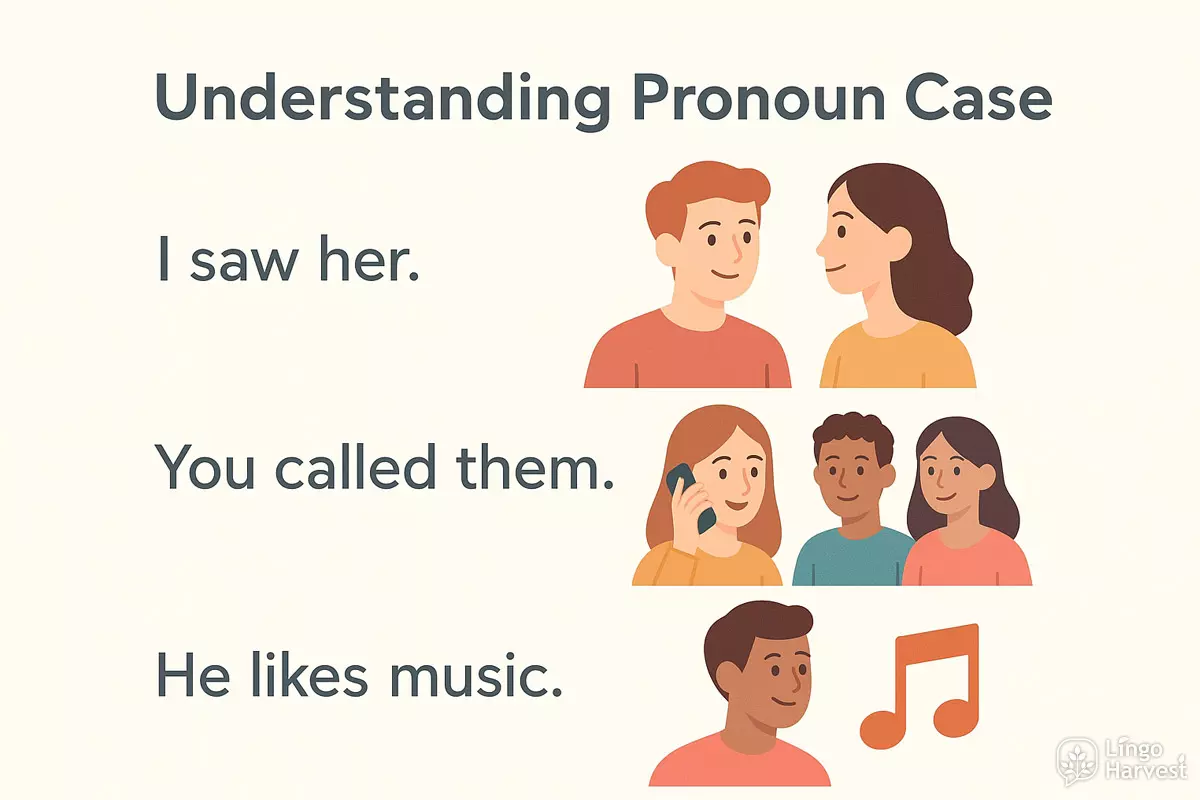
Understanding Pronoun Case
English pronouns change form depending on their grammatical function in a sentence. This grammatical distinction is called case, and it determines whether a pronoun is used as a subject (the one doing the action) or as an object (the one receiving the action). Recognizing the correct form is essential for clear and accurate communication.
What Are Subject and Object Pronouns?
Subject pronouns are used when the pronoun is the subject of the verb, meaning it performs the action. Object pronouns, on the other hand, appear when the pronoun receives the action, usually after verbs or prepositions. Using the correct form helps your sentences sound natural and avoid confusion.
| Subject Pronoun | Object Pronoun | Example Sentence |
|---|---|---|
| I | me | I saw her. / She saw me. |
| you | you | You called them. / They called you. |
| he | him | He likes music. / Music likes him. 🟢 |
| she | her | She helped me. / I helped her. |
| it | it | It works. / I fixed it. |
| we | us | We invited them. / They invited us. |
| they | them | They know you. / You know them. |
Common Usage Patterns
- After a verb: Use the object form (e.g., "He saw me," not "He saw I").
- As the subject: Use the subject form (e.g., "She is here," not "Her is here").
- After prepositions: Always use the object form (e.g., "with us", "for them").
- With compound subjects or objects, each pronoun must match its role: "Jack and I went," "Give it to her and me."
- After than or as, choose the form based on the implied verb: "She is taller than I (am)," "He is as smart as she (is)."
Mistakes in pronoun case are common, especially in informal speech, but mastering these forms will improve both your writing and speaking. Remember, the context in which the pronoun appears determines which form is appropriate. With practice, choosing the correct form becomes automatic.
Subject Case Uses
English pronouns change form depending on their role in a sentence. The subject form of a pronoun is used when the pronoun acts as the main actor or focus of a clause or sentence. This means these forms are chosen whenever the pronoun is performing an action, describing a state, or being linked to a subject complement.
When to Use Subject Pronouns
Subject pronouns appear in a variety of situations, not just as the first word in a sentence. They are needed:
- As the grammatical subject of a verb (e.g., She runs every morning.)
- When introducing a sentence or clause (e.g., We will meet at noon.)
- After linking verbs as subject complements (e.g., The winner is he.)
- In questions where the pronoun is the subject (e.g., Who is calling?)
- In compound subjects (e.g., You and I should go.)
- Following "than" or "as" in comparisons when the subject is implied (e.g., She is taller than I.)
- When making statements with ellipsis (e.g., They can sing, and so can we.)
- In relative clauses (e.g., The person who called was my friend.)
- As part of fixed expressions (e.g., It is raining.)
- With verbs in imperative mood when emphasis is needed (e.g., You be careful!)
List of English Subject Pronouns
The set of pronouns used for this grammatical role is straightforward. Here are the standard forms:
- I
- you
- he
- she
- it
- we
- they
- who
Comparison: Subject vs Object Pronouns
It's easy to confuse subject pronouns with their object counterparts, especially since some forms look the same. The table below shows the differences for quick reference:
| Subject Pronoun | Object Pronoun |
|---|---|
| I | me |
| you | you |
| he | him |
| she | her |
| it | it |
| we | us |
| they | them |
| who | whom |
Choosing the right form depends on whether the pronoun is doing the action or receiving it. In summary, subject forms are essential for clarity and correctness in English sentences.
Object Case Uses
When English pronouns function as objects rather than subjects, they shift to a different form—known as the object case. These forms are used in various grammatical situations, each with its own rules and patterns. Understanding when and why to use these forms helps make your spoken and written English sound more natural.
When to Use Object Pronouns
Object pronouns come into play whenever a pronoun receives the action in a sentence, or follows a preposition. Here are the main situations where you’ll encounter them:
- As the direct object of a verb (e.g., “She called him.”)
- As the indirect object of a verb (e.g., “He gave me a gift.”)
- After prepositions (e.g., “Sit with us.”)
- In comparisons (e.g., “She’s taller than me.”)
- After certain verbs that require an object (e.g., “It surprised them.”)
- In short answers (e.g., “Who wants ice cream?” “Me!”)
- With infinitive phrases (e.g., “I want him to help.”)
- When used for emphasis or clarification (e.g., “As for her, she disagrees.”)
Common Object Pronouns
These are the standard object forms you’ll encounter most often:
- me (for “I”)
- you (same as subject form)
- him (for “he”)
- her (for “she”)
- it (unchanged)
- us (for “we”)
- them (for “they”)
- whom (object form of “who” in formal English)
Visual Comparison: Subject vs. Object Pronouns
To clarify the switch between subject and object forms, here’s a quick reference:
| Subject Pronoun | Object Pronoun |
|---|---|
| I | me |
| you | you |
| he | him |
| she | her |
| it | it |
| we | us |
| they | them |
| who | whom |
Examples in Sentences
Seeing object pronouns in context helps reinforce their correct usage. Here are several examples:
- Can you help me?
- They invited us to the event.
- She saw him at the station.
- The gift is for her.
- I’ll call them later.
- It surprised me.
- Come with us.
- Between you and me, that’s a secret.
- The teacher noticed her in class.
- This is for you.
- The dog followed him home.
- Who did you see? Whom did you call?
By recognizing these patterns and forms, you’ll be able to use object pronouns comfortably in both everyday conversation and formal writing.
Pronouns After Prepositions
When a preposition comes before a pronoun in English, the pronoun must take its object form. This is a key difference from subject pronouns. Native speakers use these patterns naturally, but learners often make mistakes by using subject pronouns after prepositions.
Common Prepositions with Pronouns
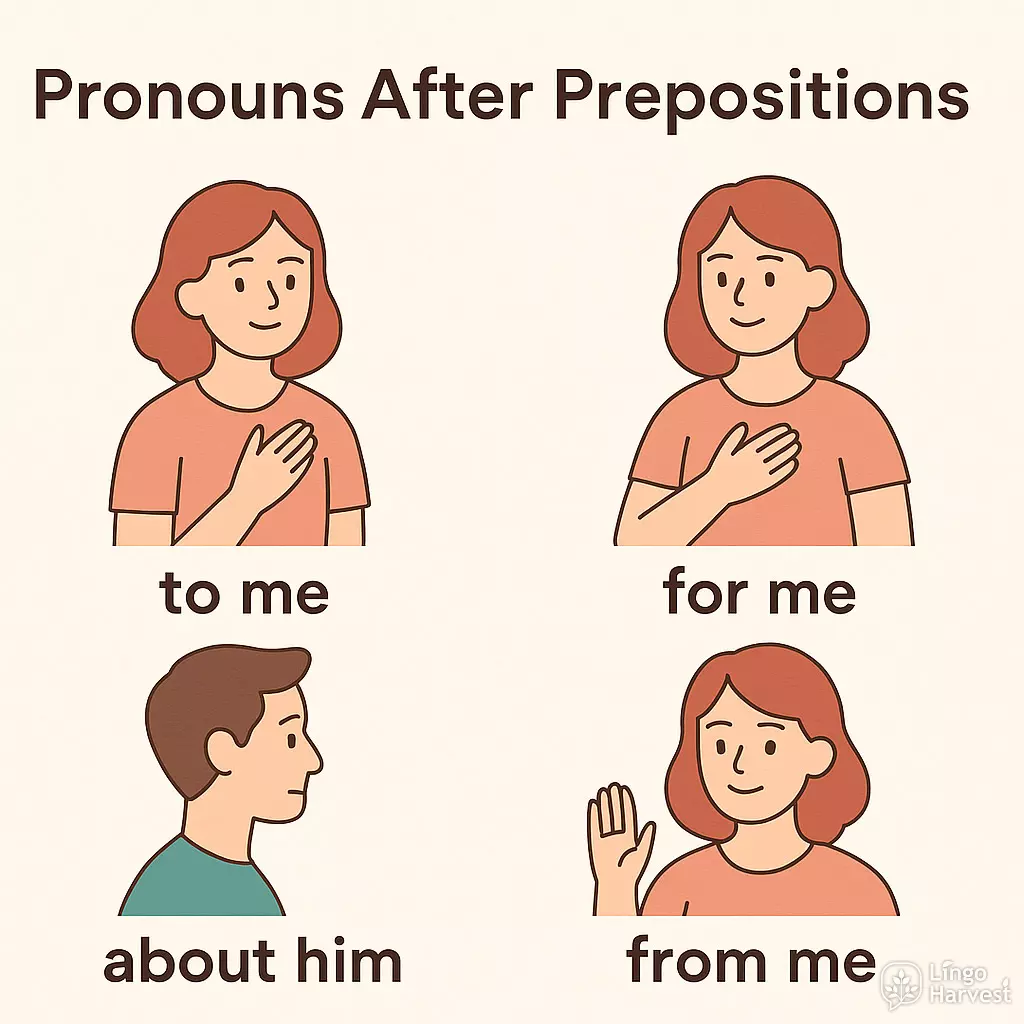
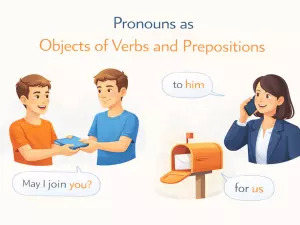
After words like "to," "for," "with," and "about," object pronouns are required. For example, “with me,” not “with I.” Here are some of the most frequent combinations:
- to me / to you / to him / to her / to us / to them
- for me / for her / for us / for them
- about him / about her / about us
- from me / from them / from him
- with you / with her / with me
- at him / at us / at them
- between us / between them
- without me / without you / without him
- by her / by them / by me
- of him / of her / of us
Comparison: Subject vs. Object Pronoun After Prepositions
The difference becomes clear when you compare correct and incorrect forms. See the table below for a side-by-side look at common mistakes versus proper usage:
| Incorrect | Correct |
|---|---|
| for I | for me |
| to she | to her |
| with we | with us |
| about they | about them |
| from he | from him |
| between I and you | between you and me |
Special Cases and Idioms
Some phrases have become set expressions, like “between you and me.” Using the subject form (“between you and I”) is a common but incorrect construction. The rule remains: after any preposition, always choose the object form of the pronoun.
Quick Tips
- Always check if a preposition comes before a pronoun.
- Use “me,” “him,” “her,” “us,” “them,” and “you” (object forms) after prepositions.
- Never use “I,” “he,” “she,” “we,” or “they” after prepositions.
- Listen for common set phrases to reinforce the pattern.
Understanding this pattern will help you sound more natural and avoid common errors in both writing and speech.
Mistakes in Spoken English
Many English learners mix up subject and object pronouns when speaking, especially in casual conversations. These slip-ups can make sentences sound odd or even change the meaning. Native speakers sometimes make these errors too, particularly in informal speech or regional dialects.
Common Pronoun Confusions
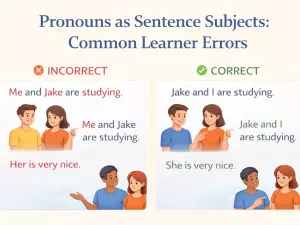
Mixing up "I" and "me" or "he" and "him" happens frequently. For example, people might say "Me and her went to the store" instead of "She and I went to the store." Such small changes can affect clarity and correctness.
Frequent Patterns of Mistakes
- Using object pronouns as subjects: "Her did it" instead of "She did it."
- Using subject pronouns as objects: "Give it to I" instead of "Give it to me."
- Double subjects: "Me, I think it's fine."
- Incorrect pronoun order: "Me and him are friends" instead of "He and I are friends."
- Omitting the subject: "Went to the store" instead of "I went to the store."
- Using "us" for "we": "Us are ready" instead of "We are ready."
- Using "them" for "they": "Them are coming" instead of "They are coming."
- Swapping "who" and "whom": "Who did you give it to?" vs. "Whom did you give it to?" (Though "who" is often used in speech for both.)
- Mixing up reflexive pronouns: "Myself did it" instead of "I did it myself."
- Adding unnecessary pronouns: "My brother he is coming."
- Forgetting to use a pronoun: "Is raining" instead of "It is raining."
- Using "them" as a subject: "Them want to go" instead of "They want to go."
- Overusing "me" in compound subjects: "Me and John will help you."
- Using "us" as a subject: "Us will be late."
- Swapping positions in formal writing: "Between you and I" instead of "Between you and me."
- Confusing "she" and "her" in subject position: "Her is here."
- Using "him" for "he": "Him went home."
- Using "me" after "than": "She is taller than me" (informal, but "than I" is more formal/standard).
- Redundant pronouns: "Myself, I think..."
- Using "they" for "he/she": "They is coming" instead of "He is coming" or "They are coming."
Typical Corrections: Subject vs Object
| Incorrect (Spoken) | Correct (Standard English) |
|---|---|
| Me and him went home. | He and I went home. |
| Give it to I. | Give it to me. |
| Her did it. | She did it. |
| Us are ready. | We are ready. |
| Them want to play. | They want to play. |
| Between you and I | Between you and me |
| Myself and John will go. | John and I will go. |
| Who did you see? | Whom did you see? |
Why Do These Errors Happen?
Most of these mistakes occur because everyday speech is less formal and rules are often relaxed. Children, non-native speakers, and even adults pick up patterns from those around them, leading to persistent errors. Being aware of these common slip-ups makes it easier to notice and correct them, especially in writing or formal situations.
Quick Tips to Remember
Sorting out when to use subject and object pronouns in English can be tricky, but some simple strategies can help you get it right. Below are practical reminders and examples to clarify their use in everyday sentences.
Recognizing Subject and Object Roles
- The subject pronoun is the “doer” of the action (e.g., she runs).
- The object pronoun receives the action (e.g., He sees her).
- Subject pronouns usually come before the verb, while object pronouns usually come after the verb or preposition.
Common Mistakes and How to Avoid Them
- ❌ Me went to the store. → ✅ I went to the store.
- ❌ Give the book to she. → ✅ Give the book to her.
- After prepositions (to, for, with, etc.), always use the object form: “for him,” not “for he.”
- In comparisons, finish the sentence in your head: “She is taller than I (am),” not “than me.”
Subject and Object Pronoun Reference Table
| Subject Pronoun | Object Pronoun |
|---|---|
| I | me |
| you | you |
| he | him |
| she | her |
| it | it |
| we | us |
| they | them |
Extra Pointers for Everyday Use
- When two people are the subject or object, put yourself last: “My friend and I went,” “She saw my friend and me.”
- Never use the subject form after prepositions: say “with us,” not “with we.”
- Remember that “it” stays the same for both cases.
- For questions, subject pronouns usually come before the verb: “Who is calling?”
- For short answers, use the subject form: “Who wants cake?” “I do.”
- When in doubt, try rephrasing the sentence to see which form sounds natural.
Practicing with these simple reminders will help you confidently choose the correct form, whether you’re writing or speaking.
Practice Examples
Understanding the distinction between subject and object forms in English pronouns is essential for constructing clear sentences. The following activities and sample sentences help you recognize and choose the correct form depending on the pronoun’s function in a sentence.
Identify the Correct Pronoun
For each sentence, select the correct pronoun to complete the sentence. Focus on whether the pronoun acts as the subject (doing the action) or the object (receiving the action).
- ___ went to the store. (She/Her)
- The teacher gave ___ a compliment. (he/him)
- ___ and I will help with the project. (Me/My)
- Could you pass ___ the salt? (they/them)
- This is the book ___ recommended. (he/him)
Show answers
- She
- him
- She
- them
- he
Common Subject vs Object Pronoun Forms
Review the table to compare forms used for subjects and objects. This helps clarify which pronoun fits in which role.
| Subject Pronoun | Object Pronoun |
|---|---|
| I | me |
| you | you |
| he | him |
| she | her |
| it | it |
| we | us |
| they | them |
Rewrite Sentences
Replace the noun in each sentence with the correct pronoun. Pay attention to whether it should be in the subject or object case.
- Maria called John. → ___ called ___ .
- The book belongs to Sarah. → The book belongs to ___ .
- David and I finished the homework. → ___ finished the homework.
- I saw the cats. → I saw ___ .
- The teacher asked the students and me a question. → The teacher asked ___ a question.
Show answers
- She called him.
- The book belongs to her.
- We finished the homework.
- I saw them.
- The teacher asked us a question.
Quick Check: Spot the Error
Each sentence contains either a correct or incorrect pronoun. Decide if the pronoun is used correctly. Mark with ✅ for correct and ❌ for incorrect.
- Me went to the park.
- She gave him the keys.
- Us are ready to leave.
- He saw them at the movie.
- Her is my friend.
Show answers
- ❌ ("Me" should be "I")
- ✅
- ❌ ("Us" should be "We")
- ✅
- ❌ ("Her" should be "She")
Regular practice with these sentence patterns builds confidence in choosing between subject and object pronouns. As you review, try making your own examples to reinforce your understanding.