Pronouns as Objects of Verbs and Prepositions

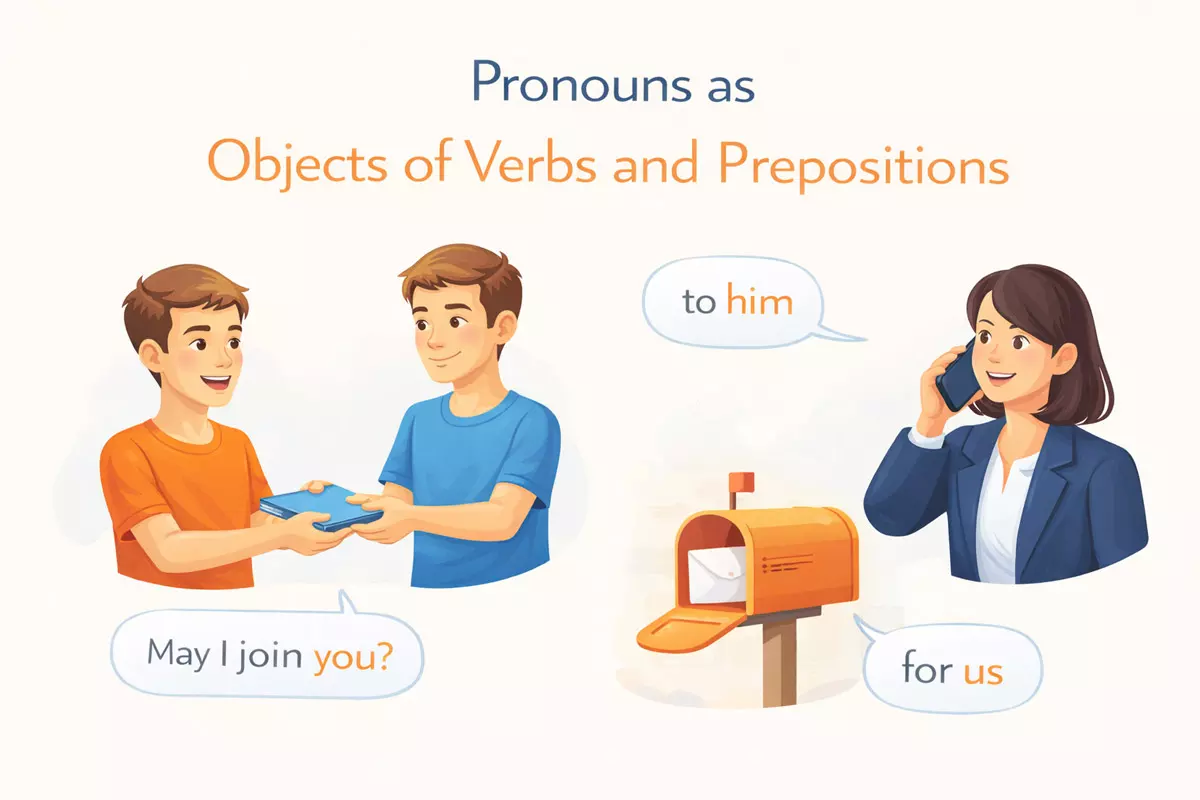 This article explains what object pronouns are and when to use them, including as objects of verbs and prepositions. It covers common errors, their use in questions and with infinitives or -ing forms, word order with two objects, and includes practice exercises.
- What object pronouns are and when to use them
- Objects of verbs: see him, call her, help us
- Objects of prepositions: with me, for them, between you and me
- Common error: between you and I
- Object pronouns in questions: Who did you see?
- Object pronouns with infinitives and -ing forms
- Word order with two objects: give it to him vs give him it
- Practice: choose the correct object form in context
Choosing between words like him, her, and us after verbs and conjunctions can be challenging for both English learners and native speakers. Mastering the correct usage in these situations not only improves your grammar but also enhances the clarity and effectiveness of your communication. By paying attention to the context and understanding the function of each pronoun, you can make more confident choices in both writing and speaking, leading to more polished and accurate language skills overall.
What object pronouns are and when to use them
Object pronouns are words that replace nouns when those nouns act as the receiver of an action or follow a preposition. Instead of repeating a person’s name or a thing, these pronouns help keep sentences clear and efficient. You’ll usually find them after verbs or prepositions, where they stand in for people, animals, or things affected by the action.
How object pronouns work in sentences
When a noun is the target of a verb—like in “She saw him”—the pronoun “him” is the object. Similarly, after prepositions (like “with,” “to,” or “for”), these words take the place of nouns: “Give the book to me.” This is different from subject pronouns, which do the action in a sentence.
Common English object pronouns
Here are the most frequently used object forms:
- me (She called me.)
- you (I saw you.)
- him (We invited him.)
- her (Can you help her?)
- it (I found it.)
- us (They joined us.)
- them (The teacher knows them.)
- whom (To whom did you speak?)
- whomever (Give it to whomever you want.)
- yourself, ourselves (for reflexive uses)
When to choose an object pronoun
Object pronouns are essential in these situations:
- After action verbs: “She hugged me.”
- Following prepositions: “He sat beside her.”
- As the object of infinitives or gerunds: “It’s hard for them to focus.”
- With phrasal verbs: “They looked after us.”
- In comparisons (sometimes informal): “He’s older than me.”
Comparing subject and object pronouns
To avoid confusion, here’s a quick look at how subject and object pronouns differ:
| Subject Pronoun | Object Pronoun |
|---|---|
| I | me |
| you | you |
| he | him |
| she | her |
| it | it |
| we | us |
| they | them |
Choosing the right form is important for clarity. Use the object version whenever the pronoun is not doing the action but is receiving it, or follows a preposition. This helps your sentences flow naturally and prevents misunderstandings.
Objects of verbs: see him, call her, help us
Understanding how pronouns work as the objects of verbs is essential for clear and natural English. When a verb needs something to receive the action, we usually use an object pronoun, such as "him," "her," "us," or "them." These pronouns replace nouns to avoid repetition and make sentences smoother.
What are object pronouns?

Object pronouns take the place of nouns that receive the action of the verb. They are different from subject pronouns, which do the action. For example, in "Sarah knows him," "him" is the object pronoun, receiving the action of "knows." Common English object pronouns include:
- me → She invited me to the meeting.
- you → I’ll call you later.
- him → We saw him at the station.
- her → Please send her the file.
- it → I fixed it this morning.
- us → They asked us to wait.
- them → I met them yesterday.
Examples of verbs with object pronouns
Using object pronouns after verbs is straightforward. Here are some common patterns:
- I see her every day.
- Can you help us?
- We called them last night.
- He invited me to the party.
- She doesn’t like it.
- They found him at the station.
- Please tell me the truth.
- I didn’t hear you.
- The teacher asked us a question.
- We lost them in the crowd.
- Could you show me the way?
- My friends called her yesterday.
- He trusts them.
- She didn’t recognize him.
- They remember it well.
Quick tips
- Object pronouns always follow the verb directly (e.g., "call him").
- Never use a subject pronoun as the object (say "help us," not "help we").
- When in doubt, substitute the noun with the correct object pronoun from the table above.
Mastering the use of object pronouns after verbs helps you sound more fluent and makes your English much easier to understand.
Objects of prepositions: with me, for them, between you and me
Pronouns often appear after prepositions such as “with,” “for,” and “between.” In these situations, English uses the objective forms (sometimes called object pronouns) rather than the subject forms. For example, we say “with me” rather than “with I,” and “for them” instead of “for they.” Prepositions require their objects to be in the correct grammatical case, which is why using the right pronoun matters for both clarity and correctness.
Examples of Pronouns as Objects of Prepositions
You’ll encounter object pronouns after prepositions in everyday English. Some typical patterns include:
- Come with me.
- This gift is for him.
- She sat beside us.
- The decision is up to them.
- He was talking about her.
- Between you and me, that movie was boring.
- Is this message for you?
- The cat jumped over him.
- Without her, the project would fail.
- They went ahead of us.
- Everyone except me was invited.
- Nothing can come between us.
- Can you help me with it?
- According to them, it’s a good idea.
- He brought it for us.
Special Note: “Between you and me”
A common point of confusion is the phrase “between you and me.” Some mistakenly say “between you and I,” but the correct form uses object pronouns, because “between” is a preposition. This pattern applies to any pair or group following a preposition.
Quick Tips
- Always use object pronouns after prepositions (e.g., to her, for us, with them).
- When listing multiple people, use object forms for all (e.g., between him and me).
- If unsure, try the sentence with just one pronoun: “for me,” not “for I.”
Choosing the correct pronoun after a preposition helps your English sound natural and accurate. With practice, these forms will become second nature.
Common error: between you and I
Many English speakers mistakenly use subject pronouns after prepositions, especially in combinations like "between you and I." This happens because "I" often feels more formal or correct, but in standard English, prepositions require object pronouns. The correct form is "between you and me."
Why does this happen?
The confusion arises from overcorrecting. People remember not to say "Me and John went to the store," so they assume "and I" is always correct. However, after prepositions like "between," "with," or "for," we need the object form: me, him, her, us, or them.
Correct vs. Incorrect Examples
- ❌ She sat between you and I.
- ✅ She sat between you and me.
- ❌ This is a secret between he and I.
- ✅ This is a secret between him and me.
- ❌ There’s a difference between she and I.
- ✅ There’s a difference between her and me.
- ❌ The gift is from John and I.
- ✅ The gift is from John and me.
- ❌ For you and I, this is important.
- ✅ For you and me, this is important.
- ❌ It happened to he and I last year.
- ✅ It happened to him and me last year.
- ❌ Please come with Sarah and I.
- ✅ Please come with Sarah and me.
- ❌ The story was told by she and I.
- ✅ The story was told by her and me.
How to check yourself
If you’re unsure, try removing the other person from the sentence. For example, "between you and me" becomes "between me"—which sounds correct. "Between you and I" becomes "between I," which is clearly wrong. This trick works with other prepositions too.
Summary of object pronouns after prepositions
- me (not I) → She called me, not I.
- him (not he) → I saw him, not he.
- her (not she) → We invited her, not she.
- us (not we) → They helped us, not we.
- them (not they) → I met them, not they.
- you (same for subject and object) → You can join us, and I can help you.
- it (same for subject and object) → It looks expensive, but I can’t afford it.
Remember, after any preposition (like between, with, for, to, from, by), always use the object form of pronouns. This small detail helps your English sound more natural and precise.
Object pronouns in questions: Who did you see?
Questions often require object pronouns when someone is asking about the person or thing affected by an action. In English, when forming questions like “Who did you see?”, the pronoun “who” acts as the object. This is different from “who” as a subject (as in “Who called you?”). Recognizing whether a pronoun is functioning as an object or subject helps you answer and form questions more accurately. When “who” is used as the object, the question word usually comes first, followed by the auxiliary verb (did, do, does, etc.), then the subject and the main verb. The object pronoun follows the verb or preposition, depending on the sentence structure.
Common patterns for object pronouns in questions
- Who did you meet at the party?
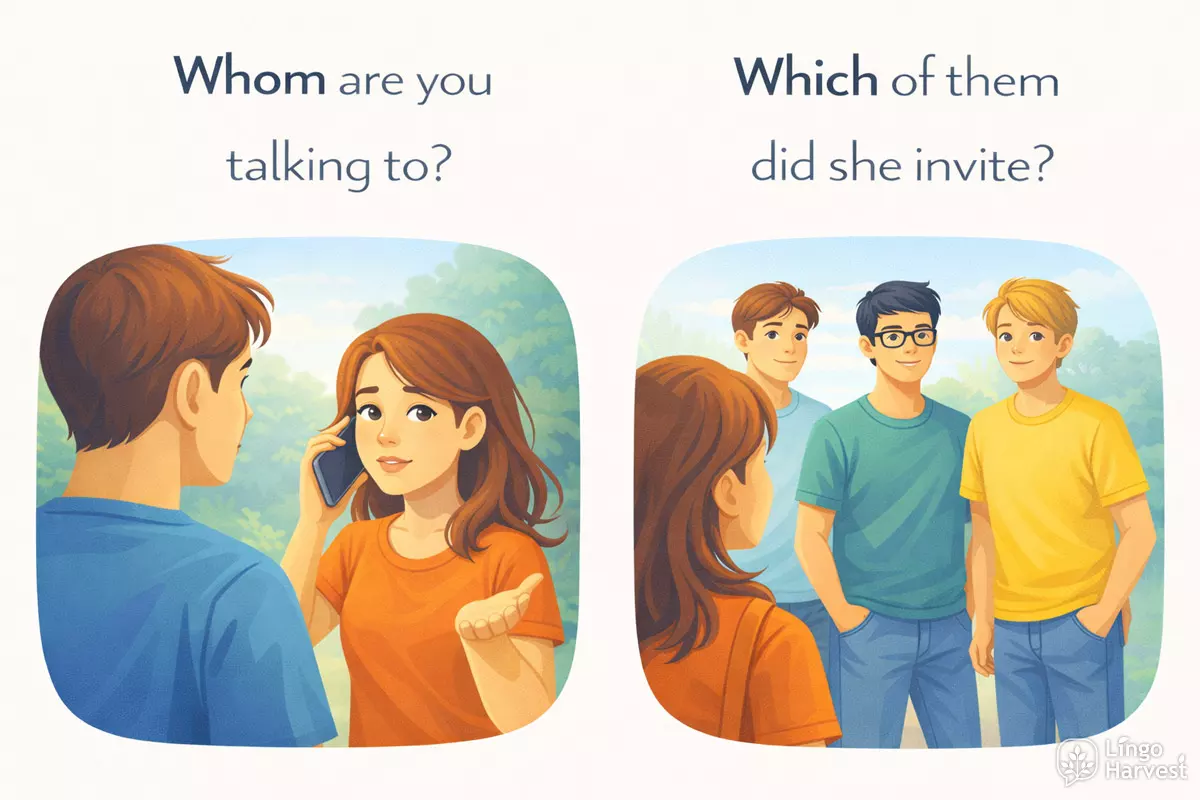
- Whom are you talking to?
- Which of them did she invite?
- What did they buy for you?
- Who are you waiting for?
- Whom should I call?
- Which one did he choose?
- Who did she write to?
- What did you tell him?
- Whom did they see at the station?
- Who did you help?
- What did she give you?
- Which movie did you watch?
- Who did you send the letter to?
- What did you ask him?
- Who are you looking for?
- Whom did you support?
- Which team did you join?
“Who” vs. “Whom” in object position
In everyday English, “who” often replaces “whom” in questions, even when “whom” would be strictly correct as the object. However, “whom” is still preferred in formal writing or when following a preposition.
| Question | Explanation |
|---|---|
| Who did you see? | “Who” is used as the object of “see” (informal, common usage). |
| Whom did you see? | “Whom” is the formal object pronoun (rare in speech, formal writing). |
| To whom did you speak? | “Whom” follows a preposition (“to”) for extra formality or clarity. |
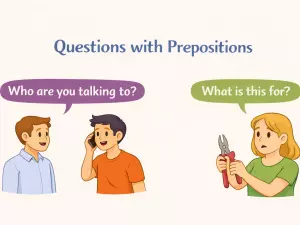
| Who are you talking to? | Informal: preposition at the end, “who” as object (common speech). |
Tips for identifying object pronouns in questions
- If the answer to the question would be “him,” “her,” “them,” etc., you need an object pronoun.
- Look for verbs or prepositions that require an object to complete their meaning.
- In casual English, “who” is almost always used, but in formal contexts, use “whom” when it is the object.
- Check if the question word is receiving the action rather than doing it.
Understanding how to use object pronouns in questions will help you communicate clearly and avoid common errors—especially in exams or formal writing.
Object pronouns with infinitives and -ing forms
When using verbs followed by infinitives or -ing forms, the pronoun acting as the object often appears just before the verb form. This is especially common with certain verbs that require an object before the infinitive or gerund. Understanding which verbs take which structure can help avoid awkward or incorrect sentences. Some verbs allow or require an object pronoun before the infinitive (with "to") or before the -ing form. For example, with verbs like "want," "ask," or "expect," you often use an object pronoun before the infinitive: "She wants him to help." Other verbs, like "enjoy," "dislike," or "avoid," can take an object pronoun before the -ing form: "I saw her leaving."
Common Patterns
Here are some typical patterns where object pronouns are used with infinitives and -ing forms:
- He asked me to call him.
- They want us to join them.
- She expects you to finish the work.
- I saw him crossing the street.
- We heard them singing.
- The teacher told me to study harder.
- Did you notice her leaving?
- Let me explain.
- My parents allowed me to stay out late.
- She caught him cheating on the test.
- They made us wait outside.
- We watched them play football.
- I prefer him driving.
- Would you like me to help?
- He persuaded her to try again.
- They advised us to leave early.
- I don't mind you joining us.
- She hates me interrupting her.
Infinitive or -ing? Differences in Use
Some verbs can take both structures, but the meaning might change. For example:
- "I saw her sing." (I saw the whole action.)
- "I saw her singing." (I saw her while she was singing.)
Not all verbs allow both forms, so it's important to learn which verbs pair with infinitives, -ing forms, or both.
Summary Table: Verbs + Object Pronoun + Infinitive vs. -ing Form
| Verb | Example with Infinitive | Example with -ing Form |
|---|---|---|
| Want | She wants him to stay. | ❌ (not used) |
| See | I saw her cross the road. | I saw her crossing the road. |
| Let | Let me go. | ❌ (not used) |
| Catch | ❌ (not used) | She caught him cheating. |
| Allow | They allowed us to leave. | ❌ (not used) |
| Hear | I heard them sing. | I heard them singing. |
Quick Tips
- Check which verbs require an object before the infinitive or -ing form.
- Remember that not all verbs work with both structures.
- For verbs of perception (see, hear, watch), both forms are possible but may change the nuance.
- After "let" and "make," use the bare infinitive (without "to") with the object pronoun.
The right choice depends on the verb and the meaning you want to express. Practice noticing these patterns in real sentences to use them naturally.
Word order with two objects: give it to him vs give him it
When a verb takes both a direct and an indirect object, English generally follows certain patterns, especially when pronouns are involved. The choice between forms like “give it to him” and “give him it” depends on the type of objects (nouns or pronouns) and on what sounds natural in everyday use.
The basic patterns
In most cases, if both objects are pronouns, the structure “give it to him” is much more common than “give him it.” However, with noun objects, both orders are possible, but they can sound slightly different in formality or emphasis. Here’s how these constructions typically work:
- Verb + indirect object + direct object: “She told me the story.”
- Verb + direct object + to/for + indirect object: “She told the story to me.”
- With pronouns, “She told it to me” is natural, but “She told me it” is less common.
Which order is preferred?
When both objects are pronouns, native speakers overwhelmingly prefer “give it to him” over “give him it.” The reverse order can sound awkward or old-fashioned. However, with at least one object as a noun, both orders are possible, though “give the book to John” is often clearer than “give John the book.”
| Order | Example | Naturalness |
|---|---|---|
| Pronoun + pronoun | Give it to him. | ✅ Most common |
| Pronoun + pronoun | Give him it. | ❌ Rare, sounds odd |
| Noun + pronoun | Give the book to him. | ✅ Natural |
| Pronoun + noun | Give him the book. | ✅ Natural |
| Noun + noun | Give the book to John. | ✅ Natural |
| Noun + noun | Give John the book. | ✅ Natural |
More examples of verbs with two objects
Many verbs can take both a direct and an indirect object. Here are some common verbs and how they work with different object orders:
- Send: “Send it to me.” / “Send me it.” (first is more natural)
- Lend: “Lend it to her.” / “Lend her it.”
- Show: “Show it to us.” / “Show us it.”
- Tell: “Tell it to them.” / “Tell them it.”
- Offer: “Offer it to me.” / “Offer me it.”
- Read: “Read it to him.” / “Read him it.”
- Buy: “Buy it for her.” / “Buy her it.”
- Get: “Get it for me.” / “Get me it.”
- Make: “Make it for us.” / “Make us it.”
- Pass: “Pass it to them.” / “Pass them it.”
- Hand: “Hand it to me.” / “Hand me it.”
- Bring: “Bring it to her.” / “Bring her it.”
- Give: “Give it to him.” / “Give him it.”
Summary
The most natural and clear order when both objects are pronouns is to put the direct object before the prepositional phrase (“give it to him”). Using “give him it” is rarely heard in modern English and can sound strange. For clarity and fluency, especially in speech, following the standard order helps your sentences flow more smoothly.
Practice: choose the correct object form in context
Understanding when to use object pronouns is essential for clear communication in English. Object pronouns (me, him, her, us, them, etc.) are used after verbs and prepositions. Let’s work through some practical examples to reinforce how these forms function in sentences.
Fill in the blanks
Decide which object pronoun fits each sentence. Choose from: me, him, her, us, them, it, you.
- Could you help ____ with this problem?
- I saw ____ at the concert last night.
- She brought the book and gave ____ to ____.
- Would you like to come with ____ to the museum?
- The teacher asked ____ to answer the question.
- Please tell ____ the truth.
- We invited ____ to our party, but she couldn’t make it.
- This is my favorite song. I listen to ____ every day.
- Don’t forget to call ____ when you arrive.
- He’s angry because they didn’t include ____ in the game.
Show answers
- me
- him/her/them (any singular or plural object pronoun depending on context)
- it, me
- us
- me
- me/us/them (any object pronoun depending on context)
- her
- it
- me
- him
Object pronouns after prepositions
Object pronouns are always used after prepositions such as to, for, with, at, about, and between. Review these examples:
- Can you come with us?
- This gift is for her.
- He sat between you and me.
- She was talking about them.
- The secret is safe with him.
- The letter was addressed to me.
- They made dinner for us.
- Let’s keep it between you and me.
Recognizing subject vs. object forms
It’s important to distinguish between subject pronouns (I, he, she, we, they) and object pronouns (me, him, her, us, them). Here’s a quick reference:
| Subject Pronoun | Object Pronoun | Example in a Sentence |
|---|---|---|
| I | me | She saw me at the store. |
| he | him | We called him yesterday. |
| she | her | I met her in class. |
| we | us | They joined us for lunch. |
| they | them | I spoke to them after the meeting. |
| you | you | I will call you later. |
| it | it | Can you move it? |
Quick check: Choose the correct form
For each sentence, select the correct pronoun.
- _____ (He/Him) gave the book to _____ (I/me).
- Would you like to join _____ (we/us) for dinner?
- She is waiting for _____ (they/them) at the station.
- Tell _____ (she/her) the news.
- Can you help _____ (I/me) with this task?
- _____ (He/Him) invited _____ (she/her) to the event.
- The manager spoke to _____ (we/us) after the meeting.
- Please send the files to _____ (they/them).
- _____ (She/Her) thanked _____ (he/him) for the support.
- They asked _____ (I/me) to arrive early.
- _____ (We/Us) met _____ (they/them) yesterday.
- The teacher called _____ (he/him) and _____ (she/her).
Show answers
- He, me
- us
- them
- her
- me
- He, her
- us
- them
- She, him
- me
- We, them
- him, her
Practicing these distinctions will help you master using pronouns as objects of verbs and prepositions in everyday English.