Common Pronoun Confusions in Theory

 Here we common pronoun problems, such as he vs him, this vs that, and who vs whom. It explains confusing cases like reflexives and everybody vs every one, and offers sentence practice to improve your grammar.
Choosing the right words when referring to people or things can be surprisingly challenging, particularly when dealing with abstract or theoretical concepts. Even small mistakes in word choice may result in confusion or miscommunication, so it is important to pay close attention to context and meaning. By carefully considering how language is used, we can avoid misunderstandings and ensure that our ideas are conveyed clearly and accurately to others.
Typical Problem Pairs
Many learners and even advanced writers stumble over certain pronoun distinctions that are deceptively tricky in theory. These issues usually arise from similarities in form, ambiguity in reference, or overlapping grammatical roles. Below, we’ll look at some of the most frequent sources of confusion, highlighting both English and cross-linguistic examples where relevant.
Commonly Confused Pronoun Sets
Mix-ups often occur between pronouns with similar forms or functions, especially in complex sentences. Here are some classic examples:
- Who vs. Whom – Subject vs. object position confusion.
- They vs. He/She – Singular ‘they’ used for unknown gender or nonbinary individuals.
- I vs. Me – Subjective vs. objective case errors, especially in coordinated phrases (“John and me” vs. “John and I”).
- Its vs. It’s – Possessive determiner vs. contraction.
- Which vs. That – Restrictive and non-restrictive clauses.
- Who vs. That – Human vs. non-human antecedents.
- Himself vs. His – Reflexive vs. possessive confusion.
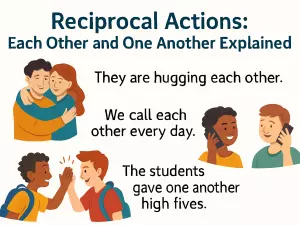
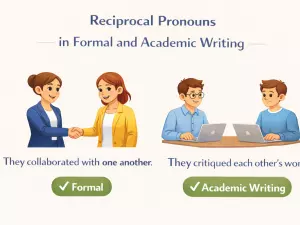
- Each other vs. One another – Pairwise vs. group reciprocal actions.
- Anyone vs. Any one – Indefinite pronoun vs. quantifier + noun.
- None vs. No one – Absence of quantity vs. absence of individuals.
- Somebody vs. Someone – Subtle register or stylistic differences.
- Yours vs. Your’s – Correct possessive pronoun vs. incorrect form.
- Whoever vs. Whomever – Embedded clause subject/object ambiguity.
- Myself vs. Me – Unnecessary reflexive usage.
- She vs. Her – Subject vs. object/possessive confusion.
- They vs. Them – Subject vs. object roles, especially in colloquial speech.
- Whose vs. Who’s – Possessive vs. contraction confusion.
- These vs. Those – Proximity distinctions blurred in spoken language.
- Few vs. A few – Negative vs. positive quantity implications.
- Either vs. Neither – Affirmative vs. negative choices.
Reference Ambiguity and Agreement Problems
Ambiguity in pronoun reference is a major theoretical problem. For instance, in the sentence “Alex told Jordan that he was late,” it’s unclear who was late. Agreement issues can also trip up writers when the antecedent is collective or indefinite (“Everybody forgot their ticket” vs. “Everybody forgot his or her ticket”).
| Problematic Pair | Typical Confusion/Context |
|---|---|
| Who / Whom | Subjective vs. objective case in questions/clauses |
| Its / It’s | Possessive adjective vs. contraction for “it is” |
| I / Me | Incorrect use in compound subjects/objects (“Me and John”) |
| They / He or She | Use of singular ‘they’ for gender neutrality |
| Whoever / Whomever | Choosing case within embedded clauses |
| Each other / One another | Distinguishing pairwise from group interactions |
| Few / A few | Negative vs. positive connotations in quantity |
Why These Pairs Matter
Misunderstandings with pronouns can lead to unclear or even misleading statements in both everyday communication and theoretical writing. Mastering these distinctions helps ensure precision, especially when discussing abstract concepts or constructing logical arguments.
He vs Him / She vs Her
Understanding the distinction between subject and object pronouns can be tricky, especially when the forms are similar and both refer to people. In English, "he" and "she" serve as subject pronouns, while "him" and "her" function as object pronouns. This means that "he" and "she" are used when the person is doing the action, and "him" and "her" are used when the person is receiving the action. Confusing these forms can lead to sentences that sound awkward or incorrect to native speakers.
Typical Usage Patterns

The subject form appears before the verb, showing who performs the action. The object form comes after the verb or after prepositions, indicating who receives the action. Here are common scenarios:
- He likes coffee. (subject)
- I saw him at the café. (object)
- She runs every morning. (subject)
- The teacher called her. (object)
- Can you help him?
- She will join us later.
- Give the book to her.
- He and I are friends.
- That’s for him.
- She knows the answer.
- It was him on the phone. (should be "he")
- It is she who called.
- Between you and me/him/her (never "I/he/she" after prepositions)
Common Mistakes and How to Avoid Them
Mixing up these forms often happens in compound subjects or objects, or after linking verbs like "is" or "was." To check correctness, try the sentence with just the pronoun: "He went to the store" (correct), not "Him went to the store" (incorrect).
| Function | Correct Form | Example |
|---|---|---|
| Subject (does the action) | He / She | He reads. / She sings. |
| Object (receives the action) | Him / Her | I saw him. / We met her. |
| After prepositions | Him / Her | With him. / For her. |
| After linking verbs (formal) | He / She | It is she. (formal) |
Quick Tips
- Use the subject form before the verb: He/She runs. - Use the object form after verbs and prepositions: I saw him/her, for him/her. - After "to be" verbs ("is/was"), formal English prefers "he/she," but informal speech often uses "him/her." - In compound structures, test the sentence with only the pronoun to check for correctness. Mastering these distinctions helps you sound more natural and avoid the most common pitfalls with English personal pronouns.
This vs That
Understanding the distinction between “this” and “that” is essential for grasping how pronouns function in theoretical frameworks and everyday language. Both terms refer to nouns, but their use depends on context, proximity, and sometimes even the speaker’s attitude. Misusing them can lead to ambiguity or unintended emphasis in both academic writing and casual conversation.
Core Differences
The fundamental difference lies in reference point and distance. “This” typically points to something close to the speaker or writer—either physically or conceptually. “That” is used for things farther away, or for something already mentioned or less immediate. In abstract contexts, the choice can signal focus, importance, or even emotional distance.
- “This” – Indicates nearness (in time, space, or thought)
- “That” – Refers to distance (literal or figurative)
- “This” often introduces new topics or examples
- “That” usually refers back to something previously discussed
- Choice can affect the clarity of theoretical arguments
- Switching between the two incorrectly may confuse readers
- Both can act as determiners (“this idea”, “that theory”) or pronouns (“This is complex”, “That was unclear”)
- In academic prose, “this” followed by a noun (“this hypothesis”) is clearer than a bare “this”
- “That” sometimes carries a dismissive tone, especially in critique
- Some style guides discourage using “this” or “that” alone, to prevent ambiguity
- Speech often relies on physical gestures to clarify; writing must rely on context
Comparing Usage in Theory
In theoretical texts, these pronouns frequently summarize complex ideas or arguments. The selection influences how readers interpret relationships between concepts.
| Function | “This” | “That” |
|---|---|---|
| Proximity | Near (physically or conceptually) | Far or removed from speaker/writer |
| Reference | Introduces new ideas, emphasizes immediacy | Refers back, indicates distance or previous mention |
| Clarity | Best with a noun (“this concept”) | Often used to clarify or contrast (“that approach”) |
| Tone | Neutral or engaging | Sometimes critical or distancing |
Common Pitfalls
Writers sometimes use “this” or “that” without specifying what is being referenced, leading to vague statements. Always pair these words with a clear noun when discussing complex theories. For example, instead of “This is problematic,” use “This assumption is problematic.” Such precision strengthens arguments and helps avoid confusion in theoretical discussions.
Who vs Whom Basics
Understanding the distinction between “who” and “whom” is a classic stumbling block in English grammar. The essential difference lies in their grammatical roles: “who” functions as a subject, while “whom” serves as an object. This section clarifies their usage with practical explanations and clear examples.
Subject vs. Object: The Core Principle
The pronoun “who” is used when referring to the subject of a verb—the person performing the action. Conversely, “whom” is used for the object—the person receiving the action. To test which pronoun is appropriate, try substituting “he/she” (subject) or “him/her” (object) in the sentence:
- “Who/Whom is calling?” → “He is calling” (subject, so use “who”)
- “To who/whom should I address the letter?” → “I should address the letter to him” (object, so use “whom”)
Examples in Everyday Sentences
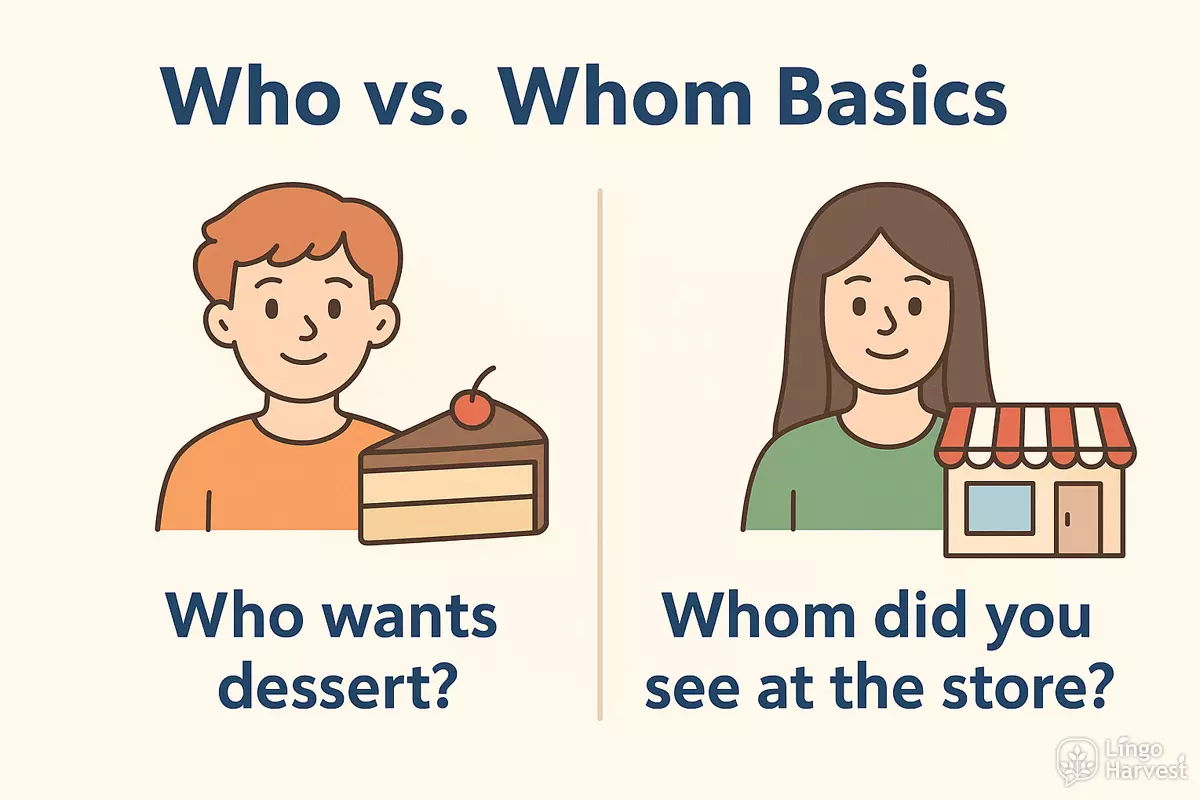
Below is a list of sentences demonstrating correct choices between these pronouns. Each example pairs a situation with the right form:
- Who wants dessert?
- Whom did you see at the store?
- Who is responsible for this report?
- To whom should we send the invitation?
- Who made that suggestion?
- With whom are you traveling?
- Who will attend the meeting?
- Whom are you inviting?
- Who left their umbrella here?
- For whom is this gift intended?
- Who called earlier?
- About whom were you speaking?
- Who finished the project?
- Whom do you trust?
- Who broke the vase?
- To whom does this belong?
Quick Reference Table
| Usage Type | Correct Pronoun | Example |
|---|---|---|
| Subject of a sentence | Who | Who made this cake? |
| Object of a verb | Whom | Whom did you call? |
| Object of a preposition | Whom | To whom should I speak? |
| Subject complement | Who | The winner is who? |
Tips for Remembering
- “Who” = “he/she”; “Whom” = “him/her.”
- If you can answer with “him” or “her,” use “whom.”
- In informal English, “whom” is often replaced by “who,” but formal writing prefers the distinction.
- Prepositions like “to,” “for,” “with,” or “about” usually signal the need for “whom.”
Mastering this difference clarifies your sentences and improves formal communication.
Everybody vs Every One
Distinguishing between these two expressions can be tricky, especially since they look almost identical. However, their meanings and usage differ in subtle but important ways. Understanding when to use each form will make your writing clearer and help avoid common mistakes in both academic and informal contexts.
Meaning and Usage
Everybody is an indefinite pronoun referring to all people in a group collectively. It’s always treated as singular, even though it refers to more than one person. In contrast, every one (two words) emphasizes each individual within a group, often followed by "of" and a noun or pronoun. The distinction is much like the difference between talking about a crowd as a whole versus focusing on each member separately.
- Everybody likes pizza. ✅ (All people as a group)
- Every one of the students passed the exam. ✅ (Each individual student, considered separately)
- Everybody knows the answer. ✅
- Every one of the apples was rotten. ✅
- Everybody is welcome to attend.
- Every one of them received a certificate.
- Everybody makes mistakes.
- Every one of these books is new.
- Everybody agrees with the decision.
- Every one of her friends called to congratulate her.
- Everybody arrived on time.
- Every one of the tasks was completed.
Common Pitfalls
Writers often confuse these forms because they sound similar. A quick check: if you are referring to a collective group, use the single-word form. If you are emphasizing individuals within that group, use the two-word form, typically followed by "of".
| Form | Typical Usage |
|---|---|
| Everybody | Collective reference to all people; singular verb. Example: Everybody is here. |
| Every one | Emphasizes each individual; often followed by "of". Example: Every one of the answers is correct. |
Quick Tips
- If you can replace it with "all people," use the single-word form.
- If you can replace it with "each individual," use the two-word form.
- Remember: "everyone" and "every one" follow the same distinction.
Confusions with Reflexives
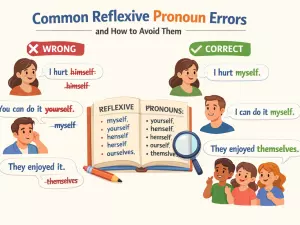
Misunderstandings about reflexive pronouns often stem from their flexible roles in English grammar. These pronouns—such as "myself," "yourself," "themselves"—can serve as both objects and intensifiers, which leads to frequent errors, especially in academic or theoretical writing. It's easy to mix up when to use a reflexive versus a standard object pronoun, or to overuse them for emphasis.
Common Mistakes and Why They Happen
Writers sometimes choose a reflexive form where a simple object pronoun is correct, or vice versa. Overcorrection is also an issue; people often insert reflexives because they "sound formal," even when they're not required. Consider the following situations where confusion commonly arises:
- Using "myself" instead of "me": Incorrect: Please send it to myself. ❌
- Forgetting reflexives after prepositions: She looked at herself in the mirror. ✅
- Misusing reflexives for emphasis without a clear subject: Myself, I disagree. ❌
- Applying reflexives to inanimate objects: The book placed itself on the table. ❌
- Incorrect agreement: They did it hisself. ❌
- Using a reflexive as a subject: Myself will attend the meeting. ❌
- Placing the reflexive too far from its subject: She gave the letter to John herself. ✅
- Redundant reflexives: He himself personally approved it. ❌
- Confusing possessive and reflexive: That is my own book. (possessive) vs. I did it myself. (reflexive)
- Using reflexives with verbs that don't take objects: He arrived himself. ❌
- Wrong plural form: Themselves (correct) vs. theirselves (incorrect)
- Reflexive for reciprocal action: They saw each other. ✅ vs. They saw themselves. ❌
- Pronoun mismatches: Her did it herself. ❌
- Unnecessary reflexive in passive: The decision was made by myself. ❌
- Using "myself" in place of "I" as subject: Myself and John are coming. ❌
Reflexive Pronoun Forms
The English reflexives are systematic, but their forms can still trip up even advanced writers. Here's a quick reference for the standard forms:
| Subject Pronoun | Reflexive Pronoun |
|---|---|
| I | myself |
| you (singular) | yourself |
| he | himself |
| she | herself |
| it | itself |
| we | ourselves |
| you (plural) | yourselves |
| they | themselves |
Tips for Getting It Right
To avoid errors, always check if the pronoun refers back to the subject of the clause. Use reflexives only when the subject and object are the same or for genuine emphasis. When in doubt, try rephrasing the sentence to see if the reflexive is necessary. Overuse can make writing awkward or unclear, so reserve them for clarity and precision.
Practice: Correct the Sentences
Misusing pronouns often leads to unclear or incorrect sentences. To help you identify and fix these common mistakes, try working through the following exercises. Each example contains at least one error related to pronoun choice, agreement, or reference. After considering your answer, you can check the suggested corrections.
Exercise: Spot and Fix the Pronoun Errors
Read each sentence and decide how you would correct the pronoun issue. Some sentences may have ambiguous references, incorrect agreement, or the wrong case.
- Everyone must bring their own pencil to the test.
- Neither of the boys brought their lunch.
- Jessica gave the book to he and I after class.
- The dog chased its tail until they got tired.
- If a student wants to succeed, they should study regularly.
- When the teacher arrived, she greeted the students, but they did not see her.
- Me and Sarah went to the library, but she forgot her card.
- Each of the girls must submit their application by Friday.
- It was them who answered the question correctly.
- Somebody left their umbrella in the hallway.
- Every employee must record their hours accurately.
- Neither John nor his brothers remembered his appointment.
- If anyone has a question, let them ask now.
- This is the person whom I think will win the award.
- The committee made their decision late last night.
Show answers
- Everyone must bring his or her own pencil to the test. (Traditional; "their" is now widely accepted in informal contexts.)
- Neither of the boys brought his lunch. (Agreement with "neither," which is singular.)
- Jessica gave the book to him and me after class. ("To" calls for object pronouns.)
- The dog chased its tail until it got tired. ("Dog" is singular.)
- If a student wants to succeed, he or she should study regularly. ("They" is common in informal usage.)
- When the teacher arrived, she greeted the students, but they did not see her. (Pronouns are correct; no change needed.)
- Sarah and I went to the library, but she forgot her card. ("I" is subject; order is polite.)
- Each of the girls must submit her application by Friday. (Agreement with "each," which is singular.)
- It was they who answered the question correctly. ("They" is the correct form after "was.")
- Somebody left his or her umbrella in the hallway. ("Their" is often accepted in modern usage.)
- Every employee must record his or her hours accurately. ("Their" is common in speech.)
- Neither John nor his brothers remembered their appointment. (Agreement with the nearer subject, "brothers.")
- If anyone has a question, let him or her ask now. ("Them" is common in informal contexts.)
- This is the person who I think will win the award. ("Who" is the correct subject form.)
- The committee made its decision late last night. ("Committee" is treated as singular.)
Common Pronoun Error Patterns
Below is a summary of frequent mistakes and their corrected forms for quick reference.
| Mistake | Correction |
|---|---|
| Me and Tom went to the store. | Tom and I went to the store. |
| Each student should bring their ID. | Each student should bring his or her ID. |
| The team finished their project early. | The team finished its project early. |
| Her and I will call you later. | She and I will call you later. |
| Neither of the answers are correct, is it? | Neither of the answers is correct, is it? |
| If anyone calls, tell them I’ll call back. | If anyone calls, tell him or her I’ll call back. |
| This is the girl whom won the prize. | This is the girl who won the prize. |
| It was them at the door. | It was they at the door. |
| Somebody forgot their ticket. | Somebody forgot his or her ticket. |
| Between you and I, this is a secret. | Between you and me, this is a secret. |
Review these patterns to reinforce your understanding of correct pronoun use. Watch especially for errors in agreement, case, and reference, as these are the most common sources of confusion in both speech and writing.