Action and State Verbs: Theoretical Difference

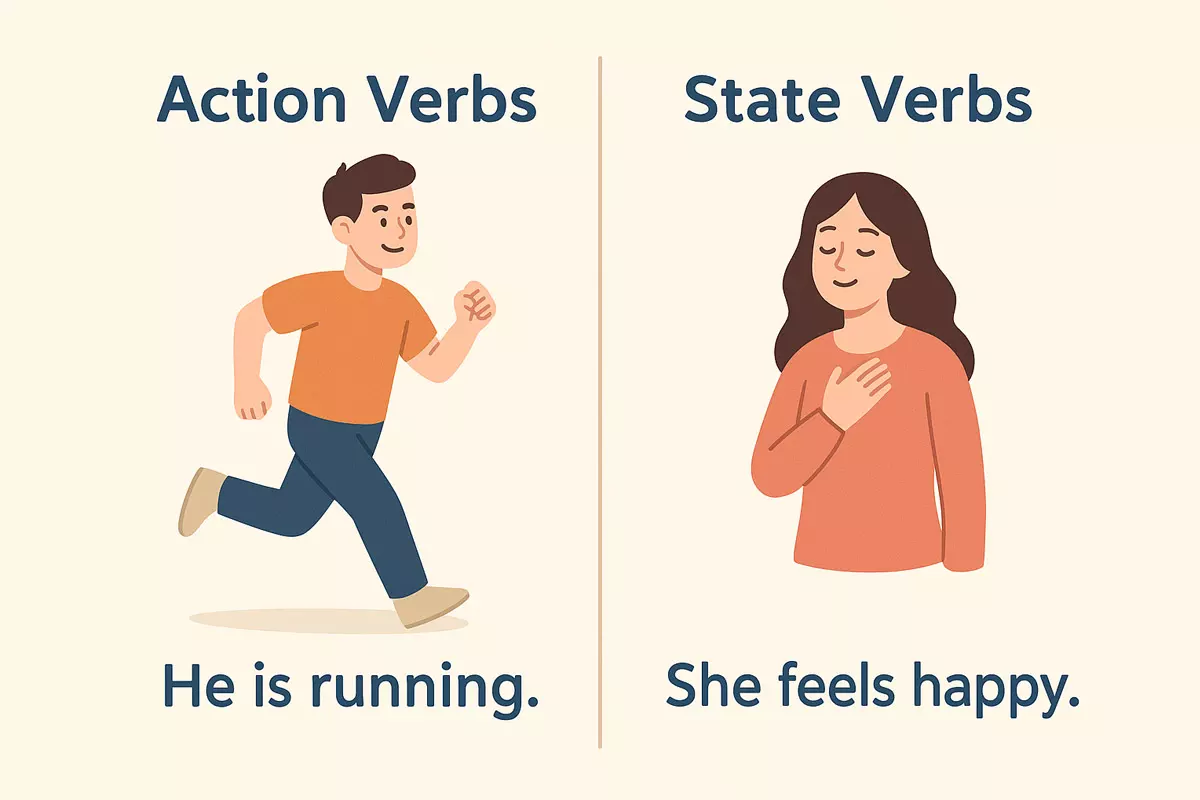 This article explains how action verbs express actions and state verbs show conditions or feelings. It highlights key differences, lists verbs not used in continuous forms, provides daily English examples, and offers practice sentences.
Mastering English grammar requires understanding the different types of verbs and how they function within sentences. Action verbs describe activities or processes, such as "run" or "think," while linking verbs, like "be" or "seem," express a state or condition rather than an action. Recognizing the distinction between these types of verbs is important because it influences how sentences are structured and how meaning is conveyed. This knowledge helps learners construct clearer, more precise sentences and improves overall communication skills.
What Action Verbs Show
Action verbs highlight activities, processes, or events performed by the subject. Unlike state verbs, which describe conditions or situations, these words make it clear that something is actively happening. They answer questions like “What is the subject doing?” and indicate movement, change, or completion.
Indicating Dynamic Processes
Action verbs reveal dynamic processes. They tell us about actions that start, continue, and finish, making them essential for describing events or sequences in time. For example, in “She runs every morning,” the verb “runs” shows a repeated, intentional activity.
Expressing Agency and Intent
These verbs often express the subject’s agency or will—who is responsible for the action. This can include both physical and mental acts. For instance, “think,” “build,” and “choose” all demonstrate someone initiating an action or process.
Examples of Common Action Verbs
- Run
- Jump
- Write
- Speak
- Move
- Build
- Draw
- Eat
- Throw
- Drive
- Carry
- Swim
- Sing
- Fix
- Walk
- Climb
- Catch
- Kick
- Lift
- Paint
- Open
- Close
- Push
- Pull
- Turn
- Cut
- Cook
- Clean
- Wash
- Study
- Learn
- Watch
- Listen
- Play
- Help
- Tell
- Follow
- Choose
- Buy
- Send
- Bring
- Break
- Hold
- Smile
- Laugh
- Raise
- Lower
- Hug
- Touch
- Shake
- Dig
- Repair
- Answer
- Ask
- Plan
- Organize
- Measure
- Count
- Jump
Time and Aspect with Action Verbs
Verbs of action naturally fit with continuous and perfect aspects. For example, “is running” (present continuous) or “had eaten” (past perfect) both show actions in progress or completed at a specific time. This flexibility makes them versatile in expressing when and how often something occurs.
Comparison: Action vs. State Verbs
| Action Verbs | State Verbs |
|---|---|
| Describe physical or mental actions ✅ “run,” “decide,” “throw” |
Describe situations or conditions ✅ “know,” “belong,” “love” |
| Used in continuous tenses → “is eating” |
Rarely used in continuous tenses ❌ “is knowing” |
| Imply change or movement | Imply stability or unchanging state |
| Often answer “What does the subject do?” | Often answer “What is the subject like/feel?” |
Summary
In essence, verbs that denote actions provide clear signals about what is happening, who initiates it, and how it unfolds over time. They are essential for describing events, routines, and steps in any narrative or explanation.
What State Verbs Show
State verbs describe conditions, situations, or characteristics that tend to remain stable over time rather than actions that occur or change. These verbs focus on existence, possession, emotion, perception, and mental processes, rather than physical activity or observable change.
Typical Meanings Expressed by State Verbs
State verbs often refer to:
- Possession (e.g., own, belong)
- Mental states (e.g., know, believe, understand)
- Emotional states (e.g., love, hate, prefer)
- Perception (e.g., see, hear, smell in their non-action sense)
- Existence or presence (e.g., be, exist)
- Relationship (e.g., consist, contain, include)
- Measurement (e.g., weigh, cost, measure when not describing an action)
- Opinion or preference (e.g., seem, appear, prefer)
- Desire or wish (e.g., want, wish)
- Ability (e.g., can as a modal verb expressing knowledge or skill)
- Ownership (e.g., have in the sense of possession)
- States of mind (e.g., remember, forget)
Grammatical Characteristics
One important feature of state verbs is their limited use in continuous (progressive) tenses. For example, we say I know the answer ✅, but I am knowing the answer ❌. This limitation comes from the fact that these verbs describe situations that do not have a clear beginning or end, and are not typically seen as dynamic processes.
Comparison: State vs. Action Verbs
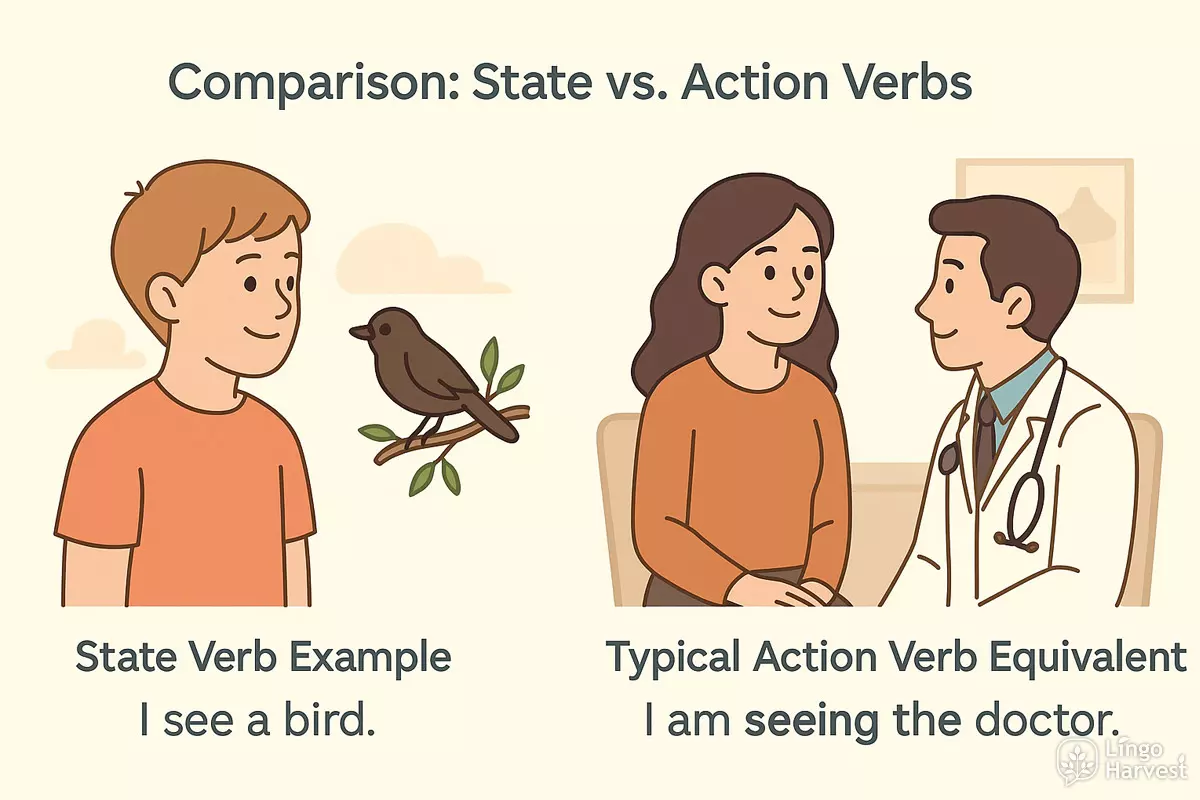
| State Verb Example | Typical Action Verb Equivalent | Can Use Continuous? |
|---|---|---|
| think (opinion): I think it’s good. | think (process): I am thinking about it. | No / Yes |
| have (possession): She has a car. | have (experience): She is having lunch. | No / Yes |
| see (perception): I see a bird. | see (meeting): I am seeing the doctor. | No / Yes |
| love: They love music. | — | No |
Summary of Patterns
State verbs provide information about ongoing situations, relationships, and mental or emotional conditions. They help us express what someone is or feels, rather than what someone does. Such verbs are essential for describing facts, thoughts, and feelings that do not involve active change.
Key Differences
Action verbs and state verbs serve distinct functions in English grammar. Action verbs (sometimes called dynamic verbs) describe activities or processes that can be seen, done, or measured. In contrast, state verbs (also called stative verbs) refer to conditions, feelings, thoughts, or possession—situations that exist rather than occur.
How They Function in Sentences
Typically, action verbs indicate something happening or changing over time. For instance, "run," "eat," and "write" all express actions performed by the subject. State verbs, like "know," "believe," and "own," describe a situation or mental state that does not involve a clear action.
Main Areas of Distinction
- Meaning: Action verbs denote physical or mental activities; state verbs relate to existence or condition.
- Continuous Tenses: Action verbs can be used in continuous (progressive) forms ("She is running"), but state verbs usually cannot ("She is knowing" ❌ is incorrect).
- Change vs. Permanence: Dynamic verbs often imply change or movement, while stative verbs suggest stability or unchanging situations.
- Usage Frequency: Everyday communication relies on both, but action verbs are far more common in narratives and instructions.
Typical Examples
| Action Verbs | State Verbs |
|---|---|
| run | believe |
| jump | know |
| write | own |
| swim | prefer |
| eat | love |
| drive | hate |
| sing | seem |
| build | belong |
| draw | remember |
| play | understand |
| read | appear |
| cook | contain |
Summary of Practical Implications
Choosing between these verb types affects tense, aspect, and sometimes even the meaning of a sentence. For example, "I think" (state) vs. "I'm thinking" (temporary action or consideration). Writers and speakers need to recognize these distinctions to use verbs naturally and avoid ungrammatical constructions.
Common State Verb Groups
Verbs that express a state rather than an action tend to describe situations, feelings, mental processes, or relationships that are static rather than dynamic. Understanding how these words function helps distinguish when to use simple forms versus continuous forms in English. These verbs typically don’t combine naturally with progressive tenses because they refer to conditions that are not seen as changing over time.
Typical Categories of Stative Verbs
Most non-action verbs fall into a few broad semantic groups. Here are some of the most frequent types:
- Emotion and Feeling: love, hate, like, dislike, prefer, want, need, wish, fear
- Possession: have, own, belong, possess, include
- Thinking and Opinion: know, believe, remember, understand, mean, realize, suppose, recognize
- Perception (with the senses): see, hear, smell, taste, sound, seem, appear
- Existence and Being: be, exist, consist, contain
- Desire and Preference: desire, wish, hope
- Measurement and Cost: weigh, measure, cost, owe
- Relationships: concern, involve, include, resemble, fit
- Agreement and Disagreement: agree, disagree, deny, promise
- Others: need, depend, matter
Examples in Context
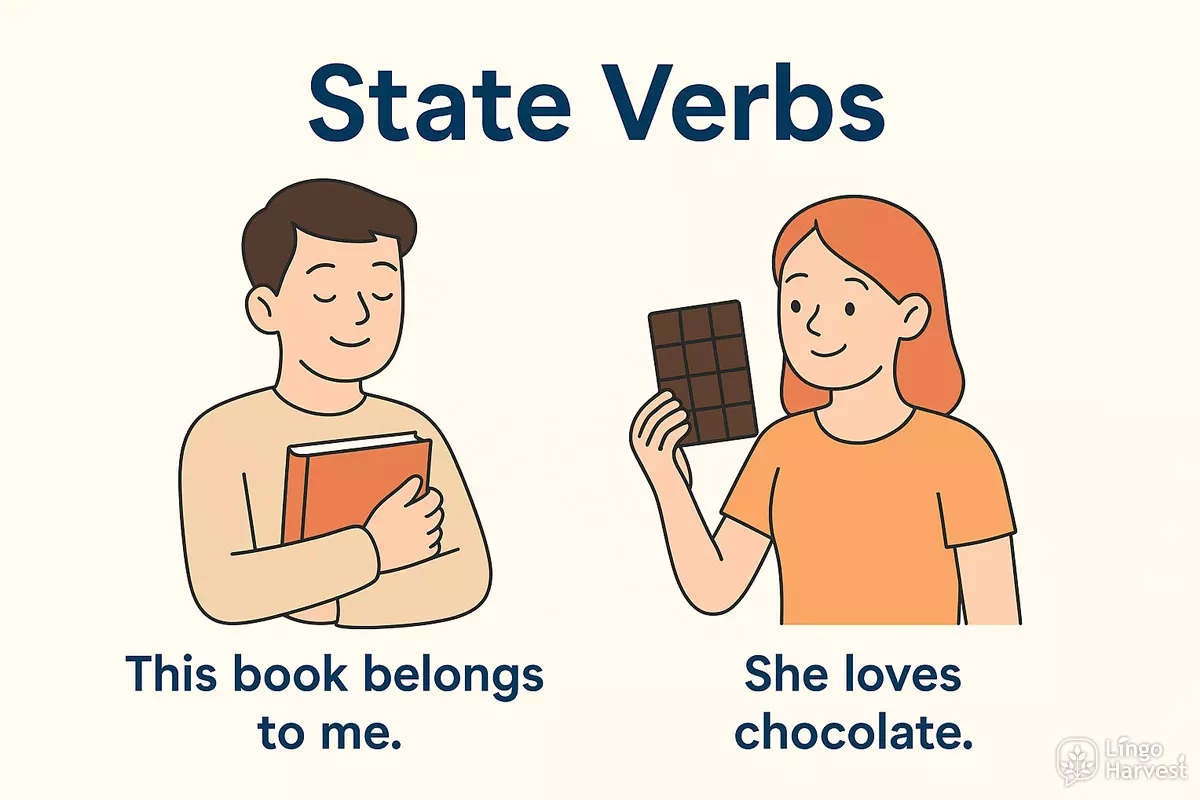
To illustrate the distinctions between stative and dynamic uses, consider the following:
| Verb | Typical State Usage (Correct) ✅ |
|---|---|
| know | I know the answer. |
| belong | This book belongs to me. |
| love | She loves chocolate. |
| seem | It seems difficult. |
| own | They own a house. |
| understand | We understand the problem. |
| contain | This box contains old photos. |
| prefer | I prefer tea to coffee. |
Notes on Usage
It’s important to note that some words can be both stative and dynamic, depending on context. For example, have can indicate possession (“I have a car”) or an activity (“I’m having lunch”). In state verb usage, progressive forms like “I am knowing” or “She is loving” are generally not acceptable. Recognizing these groups and their typical uses helps learners avoid common mistakes and choose the right verb forms in both spoken and written English.
Verbs Not Used in Continuous
Some English verbs are rarely, or never, used in continuous (progressive) forms like “am knowing” or “is loving.” This usually happens because the meaning of these verbs relates to states, not actions—something that does not change or develop over time. These are often called stative verbs, and they describe situations, feelings, possession, thoughts, and senses.
Common Categories of Non-Progressive Verbs
Stative verbs generally fall into a few main groups:
- Emotions and feelings: love, hate, prefer, like, dislike
- Thoughts and opinions: know, believe, understand, remember, forget, mean, suppose
- Possession: have (when it means possession), own, belong, possess
- Perception (by senses): see, hear, smell, taste, seem, appear
- Other states: need, contain, consist, depend, deserve, matter
Examples: Typical Usage
You’ll notice these verbs are almost always found in simple (not continuous) forms. For example, we say “I know the answer” (✅) and not “I am knowing the answer” (❌).
| Verb | Correct Example (Simple Form) | Incorrect (Continuous Form) |
|---|---|---|
| know | She knows the truth. | She is knowing the truth. |
| love | I love chocolate. | I am loving chocolate. |
| belong | This car belongs to me. | This car is belonging to me. |
| understand | Do you understand? | Are you understanding? |
| seem | It seems important. | It is seeming important. |
| possess | They possess many skills. | They are possessing many skills. |
| depend | It depends on the weather. | It is depending on the weather. |
| prefer | She prefers tea. | She is preferring tea. |
| own | He owns a bike. | He is owning a bike. |
| believe | I believe you. | I am believing you. |
Exceptions and Special Cases
Some verbs, such as “have,” can be used in continuous forms if their meaning is active (“I’m having lunch” → eating), not stative (ownership). Context and meaning influence whether a verb can take the progressive aspect. Understanding which verbs typically avoid continuous forms helps you sound more natural and accurate in English. When in doubt, check if the verb describes a state or an action.
Examples in Daily English
Understanding the distinction between verbs that show actions and those that express states is easier when you see how they appear in real conversations or writing. Here are some common ways these verbs are used, along with typical mistakes and clarifying contrasts.
Typical Sentences with Action Verbs
- She runs every morning before breakfast.
- They built a sandcastle on the beach.
- We are watching a movie right now.
- He writes emails to his clients daily.
- I called my friend yesterday.
- The dog chased the ball across the yard.
Everyday Use of State Verbs
- I know the answer.
- She loves chocolate ice cream.
- They believe in hard work.
- He owns a red car.
- We prefer tea to coffee.
- This book belongs to Sarah.
Comparing Action and State Verbs in Context
| Action Verb Example | State Verb Example |
|---|---|
| She is eating an apple. | She likes apples. |
| They are listening to music. | They hear a strange noise. |
| I am smelling the flowers. | The flowers smell nice. |
| He is thinking about his plans. | He thinks it will rain. |
| We are having dinner now. | We have a new car. |
Common Mistakes to Avoid
- ❌ I am knowing the answer. → ✅ I know the answer.
- ❌ She is loving this song. → ✅ She loves this song.
- ❌ They are having a car. → ✅ They have a car.
In natural speech, activity verbs often appear in continuous forms (e.g., is running), while verbs expressing conditions or feelings usually do not. Recognizing this difference helps avoid awkward phrasing and makes your English sound more fluent.
Practice Sentences
Understanding the contrast between dynamic and static verbs becomes easier with targeted sentence practice. Below, you’ll find a range of sentences and exercises that highlight how each type is used in context. These activities encourage you to notice patterns and typical collocations for both categories.
Identify the Verb Type
Decide whether the main verb in each sentence expresses an action or a state.
- She knows the answer.
- They run every morning.
- I believe your story.
- We built a sandcastle.
- You own a beautiful car.
- He thinks about the problem.
- The children laughed loudly.
- She feels happy today.
- He remembers the event clearly.
- The dog chased the ball.
Show answers
- State
- Action
- State
- Action
- State
- State (unless “thinks” means “is considering”, then Action)
- Action
- State
- State
- Action
Correct or Incorrect Usage
Some verbs rarely take continuous forms. Mark each sentence with ✅ if it is acceptable in standard English and ❌ if it is not.
- I am loving this song.
- She is knowing the facts.
- They are having dinner now.
- He is believing you.
- We are thinking about moving.
Show answers
- ✅ (colloquial, but accepted for emphasis)
- ❌
- ✅
- ❌
- ✅
Common Verbs: Action vs State
The following table contrasts typical examples of dynamic and stative verbs, illustrating their usage in simple sentences.
| Action Verb | State Verb |
|---|---|
| run – I run every day. | know – She knows French. |
| eat – They eat lunch at noon. | believe – I believe you. |
| build – We built a house. | belong – This book belongs to me. |
| travel – He travels a lot. | prefer – She prefers tea. |
| write – I write stories. | own – They own a shop. |
| paint – She painted the wall. | seem – He seems tired. |
Transform the Sentences
Rewrite each sentence in either the present continuous (for dynamic verbs) or the simple present (for stative verbs).
- He (run) in the park.
- I (like) chocolate.
- They (wait) for you.
- She (own) two cats.
- We (study) English.
Show answers
- He is running in the park.
- I like chocolate.
- They are waiting for you.
- She owns two cats.
- We are studying English.