Action Verbs vs State Verbs: Easy Guide

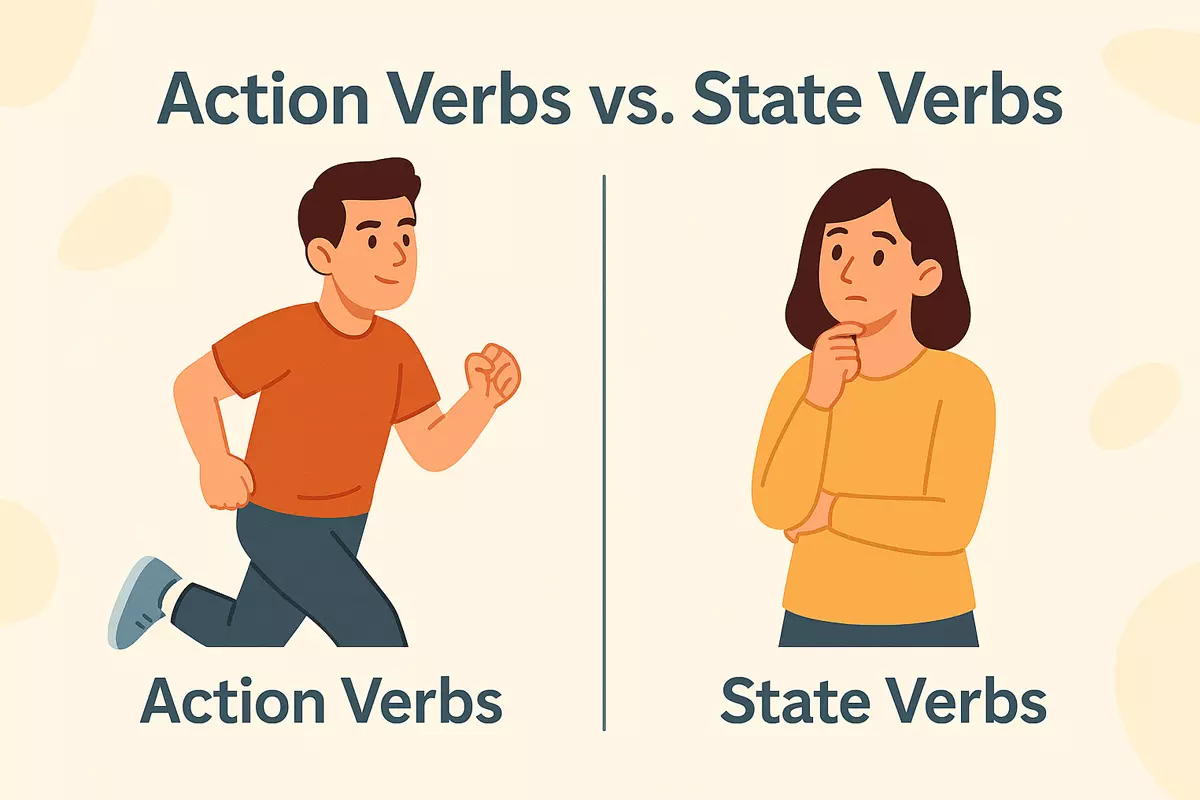 This article explains action verbs and state verbs, how their meanings can change, and when state verbs can be used in the continuous tense. It also lists verbs used both ways, gives real-life examples, and includes practice exercises.
Have you ever noticed that some English verbs refer to actions you perform, like run or write, while others describe conditions or feelings, such as believe or seem? Recognizing the distinction between action verbs and state verbs is important for using English accurately and naturally. Action verbs show what someone or something does, highlighting movement or activity, whereas state verbs express situations, emotions, or states of being that are generally static or ongoing rather than dynamic.
What Are Action Verbs?
Action verbs are words that describe activities, processes, or events that can be performed or observed. They express something that a subject does, rather than a state or condition. These verbs often answer the question "What is happening?" or "What is someone doing?" Unlike state verbs, which describe situations or feelings, action verbs show movement, effort, or an ongoing process.
How to Recognize Action Verbs
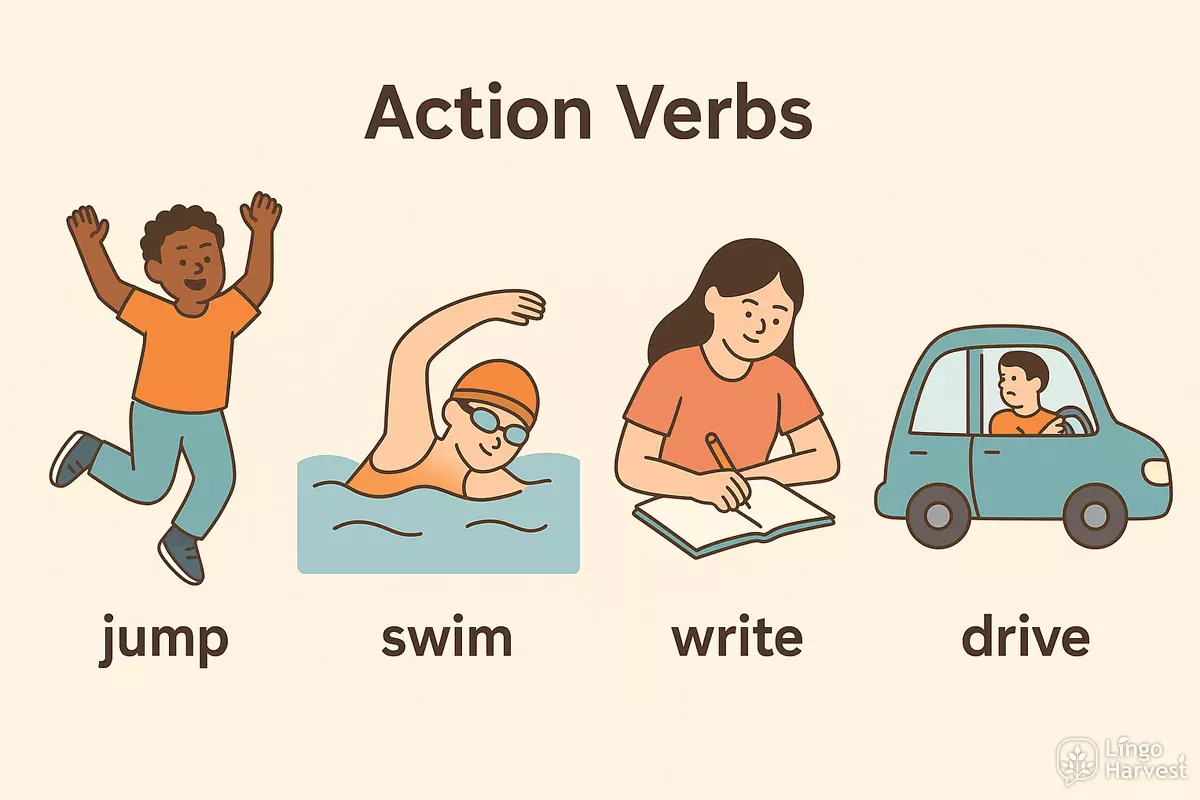
A simple way to spot an action verb is to see if the word involves an activity you can physically or mentally do. For instance, you can "run," "think," or "build." These verbs often work well with continuous (progressive) tenses, since actions can start, stop, and change over time.
- They can describe physical activities: jump, swim, write, drive
- They may refer to mental actions: decide, plan, imagine, consider
- They often answer "What is happening?" in a sentence
- They usually appear in instructions, stories, and descriptions of events
Common Examples of Action Verbs
Here are some widely used action verbs in English:
- Run
- Eat
- Speak
- Draw
- Open
- Write
- Climb
- Throw
- Learn
- Listen
- Drive
- Fix
- Carry
- Sing
- Build
- Jump
- Think
- Play
- Cook
- Lift
Action Verbs in Sentences
To see how these verbs work, consider the following examples:
- She runs every morning.
- They built a sandcastle.
- I am writing an email.
- He thinks about his future.
Action vs. State Verbs: Key Differences
Action verbs are often confused with state verbs, but their grammatical behavior is different. For instance, action verbs are typically used in continuous tenses, while state verbs rarely are.
| Action Verb Example | State Verb Example |
|---|---|
| I am running now. | I know the answer. |
| She is eating lunch. | He believes you. |
| We are making a cake. | They own a car. |
| They play football. | I like music. |
Understanding these verbs helps learners use English more naturally, especially when choosing the correct tense or describing an activity accurately.
What Are State Verbs?
State verbs (sometimes called stative verbs) describe conditions, situations, or feelings that exist rather than actions that happen. Instead of showing something someone does, these verbs express a state of being, thinking, possessing, or feeling. Often, state verbs refer to thoughts, emotions, relationships, senses, possession, or measurements.
How State Verbs Work
Unlike action verbs, which can be used in continuous tenses (like “I am running”), state verbs generally are not used in the continuous form. For example, we say “I know the answer,” not “I am knowing the answer.” This is because these verbs refer to conditions or situations that are static or unchanging at the moment.
Common Types and Examples
To give you a clearer picture, here are some common categories and examples:
- Emotions: love, hate, like, prefer, want, need
- Possession: have, own, belong
- Thoughts: know, believe, remember, understand, mean
- Senses: see, hear, smell, taste, seem
- Other states: contain, consist, include, fit, depend
State Verbs vs. Action Verbs: Key Differences
Some verbs can be both stative and dynamic, depending on the meaning. For example, “have” can show possession (state: “I have a car”) or an action (dynamic: “I’m having lunch”). Here’s a comparison to illustrate the contrast:
| State Verb Example | Action Verb Example |
|---|---|
| I believe you. | I am running. |
| She owns a house. | He is eating. |
| They know the answer. | We are swimming. |
| I need help. | You are writing. |
Recognizing State Verbs
Look for verbs that describe thoughts, feelings, relationships, or possession, and check if they sound awkward in continuous tenses. If “I am knowing” or “She is owning” seems wrong, it’s probably a state verb. Awareness of these verbs helps you use English naturally and avoid common mistakes with tense.
How Meanings Change: Action vs State
Understanding how verb meanings shift between actions and states is essential for accurate English usage. Some verbs can express both a dynamic process and a static condition, depending on the context or tense. This distinction affects which tenses are possible and can even change the meaning of a sentence entirely.
Verbs with Dual Meanings
A number of common verbs have both action and state uses. For example, "think" can refer to the process of considering something (action: "I'm thinking about dinner") or to an opinion (state: "I think pizza is delicious"). The meaning influences grammar: action uses allow continuous forms, while state uses typically do not.
- Have: "I have a car" (possession, state) → "I'm having lunch" (eating, action)
- See: "I see your point" (understand, state) → "I'm seeing the doctor" (meeting, action)
- Taste: "The soup tastes good" (state) → "I'm tasting the soup" (trying, action)
- Think: "I think he's right" (opinion, state) → "I'm thinking about the answer" (process, action)
- Be: "He is rude" (character, state) → "He is being rude" (temporary behavior, action)
- Feel: "I feel tired" (state) → "I'm feeling the fabric" (touching, action)
- Look: "She looks happy" (appearance, state) → "She is looking at the sky" (action)
- Appear: "He appears confused" (seems, state) → "He is appearing on stage" (performing, action)
- Smell: "The flowers smell nice" (state) → "I'm smelling the flowers" (sniffing, action)
- Weigh: "The bag weighs 2 kg" (state) → "I'm weighing the bag" (measuring, action)
- See: "Do you see the bird?" (perceive, state) → "Are you seeing anyone?" (dating, action)
- Fit: "The shoes fit me" (state) → "The tailor is fitting the dress" (adjusting, action)
Context and Tense: Why It Matters
The context often signals whether a verb acts as a process or a condition. State uses rarely appear in continuous tenses, while action meanings often do. For example, "I am loving this movie" (action: enjoying right now) versus "I love chocolate" (state: general feeling). Misusing these forms can sound unnatural to native speakers.
Quick Comparison: Action vs State Uses
| Verb | State Meaning ✅ | Action Meaning ✅ |
|---|---|---|
| Have | Possess: "I have a dog." | Experience: "I'm having fun." |
| See | Perceive: "I see the mountain." | Meet: "I'm seeing a friend." |
| Think | Believe: "I think it's true." | Consider: "I'm thinking about it." |
| Be | Character: "She is polite." | Acting: "She is being polite." |
| Taste | Has flavor: "It tastes sweet." | Sample: "I'm tasting the cake." |
Key Takeaways
- Some verbs shift meaning between a static condition and an active process.
- State meanings usually avoid continuous tenses; action meanings typically allow them.
- Tense and context help clarify which meaning is intended.
- Choosing the correct form prevents misunderstandings and makes speech sound natural.
State Verbs and the Continuous Tense
Some verbs in English describe conditions, feelings, or thoughts rather than actions. These are often called stative verbs. Unlike action verbs, they rarely appear in continuous (progressive) forms like “am knowing” or “is believing.” This is because stative verbs typically refer to fixed or unchanging situations, making continuous forms unnatural.
Common State Verbs
You’ll notice certain verbs are almost never used with -ing forms. Here are some of the most frequent examples:
- like
- love
- hate
- prefer
- know
- believe
- understand
- remember
- belong
- own
- cost
- seem
- appear
- need
- want
- contain
- include
- hear
- see
- suppose
Why State Verbs Don’t Use Continuous Tense
The continuous tense describes actions in progress or temporary situations. States, by their nature, are ongoing or permanent, so using the progressive form is often illogical. For example:
- ❌ I am knowing the answer. → ✅ I know the answer.
- ❌ She is owning a car. → ✅ She owns a car.
- ❌ We are needing help. → ✅ We need help.
Exceptions and Special Cases
Some verbs can be both stative and dynamic, depending on meaning. For instance, “think” can describe a state (“I think it’s true”) or an action (“I am thinking about my homework”). Here’s how usage changes:
| Verb | State Meaning (Simple) | Action Meaning (Continuous Possible) |
|---|---|---|
| think | I think you’re right. (believe) | I am thinking about dinner. (considering) |
| have | She has a car. (possess) | She is having lunch. (eating) |
| see | I see your point. (understand) | I am seeing the doctor. (meeting) |
| be | He is kind. (characteristic) | He is being silly. (behaving now) |
Summary
To sum up, state verbs usually avoid continuous forms because they describe conditions, feelings, or mental states that are not actions in progress. However, always check the meaning—sometimes a verb can shift from a state to an action, changing the grammar that’s possible.
Common Verbs Used in Both Ways
Some English verbs can be both dynamic (action) and static (state), depending on the context and meaning. This can sometimes cause confusion, as the same word may express a physical action in one sentence and a condition or feeling in another. Understanding which verbs can shift roles—and how their meanings change—is useful for speaking and writing naturally.
Examples of Dual-Use Verbs
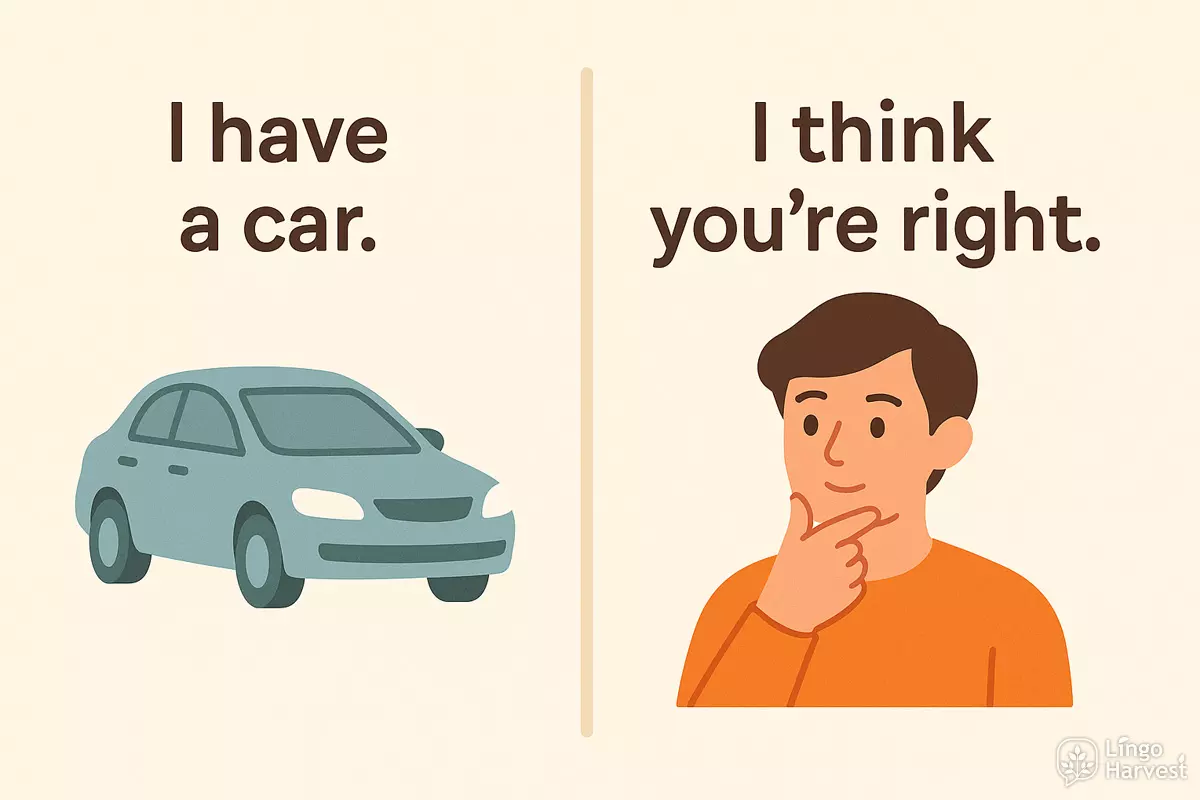
Here are several verbs that regularly appear as both action and state verbs:
- Have — “I have a car.” (possession, state) vs. “I’m having lunch.” (activity, action)
- Think — “I think you’re right.” (opinion, state) vs. “I’m thinking about my plans.” (mental process, action)
- See — “I see the mountains.” (perception, state) vs. “I’m seeing a doctor.” (meeting, action)
- Taste — “This soup tastes delicious.” (quality, state) vs. “She’s tasting the sauce.” (trying, action)
- Smell — “The room smells bad.” (quality, state) vs. “He is smelling the flowers.” (sniffing, action)
- Appear — “She appears tired.” (seems, state) vs. “She’s appearing in a play.” (performing, action)
- Look — “You look happy.” (appearance, state) vs. “She’s looking at the painting.” (active gaze, action)
- Feel — “I feel cold.” (state, sensation) vs. “He’s feeling the fabric.” (touching, action)
- Be — “He is rude.” (character, state) vs. “He’s being rude today.” (behaving, action/temporary)
- Weigh — “This bag weighs 5kg.” (state) vs. “She’s weighing the fruit.” (measuring, action)
- Measure — “The room measures 20 square meters.” (state) vs. “He’s measuring the window.” (action)
- See — “Do you see the bird?” (perception, state) vs. “Are you seeing anyone?” (dating, action)
- Fit — “The shoes fit me.” (state) vs. “She’s fitting a new carpet.” (installing, action)
- Think — “I think it’s true.” (believe, state) vs. “He’s thinking about the answer.” (considering, action)
- Expect — “I expect you’re tired.” (assume, state) vs. “We’re expecting guests.” (waiting for, action)
How Context Changes Verb Meaning
The way these verbs are used changes their grammatical patterns. For instance, when describing possession or a state, verbs like have and be are rarely used in continuous forms. However, when they describe actions or temporary situations, the continuous form becomes correct and natural.
Quick Reference Table
| Verb | State Example | Action Example |
|---|---|---|
| Have | I have a question. | I'm having a good time. |
| See | I see your point. | I'm seeing a therapist. |
| Think | I think it’s important. | I’m thinking about my future. |
| Be | She is quiet. | She’s being quiet today. |
| Look | You look tired. | He’s looking for his keys. |
| Smell | The cake smells good. | She’s smelling the perfume. |
| Taste | The tea tastes sweet. | He’s tasting the soup. |
| Feel | I feel sick. | She’s feeling the fabric. |
Notice how the verb forms and meanings shift with context. Learning these patterns will help you use English more flexibly and accurately in both speech and writing.
Examples in Real-Life English
Understanding the difference between verbs of action and verbs of state is easiest with real conversational snippets and everyday situations. These examples show how both types of verbs naturally fit into daily communication, helping you recognize and use them correctly.
Common Action Verbs in Daily Scenarios
- She runs every morning before breakfast.
- We build sandcastles at the beach.
- They discuss their plans after work.
- I cook dinner for my family every night.
- He paints landscapes on weekends.
- Maria drives to school.
- The children play in the garden.
- My friend calls me every Friday.
- We explore new restaurants in the city.
- She teaches French at the community center.
Typical State Verbs in Context
- I know the answer.
- She loves chocolate.
- They believe the story.
- He owns a red car.
- We understand the rules.
- The soup smells delicious.
- It seems difficult at first.
- I prefer tea to coffee.
- She remembers your birthday.
- They agree with the decision.
Comparing Action and State Verbs in Sentences
| Action Verb Example | State Verb Example |
|---|---|
| She reads a book every night. | She likes reading mysteries. |
| We watch movies on weekends. | We enjoy good films. |
| He opens the window. | He feels cold. |
| They visit their grandparents. | They miss their hometown. |
| I write emails daily. | I need more time to reply. |
These examples highlight how verbs of action describe what someone does, while verbs of state express feelings, thoughts, or possession. When you listen to or read English, notice how some verbs naturally fit with ongoing actions, but others simply describe how things are or how someone feels. This awareness boosts both understanding and fluency in conversations.
Practice
Understanding the difference between dynamic and static verbs is easier with real-world use. Below, you’ll find exercises and illustrative examples to help you check your understanding and get comfortable using each type in everyday situations.
Quick Check: Identify the Type
Decide if each verb is an action verb (dynamic) or a state verb (static):
- enjoy
- believe
- run
- own
- sing
- prefer
- think (meaning "have an opinion")
- swim
- hate
- drive
Show answers
- enjoy – state
- believe – state
- run – action
- own – state
- sing – action
- prefer – state
- think ("have an opinion") – state
- swim – action
- hate – state
- drive – action
Fill in the Blanks
Use the correct present simple or present continuous form. Some verbs cannot be used in continuous forms—spot them!
- I ______ (understand) what you mean now.
- She ______ (eat) lunch at the moment.
- They ______ (own) a red car.
- We ______ (think) about your offer.
- He ______ (believe) in fairies?
- I ______ (read) a great book right now.
Show answers
- understand
- is eating
- own
- are thinking
- Does he believe
- am reading
Common Verbs: Dynamic vs. Static
Here’s a quick reference for common English verbs and how they are typically used:
| Verb | Type & Typical Use |
|---|---|
| know | State – expresses knowledge; not used in continuous forms |
| play | Action – describes an activity; can use continuous forms |
| love | State – describes feelings; rarely used in continuous |
| make | Action – describes doing something; continuous possible |
| hear | State – relates to senses; not used in continuous forms |
| eat | Action – physical activity; continuous common |
| belong | State – ownership; not with continuous |
| watch | Action – can use continuous forms |
| remember | State – mental process; not continuous |
| write | Action – activity; continuous possible |
Transform the Sentences
Rewrite these sentences with the correct verb form. Pay attention to whether the verb can use the continuous tense:
- I am knowing the answer. →
- She is loving chocolate. →
- They are having a meeting right now. →
- We are hearing some strange noises. →
- He is making dinner at the moment. →
Show answers
- I know the answer.
- She loves chocolate.
- They are having a meeting right now. (Correct)
- We hear some strange noises.
- He is making dinner at the moment. (Correct)
Practicing these distinctions will help you sound more natural and accurate when choosing between static and dynamic forms in English. Consider making your own sentences to reinforce these patterns.